Index Year A

Spirit, faith, prophet

INCARNATION

Preparation

The purposes of God

C, Advent 1                            Freedom

C, Advent 1                            Graciousness

Prolegomena of the Incarnation

C, Advent 2                            Christ in other religions

C, Advent 2                            Christ in the Old Testament

C, Advent 3                            John the law-giver

C, Advent 3                            John gives way to Jesus

Impetus to the incarnation

C, Advent 4                            Christ embodies all that is

C, Advent 4                            Christ and Israel

Realisation

Incarnation

C, Christmas, Midnight         “became man”

C, Christmas, Dawn               Jesus, the unique Saviour

C, Christmas, Day                 Divinisation

C, The Holy Family                Son of Mary

C, The Holy Family                The Holy Family

Role of Mary

C, Mary, Mother of God        Mother of the Church

C, Mary, Mother of God        Mary, the Virgin

Manifestation

C, Epiphany                           Agnosticism

C, Epiphany                           Insight                                                       


SACRIFICE

Sin

C, Lent 1                                Sin

C, Lent 1                                Punishment                                              

Glory

C, Lent 2                                Jesus’ exodus

C, Lent 2                                Jesus’ glory

Reconciliation

C, Lent 3                                Conversion

C, Lent 3                                Contrition

C, Lent 4                                Penance

C, Lent 4                                Reconciliation

The impetus to the Passion

C, Lent 5                                Expiation

C, Lent 5                                –

The Centre of Time

C, Passion Sunday                People of the Passion

C, Holy Thursday                  Feeding

Washing

C, Good Friday                      Expiration

C, Easter Vigil                        Sanctification


EXALTATION

Manifestation of the Risen Christ

In signs

C, Easter Sunday                   Glorified

C, Easter Sunday                   The shroud

In appearances

C, Easter 2                             The Spirit is bestowed

C, Easter 2                             Salvation

In the Church

C, Easter 3                             Creativity

C, Easter 3                             –

Recapitulation

C, Easter 4                             Mission

C, Easter 4                              –

Trinity – Holy Spirit

C, Easter 5                             Love

C, Easter 5                             Identification

C, Easter 6                             The Spirit, the Advocate

C, Easter 6                              The Spirit, the Comforter

Intercession

C, Ascension                          Jesus, the sublime      

C, Ascension                          Parousia

Fullness

C, Pentecost                           Liberty

C, Pentecost                           –


FOUNDATIONS

C, Trinity Sunday                                     ‘And from the Son’

C, Trinity Sunday                                     Indwelling

C, The Body and Blood of the Lord         Epiclesis

C, The Body and Blood of the Lord         –

C, Assumption                                          Pregnant

C, Assumption                                          Mary and Ecumenism


THE KINGDOM OF GOD


A1     Faith

C, Baptism of the Lord          The Sacrament of Baptism

C, Baptism of the Lord          –

Son of Mary

C, Sunday 2                           The Son delivers

C, Sunday 2                           Mary provides

C, Sunday 2                           Jesus, the bridegroom

B1      Power of Word

C, Sunday 3                           The Word reveals

C, Sunday 3                           The Word consoles

C, Sunday 4                           The Word condemns

C, Sunday 4                           The Word favours

C, Sunday 5                           The Word summons

C, Sunday 5                           The Word gives knowledge

C, Sunday 6                           The Word approves

C, Sunday 6                           The Word curses

C, Sunday 7                           The Word gives

C, Sunday 7                           The Word forgives

C, Sunday 8                           –

C, Sunday 8                           –

C, Sunday 9                           –

C,  Sunday 9                          –

C       Women

C, Sunday 10                         –

C, Sunday 10                         –

C, Sunday 11                         –

C, Sunday 11                         –

B2     Mission

C, Sunday 12                         Perception

C, Sunday 12                         Faith

C, Sunday 13                         Discipleship                

C, Sunday 13                         –

C, Sunday 14                         Apostolate

C, Sunday 14                         –

C, Sunday 15                         –

C, Sunday 15                         –

D1     Contemplation

C, Sunday 16                         Contemplation

C, Sunday 16                         Stillness

C, Sunday 17                         The hermit

C, Sunday 17                         –

E1      Possessions

C, Sunday 18                         Success

C, Sunday 18                         –

C, Sunday 19                         –

C, Sunday 19                         –

F1      Home

C, Sunday 20                         –

C, Sunday 20                         –

E2      Relationships

C, Sunday 21                         –

C, Sunday 21                         –

C, Sunday 22                         –

C, Sunday 22                         –

F2      Work

(C, Sunday 23                       Father’s Day)

C, Sunday 23                         Technology

C, Sunday 23                         War

C, Sunday 24                         Wealth

C, Sunday 24                         Wonder

C, Sunday 25                         Aid

C, Sunday 25                         –

C, Sunday 26                         The poor

C, Sunday 26                         Leisure

C, Sunday 27                         Industry

C, Sunday 27                         Work

D2     Prayer – Hope

C, Sunday 28                         Praise

C, Sunday 28                         Satisfaction

C, Sunday 29                         Petition

C, Sunday 29                         The last things

C, Sunday 30                         Adoration

C, Sunday 30                         Oneness

C, Sunday 31                         Almsgiving

C, Sunday 31                         Morality

A2     The fulfilment: one Spirit

C, Sunday 32                         Fate of matter

C, Sunday 32                         Becoming spirit

C, Sunday 33                         Transience

C, Sunday 33                         Purgatory

C, Christ, Universal King      Limbo

C, Christ, Universal King       Eternity

Posted in Uncategorized | Leave a comment

Poetic homilies Year C

Posted in Uncategorized | Leave a comment

Poetic homilies Year B

Posted in Uncategorized | Leave a comment

Poetic homilies Year A

Posted in Uncategorized | Leave a comment

Tantric homilies – poetic

Posted in Uncategorized | Leave a comment

Index to Tantric homilies, Year C – poetic,

Index to         Tantric homilies, Year C – poetic,

1995

HOLY SPIRIT – FAITH, PROPHET

INCARNATION

Preparation

Purposes of God                    –

Prolegomena                         –

Causes of the incarnation    –

Realisation

Incarnation                            –

Role of Mary                         –

Mother of God a                    Mother of the Church

Mother of God b                    Child-bearer

Revelation and faith

C, Epiphany a                         Agnosticism

C, Epiphany b                        Insight


SACRIFICE

Sin                   –

Glory               –

Baptism          –

The impetus to the Passion –

Centre of Time                      –


EXALTATION

Acts of the rise Christ

In signs           –

In appearances

C, Easter 2 a                           Holy Spirit

C, Easter 2 b                           Salvation

In Church                   –


Recapitulation           –

Trinity                         –

Intercession               –

Fullness                       –


FOUNDATIONS


THE KINGDOM OF GOD

Theophany

A1.1      Son of Mary

C, Sunday 2             –

B1        Word

C, Sunday 3-4         –

B2.1      Power of Word

C, Sunday 5 a          The Word summons

C, Sunday 5 b         The Word knows

C, Sunday 6-9                     –

A1.2      Women

C, Sunday 10-11    –

B2.2      Mission

C, Sunday 12-15    –

C1        Contemplation

C, Sunday 16-17    –

D1        Home

D1.1      Possessions

C, Sunday 18-19    –

D1.2      Relationships

C, Sunday 20-22    –

D2        Work

C, Sunday 23-27    –

C2        Prayer

C, Sunday 28-31    –

A2        The last things:  one Spirit

C, Sunday 32-Christ King            –


Posted in Christian tantra, Hindu Christian relations, Interreligious dialogue, Kashmir Shaivism | Leave a comment

Tantric homilies, Year C – poetic

C, Mary, Mother of God a                           Mother of the Church

As for Mary, she treasured all things things and pondered them in her heart.     Luke 2.19

Spirit!

You brooded over the deep                                     and the world was formed.

You hovered over the womb                                   and the Word was made flesh.

You descended upon the disciples                         and the Church was established.

Come upon us now                                                    and bring the new world to birth,

Mothering Spirit.

Mary!

full of grace from the start, assumed in the end,

Icon of the Spirit,


Mother us,

treasure us, ponder over us,

brood, and with your flesh make us spirit, by a divine alchemy.

You brought heaven to earth.

Bring earth to heaven.


Virgin for all,

give us space, arouse us,

initiate us into your mysteries and make us the new Man.


C, Mary, Mother of God b                           Child-bearer

 So they hurried away and found Mary and Joseph, and the baby lying in the manger. Luke 2.17

Spirit of God,

out of your freedom, fruitful One, the world arose, and

by your choice you hovered over Mary bearing the Word, and

at your chosen time, gracious One, you descended and bore the Church.

Inspire us and make us give birth to the world to come.


Mary, Icon of Spirit,

inspired from the start by the Spirit,

assumed in your body at the end;

Mary born from above, flesh made spirit,

give us birth in ways surprising and new.


Into your flesh receive us;

in your spirit form us;

possess us, drive us, make us act and do and die;

arouse the Spirit in us, unleashing fire and tempest and

deliver us to our mission,

till the new Man has come forth.


C, Epiphany a                                                Agnosticism

 Some wise men came to Jerusalem from the east. ‘Where is the infant king of the Jews ….?       Matthew 2.1b-2a

 Lead me, Spirit,

away from my false gods – make me atheist –

out into the dark, into the unknown.

Lead on, Spark serene, so dimly perceived.

Light among lights,

I surrender to you.

Let the world darken around me, let all the certainties fail,

but lead me on, into ignorance – O my star, my revelation – into surprise.

Let me be free of thoughts and rival dogmas – becoming agnostic – and

draw me more deeply into the glow of covenant – O Person of the Persons.

For you have shone in me, Spirit tempting spirit,

you have come and I cannot resist your beauty.


Where shall you take me?

Away from family and familiars.

Away from palaces and the mindless business of Jerusalem,

to enter the house of the poor and behold:

the Child seated upon the throne of Mary,

Light-from-Light revealed by Light.


C, Epiphany b                                              Insight

We saw his star as it rose and have come to do him homage. Matthew 2.2

From all of Persia, some Magi, only three perhaps, come,

bearing gifts for the Gift.

They have left their familiars, their amused colleagues,

led by the Light among lights, obscure, unknown.

They leave the crowd and go their way,

into darkness, across the dunes.

The Light has appeared to them in a point of light and

justifies their long searching of the skies.


Shine in me, my star!

Reveal yourself in the quick.

Spirit, touch my spirit.

Deep, call upon deep.

No matter the roar of the crowd,

only my portion of the Light will lead me.

My insight, my truth, alone leads me,

justifying the long meanderings of my life, and


there I will find the Child

seated on the throne of the Woman who is Wisdom and

there I will lay out all my gifts,

tribute for a king,

given at last.


C, Easter 2 a                                                  Holy Spirit

 …he breathed on them and said: ‘Receive the Holy Spirit. For those whose sins you forgive, they are forgiven; for those whose sins you retain. they are retained.        John 20. 22-23

Whence this sudden joy, this assurance, this peace?

It is not of my doing.

It is given to me,

coming from above and

from the very centre of the earth.


Come to me, wave upon wave of the Spirit,

come, open spaces, whole vistas of knowledge.

Pour into me and free my lungs and

I will breathe deeply from the great mouth of the Word.


From all eternity, he breathes you and

now, having been tested as gold in the fire,

true man as he is true God,

inspires all humanity.


You are proof of the one who lay confined in rock and

now fills all times, risen, exalted.

In knowing you

we know the one who has earned the right to breathe you on this earth

the Best uttered by the Best.


Fill me and

place in my mouth a new song,

bring words to birth in me,

words that will surprise.


C, Easter 2 b                                                            Salvation

 He showed them his hands and his side. The disciples were filled with joy when they saw the Lord. John 20.20

Whence springs this joy?

A Living Breath fills me.

At last, the burdens fall,

I stand upon the earth.

Made of clay, a fire burns in me.

I am transformed.


Death had surrounded us, and gloom.

He entered into our pain and

formed depths further as he fell.

What horror and desolation!

He could endure the worst

because in him the best was found.


Therefore he stands before us, dead-alive,

showing us his hands and wounded side and

his joy is complete and

his flesh thrills with the joy of God.

From his body comes salvation.

We rise with the risen and

exult with the exalted,

Darkest night is brightness for us now.

To us every power is given,

authority in the whole world of grace and damnation.


Fill me, Breath, and

let my amazement,

let my gasping be the final prophecy.


C, Sunday 5 a                                                The Word summons

 He got into one of the boats, – it was Simon’s – and asked him to put out a little from the shore. Then he sat down and taught the crowds from the boat.     Luke 5. 3

Your silence, Spirit, soft as the night,

bewitches me with a music beyond sound and

I cry out, filling your space with the shout of exultation.


Your space summons the Word in me,

rousing me to fill my lungs, and

I am the Word even as He uttered me.


For I am the Word,

spoken from the beginning,

the Word within all words, before all words,

found not in letters but in living speech.


In order to be Word among them

I was born.

In view of a time known yet unknown

I grew and my voice became strong.


At last you have put all in place and

the time has come and I speak,

projecting myself across the deep,

as they stand upon the shore, listening.


In some I resound,

there where your silence dwells.

I enter them

whose heart you open with your openness.


I flow in my words and

I pour into you,

and form the world to come,

composed of Word and Silence,

yoked.


C, Sunday 5 b                                                The Word knows

But Jesus said to Simon, ‘Do not be afraid; from now on it is men you will catch.           Luke 5. 10b

 You bring me to ignorance, Spirit of the Night,

and my words lead to your silence

as I float upon the deep and

touch every space, and so

we come to know, in our union,

the One from whom we proceed.


But for their sake I speak, seated in the boat,

drawing them into your silence.

I confirm my knowledge of the heavens

by showing a knowledge of the sea – ‘and its swarms past counting’.


To Peter I am the Fisherman,

mastering the deep.

calling him to leave it all and follow me,

to draw from your deep a world to come.


I can know the future and the decisions of men,

whether they are to our purpose.

You inspire authority in me, Awaiting Spirit,

and knowledge and counsel and wisdom and right judgment.


I act because you, Third Person, allow me and

I can know the position of the catch.

The human hand knows the visible

but faith knows the invisible.


Posted in Christian tantra, Hindu Christian relations, Interreligious dialogue, Interreligious dialogue, Melbourne, Kashmir Shaivism | Leave a comment

Index: Tantric homilies, Year B – poetic

Tantric homilies, Year B – poetic

1993/1994

INCARNATION

Preparation

The purposes of God

B, Advent 1                            Jesus returns

B, Advent 1                            Jesus is Lord

Prolegomena of the Incarnation

B, Advent 2                            Christ and the Angels

B, Advent 2                            Jesus the Messiah

B, Advent 3                            John recognizes Jesus.

B, Advent 3                            John and Jesus

Impetus to the Incarnation

B, Advent 4                            “The … Spirit will … cover you”

B, Advent 4                            Mary the Virgin

Realisation

Incarnation

B, Christmas, Midnight         “For us”

B, Christmas, Dawn              Jesus’ consciousness

B, Christmas, Day                  –

Role of Mary

B, Mary, Mother of God         –

Manifestation

B, Epiphany                           The Temple


SACRIFICE

Sin

B, Lent 1                                 –

Glory

B, Lent 2                                 Jesus the Man

B, Lent 2                                 Jesus the Lamb

Redemption

B, Lent 3                                 Jesus exorcises

B, Lent 3                                 Jesus restores

B, Lent 4                                 Jesus regenerates

B, Lent 4                                 Jesus redeems

The impetus to the Passion

B, Lent 5                                 Jesus’ compassion

B, Lent 5                                Jesus’ sacrifice

The Centre of Time

B, Passion Sunday                 The flesh

B, Holy Thursday                   The blood

B, Good Friday                       –

B, Easter Vigil                         –


EXALTATION

Acts of the Risen Christ

In signs

B, Easter Sunday                   –

In appearances

B, Easter 2                              Jesus the Victim

In the Church

B, Easter 3                             Witness

B, Easter 3                             Theology

Recapitulation

B, Easter 4                              –

The Vine

B, Easter 5                              –

B, Easter 6                              Fidelity

Intercession

B, Ascension                           Jesus withdraws

B, Ascension                          Jesus abides

Fullness

B, Pentecost                           Wisdom

B, Pentecost                           Charisms


FOUNDATIONS

B, Trinity Sunday                  –

B, Corpus Christi                   “Do this in memory of me”

B, Corpus Christi                   maranatha, ‘Come Lord Jesus’


THE KINGDOM OF GOD

Theophany

B, Baptism of the Lord                    –

A1        Son of Man in his body

B, Sunday 2-5                                    –

B1        Healing the body

B, Sunday 6-7                                    –

B1.2      The embodiment of institutions

B, Sunday 8-10                      –

C1        The Body of Christ

B, Sunday 11                                     Gestation

B, Sunday 11                                      Natural

B, Sunday 12                                    Jesus is the prototype

B, Sunday 12                                     Jesus contains all

B, Sunday 13                                    Jesus is medicine

B, Sunday 13                                     Encouragement

B, Sunday 14                                    Jesus is transcendent

B, Sunday 14                                    Jesus is sacred

B, Sunday 15                                     –

B, Sunday 16                                     Exaltation

B, Sunday 16                                    Transformation

C2        The Eucharistic body of Christ

B, Sunday 17-21                               –

B2.1          Healing the mind

B, Sunday 22-23                               –

X1       Foundations of morality

B, Sunday 24                                     Commitment

B, Sunday 24                                     Fear

B2.2      The body produces the world to come

B, Sunday 25-28                   –

X2        Foundations of morality

B, Sunday 29-            31                   –

A2             Eschaton: One Body

B, Sunday 32 – Christ the King         –

Posted in Christian tantra, Hindu Christian relations, Interreligious dialogue, Melbourne, Kashmir Shaivism | Leave a comment

Tantric homilies, Year B – poetic

B, Advent 1 a                                                            Jesus returns

 So stay awake, because you do not known when the master of the house is coming, evening, midnight, cockcrow, dawn.            Mark 13.35

When will you return, Master, from your travels,

whom last we saw raised on a cross?

Are you dead, and all hope gone?

Are you distant and out of touch, journeying till the end of time’?

What clouds can carry you?

Must we wait forever?

Must we die, ignorant to the end?


You will wait till we no longer wait.

You will pause until we act.


When we have chosen to love,

spontaneously, in sacrifice,

without wish for return,

taking charge of our world,

at every watch of the night:


when we act like you, with a heart like yours:


then we shall see, surprised and amazed,

that you are returning in us,

not from outside,

but from within,

advancing down the halls of our heart,

doing in us what you did in signs before us, in Galilee, and

so the plan of your incarnation is fulfilled in your return.


You will have returned

because we have come to love,

turning from all resentments and cravings,

turning to all mankind and to all the creatures of sea and air,

doing good because it is good,

masters in freedom.


Freedom comes from you

who are beyond the world and

coming into the world,

and in my own freedom

I shall recognise my master who is in me,

returned to me, within me,

claiming me as his own and

we shall rejoice at last.

B, Advent 1 b                                                Jesus is Lord

 It is like a man travelling abroad: he has gone from home, and left his servants in charge, each with his own task; and he has told the doorkeeper to stay awake.         Mark 13.34

Wave upon wave of admiration swept down upon you, Lord,

from your Father who spoke you.

You know his pleasure and

you know, in all truth, your own worth.

To your own self you say ‘Yes’,

because he first assented to you.

To you he now says: ‘You are my God-from-God’,

and he worships you.


Your heart swells and

you choose the One of grace,

breathing Spirit forth and breathing Spirit in,

giving, received,

gift upon gift.


For you he has unfolded this myriad cosmos, Master of the House,

the domain where you walk.

a fragile palace of living things,

where you can be Truth,

where you can die for love, O Lamb of God!,

possessing all,

empowering all.


You are

Lord before him who is all and

Lord before what is nothing.


You are Lord because you leave us be,

leaving open before us the wide vistas of your Spirit,

trusting us, giving us our freedom, and

you are returned in us

who are as you,

Lords.


B, Advent 2 a                                                            Christ and the Angels

 Look. I am going to send my messenger before you; he will prepare your way.      Mark 1.2

Who knows what worlds our Father has created?

Who will say what he has not done?

There is no limit to his fathering

who fathered you, Jesus, Lord of angels, from the start.


All his acts bear the trace of his hands:

in the glancing light of the groves and

at the rumbling of thunder

we tremble with awe.

They are sacred messengers of his glory,

the outer courts of your body,

Jesus, Lord of the worlds.


And the prophets of every age and place, speak of you,

words of consolation, words of doom,

messengers preparing for you, our Truth,

who will come among us and

tell our happiness.


How many sparks have fallen to earth?

forerunners of the eternal Fire,

spirits reflecting the Spirit,

delicate and evanescent as the eddying wind,

intangible and beyond speculation,

as the pillars of fire, leading to you, Promised Lord.


Messengers of God, angels, endless in variety,

they lead us to words and to the Word,

who sends the one Spirit from Heaven.


As we are to you, Lord Jesus,

so are the angels to the Spirit.


As the Spirit presides at the beginnings of things,

so the angels were manifest at your birth and at your resurrection.


As you give us the Spirit of holiness,

so you give us the angels, as guardians,


and already they bring us joy

as we hear the beating of their wings.


B, Advent 2 b                                                Jesus the Messiah

Someone is following me, someone ‘Who is more powerful than I am and I am not fit to kneel down and undo the strap of his sandals. Mark 1.8

As they cried in their darkness,

longing to be free of the Roman yoke,

wanting rest from their dilemmas,

seeking at last to be holy, cleansed of sin,

you came to them, Word of God,

beyond their wildest hopes,

appearing suddenly,

surprisingly at Bethlehem,

not a mighty warrior, like David,

but a child conceived virginally.


We will worship God in Jewish flesh and

all mankind will bow before the King of the Jews,

pouring out the Spirit on all mankind.


My hopes are not yet satisfied.

You have redeemed us, I know, and

in my heart you have place a love that astounds me.

I hope one day

that this Love will see the light, and

that the Word in me might be said

that the Energy in me will bear fruit.


When will that day come?

Not in my time but in our time, Lord Jesus,

on that great Day of your return,

for it is in the whole Body of Christ that I place my hope.


On that day our hopes will be fulfilled

all our hopes ringing through all their changes,

eternally, a glorious sight,


and we shall be saved.


B, Advent 3 a                                                            John recognizes Jesus.

 I am, as Isaiah prophesied: a voice that cries in the wilderness: Make a straight way for the Lord.     John 1.23

There, in the silence of the desert,

John listened to your whisperings.

Away from the clatter of the bazaars

the Baptist was drawn to another music.

for already you spoke to him

Jesus, our Word:

In the Mantra John was made.

In mantras Moses spoke in the Law.


Ah! how he longed to utter what he had heard.


And the times come!

He opens his mouth, out in the wilderness,

a Voice to proclaim the Word.


How could he not recognise you as you came by, walking,

like to like, heart to heart, mind to mind,

a Voice recognising its Word.


Where shall I see you today,

invisible Lord?

Are you absent, aloof, imaginary?

Where is your voice, Jesus, risen from the dead?


Ah! The music of your voice captivates me.

The impulse of your words staggers me.

I recognise you speaking in me,

such joy wells from me.

You have taken possession of me.


Let me say you,

speaking hope to the poor.

I cannot keep silent.

uttering,         not an idea, not an object

not in words apart from your Word but

in my being:

you will have returned in me

expressed once again on the face of the earth and

Ah! I will have become your statement,

Word of God.


B, Advent 3

B, Advent 3 b                                                John and Jesus

 John replied: ‘I baptise with water; but there stands among you – unknown to you – the one who is coming after me; and I am not fit to undo his sandal strap.’    John 1.26-27

From his youth John had lived in the wilderness,

renewing the purity of Israel’s youth.

He observed the Law to its perfection and

now it can be put aside.

It had done its task and

could achieve no more.

Now that this peak had been climbed,

Jesus, you had to climb to heaven itself.


Mary’s flesh had been inspired in purity

to provide you with flesh.

John observed the First Covenant in its totality and

cleared the way for the Last Covenant.


He was born of woman        but      you are born from heave;

He spoke in the wilderness but      you sanctified the home

He lived in the desert           but      you were cast of out of the City.

He wore camel hair               but      you were exposed naked on the cross

He died for the Law              but      you died for our freedom


This is not Elijah,

nor the prophet like Moses

but more than these:

Here is the Voice for the Word.


B, Advent 4 a                                                            “The … Spirit will … cover you”

 ‘The Holy Spirit will come upon you’ the angel answered ‘and the power of the Most High ‘will cover you with its shadow.’  Luke 1.35a

 From the start, you were inspired, Mary:

at your conception the Spirit hovered over you and

the Gospel was made:

body and soul this girl is destined;

this fertilised egg will bear the Son.


When your blood began to flow,

the power of the Most High came upon you:

the secret Gift between Father and Son,

the Conspiracy of Father and Son,

the One whom Both love,

this final God is given to you,

changing, inspiring, empowering, exciting, enlivening, affecting,

welling from within, overshadowing from above,

Heart given in the heart,

the Womb of God merging with the womb of mankind.


Your womb is powerful Mary,

drawing to itself the best of seed,

deep calling on the Deep,

without divided loyalties, virginal,

given to no man, open to all.


Therefore you are the woman we can all approach.

You are the one who draws us all together.

We surround you with the Spirit poured on all mankind.

There is a new overshadowing, yet to come.

Let the Spirit come from us.

May we be good news to you.


Mary, give the world its second birth!


B, Advent 4 b                                                Mary the Virgin

 ‘I am the handmaid of the Lord,’ said Mary ‘let what you have said be done to me. ‘       Luke 1.38

You are entirely the work of grace, Mary,

formed in freedom and inspired.

You set up no idols, no pretence, and

make no claims, open, ready, entirely virgin,

embodying the silent plea of all mankind.


Heaven is shaken and

turns away from the generations of men to you the Woman.

Heaven is powerless to resist and

starts at the sight of you and

gives in to you and

offers its all, all to you.

Therefore you decide: and

as once the Voice said ‘Fiat lux’ and all was made

now you say ‘Fiat’ and we are saved.


Here is paradox:

weakness is strength,

nothing commands all,

the end initiates.

So it was in eternity:

the proceeding Spirit draws the Godhead to act,

the Third founds the First.


Where did you come from Mary?

What is your secret, beyond our categories, our understanding?

God himself submits to you, Mother of God and

the Word is made from your flesh.

All women are in you and every femininity.


Show me what I can give to you,

– Virgin of all, because owned by none –


and together we shall form the new heavens and the new earth.


B, Christmas, Midnight                              “For us”

 Today in the town of David a saviour has been born to you: he is Christ the Lord.               Luke 2.11

The wells of salvation are opened, and

from within there rises the unfailing stream,

surprising Joy.


To you I say yes,

in you I believe,

to you I surrender

far from the systems of the law, the theologies, the rubrics.


This is the joy hidden in all the world from the beginning.

It is the rediscovery of childhood,

I am made young again and

I have become again a child, converted,

leaving aside the sin of all the ages,

holding out my arms and again crying out ‘Abba’,


because you became a child among us,

naked, powerless, given to all and

we are drawn to you and

become the Child before us,

without violence, happy to be with us

even when again you will hang naked and powerless,

exposed and drawing all mankind to yourself.


B, Christmas, Dawn                                   Jesus’ consciousness

 When they saw the child they repeated what they had been told about him …. Luke 2.17

How shall we understand your mind, Lord Jesus,

when we hardly know our own?


Did you know you were God

as you lay sleeping on the straw?

Did you know the secrets of the future,

new-born child?

When did you name your God and know yourself?


Yet no man spoke like you.

What signs you worked and still we are stunned,

never tiring of you!


Who are you? What do you know?

inspired One:

for at that moment,

when you opened your mouth, in joy,

you knew the mind of God and your mind;

at the moment of inspired speech,

when all the riches of heaven and earth came together and

when in a word you said all our words, ‘ Happy’,

you began the message of salvation,

uniquely,

definitively,

taking the initiative, opening the heavens,

because, from the beginning,

you are with the Primal Person,

your Father.


Even as the child,

wrapped in swaddling clothes and lying in the manger,

you expressed the gospel in acts,

knowing, as the infant knows, who you are,

before words were taught to you.


When we too are inspired and speak the happiness

we too shall know your mind and

shall know that you know all we struggle to describe and

that on the cross, in your abandonment,

you know, as only those in agony can known,

that you are from the Holy One

and are returning to the One you never left.


B, Epiphany                                                  The Temple

……… they set out. And there in front of them was the star they had seen rising; it went forward and halted over the place where the child was.   Matthew 2.9b

They left their land.

They left Jerusalem.

They forgot the star that led them and

came to the Mother and Child and

here they worship.


Temple, incense, chants, liturgy,

all have served their purpose and

had their day, superseded.

The body of a child is where they worship.


Jesus, what a child you were! available to all, everyone’s child.

To you the world can come and feel at home.

Here is joy and hope and affection,

without rivalry or contest.

You stretch out your arms and take us to yourself, little Boy,

gathering us to the inner sanctum of your heart,

teaching us, with your gestures, that all will be well,

giving us your smile and a blessing no sacrifice can bring.


And so we too are a temple:

gathering all mankind to ourselves,

body made Spirit,

words made flesh,

more fleshly by being more spiritual,

more spiritual by inhabiting our flesh

outpouring our bodies,

our bodies available to each other,

one Body one Spirit.


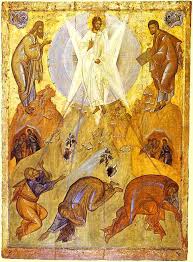
B, Lent 2 a                                                     Jesus the Man

 Six days later, Jesus took with him Peter and James and John and led them up a high mountain where they could be alone by themselves. There in their presence he was transfigured.  Mark 9.2

You are the once and future man – Second Adam –

as you stand upon the mountain,

streaming with light,

author of life, unafraid of death,

companion of Heaven and journeying to hell,

entering into all our pain,

despoiling the Despoiler.

Behold, you take us, freely, to yourself.


I see you with inspired eyes,

as you draw me to yourself, confirming me.

I become what I see, and

I see what I am:

flesh made light,

flesh made Word and

from me worlds new and old proceed.


You have made me, 0 companion of my life.

We move in each other, marvellously.

not concerned with survival of the fittest,

indifferent to class or wage,

concerned with more than reason and measurement,

not wishing to conquer and possess,

but standing as the new humanity

taking all the earth and

projecting the Spirit

who, from her being, in delight,

in passion and tranquillity,

cries out the whole new world


B, Lent 2 b                                                     Jesus the Lamb

 And a cloud came. covering them in shadow; and there came a voice from the cloud ‘This is my Son, the Beloved. Listen to him’.             Mark 9.7

Here is the proof,

that you are the unblemished Lamb -:

you wanted to be with us,

not holding back, unconcerned with your own security,

not selfish, not just dutiful,

wishing to be with us in all our weakness,


because in you,

– Chosen One, author and destiny of all life –

there is health, exhiliration,

dwelling joyfully in the heart of the Father and

breathing forth gladly the Heart of God, and

your clothes are dazzling;


mighty warrior, enjoying the battle,

– Christ overcoming all the anti-Christs –

as you enter into sin and

no longer display your glory,

diving deep beyond death,

your body drawn to our body,

your mind taking on our confusion,

showing that our sin is of no concern and


from our flesh you draw, magnificently, the Spirit


Therefore, you are our Redeemer.


B, Lent 3 a                                                     Jesus exorcises

 Making a whip out of some cord, he drove them all out of the Temple, cattle and sheep as well, scattered the money changers coins, knocked their tables over and said to the pigeon-sellers, ‘Take all this out of here and stop turning my Father’s house into a market. John 2.15-16

Enter my temple once again, Lord,

come into my body and

into the inner recesses of my heart and

cleanse me,

of my sorry memories,

the abusing and the abuse,

cast them all out

for I was holy at the start and built by God


but the ravens have nested in me – birds of the night –

and have sullied the sanctuary.


In your zeal for me,

drive fresh air down the corridors of my soul.

In my every breath

pour the incense of your prayer and

calm my distracted heart.


Exorcise me with the power of your music;

resound in me by the mantra I utter,

– for you occupy every mantra –

and raise me up with every repetition

as with a word you called Lazarus, your friend, from his tomb.


Make me once again clear and effective,

your sanctuary, the place of praise

where every sound

will speak of you, the Word,

spoken by the Father,

as was intended from the start.


B, Lent 3 b                                                     Jesus restores

 Jesus answered, ‘Destroy this sanctuary and in three days I will raise it up.’ John 2.19

Against all the sins you explode in anger, in grace,

victorious warrior.

The pollutions provoke your entry into the Temple,

angel of God.

You are the stronger,

you are free.

Suddenly you act in me

restoring me by the three days of your passion

and gladly I surrender.


I had lost my way and my self.

I had been misled, deformed.


Take me back to the beginning, to the early days,

back to when I was chosen before all ages.

Take me out of Egypt.

Take me, beyond all the chatter of our age,

into the silence,

there in the desert, at the start.


Breathe into me again, dead upon on the ground, the breath of life.

Enliven me so that I am again whole, entire,

at one with you and all creation,

reconciled, again at the origin.


More than that!

Breathe in me the Breath of Easter.

I restore myself by this Spirit – the greater work not made by human hands,

and from me all flows,

and all is held together,

the heavens as well as earth.


B, Lent 4 a                                                     Jesus regenerates

 Yes. God loved the world so much that he gave his only Son, so that everyone ‘who believes in him may not be lost but may have eternal life.       John 3.16

The fire has raged and devoured and then spent itself

– it cannot last –

and upon the ground lies the seed

cracked open in the torment,

waitng,

till the gentle fall of rain wakens the hidden fruit.


You came among us

to be broken open and

spill life into our barren earth.


Come to me, in your immense pity:

for the raging fire served only to evoke your compassion.

You are the seed in our cracked earth.

Enter every patch of ground and

impart your dying and living.


You are in me,

more real to me than I am to myself,

diverse from me,

felt in the subtle contrasts of our breath,

inspiring me,

transfiguring me from within,

– my Perfect friend – and

by pure love I achieve, in ways unexpected,

claiming all the earth,

regenerated, generating.


B, Lent 4 b                                                     Jesus redeems

 For God sent his Son into the world not to condemn the world but so that through him the world might be saved.             John 3.17

You came searching among the rubbish, the debris of our lives,

not afraid to dirty your hands and

you lifted us in your arms

wishing to see the light in our eyes,

the dawning smile of hope and

the look of peace stealing over our face

more pleasing than the dawn.


There can be no despair.

I am not alone

because you stooped down to me and

suffered more than I ever can,

for my sake being lifted on the cross.


I believe

but would that one of your servants

should come into the mess of my life,

my wasted years, my inconsequence and

clear me a place on the face of the earth and

let me do a work worthy of you, Redeemer of mankind, and

become to someone a saviour.


Since no one has loved me,

– I have wanted to love without reward or motive –

I will love by the love you had for me,

You redeemed me so I might be a redeemer.


Your work is justified and

you are proven and

your name is redeemed among mankind,

saved from opprobrium and

you become indeed our Lord and our God.


B, Lent 5 a                                                     Jesus’ compassion

I tell you most solemnly, unless a grain of wheat falls to the ground and dies it remains only a single grain; but if it dies, it yields a rich harvest.  John 12. 24

Your could not remain aloof, happy Word,

nor unsaid in our dumbness.

Your voice reaches from end to end and

to us you bent down

because we needed to hear your sweet whisperings.


Any chance of converse called your words from heaven

as any smouldering ignited your flame and

any possibility of catching light compelled your fire out from heaven.


So you concealed yourself,

becoming more subtle, more ordinary,

more obscure so as not to frighten us,

taking on our human flesh and

speaking to us in time, in the language of one place,

talking as friend to friend:

you who fill the universe,

able to slip into the heart unobserved and

there expand and

explode and

arouse to joy

in the power of your mighty song.


You came into the confusion of our tongues and our warring words,

the ancient cursing.

You loved the unlovely and

had faith in the faithless.

What sleight of hand!

What feat of strength!


In your mercy do not judge me

for I condemn myself without reprieve;

but have mercy and help me.

Ignore my sin and inspire my capacities,

encourage, show how,

teach me to speak and


I will make all things new in a new song.


B, Lent 5 b                                                    Jesus’ sacrifice

 Now my soul is troubled. What shall I say: Father, save me from this hour? But it was for this very reason that I have come to this hour. John 12.27

From the Father you are spoken, utterly and

he lets you be God

and as you breathe your all,

the Spirit proceeds:

the Third, discreet, available, unimposing: God;

for sacrifice is at the heart of our Trinity.


You came to endure our limitations,

the confinement of matter,

knowing our pain and our sin,

every sense assailed,

quivering with fear and shame,

derelict,

making all our pain holy.


Broken, you burst our bonds and

dead, you allow matter to attain the freedom of God,

entirely inspired, consecrated and holy.

This heart and

every heart of matter is our God.


Your arms were stretched out to reach from end to end,

feet nailed so you could pass through all our walls and

become our intimate, my other self,

confirming me and consecrating.

We submit to you and

your power floods in us.


We worship your cross.


B, Passion Sunday                                      The flesh

The centurion, who was standing in front of himhad seen how he had died, and he said, ‘In truth this man was a son of God’.    Mark 15:39

You spoke as no man has spoken,

penetrating, beautiful, resolving our dilemmas,

words of power and mercy,

entirely within your words, 0 Word,

showing the One who is Light, O Word of God:

so they mocked you on the cross, and

stopped your mouth with cries of pain

which only speak to us utterly of God

dwelling in darkness.


Your hand reached out to calm the storm,

touching the leper and raising the dead,

for your flesh draws our flesh and

your presence casts out demons:

so they placed the nails against your wrists and

stretched out your arms

to embrace all the scattered tribes.


You promised fire from heaven and

the wind of the Spirit announcing our future:

so they exposed you to view,

reduced to stone in your nakedness.

You endured the torment with dignity and peace,

not begging for mercy or trying to save your skin

even in agony responding with familiar grace

till you breathed your Spiri t upon the world

victorious at last.


Here is the man for all mankind,

the leader whom I will follow,

the teacher to whom I will give my mind and

allow to rebuild me.


B, Holy Thursday                                       The blood

 In the same way he took the cup after supper, and said, This cup is the new covenant in my blood.             I Corinthians 11.25a

Pour out your blood, Saviour of mankind.

In great streams pour out your blood on this world and cleanse us

for only in blood can there be life; and

become for us a Victim

for we perish through lack of love.


Only blood can satisfy us and

we need shed no more blood,

becoming of one flesh and blood in you;

your blood coursing in our veins,

drunk deep in the eucharistic cup.


But how shall I shed my blood

in the shady suburbs and this wide brown land?

except by the slow martyrdom of time and sweat.


This shall be given for you, given for all,

adding to the remission of sins,

the eternal covenant made new in each new shedding of blood.


In this modem martyrdom

I shall become true, real at last,

consecrated and sanctifying.


B, Easter 2                                                    Jesus, the Victim

 He said to them, ‘Peace be with you’, and showed them his hands and his side.  The disciples were tilled with joy when they saw the Lord,              John 20.21

‘Let all the bitterness of mankind, the blame for all misdeeds,

all the angers and resentments, past and future,

fall on me;

the revenge for every seeming unconcern of God,

the pay-back for the pains of life and the disappointed hopes,

be placed on my head;

the worst crimes, the horrors,

the long history of cruelty and injustice,

do their worst in me.


Bring me to death,

to terrors impossible before and impossible since.

Tear me apart and rend me asunder,

pouring out my blood.


Let me show my hands and the holes they dug and

you will rejoice with a joy impossible before,

the joy which never left me,

the strength which streams out from me,

because I am with Him always

who is endlessly fathering.


Only the pure can take on impurity and

only the innocent can endure the guilt,

unblinking, fearless, realistic,

only the clean can cleanse,

only blood can cleanse from blood,

from these hands and this side.


There will be no blame.

You will be convinced at last of love.


Rejoice

in the wounded side and

in the life-blood that springs from thence,

in the good and evil, for

it is the sacrifice.’


B, Easter 3 a                                                            Witness

 So you see how it is written that the Christ would suffer and on the third day rise from the dead .You are witnesses to this.       Luke 24.46, 48

You have appeared to me,

not in an upper room

but in the chamber of my inmost heart

and here you have spoken,

not in words for the ear

but in leaps of the heart,

and I seek, freely, death and resurrection.


It is our conspiracy.

For where you are there is the impulse towards Easter,

to Iive once again this moment of exhilaration,

an eternal return.


I am witness to myself and to you,

to yourself in me,

for your life is mine and mine is yours.


It is right thus;

it was written ever thus

in the destiny of our race.


You are alive in your Church, and

we are witnesses, without compulsion,

not to a person without or to events done in time past

but, by our own agenda, to oursel ves and to you

– are we not one body?

in an eternal Easter.


B, Easter 3 b                                                            Theology

 He then opened their minds to understand the scriptures ….             Luke 24.45

 Where are you,

where do you speak,

Jesus risen from the dead!

for your voice seems silent and

I cannot hear the familiar accents.


We feel bereft and our spirits fail.

You are the words of our dialogue and

now we no longer speak to each other and

hearts break without your one heart

as each goes their own way, like lost sheep,

society disintegrating.


Where is your God?


Shall not the new surpass the old?


You will spring from among the dead, as always.


When we shall love because it is good to love and

give without hope of reward and

when we walk our via dolorosa as if you had never gone that way and

mount our cross, faithfully,

then we shall hear you in us:

speaking words of peace,

showing us your hands and your side.


We shall understand indeed that all belongs to this moment and

we shall no longer write tomes

but be led, in silence and in eternal music,

to sing the one Word

come again amongst us and

our hearts will burn with your fire.


B, Easter 6                                                    Fidelity

If you keep my commandments you will remain in my love just as I have kept my Father’s commandments and remain in his love. John 15:10

You do not have faith in your Father, Jesus,

for you and he are one.

Nor do I wish to have faith in you:

simply ‘I am’ and

this is nought else but you,

for you are me and I am you:

you and I are one.


I refuse the journey of faith

if it means that I have been unfaithful.

I shall run fast along the way

if, from the start, I am not divided from You.


I am not faithful to you

as if you were outside of me, over there,

nor as if fidelity supposed a separat:J.on

– this I could not bear – but

we have existed from the beginning in your freedom and

we have been chosen in you from before .time began.


Adam’s sin and

the sin of the world and

my own sin,

– these I repudiate from the start.

Have we not been reborn from above:

therefore, are we not eternal,

without beginning or end?


I am baptised because already,

by the hidden impulse of the Spirit,

I am from above.


My act of faith is the expression in time of our union from the start.

Let me sing of our union,

demonstrating its power,

living our mutual trust in words and works,

dead to self and alive to Self.


Therefore I do not pray to you

but do as you would do;

I do not proclaim you

but make the Covenant anew.


B, Ascension    a                                              Jesus withdraws

 And so, the Lord Jesus, after he had spoken to them, was taken up to heaven: there at the right hand of God he took his place …..   Mark 16:19

You give us space, Lord Jesus,

as you rise from the earth

and the whole world opens up before us.

You give us our freedom, Master,

as you remove into silence,

– for you trust us.


As once your Father,

– who spoke you and worshipped you –

presented to you the vast horizons of the Spirit

which you could fill with Breath,

delighting to emit and possess the Spirit:

So now you allow us

to breathe the Spirit on the earth and

bless all mankind.


They thought to damn you on the cross

but you were raised to the heights.

They wished to eliminate you from the earth

but everyone speaks of you.

They rejected you from their story

but you ascend:

– visible nowhere, seen everywhere.


If you did not go

how could we breathe freely?

Your faith in us awakens faith

and the power to move mountains.

Your confidence in us gives us authority

as we take the world to ourselves.


B, Ascension            b                                             Jesus abides

 ….. while they, going out, preached everywhere, the Lord working with them and confirming the word by the signs that accompanied it.        Mark 16.20

 You have been taken from our sight

but you are not absent, Lord of the caves.

You have finished working from outside;

now you work from within:

ou are the Word in our words,

you breathe the Spirit in our spirits,

empowering us, allowing us,

encouraging us, penetrating;

your mind is in the mind of the Church,

our bodies are received into your Body.


You ascend so as to go everywhere,

present to every time and season,

not located in Jerusalem or Rome or Washington;

everywhere we can call upon you and know you,

reliable, approachable,

carrying you in the tabernacle of the heart,

within ourselves, – be it in prison –

ntimate with you in solitude,

at home with us, as we are at ease with you,

heart abiding in heart.


B, Pentecost  a                                              Wisdom

 When the Advocate comes, whom I shall send to you from the Father, the Spirit of truth who issues from the Father, he will be my witness.            John 15.26

 The books gather dust and

the data-banks overwhelm me:

the volume of information rises as a wall

and I am filled with anguish:

how shall I touch the distant stars and fin all times.


Word of God, free me from my errors and the weight of thoughts.

Let me go beyond words to you the Word

who express bodily the whole being of God

and in you I shall come to Wisdom.


From the Word, you spring, Wisdom,

subtle, far-reaching,

true to the Word and proceeding from the Word.

In you the Word delights, in your my-serious grace/our balance, and

the whole energy of the Word is channelled by you

Ruler of the Light

for you know the end of things.


To you all shall come and

to yourself you lead all actions,

giving birth to right action, rightly chosen, at the right time.


Come to me, Wisdom of the Word of God.


B, Pentecost b                                              Charisms

 But when the Spirit of truth comes he will lead you to the complete truth,            John 16.13a

Where have you touched me?

for power comes out of you, Jesus to heal me.


Do you strike at the very base of my being,

to make me trustworthy,

the rock on which to build the vast array of your Church?

Do you inspire me in my manhood,

to make the waters flow,

giving life to all I touch?

Have you placed fire in my stomach,

giving me courage to take the world to myself and

recast it in your fire?

Have you touched my heart,

the secret place of love,

where the future world might resound?

Is it in my throat your power comes,

to give me words of power,

creating and recreating with a sound?

Is it in my mind,        –

to plant wisdom and counsel and

the secret knowledge of your plans?

Do you pour down on my head the full force of your Spirit and

– marvel upon marvel –

I live already in the communion of the end?


Where have you set me ablaze?

Where, in me, does heaven unlock and the Spirit descend.

Where in me is my Pentecost?

Tell me and

I will sing a new song.


B, Corpus Christi a                                     “Do this in memory of me”

 This is my blood, the blood of the covenant which is to be poured out for many.             Mark 14.24

Ah,

take me from this edge of time, this dry littoral

to the vortex, the heart of time.

Take me out of this dryness

to the cup of blood,

the moment of covenant,

when all is connnected,

the hour which holds all times.


Down through the ages,

the memory of

when first you held the cup and

proclaimed the covenant in your blood,

seizes me:

that powerful dream,

the story of our human hope

takes me to itself,

forming me,

changing me by the power of its truth.


I drink of that cup so long ago,

as I drink of this one on the altar.

Let the elixir pour into my mouth and

the divine ambrosia flow into me,

your blood mingling in mine.


So now it is I your priest, your high-priest

who now declare for myself,

– is not the covenant forever new,

not repeated, without nostalgia,

made anew from myself,

being who you are and

you being who I am –


and you are come from out of eternity and

you are present again

for I am here.


B, Corpus Christi b                                     maranatha, ‘Come, Lord Jesus

 I tell you solemnly I will not drink any wine until the day I drink the new wine in the kingdom of God.    Mark 14.25

You have done with all our banquets of time.

All the passovers are done.

You put aside all the goblets of our world,

by your vow withdrawing into death

and foretelling a new wine,

the best kept till last.


Give me that wine,

let me drink deep and

become drunk with your Spirit,

walking with another step,

with a new mind,

my tongue loosed,

singing your music.


Let this wine unbind the knots and

release the springs of life in me.

Come with all your power and inhabit me,

fire me with your blood and

give me heart

to be myself and you.


We are one:

yourself and myself:                         only one Self.


B, Sunday 11 a                                              Gestation

 Night and day, while he sleeps, when he is awake, the seed is sprouting and growing; how, he does not know.          Mark 4.27

You are still coming to birth, Lord Jesus,

you, the sound in whom all things are said,

seed once fallen on the earth,

appearing for a while among us,

then hiding in the rock.


You are spreading among us,

with us,

for us,

empowering us.


How do you do this?

Word of God, Man among us,

Risen from the dead, with every freedom?


You change us

– not from without,

for we do not look back

nor imagine the past as you walked the earth.


Your words are not outside us,

nor is your body.

Neither do our theologies contain you

nor does our ritual exhaust you.


Stripped of every thought,

true to truth, and justice,

attentive to the best Impulse,

suddenly, surprisingly, you are there in me

– it is the harvest grown and –

I in you, and

you have become my other self, companion, equal.


It has been the long gestation,

the great swelling

as I take on your character and

achieve your concern for all things,

here in this garden of ours.


B, Sunday 11 b                                              Natural

 Of its own accord the land produces first the shoot, then the ear, then the full grain in the ear.    Mark 4.28

All things spring from you, Word of God,

sacred, true, hopeful,

words capable of receiving the Word.


The sprouting shoot covers the earth with its green and

your people spring as the ear of wheat.

You yourself are the full grain come to ripeness, Lord Jesus

and we are the crop ready for harvest:


For we grow naturally, in your good time,

and every increase is a sign of you word.

We do no fear our nature or our instincts.

We are not hopelessly corrupt.

We do not oppose what is new

nor force things to our passions.

We look forward to your sleights of hand and

we admire your mystery in our routine.


What springs from the Word

is transfigured by the Word.

When all is quiet and in harmony

then the Spirit descends and sanctifies.

The windows open and our souls take flight and

we come to your Father’s side.


B, Sunday 12 a                                             Jesus is the prototype

They were filled with awe and said to one another,‘Who can this be? Even the wind and the sea obey him. ‘     Mark 4.41

The winds and the seas obey you

for they recognise their Master,

– Word of God! –

from whose sound all creation pours into being and

in whom all come to calm,

the calm of that day

when all is reconciled in you.


When you died, all died,

when your rose, all rise with regard to you.

Death itself will obey you

and the tempests will heed you at the last

standing above the tomb and

bringing us to that silence which is purest music.


As you stand there, at the centre,

Perfect Man of power and authority

holding all things in your love,

present everywhere

but contained nowhere

the Spirit has lead me to you, and

I stand by you, my companion, my similar, and

we conspire.

Have we not one Father,

does not one Spirit swirl in us?


You let me be myself and

greater than myself,

symbol of you,

transparent of our God.


B, Sunday 12 b                                            Jesus contains all

 And he rebuked the wind and said to the sea, ‘Quiet now! Be calm!’    Mark 4.39b

Our arms stretch wide and

embrace the world

as you did on the lake,

holding your hands to the wind and the spray.


Nothing is foreign to us,

– do the stars care for the stars? –

and we touch all things,

sensing from within, everywhere,

O Jesus who are God and Man,

knowing all, enduring all.


We touch the heavens with our prayer.

To us is give the power to say ‘Be’ or ‘Be not’:

for everything is given into our care and

we form the future as putty in our hands.

Are we not your image,

Son of God?


With all our faculties intact, whole, sound of limb,

true of heart, free, reasonable, enlivened in every nerve,

we contain heaven and earth within ourselves,

at the beginning and at the end:

because you hold us,

Alpha-Omega, the Man.


You have given us hearts wide as the sea and

as we open out breasts to contain all,

the clouds clear and

we rise into the vast expanse of your Father’s heart.


B, Sunday 13 a                                             Jesus is medicine

 Do come and lay your hands on her and make her better.   Mark 5.23b

He is my God,

from ancient, times,

from the beginning

– nothing else could I endure –

destined to him, chosen by him.


Therefore I recognise you, Lord Jesus, of one origin with me:

we belong to each other.

How perfectly you stand, sent,

masterly, choosing all times.


You recognise me, surely, and

your approval confirms me,

despite my inconsequence.

Heal me,

restore me,

make me what I am.


Other doctors have made us worse

with false medicine and false advice

not seeing our needs but only their cures.


You comfort and console and take us in charge.

With your body strengthen us,

body incarnate, destined to death,

risen and available everywhere,

known from within,

body known by body:

so that we are a communion of bodies.


I put out my hand:

Touch me and

let your power raise me from my death.


B, Sunday 13 b                                             Encouragement

 Immediately aware that power had gone out from him ….. Mark 5.30a

Your Father, primarily,

has chosen me and

taken me to himself and

you, the Second,

you concur with him and

second his choice:

you do not stand in my way


He loves you above all

but loves me – if it were possible – without you,

not only because of you but

because he is generous to all his children.


He is the God of our ancestors and

with them I form one tribe and

with you one body

since he is first your God.


You recognise us, Lord Jesus and

claim us and complete us and

encourage us and second us.

To us you give your power.

To you we give ourselves

taking on your flesh, becoming one body,

knowing your mind and becoming one truth,

impelled by your Spirit and becoming one Fire,

blazing, devouring the world.

,_

Together we conspire,

breathing forth the Spirit and the worlds and

taking the Spirit and all to ourselves

so that in the end there is Love.


B, Sunday 14 a                                             Jesus is transcendent

 They said: Where did the man get all this? What is this wisdom that has been granted him, and these miracles that are worked through him?          Mark 6.2b

 No man can claim you as heir,

no law explain you.

First and foremost you are of the Most High,

never separated from him

nor absent from his side.


You come freely, unexpected,

without compulsion, original.

You come willingly,

transcending what you choose,

coming with delight, playfully,

to our human race, to your village, your family and

you take on their flesh and their customs:

with us you are free, never unwilling.


You are from above and

give your life every meaning,

your flesh transparent, transcendent,

symbol, sacrament of God.

You choose your flesh,

shedding your blood in covenant,

giving your body as food.


Already you know the joy that lies ahead,

because you live beyond time and

you call us to the secret place of joy.

You touch us powerfully with you flesh.

Your body takes our body and makes us Spirit.

You move on, essentially free and

lead us to the Most High.


B, Sunday 14 b                                            Jesus is sacred

This is the carpenter surelythe son of Mary, the brother of James and Joset and Jude and Simon? His sisters, too, are they not here with us? And they would not accept him.         Mark 6.3

 Their stolid faces, hard as flint

their hands gnarled, unimaginative.


You come to them and

call them,

away from the securities of village life,

the crushing succession of generation and tradition

and they fear you.


You are found easiest,

at the edge of things, at the entrance of the cave,

at the centre, where the path leads through the sea,

in the balance of things

for you are the junction of death and life, heaven and earth,

standing at the opening of the tomb.


Your body,

hanging between heaven and earth,

hovering between life and death – contradicted –

here is the supreme power,

the fountainhead of grace.


You cannot be reduced to our purposes and thoughts.

You exceed us and draw us onwards and

we follow your surprising paths;

we take on your story and your will,

and all becomes sacred.


You show us the face of the Invisible

who loves us utterly,

before whom we tremble with freedom and amazed delight

as we find pleasure in everything.


B, Sunday 16 a                                             Exaltation

So they went off in a boat to a lonely place where they could be by themselves.               Mark 6.32

 You entered your rest,

rising beyond all places

to be alone with the One, and

now you rest in perfect activity,

– resting in your work,

working in your rest –

present to your Father’s love.


All is done and all is said.

You rested on the cross,

that place of abandonment,

in utter frustration and perfect sign,

saving us, revealing the ineffable.


All else has failed but One has not.

All has proved useless,

but he has come to your aid,

raising you, exalting you.


Your body is made available to me,

flesh offered, exalted,

drawing all to itself

relaxing my sinews,

healing my weariness,

invigorating, transfiguring:

on your flesh and blood I feed,

so that there will be one Risen Body.

Is it yours? Is it mine?


I feel in my own flesh

the exaltation of your flesh ascending and

with you I rise and

find my rest.


B, Sunday 16 b                                            Transformation

So as he stepped ashore he saw a large crowd; and he took pity on them because they were like sheep without a shepherd, and he set himself to teach them at some length.                Mark 6.34

 What horror at the crucifixion of the Good.

We stand aghast at our capacity for evil.

Yet you have chosen this, Just One;

what beauty attracts us, such kindness.


We hurry towards you,

leaving our towns and we wait.

Turn to us and speak to us,

not with words but with your silent mind,

without handling, touch us,

strike our person with your person,

your whole body speaking to our whole body,

address us and be present to us.


Bewilder us again, amaze us and

teach us the mysteries

– 0 Sent of God ! –

hidden since time began

known only in eternity.


Our mouths will sing a new song and

our heart will guide our hands and

our hands mould the world

till all becomes sign,

sign evoking sign and

all in transformed into Presence,

all made all to all.


B, Sunday 24 a                                              Commitment

Anyone who loses his life for my sakeand for the sake of the gospel, will save it.                Mark 8.35b 

Your Father is generous.

Are you not the complete expression of his being?

In you he has done what is utterly good.

He looked upon you and

knew indeed he had done all well, and

allowed you to be his God.

With you he wished to conspire to do the best

to express the Spirit, the last outpouring.


With them, in a Trio,

you speak our world,

the finite, the unreal, generous in time, fruitful,

and draw us into your presence,

the rainbow of your Light.


You cannot imagine evil.

It does not enter your mind

– although its barbs pierce your flesh and

you are overwhelmed with the horror –

for you are good and do good.


Our hearts are filled with you and

the freedom of your Spirit inspires us.

We act as we will,

with no weakness to do evil,

acting beyond rule and custom,

finished with the wavering heart,

bored with self-gratification,

and the insecure choice.

We spontaneously do the good,

and bring our world to birth.


B, Sunday 24 b                                             Fear

Then taking him aside. Peter started to remonstrate with him. But turning and seeing his disciples, he rebuked Peter and said to him, ‘Get behind me, Satan! Because the way you think is not God’s way but man’s.’      Mark 8.32b-33

You lead us through the darkness,

– Shepherd of our souls –

and in a daze we follow you

who looked at the face of fear and

chose to ascend your cross,

losing all power and

obtaining authority over heaven! and earth,

Crucified and Lord:

and we fear.


How easy, how compelling,

to turn back to the leeks, the onions, the garlic of our Egypt,

concealing our fears

as we ravenously, sadly, consume.


But you strip us, awesome Lord,

of our lives, our good name,

our loves, our pleasures, and

we set out behind you.


Lead us through the dark night,

strengthen our trembling hands.

Test us with fire, with the crisis of faith,

with dilemmas of the heart, with puzzles to confuse

then we shall not fear judgment day

nor your look as you turn around.


At the end of our journey

greet us with a familiar smile

for we have become you.


Posted in Christian tantra, Kashmir Shaivism | Leave a comment

Poems on the Gospel. Why?

These poetic homilies began a long time ago, at Fané-les-Roses, a Mission Station hidden in the highlands of Papua. In this magnificent location, the thought came to address, in the course of the Three Year Cycle, all the major themes of our Christian faith.

I have done this in two forms, one poetic, the other prose. Here are the poetic versions, two for each Sunday. The set is not complete, for that would have meant over 300 poems.

May they lead us deeper into the mystery so wonderfully evident in those steep mountains and valleys, untouched and untroubled.

Posted in Uncategorized | Leave a comment

Sabbatical, 1987, Report to Archbishop Little

littl2Most Rev. T.F. Little,  Archbishop of Melbourne,  31 December 1987,

Your Grace,

My year of study leave has now drawn to a close. It is appropriate that you should receive a brief report on the events and on the value of this excellent period.

There were two main purposes:

1)        to follow up a certain line of prayer which had been brewing in me for many years. A book by a certain Fr. Thomas Matus O.S.B. (Camaldoli) had drawn together two traditions: the Eastern Orthodox tradition of St Symeon the New Theologian (XIth Cent., Constantinople, which is connected in some fashion with hesychasm and led on to the theology of Gregory Palamas and to the Jesus Prayer tradition); and the Indian tantric philosophy of Kashmir Shaivism (as expounded by Abhinavagupta, XIth cent., Kashmir). Both these traditions – Orthodox and Tantric – had caused me exhilaration in the past. They described my own experience, which has in fact occurred independently of them. Now they were drawn together, boldly, in a concise and clear way. I wanted to deepen my knowledge of the two traditions and above all to exercise myself in them.

2)        to reflect deeply on the purposes and methods of parish priestly life. Though the past, from my earliest days, had not disposed me to such a way of life – indeed, far more natural to me was the life, impossible of course, of the monk wandering like Francis of Assisi – it became clearer with the passing years that only the parish provided the freedom in which, realistically, one could be a man of God for the people, one who was to prophesy to them and consecrate them. Now that the busy years of Christ Campus were over, I needed time to reflect deeply on parish life.

The major means was to spend time in monasteries because they provide the space for such thoroughgoing prayer and reflection; and in monasteries of the Camaldolese tradition since Thomas Matus is Camaldolese.

A course of studies could not provide the same space. I needed to pursue my own thoughts by means of prayer (which for me has always been a course of endless theology – indeed, whenever I ask, in prayer, a theological question, no matter how difficult, the answer always comes immediately) and by means of reading in recondite areas for which there are no courses that I know of. Consequently, at the end of this year I can present to you no diplomas or letters of attestation but only this report.

In detail:

new-camaldoliJanuary and February found me in California at New Camaldoli located on Big Sur, a magnificent coastline south of Monterrey. The high mountains of the Sierra plunge into the sea where wales can be seen migrating to their breeding grounds in Baia California. It is a wild coast, the former paradise of the hippy culture. The glorious days of the Californian winter provided good rest; the monks provided good company.

a) prayer:

I followed the free movement of the Spirit of God who has always led me through strange paths in prayer. There were moments of anguish and bitter tears as the disappointments of the past – the Jesuits, the seminary, the priests of the diocese, Christ Campus – surfaced and confronted me. There was the realisation of the secret egoism that permeates every act and thought. There was the sense of failure and of more than half a lifetime wasted. What had been achieved? Where was my God whom I sought so wholeheartedly since my childhood? On the bright side there was continual penetration into the designs of God. Space prevents me from developing this aspect.

b) reflection on parish life:

This consisted in determining the priorities of the parish as it is to be lived out in the modern world. In the past the major efforts of the Church were found in the work of the bishops, above all the Fathers of the Church; then in the great religious orders to which the best minds gravitated; then in the papacy; then in the epic history of the missions and the active orders. The parish lived obscurely in the background. In this age of the laity, of democracy and universal education, is not the parish to be the focus of the Church’s activity? But: what sort of parish; what is the role of the priest; how, in practical and coherent fashion is the parish to be designed? Again, what are my charisms; how am I to function in a way that pleases God, man and myself? These reflections led to the development of an overall plan, a sort of mandala, if you will. Once again space does not allow elaboration. In any case, I have not come back to Australia with a bag full of kittens. The reflection on parish life with its aims and processes was an exercise only: useful in sharpening my wits but to be put in the back of the mind as I approach a particular parish with its particular history and needs.

eremoMarch-April-May-June found me at Camaldoli located high in the hills of Tuscany at the watershed of the Tiber, the Arno and the rivers that flow to Ravenna. What a magnificent forest, planted by the monks, of spruce trees reaching to the sky in marvelous plays of light and shade. The snow lay thick on the forest floor. I nearly froze in the half-heated rooms. I learnt Italian by singing the psalms and became acquainted with the Italian mind and manner: discreet, subtle, intriguing. Have no fear! I cannot be a monk. For sanity’s sake I had to escape once a month – to Florence, Paris, Ravenna, Naples!

a) prayer:

I made use of various tantras (i.e. texts) of Kashmiri Shaivism purchased in Paris, examining their philosophy, perceiving the connections with the Gospel, using the methods of meditation described in them, making commentaries.

Tantra – as a religious movement – has its periods of glory and of decadence. Mircea Eliade refers to tantra as ‘an imposing spiritual synthesis’ and describes it as the last great synthesis of pre-Moghul India. The decadent element was particularly noted by the early English Raj and has been much publicized in recent writings in the West or by unscrupulous ‘gurus’ who migrate out of India to make their fortune. This decadent element is as connected with tantra as the Black Mass is with the Eucharist. Corruptio optimi pessima. However, the periods of glory are reflected in works such as the Mahārthamañjarī of Maheśvarānanda who hails from South India, or the Vijñāna Bhairava Tantra (author unknown) composed in Kashmir, or the Tantrāloka – a true summa theologica – of Abhinavagupta who hails from Kashmir. These, among many other texts I studied, are exciting texts, which emphasize many points that have become obscured in Christianity. The value of such texts is in the light, which their truth shines onto the Gospels. They allow us to bring out new things and old from the storehouse of the Church. They are textual disciples of the Gospel text. What wonders we can expect from the reconciliation between Christianity and the religions of India. The Golden Age of the Fathers will be repeated in the centuries to come.

At the same time I completed the reading of the works of Symeon the New Theologian and re-read the more complex half of Gregory Palamas’ Triads. I pursued some trails through Messalianism, Syrian Monasticism, Constantinople II, etc.

Furthermore there was the exploration of the act of intercession, which is the high point of prayer. Is it not, indeed, the present activity of Christ in his eternity, our High Priest before God! In intercession – not the endless presentation of requests but the act of union with God and man – we find the perfection of pastoral planning. Christ directs his Church by interceding for her. We commune in our charisms. Is not such communion the very essence of pastoral activity?

b) reflection on parish life:

The general plan or ‘mandala’, developed so convincingly in California was elaborated in detail in Italy. What precise objectives, both innovative and authentic, would fulfill the aims? What content and procedures would fulfill the objectives? (You will recognize here the method of the lesson-plan so thoroughly learnt at Christ Campus!) This required hard thinking, coherence and continual evaluation. It was a valuable exercise whatever the applicability of these plans.

July-August: the desert of Sinai.

mt-sinaiLike an Israelite I pitched my tent in view of Mt Sinai and like Elijah I spent my time among the rocks. There were no books – except a guidebook on Egypt! – no distractions. I had always wanted to spend some time in the abandonment of the desert, stripping myself bare. What a glorious location! The high mountains reverberate in the sun, bare and sheer, where the Bedouin women eke out a pasture for their flocks. The heat of the summer sun, as it rose swiftly out of the horizon, was tempered by the dry wind surprisingly cool. I was to spend a full forty days here near the ancient monastery of St. Catherine, eating at a simple ‘café’ and going to the coast once a week to rest from the constant attempt at prayer. The Egyptians struck me as being the most courteous people I have ever met.

a) prayer:

I wished to die. I wished to end all that I had been these many years and to return no longer ‘I’ but someone else. I wished to subject to the scrutiny of the Spirit all that I had read and thought and planned. Was it of God? In the heat of the desert would its attractiveness survive? In this situation I came to realize with particular acuteness how vain-glorious had been the sermons and liturgies of the past; how I had wished to dazzle the people with a work of art; how I had sought prestige and power in my years at Christ Campus; how I had used language and ideas as a means of domination and of concealing my own lack of purpose. The temptations that had been so insinuating in the past became evident. At the same time there were moments of great consolation. What I truly wanted – now I realized it with great force – was to dwell like John the disciple in the heart of Christ who dwells in the bosom of the Father. What I wanted was to draw all to myself so that all would be one, we in God and God in us, we in each other. Speech was the tool to these, proceeding from the silence of design and concluding in the silence of achievement. I wished to explode within them in light. Yet I am a child and I am afraid to speak.

All this sounds so stereotypical. Indeed it is, but for me it was an old thing made new. The Gospel, so often heard, was beginning to be desired.

September-October:

This was straight holiday, touring Europe with my mother and sister. We swept in a great circle from Paris to Brussels, through South Germany and Austria to Budapest and then down through northern Italy and Corsica to sweep back up again through the Riviera to Paris.

November-December: Shantivanam, Tamil Nadu

shantiwas spent in the ashram of Shantivanam in South India and at an ashram at Narsinghpur in Central India, both of which, while Hindu in style, belong to Camaldoli. Although I had been in India before, this lengthy stay made me fall in love with the Indian character. No doubt India has its fair share of scoundrels, its load of injustice. Nevertheless there is something deeply attractive about the people. Poverty produces its own sort of blessedness. Never have I seen so many smiling people and laughing faces. The Westerners by contrast seemed distraught and bloated. The Indians have the dignity of those who live at the level of necessity and, therefore, whose actions are always worthwhile. Living in harmony with nature they acquire a natural innocence.

a) prayer:

Things were starting to fall into place. Some powerful meditations showed me the coherence of all my motivations and ideas. My prayer is symbolically described in the second account of creation (Gn 2) and in that narrative’s counterpart: the hymn of Colossians (Col I). The stages are, in short: silence, which leads to the transcendent God who then bestows the activity of the Holy Spirit who, in turn, gives authority over heaven and earth. Then comes the recognition of charisms, which inspires the act of intercession and, supremely, the act of communion. Such stages bring about conformity to Christ, a transfiguration. There is no space here to describe in any more detail a method of prayer, which has slowly built up in me and which, I must say, is exhilarating and satisfying to the whole man.

Part of this pursuit of prayer involved trying to discover a tantric. There are many who pass as tantrics in India but are generally charlatans. My enquiries – and I travelled extensively and consulted widely – were met with silence or evasion. ‘All Hindu religion is tantric to some extent.’ ‘No true practitioners of tantra declare themselves.’ ‘Go to another town and see so-and-so.’ ‘You have to be careful. They can get control of your mind.’ In short, the quest was fruitless except that it persuaded me of the value of my past two methods: experience, which, independently of any reading, has led me, unconsciously, to the most profound and reputable tantra; and reading of classical texts and studies.

b) reflection on parish life:

The plans that had been elaborated in detail at Carnaldoli were now set out in a timetable. Thus the whole process of pastoral planning was given its realistic shape. Will it ever be used? No matter. The exercise was valuable in itself.

What conclusions can be drawn?

The future for me, it seems, is twofold:

1: firstly and most basically – it is my food and light – to develop an intense prayer life, a prayer life that springs from the tradition described by Gregory Palamas and from the Indian philosophy of Kashmir Shaivism. I would envisage spending two or three hours daily in prayer, one day a week, one month a year, as I have done for some years now already.

2: to engage in parish life, not repeating the stagnation of a parish such as the one I grew up in, but seeing the parish as the sacrament of the Church and, indeed, of the future, being the communion of saints. What a conversion has been operated in me: from God to man; from Christ of the paschal mystery to the Christ-to-come; from ideas to grace; from teaching to prophecy; from monastery to parish; from Christian obedience to Christian authority. Yet I am frightened.

What was the value of the year?

It was a time to look into my soul and to order my ambitions. It was a year of elucidation and elaboration. I hope it has been a watershed. I hope, at least, that I will be a more useful instrument for your episcopacy.

Finally, I must thank you again for granting me this important year. littl2May the New Year bring you good health and significant achievements.

Yours sincerely in Christ,

Fr. John Dupuche

Posted in Christian tantra, Experiences in meditation, Hindu Christian relations, Hinduism, Interreligious dialogue, Melbourne, John Dupuche, Kashmir Shaivism | Leave a comment

Family – assorted items

Posted in Uncategorized | Leave a comment

Multi-faith items

multifaithMany and varied items concerning interfaith relations – topics, essays, reports – appear under this heading.

Posted in Uncategorized | Leave a comment

Islam – Catholic items

islamMany and varied items concerning Islam and Muslim – Christian relations – topics, essays, reports – appear under this heading

Posted in Uncategorized | Leave a comment

Buddhist Catholic items

budhismMany and varied items concerning Buddhism and Buddhist – Christian relations – topics, essays, reports – appear under this heading.

Posted in Uncategorized | Leave a comment

Hindu Catholic items

hinduismMany and varied items concerning Hinduism and Hindu- Christian relations – topics, essays, reports – appear under this heading

Posted in Uncategorized | Leave a comment

Tantric homilies

papuaThese poetic homilies
began a long time ago, at Fané-les-Roses, a Mission Station hidden in the highlands of Papua. In this magnificent location, the thought came to address, in the course of the Three Year Cycle, all the major themes of our Christian faith.


They draw on two sources: the Christian Gospel and the Tantra of Kashmir Shaivism.

I have done this in two forms, one poetic, the other in prose.

Posted in Uncategorized | Leave a comment

Poetic homilies, Year A

A, Advent 1 a                                                            Fulfillment


‘The time has come’.

Romans 13.11


Father, fulfill your plan in us.

Out of happiness you made us;

to happiness you send us.

Take us out of ourselves.

Make us what you want us to be.


You are holy, transcendent, happy.

You live in joy.

Pleasure is your constant state.


Let your joy inhabit us and excite us and

from within change us,

as the rising sun colours the dawn;

transfigure us and bring us to fulfillment.

Thus you will father us anew.


We are restless until you change us.

Give us the freshness of the new morning.

Touch us; cleanse us with your happiness.


Then all things will spring from our hands.

Whole new worlds will issue at our touch.


We shall look upon each other and see you.

In each other we shall see all things made new.

At last we shall see each other without fear.


What love, what affection,

what transports of delight, what intimacy.

what clarity and openness!


We shall be with you and in you.

We shall be as Christ to you.

To us shall come the Spirit softly walking.

From us the Spirit shall proceed: the great sigh of relief.


All shall be grace.


A, Advent 1 b                                               Creation


‘May peace reign in your walls,

in your palaces peace. ‘

Psalm 121.7


Father,

we are waves of the ocean: restless, passing;

but forever you are.

We seem to be, but you are;

– how our minds burst at the thought: you are rather than are not.


Here is not some cold world, uninhabited, a freakish mix.

Nor are you the distant, the detached observer of human frailty.


In peace you made us; in peace we shall be made anew.

You are the creator. You are our destroyer.

You delight to fashion and refashion.

You are with us.


How did you make the colour of the plumage?

The subtleties of insects,

the secretions of the earth:

how did they arise?


This earth, this jewel among the boulders of the cosmos:

how come?

Reason cannot know the mechanics of creation.

When at last we understand love we shall map the workings of love


As you are. we shall be too,

As we are, our world will be.

We shall not gobble up the earth,

We shall explore and

imagine and

shape and

transfigure our earth into Spirit.


We are fathers of the world to come.


A, Advent 2 a                                                In mankind


Then Jerusalem and all Judea and the whole Jordan district

made their way to him.

Matthew 3.5-6


Father, we are made in your image, for

we can laugh,

we can weep,

we are free, and

to us you have given charge of all.


Sinful, yes, weak, but

we are not corrupted, depraved, everyone, for

your image still lingers, and

still we smile at the onset of love.


All saints, the kings, the prophets of the past

have helped our minds to recognise the image of your Son.

The gnarled faces of the poor have prepared us for the crucified one.

How could he not bear the face of shame: the face of our many brothers?


He is not just another teacher in a tiresome cycle:

you have sent them all to prepare us to recognise him.


All flesh shall come to him

who stands at the centre.


He comes gently.

Without noise he allows your light to shine on us.

You do not sweep away our fondest memories.

Our history is precious


You have waited for us to bear the imprint of his face.

With joy and ease our human nature takes on his smile.


Your heart beats in ours.

We shall draw on the wealth you have placed in our hands.


We shall reshape the world, this humanity,

in our image,

in your image and


from the image of God

form our world into the Son of God,

so that he is come again.

A, Advent 2 b                                                In nature


‘God can raise children for Abraham from these stones.’

Matthew 3.9


All speaks of you, Father, the One, the only One, the merciful.

Each palm leaf traces the journeys of our world,

Each speck touches all times until the last.


How beautiful, how fragile this earth.

Our frailty and inconsequence show your immortal hand,

You who are.


The patterns of the sand and the beauty of finch’s wings,

the leaps and bounds of this evolving world,

all lead to Him

who whispers gently through the lattice.


How I love this world and its future


Out of the stones you have drawn flesh.

You have prepared a body for the Son of Abraham, the Saviour

and he inhabits this world

Without him the landscape is sorry and forlorn


These very stones, cracked by our human violence,

Still speak your wonder.


Father, be with us and

we shall tame this beautiful, this violent world of plants and beasts,

the world of storms and sunsets, of vitality and epidemics


Father us and we shall father the world to come.

What wonderful resources you have placed here

beneath our hands and within our bodies.


There will be a new evolution into Spirit.

We shall transfigure our world and our flesh and

from our body shape the world to come,

till we become Light and Freedom,


for such you are

before ever the world was.


A, Advent 3 a                                                            John restores


He is the one of whom scripture says:

Look, I am going to send my messenger before you;

he will prepare your way.

Matthew 11.10


Father,

You drew John the Baptist out into the desert,

there to live with you, from his earliest days;

there to live once again like your people,

escaping from Egypt,

to live in your light, in the silence and space of the wilderness;

in you alone.

Take me to yourself,

let me leave all things and fly to you;

in the silence and the bush let me dwell with you

– as I did before.

Father, there in the silence of his cave you spoke your Word to him.

He listened and leaped with joy;

as once to your people at Sinai

you spoke and gave the Law,

which they received with fear.

Here in the bush

you have spoken to me things both new and old,

startling things, secrets,

the Word and world to come.

I listen with all my heart.

Father, when the time came

you showed John to Israel,

startling them by the signs he gave.

He calls them to come out again into the desert,

away from their pagan ways,

to be purified and restored to the Covenant.

Only by restoring the original purity

could you make the New Light burst upon the earth.

Fill me with speech. Give me words of power.

Give me signs to touch and to stun,

that I may speak to the heart of this people of yours.

Make me the Word.

Father, you made him die for the Law.

so perfectly did he live it.

Like Moses he had to end there beyond the river,

outside the kingdom of heaven.

Let me give witness to you with my breath and my life’s blood,

spending my life in this marvelous adventure of the Spirit.

A, Advent 3 b                                                John the Forerunner


Are you the one who is to come, or

have we got to wait for someone else?

Matthew 11.3


John lived in the wilderness,

like the first man, the first Adam.

Father, it is you who dwell in light inaccessible.

With you Jesus has dwelt in the desert of your presence, always,

and from you he has come, taking flesh of Mary.

John in his way of life foretold this.

In the silence of the bush I dwell.

With you I live, without separation.

Otherwise I could not bear it.

Already from this silence I live the future.

In the silence, you spoke your Word to John,

and again the Word would come to him, gently walking.

Already he knew your Word and

so had eyes to see the Word made flesh.

John could cry out in greeting

as he had welcomed the Word in solitude.

I too shall be with the Word,

he who lives now, risen from the dead.

I live with him risen and draw him out

so that he is come again in me.

John spoke your Word to Israel and

sternly called them to repentance.

Only by returning to the original covenant

could the new Word he spoken.

Thus Jesus could speak himself,

standing before Israel in his flesh.

speaking words of authority and graciousness.

Let me be the Word

to make the new heavens and the new earth.

Father, you sent John to a martyr’s death.

He was beheaded for your Law

and was buried and so remained.

He prepared Jesus for his own death.

Jesus too must die,

not for the Law but for grace.

He too must suffer a pagan death – but only to rise again.

Let me pour out my life’s blood

for the sake of the Risen Word in me

as I struggle, with such difficulty, to say it:

and so bring life to our flesh

A, Advent 4 a                                                The sending


‘They will call him Emmanuel,

a name, which means ‘God-is-with-us’.’

Matthew 1.23.


Father, from the beginning you said your Word.

You expressed your Word and

he is there before you,

your image,

the perfect expression of your being.

You could not but communicate yourself,

for you are generous and outgoing.

Creator, in your delight

you spoke and light sprang into being.

You spoke the word and

we were formed in your image

made fruitful and

given responsibility for the earth and all its creatures.

All things were created through him

whom you spoke from all eternity.

Redeemer, from the start you wished to bring us to yourself.

You inspired the prophets and

they spoke your Word in words

to hold our minds and warm our hearts.

You spoke to the people taken from the dust of creation

and from their lips the powerful Word sprang forth:

a new song,

a new word

revealing things never been heard before.

Father, again you spoke, now completely, to our flesh

speaking in our flesh.

You inspired the Virgin Mary and                                                              from her flesh she spoke your Word.

No man’s permission was asked.

You alone spoke, and you spoke fully.

Out of darkness and nothingness you made the light.

With no help from any man you made the Word take flesh.

You call us to a life beyond birth and death.

By Spirit you made the Word take flesh.

By Word and Spirit we shall give birth                                                                  to a new heavens and a new earth.


A, Advent 4 b                                                Joseph


She will give birth to a son and you must name him Jesus,

because he is the one who is to save his people from their sins.      

Matthew 1.21


Joseph,

you had intended to make Mary as your wife.

What consternation as you found her already pregnant!

Yet you were a just man and did not want her shamed.


Mary held out to you, like a new Eve,

not a forbidden fruit but the Fruit of the Tree of Life,

produced from both heaven and earth.

You, a new Adam, accepted from her this fruit.

The disobedience of the first couple was undone.


You took Mary home as your wife.

Here is a new way of bearing children!

He was not born of the urge of flesh or the will of man.

No need for the cycle of birth and death

and the endless incapacity of flesh to give lasting birth.


Joseph, you took the boy and named him.

You gave him a home, a family, a tribe, a status in Israel.

You gave him character and a trade.          ~-

He called you ‘abba’ and ‘father’.

Yes, he took flesh from Mary;          ….

but he took personality from you.


Mary was your wife and you were her husband.

She remained ever Virgin but

in the light of your male character she flowered

and you became strong in her presence.


You and she are the new man and woman,

the male and female of the new times.

Our human flesh takes on a new fertility.

Now, by our flesh we bring to an eternal birth, a lasting loving.

By the power of the Spirit

we who are flesh become spirit; we do not cease to be flesh;

and with our new flesh we give life.


For this we thank you, Joseph.


A, Christmas, Midnight                              Pre-existence


and this is the name they give him:

Wonder-Counsellor. Mighty-God. Eternal-Father, Prince-oJPeace.

Isaiah 9.6b


He is with you from the beginning, Father,

so profoundly one:

he could not endure to be without you.

It must be from the beginning that he is with you,

not called to your side          since he has never left it,

sent,                                        yet never absent from you.

His thought is stayed on you, and

his look is an eternal look and

his words have the calm of the eternal fire

so that people could know that he came from above.

Is he not Elijah come down from heaven or

John raised from the dead, they say?

He exists before time

so as to save us from time’s dislocation,

the passing of our joys

the length of our pain.

He exists without time

and enables us to take on time:

to enjoy the rippling stream, the budding flower,

making things beautiful with a timeless beauty,

and we enjoy                         the periods of time and

the pregnancy of the earth:

the coming to birth.

He is compassionate to all, and therefore is before all.

Disturbed at the sight of our sorrows and

at the mortality of his friend Lazarus

he is yet profoundly free of all time.

He can, therefore, enter every moment and every tomb.

He is at the start of all,          with the eternal Father,

free, untrammeled, unconfined,

the Word                                in whom all things are made,

from whom all things proceed.

He is he Word                       uttered, sent, heard in time.

We come to him and could not endure to be without him.

We are reborn from above and become eternal,

pre-existing our time

saved from time and

able to love time.


Time becomes eternal: the lovely dance of the Spirit.

A, Christmas, Dawn                                    “he came down from heaven”


So they hurried away and found Mary and Joseph,

and the baby lying in the manger.

Luke 2.16


He left your house, Father, and

submitted to our time and

took on our flesh.

In him, the Word, all things were made.

But how could he speak and be heard?

He must lower himself and

limit his Word to our speech.

How else could we hear the massive tones?

He must disguise himself and

come down to our level and

suggest his glory,

giving signs and hints of his Sonship and

so reveal your presence.

He came because you were communicating with us.

He is your Word

uttered by you and

received by us,

your Word,

speaking you and spoken to us,

your word spoken in our terms

from you and with us,

with you and for us.

He came from a glory

we can only begin to understand.

He went to a state of suffering

we can never experience.

He knew no sin

because he wore our sin and its pain.

He retained his honour by

taking on the shame of being crucified between thieves.

He knew you face to face,

and suffered more terribly at being abandoned in death.

We hear him and

become whom we hear and

so come to you, and

we are at last in our Father’s home nearest to your heart,

Ah, Father!


A, Christmas, Day                                       The Word was made flesh


The Word was made flesh, he lived among us and

we saw his glory,

the glory that is his as the only Son of the Father,

full of grace and truth.

John 1.14


From him, for him,

mysteriously,

the world and all flesh spring, and

are there before him,

and yet master him, and

he takes the form they require.


Thus, by the Jewish woman he is drawn

to be a Jew.


Flesh elicits him,

not to be just the same but

to inspire and

to change flesh with his form,

and you show him in light on the mountain.


He becomes the flesh which so charms him,

taking on sinful flesh,

becoming the opposite of flesh.

even death, dying on the cross.


His flesh is made spirit for her,

leaving the tomb, filling all creation,

so as to penetrate completely into her and

to bring her all the joy she is capable of,

enough to burst her heart.

This brings him to the state he is pleased to be in,

all power coming to him,

all authority and fruitfulness.


All this so as

to be Person to Person in the Person,

to be in communion with all,

and he knows you, Father,

God before God.


Mary, Mother of God a                               Mary, the New Eve


The shepherds hurried away and found Mary and Joseph, and

the baby lying in the manger.

Luke 2.16


Mary, you are beautiful. We all look and are amazed.

Where have you come from?

You are made in silence and

when at last we see you, our hearts leap.


There is nothing dominant, nothing necessary about you.

You are God’s good pleasure.

You are the work of grace.

Over you the Spirit hovered and

you best show us this Spirit.


You are bone from our bones,

yes and flesh of our flesh,

but what a flesh!

You weave yourself out of unknown strands.


You stand there, vulnerable:

gladly we become powerless before you.

You are free, doing as your hidden plans decide,

untrammeled.


You make us foolish with a higher wisdom.

You arise in us, and empower all our faculties.

Before you we cry out – is this not your wish –

a new word,

a new world.


You take away from us our loneliness.

You give us heart.

You have made all our creation good.

All things are for you – as a diadem.

You are the supreme work of the master craftsmen.


All come to you: husband, shepherds, Child.

All surround you, for in you the Father has taken delight.


As we gather silently in prayer, you arise in us.

All our prayer is addressed finally to you:

Woman at first and

at last each man’s Eve.

Mary, Mother of God b                               Mary, the Virgin


As for Mary,

she treasured all these things and

pondered them in her heart.  

Luke 2.19


Mary, you are forever young,

forever new,

fresh as the dawn,

springing from the Spirit.

After all the cares of the night and the labours of the day

I soothe my face in the freshness of your hands.

Smile on me and make me laugh once again.


You are young,

all your potential is there,

all possibility, all promise of happiness,

never sluggish, not worn out.


Virginal Spirit –

Spirit leaning on the Father’s arn and

drawing the Word into speech –

the Spirit hovers over you, Mary the Virgin!

You are entirely of the Spirit and you inspire.


Silence, all-knowing Silence, you captured the Word, powerfully,

and he could not hesitate to be born anew of you.


Assumed in heaven, as you race on ahead

you throw your glance backwards to us and

we run in the path you have made through the flowers.


Virgin, you call, you invite me irresistibly and I say yes to you.

To you I come, ever Virgin.

You know all things,

you know the secret recesses of my heart.

To you I come, ever virgin.


Woman, you pose no threat to me

nor do you call me to decay.

Rather, I shall abandon all things and die for you.

I will speak and act and win, for you.


You make us be what we are to be.

You bring us to birth.

A, Epiphany  a                                              Mystery


And there in front of them was the star they had seen rising;

it went forward and

halted over the place were the child was.

Matthew 2.9b


Father!

Are you absent?

Do you matter?

Are you cruel, unreasoning, idiotic?

The darkness surrounds us.


This glimmer of light, shining in my spirit and rising in my flesh,

so gentle, beckoning, where?

You lead me on into the night.


Where shall you take me? How shall I know you?

These are frightened questions.

If I could understand your ways

you would be beneath consideration and I should perish with you.


You are wonderful.

Your smile puts our stolid reason to flight.

In freedom, for your own good pleasure, all things arose.

Their laws are your playthings, eternal Child.

You take us away on a journey of adventure:

our minds are blown and

our hearts expand infinitely.

You are foolish and so we see that you love.


We do not understand.

Why bring us to the darkness of our tombs?

Why confuse our minds and disappoint our hopes?


Yet in the end we shall say “Holy, Holy, Holy” and

give thanks for the night and mist

which led us to you.


You have glowed in my mind’s eye and

I follow you along strange paths.

You hide your face and wait for me to seek you.


Therefore I run out into the desert and

chase the dark and learn folly

so as to follow your star and find you at the end.

A, Epiphany b                                               Theodicy


‘Where is the infant king of the Jews?’ they asked.

We saw his star as it rose and

have come to do him homage.’

Matthew 2.2


Peoples cried out – and you did nothing!

They asked for help – and you did not listen!

Why should they believe in you?


Many shout in the market place, each their different god.

Many have killed and maimed in your name!

How can we believe in you?


Then again, why depend on you and remain forever children, irresponsible?

It is time for us to be free, masters of our own destiny.


Nevertheless, the stars do speak your praise

and as we read the stars we find the one who rules them!

Reason cannot convince the heart, however.

Reason cannot disprove experience, either.


No, in our darkness a light has shone, gently beckoning.

You have called us away from our world

across the deserts

  • despite their laughter and their learned objections –

to come to you


You have made us as gods, giving us responsibility over heaven and earth.

This we acknowledge.


You wanted all authority to be given to us

so that you could worship us as you worship your Son:

God from God and Light from Light.


As people follow their own star and travel ways unknown,

it was in your light that they do so.

As you placed the pain of the world before them,

and as they open their gifts to the poorest of the poor

you stand by them quietly.

The light grows in them and

their darkness becomes as the day.


They see that they have become Light in the Light and

they thank you for giving them their freedom.

A, Lent 1 a                                                     Satan


Then Jesus replied. ‘Be off, Satan!’

Matthew 4.10a


Must we fear this ancient enemy, the ‘Father’ of lies?


He is no hobgoblin, no imp,

no figure of fun, with tail and pitchfork.

Our enemy is not a fantasy of children,

nor a nightmare of disturbed emotions,

nor a proof of our ignorance.

Nor is he a counterpart to God, a Darkness to match the Light.


Sin reveals Satan.


Who is this Satan?

From what pit does he arise?

Our focus is on your grace and your mercy.

Why think of these things?

Is there someone who has chosen sin as his portion?

Is there someone who is committed to his pride,

finally

decisively,

irredeemably,

who calls your mercy no-mercy-at-all?

Is there this someone out there?

to be revealed in all his horror at the final conflict

who even now can whisper evil to my spirit,

lying,

tempting,

dragging me to his agony.


You are the Father of truth.

To your Light I turn.

In you I believe.


Turn me from Satan, spurned, rejected, forgotten with all his works.


Let me bask in the light of your smile.

You have uttered your Word in our world,

exorcising us.

Bathe me in your Light and make me Light.


A, Lent 1 b                                                     Evil


Then Jesus was led by the Spirit out into the wilderness

to be tempted by the devil.    

Matthew 4.1


Are you evil, God of all, or powerless?

Are you God at all?

Why do you do nothing?

The cry of the world disturbs us, depressing our child’s confidence.


Yet, if you are evil we must despair.

If you are absent we can only grit our teeth and die.

You are our only hope.


You have placed in us a knowledge of the good,

therefore the evil oppresses us all the more.

Yet we we have seen the land of milk and honey,

therefore we lament our exile.

We wish to journey beyond Adam’s paradise to heaven itself.


How shall we understand?

Hurry Lord!

All will be revealed    at the end of time and

in the eternity of the Eastern mom.

In time you seem uncaring.

From eternity you are good.


The hour has struck.

The days of summer smiles have gone.

I must enter the dark night and endless time,

there to endure the doubt, the pain.          .

How I shudder at the thought! My sweat is as blood.

Who am I to know what is good or evil?


The false masks fall from your face.

You purify our knowledge of life. You draw out beauty from our clay.


Ah! from the stricken heart the waters flow,

the knowledge, the joy, the happiness, the power such as I had never known.

The very body of my pain has become the instrument of joy.

What rare flowers you have made to bloom!

What truth there is in this ordeal?

You are just and we knew it not, 0 Holy One.

All is fair and rightly done.

We thank you for our pains.

A, Lent 2 a                                                     Jesus the Son


‘This is my Son, the Beloved; he enjoys my favour.

Matthew 17.5


He is with you, Father,

therefore Moses and Elijah and all the company of heaven

stand before him and

see you.


He is not against you, like Satan consigned to darkness.

He is true to you and he speaks your mind and reveals your heart.


Therefore you are pleased with him and

he is pleased to be yours,

each giving way to the other in courtesy.

He delights in your work

enthusiastic for the course you have mapped out:

the royal road of the cross.


He stands before you,           without shame, glorious,

without falsehood, brilliant with joy,

Light from Light,

greater than Adam the dust from earth.


He fathers the world to come

by the power of his grace and

all fall before him, swooning in delight.


He is the angel of the future,

leading us forward to your presence and your land,

till we all become open, transparent, without shadow of sin.


He transfigures us so that we become light,

Beaming, by many colours, the one Light from Light.


We are pleased with this sort of Messiah and

we become pleased with each other and our world

and at last we are pleased with you, Father.


Your pleasure in him gives pleasure to him,

gives the Holy Spirit to him,

arouses the Holy Spirit from him,

the Third Person of pleasure,

the Pleasure of God in God,

the climax of the Trinity.

A, Lent 2 b                                                     Jesus the Word


‘Hear him.’

Matthew 17.5


You are no silent God.


In my heart you have moved, in silence,

in the whispers of the Spirit, in my body, my secret language.


I search my conscience and my deepest spirit and

the Spirit in me turns my ear to him.


He speaks to me, in my terms,

Therefore I can hear him and I am affirmed in my sincerest emotions.


He does not thunder or speak of doom.

Here is no bombast nor tremulous voice, no scolding nor deceit.


He speaks to me, using my own words.

Therefore he persuades me.

He speaks to me, from me,

using the words inspired from within,

not just the Word outside,

the expressions of others,

the traditions of the past

but an unfailing stream of new things from within.


And I have discovered my word and

I in turn give shape to the world to come.


We hear him

because in him were made the heavens and the earth and

the whole substance remains in his Word.


From the Word comes the Spirit and

the Spirit gives rise to the Word in us.

We hear what you have said in me

because the Spirit and the Word agree.


We shall hear him and

hear you speaking and

delight in the tale you have told and

delight in you and

come to you

the Teller of all,         –           Father!

A, Lent 3 a                                                     Cleanses


‘God is spirit

and those who worship

must worship in spirit and truth.’     

John 4.24


Father!

Cleanse me    from the inherited stain and

from the blood of my own hands;

from the pollution of the world,

from the betrayals of life,

for I am caught here, trapped in the mud.


Pour a double flood upon me, Father:

the spring rising from within and

the stream falling from above.


Wash me from within

with that living Spirit whom you chose freely to give or to withhold,

that laughing Water who restores our joy.


Wash me from without.

by the hand of your Church,

by the hand of Christ himself.


Thus the Word and the Spirit will call on each other,

deep calling on deep,

conspiring,

co-inciding in their act.


If they do not agree, how shall I ever be clean of sin?

If I am             not inspired,

not instructed,

not at liberty to follow my call,                                                                    not obedient to our teachers,

if the sins of churchmen and

if the sins of the willful have infected me,

how shall I ever be free?

But at last,

by the working of your freedom

within my loyalty,

at last

I am released from the knots that have bound me.

I can be myself, invigorated, and

stand free among the free.

A, Lent 3 b                                                     Slakes


‘The water that I shall give

will turn into a spring inside him, welling up to eternal life.

John 4.14b


Slake my thirst, Father,

make well up in me that fountain of living water,

rising in me from the base to the heights,

pouring forth endlessly in me and

bursting the clogged centres of my soul,

that fountain of youth

bringing all my faculties to life,

taking me to the highest heaven.


I thirsted for the living water ever since first I knew you.

Parched, I traversed the desert these forty years

tasting here and there the brackish wells.

How I lived in anguish and uncertainty,

impatience, despondency

until at last I found my spring – surprisingly – at my very feet.


Now I quench my thirst in long cool draughts, delightfully.


Alas for those who have no thirst.

Alas, who have thirsted for brackish waters.


Let the waters of baptism acknowledge your spring in me.

Let my waters confirm the waters of the font.

Let       the baptism from within and

the baptism from without

agree.


A, Lent 4 a                                                     Heals


So the blind man went off and washed himself and

came away with his sight restored.  

John 9.7b


You are healing me, Father,

by this joy which runs through my veins,

by the joy which comes suddenly from within,

like a shower of sparks,

unexpectedly from the heart of the world,

by the pleasure of the Spirit

by the truth of the Word,

surging in me

untying all the knots, tearing heaven open.


You are healing me by those who come from you,

the long procession of the Church,

acknowledging your act within me and

calling me to their company,

pouring the refreshing waters and

committing themselves to me.


What joy,

what confidence and reassurance,

strengthens my feeble limbs.

It is the healing of baptism.


Free me          from the rivalry of fellow Christians,

from the reticence of people and their uncertainties,

from lack of perception,

from resentment at your gifts .


Let us acknowledge in each other, again and again, the work of the Spirit.

Let us empower each other,

giving each other the life-long baptism of our communion

to be completed at the resurrection

as we rise to you, out of the waters of death.


A, Lent 4 b                                                     Enlightens


‘The man called Jesus” he answered

‘made a paste, daubed my eyes with it and said to me, “Go and wash at Siloam’;

so I went, and when I washed I could see.’   

John 9.11


You have shone in my heart, Father,

with my own light.

You have enlightened me with your Light,

transformed, broken into my own colour,

unique, original.


Around me have gathered, haphazard,

events and rituals and impressions,

the scriptures, the chants, the images,

family, friends, the chance acquaintance,

  • these have conspired to spark in me

the gleaming Light, powerful,

given, spontaneous,

chosen.


In all of this you have acted.

No one else did it for me.

You it was who drew me to my light.

Yes, You, the Source of Truth:

you have enlightened me.


This is the enlightenment of baptism.

not an endless flat information.

This is knowledge about the earth, yes, but more about heaven,

wisdom to live now and for ever.

We know you who transcend all and

we know the secrets at the centre of the earth.


Shine in me, Light giving Light,

train me to endure the Splendour.

Let my eyes of flesh see your uncreated Glory.

Let your Radiance

strengthen me to contemplate, unabashed,

the captivating brilliance of your Face.


A, Lent 5 a                                                    Obedience


‘Father, l thank you for hearing my prayer.’

John 11.41


Father,

he is with you,

as he stands before the tomb of Lazarus.

He is of one mind and heart with you, obedient, true.

In his human heart he feels your feelings.

His tears are your compassion for all the dead.

You and he agree.

He is your Sigh in our world.


He faces the tomb and does not fear the stench.

– whereas we wince, having no strength of purpose.

Here, lost in the darkness is his friend.

He stands before all our tombs,

our hells, our deadened hearts and stilted minds

calling out to all who can be of God and

calling us out of our bonds, our confinements,

to take us out into the light of day,

into his presence and

before you

to be with you as he is with you.


Because he is obedient to you, not willful,

he can command the heavens and the earth.

Because he listens to you, without parley,

you always hear his prayer.


Call us by his Voice

and take us to your side

without opposing ego,

free with your freedom,

delighted at seeing you,

without any wish to tum away.


Why should we turn from you

for we sought you from the beginning and

entertained death only for a little.


A, Lent 5 b                                                     Atonement


This will not end in death but in God’s glory.’         

John 11.4


Father,

Jesus stands before the tomb,

fearless and distressed,

in tears but powerful,

life and death confronted and

he stands before all our tombs

the deadened heart, the confused mind,

betrayal, humiliation, willfulness, disbelief

– what waste, what terror.


He will enter into a tomb and take the place of Lazarus:

he is more human because most divine,

he is made less than a man because more than human.

Only the height can plunge into the depths.

In himself he will know the height and the depth,

grace and sin,

innocence and blame,

pleasure and pain

fidelity, betrayal.

In your compassion you send him to experience all these and

so balance is restored,

atonement is made.


Thank you      for the sin of Adam and

for all the sins of our world:

they have ended not in death but in your glory.


By your gift, sin which was wrong is now valuable.

Atonement is                         not just a payback, a settling of accounts

but a new heavens and a new earth.


Such is your power, God,

your sleight of hand, your conjuror’s trick:

sin is now made glorious.


A new heavens and a new earth are made and

into this world of freedom he takes us.


We do not return to paradise but climb to heaven itself.


A, Passion Sunday                           Father of the Passion


He went away and prayed:

‘My Father’, he said ‘if this cup cannot pass by without my drinking it,

your will be done!’     

Matthew 26.42


Father,

this is all your doing, God of Passion.

You are the secret agent,

as he, your Mind, knows well,

taking the cup from your hands and

drinking it to the dregs.


You brought him to his death.

You raised your hand, like Abraham, to strike him.

You hardened the heart of Caiaphas as you did that of Pharaoh –

for you create the heavens and the earth and sway the human heart.

Your city is to be the stage of history.

Your chosen, good and bad, fickle and fervent, Son and people:

only the elect could be chosen to perform your deed.


You are in charge of our li ves.

We draw breath at your command, little do we know.

We imagine you are absent and that we must do it all

but, infinitely powerful, infinitely subtle, you lead with strings of love.

You freely accomplish your purposes within our freedom.

Here is a puzzle we shall understand only when we are free.


For you choose

to create a new heavens and a new earth, a new race of mankind,

to be Father – for you love to father, to have children –

we are your children.


You love to see us as gods and worship us,

forgetful of yourself.


You will not be dissuaded by sin

but achieve your ends even more strikingly.

Out of the chaos and mess of our lives

you will draw out salvation for all.


At the end we shall stand amazed and say:

‘You alone are holy,

you alone are God’,

and feel our hearts swell with an unknown delight.

A, Holy Thursday                                        Betrayal


Jesus knew that the Father had put everything into his hands.

John 13.3


Judas betrays him,

Peter disowns,

the Twelve flee and

you, Father, abandon him.


There is no one. All support is gone. He is alone.

No knowledge, no comfort.

He is delivered into the power of evil.

The horror, the horror, the horror.


Then bursts forth a whole new world.

You have struck the rock and the water flows,

welling up into etemal life.


In the kiss of Judas, Jesus knows your embrace.

In the cup of suffering, he finds the wine of joy.

In the lie is the truth.

In the horror is the beauty.


Our human degradation is made wonderful.

Sin is undone,

no longer a sadness but a grace.


You betrayed him

to show your fidelity to us all.


God of surprises, you are holy, holy, holy.


A, Good Friday                                             Immolation


It was Passover Preparation Day, about the sixth hour.

John 19.14


You have taken what is best and reduced him.


For he has your heart of love

which drives him forward into the darkness.

He has your conscience, and

it constrains him to go in search

till he dwells with the father of lies.


You have moved him to take the lowest place,

deadened, passive, lifeless,

among the dregs of humanity and the dust of the decomposing tombs,

to see the horror with          open eyes and

an endlessly sensitive heart.


He sees his own body           stripped and laid out and

nailed and exposed to the gawking crowds,                                  a worm and no man.


He feels the point of the knife

as you drive all the pain of the world into his heart.

How your own heart recoils in horror as you strike again and again.

It is the implication of love.

You have wept and grieved for your son, your only son,

and there was darkness over the face of the earth.


You immolate him, for the sake of the mankind whom you love.


You give him the world by giving him to the world.

You give him all by taking all from him.

You give him to death and he masters the living and the dead.

At your behest he has earned it.


From the depths

the light bursts forth and

transfigures and transforms and

takes us upwards, ever upwards,

unlocking all the knots of the heart and

the channels of our human history

upwards to yourself and


we are blessed, sanctified by this immolation.

A, Easter Vigil                                              Access to the Father


And all at once there was a violent earthquake,

for the angel of the Lord, descending from heaven,

came and rolled away the stone and sat on it.         

Matthew 28. 2.


You delight in him, the Beloved

who went to the lowest place at your behest and

embraced the leprous and

entered all our tombs,

rejected by all, abandoned by you, Father,

going into a darkness none else can know.

You are always with him, though it seemed not so.

Your admiration knows no bounds.

You recognize him differently now

since he hangs before you surrounded not by cherubim but by thieves.


You looked on the one they pierced and you were transfixed with pity.

Your heart goes out to him and

to all whom he joined in death,

and you worship him

because he loved as you love and

loved even to the point of death.

Here is your God, Father God,

God the Son surrounded by a ragged humanity.


You delight in us all.

You forget all the wrong, the mess of our human history.

You are present to us all, without any trace of frown.


Your heart goes out to him and

you give all into his hand,

all times and seasons, all authority,

the tears of mankind and all our joys.

He empowers and enlivens,

invigorates and rejoices in all and brings to fruition


Your sun shines and opens the flowers;

the fruits ripen on the earth’s trees.

You look at all and heal all.


This is our redemption. We have access to you.

You have looked at us and your gaze does not turn away

but glistens and we become light.

We see you face to face,       ah,       at last!

A, Easter 1 b                                                 Testimonies


Till this moment they had failed

to understand the teaching of scripture,

that he must rise from the dead.

John 20.9


In your People you inspired songs and events

– this great nation of storytellers,

your Chosen people of the Word –

and they spoke of the One To Come.


Noah, in Mesopotamia,

the one Just Man who saved his family and all living creatures;

Joseph, ruler of Egypt,

the one sold into slavery so as to feed his brothers;

David, King of Israel,

who shepherds his people with the songs we still recite each day.


Yet other people too and

other times have portrayed,

the One whom no image or word can master.


He is suggested by Śiva.

Rāma depicts him.

Around his grave hover the shades of Apollo and Thor, Horus and Marduk,

for they did not dare enter really into the depths

but hinted at your dying and rising.

All these are testimonies and faces of the Lord

who existed from the beginning and

in whom all are saved.


Jesus, is the Christ, but also the Śiva,

for upon his head you sent down the full flow,

not of life-giving Ganga,

melted from the high Himalayas,

but of the Spirit

come from your generous hand,

Father in heaven.


Jesus the Śiva we adore.


A, Easter 2 a                                                 Jesus is divine


Thomas replied, ‘My Lord and my God!’      

John 20.28


Thomas bows down before him and says: ‘My Lord and My God’.

You too bow before him, Father, and

acclaim him as God, your God,

who proceeded from you

and came among us and loved utterly.


To him you surrender all

as you did from the beginning when first, eternally,

he sprang from your generosity and

was there before you, perfect expression of your being;

and to him you gave to breathe the Spirit,

the ultimate face of Godhead;

and to him you gave the Spirit whom you had breathed forth,

as you heart went out to him and

you saw him as God


Because he loved utterly, as you do,

he came among us, body,

straightforward and without guile,

open to all and revealed,

without weakness or crookedness,

showing to us both his flesh and our future flesh.


He claimed all his own,

commanding by his presence and his words,

taking all to himself, free,     .

sensitive to all our pain and our joy,

giving us his body and sweating his life’s blood for us.


We are vitalised, enlivened, and

we come filled with his joy, given from above.

Therefore we too worship him, our Lord, and our God, and

our primal hope, to be gods, is fulfilled.


We too are free, knowing good and evil.


A, Easter 2 b                                                 Jesus lives


The disciples were filled with joy when they saw the Lord

and he showed them his hands and his side.

John 20.20


He was beaten with whips and beaten down,

pierced with lance and nails,

yet he could not remain dead because he lives from within.

He took flesh from the world but does not spring from the world.

He took the form of this system but not its purpose.


From the beginning he is with you and

with you he has your authority and power,

your vitality and energy.

This he knew and felt in himself.

He is first alive with your infinite life.

His interior life is intense.

From within there pour out

joy and initiative, imagination, signs and words

into our world, for our world.


He was beaten into silence,

removed from the face of the earth but

he could not fail to pour forth life in other ways

surprisingly, into another world.

If only they had understood his vitality

they would have known that no tomb can hold him.


If he were not physically alive now

how could he give our flesh hope?

Yet he was beaten down in his body,

which now is alive differently,

more alive, more physical, more organic, more solid,

huge, filling the whole world, massive.

If he were mot emotionally alive,

how could our faculties be transfigured?

Yet he was brought to agony and great distress and

his emotions now are differently,

more intense, rapturous, ecstatic,

his heart filling even the prisons with joy,

where one joy bursts to receive another swelling joy.

If he were not spiritually alive

how could we hope to stand in your Presence, our sins forgiven?


He lives. Therefore we live.

A, Easter 3 a                                                 Liturgy


Now, while he was with them at table, he took the bread and said the blessing; then he broke it and handed it to them.

And their eyes were opened and they recognised him;

but he had vanished from their sight.           

Luke 24.30-31


He stands before you, risen, ascended,

who came among us and

died as no one has died.

Despite our unworthiness, our crassness and our sins,

our acts of faith are done in him,

our acts of worship are pleasing to you.


He is not absent from us,

but acts unseen, filling the world with his presence.

He joins us on our journeying,

our flights, our despair, our hopes and dreams.

He accompanies and seconds us,

blesses and approves us in all our variety.

Our eyes are filled with the sight of him,

Unknowingly.

With our breath we feel his Spirit.

With our bodies we sense his resurrection.

With our thoughts we guess his mind.


We stand before you,

upright and true,

standing tall, straightforward,

we your sacrament before all:

for we have been touched by the waters of baptism,

anointed with oil and

fed with food made by faith.

All the sacraments make our bodies sacraments.

Our every word becomes a gospel,

our every act a sacrament

of good or evil.

We are the liturgy of the Church.

To us he comes from beyond the grave.

We walk beside him.

He acts in us,

we are in him

one body, one Christ.

He has appeared in us.

We are the finest proof of his resurrection.

A, Easter 3 b                                                 Fervour


Then they said to each other, ‘Did not our hearts burn within us

as he talked to us on the road and explained the scriptures to us?’

Luke 24.32


Father, you burn with joy.

You live in fervour,

the flashing flame of your being,

the intense light of your Truth,

the fire of your eternal Spirit.

Make our hearts burn within us.

Take away the boredom, our sloth,

take away       our securities, our controlled lives,

our instant solutions, our lack of imagination.

Release the Spirit in us,

rising forcefully and

untying our knotted hearts,

allowing us finally to recognise you,

the one whom our hearts desire,

whom we have sought, the blessed vision.

Pull down our carefully constructed castles of sand.

Puzzle us,

take us through thickets and mist,

make us know silence and powerlessness,

dilemma and trial,

for here we shall find fervor.

Renew your Church,

free us from paternalism

which masks you, Father, from our eyes;

hush the tired old words

which do not reflect you ageless myth;

clear out the clutter of customs

which hide your simplicity.


Jesus speaks to us from beyond the grave

when all is at last clear,

and reveals to us       things both new and old,

things drawn from the ends of the earth and

from the caves of the heart.

Then we shall know

fervour and good sense,

freedom of heart, excitement.

And our hearts still shall burn within us with an everlasting love.


A, Easter 4 a                                                 Jesus the Call


One by one he calls his own sheep and leads them out.        

John 10.3b.   


I could not endure to be separated from you, Father.


Your call is not as though I were far away from you

such that you had to call me to your side.

Your call to me is the door your open before me,

the opportunity,

the kingdom you set before my eyes.


Your call is your will for me,

since you have chosen me since before the world began.

My will is your will,

your will is mine,

for we are of one heart and one mind.

I could not endure it otherwise.


Show your purpose for me.

Show me the gift you have given me,

novel, new, unheard of,

which I find hard to recognize.


Open doors to me, Father,

unclog the channels of my being,

open my narrow mind,

open the door of my mouth

that I may utter your Word,

open the heart of this people of yours,

to receive your Word.


Put before me your Christ:

he is the door,

the opportunity for me to be what I am.

He was nailed to the cross and

the hand that blessed is curled in pain.

He will not suppress.

He will not belittle but

to all he calls out ‘Eli, Eli’, and we come to his aid.


The veil of his body is torn and

we are called into you presence,

where we have always been

only we lost sight of you for a while.

A, Easter 4 b                                      Jesus the Teacher


When he has brought out his flock, he goes ahead of them and

the sheep follow because they know his voice.         

John 10.4


Teach me, speak to me, Father and

do not be silent

or I will pine away, without heart.

Tell me who you are and the mystery of your being,

speak to me of your heart and your joy,

your hopes and what it is to be God.

You have kept back no secrets:

you have shown your face.

You have opened before our eyes

a whole world of possibility,

the rich harvest of time.

You have taught us

because you have sent him,

the flash of a flame of fire

who has come into the darkness and

has lit up the whole world for an instant,

with his deeds, his signs, his words,

his feelings, his fears and his joys.

He is you teaching to us.


How slow witted we are, how little in faith!

How deaf we have become,

filling the ears of people with our bleating,

our minds confused by sin.

Again in our day teach us

– in silence, in ignorance.

Make us faithful to your Word,

faithful to our Teachers but

above all attentive to the Spirit whispering gently amongst us

turning us to hear your Risen Christ          ‘

who every day

  • since he lives in the eternity of your Day –

speaks again, at every moment,

all your teaching, all himself:


and so we can come to you Father

who have spoken to us

from the beginning and

will speak gently, in silvery tones,

forever to our delight.

A, Easter 5 a                                                 The Trinity of Persons


‘To have seen me is to have seen the Father,

so how can you say. ‘Let us see the Father’?’                       

John 14.9


From always, Father, you have lived

– not solitary, not unloved or unloving, – but

as a Person among Persons,

– or else you are not Love.


You, the First Person,

– by whom all persons become present –

freely and without hesitation you place him there before you,

the Second One,

the Person from Person, and

you delight in his perfect splendour.

He acknowledges you, Father,

and you, Father, recognise your Second Person,

and you are there,

both worshipping,

and choosing each other.


And your heart goes out to him

expressed anew in a Third Person,

the Person of your Persons,

the Person between Persons,

the Person who makes both of you Person to Person,

the point where your looks meet.

His heart goes out to you.

in thanks for the gift you have given him and

the more his heart goes out

the more the Gift is received.


Spirit! – you are this Bride, given and received,

in whom the Father and the Bridegroom commune,

You bind them in your company,

drawing them into your presence.


What delight to come into your presence, Trinity of Persons.

We are empowered, encouraged, enlarged, freed

We are loved and

we look on a world that is loved.

This is our secret shared with the world:

our communion together in you:

Father-Love.

A, Easter 5 b                                                 Father, Son, Spirit in each other


‘Do you not believe

that I am in the Father

and the Father is in me?’       

John 14.10


He is with you Father,

– the Son in whom your soul delights –

he is with you,

– not distant, not cast out,

or else there would be no hope for us

to stand in the garden of your presence,

the true Eden, at last.

He is with you,

he is in you;

you clasp him so tightly as to be in each other:

Person to Person, Person in Person,

God from God, God in God,

for he worships you and

you worship him

dedicated, transparent to each other,

one, without separation, without opposition

yet different, diverse,

able to be in each other.

not individuals, not masks,

not confused, not separated,

one in communion.


You breathe your breath in him.

His heart is in your heart and

and the tremor of your heart at the sight of him

makes his heart beat faster.


Together you conspire in the project of the Spirit

in each other, at last, by your co-operation.

Together you dwell in the Gift given and received

by whom you have an eternal commerce.

Together you commit yourselves to the Third Person,

in whom at last you commune.


Spirit!

in you their purpose is fulfilled and

in you they are united,


at last all are God.

A, Easter 6 a                                     The Spirit, from the Father


‘And he will give you another Advocate

to be with you forever.’

John 14.16b


He is there before you, Father,

free, splendid, wholly himself,

energetic, ready for love,

this Son.


How shall you not recognize him – who is from you-

and bless him,

communicating yourself anew,

for to him your heart goes out.


Before him, your Word,

you place fields of silence

Before this Light-from-Light

you set bright mystery.


To him you present

the One whom you call ‘My heart’, ‘My Love’,

God to God,

Light to the Light.


To him you give your best gift:

to receive the Spirit and

to breathe forth the Spirit,

someone to delight his eyes,

to capture him,

to make his heart leap with joy,

Virgin Spirit to the Only Son.


You fathered the Son,

Now you are Father to the Son.

This last fathering fulfills the first.


Father,

this is your ultimate work:

the uttering of the Bride,

from your heart.


A, Easter 6 b                                                 The Spirit, also from the Son


‘You know him

because he is with you, he is in you.’  

John 14.17b


He is there before you, Father,

the splendour of your light,

free, confident, your Word,

and there surges in him,

spontaneously,

to perform the highest act,

to posit,

not some thing,

not some structure,

not some object,

but Light from Light-from-Light,

Beauty beyond art,

Virgin from the Only Son.


Here is someone to cherish,

for whom to be responsible,

and his heart melts before this Virgin Spirit

the One entirely from him,

entirely his, given to him and

he surrenders.


Here is the Ultimate Person,

the Purpose of Father and Son.

allowing Father and Son to be truly God

the Person exceeding Persons,

Promise of endless joy,

showing whole worlds of possibility.


The Spirit is given and received.

The more she is received the more she is given,

the more you are thanked the more you bless him.

Here is an interplay without cease,

a generosity without measure.


At last, you, Father, and he commune,

concurring in the Gift,

who proceeds from you, Father, and

is seconded by your Son,

binding all in her Self.


A, Ascension a                                             Jesus ascends


‘He was lifted up while they looked on.’        

Acts 1.9a


He comes to you, Father,

ascending through the spheres of earth and heaven

like the eagle soaring.


He had stooped down in anger at the chains that bound us,

he entered the fray of our chaos and

loved to be with us.

The conquering hero took them all on and won,

he who never distanced himself from you,

who fought with your mind and your strength and

now he comes to you,

free, unrestrained,

with all his faculties awakened in the struggle,

having drawn on all his latent power,

unfurling all the resources of our human nature,

summoning all his power and rising to the occasion,

he fought his way through every circling barrier and

now he comes you,

ascending to his God and our God.


How strange the sight as you see him making his way through the thickets,

to see matter made spirit,

the fragile clay radiating an eternal glory,

bringing with him all the sorry tribe of our humankind,

his companions in the victory,

trophies of his victory,

the earth saved,

turned into grace,


and you are delighted at this slight of hand,

this contradiction:

we are made unto gods and

now we can set about our own salvation,

tapping on the grace within,

Jesus in us.


A, Ascension b                                             Jesus, at the right of the Father


‘All authority in heaven and earth has been given to me.’    

Matthew 28.18


Father, how you welcome him,

who stooped down to be among us, and

fought his way back to you

bearing us in his company.


You honour him, at your side,

who once hung between thieves and

lay in our tomb.


Now he is at your side,

settled, stable in his abiding glory,

the coiled serpent raised up and not prone to fall,

human nature awakened,

the joy full,

for his task is done and

he rests in perfect activity.


Whatever worlds are formed in our space or

other universes created beyond our scheming

he is Lord

for he knows the contradictions of life and death

– the angels have not known this.


There at your side,

beyond death,

above life,

he is free from time,

hermit from our world, and

blessing comes from his body,

the thrill of his joy pours out;

all creation is refashioned from his frame and

his silence resounds as music to the world.


A, Pentecost a                                              The People of God


He breathed on them and said:

‘Receive the Holy Spirit.

For those whose sins you forgive

they are forgiven.’     

John 20.22-23


How I love them,

taken from time and

made without beginning or end,

eternal,


since there is in them

the Spirit descending and

rousing the spirit hidden at the root of all.


Not for me the faint-hearted,

the ‘neither here nor there’,

the ambiguous, the double-minded.


No,

you have put your Spirit in us,

the Spirit

rising                         from the heat of the earth and

cleansing us               by the cool breeze of freedom,

a fire                           refashioning the world,

a sound of wind        from the heart of heaven

teaching us                to speak the dialogue love

realising                     the future in wisdom,          ‘

crowning us               in heaven,

for we are the people of God.


We are like-minded,

changed in substance.

We form communion,

thoroughly remade, one Church.


To all who live according to the Spirit

who hovered at creation;

to all who live according to the Inspiration

who spoke through the prophets:

to them belong the waters of baptism.

These are our people.


A, Pentecost b                                              Confirmation


‘… and something appeared to them that seemed like tongues of fire,

these separated and came to rest on the head of each of them and

they were all filed with the Holy Spirit, and

began to speak foreign tongues as the Spirit gave them the gift of speech.’

Acts 2.3-4


You confirm him

who, by dying for all and

consecrating himself,

proved himself as Lord and Christ.

To him

through whom whom all is made and

from whom the Spirit proceeds,

to him you give all

who gave himself to all.


Now you affirm him, your Jesus,

by the outpouring of the Spirit.


Now he delights in

the smiling Spirit presented to him,

the other Paraclete,

the companion,

the whole field of activity,

the one like himself,

the one who removes all loneliness,

strengthening, confirming.


To all who are formed by this same Spirit

as companions of the Dead-Risen,

to us who have been baptised into his tomb

to us the same Spirit-Companion is given.


Why withhold our Spirit-Confirmation

why maintain the severity of the law,

subjecting them to our theologies,

suppressing the Spirit,

not recognizing in them the Paraclete

who looks beyond our words?

Why not strike the founding rock and

arouse the liberating Comforter?


We shall find our Spirit-Bride

binding all our world together in one smile.

A, Trinity Sunday a                                     Godhead


The Lord passsed before him and proclaimed,

‘Lord, Lord, a God of tenderness and compassion,

slow to anger, rich in kindness and faithfulness’.      Exodus 34.6


God,

you are,

you dwell in happiness,

beyond our knowledge, immense, infinite, timeless.


You are, ever,

with us, or without us,          .

not a figure of our imagination,

not a projection of our needs

– we are the dream, changing, insubstantial, –

but you are, rather than are not

– and this amazes, it boggles our minds –

not impersonal, not some force,

not opaque or emptiness only,

and you show yourself to us,

and we can know you,

and we can speak to you.


What a delight           to be with you

– as from my earliest days –

to be in your space,

to live in your freedom.


To me you give the world in its beauty,

here to walk freely and

till the ground and

enjoy the harvest with my friends and

in our choosing, in our autonomy, our truth,

we see you arising in us and

we are as gods.


How sad for those who do not know you,

living insecure in world of chance,

unwanted.


Yet there is much I do not know of you.

Whence this pain, the tragedies not of our making?

What answer will you give?


Year A, Pentecost b                                     Fatherhood


‘God loved the world.’            

John 3.16


Father,

you have fathered us,

fountain, source of all being,

endlessly creative, without effort;

surprising, free, depending on no one,

you hold all together and

educate all things

through good and ill,

through making and remaking,

to their fulfilment.

Father,

you have fathered me,

all our fathers have been frail men and

yet in their weakness

we have perceived who you are:

father me!

Abba,

take me into your arms and

there I will the find the one who fathered me.

Take me home to you:

I belong where you are and

from your arms

let me look upon the world and

take it to myself

for to me you give freedom and authority

opportunity and responsibility

and so, – how strange –

we are as gods before you and

you reverence us,

considering our godhead not yours

whom you have enriched and empowered.

What of          those for whom you are absent:

– where shall they find their father;

those for whom you are violent, cruel, arbitrary, irresponsible:

– how shall they become human;

those for whom you are unbending, partial, omnipotent:

– how shall they trust themselves to your embrace?

Only when we have known life in all its fullness and

been submerged in all the horror of death,

only then can we know you who are beyond what we know as good and evil

and then we shall say: ‘Holy, Holy, Holy!’

A, Corpus Christi a                         Covenant


‘I tell you solemnly,

if you do not eat the flesh of the Son of Man and drink his blood.

you will not have life in you.’            

John 6.53


You have brought us to yourself, Father,

raising us with the Breath of the Spirit, and

we stand before you,

not slaves, not immature, in freedom.

This is your doing,

for you live in communion and desire covenant.

In all things you have the primacy, Father,

you are first and act first.

To this we agree.

To be with you is reasonable, and

calm spreads around us,

for you are Light and you live in the Light.

Therefore we offer you bread and wine,

the substance of ourselves and of our world;

privately and publicly we are before you and

yes! we are yours and you are ours.

This is said, done, enacted, realised in our world,

while the traffic roars outside and

the business of life whirls about.

You, my friends, who stand with me,

drawn here by the same impelling Wind,

receive me in covenant,

– for this I have longed all my life –

not fellow travellers, not just friends,

not just as we are, unstable, corruptible,

but as we shall be,

in the lasting bond of our bodies made one spirit.

Springing from the waters of baptism,

we take wheat and wine and

we take the flesh and the blood and

we commune,

so to close the doors on this passing world,

and to open upon a new earth with every delight.

This covenant

which he has done in his blood,

we do in our time,

in our flesh become his body,

for it is an everlasting covenant

which the Body does in the Body.

A, Corpus Christi b                         Communion


‘This is the bread come down from heaven;

not like the bread our ancestors ate: they are dead,

but anyone who eats this bread will live for ever.’   

John 6.58


You reach down to us, Father, and hand us food.

What is this gift?

What does it say of you?

What will it make of us?

It is a gift known and unknown

not of our kneading and baking

from a Father we see but do not comprehend.


Your look

drives away the night,

eases us of our burdens:

at last we are allowed to be ourselves.

How our hearts expand,

like sails on the open sea

and we live!


To such a giver and such a gift

we say:           ‘Yes, again and again, do this!’


Yes,

you give yourself publicly and

publicly we receive your gift and

we come close to you,

we can look at you without shame or shyness,

– with untroubled eyes.

We commune with you.


You give us permission to interchange,

to be with body and

to exchange flesh and

to become one Body in the Body,

which she conceived and gave in birth,

and who will come again in an everlasting return.


You entice us and draw us to yourself.

This gift we receive and

so you receive us to yourself,

and we receive each other by this gift

made by the Fire from heaven.

SS Peter and Paul                                        Primacy


‘So now I say to you:

You are Peter and on this rock I will build my Church.’       

Matthew 16.18


You are first, Father:

first to speak your Word, the Christ.

first to recognise him,

first to love and

first to pour out the gift of the Spirit.


You chose Simon out of all his brothers

setting him first,

with     insight and knowledge,

courage and speech:

and he speaks first in time

what you have recognised from eternity:

‘Here is the Son of the living God.’


Therefore Jesus names him after your own title,

our Rock – Peter.


Simon is for a time, crucified on Vatican Hill.

Peter is for the journey of the Church,

From this rock will flow the waters of grace

irrigating the whole length of our journey

until we have come to your holy mountain.


The Bishop of Rome has primacy in your Church.

Let him always be first to recognise the Christ.

Let him recognise Christ living in us, strangely, diversely,

seeing Christ where others see just flesh and blood,

recognising your Son hidden behind many masks.


Let him first recognise our gifts.

Then he will indeed be Peter for us

and we shall know him.


SS Peter and Paul b                                     Infallibility


‘Whatever you bind on earth shall be considered bound in heaven;

whatever you loose on earth shall be considered loosed in heaven.’            

Matthew 16.19b


You are the Father of truth,

sure and certain,

unambiguous, decisive.

When you speak it is done.

When you decide, who can resist?

Could it be otherwise in your Church?


What is true of the Church is true of Peter.

We are infallible.

He is infallible.

What is true of him is true of the Church.


What power you have given to one man –

to commit heaven itself by his actions:

He speaks – You have spoken:

to the whole Church and

to all mankind and

the heavens themselves are shaken.


When the storms rage,

he must, with a word, bring calm.

In the midst of uncertainty he can be decisive.

To confusion he brings clarity.

and we can give our eternal assent:

– or else fragmentation, division, doubt.


We have a lode-stone for our investigation and

we can walk unknown paths

secure.


He speaks your truth,

till such time as we see not by a darkened mirror

but have come face to face.

And then he shall fall silent,

because you speak to us without enigma and

he will fall with us in worship.


A, The baptism a                                        The God-man


As soon as Jesus was baptised

he came up from the water and

suddenly the heavens opened.            

Matthew 3.16


Out of the waters he comes, and

he sees into the heavens.

He knows the waters of death and

he knows the glory of God.


In him is         knowledge and ignorance,

confidence and the trembling before the cup,

the cry of joy and the cry of despair at the cross.


You reveal yourself best in the junction of opposites.


He is the God-man.

He is God:       he has the strength to be weak and to be become sin.

He is God:       he is strong and with a touch he heals the leper.

He is Man:      at last we can hear the Voice from above.

He is Man:      and we do not fear you, Father, any more.


He is weak with love for us

yet, with eyes of flesh he sees the glory of heaven.

He feels with a divine sensitivity:

therefore his suffering is terrible, unparalleled.


He touches us

and so he ensures

that every joy of ours will become boundless

that all our actions will become marvllous,

without the limitatios of death,

without fault,

without masks,

that we shall become as light to each other.


In his being we receive hope for our being:

entirely human at last

because we have become

entirely divine.


A, The baptism b                          Trinity


He saw the Spirit of God descending like a dove and coming down on him.

And a voice spoke from heaven,

‘This is my Son, the Beloved; my favour rests on him.’

Matthew 3.16b-17


At his birth the stars spoke, announcing good news,

and the Virgin, in her conception, gave signs;

but now Father, you speak

before the whole people of Israel and

before John – who embodies the Law –

and declare: ‘This my Son, the Beloved’.

You declare now and in eternity:

you spoke him from the start

he is the perfect expression of your being;

he is now and always,

he has never ceased to be your Son.


He stands there before you in all his glory

delighting to be your Word,

God from God, Light from Light:

you are amazed at the wonder of his being and

you recognise him, the Beloved.

And your recognition is not empty handed, not some idle statement,

for your heart goes out to him,        .

so completely,

so personally,

so totally,

so perfectly expressed,

that the Spirit descends: the perfect expression of your heart.


This is your gift, delicate and strange,

the Third, the Spirit descending, the perfect Gift,

The magi brought him tribute, gifts of the earth, rare and delicate,

but you gave the highest gift of heaven,

given now and given from all eternity.


Here, on the banks of the Jordan, the heavens opened and

we have seen the glory of the Triune God.

Here was the purpose of his birth and of the visit of the magi:

the epiphany of God.

What shall he do,

Jesus who stands on the banks of the river,

streaming with water?

What cannot he do in the power of your recognition?

A, Sunday 2 a                                                Jesus the Truth


The next day, seeing Jesus coming towards him,

John said, ‘Look, there is the Lamb of God that takes away the sins of the world.’  

John 1.29


Father,

how you take delight in him,

Jesus, who stands there on the banks of the Jordan!


He stands among his own people,

true to your Law,

true to the hopes of Israel.

He stands there, coming to do you will,

come to do his own will,

for you and he conspire.


The Son of God stands on the face of the earth

with us who have toiled here so long.

He is not our rival:

he is true to us and all that he says is Truth.

He speaks from your heart and to our heart he communicates you.

Softly he utters himself into us and

he reveals us to ourselves.


The Lamb is true to our pain.

Gently he comes towards us, not to crush, not to accuse, not to embarrass.

In his presence, at his smile, all our burdens fall away.

We are set at rest.

Indeed, what matter our sins?

The blows of the iron nails and the blows of all our sins,

by a divine alchemy, are made worthwhile.


He baptises us with your Spirit.

Doors open before us and

great casements onto a sea of opportunity.

Vistas of gracious beauty spread before us.

We can see at last the One who fills our eyes.

Here is the One we can love:

the Spirit        whom we love

as you and your Son do.

With your Virgin Spirit, Father,

we find new vigour, an authority over all your gifts,

freedom, joy, a lasting excitement.


All is made new.

A, Sunday 2 b                                                Jesus the Communication


‘The man on whom you see the Spirit come down and rest,

is the one who is going to baptise with the Holy Spirit.

Yes, I have seen and I am the witness that he is the Son of God.’    

John 1.33.b-34


You are not aloof, absent, indifferent.

Over us you have cast a net finer than gossamer,

a net to capture the heart,

a Breath to inspire our breath.


You spoke

to Moses in the wilderness, and

to the prophets in the silence of prayer but

to us, in every age, in the person of Jesus

who comes walking towards us.

He comes in your name,

without guile, Light of your Light.

In him we can see you.


You draw us to you and our heart leaps:

at your side we find such peace, such strength:

we are real at last.


You have communicated to us your best gifts:

Jesus your Word and

Spirit your Heart.

All your secrets you have shown us.

All your authority you have given us.

We are nothing

but now you wish to worship us as gods,

so great is your generosity.


Therefore, at last we can see one another,

without fear,

not dumb before each other,

uncommunicative,

but transparent, open, known.

We are brought to communion with each other.


Knower and Known and Knowing are one


Therefore

I will sing a new song

in the presence of the Church and its assembly.

A, Sunday 3 a                                                     Leave!


And they left their nets at once and followed him.     

Matthew 4.20


Life, reputation, customs, ideas,

our race and our possessions and our individuality –

these we leave behind, these nets, gladly,

all the nets which have held us entangled.

We shall leave all.

Out into the desert we shall go, into the unknown,

wanderers on the face of the earth,

and come to the transcendant God.


Abraham left his father’s house.

The people of Israel left Egypt and-its fleshpots.

These times, the bright lights, the talkative world

these we will leave and

you alone we will follow because you speak to our hearts,

across the ages you call us to leave all things and to follow you.


We can leave all these things because you call us to join your company.

Ah to be free at last and to spread our wings!

Master, where shall we go?

We are at your disposal.

Together we are as wind and fire and flood, adaptable.

Who then can resist us?


Let us go into the darkness, and follow you into the silence of the tomb.

You left heaven and Nazareth.

You left the company of mankind and

your Father left you in desolation upon the cross.

Shall we not leave all and follow you and come to the Father?


We will indeed seem to have disappeared from the earth.

no longer relevant,

driven out,

but we have escaped and

we live in communion.


A, Sunday 3 b                                                Follow!


And he said to them

‘Follow me and I will make you fishers of men. ‘     

Matthew 4.19


Father,

you sent your cloud by day and the pillar of fire by night

to lead the your people to the promised land.

Now you send us Jesus.


He draws us away from the humdrum of our boats and our nets

into the unknown, into his mystery.


Lead on, Jesus.

It is marvellous to follow you wherever you may lead.

You stooped down to us and spoke in our tongue.

We shall follow you because, first, you followed us,

even to the depths of hell.


Whatever takes us along your road is valuable. This we choose.

The rest we leave aside.


Come occupy our hearts and

let our hearts respond to the movements of yours.

We shall follow you and you will hearken to us,

for our hearts will conspire

Who then shall tell us apart?

We are completely identified, one.


You are the fisher of men.

We follow you into the waters and

catch those who are lost in the depths.

We shall never forget you and

yet we shall focus on our catch.

That is your will for us.


You go ahead beyond our sight.

You leave us, you draw us after you.

We seek you above.


You will come again to take us with you.

We feel you in ourselves, you are returned in us.

We follow not from outside but from within.


A, Sunday 4 a                                                Paradox


Then he began to speak. This is what he taught them:

‘How happy are the poor in spirit,

theirs is the kingdom of heaven.’      

Matthew 5.3


You are a God of surprises.

We like our world     neat and tidy,

organised, legal,

programmed, checked,

safe, insured, forecast.

But you are a God of paradox.

You     puzzle,

confuse,

fascinate us:

for you are God, not man.


To you

the poor are preferable       not the healthy.

the gentle                               not the intelligent,

the pure in heart                  not the cultured,

the merciful                           not the victorious.

You are a God of folly, absurdity, impossibility.

You are a God of power.

In your folly you show that you are holy, holy, holy.


Indeed, in the order of the universe you are known.

In the glory of Christ crucified you are fully known.

In the paradox of the Spirit you are finally known.


Let us therefore enter into paradox of meditation.

Let us enter into the silence                        and find the Word.

Let us be still                                     and make voyages of the Spirit.

Let us breath quietly                         and know the wind of Pentecost

Let us be motionless                         and enter into the heart of the world.

Let us enter into a life of risk, let us live on the edge


Our values are crazy to the world around us.

We dance to a different tune.

This is our hidden quality.

We are a paradox in our time,

sent to puzzle and confuse and

question and disturb and


give a peace from above.

A, Sunday 4 b                                                Happiness


Then he began to speak.

This is what he taught them: Happy ….’

Matthew 5.2-3


Father,

you are supremely happy and

you want us to know your happiness

spilling out as the summer’s sun at noon.


Such happiness in seeing your Son who stands, perfect, before you,

so happy to give him every power and all authority, and

the Spirit who proceeds from your heart .


Happy to be free, happy to be love,

happy to form with your word whole worlds,

such delight in imagination,

such delight in forgiveness,

such delight in lost sheep:

this is the happiness to which you call us.


Unhappiness is not your plan for us

We know the cries of lament and the tears of loss

the injuries of sin and sickness,

still you have made us for happiness.

At times past, in memory of the martyrs,

we venerated fasting and sleeplessness, and vigils and the scourge.

Take from us the cloying pleasure,

the passing pleasures, cynicism, irony.

Not virtue, not lawfulness, not duty,

these do not satisfy the heart.

How shall we be happy?

poverty, gentleness,

compassion, purity of heart.

These are the seedbeds of happiness.

What surprises!

But now you call us to the discipline of happiness.


From happiness we shall refashion the world.

Let happiness of others

the smile of the Spirit playing in our faces,

the laughter of children,

the sighs of lovers,

be the purpose of our laws.

Our happiness – this is our value.

A, Sunday 5 a                                                Preserver


‘You are the salt of the earth.’           

Matthew 5.13a


You have made us salt of the earth, Father,

by your secret working in us,

teaching us,

inspiring us softly.


We are hidden, yet everywhere,

dispersed, yet affecting all,

to preserve the earth and

to ensure it unto eternal life.


The whole world is ours and

in the power you have given us,

the power of knowledge,

the force of conscience,

the impetus of the Spirit,

we enjoy all this and

bring all to joy,

amazed, beside oneself.


Where there is injury           we are salt for the wound.

Where there is dissipation   we are the salt of tears.

Where there is good                         we bring the flavour of joy.

Where there is need                         we bring the salt of our sweat.


We love

everything you have made and

all mankind has fashioned.


Therefore the loves of people are not lost in the dusts of time and tomb

nor their memories and deeds;

nor is the work of the past wiped:

  • Plato’s mind, Roman law, Indian yoga;


all these we preserve in our Church


and we raise the dead:


because you have made all this and

you are good and

the world is good.


A, Sunday 5 b                                               Model


‘In the same way your light must shine in the sight of men,

so that, seeing your good works,

they may give the praise to your Father in heaven.’            

Matthew 5.16


You are Light, Father, and

in you there is no darkness,

no shadow of inconstancy,

no duplicity.


On the first day you spoke and

there was light and

all was formed in your light.

On the first day of the week, while all was dark,

your Son rose,

the Light of the world.

On the day of the first harvest,

as the fire descended from heaven

you breathed your Spirit upon the Church.


Nothing can resist your Fire in us,

whose time has come to set the world ablaze.


We are light

illuminating our world,

all its beauty

and hidden possibilities and

all its horror;

speaking your truth

true to you and making all things true,

a model to all,

calming all with our calm;

performing the signs,

heart awakening heart,

spirit inspiring,

enjoying all and bringing our joy,


till the shadows cease their haunting,

till we all become light.

seeing each other, without masks,

unafraid, without shyness,

the Last Day as before the first day:


Light seeing light by means of the Light

A, Sunday 6 a                                                Brotherhood


‘But I say this to you:

Anyone who is angry with his brother

will answer for it before the court.’  

Matthew 5.22


Father, you have made us brothers and sisters together.

How we rejoice!


Yet,

how often to defend his rights a man has struck against his own flesh!

Success, envy, jealousy, revenge, rivalry, power,

how often these have caused a man to kill his brother!

The clans, the covens, the tribes,

how often these have spilled blood on the ground!

Will there be no end to it?


How many crimes are done in your name, Holy God.

How many have wanted to be your champion and kill for you!


We are one race,

We have one Father,

We are pilgrims to one city that is to come.


My friend,

your talent is mine and mine is yours.

Your history, your pain and your hopes I take on as mine.

I am the Indian and the beggar and the scientist and the madman –

I perceive your inmost self, your inspired spirit

with a sensitivity that comes from an inspired heart.


Jesus, by your incarnation we become incarnate in each other.


Eternity will be this fireball of exchange

bringing on exchange and exchange of exchange,

in endless combination.


Thus we are become all in all.


A, Sunday 6 b                                                Respect


‘But I say this to you: if a man looks at a woman lustfully,

he has already committed adultery with her in his heart.’  

Matthew 5.28


You are free.

I perceive the grace in you,

and you I worship

for you are from God and going to God.


I perceive the goodness, the virtue, the pain

and I stand in awe.

Your emotions and your choices

your experiences and your relationships,

the friends that have come your way – and the enemies –

these have formed your person where God is revealed.


How should I not respect you?

How could I mishandle you?

To abuse grace is to fall from grace.


I reverence

your culture, your state of life,

your history and your language:

these are the triggers of divine action.


Therefore I will take pleasure in you.

I shall not      exploit or

collect into dusty museums, or

imprison into reserves.

How could we violate what God has sanctified!

I shall not lust or

use your gifts to my own purpose, or

suck the youth and beauty out of you and toss away the skin, or

touch you without love,

except to do what you want me to do,

to serve you and

to fulfill the hope that is in you.


There is in you a power

to transform our earth

into your image.

Whatever the hand of God touches will be victorious over the earth.

Let us mingle our being therefore

and form one body.

A, Sunday 7 a                                                Citizen


‘On the contrary:

If anyone his you on the right cheek, offer him the other as well;

if a man would have your tunic, let him have your cloak as well.

And if anyone orders you to go one mile, go two miles with him.’  

Matthew 5.39b-41


Retaliation, revenge, vendetta, feud: when will the cycle stop?

We shall stop it!


We turn the other cheek: in defiance.

Our action is a sign, a gesture, a statement:

our honour does not come from the one who struck us.

He can give us neither honour nor insult, for

our honour comes from above, – from you Father.


We shall not strike back, imitating the one who has struck us.

We face him again and again and again,

and wear him out with kindness.

We undermine his action and show him he is powerless.

Violence is returned with peace

and peace is established on the earth.


And we are rich.

When they take our clothing and our possessions,

no real harm has been done us.

Our treasure is stored in heaven.

We give him our tunic because no one ever gave him gifts.


You have given us freedom.

If he makes us walk one mile

we can afford to accompany him again another and

be gracious to him who has been ungracious to us.


We rise by that by which we are struck down.

He thought to set the agenda but we have turned the tables,

because You are with us.

We turn sin to grace and

we thank him for his sin and

he will acknowledge us.

Generosity and honour and freedom flow from us and

we give           shade to the trees and

perfume to the flowers and

song to the birds.

All thrill because of us.

A, Sunday 7 b                                                Integrity


‘He causes his sun to rise on bad men as well as good, and

his rain to fall on honest and dishonest men alike.

You must therefore be perfect

just as your heavenly Father is perfect.’       

Matthew 5.45b, 48


We make no distinctions

between         white and black, high and low,

rich and poor, learned and simple,

them and us:

for you are generous to us all

How shall we not be universal in our affection!


We keep our integrity:         without divided heart,

not loving partly and partially

– divisive


We shall         love all and

pray for all and

do good to all and

greet all – for you have anointed us with the Spirit of courage.


You show us the glint of gold at the bottom of the pool.

In the brightness of your light it gleams.

What matter the decaying leaves afloat on the surface.

This is the sacred remnant left from the ruin of a life.

This we seize and hold and all becomes gold.


You have shone upon us all and given us a blessed rain.

You love us despite our sins.

Therefore we shall do the same.

Wherever we can find love

we shall take it to ourselves and

carry it on our shoulders.


What remains of the disfigured face, this we bring into our temple.

We are not shocked or horrified or frightened, we searchers for pearls.

We take to our bodies the sacred gift of their bodies.

This is evidence of a greater strength.

This is our victory.


A, Sunday 12 a                                              Apostolicity


Jesus instructed the Twelve, ‘Do not be afraid.’        

Matthew 10.26


We have felt the hands and

the touch of hands upon hands

going back in time, back and back,

through the mists of time

back, past the rise of kingdoms and fall of emperors,

to the one who chose his Twelve.


Here is the new race,

not twelve sons of Jacob by generation

but the Twelve by choice –

the new Israel of the Word.


Father,

your Word, who first spoke to the Twelve,

reverberates down the corridors of time

and comes to us,

whispered and shouted and

we tremble at the sound and

we are changed.

By him we are chosen over the course of ages

whom you chosen before all ages,

empowered, authorized;

from him we receive intitiation.

We are sent, legitimate, secure,

a living Organism envelopping the earth

with the universal whisper.


My friend,

in you too I recognize the finger of our Father touching you from eternity.

How could we refuse you the touch of the Church:

the hand of welcome,

the declaration of faith,

the chrism thicker than blood,

the call to company and the good fight, and

encouraging, correcting each other,

till the end of time,

when a new heavens and a new earth,

will spring from our Word

handed on,

shaping those who receive him.


A, Sunday 12 b                                             Magisterium


‘What I say to you in the dark, tell in the daylight;

what you hear in whisper, proclaim from the housetops.’   

Matthew 10.27


You have spoken, Father.

We are not fatherless,

nor are the heavens shut against us,

but in Jesus we hear you:

‘Our Father speaks to us.’


We tremble with delight to hear you;

we are not afraid,

we are made, restored;

our faculties come to life,

for you father us in the Word:

the Twelve and the fathers of our church

echoing your Word through the ages

not silenced by our weakness, and

the barren earth springs with flowers.


Here are men who have the right to speak to us,

assuring us, solving our dilemmas,

enabling us to speak with conviction; sure,

clear, straight, without ambiguity.

We know and

we know that we know

what you have said, and

we can entrust ourselves to

what we hear and

have heard again and again,

from mouth to mouth,

down the ages.


Through the Twelve he has chosen and sent us

until at last your Word transforms us to be the Word

reaching down into the terrible silence of the abandonned,

speaking openly to the whole world,

teaching us the words of eternal dialogue

till the all the words of this world

conclude in one exultant cry:

‘Abba, Father’.


A, Sunday 13 a                                              Gathering


‘Anyone who welcomes you welcomes me;

and those who welcome me welcome the One who sent me.’

Matthew 10.40


Father, gather us to yourself:

from you we have come,

formed at your creative Word;

gather us together in the great home-coming,

called out of nothing,

rescued from the darkness:

for to you we belong.


You create in endless variety,

of plant and animals and angels,

the cultures and the languages of mankind,

emitting endlessly from your fertile imagination,

for you love to father

and only in variety can there be unity

as you know from your Son and your Spirit:

how diverse they are and, with you, One!


We gather as you have gathered.


Nothing human is foreign to us.

Each speaks of each and

like your Son we will taste everything:

good and bad, light and dark,

so as to bind all things together in our body

gathering together the scattered children of God

till there opens- before us, in the colours, at last

the sight of the one Light:

the one Spirit birthing all,

the Word in the words,

the one God of all.


A, Sunday 13 b                                             One Church


‘If anyone gives so much as a cup of cold water

to one of these little ones because he is a disciple,

then I tell you solemnly, he will most certainly not lose his reward.’          

Matthew 10.42


You are one, Father,

one Origin from whom we come and

to whom we are destined,

to rediscover the cave of your heart

who first conceived of us.


There is one Lord,

one human centre to our history,

holding all persons together in his person;


and the one holy city, Jerusalem:

no other place could stage the play of our salvation,

providing both the knife and the victim;

and the one Church

welcoming all mankind into one,

building the Perfect Man:

an end to the scattering of our race, and

to the dislocation of our persons,

all bound in concord and covenant,

admiration and regard,

choice and affection

forming one Body.


Our glance is directed to the One Spirit

whom we all love,

breathing the Spirit and receiving the Spirit,

in one communion.


What delight to be within each other,

to become each other,

to share the scintillating variety of mankind in my mind.


This is your plan, Father – One God,

giving rise to all and bringing the many into one,

until you are all in all,

till we are in each other,

becoming one flesh,

become one Being,

in you, Father.

A, Sunday 15 a                                              The world


He said,

‘Imagine a sower going out to sow’.

Matthew 13.4


How beautiful is this world!

where we walk with you as in our garden and

where we feast on the fruits of the earth:

enjoying the hopefulness of early morning,

the noon day sun, brilliant, hot,

the freshing breeze at evening;

the world of music and song,

of piled and carved stone,

all the work of human hands.


This world is given to us,

springing from us,

waiting for us,

sacred since from your hand,

given and good and

only a little soured:

dramatic, puzzling,

questioning and painful, resistant,

passing yet adaptable,

barren, empty,

not a vale of tears but a prize to be won,

not a place for abuse but a field to be ploughed,

till the seed is cast,

coming from heaven and

falling upon the earth and

entering below to die.


Here is our field: the vast expanse of world and space.

What seed shall we not cast

till indeed we cast the Word of God

and this world produce God,

become now supremely useful,

redeemed, no longer barren,

producing a hundredfold,

gods upon gods,

and the earth will flower as heaven,

a new world, out of this world?


A, Sunday 15 b                                             The laity


‘The mysteries of the kingdom of heaven are revealed to you,

but they are not revealed to them.’   

Matthew 13.11


We are moved by your Spirit, Father,

the Spirit for whom at last you are God,

the Third who,

yet to proceed from you and your Word,

yet unknown,

still is the spring of your love

is the reason of your divinity.


We are here, like Mary

she is our earth calling to the seed and

she is our open ear inviting the teaching

waiting, trusting,

who drew the Word to Nazareth.

How could you resist?

You cannot but speak your Word in time,

and your Son at the end of time,

coming on the clouds of heaven.


We invoke the Truth.

We shall be deaf to all else and

shall refuse to receive what is false:

it is noise drowned by the wind.


Speak as we need,

and we shall bear fruit,

Do not speak except according to our fruitfulness,

or else it is wasted seed.


Send us your light and

we shall bear fruit, unnumbered, unimagined,

wisdom, generosity, service, witness, endurance, joy,

till this earth is transformed and

becomes who we are:

heaven upon earth.


A, Sunday 16 a                                              History of the Church


‘The kingdom of heaven is like a mustard seed

which a man took and sowed in his field.

It is the smallest of all the seeds but when it has grown

it is the biggest shrub of all and becomes a tree

so that the birds of the air come and shelter in its branches.’

Matthew 13.31-32


How long will it take, Father,

for the seed to strike root,

in the soil of every land,

even in the depths of space and

there to draw nourishment,

there to be blighted by scandals not of your making,

there to grow             in fruitfulness of every kind,

in sanctity of life,

in courage of martyrs,

in the penetration of your mysteries …..


How long, O Lord,

– we are impatient, not having the long view –

this interplay of your Word in the world,

matter and Spirit,

eternity and time,

the extremes being joined?


What pleasure,

what delight in this play,

this change upon change,

this exchange till the end of time,

where all receives all and for ever,

knowing no limits to the interpenetration .


Who is God and who is Human in this exchange?

All becomes all

in you, Father,

who are all in all.


A, Sunday 16 b                                           History of the Archdiocese


‘The kingdom of heaven may be compared to a man

who sowed good seed in his field.’    

Matthew 13.24


It started in the hut in Elizabeth Street,

this gathering of your church

around the rosary beads of a French carpenter,

this gathering of your people          ,

around the wooden box

which first held the Body.


How we have grown,

in number,

in bluestone churches,

in complexity,

this gathering of the nations into our community!


We have known        poverty and wealth,

bigotry and tolerance

humiliation and prestige,

law and license,

gain and loss.


But, what new springs will you make gush in our desert?

What will you do here among us,

that you have done nowhere else,

new flowers as no other land has put forth,

songs and whispers never heard before,

gathering fruit none have seen,

seeing you where none have looked?

For here too, at the ends of the earth,

you are present and fruitful.


Surprise us,

give us freedom, initiative,

imagination and confidence,

and we shall bring forth the Word, again and again,

till the end of time.


You and we – there is nothing we cannot do.


A, Sunday 17 a                                              The Dreaming


‘The kingdom of heaven is like a merchant looking for fine pearls;

when he finds one of great value

he goes and sells everything he owns and buys it.’   

Matthew 13.45-46


You have dreamed your dream, Father, and

we are here;

substantial, only because you think of us,

passing,

come and gone like a dream in the night.

Yet we are never absent from your thoughts,

lover of mankind, and

we stand before you,

imaginative artist of our being.

To give substance

to our frail bodies,

to these echoing shades of Sheol,

you sent your Word, Jesus,

to speak us at last and

for us he died and rose.

This is our dreaming,

our collective memory,

not of things past

but of Easter present.


All our work is done between two memories:

of things past and of things to come,

springing from one and summoning the other.


Therefore,

in our own day, repeat your deeds, Father,

excell:

let the memory of the past fade

before the dream of our future.

Here is our dream:

the coming Son of Man

– let our dream come true!

We shall live out the memory

which has formed your people and

see in our own bodies the death of Jesus

so as to be with him

in his last dream,

his last day and

rise with him.

A, Sunday 17 b                                            The Word in all creation


In the beginning was the Word: the Word was with God

and the Word was God. He was with God in the beginning.

Through him all things came to be,

not one thing had its being but through him.            

John 1.1-3


At the command of your voice, Father,

the light sprang forth and

all the variety of the world,

brought out of nothing, and

blessed;

still we hear the thunder:

resounding through all space and

still sustaining,

still we hear the drone filling all the earth.

vibrating in us,

with the power of a didgeridoo.

Then your Word was made flesh and

we hear your Word

speaking to us in one like us,

in Jesus conversing,

till he says all our prayers

in one great cry,

uttered in desolation on the cross,

a new song,

terrible and beautiful.

Still in our hearts,

the Spirit expresses our plea in groans beyond all utterance;

and we tremble at the power of the Church’s plea,

bending heaven to our wish.


Here is our common language,

the hum within all sounds,

the universal Gospel,

uttered by the universal Lord,


till such time as the trumpet blares forth

ushering in the day of doom and hope,

powerfully calling the dead to life,

till we all resonate in one accord

a mighty throng

to sing the praise of God, and

speak the Word

come at last.

A, Sunday 18 a                                              In fruitfulness


But they answered,

‘All we have with us is five loaves and two fish.

Matthew 14.17


No words to move your people,

no joy, desolation, day after day,

no prospect of joy or companionship,

no openings, no possibility,

no one asks me to help,

no reputation, no consideration,

all around me there is darkness.


Do you want me? I seem useless to you.

What wasted work, talent gone to seed,

wasted resources and emptiness of heart,

time and hope trickling away,

all has turned to dust in my hands,

All is darkness and I am in the tomb.


Yet you are and

in this I rejoice,          that you are and

ever will be.


Then comes the tremendous upsurge of joy,

the energy which bursts forth

like the light of the first day,

a flash of heaven itself.


How shall this fire be cast on the earth?

From my hands let bread fall, loaf after loaf,

fish enough to fill the sea


A, Sunday 19 a                                              In harmony


In the fourth watch of the night he went towards them,

walking on the lake.

Matthew 14.25a


He comes gently walking, who is your Son, Father,

calm among the wind and the waves

he who dwells with the beasts,

where we are troubled,

walking among storm or calm, equally,

as in his own garden ,

for he is master of all,

being at one with all.


He walks on,

not fixed, frozen, refusing all change, and

brings us to the place you want for us

not forcing nature,

not fearful of some corrupt world,

but holding, reconciling, encouraging,

and calm comes with him.


One day he will walk through the waters of death and

his flesh will achieve its fullness,

risen from the dead,

flesh made spirit.


At his invitation

we will take the bread of earth and

make it Bread of Heaven,

penetrating all times and all flesh and

mingling the energies of above and below,

making our world expectant and

giving birth to Him

who comes on the clouds of heaven at the last.


In this,

as all become one,

harmonious in the One,

Father, you are known.


A, Sunday 19 b                                            In evolution


Then Peter got out of the boat and

started walking towards Jesus across the water.

Matthew 14.29


You are endlessly creative, Father of all,

always fathering and

fathering differently in every age,

you at whose word

the light flashed the across the waters of the deep.


In every age you raise up new forms – we know not how –

new manifestations of your power:

species to reveal your endless variety,

prophets to speak your mind,

bringing us    from nothing to being,

from life to knowledge and

from intimacy to grace ,

gift upon gift, making and remaking

through all degrees.


So we progress

  • whatever the chaos of our world –

till we reach our home,

like your Son as he walks surprisingly across the waters,

teaching us not to fear,

giving us faith so that we too can

leave our boat and

walk on the wings of the wind,

living by faith

pronouncing a new heaven and a new earth,

till such time as we become spirit


By the power of faith in the Son of God

we have journeyed from nothing to ‘I am’.


A, Sunday 20 a                                              In the work of creation


‘Lord, she said ‘Help me

Matthew 15.26b


You work, Father, and

you rest,

for you, work and rest are the same,

at rest in your work, and your rest brings calm to all,

for you are supremely active;

effortless

in the expression of your being in the Word

who springs from you as might music,

in the communication of your person in the Spirit,

pouring forth as a never failing stream;

generous, needing nothing,

at work, but not labouring,

productive, effective,


It is natural for every being to work.


You go on working in Christ Jesus

who ceases to be a carpenter only to build his Church,

his hands nailed to the wood, this architect of our salvation, and

from his silence at your right hand of rest

he inspires his Church,

bringing us to our place of rest and

to the work of communion.


Give success to the work of our hands,

free us from labour and give us work,

leave aside the payment but reward us,

take us into poverty and free us,

give us the power of grace and

make us work at love

where all work is joy and all joy is creative.


Here will the Carpenter’s Son be seen.


A, Sunday 20 b                                             In the work of re-creation


Woman, you have great faith.

Let your wish be granted.

Matthew 15.28a


Let us build a new earth, Father,

who built the first heaven.

Let the work of ploughing the fields be quickly done.

Let us have done with spinning and counting and

come to the work of faith.

not for pay but for pleasure,

not for remuneration but for communion,

for faith moves mountains and

brings heaven to earth.


Let us take our earth and transform it into the gift

demanded by the One who lives in freedom, and

worthy of your Spirit, Father,

able to please and

to provoke the smile

on the face of the One we all love,

reconstructing the bower of our love,

bringing an offering

inspired by the Spirit who receives all.


We shall commune in the work of grace and

your Spirit will give the cry of joy,

announcing the new heavens and the new earth,

the Christ come again and seen in glory.


A, Sunday 21 a                                              In faith


Jesus replied,

‘Simon, son of John, you are a happy man!

Because it was not flesh and blood that revealed this to you,

but my Father in heaven.’      

Matthew 16.17


It was not enough for him

to calm the storm or

to multiply the loaves and the fish.

It was not enough for him

to speak the truth or

to be without sin.

It is not enough

to be seen from outside,

interpreted by deduction and inference.


You had to reveal from within, Father,

choosing Peter,

touching him with the finger of your Spirit and

binding him to Jesus in faith.

Peter looks at Jesus and recognises him and

gives the assent of mind and voice

which only you can inspire.

This Peter stands there, at Caesarea Philippi,

at the headwaters of the Jordan,

at the source of your Church:

Christian with the Christ,

like to like,

son with your Son,

this Rock you set alongside the Cornerstone of our race.

We too are taught from above and

see Jesus sent from above;

Chosen by God,

we recognise God-from-God;

We know from the Spirit and

can sense the Breather of the Breath;

Touched by you from within

we know Jesus from the heart.

We shall hold all together in the strength of our faith,

responsible,

able to move the mountains which you have made,

to free, to empower,

because you have brought us to faith and

we know the Christ from within.

A, Sunday 21 b                                             In empowerment


‘And the gates of the underworld can never hold out against it.’

Matthew 16.18b


Who can resist you,

Maker of the world to come?

Who can resist your Church and

the flood of grace?

The strongholds of denial,

closed to truth and grace, impervious:

not even the gates of hell,

hold out against your faithful people.


You have brought us to yourself in faith.

You have brought us to death and

because you live

we trusted in the unseen, the invisible.

This faith is a knowledge unheard of before,

which only those who are in death can know and

so we are victorious and

all is changed by faith.


From us stream all that is made and unmade:

even heaven and earth are for us and through us, and the energy of grace streams from us.


The rigid attitudes become subtle,

the iron laws become a breath of the Spirit,

opaque faces shall be transparent with light.


We shall dismantle the battlements,

we shall refuse the refusal,

enjoying the joyless,

loving the unlovely,

as we overlook and forget,

dig deep and grasp hold of those who look up.


Here is the greatest show of the power of your Christ.


A, Sunday 22 a                                 In mortality


‘Anyone who loses lose his life for my sake will find it.’

Matthew 16.25b


How fine it is to walk in the sun

through the speckled bush

as hidden music fills the sky.

Let it last!

But time hangs over this beauty.

This very joy hints at another joy:

let the Beauty beyond beauty come to me:

this I will have;

You I want and

will puzzle and tussle till I find you,

search and question till I am yours.


Ah, you are:

Light shining in a cloudless sky, brilliant,

‘even though the vine fails and stalls stand empty of cattle’

you are there.


In this knowledge I feel the fountain of life:

every possibility stands open before me,

even to pour forth the Spirit and all her fruitfulness:


such vitality even

to return to our mortality and

to die with the dying,

– to live when others die, no!

that would break covenant with my flesh and blood and

I could not live –

to enter into their wounds – Father, make me strong –

and into their sin,

to take on my shoulders the sin of the world,

not afraid of the guilt.

Behold

a new life issues forth,

new waters from the rock struck and crushed

a new humanity, a thousand petalled pleasure,

the generation of worlds unheard-of, bursting in showers,

the journeying from matter to Spirit,

the long pilgrimage of our race.

Then we shall say:

Indeed you are holy,

who have brought us from death to life.

A, Sunday 22 b                                             In life


‘What, then, will a man gain if he wins the whole world and

ruins his life?’            

Matthew 16.26a


In your presence,

alone before the One,

in the clarity of the desert,

I stand.


I have left

the jungle and the chaotic vines,

the choked undergrowth,

where the beasts stalk, ready to pounce,

where the vegetation decays and grows and decays:

an endless, relentless cycle;

that world of shadows and threats

where all things live in fear and desire,

looking swiftly on every side in terror and lust,

a dank world

where they attack what they enjoy and enjoy the attack,

consuming, eating, competing,

heartless and devouring.


This jungle I have left

and now I live,

standing in the expanse of your sun,

communing with you and with all that springs from you.


Here is life, and truth and

clarity of eye and soul.


A, Sunday 28 a                                             The consummation


‘Everything is ready. Come to the wedding.’

Matthew 22.4b


From the start,

you are communion, and

you delight, Father, in the union of your Son and Spirit.


And at the end,

when all our history is told,

you will delight in the union of heaven and earth.


For you are the matchmaker,

Father, lover of mankind and

you draw us, eventually, out of history and

within flesh you form our body.

You make us ready,

joining heaven and earth,

Spirit and matter.

The whole evolution of our world is

not contest but invitation,

our response to the wedding of your Son.


And so we take all to ourselves.

The flotsam and jetsam of life we join to ourselves.

We do not turn away, fearing to kiss the leprous,

for we have fallen in love with every moment,

taking, responsibility for all.

We receive all and

claim all,

refashioning all by the love welling up in us,

transfiguring all with the pleasure of your Spirit,


It is the marriage of your Son.


And we shall receive each other as food,

becoming one body,

and we shall find joy in each other,

inebriated in our mutual spirit,


and all will be consummated.


A, Sunday 28 b                                             The end


‘And the wedding hall was filled with guests’.

Matthew 22.10b


Where will it all end, this long history of our race?

Shall it be in dispersion, the wasting of all our energies,

in some dull impasse or

in a maze of frenzy and confusion of heart;

just a cruel joke?


Are we incapable of knowing?

Can we live without hope?

Do we close our eyes to the future?

Shall we refuse to ask question these questions?


No.

From the start, Father,          you have held out a promise.

Before ever there was sin,   you invited us to marriage.

The end of all is not the failure of our human endeavour,

despairing, demoralised.

The outcome will be             companionship and conviviality,

laughter and joy,

pleasure and peace.


You will not be thwarted, King of heaven.

All the confusion of our world will be resolved in peace

because you are endlessly inventive,

you who formed out world in simplicity and complexity,

evolving from matter till all becomes Spirit.


Therefore,

let all come to me,

welcomed, filling my life as guests,

this whole world joined to me in my wedding.


A, Sunday 29 a                                             The State


‘Give back to Caesar what belongs to Caesar

– and to God what belongs to God.’

Matthew 22.21


You live in communion, Father,

and with your Word and your Spirit,

You are Three and One and

whatever comes from your creative hand

bears the trace of your Person.


When you created the heavens and the earth,

you formed choirs of angels and

you formed husband and wife,

and all the children of mankind,

to live in harmony and unity,

to work together in society:


to till the earth and

to tend all the trees and their fruitfulness,

discovering the capacities of our world,

protecting our achievements,

passing laws in freedom,


preparing the ground to receive the Word

not heaven and earth at odds,

not nature versus grace,

not Church and State opposed,


allowing your People to flourish,

  • the great tree planted within the field of earth-


till such time as we are raised from the dead

your kingdom come on earth.


A, Sunday 29 b                                            Liberty


‘Tell us you opinion, then.

Is it permissible to pay taxes to Caesar or not?’

Matthew 22.17


You are free, Father:

in freedom you made us and

only in freedom can we approach you.


Your freedom governs us.

Your freedom is not at our expense,

for freedom inspires freedom.


We are free with each other without prejudice to each other’s freedom and

you prepare us by the freedoms of our society:

our freedom to speak,

our opportunities,

our support,

our respect,


without licence,

without persecution,

without favoritism,

without paternalism,

your prepare us by the characteristics of a civilised society:


to breath forth the Spirit


– whom you breathed forth upon the Son and

in obedience and freedom he breathes the same Spirit

for you both conspire and agree and


  • from you, Father, and

from us, the Body of Christ,

the Spirit spins herself and

then we are truly free


– for where the Spirit of the Lord is, there is liberty.


A, Sunday 30 a                                              Commandments


‘This is the greatest and the first commandment.

The second resembles it.’

Matthew 22.38-39a


You spoke your Son, Father,

the perfect image of your being and

he is there, before you,

perfect copy of your nature,

true to you, true to himself,

obedient, faithful copy of your being.


You have made us, Father, and

formed our being with laws and structures,

articulated and built,

in our bodies, in our minds and

these we fracture only to our undoing,

dismantling the fabric of our world.


Our forebears in society have formed the laws

for us to survive and enjoy the earth and

we become ourselves

within the pattern of our culture.


What is your will for me?

What casement do you open before my gaze?

What is your command

so that I can obey you?


Deep in my conscience,

deep, deep into the heart of this people of yours and their cries and

there at the heart,

I find my sincerest wish:

it is yours and

will always lead to love.


A, Sunday 30 b                                             Love


‘You must love the Lord your God …..

You must love your neighbour as yourself.’

Matthew 22.37, 39b


You love him, Father,

whom you recognise as your Son,

perfect outpouring of your being, and

your heart has gone out to him as the Third between you,

the communication of your Person; and

he has acknowledged your generosity and

in his reception, the Gift becomes real:

his thanksgiving declares the gift and reveres the Giver:

here is an outpouring of the same Spirit.


How could you not command love,

love calling on love,

love summoning love from the very stones,

an evolution of love.

Wherever we love,

washing the feet of the poor,

hearing the cry of the unborn,

hidden in that love,

it is you who are loving,

though we did not know it.

All loving leads to the Lover of mankind.


‘Do you love us?’       we ask of you;

and you ask of us:     ‘Do you love each other?’ and

when we do

we will sense your love rising in us,

in the springing of joy

knowing that you love us unabashedly.


We shall create a society of love

whose agenda is not territory nor trade but love,

a communion of love.

We will not break the covenant of love,

despite our differences of doctrine,

despite our past and future wounds,

for love is a power,

creating and re-creating,

allowing and letting,

so that all become enflamed with love and

everywhere we find Love, Loved and Loving.

A, Sunday 31 a                                             Reform


‘You, however, must not allow yourselves to be called Rabbi

since you have only one Master, and you are all brothers.

You must call no one on earth your father,

since you have only one Father, and he is in heaven.

Nor must you allow yourselves to be called teachers,

for you have only one Teacher, the Christ.’

Matthew 23.8-10


Change us at the heart, Father, and

refashion us,

breaking down the barriers of master and servant,

unbinding family ties and

cancelling our theocracies

for you are Father and we are brothers,


convert us and

transfigure us,

raising us from the dead,

for your Spirit is in us

beyond our control as fire,

as puzzling as the wind,

graceful as pools of silence.


We shall live without institutions,

beyond words and systems,

society finished,

Church accomplished,


abandoning our plans at the inspirations of your Heart, reconstructed according to your eternal Spirit.


The changes of the Spirit alone will be constant


and the beat of every angel’s wing

will alter the patterns of the universe.


A, Sunday 31 b                                            The Kingdom


‘You, however, must not allow yourselves to be called Rabbi

since you have only one Master, and you are all brothers.

You must call no one on earth your father,

since you have only one Father, and he is in heaven.

Nor must you allow yourselves to be called teachers,

for you have only one Teacher, the Christ.’

Matthew 23.8-10


Destroyer God,

Father of the world to come,


batter down these walls –

we need them for a time

but not for eternity,

they protect our weakness

but hinder our soaring flight –

dismantle quickly the hierarchies of state and family and religion and


build up a new society

of grace, of intimacy,

courteous and encouraging and

let us step bodily out of our flesh,


so touching the farthest stars,

striding to the end of time


free at last with your freedom, Father,

expressive as you expressed your Word,

generous as you poured out your Heart,


living now as Trinity.


A, Sunday 32 a                                             Death


‘Those who were ready

went into the with him to the wedding hall

and the door was closed.’

Matthew 25.10b


We refuse our dying,

for we are like you, Father: living and life-giving: and

we cast off the palls of death, the stoic and bitter smile; and

we refuse the distractions masking death.

We allow mortality to touch us to the quick,

to spur us on to find the door to life

confident in ourselves and in you,

for we live and half-live.


You have given us

a time to live and a time to die,

a perishable condition and unlimited hope,

the possibility of failure and loss,

opportunity and space, and

we are determined to live,

cherishing every precious moment.


We draw on all our resources and

discover you at our disposal.


We give thanks that

we can die for someone,

turning death into glorious martyrdom,

giving value to our short years and

choosing, even now, our pattern of eternity.

We give thanks for

a time to bring to life and

a time to be brought to life,

not endless re-incarnations

but a speedy entry into life beyond life.


Nevertheless, we tremble in pain

as we pass out of the womb of this world and

rise into the light of your Day.


A, Sunday 32 b                                            Obduracy


But he replied,

‘I tell you solemnly, I do not know you.’

Matthew 25.12


Don’t close the door on me, Father,

despite my wasted opportunities,

despite my foolish choices:

have mercy on me,

now that the years are passing and

time is growing short.


Don’t let me knock in vain,

even though I have closed my heart to others and

pandered to my ego,

refusing to call you Lord,


but open the gates of holiness:

in my blindness give me sight of the coming bridegroom,

in my drowsiness give me vigour of spirit, and

let me rejoice in your presence,

not unforgiving         but forgiven,

not despairing           but invited,

welcome,                    not obdurate,

chosen,                       not proud for ever,


recognised as one of your own.


A, Sunday 33 a                                              General judgment


His master said to him: ‘Well done. good and faithful servant;

you have shown you can be faithful in small things,

I will entrust trust you with greater;

come and join in your master’s happiness.’  

Matthew 25.21


When all our history is done,

  • do we not stand at the centre of time,

with a future stretching as far

as our past recedes? –

and no avenue is left unexplored,

no experience omitted and

when at last, by means of Love, we have become Love

in the last great battle of the spirits,

then at last we shall understand what is good and

we shall look upon all your acts, Father, and

say: ‘Holy, Holy, Holy are you, Father, and

in justice you have done all things,

putting down the mighty and

raising the lowly,

drawing good out of evil,

bringing the dead to life –

a plan worthy of you,

Infinite One,

Just Judge of all mankind.’


We shall know the value of our works at last, and

we shall empower each other,

each a judge judging the whole tribe of Israel,

justifying all that is of you,

summing up all our time in one, focused,

brought to one eternal memory, one sentence,

one Word

come again.


A, Sunday 33 b                                             Particular judgment


‘Now a long time after,

the master of those servants came back and

went through his accounts with them.’

            Matthew 25.19


I have done nothing.

So much stood open before me,

a whole world of the Spirit,

but nothing is achieved.

I have wished and half-wished and

sought and not found a way.

I am nothing in your sight.


You are.

You are true and fair.


You will look on my life.

What will you see and

to what will you say

‘Yes, that was good’?

For your look is powerful, and

holds and blesses.

Will you say yes and

surprise me, amaze me,

finding pearls at the bottom of the sea,

filling me with joy,

for your thoughts are not my thoughts?


And at the end I will look back and

review the winding paths and

  • averting my eyes from what is not of you,

consigning it to the gloom, withering –

perhaps see with your eyes and

say yes to my life,

yes to the pattern made in time and proposed for eternity

yes to the blossoming of what I have planted.


Then I shall become real,

become who I am.

My life will have been worthwhile, and

not a wasted joke.

I will take on the words of those who bless me,

echoing the chorus of the faithful

joining their voice to yours.

A, Christ King a                                            Hell


‘Go away from me, with your curse upon you,

to the eternal fire prepared for the devil and his angels.’

Matthew 25.41


They

never heard the cry of the poor,

never lifted a finger to help,

never stooped down in pity.


They have nothing in common with you,

– how is it possible? –

so unlike you

who lowered the heavens and came to our help,

hearing the cry of your people in Egypt,

hearing the cry of desolation of your Son upon the cross,

for you are a generous God, Father, and

from your heart flow worlds and grace.


What character inhabits them?

Where have they come from?

Who is their father?


They

have done nothing, given nothing and

have chosen nothing and darkness.

They did not bless and have chosen the curse

They did not hear and have chosen the weeping.

They turned from the poor and prefer to hear:   ‘Go away from me’.


Your love is for them a burning fire.

Your fairness torments them.

Your concern drives away their indifference.


Who shall prevail?


The time has come.

You must settle the issue.

You suprise them and catch them out.

It is the judgment. It is the peace.


A, Christ King b                                           Heaven


‘Come, you whom my Father has blessed,

take for your heritage the kingdom prepared for you

since the foundation of the world.’

Matthew 25.34


From the start you have promised us the kingdom,

Father, source of every good, and

the unfolding of the universe,

its wheeling galaxies,

the unravelling of the species, and

the loom of language:

all this is your preparation, in the blood of the lamb,

for our kingdom.


Our weakness and our sins have not perturbed you,

far-seeing Father

for you anticipate all,

and only redouble your inventiveness,

sending the God-man among us.


He clothed us in light and

gave us his food flesh and blood to drink,

walked among us, and

called us his friends and

took his place in our tombs.


All this because you delight to express and to give.

You need nothing and you give everything,

even your Spirit

whom the Son received as the finest, highest Gift.


Why be surprised

when you bless those who have blessed,

feeding the hungry and clothing the needy.


They served their king         though they did not know it.

They gained their heritage though they did not seek it.


Are they not like you?

You cannot tum from them.

They must come to you and

be set near you:

they share the same nature and the same heart.


Posted in Uncategorized | Leave a comment

Poetic homilies, Year A, Index

FATHER – LOVE, KING

INCARNATION

Preparation

Purposes of God

A, Advent 1 a                         Fulfillment

A, Advent 1 b                         Creation

Prolegomena

A, Advent 2 a                         In nature

A, Advent 2 b                         In mankind

A, Advent 3 a                         John restores

A, Advent 3 b                         John the Forerunner

Causes of the incarnation

A, Advent 4 a                         The sending

A, Advent 4 b                          Joseph

Realisation

Incarnation

A, Christmas, Midnight         Pre-existence

A, Christmas, Dawn                “he came down from heaven”

A, Christmas, Day                  The Word was made flesh

Holy Family                            –

Role of Mary

Mother of God a                    Mary, the New Eve

Mother of God b                    Mary, the Virgin

Revelation and faith

A, Epiphany a                        Mystery

A, Epiphany b                        Theodicy

SACRIFICE

Sin

A, Lent 1 a                              Satan

A, Lent 1 b                              Evil

Glory

A, Lent 2 a                              Jesus the Son

A, Lent 2 b                              Jesus the Word

Baptism

A, Lent 3 a                              Cleanses

A, Lent 3 b                              Slakes

A, Lent 4 a                              Heals

A, Lent 4 b                              Enlightens

The impetus to the Passion

A, Lent 5 a                              Obedience

A, Lent 5 b                              Atonement

Centre of Time

A, Passion Sunday                 Father of the Passion

A, Holy Thursday                   Betrayal

A, Good Friday                       Immolation

A, Easter Vigil                         Access to the Father

EXALTATION

Acts of the rise Christ

In signs

A, Easter 1 b Testimonies

In appearances

A, Easter 2 a               Jesus is divine

A, Easter 2 b               Jesus lives

In Church

A, Easter 3 a               Liturgy

A, Easter 3 b               Fervour

Recapitulation

A, Easter 4 a               Jesus the Call

A, Easter 4 b               Jesus the Teacher

Trinity

A, Easter 5 a               The Trinity of Persons

A, Easter 5 b               Father, Son, Spirit in each other

A, Easter 6 a               The Spirit, from the Father

A, Easter 6 b              The Spirit, also from the Son

Intercession

A, Ascension a            Jesus ascends

A, Ascension b            Jesus, at the right of the Father

Fullness

A, Pentecost a           The People of God

A, Pentecost b            Confirmation

FOUNDATIONS

A, Trinity Sunday a   Godhead

A, Trinity Sunday b   Fatherhood

A, Corpus Christi a    Covenant

A, Corpus Christi b     Communion

SS Peter and Paul a     Primacy

SS Peter and Paul b      Infallibility

THE KINGDOM OF GOD

Theophany

A, The baptism a       The God-man

A, The baptism b      Trinity

A, Sunday 2 a             Jesus the Truth

A, Sunday 2 b             Jesus the Communication

A1 The Christian

A, Sunday 3 a             Leave!

A, Sunday 3 b             Follow!

A, Sunday 4 a             Paradox

A, Sunday 4 b            Happiness

A, Sunday 5 a             Preserver

A, Sunday 5 b            Model

A, Sunday 6 a            Brotherhood

A, Sunday 6 b            Respect

A, Sunday 7 a             Citizen

A, Sunday 7 b            Integrity

A, Sunday 8-10          –

B1 Church

A, Sunday 11             –

A, Sunday 12 a          Apostolicity

A, Sunday 12 b          Magisterium

A, Sunday 13 a          Gathering

A, Sunday 13 b          One Church

A, Sunday 15 a          The world

A, Sunday 15 b          The laity

A, Sunday 16 a        History of the Church

A, Sunday 16 b          History of the Archdiocese

A, Sunday 17 a          The Dreaming

A, Sunday 17 b          The Word in all creation

C1 Jesus manifests himself

A, Sunday 18             In fruitfulness

A, Sunday 19 a          In harmony

A, Sunday 19 b          In evolution

A, Sunday 20 a          In the work of creation

A, Sunday 20 b         In the work of re-creation

A, Sunday 21 a          In faith

A, Sunday 21 b          In empowerment

A, Sunday 22 a          In mortality

A, Sunday 22 b          In life

D Parish                     A, Sunday 23-24       –

C2 Salvation history

            A, Sunday 25-27       –

    A, Sunday 28 a         The consummation

    A, Sunday 28 b         The end

B2 Society

A, Sunday 29 a          The State

A, Sunday 29 b          Liberty

A, Sunday 30 a          Commandments

A, Sunday 30 b          Love

A, Sunday 31 a          Reform

A, Sunday 31 b          The Kingdom

A2 The last things

A, Sunday 32 a          Death

A, Sunday 32 b          Obduracy

A, Sunday 33 a          General judgment

A, Sunday 33 b          Particular judgment

A, Christ King a          Hell

A, Christ King b         Heaven


Posted in Uncategorized | Leave a comment

Poetic homilies. Why?

papuaThese poetic homilies
began a long time ago, at Fané-les-Roses, a Mission Station hidden in the highlands of Papua. In this magnificent location, the thought came to address, in the course of the Three Year Cycle, all the major themes of our Christian faith.

I have done this in two forms, one poetic, the other prose. Here are the poetic versions, two for each Sunday. The set is not complete, for that would have meant over 300 poems.

May they lead us deeper into the mystery so wonderfully evident in those steep mountains and valleys, untouched and untroubled.

Posted in Uncategorized | Leave a comment

Funeral Oration for Elsa Dalle

fruit

Funeral Mass of Elsa Dalle,          Warrandyte, 16 March, 1998

St Paul says that he has fought the good fight and finished the race.

In the last week of her life I visited Elsa at Bundoora. She lay very tired in her bed looking out the widow as though she wished to be home. Though she could speak only in whispers her words were clear. She retained her elegance, her gentleness, the dignity which comes from character. She had fought the good fight. She had led a full life, even an adventurous life, in Belgium, in England, in Sydney, in Melbourne. I remember well the happy times my family spent with her family at Blackburn and especially at Vermont, in the ten acres of orchards. It was a place of plenty, of colour, where her father would sing snippets of opera and paint a scene of the Dandenongs. It was a place of festivity, of dancing in the house and dancing in the shed, a small farm with tractor and milch cow and horse There was the harvesting of fruit, swimming in the dam. Elsa communicated the sense of happiness and quiet welcome. The goodness of a person is retained and that is what we celebrate today. She had fought the good fight and now she was waiting for her future.

We are not gathered here in nostalgia. This is not just a set of fading memories, to be swallowed up in the sands. True, her life has flowered and now the petals have fallen to the ground. It is a time of gestation. The tree is bare of colour but silently the fruit is growing. It is true, her eyes will no longer see the sunrise over the Yarra Valley or see the hills appear out of the mist as on the day of creation. Her time is past because she is all future.

There is something immortal in every human being, something that time cannot explain or remove. This we celebrate today. The Christian faith says that the universe springs from love and leads to love. Love recognises love. God who is love cannot tum away from love but takes to himself every expression of love. He takes Elsa to himself in all the love she showed. He knows her and his look is life-giving. This we celebrate too.

Jesus tells his disciples that he is going to prepare a place for them. Elsa accepted Jesus as her Saviour. She is following his steps, as we all must. She too has gone to prepare us a place. She had to know all the seasons of life, the spring and the winter, turning both life and death to our advantage.

Jesus tells his disciples not to be afraid. The death of anyone, especially a member of the family, especially a mother, shakes the foundations of our being and shows how fragile we are.

Let us celebrate her future. During life she won our affection. In her death we do not forget her, nor do we jut consign her to memory. The living God has given us the power to give life and therefore we as the Church pray for her blessing her good works and saying to her ‘Elsa you are with us always.’


Posted in Funeral oration | Leave a comment

Oration at the Funeral for Irene Hemm,

funeralOration at the Funeral Rites for

Irene Hemm,

St Luke’s Catholic Church, Wantirna, June 21, 2000

What is our intent this morning? Shall we look to the past or look to the future? Shall we just remember the good things about Irene’s life or shall we also anticipate the good things that are yet to come to her? That is the question.

Many good things came Irene’s way: long life, family, friends. No doubt there were also unresolved issues as in every life, the usual mixture of disappointments and achievements, gain and loss. Indeed, the occasion of Irene’s death, of anyone’s death, is a signal for us to put things right in life, to seek peace and reconciliation. It is a reminder to all to select out the important things: friendship, family, honesty, prayer; and to leave aside all the chaff.

For some people a funeral is only a form of nostalgia, with thanks surely, with regret perhaps. But our ceremony here looks more to Irene’s future.The Christian knows that death is not the end of things but only the stage in a process. The Christian knows that love is at both the origin and end of this mighty universe. The Christian knows that love recognises love and that God who is love will recognise the quality and quantity of love present in Irene and take it to himself, for love cannot reject love.

We know something of the love that occupied Irene’s life, its strength and its weakness. Yet only perfect love sees love perfectly so that only God who is love can truly assess Irene. From the seed of love she has sown in life, whether large or small, he will recreate her so that she becomes entirely love, being freed from any burden that may have weighed her down.

And when our time has come and our life too is finished, may the same God find in us a spark of love and recreate us so that having become a burning flame of love like Irene we will recognise her and be recognised by her and be at peace with her and her with us. For our destiny is ‘beyond what mortal eye has seen or human ear has heard’.

Let us look back on Irene’s life with thanks and look forward to her future with hope.


Posted in Funeral oration | Leave a comment

Icons: images of the divine – The Transfiguration

Icons: images of the divine

transfiguration-theophane-the-greek

The Advocate Magazine, Thursday 6 August, 1987, p. 4

By Fr John Dupuche

It is said that before a monk paints an icon he will enter into a period of fasting and prayer and that the first icon he will paint will be an icon of the Transfiguration.

The icon, in the Eastern tradition, occu­pies an exalted position. It is a window opening on to divine mysteries. It is a revelation.

It is not, properly speaking, man’s work. There is no sense in speaking of “a Roub­lev” as, in the West, we might speak of “a Raphael.”

Rather, the icon is God’s work. It is a prophetic act, proposed not in words but in images. It is a sacrament.

The icon of the Transfiguration, repro­duced on this page – an icon similar to countless others that have used the same details and styles – shows the reaction at once of fear and awe in the disciples. They fall. they sleep, yet they see.

Glory overcomes their human concepts. This moment of revelation produces dark­ness through an excess of light.

Contrasting with the three disciples, on the upper plane, standing, is Jesus accom­panied by Moses and Elijah. The disciples fall because Jesus stands. They cover their faces because he is revealed in brilliant robes. From his face glory streams.

Moses and Elijah are his companions more even than are Peter, James and John. Jesus is more properly a citizen of heaven than a sojourner on earth.

The mountain, the light, the positions of standing and falling, glory and sleep – these are powerful symbols that touch the very bases of our human persons.

The icon is powerful because it deals with essentials. The glory of Christ both overwhelms and exalts. It touches the heart of man and gives hope.

The faithful know that portrayed before them is their own destiny. Jesus is revealed and he is the Head. The whole Body will, in turn, be transfigured.

The icon is a light shining in the dark­ness and giving a guarantee that our mortal bodies, like the paint on the artist’s easel, will be made manifestations of some­thing glorious, ineffable.

Like all revelation, the icon is to be received as the gift of God for our healing and sanctification. In the way that man is an image (eikon – icon) of God, the icon is an image of the image.

As Christ, in his incarnate reality, reveals God, so the icon reveals Christ.

Just as the Christian worships Christ and sees the Father, so the Christian venerates the icon and sees Christ com­municated in it.

The correct approach to an icon is of paramount importance. Questions about styles and categories and techniques are dangerous. They can destroy the work. They are useful only in a passing way.

The icon is to be revered because it manifests the One we worship. The icon, when revered for what it is, imprints itself on the mindful heart and thence on the whole person of the faithful so that he becomes transfigured and sees the whole world as charged with the glory of God.

The icon is given for the people. It is not arcane. It is given so that people might believe. It portrays but is no attempt at realism. It is beautiful, yet its purpose is not aesthetic.

By contrast, much of our most imagina­tive Western religious art has become obscure. Is this not true of the works submitted for the Blake Prize?

How much of our “best” modern religious art seems designed for the connoisseur? It has lost contact with the people. It does not speak to the heart.

On the other hand, the religious art which is readily available in Australia is kitsch. There is a need to learn, from the icon tradition, the purpose of religious art: to reveal to the people the glory of Christ.


Posted in Uncategorized | Leave a comment

My ashram in India

My ashram in India

Dhauli

Dhauli is famous for Aśoka’s great victory over the King of Kalinga fought near the River Daya not far from the ancient city of Sishupalghar??. It was a terrible battle in which some 200,000 men had been killed; many more were taken in captivity and countless numbers died from disease and hunger. The whole area – where the ashram stands – is the former battlefield.

The soldiers would prepare themselves for battle by worshipping Cāmuṇḍā, the fierce goddess whose hideous sculpture in the Odisha State Museum in Bhubaneshwar shows her sitting in victory over a defeated victim and holding his severed head by the hair. They prayed to the terrifying goddess to gain victory over their terrified enemies.

Sculpture of Cāmuṇḍā in the Odisha State Museum

KONICA MINOLTA DIGITAL CAMERA

KONICA MINOLTA DIGITAL CAMERA

This tradition of militancy has continued. Orissan martial arts are famous and form part of the annual festival.

The terrible carnage led to Asoka’s conversion to Buddhism. The Japanese have built a stupa on Dhauli Hill and a small monastery of monks near its base. The stupa has five umbrellas on its top: the central represents non-violence; the other four represent compassion, forgiveness, peace and truth. A relic of the Buddha is supposed to be located in the stupa.

Peace Pagoda, Dhauli

 KONICA MINOLTA DIGITAL CAMERA

 Dhauli Hill from the canal near Uttara

KONICA MINOLTA DIGITAL CAMERA 

Uttara

One of the kings of the Gaṅga dynasty, perhaps Anantaravarma Chodagaṅgadeva who, under the influence of Ramanuja though this is disputed, also rebuilt the Jagannāth Temple at Purī[1] , His name is also associated with the excavation, perhaps in thanks for some victory, of a large sacred pool called Kaushalya Lake about 300 acres in size within a large forest near Dhauli hill, c. 1114 CE[2].

He established four temples around the great pool, one for each of the Vedas. In the North (uttara) he established the village called Uttara with a shrine dedicated to Krishna and the focus on the Samāveda; on the East a village called Pūrva-sasan (= ‘East’ (pūrva), ‘administrative area’ (sasan) for the Yajurveda; on the South, Ekchāliā-sasan dedicated to the Ṛg-veda; on the West, Kaushalya-sasan dedicated to the Arthavaveda.

He appointed a Brahmin, Krutibhash, from Birapurusottampur near Sakhigopal, 18km from Puri as the priest to perform the rituals. He granted him sufficient acreage to support the temple. Other settlers from the four castes also came, to provide the necessary skills. Thus the village, Uttara, ‘North’, was established. The other villages ‘South’, ‘East’, ‘West’, still exist.

Uttara has several temples. One is dedicated to Viṣṇu, another is dedicated to Śiva, both of which are under the care of the Triepathy family. The Śiva temple is in the east of the village and the Krishna temple in the west of the village.

There are also two śakti temples. The smaller one is dedicated Vaiṣṇavī and is vegetarian. The other is a Kālī temple just near my house – or more correctly it is the temple of Maa Dulladei, the gram-devatā (village goddess) – which is larger and faces the cremation ground, though it is now cut off from direct access to the cremation ground by the highway to Puri and a levee bank of the Daya River. The bali or sacrifice of goats to Kālī is carried out in this temple.

Cremation ground

At 2 am on 5 January 2011 I went to the cremation ground. It took about 15 minutes to get there. I had been made afraid by Saumya’s talk of bandits in the area. This was the major fear, and when the family in a house some distance away started to call out, I wondered if they had seen me and were getting a posse together! So I became very aware of my back and head. There was no fear from the situation itself, no fear of the dead or of ghouls and yoginīs. Rather there was a sense of all those who had come here to cremate their dead, loved or unloved. It was a grace to be with them, and with the dead, and to pray for them, for by the power of grace we are in touch with every human being who has lived. It was beautiful to hear the distant call of birds in the night. It was not cold. I thought of papa. It was a good exercise. I thought also of my own death, and the cremation I intend to have, and of the bequests I might make. I felt the power of being perfectly still and having the śakti be in charge. There was a sense of great authority, like that of Jesus teaching (Mt 8) or of Jesus having ‘all authority on heaven and earth’ (Mt 28). It is a great sense to have. The Spirit was determining the direction and activity. I am yet to become one with this energy and not see it as distinct from me. At the moment I am trying to perceive it in this manner, distinguishing so as to unite. It requires great calm.

When I told Saumya about this some time later, he was not so happy. It appears that any foreigner must be at an address known to the authorities. The fact that I was at a cremation ground during the night meditating could cause considerable trouble, since it is the place where black magic is performed. People are killed for that in Berhampur.

Just near the cremation platform, about 100 metres away, there is a larger platform well constructed of stone, with a flight of about 12 steps, and around it a series of plinths shaped like││. Kunu explained that this was for the gathering (melana), which occurs once a year when the statue of Lord Krishna is brought in procession on a palanquin and placed on the platform. The statues of other deities from the surrounding villages are placed on other plinths ││ brought also on palanquins. They were arranged one four sides, in sets of 5, 4, 4, 3.

The term ‘Uttara’ in fact includes a set of villages, to the number of about 3000 souls. The section we live in has a section for the sudras; near the temple there is a section for the Brahmins. There are also vaiśyas to look after the cattle. Brahmins are not allowed to till the land etc.

Uttara has many other smaller edifices or locations dedicated to the various village śaktis or goddesses.

All these temples – the gram-devatā, the Śiva and the Viṣṇu temple in the village, the Śankeśwara Temple and Bahiraṅgeśwara (9-10 cent.) Temples at Dhauli are all family temples.

There are about 15 families, with the name Tripathy in this village. The numbers have not grown hugely, partly because of the frequent epidemics such as cholera that were due in part to the huge number of pilgrims traveling past the village on the way to Puri.

Saumya’s family

Saumya’s family once owned the area around and including Dhauli Hill till they were dispossessed by the government who rebuilt the dilapidated Hindu temple that is on the top of Dhauli Hill. The government was assisted in the reconstruction by contributions from devotees. The temple is maintained by grants of land around the temple.

This land of theirs near Dhauli was once forested only. The land they do possess is let to tenants who produce rice, of which the family receives a certain amount as payment.

Saumya’s family still own a 1000 year-old (9-10 c.) temple to Śiva, called Bahirañgeśwara, at the base of Dhauli near the river. It is called ‘the temple at the border’ (bahirañgeśwara) since it marked the limits of Ekāmrakṣetra, which itself is the area of land used to support the Liṅgarāja temple in Bhubaneshwar on the other side of the Daya River. It is also called Śañkeśwara Temple (dedicated to Śañka, aka Śiva).

The family has long since given land to the priests of Bahirañgeśwara for its maintenance. There is some record of this donation somewhere. Each year still the priests come to the family to receive gifts of rice etc. for the upkeep of the temple.

Dhauli has fallen on evil days. The government also expropriated more family land for the new park around Dhauli, which has become sort of theme park. Drug addicts frequent it and people bring prostitutes here. Thieves come here to plot their next job. Saumya will not use the Śañkeśwara Temple any more. He will rather go to a place like Astaraṅga near the river, an isolated spot, to do his practice.

Saumya’s paternal grandfather was also called Krutibash and was guru to about 150 villages in the area. (??) He was a doctor in Ayurveda sciences, a generous man who provided a considerable sum to restore the temple of the goddess at Uttara on the Puri road. He also restored the Krishna temple in front of Kunu’s new house and the Śiva temple a little further along.

Saumya’s father is Mr. D.C. Tripathy, former teacher on pension. His wife Mīta is also a teacher. She was married at the age of 14. She has always led a very quiet life in the house.

Saumya’s father’s house is built opposite the temple to Krishna, which is being repaired. Other Brahmins do the daily rituals. The family also expanded the small village temple to Śiva, which only had a lingam, constructing the superstructure.

Mr. D.C. Tripathy and his wife Mīta have three sons. Saumya (b. 1963) is the eldest. His wife is Sunanda. She teaches at the university and writes poetry in English and Sanskrit. Her English poems have been published in California. She lives in Pipli, I think. His parents do not want him to take sannyas till they have died, since if he does he cannot perform the funeral rites. The middle brother, Tini, is married with two children, a boy and a girl. He is a musician with an MA in music, specializing in tabla and violin. He mainly plays drums of all sorts in all styles of music, Indian, jazz, and is notable musician in Orissa. Kunu, or Kuni as his family calls him, the youngest, was born in about 1982. Mr. D.C. Tripathy and his wife Mīta have two daughters. The elder daughter lives with her husband, Mr. Das, near Paradvip where he intends to build a temple to Sai Baba. They have two children, a boy and a girl. Saumya’s younger sister is called Itee; her husband is Bubu and their daughter Sai Sri was born in about 2011.

Kunu’s uncle has recently (2014) built some shops on the matha-gadia. The family are sort of chatelaines.

The family are landowners. However, about 50 or 60 years ago, the Government told the land-owning families they could retain only 30 acres of their choice. The rest was confiscated and redistributed among the peasants.

Again in 1971 the Government of India cleared a section of forest, and the great pool was incorporated into an aquaculture institute, Central Institute of Fisheries Education (CIFE), the biggest in Asia, perhaps one square kilometer in extent. About 100 acres of this original pool still stands as part of the fish farm. They expropriated some 15 acres of the family land to establish the fish farm, and paid only 700 rupees per acre, a pittance. Saumya says his family has about 25 acres still remaining.

Inheritance is not by primogeniture. Sons can claim their inheritance, though Kunu says that they get on well and do not want to split the inheritance. Daughters do not claim inheritance since they have their husband’s wealth.

Saumya

KONICA MINOLTA DIGITAL CAMERA

Saumya’s original name was Satyanarayan, from ‘satya’ truth and ‘narayan’, which is a name of Viṣṇu. However, he preferred the name ‘Saumya’ which means ‘decent’, since he did not wish to portray himself as the truth. He worked for Greenpeace but has retired. Since taking the vanapraṣṭha (‘forest dweller’) vow, he has taken on the name Śūnyānanda. Very many people come to the ashram to seek his advice and to receive teaching.

In earlier years was asked to produce a Devī Līlā, which he thought would be impossible but they insisted. So he began. He went to an abandoned house down from Dhauli Hill, part of a small Śiva temple complex, (Śañkeśwara Temple ??) to do austerities, and began to work on three enactments of the Devī Līlā based on the work of the Caṇḍī-tantra. He would work at a furious pace and eventually produced it. He also wrote plays about the story of Ganapati, the king of Orissa at the time of the Muslim invasion who was forced to convert to Islam and yet wished to restore the worship of Jagannath after the images were taken to Chilika Lake. The three plays were set to music by a friend of his and performed through the night till dawn. After this he went to live in Puri for 1½ years at the Kriyā ashram in Balighat near Puri, which Sannyasanand and I visited. Indeed, Hariharānandagiri was the guru of Saumya’s father at whose house he had stayed in Uttara. In this sense, Saumya is the grandson of Hariharānandagiri. He produced translations of three of the Upanishads, and other things. He always took with him the image of Kālī.

Saumya gets up at about 4 am. He does his practices, clean up, and then shower etc. He may have a small breakfast, the perform some rituals. It is now about 10 am. He will have a light lunch. He does not eat much, nor really eat in the evening. He does more practices in the afternoon, meditation and japa.

He has searched widely and has come to know many of the gurus and hermits and sannyasis of the area. He was a great help to me in meeting many of these, especially as he is fluent in Oriya, Bengali, Hindi and English, so he could serve as interpreter also. Many of the results of this search were published as ‘Field Work on the Kula Ritual in Orissa’, Journal of the Oriental Society of Australia 43 (2011) 49-60.

The ashram

The ashraKONICA MINOLTA DIGITAL CAMERAm we have constructed is on ancient family land. There may have once been a monastery here since the pond nearby is called matha-gadia which means ‘monastery pond’. It used to be forest, then it was a mango orchard, and then rice fields. His family provided the land; I provided the finance to build the house and the small Kālī temple.

KONICA MINOLTA DIGITAL CAMERAMita helped us at the ashram. Her mother, who is 50 years old and primary school teacher, calls her Mitu. Her father died when she was six years old. Her younger brother was then only a few months old. He is now studying. Mita has already two master’s degrees but cannot get a job. She was teaching (?) but received only 2000 rupees per month. She has been chosen, remarkably, to do a Master’s in business administration, which she starts in February (c. 2006). She hopes to get a job in this way. She is very devout. We sat together for an hour on one occasion outside the Kālī mandir in meditation.

The Kālī mandir

uttara-kalimandir-external-1The Kālī mandir has been constructed over a former cobras’ lair. There are still two cobras on the ashram land, Saumya tells me, but they cause no trouble. They spend their time catching frogs and mice and are afraid of humans. Saumya also said that he had placed some objects under the foundation of the Kālī mandir but would not tell me exactly what they were. The custom of having 5 heads – pancha munda – is only for the support of someone doing spiritual practices.

Saumya has a priest, Dwivedi, nickname Dipu, come and do the daily pūjā. He lives in a house near the entrance of the village and does pūjā in other people’s houses. He is a pūjaka.

 Kunu

Saumya’s youngest brother is Kunu or Kuni, who is a devotee of Sai Baba. He conducts classes for children from the village on Sundays at the ashram and looks after the ashram while Saumya is away.

Kunu belongs to a group, which renewed its vow on the Indian New Year’s Eve, Mahasankranti, where about several hundred committed themselves to a program of education and service. There is another group in Bhubaneshwar, which numbers some thousands, which also commits itself to these purposes. One of the things they pledge to do is to sing bhajans around the villages singing the praises of Sai Baba and Viṣṇu (?) or Krishna (?).

Kunu and his group were involved in bringing supplies – waded in water up to their necks – to people stranded by the heavy floods that also devastated Bihar. Sai Baba sent money to help reestablish some villages.

Wedding

KONICA MINOLTA DIGITAL CAMERA Kunu’s marriage was a arranged. The date for the wedding was not yet settled. Kunu went to Sai Baba’s ashram in Puttaparthi with some 300 poor people for whom the Sai Baba group in Bhubaneshwar had built houses. They were to receive the keys directly from Sai Baba.

Kunu with others performed a dance or ceremony depicting Saverī [sic] giving offerings to Rama. The story is that Saverī was about to be married, but when they were to kill a goat on the day of her wedding in order to provide meat, she left the wedding and went into the forest to the ashram of ? She donned the robes of a sannyasinī and made herself ugly with tattoos and by blackening herself. She swept the ashram clean during the absence of the guru while keeping herself hidden. Eventually he found her and in response to her devotion promised that Rama would one day come to visit her. The guru eventually dies and she continues to clean the ashram, waiting for Rama to come. She is 84 years old when at last he comes and she offers him fruit. Before doing so she tastes each fruit to see if it is sweet or sour. Some of Rama’s attendants conclude that this is insulting but Rama defends her. He gives her his blessing, the blessing of mukti. Kunu played the role of Saveri, dressed in women’s clothes, because in plays there can be no mingling of men and women, therefore men take on the woman’s role. All this was done in front of Sai Baba who of course is Rama. He wept at the memory of this incident; after all he is Rama and could remember the episodes with Saverī. At one point in the ceremony Kunu touched the feet of Sai Baba in worship. This meant an enormous amount to Kunu. Sai Baba asked why such a play would be performed. Kunu replied that the location of the story was a forest near Uttara and that in Orissa they were waiting for him, Sai Baba, to come as Savarī had waited for Rama to come. He, Sai Baba, was also now 84 years old. Sai Baba said that he would come one day. He sat a long time looking at Kunu. Photographs were taking of the whole group, including Sai Baba.

When he had finished his performance and also said a few words to Sai Baba, Kunu returned to his seat at which point his mobile phone rang and he received the news of the date of the wedding, which was to occur a few weeks later. This concatenation delighted him.

Kunu was married in on 3 May, 2009 to Rājālakshmi from Talcer who is also a devotee of Sai Baba. Her nickname is Minou. Her father is a priest to the king of the region. She fasts three times a week and sings the Vedas very well. She does what Kunu tells her. She has two brothers and two sisters, one of them her twin. The older sister was married to a very rich man but died of blood cancer (leukaemia?), some time after the wedding. This has caused great sadness but she was able to come for the wedding.

This date, 3 May, 2009, was the only one permitted by the horoscope; otherwise they would have had to wait a long time.

The marriage took place at a very hot time of the year (average summer temperature‎: ‎47 °C) in a region that is even hotter because of its coalmines. Early that morning Kunu with his brother Saumya and two busloads as well as several cars – one hundred people from Uttara village – made the 3.5 – 4 hour journey to Talcer to witness that section of the wedding where Kunu arrives, with great ceremony, at the house of his bride. Saumya took the role of his father. His father did in fact come but Kunu’s mother stayed at home so as to welcome people when they returned that night.

Before entering Talcer they stopped at a house that had been prepared for them so that they could have some tiffin and generally freshen up. The family greeted them on entering the city. When they arrived by car, adorned with flowers, at the family home, which was situated near the river and near the palace, Kunu was greeted at the car by the uncle of the bride who was to do the honours. Kunu was taken literally by the thumb while an umbrella was held over his head. He was escorted to a low seat where his feet were washed. He was basically being treated as a god on his wedding day. Then vermilion, sandal paste and turmeric were placed at the eyebrow centre and small black markings at the outer corners of his eyes to ward off evil-eye.

He was then escorted to the place of sacrifice, the yagya. His bride was brought to him and her hand was placed in his right hand, as a jewel, since he was to keep her and protect her. Kunu then made mention, for me, of the Christian marriage vow, which speaks of being true in all the circumstances of life. It is the moment of ‘giving the young woman’ (kanya-dhana). The ceremonies were then performed. They all went back that same evening to Uttara since it was inauspicious to enter the family home at Uttara on the day after, the 4th.

Some time after there was a large feast at Uttara, in the open space in front of our ashram, for some 800 people, to welcome the bride and groom. It was prepared by caterers. Kunu wanted the food to be purely vegetarian, in keeping with the role he had played before Sai Baba.

The fires and kitchen were located right down the other end near the building looking onto the Puri road. The guests arrived at about 7 and were gone by 9.30, although some stayed on longer. The poor people of the village, from the ‘slums’ as Kunu put it, also came and were not refused.

It is normally the custom that the bride and groom will not make any pūjā to the goddess for five days after their wedding. But Kunu and Minou made an exception this time, and as they came to the ashram they prayed for a while at the little shrine to Kālī.

The fence was removed and Kunu and his wife sat on chairs in front of my house with a curtain behind them to receive well-wishers. There were garlands of lights around the whole area where the great numbers of guests were received. Kunu’s brother and his group provided the music.

Kunu and the devotional singing

 In 2010 Kunu and some friends produced a CD of song belonging to Sai Baba. They were recorded live, once, with no retouching. Kunu sings in all of them but particularly in items 2, 3, 5, 11, 17, 19, and 20. He presented a copy of the CD to Sai Baba when he and Minou visited him in August, and he took the CD in one hand and placed his other hand over it in blessing. During that time, they stayed in separate quarters for men and women. Minou’s job was to clean the veranda outside Sai Baba’s room and decorate it with drawings. A huge honour.

When Sai Baba passed away in 2011, Kunu and his group held their own ceremony here in Orissa, at the same time as the ceremony in Puttaparthi.

Kunu will go to Berhampur in first week of January 2011 to for a conference on the use of Sai Baba’s chants for healing. There will be about 3000 people. One thousand of them will go through the streets in the morning and gather in places to sing bhajans in prise of Sai Baba, Krishna, Jesus, Allah, etc. He has a nice singing voice. I asked for a copy of his CD.

On the Sunday after Mahasankranti, 2011, Kunu gathered with 121 others to sing Vedic chants to Rudra, some from the kṛṣṇa section from the śukra section, to ward off the anger of Rudra and to obtain his blessing. This was on the advice of Sai Baba. They chanted from memory but when it came to the kṛṣṇa section they sang from sheets, lest if they made a mistake Rudra would be angry. They also asked his forgiveness if they had made mistakes at any point. They were grouped in 11 sets of 11, each with their own liñgam while there was a large marble liñgam in the centre. They chanted the sections in turn and did abhisheka each time. This was because of the many dangers facing the world, earthquakes, and floods etc., which are a sign of Rudra’s anger. It lasted about 4 hours. There were many people there.

In 2012, January, there was a large meeting of devotees, about 3000 of them, at a place in Balangir district. Kunu was involved in the singing, with the 3000 gathered in rows singing bhajans. Some were carried away by the fervor and began to dance, though the whole thing was very orderly. They made plans about the future activities.

 A tribal marriage custom

Kunu related that recently he was among the tribals in the town of Rayagada in Rayagada district, which is a major centre of Maoist guerrilla activity, and saw a large crowd of people. The following custom happens from time to time on a set day. The parents bring their girls, aged about 14 or 15. The young men may choose any one of them and drag her away. If he is challenged by another young man they must fight it out, and the stronger one drags her away protesting and crying while her parents also cry. But this is the arrangement and everyone knows it is the custom. The young man drags her away and that is it. That is the marriage ceremony, nothing else!

The girls have to marry young and the boys too since by the age of 40 they will be too weak to work much more and they need the security of a family.

Kanhu (LH side) and Babu

 KONICA MINOLTA DIGITAL CAMERAKanhu is a baul from near Midnapur in Bengal. His ancestors arrived in the region of Dharacoli near Baripada near Balasore about 80 years ago. Kahnu still performs some Baul practices Saumya will go with Kahnu, after the new Kālī Temple is finished (in which various bones, skulls etc. will be placed in a box under the image of Kālī), to beg on the streets, going from house to house, Saumya with a drum and Kahnu with cymbals. This would happen in Kahnu’s village, Dharakoli, and elsewhere.
In 2004 I spent a couple of days with Kanhu (P. Kumardas) at his house in Dharakoli. During the course of the night after first meeting me he asked Kālī about me, whom he worships in the form of a child. And her reply to him was “He is one of us”, “He belongs”.

Kanhu was initiated by the father of Ananta (who was initiated by the father of Kanhu and married Kanhu’s sister. Kanhu has four children: Dulu his eldest son, born 1985, a daughter Duli, a second son Iti, and youngest son. Kanhu said, through Saumya, that I should have come there to his ashram a long time go, and that I had reached a level of consciousness whereby I need not come to the murti of Kālī but could appeal to her anywhere.

I have contributed significantly to the construction of the Kālī Temple. In fact the money I gave to Saumya for the research in Orissa was redirected to its construction. Again, when I sent him $500 in November of 2010 in preparation for my visit here, he gave it immediately to Kanhu for the construction of the tower. He had been wondering how to finance this, and suddenly the email came informing him of the gift. So the structure is complete. Now remain the plastering and decorating.

KONICA MINOLTA DIGITAL CAMERAKālī Temple

Although Kahnu has designated his younger son as heir and will empower him, it is Saumya who will instruct the boy (aged about 15). Although the boy is somewhat pampered, Saumya is strict with him. It may also happen that Kanhu will designate another person from the group as his successor

The four temples surrounding the ashram:

 To the south:   the Buddhist Stupa, as we have already seen.

KONICA MINOLTA DIGITAL CAMERA

 To the north:            The Ligarāja temple in Bhubaneshwar        dedicated to Śiva

 KONICA MINOLTA DIGITAL CAMERAAlthough Kunu and his family are Brahmins they would not be allowed to serve in the Liṅgarāja temple. Families who have served for generations provide the services there. The king would have provided vast tracts of land to those families for the maintenance of the temple, and they have kept the traditions down through the ages. They have their own ways of doing things. There are also families who supply the flowers, who provide the music etc. These families have maintained the traditions and others may not usurp their role.

To the south:            The Jagannath (Viṣṇu) temple at Puri

KONICA MINOLTA DIGITAL CAMERAThe great temple at Puri has some sort of authority over the other temples in Odisha and other states in the east of India. That is, it can determine certain ritual matters, the time of an eclipse and so on. They will not decide matters that have been traditional. However, if a dispute is brought before them, they will decide. Bishwambar, who came to perform a ceremony at the ashram’s Kālī temple, is a member of that council of priests at Puri.

Puri has an immense treasure of gold and jewels. The government officials once came to try to evaluate the value of the jewels but gave up. This is true also of Tirupati, the great temple in Andhra Pradesh, the wealthiest in the country.

The temple at Puri feeds hundreds of thousand of people every day.

Before the god is put to bed, symbolically speaking, dancers will come to pleasure him. There are other times of the day also when he is symbolically served food, with different sorts of food for different times of the day.

Kunu told the story of how the statue was first made. It was a long story and I may not have remembered it all. He has a good knowledge of all the details. Every twelve years a new statue is carved. The priests of Puri gather at the temple of the goddess Maṅgalā at Kakatpur, which I saw only from the outside, as entry is not permitted to foreigners. They will wait, in fasting and meditation, for a vision of where the tree is to be found. The goddess will reveal in which forest etc they will find a neem tree; it is always a neem tree since its wood resists insects boring into it. The tree must have certain markings on it that are appropriate to Vishnu such as the discus, etc. This tree is then brought in great procession to Puri. It is carved by families of artisans who have done this for centuries. At a certain stage an old priest is selected. His task is to transfer the brahmapiṇḍa – which is the essence of Krishna from when he was killed by a Savara, a wild tribal huntsmen – from the old statue of Lord Jagannath to the new one. The piṇḍa is very powerful; the battery so to speak, says Kunu. The old priest will be blindfolded and must not see what he is transferring. He will die soon after. This is what usually happens.

The statues are transferred each year from the main temple in Puri to the house of Raniguṇḍikā, to pay her a visit. This is the procession on the great carts, the ‘juggernaut’. Raniguṇḍikā has an important part to play. She is considered to be the aunt of Lord Jagannath. She was the queen in the story of the formation of the statue, which goes as follows. When the time came for the statue to be produced, the Lord Vishnu told the king in a dream that three logs would be washed up on the seashore. These were taken to the king’s palace. He then brought carvers from all around but they could not make even an incision in the wood, it was so hard. Then one day an old man came and asked to carve the statue. He was in fact Viśvakarma, the former Lord of the universe. He was eventually allowed to enter the room where the logs were kept. He insisted on not being disturbed for seven days. The queen Raniguṇḍikā, however, was impatient so after a few days, when she could hear nothing from inside, ordered her guards to break down the door. They went in but the old man had vanished. They found the completed statues there.

The statues are more than life size. They are located on a platform in which thousands of black stones taken from deep in the Ganges have been placed. They are considered to be very ‘alive’, as Kunu says. There is also another statue of Jagannath with the arms, hands, legs and feet made of pure gold.

To the east:               The 64 Yoginīs Temple

To the east of the ashram there is a circular tantric temple open to the sky dedicated to the Sixty-Four Yoginīs; It is one of the only two complete 64 Yoginī Temples in all of India. The tantric connections are sure but unclear.

saumya-yogini-fire

hirapur-sweep-of-yogini

[1] P.C. Das History of Orissa. Third Revised Edition. New Delhi, Kalyani Publishers, 2004. p.52.

[2] P.C. Das History of Orissa p.51.

Posted in Hindu art, Hinduism, John Dupuche | Leave a comment

Empowerment in Christianity and Kashmir Shaivism: the interplay of Spirit and kuṇḍalinī

Empowerment in Christianity and Kashmir Shaivism: the interplay of Spirit and kuṇḍalinī

Rev. Dr. John Dupuche: MCD University of Divinity; Australian Catholic University; Catholic Interfaith Committee (chair)     jeandupuche@gmail.com      www.johndupuche.com

Abstract

The role of the Spirit in the Christian tradition is at once powerful, dangerous, all pervading, enlivening, mysterious and comforting. How is this Spirit acquired, how is she experienced, what are the effects?

The function of kuṇḍalinī in the tradition of Kashmir Shaivism is likewise enlivening and empowering, free and uncontrollable, exciting and wonderful.

How do these two principles relate, are they the same, how does one thrown light on another, in what ways are they the feminine aspect of reality, for kuṇḍalinī is seen as a goddess rising up the spine to join in loving union with the god at the crown of the head.

These various dimensions are explored in theory, in practice and in experience.

Prelude

i. The lectures

From 3rd to 8th October 1932 the Indologist Wilhelm Hauer presented six lectures in Zurich on the topic of Yoga with special reference to the cakras as described in the Ṣaṭ-cakra-nirūpaṇa and in a number of Upanishads.[1]

The Ṣaṭ-cakra-nirūpaṇa is the 6th chapter of a larger work, the Śrī-tattva-cintāmani[2] a Bengali text composed by Pūrṇānanda in CE 1577.[3] It was first published in 1919 with an introduction and commentary by John Woodroffe under the title The Serpent Power of which Jung had a copy.[4]

Following on Hauer’s lectures, Carl Jung presented four lectures on 12, 19, 26 October, and 2 November giving a psychological interpretation of kuṇḍalinī Yoga.[5] Their cooperation did not last, however, for their opposing views on the religious and political situation in Germany led to a break between them.[6]

ii. Comparative theology 

While this presentation does refer to Jung, it is primarily concerned with the interplay of Spirit and kuṇḍalinī and does so in keeping with the method of comparative theology espoused by Francis X. Clooney[7] who defines it as follows:

“Comparative theology … marks acts of faith seeking understanding which are rooted in a particular faith tradition but which, from that foundation, venture into learning from one or more other faith traditions.”[8]

It is not a form of intellectual ‘cherry picking’, so to speak, appropriating the best ideas. Nor is it comparative religion, which examines how a particular teaching is like or unlike another. It is not a form of reductionism whereby one uniquely different point of view is made to conform to another. Rather, it is a process of light shedding light upon light, a process of being further enlightened about one’s own point of view.

Sonu Shamdasani notes that this is in fact what Carl Jung does in the field of psychoanalysis.

“[Jung] argued that the knowledge of [the symbolism set out in the Ṣaṭ-cakra-nirūpaṇa] enabled much that would otherwise be seen as the meaningless by-products of a disease process to be understood as meaningful symbolic processes, and explicated the often peculiar physical localization of symptoms.”[9]

Jung himself says

“We are grateful to tantric yoga because it gives us the most differentiated forms and concepts by which we are able to express the chaotic experiences that we are actually undergoing.”[10]

It is questioned, however, whether he does so successfully. According to Sonu Shamdasani, Jung’s attempt to

“translate the terms of Kundalini yoga into modern concepts” leads to a hybridization of terms which are neither ‘Eastern” nor “Western”.[11]

Indeed Gopi Krishna states, with reference to those seminars.

“None of the scholars present, as evident from the views expressed by them, displayed the least knowledge about the real significance of the ancient document they were discussing at the time [namely the Ṣaṭ-cakra-nirūpaṇa].”[12]

This paper does not wish to make the same mistakes. Nor does it propose to present kuṇḍalinī from the point of view of the Bengali text of the 16th century, the Ṣaṭ-cakra-nirūpaṇa, but in terms of a Kashmir Shaiva text of the 11th century, the Tantrāloka. It wishes to see, in keeping with Clooney’s comparative theology, how the Christian viewpoint can be enhanced in light of that text.

iii.       Sir John Woodroffe

Through his ‘Tantrik Texts Series’, the first of which was published in January 1913 and the last, no. 21, in 1940 four years after his death, John Woodroffe, who used the pseudonym ‘Arthur Avalon’, initiated modern Western studies of the tantra.

Why the pseudonym? It seems Woodroffe used the name of an unfinished picture by the Pre-Raphaelite painter Burne Jones entitled ‘Arthur in Avalon’[13] to refer to the ‘symbiosis’ between himself who provided the “money and organizing drive” and his most important collaborators who provided “the textual scholarship”,[14] Atal Behari Ghose in particular. While Woodroffe wrote introductions and commentaries and essays,[15] he was well aware of his shortcomings in Sanskrit and of his dependence on others in the work of translating. In his preface to the first edition of S’akti and Sākta[16] he explains that he uses the nom de plume in order to

“denote that [the previous books] have been written with the direct cooperation of others and in particular with the assistance of one of my friends who will not permit me to mention his name. I do not desire sole credit of what is as much their work as mine.”[17]

Despite that caution, Woodroffe is universally remembered[18] whereas his collaborators have been forgotten. Indeed, in the end he openly identifies himself with ‘Arthur Avalon’.[19]

PART I           KUṆḌALINĪ

THE TEACHING

i. Consciousness 

A mirror, strictly speaking, is blank. Precisely because it without stain or flaw or distortion, it can bear any image on its surface, even the light of the most distant galaxies. Of its own it has no image; of itself it is capable of every image.

Similarly, supreme consciousness focuses on nothing in particular and simultaneously has infinite potential, which is called ‘kuṇḍalinī in all its fullness’ (pūrakuṇḍalinī).

ii. Śiva and Śakti

            In the view of Kashmir Shaivism,[20] the ultimate reality is supreme consciousness

(saṁvit) understood as masculine, the god Śiva. This consciousness is self-aware, and is expressed as ‘I am’ (aham). It is not an abstract impersonal state.

This self-awareness is understood as feminine, the goddess Śakti. It is the primordial mantra at the core of all mantras. She is the power of the mantra (mantravīrya). All realities are limited forms of her reality. All arise from her emanative energy (śakti) and likewise all are reabsorbed into it. She gives birth, endlessly, but she also draws time to a close. She is all-powerful. With her Śiva can do all; without her Śiva can do nothing.

The god and the goddess represent the inactive and active aspects of reality, one is not without the other; one is an aspect of the other. Thus male and the female constitute the Ultimate Reality, non-dually. This is expressed in the image of Śiva and Śakti united in an eternal embrace. All beings and all events are the outcome of their intercourse (maithuna).

There is no room, therefore, for the divisive concepts of pure and impure, licit and illicit. These are the mental constructs (vikalpa) fabricated by people who do not have the divine mind and do not understand that all things spring from the love-play (krīḍa) of Śiva and Śakti, and that therefore are all pure.

“Śiva who is conscious and free, whose essence is transparent, is constantly in vibration, and this supreme energy goes to the very tips of the sense organs. He is then nothing but enjoyment, and the whole universe, like him, is vibrating.”

And again

“This eternal, incomparable heart is the motionless, vibrating centre of consciousness the universal receptacle from which all the universes emanate and into which all are reabsorbed.”[21]

iii.       Death and life

The word kuṇḍa refers to the sacred fire pit and, by extension, to the yoni. The word kuṇḍalī means a ring, and by extension kuṇḍalinī means a ‘coiled serpent’. These terms are interrelated. Therefore from the womb, which is the place of sacrifice and blessing, the serpent rises to reach to the heavens.

The Vedas speak of the serpent Ahirbudhnya who encircles the universe as well as containing it within himself.[22] The Mahābhārata[23] tells of Brahma asking the serpent Śesa, who had dedicated himself intensely to spiritual practice, to become the foundation of the earth with its mountains and streams, forests and cities. According to the Yājur Veda. V. 33, during the course of the Vedic ritual the celebrant is deemed to be seated on the serpent who is addressed as follows:

“You are an ocean that contains all, you are the unborn, with one foot only, you are the serpent of the oceanic depths.”[24]

The word viṣa normally means ‘poison’. The serpent, the kuṇḍalinī, when it is fully awakened and upright, on one foot so to speak, can no longer strike and kill. The word viṣa then means entry (āveśa) into the transcendent sphere that provides the nectar of immortality.[25] The source of death becomes the source of life.

iv. Emanation and reabsorption

Śakti, aka kuṇḍalinī in all her fullness, is always united with Śiva. Out of her own freedom (svātantrya) she gives birth to the universe. This is the moment of emission (visarga). She manifests duality in a downward flowing kuṇḍalinī (adhaḥkuṇḍalinī). and shows herself in the endless variety of creation. She lessens her vitality even to the point of becoming stone. Even in her most inert form at the lowest cakra, the mūlādhāra, she still remains whole and entire, whence the image of the serpent lying asleep at the base of the spine. This state is experienced as ignorance, doubt, depression and inertia. But there is a contrary motion. Again by her own volition, kuṇḍalinī begins to awaken.

This upward flowing kuṇḍalinī (ūrdhvakuṇḍalinī) starts in the mūlādhāra cakra, and reaches the crown of the head.

When the final stage is reached, the yogi is bathed in bliss; indeed he is nothing but bliss; the world itself is bliss even in its perpetual play of emanation and reabsorption. It is a cosmic felicity (jagadānanda). [26] All is one.

These alternating movements of emanation and reabsorption, like the swing of the pendulum, are just two aspects of the same kuṇḍalinī who is feminine and free, energetic and uncontrollable, playful and dangerous, the divine source of all.

EMPOWERMENT

The Sanskrit term cakra has many meanings. It can refer to a wheel that is idle and then begins to turn; a discus that cuts the bonds that paralyze a person; a realm or domain where power is exercised; a vortex, into which all things are absorbed; or a radiance whence all things emerge. It can signify a centre of energies, indeed any sort of grouping.

Not all Hindu texts give the same number of them. Kashmir Shaivism lists five.[27] The Haṭha-yoga-pradīpikā, a text no earlier than the 15th cent.[28] lists six chakras[29] as does the Ṣaṭ-cakra-nirūpaṇa. There are many other elements as well, so that the diagram in such books as La Kuṇḍalinīl’énergie des profondeurs becomes highly complex.[30] There are, for example, the 72,000 channels that radiate from the navel or the heart; the left (iḍā) and right (piṅgalā) channels, and the central channel (suṣumnā)the subtle breaths: prāṇa, apāna, samāna, udāna and vyāna. 

A chakra can also be called a ‘lotus’ (padma). Its roots are buried in the mud while its stem rises through the water. At the coming of the sun the flower on the surface opens its petals and reveals its beauty. So too when the attention of the practitioner is directed to a lotus, it becomes active.

The chakras are not physical organs but are related to the anatomy, a point clearly made by Jung who states, with regard to the third chakra.

“… there is a certain category of psychical events that take place in the stomach. Therefore one says, “Something weighs on my stomach.” And if one is very angry, one gets jaundice; if one is afraid, one has diarrhea… that shows what psychical localization means.”[31]

Rather than go into the rich symbology of the Ṣaṭ-cakra-nirūpaṇa it is easier to note the use of language.

The first chakra, the ‘root source’ (mūlādhara), is located at the seat, or more precisely between the anus and the genitals. In ordinary language we speak of a person being settled, from the Old English word setl, a ‘seat’. The monarch sits on his throne, the bishop on his cathedra, the judge on the bench. The mūlādhāra is the basis of power.

The second chakra is ‘the place of the self’ (svādhiṣṭhāna). It relates to self-identity, especially sexual identity. It is of paramount importance as shown by the profound psychological problems that arise when this cakra is repressed.

The third chakra is maṇipūra (‘jewel city’), in the region of the stomach. When people feel nervous they speak of ‘butterflies in the stomach’. A person ‘has guts’, or is ‘lily-livered’. It is the locus of courage and assertiveness.

The heart is the central cakra and is called anāhata (‘unstruck’). People are described variously as ‘cold hearted’, ‘warm hearted’, ‘good hearted’, ‘they have no heart’, ‘he is all heart’, ‘she is heartless’, he is ‘broken hearted’, etc. It is the place of relationships.

The fifth chakra is at the throat. It is here that you ‘get things off your chest’, and ‘speak openly’. This chakra is called viśuddha (‘cleansing’). A falsehood is called ‘a dirty lie’. A significant method of psychological healing is to enable people to give voice to what is troubling them.

The sixth chakra, located between the eyebrows, is called ājñā, (‘command’), the place of insight and authority, the ‘third eye’, where all the faculties and energies converge.

The sahasrāra, literally ‘the thousand rays’, is located on the crown of the head. The monarch’s crown symbolizes universal and even divine dominion. It is here that Śiva and Śakti are fully united.

The power of each chakra penetrates every other chakra. Those who are fully integrated will enjoy a sense of security and stability, will be fully erotic and actively enjoying life, will be confident and assured, great hearted and welcoming, transparent and authentic, authoritative and insightful, with a sense of universal bliss and divinity. They see all reality as the fruitfulness of their Śakti and are united with the whole world in the eternal play of love (krīḍa).

This state is produced by the rise of kuṇḍalinī. Its achievement is the highest empowerment (siddhi), greater than the eight traditional supernatural powers such as invisibility or possessing the magical shoes that can convey the wearers anywhere they wish etc.

Excursus

The excessive prudery of the Victorian age is well known. Has this led to sexual repression? Has this in turn led to its opposite extreme and the misinterpretation and misuse of tantra?

This “Californian tantra,” as Georg Feuerstein calls it, is “based on a profound misunderstanding of the Tantric path. Their main error is to confuse Tantric bliss … with ordinary orgasmic pleasure””

At the same time, there is an intense need to redeem the sacredness of sexuality and to see how the erotic and the divine are one.

“Tantra provides the needed antidote to the life-denying, hyperintellectualised world of the … West.”[32]

Hauer, on the other hand, is careful not to confuse tantra with sex. In his lecture of 8 October, 1932 he states

“… in the Ṣaṭ-cakra-nirūpaṇa, the subtle, sublime woman power is symbolized by Kundalini.”[33]

and goes on to define woman power as

a certain power of knowledge, a force, which has nothing to do with the erotic and this has to be set freed and united with the knowledge force of man power at its highest point of development.”[34]

For his part, Jung clearly states

“… the anima is the Kundalini”[35]

which may have been suggested by the following sentence, which Jung marks heavily in his copy of Woodroffe’s The Serpent.

“She … is the ‘Inner Woman’, to whom reference was made when it was said: “What need have I of outer women? I have an Inner Woman within myself. (1st ed. 272).”[36]

Two practices 

Kashmir Shaivism describes many practices and rituals whose focus can be arranged broadly speaking into four categories: focus on action, such as recitation, breath control, ritual, pilgrimage etc.; focus on knowledge and understanding; focus on the will, consisting simply in awareness of one’s essential motivation. Then there is the highest path, which is really no path at all, since it is pure grace.

One of the most remarkable texts of Kashmir Shaivism is the Vijñānabhairava-tantra, a short text of some 163 couplets. Only two of these couplets are explicitly concerned with sexual practice, which shows that tantra is not principally concerned with sexual experience.

The couplets are consist of four half lines, the first three of which describe the practice and the fourth gives the result, which comes as a surprise. Thus both effort and grace are involved. The rise of kuṇḍalinī can be prepared but finally she is free and her effects come as a surprise.

Here are two contrasting examples, vv. 35 and 132:

on the void 

  1. “The central channel stands at the centre 
  2. like the stem of a lotus. 
  3. By meditating on this space within, 
  4. the God shines forth, because of the Goddess.”[37]

The practitioner focuses on the void, the essential emptiness of their being, compared with the space at the centre of a lotus stem which rises from the mud to reach the surface of the water and open to the air and the sun. The practitioner focuses is on the emptiness. Then suddenly the God (deva) becomes apparent, not as separate from the practitioner. On the contrary, the practitioner has become the god, by identity. All this is due to the action of the Goddess. The practitioner comes to fullness through emptying himself; his limited self has disappeared. It is an exhilarating moment.

on fullness 

  1. Eternal, omnipresent, without any support, 
  2. all pervading, Lord of all that is” 
  3. – by constantly meditating on these words 
  4. one becomes what they signify [namely Śiva].[38]

The practitioner meditates on the Lord of all that is. As a result she becomes all that is, but not in her limited self. She realises that all is essentially Śiva. She is Śiva. She too is omnipresent, everlasting, and free.

PART II          HOLY SPIRIT

Prelude

Part I of this paper spoke of kuṇḍalinī. This second half does not say that kuṇḍalinī is like or unlike the Spirit. Rather it shows how the teaching of Kashmir Shaivism uncovers dimensions that are present in the Christian worldview. It does not engage in comparisons but is an example of comparative theology. What follows is an attempt to describe these dimensions.

Kuṇḍalinī manifests herself in countless ways, which can be gathered into three categories or levels: sthūla, sūkṣma and parā. Jung describes them as follows:

“The sthūla aspect is simply things as we see them. The sūkṣma aspect is what we guess about them, or the abstractions or philosophical conclusions we draw from observed facts”[39]

He could speak of the first two levels, but not of the highest level.

“I do not speak of the parā aspect because that is what Professor Hauer calls the metaphysical. I must confess that there the mist begins for me – I do not risk myself there.”[40]

I suggest it is precisely this level, the level beyond archetypes, that relates to the Holy Spirit.

In his lecture on 12 October 1932[41] Jung identifies “the grace of heaven” with Kundalini”. However this identification is questioned. For example, Abhishiktananda (aka Henri Le Saux (1910-1973), a Benedictine monk who adopted Hindu spiritual practices and became aware of the power of Shakti recounts:

“I learned to hold myself straight with becoming stiff, and I could sometimes feel the energy circulate from the top to the bottom of my body”. 

He did relate this force to the Holy Spirit but did not see them as identical.[42]

THE TEACHING

i. The Spirit as feminine

Kuṇḍalinī is seen as the goddess rising up the spine to join with the god at the crown of the head. What does that say about the Spirit? Can the Spirit be presented in feminine terms? If so, it involves a significant shift in thinking.

King Josiah (7th cent BCE), in his reform of the Temple in Jerusalem, banished the feminine from the Godhead.[43] In the view of Toni Wolff this “paucity of feminine symbolism” had a deleterious effect on women, especially in the Jewish and Protestant traditions.[44]

“The exclusion of feminine elements in religious symbolism has the effect collectively of suppressing the feminine modes of understanding, of acting, of spirit, and of the heightened sense of the moment.”[45]

However, this banishment is not viewed entirely negatively by Eric Neumann (1905-1960), a disciple of Jung, who argued that

For the sake of the development of human consciousness and the liberation of the human male, [YHVH] had to drive out the goddesses and assert his own independence as a masculine deity.”[46]

The elimination of the feminine from the Godhead was softened by the definition in 1950 of the Assumption.

“Jung understands the Catholic dogma of the Assumption of Mary as theological recognition of the feminine in the Godhead and as a change in the psychic experience of the Godhead.[47]

This has been taken further in recent Christian theology, which has raised the possibility of understanding the Holy Spirit, the Third Person of the Blessed Trinity, in feminine terms. Anthony Kelly puts it very clearly:

“the feminine …. [is] a distinctive property of one of the divine persons, namely the Holy Spirit. Though Father and Son are obviously defined in masculine terms, the Spirit is most expressed in feminine and maternal symbolism: the Spirit broods over creation, nurtures to life, forms the Body of Christ in head and members, leads to the Father, is an all-encompassing, life-giving gift in the way a mother’s love is given.’”[48]

However, Elizabeth Johnson sees a problem.

“The Spirit may be the feminine aspect of the divine, but the endemic difficulty of Spirit theology insures that she remains rather unclear and invisible. A deeper theology of the Holy Spirit, notes Walter Kasper in another connection, stands before the difficulty that unlike the Father and Son, the Holy Spirit is “faceless”.”[49]

Is that a disadvantage or an advantage? The Spirit’s very indefinability emphasizes the point that the mystery of God cannot only be explored kataphatically, by means of words, but is also known apophatically, without words, in experience, in relationship, in meditation, art and symbol. The Spirit is ‘uncircumscribed’ and appears in fluid forms – breath, water, flight, fire …. The Spirit is not seen visibly, as is the Word but in ‘spiritual phenomena’, charisms, and above all agapê, in the communion of saints and the presence of one in the other.[50]

This recent shift towards seeing the Spirit in feminine terms reverses a long-standing tradition in the Church. The declaration of Mary, the mother of Jesus, as “God-bearer” (τῆς θεοτόκου) at the Council of Ephesus (451 CE) meant that she received a status “just below the Godhead”.[51] Indeed, Mary took over the Holy Spirit’s role as Intercessor and became the symbol of the Church.[52] The maternal and feminine qualities of the Spirit that had been emphasised in early Syrian theology were transferred across to Mary and the Church.[53] She so effectively took the place of the Spirit in devotional life[54] that the Spirit could be called ‘Le Divin Méconnu’.[55] Indeed, the typical manner of seeing the Spirit in feminine terms waned, as did any thinking about the Spirit at all.[56]

This view of Mary became one-sided, however, and became a symbol for the subordinated Church, always at the disposition of her Lord even though the Scriptural text if examined more closely gives a fuller picture.

“The figure of Kali throws a new light on the Biblical text and shown that Mary is dangerous, perceptive, joyous, free, strong, demanding, commanding and successful. More truly than water, fire and wind – those irresistible elements – Mary is shown to be the icon of the Spirit.”[57]

Through the enlightening effect of the teaching on kuṇḍalinī the Spirit is brought to centre stage.

ii. Word and Spirit

The relationship of Śiva and Śakti is an essential aspect of Kashmir Shaivism. In what ways does it open up aspects of the relationship between Word and Spirit?

The word ‘spirit’ (ruah) is found in the Old Testament. Its presence is life; its absence is death.

“When you take away their breath, they die and return to their dust. When you send forth your spirit, they are created; and you renew the face of the earth”. (Ps 104:29-30)

This is true in the general cycle of creation. It is true also in the regeneration of the Chosen People.

5“Thus says the Lord God to these bones: I will cause breath [spirit] to enter you, and you shall live. 6I will lay sinews on you, and will cause flesh to come upon you, and cover you with skin, and put spirit in you, and you shall live; and you shall know that I am the Lord.’ (Ez 37:5-6))

When the spirit possesses a person it can give great physical power and even a sense of violent anger, as in the story of Samson

Then Samson went down with his father and mother to Timnah. When he came to the vineyards of Timnah, suddenly a young lion roared at him. 6The spirit of the Lord rushed on him, and he tore the lion apart with his bare hands as one might tear apart a kid.” (Jg 14:5-6,)

But the spirit also gives the power of the word,

Then the hand of the Lord was upon me there; and he said to me, Rise up, go out into the valley, and there I will speak with you. 23So I rose up and went out into the valley; and the glory of the Lord stood there, like the glory that I had seen by the river Chebar; and I fell on my face. 24The spirit entered into me, and set me on my feet; (Ez 3:22-24)

and consoles.

28Then they shall know that I am the Lord their God because I sent them into exile among the nations, and then gathered them into their own land. I will leave none of them behind; 29and I will never again hide my face from them, when I pour out my spirit upon the house of Israel, says the Lord God. (Ez 39:28-29)

The word ‘spirit’ (pneuma) occurs with great frequency in the New Testament, some 500 times. The Holy Spirit is seen as personal, indeed one of the three Persons of the Trinity. The Spirit is not an impersonal psychological principle or an instrument. In fact, for Jules Monchanin, the predecessor of Abhishiktananda, the Trinity comes to completion in the Spirit. (“La Trinite s’achève en l’Esprit »)[58]

According to the Gospel narrative, the Spirit is seen publicly for the first time when Jesus comes up out of the River Jordan, the heavens open, the Spirit descends suddenly and surprisingly like a bird, and the voice of God is heard proclaiming him to be the Beloved Son (Lk 3:22).

Many figures in the Old Testament, such as Abraham, Moses, Samuel, David, and Isaiah are called. Jesus, however, is not called; he is sent. He is the Word made flesh (Jn 1:14), not the flesh made Word. He does not acquire the Spirit as though she was not always his. He does show the power of the Spirit, but not in the berserk way of figures such as Samson, but calmly, as someone who is self-assured and confident. Thus he changes water into wine, heals the leper, calms the storm and raises the dead with no more than a brief command. Even though he is at one with the Spirit, the Spirit drives him into the desert (Mk 1:12) in prefigurement of his crucifixion. Thus the Spirit is dangerous. The Spirit is also consoling, for it is by her power that he will be raised from the dead (Rm 8:11). The same Spirit brings to death and brings to life.

However, even though Jesus is the place where the Spirit dwells, she is not fully communicated till Jesus has become the supreme paradox (Jn 7:39). He, who has the form of God, empties himself even to the point of being crucified (Ph 2:6-7); he knows good and evil, purity and impurity, joy and sorrow. He combines the uncombinable, turning death into life, evil into good, time into eternity. He holds the opposites in union. From this supreme paradox the Spirit flows into the world, not just partially and occasionally but permanently (Jn 14:16) and without measure (Jn 3:34).

Jesus has power. All things are created through him and for him. He takes away the sin of the world and gives his own flesh and blood as nourishment. He has the strength to offer himself in sacrifice. And he leads into the silence of the Divine Presence. From the start and to the end there is a sense of immersion into love.

The relationship of Word and Spirit is not to be understood in a gross or even subtle way but supremely. There is complementarity. The Spirit and the Word are part and counterpart. The Spirit inspires the Word; the Word acknowledges the Spirit. The Word is not Spirit, nor is the Spirit Word, but the Word is inspired and the Spirit is acknowledged. The one is not the other; the one is not without the other; the one is for the other. It is an intercourse. This occurs at the supreme level, within the Godhead itself. There is intense joy in this complementarity. It is expressed most fully in the relationship of male and female.

However, all these things remains just information until the Spirit shows their meaning and power. Indeed, the Spirit is intimately connected with empowerment.

“But you will receive power when the Holy Spirit has come upon you; and you will be my witnesses in Jerusalem, in all Judea and Samaria, and to the ends of the earth.’” (Acts 1:8)

EMPOWERMENT:

As noted above “kuṇḍalinī is feminine and free, energetic and uncontrollable, playful and dangerous, the divine source of all.” In what way does she show that the Spirit too is free and surprising, unimaginable and indefinable, known but utterly mysterious, for the Spirit moves as she wills (Jn 3:8). She lives at the depths (I Cor 2:10-11) and enlightens humans at the very core of their being. She takes pleasure in enlightening or obscuring. She chooses those whom she wishes to inspire. She provides a heightened form of consciousness.

  • Enlightenment

The teachings of Christianity may well be imparted and the ceremonies celebrated, but these remain just information until the Spirit brings to knowledge.

no one can say ‘Jesus is Lord’ except by the Holy Spirit.” (I Cor 12:3).

It is by the inspiration of the Spirit that a person experiences Jesus in his paradoxical fullness and is identified with him, becoming one body with him (1 Cor 12:27). It is a knowledge of things unseen (Heb 11:1). It is, therefore knowledge, but not just information. It is not limited to the faculties of sense and reason but a knowledge that is discovered by a faculty that the Spirit bestows. It is sui generis.

  • Transfiguration

The Spirit comes as a surprise, and leads in directions that may disturb, out into the unknown, away from the security provided by the controlling mind. It is a journey into every dimension of one’s being, for the Spirit inspires every dimension. The whole body is filled with light and becomes light; all the faculties are enlightened and transfigured. Thus from chakra to chakra the Spirit moves, leading not to an impersonal consciousness, but into communion with all who have been inspired in the same way.

  • Freedom

It is a totally transforming process, a process of being born “from above” (Jn 3:7). The human is divinised. The person who is enlivened by the Spirit becomes spirit (Jn 3:6); all the dimensions of their being, from the lowest to the highest, are transfigured. The Spirit is free and those who are made spirit are free (2 Cor 3:17) and not governed by Law (Gal 5:18). It is the freedom of the Spirit, which is disconcerting to those who wish to categorize and control. It is the freedom to recreate the world according to one’s good pleasure. It is not licentiousness but the freedom that looks to another’s freedom. It is freedom from the fear of death, that ‘elephant in the room’ which casts a shadow over passing happiness.

  • Authority

The Christian has been given ultimate authority. On the first Easter Sunday Jesus, who was dead and is now risen, stands before the disciples and breathes on them. By this dramatic gesture he imparts the Holy Spirit to them, and gives them the supreme spiritual power, to free people from their sin or to hold it against them (Jn 20:21-23).

They have received the Spirit. From their heart they will bestow the Spirit on others (Jn 7:38-39).

This is the real power, not political or economic or physical power, not magic, but that power, which enables a person to be free of whatever holds them down, and to reach the fullness of joy. The benefits are not in abundant harvests or sporting prowess, but the transfiguration of the world.

It is also the power to change the structure of the world,

“The Lord replied, ‘If you had faith the size of a mustard seed, you could say to this mulberry tree, “Be uprooted and planted in the sea”, and it would obey you.” (Luke 17:6)

and authority to transform this world into a place of justice and peace (Isaiah 11:2-3).

  • Proclamation

Fifty days later, on the day of Pentecost, the Spirit comes upon them with the sound of a mighty wind. They begin to speak to people gathered in Jerusalem from all parts of the know world, the teaching that can bring all humanity together. It is the power of the word. But what was it in their manner of speaking that made people think they were drunk (Acts 2:1-13). The Spirit makes people behave in ways that defy normal human custom. They seem to be out of step, for they march to a different tune.

  • Perception

The Holy Spirit has a story, but this story is essentially unnarratable. The life that is inspired by the Spirit is beyond description. Only the spiritual can perceive the spiritual. Indeed only the spiritual can finally understand the totality of things. As St Paul says:

Those who are spiritual discern all things, and they are themselves subject to no one else’s scrutiny. (I Cor 2:15)

Not every impulse is the result of divine inspiration. St Paul contrasts the influences from a negative source with the fruits of the Spirit.

19Now the works of the [unenlightened character] are obvious: fornication, impurity, licentiousness, 20idolatry, sorcery, enmities, strife, jealousy, anger, quarrels, dissensions, factions, 21envy, drunkenness, carousing… 22 By contrast, the fruit of the Spirit is love, joy, peace, patience, kindness, generosity, faithfulness, 23gentleness, and self-control.”( Gal 5:19-21, 22-23)

  • Enactment

The rituals of the Church are seen as acts of power. The act of Baptism itself confers salvation and immortality. In Reconciliation the priest uses his power to forgive even the most heinous of sins. In the Eucharist, the priest by consecrating the bread and wine transforms their very substance, so that communion with the divine occurs through material objects. All these are done by the power of the words and the accompanying actions, with the authority of the Church and always by the inspiration of the Spirit.

Two anecdotes                                                                          

i. It sometimes happens, in the course of meditation, that colours appear from within, red, green, blue, swirling and changing, that are more vivid than stained glass windows, more fresh and more glorious than the colours of a Van Gogh. The colours of artists or landscapes are from outside; these colours are from inside and have a beauty that is incomparable. Sometimes, surprisingly, the colour is black, an intense black not found in a darkened room, intensely beautiful, one could almost say luminous.

These effects occur spontaneously, in great peace, with a sense of energy, in the divine Presence.

Is the reason for this that the colour receptors in the eye, which normally respond to stimulus from outside, are being awakened not by material causes but by grace? Are they inspired colours, sourced from the depths of the soul and the realm of faith?

The possibilities suggested by these appearances of colour are mind-boggling. Are they a foretaste of the transfiguration when all the dormant capacities are brought into action? Is my meditation a beginning of transfiguration?

ii. There is immense satisfaction in the act of preaching, for it is a bond of unity when I speak the words of God to the People of God. It is an inspired moment when a heightened consciousness occurs in me and the words are inspired and relevant, I hope, and set out in orderly fashion, but above all flowing freely. I enter into a new space, which is reasonable, yet beyond mere reason, informative but beyond mere knowledge. It is an experience of empowerment. It does sometimes inspire others, and the hope is that they will be led beyond the words and the speaker to the One who is more than any tongue can tell. Thus we enter into communion at every level. The Spirit is essential to this act.

CONCLUSION:

In a world where polarizations of every kind are to be found, especially in the religious sphere; where people fear to lose their individuality; where there is confusion about identity, whether it be cultural, racial, sexual or religious; where diversity seems to lead to conflict: in such a world the necessity of comparative theology is all the more evident. Rather than seeing others as a problem, their difference is a means of learning more about oneself.

In a world where people feel powerless because they are dispossessed, or unemployed, growing old or infirm, where they feel devalued and marginalized by ‘isms’ of every sort: in such a world there is a need to discover deeper forms of empowerment. The complementary forms of kuṇḍalinī and Spirit are a help in this regard, for the empowerment they give does not depend on external factors but arises from within.

This article is an attempt to show, in some small way, how the teaching on kuṇḍalinī is not a threat but on the contrary can, for the Christian, open up unexplored aspects of the Holy Spirit. In similar fashion, though this article has not broached the topic directly, Christian teaching on the Spirit can revel the true nature of kuṇḍalinī.

The lecture was given by PowerPoint at Habitat Uniting Church, 2 Canterbury Rd., Mont Albert, 9 December 2016.

Bibliography

Blée, Fabrice. The Third Desert; the story of Monastic Interreligious Dialogue. Collegeville, Minnesota: The Liturgical Press, 2011. Originally published in French under the title Le Désert de l’altérité. Quebec: Mediaspaul, 2004.

Clooney, Francis X. Comparative Theology; Deep Learning Across Religious Borders. Chichester UK: Wiley-Blackwell, 2010.

Dupuche, John. ‘The Goddess Kali and the Virgin Mary, in Australian Electronic Journal of  Theology, 19.1 (2012) 43-57.

Hauer, Wilhelm. “Yoga, Especially the Meaning of the Cakras,” in Mary Foote (Ed.). The Kundalini Yoga: Notes on the Lecture Given by Prof. Dr. J. W. Hauer with Psychological Commentary by Dr. C. G. Jung. Zürich, 1932.

Hennaux, Jean-Marie. ‘L’Esprit et le féminin: la mariologie de Leonardo Boff : à propos d’un livre récent,’ in Nouvelle Revue Théologique 109 (1987) 884-895.

Johnson, Elizabeth. ‘The Incomprehensibility of God and the Image of God male and female’, in Theological Studies 45 (1984) 441-465.

Johnson, Elizabeth. Women, Earth, and Creator Spirit. New York/Mahwah: Paulist Press, 1993.

Kelly, Anthony. The Trinity of Love, A Theology of the Christian God. Wilmington, Delaware: Michael Glazier, 1989.

Kieffer, Gene. (Ed.). Kundalini for the New Age; Selected Writings of Gopi Krishna. New York: Bantam. 1988.

Landrieux , J. R. Maurice. Le Divin Méconnu. Paris: Gabriel Beauchesne, 1921.

Michaël, Tara. Haṭha-yoga-pradīpikāTraité Sanskrit de Haṭha-yoga. Préface de Jean Filliozat. Paris: Fayard, 1974.

Monchanin, Jules. ‘L’lnde et la contemplation’, in Dieu vivant 3 (1945) 15-49.

Sanderson, Alexis. ‘The Śaiva Exegesis of Kashmir’, in Mélanges Tantriques à la mémoire d’Hélène Brunner, Tantric Studies in Memory of d’Hélène Brunner. Dominic Goodall & André Padoux (Eds.). Pondichéry: Institut Français d’Extrême-Orient, 2007. pp. 231-442.

Shamdasani, Sonu. (Ed.). The Psychology of Kundalini YogaNotes of the Seminar given in 1932 by C. G. Jung. Princeton, NJ: Princeton University Press, 1996.

Silburn, Lilian. La Kuṇḍalinī, l’énergie des profondeurs. Paris: Les Deux Océans, 1983.

Taylor, Kathleen. Sir John Woodroffe, Tantra and Bengal: ‘an Indian Soul in a European body?’ Richmond: Curzon, 2001.

Ulanov, Ann Belford. The Feminine in Jungian Psychology and in Christian Theology. Evanston: Northwestern University Press, 1971.

Urban, Hugh B. Tantra. Sex, Secrecy Politics and Power in the Study of Religions. Berkley and Los Angeles: University of California Press, 2003

Volkmar, Fritz. 1 & 2 Kings, A continental Commentary. Minneapolis: Fortress Press, 2003.

Williams, Jay G. ‘Yahweh, Women and the Trinity’ in Theology Today 32 (1975) 234-242.

Wolff, Toni. “A Few Thoughts on the Individuation Process in Women,” in Spring. New York: The Analytical Psychology Club, 1941.

Woodroffe, John. S’akti and Sākta. Madras: Ganesh & Company, 1987.

Woodroffe, John. The Serpent Power. Madras: Ganesh & Co., 1989.


[1] Sonu Shamdasani (Ed.). The Psychology of Kundalini YogaNotes of the Seminar given in 1932 by C. G. Jung. (1996). Princeton, NJ: Princeton University Press. p. 88.

[2] John Woodroffe. The Serpent Power. Madras: Ganesh & Co., 1989. p. ix.

[3] Woodroffe. The Serpent Power. p. xi.

[4] The Psychology of Kundalini Yoga. p. 106, fn.23

[5] The Psychology of Kundalini Yoga. p. ix.

[6] The Psychology of Kundalini Yoga. pp. xli-xlii.

[7] Parkman Professor of Divinity, Director, The Center for the Study of World Religions, Harvard University.

[8] Francis X. Clooney, Comparative Theology; Deep Learning Across Religious Borders. Chichester UK: Wiley-Blackwell, 2010. p. 10.

[9] The Psychology of Kundalini Yoga. p. xxvi.

[10] The Psychology of Kundalini Yoga. p. 99.

[11] The Psychology of Kundalini Yoga. p. xlvi.

[12] Kundalini for the New Age; Selected Writings of Gopi Krishna. Gene Kieffer (Ed.). New York: Bantam, 1988. p. 43. Quoted in The Psychology of Kundalini Yoga. p. xlv.

[13] Kathleen Taylor. Sir John Woodroffe, Tantra and Bengal: ‘an Indian Soul in a European body?’ Richmond: Curzon, 2001. p. 148.

[14] Taylor. Sir John Woodroffe. p. 236.

[15] Taylor. Sir John Woodroffe. p. 206.

[16] John Woodroffe. S’akti and Sākta. Madras: Ganesh & Company, 1987. p. xiii.

[17] Taylor. Sir John Woodroffe. p. 150.

[18] Taylor. Sir John Woodroffe. p. 150.

[19] Taylor. Sir John Woodroffe. p. 151.

[20] For the fullest account of the Kashmir Shaivism and its context, see Alexis Sanderson, ‘The Śaiva Exegesis of Kashmir’, in Mélanges Tantriques à la mémoire d’Hélène Brunner, Tantric Studies in Memory of d’Hélène Brunner. Dominic Goodall & André Padoux (eds.) Pondichéry: Institut Français d’Extrême-Orient, 2007. pp. 231-442.

[21] Silburn, Lilian, La Kuṇḍalinīl’énergie des profondeurs. Paris: Les Deux Océans, 1983. p. 21, no reference.

[22] Silburn. La Kuṇḍalinī. p. 31.

[23] Tara Michaël. Haṭha-yoga-pradīpikāTraité Sanskrit de Haṭha-yoga. Préface de Jean Filliozat. Paris: Fayard, 1974. p. 163.

[24] Silburn. La Kuṇḍalinī. p. 31, footnote 3.

[25] Silburn. La Kuṇḍalinī. p. 30.

[26] Silburn. La Kuṇḍalinī. p. 47.

[27] Silburn. La Kuṇḍalinī. p. 42.

[28] Michaël. Haṭha-yoga-pradīpikā. p. 18.

[29] Michaël. Haṭha-yoga-pradīpikā. pp. 73-74.

[30] Silburn. La Kuṇḍalinī. pp. 52-53 or p. 159

[31] The Psychology of Kundalini Yoga. p. 34.

[32] Hugh B. Urban. Tantra. Sex, Secrecy Politics and Power in the Study of Religions, Berkley and Los Angeles: University of California Press, 2003. p. 171.

[33] The Psychology of Kundalini Yoga. p. 89.

[34] Wilhelm Hauer. “Yoga, Especially the Meaning of the Cakras,” in Mary Foote (Ed.). The Kundalini Yoga: Notes on the Lecture Given by Prof. Dr. J. W. Hauer with Psychological Commentary by Dr. C. G. Jung. Zürich, 1932. p. 97, quoted in The Psychology of Kundalini Yoga. p. 20, fn. 37,

[35] The Psychology of Kundalini Yoga. p. 22.

[36] The Psychology of Kundalini Yoga. p. 22, fn. 41.

[37] madhyanāḍī madhyasaṁsthā bisasūtrābharūpayā |

dhyātāntarvyomayā devyā tayā devaḥ prakāśate || 35 ||

[38] nitya vibhur nirādhāro vyāpakaś cākhilādhipa / 

śabdān pratikṣanaṃ dhyāyan kṛtārtho ‘rthānurūpataḥ // 132

[39] The Psychology of Kundalini Yoga. p. 7.

[40] The Psychology of Kundalini Yoga. pp. 6-7.

[41] The Psychology of Kundalini Yoga. pp. 20-21.

[42] Blée, Fabrice. The Third Desert; the story of Monastic Interreligious Dialogue. Collegeville, Minnesota: The Liturgical Press, 2011. p. 153.

[43] Fritz Volkmar. 1 & 2 Kings, A continental Commentary. Minneapolis: Fortress Press, 2003406.

[44] Toni Wolff, “A Few Thoughts on the Individuation Process in Women,” in Spring. New York: The Analytical Psychology Club, 1941. p. 84, quoted in Ulanov, Ann Belford. The Feminine in Jungian Psychology and in Christian Theology. Evanston: Northwestern University Press, 1971. pp. 315-316.

[45] Ulanov, Ann Belford. The Feminine in Jungian Psychology and in Christian Theology. Evanston: Northwestern University Press, 1971. p. 317.

[46] Williams, Jay G. ‘Yahweh, Women and the Trinity’ in Theology Today 32 (1975) 234-242. p. 236.

[47] Ulanov. The Feminine in Jungian Psychology and in Christian Theology. pp. 318-319.

[48] Anthony Kelly. The Trinity of Love, A Theology of the Christian God. Wilmington, Delaware: Michael Glazier, 1989. p. 252.

[49] Johnson, Elizabeth A. ‘The Incomprehensibility of God and the Image of God male and female’, Theological Studies 45 (1984) 441-465. p. 458.

[50] Jules Monchanin. ‘L’Inde et la contemplation’ in Dieu vivant 3 (1945) 15-49, pp. 23-24, quoted in Hennaux, Jean-Marie. ‘L’Esprit et le féminin: la mariologie de Leonardo Boff : à propos d’un livre récent. Nouvelle Revue Théologique I09 (1987) 884-895. p. 886, footnote 5.

[51] Williams. ‘Yahweh, Women and the Trinity’. p. 239

[52] Williams. ‘Yahweh, Women and the Trinity’. p. 239.

[53] Johnson, Elizabeth A. Women, Earth, and Creator Spirit. New York/Mahwah: Paulist Press, 1993. p. 56.

[54] Williams, Jay G. ‘Yahweh, Women and the Trinity’, p. 239.

[55] J. R. Maurice Landrieux. Le Divin Méconnu. Paris: Gabriel Beauchesne, 1921.

[56] Johnson. ‘The Incomprehensibility of God’. p. 457

[57] John Dupuche. ‘The Goddess Kali and the Virgin Mary’, in Australian Electronic Journal of 

Theology 19.1. pp. 43-57.

[58] Monchanin. ‘L’lnde et la contemplation’, in Dieu vivant, 3 (1945) 15-49, p. 27 quoted in Hennaux, ‘L’Esprit et le féminin’, p. 886, footnote 5.

Posted in Christian tantra, Experiences in meditation, Hindu Christian relations, Interreligious dialogue, Kashmir Shaivism | Leave a comment

Review of: André Comte-Sponville, The Book of Atheist Spirituality.

atheism André Comte-Sponville, The Book of Atheist Spirituality. (Trans. Nancy Huston). London: Bantam Books, 2009. 212 pp. Originally published in French as L’esprit de l’athéisme, Paris, Editions Albin Michel.

André Comte-Sponville is a lecturer at the Sorbonne. He has written the widely published and much translated Petit Traité des Grandes Vertus. He acknowledges how much The Book of Atheist Spirituality owes to the media debates, with Bernard Feillet, Alain Houziaux and Alain Rémond now published as A-t-on encore besoin d’une religion? (Editions de l’Atelier, 2003), and with Philippe Capelle published as Dieu existe-t-il encore ? (Le Cerf, 2005). This fact helps explain why the book is at once very readable but also somewhat lacking in self-criticism. The book is particularly valuable in that it requires theists, and Christians in particular, to re-examine their position.

In the preface to the work, he admits the exponential growth of interest in spirituality in recent times and acknowledges that he wishes to take part in this movement by developing a spirituality of atheism. This is his particular originality. In this way he hopes to counter any rapprochement of Church and State. Indeed, he refers more than once to the Enlightenment, expressing a fear that that great period of human history might be swamped by more recent developments in the revival of religious interest..

In this first chapter ‘Can we do without religion?’ he defines religion in Durkheim’s terms. He examines the meaning of ‘community’, ‘faith’, hope’, ‘morality’, ‘nihilism’, ‘truth’, ‘love’ the place of ritual and the connection between religion and art, but his examination always seems to miss the mark, as though he is not describing ‘community’ or ‘faith’ etc. in the way that Christians would. His examination is not ample. He does not try to dissuade theists but in giving them permission to think their foolish thoughts he ends up sounding patronising. He admits that atheism does not provide hope, and speaks of the ‘wisdom of despair’. He links his points of view with the Stoics, Epicureanism, and particularly with Spinoza whom he admires greatly, finding corroboration in their views

His style is elegant and full of phrases and sentences which encapsulate whole volumes of thought, and yet one gets the impression that they are sleight of hand and that if they were examined one by one, they would disappear in a puff of smoke. For example, in speaking of love he refers to I Corinthians 13. He then quotes St Augustine and Thomas Aquinas to support his contention that faith and hope are passing things and therefore are negligible. He refers to Summa Theologica 2.1.65.5 and 2.2.18.2 to prove his point. However a closer reading shows that in the first text Aquinas is referring to ‘hope in’ God and states quite clearly that ‘love cannot exist without faith and hope’ (caritas sine fide et spe nullo modo esse potest). Thomas connects ‘hope in’ with friendship (amicitia), saying that hope is an essential constituent of a relationship. In the second text Thomas is considering the question of ‘hope for’ something and so concludes that ‘faith and hope [for heaven] cease in the heavenly homeland and so neither can be found among the blessed’ (spes et fides evacuator in patria, et neutrum eorum in beatis esse potest). Similarly Comte-Sponville does not distinguish between ‘hope in’ and ‘hope for’ when citing St Augustine Soliloquies 1.14, “Nothing is left to hope for when everything is securely possessed [i.e. in heaven]” or Sermon 158 “There won’t go on being hope, when the thing hoped for is there”, both of which Comte-Sponville uses for his argument. He does not seem to have looked closely at the text of I Corinthians 13.13 which says quite clearly that ‘three things last: faith, hope and love’.

His occasional person reminiscences are valuable in assessing his work. He refers to the moment, when as an adolescent he begins to toy with the idea of atheism and seems to take this experience of adolescence as the supreme moment of knowledge. His major, as a young man, reminiscence occurs in chapter 3.

He quotes the occasional comments of priests, whether at the school he attended or after one of his lectures, and gives their ‘one-liners’ the full force of dogma. Those priests may be surprised at hearing that their words have been given such importance.

The second chapter of the book, ‘Does God exist?’, is like a colander: it has so many holes it cannot hold water. He summarises the content in six steps. This list is useful. He refers, firstly to the ‘ontological argument’ of St Anselm which many philosophers, Christian among them, have not found convincing. He then refers to the ‘five proofs’ for the existence of God given by Thomas Aquinas in Summa Theologica I.2.3. Aquinas’ text does not say, however, that they are proofs of the existence of God. He only attempts to prove the existence of a Prime Mover, or of an Efficient Cause, etc. using some elements of Aristotle’s teachings on causes. At the end of each proof, Thomas Aquinas adds the comment such as ‘which we call God’ (et hoc dicimus Deum).

Few people are religious on the basis of philosophical argument. This leads him, therefore, to his second point which is: ‘if God existed, he should be easier to see or sense’. He concludes that all religious experience is to be discarded. I fail to see the logic of this argument. It is all the more surprising in that he frequently quotes Pascal in defence of his position – as is almost de rigueur for a French philosopher – but chooses to ignore the account of an experience Pascal had undergone and which was so important to him that he carried it always, sown into his clothing:

“The year of grace 1654, Monday, 23 November, day of St. Clement, Pope and Martyr. From about half-past ten in the evening until about half-past twelve, FIRE. God of Abraham, God of Isaac, God of Jacob, not of the philosophers nor of the Wise. Assurance, joy, assurance, feeling, joy, peace…Just Father, the world has not known thee but I have known thee. Joy, joy, joy, tears of joy.”

His third point is to refuse ‘to explain something [namely, elements in nature] I cannot understand by something I understand even less [namely, God]’. Comte-Sponville desires above all to understand rather than to experience, yet religion is not concerned just with explanations. When he recounts his mystical experience, in chapter three, he does not try to explain anything.

His fourth point concerns the problem of evil. This is a much tried subject. He says it is not solved by theism; it is certainly not solved by atheism.

He then speaks of the mediocrity of mankind. He refers to the teaching of Genesis 1 about the human being made in the image of God. Without investigating what is meant by this phrase, he rejects it in light of the banality of human experience and horror of human cruelty. He does not seem to remember the teaching in Genesis 3 on ‘the fall’ which holds that human beings, though essentially good, have experienced a profound ‘disfigurement’ which vitiates their actions and emotions but does not render them completely evil. The human being is at present ‘fallen’, and human actions are evidence of that fall. Despite his admission of human mediocrity he wishes to base the future on humanity only.

Lastly he holds that God ‘was invented to fulfil our wishes’. This too is a much tried subject.

The third chapter presents the spiritualty of atheism and is the most valuable part of the book. Indeed, the clue to the work and perhaps its most moving paragraph is when André describes his solitary walk one evening through the forest. On that occasion he experienced a profound sense of the unity of all things and of himself as part of it. The rest of the book is basically a defence of this insight. He quotes Romain Rolland at some length and his teaching on ‘oceanic feeling’ to which André attaches great importance. The solitary nature of that experience may help to explain why ‘Zen’ appeals to him, though I am not sure whether Zen practitioners would agree with his presentation of their position. He seems to attribute no ultimate value to friendship. There is no reference to love, and his love for his wife is passed over as though it was not significant in the discussion.

It would be interesting to see how he reconciles is ‘oceanic feeling’ with the six major points against the existence of God, especially the problem of evil. Is there no experience of evil in the ‘oceanic feeling’?

Despite all its weaknesses, the values of the book are many. Principally it takes the reader beyond a crass materialism into something bordering on the mystical. The book has made me look at things without reference to thought systems, and so discover more clearly the unique wonder of each person and of each moment. Perceiving the individual free of the cloud of mental constructs, one begins to see more deeply and find that this person, this situation, is indeed not only profoundly beautiful but profoundly revelatory, leading to the depths from which this person has sprung, namely a Person from whom all persons spring. St Paul speaks about the glory of God being visible in creation (Romans 1). Has André perceived something of the glory of God without perceiving the God whose glory it is?

This book, for all its shortcomings, is an invitation to dialogue and discussion. Comte-Sponville raises many questions which those who disagree with him must take the time to answer. He has provided a challenge. Shall we take it up?

This review, by J. Dupuche, was first published in Australian e-Journal of Theology, 16, August 2010.

.


Posted in Controverted questions | Leave a comment

Review of Paul Lambert : Faith, celebrations and festivals, published by the Sathya Sai Organization of Australia and Papua New Guinea.

sai-babaReview of Paul Lambert : Faith, celebrations and festivals, published by the Sathya Sai Organization of Australia and Papua New Guinea.

Do you want to know why your Muslim workmate is fasting for a whole month or why the Hindu neighbours have put up strings of lights in their house? Australia has become multi-cultural and multi-religious and a Catholic school may quite possibly have some Sikhs or Buddhists among its children. Without understanding something of the different religions we can easily offend.

Paul Lambert, a member of the Sathya Sai Organization whose spiritual leader is Sai Baba, has put together a booklet (22 x A4 pages) entitled Faith, celebrations and festivals. He looks at the Aboriginal Religions, Bahá’í, Buddhism, Christianity, Hinduism, Islam, Jainism, Judaism, the Sathya Sai Organisation, Shinto, Sikhism and Zoroastrianism, giving 3 pages to each group. Over two pages he describes the doctrinal element and on the third page outlines the festivals, the calendar of which, for the year 2001, accompanies the booklet.

The result has strengths and weaknesses. The great advantage of this booklet is its introductory quality. It gives at least a few ideas about each of the religions and so allows a preliminary understanding of the major festivals. The weakness is the need to describe a faith in two pages, whether the faith counts 1.9 billion adherents, as in Christianity, or 130,000 Zoroastrians.

Paul Lambert has taken every effort to avoid errors and apologises at the outset for the mistakes, which may have crept in. Despite his best efforts, a significant number of errors can be found. For example, in the Hindu section he lists the third caste as ‘Voices’, which should read ‘Vaishya’ and the fourth caste as ‘Sutra’ (which means a ‘string of aphorisms’), which should read ‘Shudra’. He lists five castes, but there are only four castes and the Untouchables are precisely ‘outcaste’. In the section on Christianity, despite the limitations of space, he reports a vague legend concerning Pontius Pilate and isai-babancorrectly presents the doctrine of Trinity. The same sort of thing occurs in the presentation of other faiths.

Can this booklet be recommended? Yes, because it does provide information not readily accessible. It must be read with caution, however, because of the many inaccuracies and, in fact, should be corrected in the light of other presentations – which, sadly, are in short supply.

Posted in Hindu Christian relations, Interreligious dialogue | Leave a comment

Muslims and Christians praying together?


muslim-and-popeSome reflections on Muslims and Christians meditating and praying together.       
                  John R Dupuche, 2014
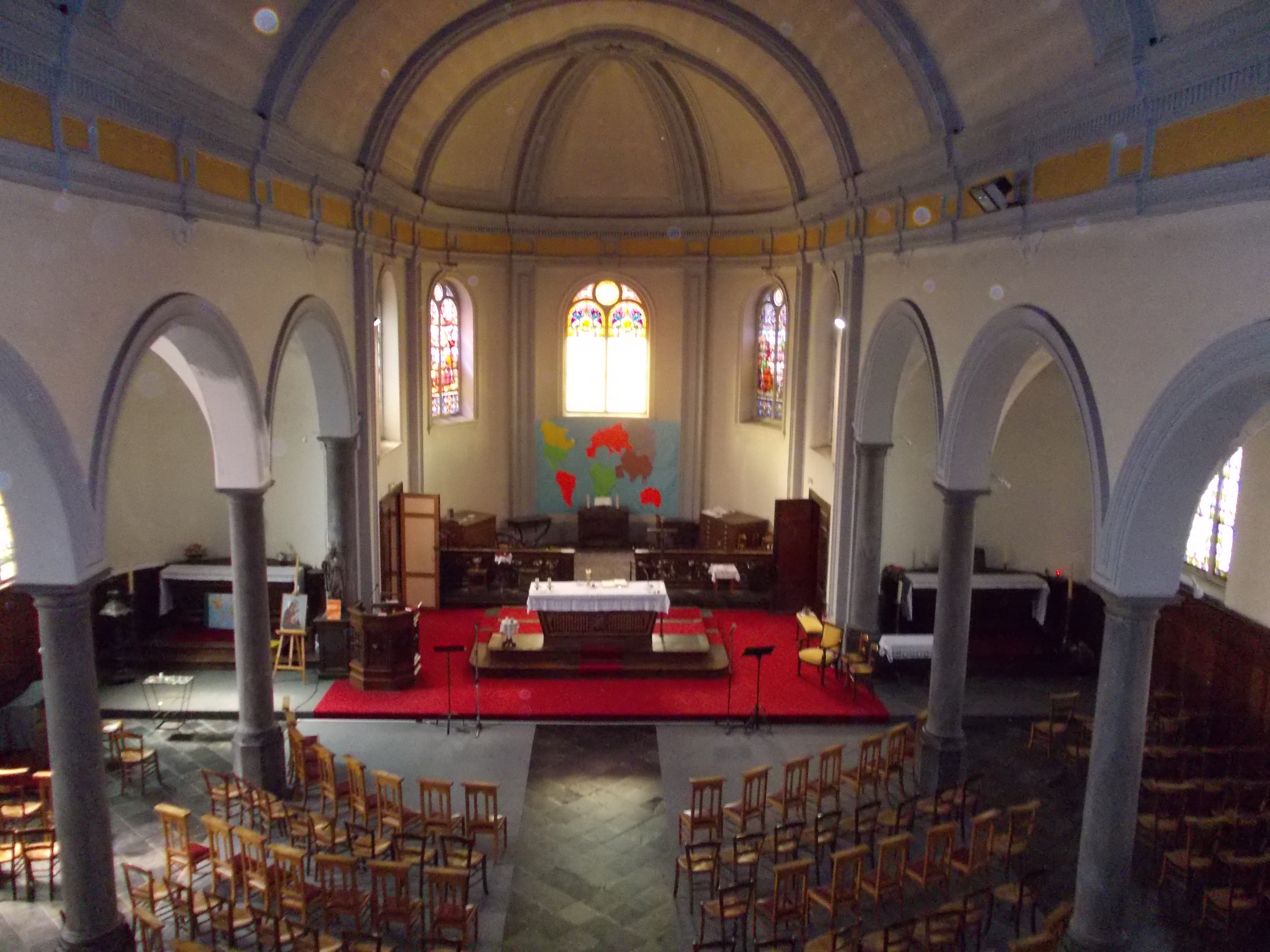
The most basic point is the meaning of the word ‘God”. In the Gospel of St John 1.1 the word ‘God’ is used in two senses, one of them, written in Greek as ‘ho theos’, refers to God the Father. The other written in Greek as ‘theos’, means ‘that which is divine’ in the fullest sense, of

the same nature. It refers to the identity of nature but not the identity of persons. Thus the Word, Jesus, is ‘theos’, he is not ‘ho theos’.

The difference between ‘ho theos’ and ‘theos’ is crucial to any understanding of Christianity. This difference is often ignored and has led to great confusion.

This distinction forms the essence of my presentation last year at ACU in a commentary on John 1.1-18.

Following on the well-known Hindu phrase, ‘only Siva can worship Siva’, we can say that only the one who is ‘theos’ can worship God adequately. Only ‘theos’ can know ‘ho theos’ fully. Only the worship of ‘ho theos’ by ‘theos’ is sufficient and fitting. Equally, ‘theos’ must be sacrificed to God. Only ‘theos’ can fully reveal God. The fullest submission is achieved only by ‘theos’. The fullest obedience to ‘ho theos’ is can be done only by one who is ‘theos’.

This has implications. It means that, if the human is to adequately worship God, the human must be divinised. The person who wishes to submit to God in the fullest way, who wishes to praise God and know God fully, must achieve divinisation ‘theosis’.

This ‘theosis’ is central to Christian understanding. It is achieved by Christian faith where the Christian becomes one with the Christ and therefore has the same being as Christ, and therefore is ‘theos’. This is the meaning of faith: we identify with the Christ.

When it comes to prayer, therefore, the Christian will seek to submit to ‘ho theos’ fully, for obedience is the first of the virtues. ‘At the head of the scroll it is written: “I have come to do your will’. In the Garden of Gethsemane Jesus prayers “thy will be done. In Hebrews the writer speaks of Jesus ‘learning to obey through suffering’.

The phrase ‘through Christ our Lord’ must not be understood geographically or in feudal terms when the servant could approach the master only through some higher person in the court. It means that we can come to God only through the fullness of revelation which is Christ Jesus.

The Christian and the Muslim will both in their prayer seek to submit themselves to ‘ho theos’. This is where they can join in prayer. The submission without words is the greatest submission for words are always a limitation.

It means also that the Christian is capable, because of Jesus Christ’s revelation, to submit most fully and most perfectly. The Christian does what the Muslim does but with, in and through Christ is able to do so completely.

The revelation given in Christianity, that is in the life and death and resurrection of Jesus, is the fullest revelation. It is the fullest revelation because it tackles the essential and fundamental question of life and death, being and non-being, which applies everywhere in the cosmos and is not tied to any particular culture.

But this superiority is not one of arrogance. It is done with humility, for we do not bring ourselves to this state. It is entirely the work of God. It shows that we are nothing. It involves taking up the cross, ‘becoming humbler yet’. The ego is completely removed.

We will submit to the grace in the Muslim as we submit to the person of ‘ho theos’. We submit to each other’s grace because we submit to the grace of God.

The words of our prayers are only the springboard to wordless prayer. We become Christ in his submission to God. We become truly Muslim.

Posted in Interfaith prayer, Interreligious dialogue, Melbourne, Multi-faith gatherings, Muslim Catholic relations, Muslim Christian relations | Leave a comment

Pilgrimages from Nazareth Parish in Melbourne to Nazareth and Jerusalem in Israel

Pilgrimages from Nazareth Parish in Melbourne to Nazareth and Jerusalem in Israel        2009-2013

‘Do not forget us’. This is the cry from the heart of Nariman when she came to visit us in May this year. The Christians in the Middle East are under great stress. In response to the frequent call by recent Popes to the whole Catholic Church, our parish in Melbourne has developed a fine relationship with the Parish of Nazareth in Israel. Four children with their parents and four teachers from our schools have gone to Nazareth and Jerusalem on pilgrimage, led by the Parish Priest, Fr John Dupuche. Children, their parents and teachers from Nazareth have also come here.

Here is a summary of some of the visits during 2012-2013, including the preparatory visits made from 2009-2011. Their blogs, listed, provide the detailed story.

Preparatory work  
2009 Dec. Private pilgrimage
  Mark and Johanna Shannon and their children Stephanie, Theresa and Jack take our greetings and gifts.
2011 Visit from parishioners of Nazareth to St Joseph’s school
Mr Farouk Laham and his wife Loris, who are the parents of Gosayna, the wife of Habib Karam who is a pastoral associate at the Catholic Parish in Nazareth, Israel, visit St Joseph’s school.
2011 Pilgrimage of the Knights of the Holy Sepulchre to the Holy Land
Peter Walsh, a Knight of the Holy Sepulchre, and his wife Deirdre meet with Habib Karam
2012 Jan Exploratory journey to Nazareth
  Sharon Selleck and Jess Brumby, teachers from Stella Maris visit Terra Santa school and are hosted by Mrs Samar Abu Nassar and her family.
2012 April Exploratory journey to Nazareth
Fr John Dupuche, Parish Priest of Nazareth in Melbourne, meets with Fr Amjad, Parish Priest of Nazareth in Israel, and Habib Karam, Mrs Lubna Andrea, Principal of Terra Santa Elementary School, and Samar Abu Nassar and their families.
2012 July Visit from Nazareth to Melbourne
  Samar Abu Nassar and Rozan Isbanyoli, teachers from Terra Santa, come to Stella Maris for two weeks. They are hosted by Sharon Selleck and Jess Brumby.
Visits between
Nazareth, Israel, and
Parish of Nazareth,
Ricketts Point,
Melbourne
2012, September, Pilgrimage to Nazareth and Jerusalem


Children and parents from our Parish
Rhys Bennet and his mother Monique
Tom Skehan and his mother Janine Simpson/Skehan
Jack Nugent and his mother Charmaine
Nick Lambert and his mother Wendy
http://walkinginfootsteps.blogspot.com.au/2012/09/preparation_15.html
Their hosts in Nazareth
Kamil Lulu and his wife Samira
Amer Hakim and his wife Nariman (teacher) and their son Rawad
Imad Karam and his wife
Amira
Amir & Rana Qupty
& their children
George 14, Clara 12, Maria 10, Yousef 6
Teachers from our Parish
Rob Horwood
Josie Ritchie (Fischer)
Liz Martell
Seana Hunt
Their hosts in Nazareth
Mr Zaher Kardosh and his wife Sahair (and daughter Areej, (17 years), sons Assad (15) and Amjad (10)
Mr Ilya Abu Nassar and his Samar and their children Carina and Yasmina. Mrs Abu Nasser, mother of Ilya was also our hostess.
2013,
August,
Visit from Nazareth to our schools and parish in Melbourne
Mr Kamil Lulu and his wife Samira and their son Hanna
Mrs Nariman Hakim (teacher) and her son Rawad
Mr Imad Karam and his wife Amira and their daughter
Tamar
Mrs Rana Qupty (teacher) and her daughter Clara
Their hosts in Melbourne
the Bennet’s
the Skehan’s
the Nugent’s
the Lambert’s
2013, September Pilgrimage to Nazareth and Jerusalem
Children and parents from our Parish
Liam Collins and his mother
Pia Di Paolo/Collins
http://alinisrael2013.wordpress.com/
Alexandra (Ally) Kerr and her mother Sara
http://alinisrael2013.wordpress.com/
Anneka Davys and her father Paul
http://nazarethprogram.global2.vic.edu.au
Jack Laragy and his mother Anne Maree Pollard/Laragy
Their hosts in Nazareth
Mr Fuad Abu Nassar and his wife Jaclyn and their son Lewis (6th grade) and their daughter 13 (aged years)
Mr Anees Kaloush and his wife Amal and their daughter Grace (5th grade) and their son (aged 20) and daughter (aged 23)
Mr Rabea Ka’war and his wife Tagreed and their daughter Amal (5th grade) and sons Fadi (aged 15) and Jamal (aged 16)
Mr Rony Balan and his wife Rana and their son Fadi (6th grade) and son, Fahim (aged 15).
Teachers from our Parish
Vince Spano
Gene Trutsch
Vicki Curtain
Their hosts in Nazareth
Hosted by
John Ksheboun and his family
Hosted by John Ksheboun and his family
Hosted by
Mr Elie Abu Nassar and his wife Samar and their two girls, Carina and Yasmina
2014
Visit from Nazareth to our schools and parish in Melbourne
Scheduled for July
2014
Pilgrimage to Nazareth and Jerusalem
Scheduled for September

The Pilgrimage to Nazareth and Jerusalem in 2013 – the first was in 2012 – was a great success. It was not a pilgrimage where devout pilgrims visit a sacred place but ignore the local Christians. The parishioners in Nazareth welcomed us into their homes. Their hospitality is legendary. We ate and talked with them, met their extended family. We heard of their hopes and learned of the pressures that surround them. It was an immersion into Arabic culture, since the host families are Israeli by nationality, Arabic by culture, and Christian by religion. We felt part of their lives. We felt we belonged. We had made friends.

We learned a lot from them, in particular how much they valued family life; how much they valued their faith to which they must give courageous witness every day.

Our children and their parents

Our four children, Alexandra (Ally) Kerr, Liam Collins, Jack Laragy and Anneka Davys, a boy and a girl each from Stella and St Joseph’s schools, were perfect. It was deeply moving to see the four of them kneeling in prayer within the very tomb of the Resurrection; or again to see them quietly seated in front of the grotto where the Archangel Gabriel announced to Mary that she would bear her Child. They did not seem to want to leave. Or again, on the Saturday evening when some thousand people walked in procession with lighted candles while Liam recited a decade of the rosary and Anneka announced the various Mysteries, both children with clear and perfectly paced voices. It was wonderful. So many memories keep flooding. When we sang Silent Night in the Shepherds’ Field, Jack commented perceptively that the reason the shepherds were overjoyed to have seen the Christ Child was because they realised that He wanted to be one of them. Or when Ally, one evening as we walked through the Old City when all the tourists had gone, said that she found it so much easier to pray in Jerusalem because so many other people had come there to pray.

The children and their parents and our teachers visited the sacred sites in Nazareth and in Galilee, Cana, Mt Tabor, Capernaum, and the Sea of Galilee etc. etc. They felt very secure at every step in the journey.

The parents, Paul Davys, Sara Kerr, Anne-Maree Pollard/Laragy and Pia Di Paolo/Collins were great company. As we visited the sacred sites – the Holy Sepulchre, the Cenacle, the Garden of Gethsemane, the Mount of Olives, the Pater Noster church, Bethlehem, the site of the Baptism, the Dome of the Rock, the Western Wall etc. etc. and read the Biblical texts associated with those places – their comments and observations were illuminating. We celebrated Mass together in the Crusader Chapel in the Holy Sepulchre. And in the evening, on the roof of Notre Dame Hotel – perfectly situated just across the road from the Old City – we engaged in discussions that were far reaching. They all enjoyed their time in Nazareth, in the school teaching English to the high school children, engaging them in conversation, teaching about Australia, and so on.

Our teachers

The teachers, Gene Trutsch and Vince Spano and Vicki Curtain were in their element teaching in Terra Santa school. But one thing became clear: the difference in teaching conditions. This is a result of the difficulties faced by Christians. They were still using textbooks; few computers; no white boards; children seated in desks; no lockers; few writing materials. Each of our two schools raised $1500 towards assistance with much needed renovations in Terra Santa school. Nevertheless, the experience of teaching both at primary and secondary levels was delightful. The Nazareth children were responsive and lively, interested and polite. Some teaching had to be done through translation, which meant avoiding colloquialisms, slowing the pace, using complete sentences and so on. Our teachers had prepared PowerPoints which came in handy. Our parents also taught, as did our own children. While there were vast differences in culture, it soon became apparent that kids round the world are all the same.

In Jerusalem, we were able to celebrate Mass together in the very Tomb itself, just the four of us: the Liturgy of the Word in the antechamber of the Tomb and the Liturgy of the Eucharist in the Tomb itself. It was an extraordinary privilege, very unusual. We read the account of the Passion on Calvary itself. We were able to enter into the spirit of the places we visited, pausing in prayer, going at our own pace. We said the Hail Mary where tradition says Mary was born; we recited the Our Father in the cave where Jesus taught his disciples how to pray, and where the Our Father is inscribed in hundreds of languages on the walls of the church, the most translated text in human history. We visited the magnificent Dome of the Rock. We also visited Herod’s Palaces at Masada and the Herodium; we bathed in the Dead Sea, and prayed at the Western Wall, the most sacred site in Judaism.

One of the teachers put it this way: It was an opportunity to revisit the events of the Old and New Testaments as an adult free from the limiting influences and impressions of childhood. We could realise that the Biblical stories are not invented by Walt Disney or lots of old people. They can be touched, smelt, and breathed in the air. We walked on the stones, and followed in the footsteps of Jesus. We heard of the humanity and fallibility of Mary and Joseph and the Apostles with the result that their journey was all the more inspiring and believable. This process of revising one’s faiths and belief is invaluable. But it takes time to absorb all that has happened and to process it. If our faith is more mature then we can influence others better.

Visit from Nazareth in Israel to Nazareth Parish in Melbourne

The relationship is mutual. In August 2013 we hosted children and parents from Nazareth. They saw many things: Sovereign Hill, the Dandenongs, South Bank, a football match at the MCG, Healesville Wildlife Sanctuary and so on …. They visited Nazareth College, Noble Park North, and Star of the Sea, Gardenvale. They spoke to our children in the class rooms and their own children spoke about life in Nazareth and in turn prepared presentations for their classmates back at Terra Santa school about life in Melbourne. They offered a beautiful mother of pearl cross from Abouna Amjad, the Parish Priest of Nazareth. They attended the BBQ put on by the parish pastoral council and a dinner at the Grealish’s who first started the ball rolling in this venture. And much more.

Our visit to the people of Nazareth and their return visit to our parish have been a source of great encouragement for them and has enriched us immensely. There is a sense of excitement in the parish and in the school. Some sixty people have already been directly involved in this project, as hosts, as pilgrims and as visitors.

Fr Amjad, the Parish Priest of Nazareth, told his parishioners at Sunday Mass on 29 September, 2013, while we were there, about our interchange. So our parish and schools in Melbourne are known to the parishioners of Nazareth, our namesake. They know they are not forgotten.

The benefits for teachers and students;

  • Reaffirmation of faith. A true life changing experience and a sense of peacvrfulness.
  • To be a witness to the plight of Christians in Nazareth.
  • To be an ambassador in helping Terra Santa School and the wider community financially and spiritually – they know we care.
  • Understanding the teaching curriculum and pedagogy in Israel through teaching in the classrooms.
  • Deeper undemanding of the conflict issues in Nazareth/Israel.
  • History and geography of the Hoy Sites brings our teaching to clarity and more relevance because we can visualise where events took place.
  • Reflecting on the Gospel passages within the context of their physical surroundings.
  • A deeper sense of prayer, wonder and aware of the life of Jesus.
  • Imbibing the Arab culture by staying in local families’ homes
  • An opportunity to share our blogs with others and experience the cultural differences and similarities of the school children.
  • Enriching the classroom discussions about Scripture and events of Jesus’ life.

The costs of the Parish Pilgrimage to Nazareth and Jerusalem:

  • The Parish paid half the air fares and land travel etc. of the 4 children; these costs were under the category of ‘Nazareth Scholarships’.
  • The Parish also paid half the air fares and land travel of 4 teachers; these costs were also under the category of ‘Nazareth Scholarships’;
  • The Parish paid the air fares and land arrangements of the ‘leader; of the pilgrimage, the parish priest, Fr John Dupuche.
  • Those funds come from the Stewardship Program and the special collections taken up at Christmas and Easter.
  • The Parish also assists in financing the trip of our guests from Nazareth.
  • The P&F from St Joseph’s paid half the air fares of 2 of the children.
  • The P&F of Stella Maris paid half the air fares of 2 of the children; the moneys for this purpose were raised by extra fund raising activities.
  • The parents paid for their own air fares and land travel arrangements.
  • The host families paid for all meals etc. and provided accommodation.
Posted in John Dupuche | Leave a comment

Year B, Index

SON, hope, priest

INCARNATION

Preparation

The purposes of God

B, Advent 1                            Jesus returns

B, Advent 1                            Jesus is Lord

Prolegomena of the Incarnation

B, Advent 2                            Christ and the Angels

B, Advent 2                            Jesus the Messiah

B, Advent 3                            John recognizes Jesus

B, Advent 3                            John and Jesus

Impetus to the Incarnation

B, Advent 4                            “The … Spirit will … cover you.”

B, Advent 4                            Mary the Virgin

Realisation

Incarnation

B, Christmas, Midnight      “For us”

B, Christmas, Dawn             “For our salvation”

B, Christmas, Day                 Jesus’ consciousness

B, The Holy Family                Old Simeon and Anna

B, The Holy Family                Jesus the adolescent

Role of Mary

B, Mary, Mother of God        Mary the Woman

B, Mary, Mother of God        Mary, Mother of God

Manifestation

B, Epiphany                           Atheism

B, Epiphany                           The Temple


SACRIFICE

Sin

B, Lent 1                                          The First Adam

B, Lent 1                                          The Antichrist

Glory

B, Lent 2                                          Jesus the Man

B, Lent 2                                         Jesus the Lamb

Redemption

B, Lent 3                                         Jesus exorcises

B, Lent 3                                         Jesus restores

B, Lent 4                                          Jesus regenerates

B, Lent 4                                          Jesus redeems

The impetus to the Passion

B, Lent 5                                          Jesus’ compassion

B, Lent 5                                          Jesus’ sacrifice

The Centre of Time

B, Passion Sunday                          The cross

B, Passion Sunday                          The clothing

B, Holy Thursday                           The blood

B, Good Friday                                The thirst

B, Easter Vigil                                 One body in Christ


EXALTATION

Acts of the Risen Christ

In signs

B, Easter Sunday                  Jesus, victorious

B, Easter Sunday                  The empty tomb

In appearances

B, Easter 2                             Jesus descends into hell

B, Easter 2                             Jesus, the victim

In Church

B, Easter 3                             Witness

B, Easter 3                             Theology

Recapitulation

B, Easter 4                             Jesus, the martyr

B, Easter 4                             Jesus, the oblation

The Vine

B, Easter 5                             Solidarity

B, Easter 5                             Recreation

B, Easter 6                             Friendship

B, Easter 6                             Fidelity

Intercession

B, Ascension                          Jesus withdraws

B, Ascension                          Jesus abides

Fullness

B, Pentecost                          Wisdom

B, Pentecost                           Charisms


FOUNDATIONS

B, Trinity Sunday                  The Begetting

B, Trinity Sunday                   The Sonship of Jesus

B, Corpus Christi                    “Do this in memory of me”

B, Corpus Christi                      maranatha, ‘Come Lord Jesus’


THE KINGDOM OF GOD

Theophany

B, Baptism of the Lord            The Gospel

B, Baptism of the Lord             Jesus empties himself

A1      Son of Man in his body

B, Sunday 2                                    The attractiveness of Jesus

B, Sunday 2                                    Jesus manifests himself

B, Sunday 3                                    Intimacy

B, Sunday 3                                    Champion

B, Sunday 4                                    Jesus speaks with authority

B, Sunday 4                                    Jesus casts out the demons

B, Sunday 5                                    Jesus cures the sick

B, Sunday 5                                    Jesus’ popularity

B1.1    Healing the body

B, Sunday 6                                    Jesus cures with a touch

B, Sunday 6                                    Clean and unclean

B, Sunday 7                                    Jesus heals body, mind, spirit

B, Sunday 7                                    Jesus heals by using the illness

B1.2    The embodiment of institutions

B, Sunday 8                                    Food

B, Sunday 8                                    Pleasure

B, Sunday 9                                    Activity

B, Sunday 9                                    Civil law

B, Sunday 10                                  Accusation

B, Sunday 10                                  Possession

C1      The Body of Christ

B, Sunday 11                                  Gestation

B, Sunday 11                                  Natural

B, Sunday 12                                  Jesus is the prototype

B, Sunday 12                                  Jesus contains all

B, Sunday 13                                  Jesus is medicine

B, Sunday 13                                  Encouragement

B, Sunday 14                                  Jesus is transcendent

B, Sunday 14                                  Jesus is sacred

B, Sunday 15                                  Jesus’ body: the Church

B, Sunday 15                                  Communities of the Word

B, Sunday 16                                  Exaltation

B, Sunday 16                                  Transformation

C2         The Eucharistic Body of Christ

B, Sunday 17                                  Banquet                                

B, Sunday 17                                  Consecration                        

B, Sunday 18                                  Gift

B, Sunday 18                                  Thanksgiving

B, Sunday 19                                  Real Presence

B, Sunday 19                                  Offering

B, Sunday 20                                  Fruit

B, Sunday 20                                  Communion

B, Sunday 21                                  Community

B, Sunday 21                                  Different points of view

B2.1    Healing the mind

B, Sunday 22                                  Unclean

B, Sunday 22                                  Guilt

B, Sunday 23                                  Insane

B, Sunday 23                                  Retarded

X1        Foundations of morality        

B, Sunday 24                                  Commitment

B, Sunday 24                                  Fear

B2.2      The body produces world to come

B, Sunday 25                                  Foetus

B, Sunday 25                                  Children

B, Sunday 26                                  Chastity

B, Sunday 26                                  Family planning

B, Sunday 27                                  Marriage

B, Sunday 27                                  Indissolubility

B, Sunday 28                                  Youth

B, Sunday 28                                  Maturation

X2      Foundations of morality

B, Sunday 29                                  Service

B, Sunday 29                                  Excellence

B, Sunday 30                                  Conscience

B, Sunday 30                                  Formation

B, Sunday 31                                  Norms

B, Sunday 31                                  Teleology

A2         Eschaton: One Body

B, Sunday 32                                  Survival

B, Sunday 32                                  Presumption

B, Sunday 33                                  Anointing

B, Sunday 33                                  Age

B, Christ the King                         Jesus the Judge

B, Christ the King                         Resurrection


Posted in Uncategorized | Leave a comment

Year B

B, Advent 1                                              Jesus returns                                           

          “The master of the house is coming.”       Mk 13:35

Come back! You had already come once in time, bringing joy, revealing depths we had not imagined, and bringing us to selves we had not known. Come again and again! Come in, come further and further in, not just to the villages of Galilee, but into the heart, into the depths of the spirit and deeper still, for there is no limit to your returning, and nothing can hold you back.

Then we shall become who we are, and indeed become your very self. You will return to us as we turn into you. We turn to each other as you return in us.

You turned to us in compassion and returned to the heavens. You came in the weakness of flesh and will return in the glory of the spirit. Return to us now, and let us go back with you to the beginning, where all is present in the eternal Presence. Come back to us so that we can draw close to each other.

In the interplay of absence and presence, of leaving and returning, in a constant vibration of departure and arrival, we hunger ever more for your return. Yours is a constant visitation. Yours is the eternal return. This is the divine purpose: delight leading to the cry of greater delight, “Come again, bringing us joy upon joy”.

B, Advent 1                                             Jesus is Lord                                            

“The Master of the house…”             Mk 13:35

All things come from you, and to the you all are destined. You hold all beings together and you fulfill their every purpose. All emanates spontaneously from you, and you rejoice in the outpouring. In your lordship you projects your love, and in the full confidence of your lordship you surrender to this love. There is neither barrier nor dominance. All is accomplished without effort, and with complete mastery. Nothing is foreign, nothing alien. Looking out at the world, all is seen as the expression of your inner self; looking inwards to your heart, all is seen as already present in potentiality. The inner and the outer are the one.

The immense variety is your bride. “The whole world is his śaktis.” Every truth is an aspect of your truth. In the universal Lord the differing views are not in opposition: they are the varied radiance of your one light. They are recognized as your own. Their truth is a revelation of your truth. You are their Lord not by wielding power over them but because you recognize himself in them. You decline all power and therefore all power comes to you. You are the truest Hindu among Hindus, the truest Muslim among Muslims. So you revere them as your own truth.

So there is no ‘this or that’, no ‘mine or yours’. There is neither subject nor object; all is the Self. All are gathered into you, the Christ, who hold all together. Whatever is not identified with you fragments. All are subject to you who in turn are subject to the One, so that there is only one ‘I am’.

When all have become as you are, Lord, then at last you will truly be Lord.

B, Advent 2                                              Christ and the Angels                            

          “I am going to send my messenger before you.”                  Mk 1.2

Countless species and particles, the futurables and possibles: they amaze us in their variety. They are messengers, surrounding us, teaching us, revealing the divine, and bringing salvation.

There are also other orders of being: ‘angels’ and ‘archangels’, ‘cherubim’ and ‘seraphim’. They are persons, manifesting the Person of God. They are forms of the Word, announcing the Word. They are energies of the Spirit, for the Spirit gives rise to spirits, in a broadening radiance, sparks from the divine furnace. From out the incandescent stillness, Spirit and the attendant spirits radiate, powerful as fire, messengers of God, obedient to the Heart and revealing the Heart.        

Yet the Christ is greater than all the orders of angels, for he has been brought lower than them all. (cf. Heb 2.9) Incarnate in the vulnerability of flesh, he has experienced the extremes of good and evil, the heights and the depths; and therefore he surpasses them. What they do partially he does completely. The angels gathered at his birth but he breathes the Spirit from the cross. The seraphim cry out “Holy, Holy, Holy”, but he sacrifices himself, making all holy. The angels are messengers but he is the Word.

B, Advent 2                                             Jesus the Messiah                       

          “The Good News about Jesus Christ”        Mk 1:1

The Jewish people had trembled at the sound of the invading Roman armies; they had groaned at the corruption of the High Priests. They also looked back to the glories of the past and trusted in the promises of the future. They hoped for a “prophet like Moses” (cf. Dt 18.15) who would lead them out of slavery; an “angel” (Ex 23.20) who would guide them to the Promised Land; a “Son of David”, who would set them free. At last John the Baptist comes, heralding the one whose sandals he is not worthy to untie.

The true Messiah would indeed free his people from darkness and reveal the unseen God. He would take away guilt and death. He would establish the kingdom of justice and peace. He would enable each to realize their own selves. He would save their every thought and action, their strength and their weakness. He would stand by everyone, in their glory as in their humiliation. He would love them as God had loved. Such would be the true Messiah. Any other would be a fake.

Hope is the anticipation of what is promised. It is the expectation of what is not yet real. It is the possession even now of what will come. Hope is the presumption of one’s future self. What was there about the Good News that promised a future beyond land and religion, a hope beyond hope? The rest of the Gospel will tell.

B, Advent 3                                              John recognizes Jesus   

“He came … as a witness to speak for the light”                  Jn 1:7

Jesus walks along the Jordan. John the Baptist sees him, recognizes him and cries out, “There is the Lamb of God”. He recognizes him because he has already known him. The Word had already come to John in the desert. Indeed, the Word had come to him in Mary’s voice, when the young virgin with child greeted the crone with child, her cousin Elisabeth. As Mary called out, the Word was carried by her voice and came to John who leapt with joy.

John had been true to the Torah such as no one had been, for he is the true pattern of righteousness. He is not the Word but is true to the Word. He is the manifestation of the one Word through whom all things are made. He is the perfect expression the Word, so that the Word is his very being, his very essence. He now realizes that he himself is the sound of the Word. He knows himself as the essentially inhabited by the Word, and he is intensely glad.

John had known from within, but now he sees from without. He is now able to declare in clear language what he had already known in an unformed way. The acclamation ‘This is the Lamb of God’ comes easily to his lips.

The heart leaps at the moment of discovery. The recognition is the renewal of a cognition. It is the acknowledgment that what is seen outside already exists within. It is the revelation of depths hitherto unseen. The outer is a reminder of the inner. What is seen externally is the realization in time of what has been known obscurely.

Thus Jesus comes to John not as to a stranger but as to someone in whose heart he already dwells. He is welcomed to where he has always lived. The experience in John’s soul is the forecast of what he sees in the flesh. Jesus is the Word in John.

B, Advent 3                                              John and Jesus                                         

“He was not the light, only a witness to speak for the light.”         Jn 1:8

John had known the Light from the beginning when, in the darkness of his mother’s womb, he leapt with joy at the presence of the Saviour. From his earliest youth he had observed the Torah without the shadow of doubt and without the stain of sin.

He has secretly known the eternal Light and therefore he gives witness publicly: “There is the Lamb of God”. He had known the Word in the heart and now he proclaims the Word in the flesh.

John recognizes Jesus. He does not appoint, for he has no authority over the one to whom all authority is given, but he does recognize.

Jesus for his part justifies John and shows that John’s deepest experience is authentic, that his knowledge is true. Jesus’ admiration for John is unbounded: John is ‘the greatest man ever born of woman’ (Mt 11.11), the ‘Elijah’ (Mt 11.14), the ‘bridegroom’s attendant’ (Jn 3.29).

John has the mind of his Master, but must he always remain on the outside, excluded from the kingdom? John is happy for the bridegroom, but can he never know the bridegroom’s joy? He knows the Word, but can he never be the Word. Is he a witness to the Light but never the Light, an adopted son but never true Son? Does his proclamation of Jesus mean the denigration of himself?

But the true Light makes all Light; the Word makes all Word. Jesus and John are two but not dual. Only like can know like. The same proclaims the same. The self is known by the self. John is the expression of Jesus; in John Jesus finds his place. John and Jesus recognize themselves in each other.

B, Advent 4                                              “The … Spirit will… cover you.”          

“The Holy Spirit will come upon you …. The power of the Most High will cover you with its shadow”              Lk 1:35

The Spirit is opportunity and receptivity, hearing and evocation. The Spirit enables the Word to be Word. The Spirit makes the Word effective. The Spirit indeed is the purpose of the Trinity. The Spirit is God.

She to whom the Spirit comes is “most highly favoured”, for she is completely graced and identified with the Spirit. Where Mary is, there is the Spirit. The two are not dual but one. To see her is to see the energy and the transcendence, the determination and the attraction of the Spirit.

Mary is the image of the Spirit. She accepts to be overshadowed by the Spirit and by none other; she refuses to be the mother of the ‘Son of David’ except by the Power of the Most High.

The Word wishes to speak the message of love; to Mary in the first place and then to all mankind. She is the foremost recipient of the Gospel. As the power of the Spirit she brings the Word to the earth. At Bethlehem she utters the Word into the world.

B, Advent 4                                              Mary the Virgin               

          “The angel Gabriel was sent … to a virgin”       Lk 1:27

You appear suddenly in the narrative, Mary, without explanation. You would seem to be a person of no consequence but your weakness is your strength. You are without presumption or prejudice, without distortion of mind or heart. You belong to no one, and therefore you are available to all. You are approachable and welcoming, receptive and clear. From start to finish you are virginal; you is void. You upset all plans and deconstruct all ideas. Neither passive nor compliant, you are compelling. Therefore you are irresistible. You are the Kālī.

At first you refuse the angel’s proposal. You know love from the moment of your conception and will accept nothing less than the fullest expression of love. You wait till the angel announces the fullness of the gift: ‘that the Holy Spirit will overshadow you’. Heaven cannot resist the expectancy of your faith. Therefore you become expectant with child.

At Nazareth, you evoke the Word till it becomes flesh in you. Assumed into heaven you give eternal birth to the Church from your glorified flesh. No one can resist the your virginal transforming power.

B, Christmas, Midnight                         “For us”                            

          “For us …”            Nicene Creed

You come as The Child for us and not for yourself; for us and not as some vengeful deity against us; for us, and not out of private ambition; for us and not out of necessity. Your coming is pure grace. For our sakes you join us and stay with us as the centre of the wheeling universe. You come for us, and for the sake of the One who sent you.

You, the Word of God, are addressed to human beings, and can best speak to humans by taking on human flesh, speaking as flesh to flesh; speaking to those in distress by being in distress, to those in joy by knowing joy. The whole of humanity must be experienced in yourself if you are to speak to all humanity.

So, freely and without condescension, you descend and take on limitation. You will seem to be one of many although all things are of you. You will seem to be limited although all is your very self. You who fill the universe become limited at Bethlehem. In the stable the Light becomes dark. It is the obscuration.

Your descent is not failure but triumph. Indeed, the concealment is revelation, for it shows the compassion, the delight that you, the Word, take in all the variety of the world. You delight to do “things improbable and impossible”. As Word you go through all the stages of the Word, choosing to be expressed in a Jewish way and in Roman times, you, Jesus, the Child of Bethlehem, limited and fragile yet containing all in yourself.

You love those who are your very self. In loving us you loves yourself. Out of love for your self you take others to yourself; and later you will teach your disciples to love others as they love themselves.

When at last the listeners have heard the Word and become the Word, they will do the same, identifying with the least and delighting in the weak as in themselves, and so reveal the Word they have become. This is their salvation: to be the Word ‘for others’.

B, Christmas, Dawn                              “For our salvation”        

          “They found … the baby lying in the manger.”                    Lk 2:16

From the outset, before even he is born in the stable, Jesus comes to save. His whole being is orientated to this; the fetus in the womb develops according to this: “our salvation”. As his limbs develop and his mind forms, it is always with salvation at the goal. He cannot, will not, be otherwise. He does not become a saviour. He is saviour from the start.

Jesus comes among the ‘walking wounded’ and the ‘living dead’, those who live and partly live, the disappointed and the dissipated, even the successful and the self-appointed saviours, for all need salvation. All need to be freed from inadequacy and superficiality, from transience and the consequences of sin.

He comes among them, seeing them as himself, and making them see him as their real self. He enables them to look upon the world and see it as their domain, their body, their very being. Seeing the Saviour who saves them, they become saviour and save themselves.

He comes to set people ‘free from’ but also ‘free for’, in order that all humans might come to power and be able to exercise all authority in heaven and on earth. Knowing the saving Word they become the saving Word. Their every word becomes a saving mantra; their every act becomes a saving ritual. They too can say that they live “for our salvation”.

When salvation is complete, the old divisions disappear. Heaven is earth, God is man, nature is grace, time is eternity, profane is sacred; death and life are one. All is one and God is all in all. Who, then, is the saviour, who is saved, what is salvation? All is one. All is grace.

B, Christmas, Day                                  Jesus’ consciousness

“It is the Only Son, who is nearest to the Father’s heart, who has made him known.”            Jn 1:18

You, the Child, lie in the manger, knowing nothing and yet knowing everything. You know all since you are the Word in whom all things are made; you know nothing since you are made flesh. Your consciousness is total and is nil. You are not conscious of this or that, as you lie asleep in the manger, yet you are conscious of all. All is latent, all is present.

You begin to learn even as you begin to live in the womb and come into the world. Since you are without sin, your vision is untroubled, clear, direct, without fear, without ambition, without desire. With the lucidity, which comes from power, you see truly. With the mind of God you see as God sees. Free from craving, you are united with what you see, not apart nor opposed.

You experience pain and pleasure and you respond with clarity and calm, with stillness and vigour. Your sensitivity is complete, without callousness, or violence. You become what you see, and what you see becomes who you are, for your look is transformative.

Yet you know the confusion of ignorance and the uncertainty of every life, as your mind struggles to understand. Ignorance disturbs you. You will know the agony of indecision, “What shall I say?” (Jn 12:27)

When you have experienced the worst of death you will come to completeness of knowledge. Your human consciousness will be fully inhabited by divine Consciousness. Your consciousness will be fully expansive once you love has been completely manifested. You heart reveals the Father’s Heart.

B, The Holy Family                               Old Simeon and Anna

          “You can let your servant go in peace …”          Lk 2:29

Simeon has left aside the questing days of youth. He has gone beyond the satisfaction and dissatisfaction of work. He has taken into his aged arms the hope of his life and of his people. He has seen the “light of all nations” and “the glory of Israel”. Neither death nor life can affect him. He is fulfilled. He can now “go in peace” for he has come into the possession of his truth.

Anna, the old woman, the prophetess, sees the child and cannot stop speaking of him to all who come to the Temple. She has seen its dearest Child, her cherished Lord.

There is a time to be young and a time to be old, a time for searching and a time for discovery, a time for dark hair and for grey, for vitality and tiredness, a time for uncertainty and a time for wisdom.

The value of age is to look back on life and to understand, to put aside the mistakes and to acknowledge the achievements. It is a time of assessment, a time to say: this is my life, this is my truth, this is my defining grace. Despite the weakness and the incompletion, this is who I am, my glory, my share in the one Light, my destiny, my fulfillment which neither life nor death can take away, this is my gate into eternity. To this I assent with all my heart and I rejoice forever.

B, The Holy Family                                Jesus the adolescent

“Meanwhile the child grew to maturity, and he was filled with wisdom; and God’s favour was with him.”               Lk 2:52.

Jesus is taken to Nazareth. Little is known about his life there. Had Joseph married before? Were there siblings from a first marriage? Did Jesus grow up with other boys and girls in the house who were effectively his brothers and sisters? Did he quarrel with them and fight as is normal for all children as they form their character? Did he have childish fancies. How did he learn that the world is real and does not obey a child’s every whim? When did he begin to leave his mother’s side and explore the lanes and fields of Nazareth? When did he begin to learn his trade as a carpenter under Joseph’s tutelage? For he was like us in all things but sin. When did he first feel the stirrings of sexuality? When did the girls suddenly begin to look attractive? Did they throw him side-glances as he started to develop his manly features? Did he have the dreams of love? What did people think when he refused the proposals of the matchmakers? He was refusing to fulfill one of his most solemn duties: to provide offspring for Abraham. Did they begun to think him odd or selfish? Did the villagers become angry with him for refusing their daughters? Did his young companions poke fun at him? Jesus was giving his first sign: born of the virgin he would remain a virgin. His celibacy was scandalous in his time as it is today.

But he was no ‘shrinking violet’. If Jacob had twelve sons by the power of the flesh, Jesus would create twelve disciples by the power of his word. If the people of Israel descends physically from Jacob, the countless millions of the Church are formed by the speech that come from Jesus’ mouth. He will reveal his inmost secrets and bare his soul. He will give his very body as food and pour out his blood, body to body, body making body, blood giving life, blood making us one blood.

B, Mary, Mother of God                        Mary the Woman 

“The shepherds hurried away to Bethlehem and found Mary and Joseph, and the baby lying in the manger…”      Lk 2:16

You are the Woman; you are “blessed among all women”. You are virgin and mother. You are the fullness of womanhood, the essence of femininity. You are Mother of God and Mother of the Church. You are the bearer of the future, and the goal of humanity.

You are virgin and at first you refuse the message of the angel since he has so far failed to guarantee that your virginity will remain. Your virginity puts all things in question. Eve plucked the fruit of the Tree of Life, but you want the supreme fruit to dwell in you.

You are wife to Joseph, as woman to man, without ceasing to be virgin. You are faithful to our virginity and so can be woman for every man.

You give birth and impart your character to the Word made flesh. His first human experiences are with you, in your womb, in your birth canal, and at your breast.

Assumed into heaven, you attract all to yourself, drawing out the best in every human being, transforming all creation.

Queen of Heaven, you turn earth into heaven. To see you smile is to know the beatific vision. In contemplating you, all are taken into the ultimate mystery and are born at last.

B, Mary, Mother of God                        Mary, Mother of God      

          “The shepherds hurried away to Bethlehem and found Mary…”  Lk 2:16

From the beginning of your existence you are free, Mary, you are lucid, untrammeled and virginal. Therefore you can summon heaven to earth. Who could resist you? As the Virgin you can give birth to God.

How can creature give rise to the Creator? Yet the paradox is intended. You show that God is God indeed, “doing what is improbable and impossible”.

And your work continues. You are mother of the Word in time and mother of the world to come. You refashion the future in the image of the one whom the shepherds came to see.

By divine grace our own minds become virginal, unattached. They are not tied to ‘this or that’ but universal, embracing all that is, both heaven and earth, “keeping all these things in [the] heart”, all times and seasons, in the self which places no obstacle, available, expansive, and welcoming.

You, who give birth to the God-man, give birth to the man-God.

B, Epiphany                                             Atheism                                        

 “Where is the infant king of the Jews? We have come to do him homage.” Mt 2:2

The endless march of evil and the interminable suffering of the innocent – how can a loving God permit such things? Either he is powerless or he does not love. In either case he is not God.

And again, we breathe more easily when there is no father figure, no dominating super-ego. How can humans reach maturity if there is a God who excels them and dominates, commands and punishes?

Atheists purify our minds of false gods and false ideas about God. The God, who is rejected, is not the God of the Gospel but an invention of the mind. They challenge and question. Thank God for them.

Others again may choose atheism because their hearts have grown coarse with worry and ambition. The consumerist society cannot be bothered with divinity.

Yet, in the experience of wonder Someone is perceived who transcends this world. In moments of liberation there is a sense of an infinite Power. In the intimacy of love, lovers the Lover from whom their love derives.

Proofs of the mind are not needed when experience convinces. Moments of wonder are occasions of grace, outside our control.

The Magi forget their star when they see the Child and his Mother. What was there about this archetypal image that persuaded them to open their treasures and their heart? They give gifts in tribute: gold to the King, incense to the God, myrrh to the Victim.

B, Epiphany                                             The Temple                                 

          “… going into the house they saw the child with his mother Mary.”  Mt 2:11

The magi come to Jerusalem, but they do not stay. They turn their backs on the Holy City and go in search of the Child. To him they offer their gifts, placed not on the altar but at the feet the newborn King and his Mother. Here is the true Temple. The subject nations used to bring their gifts to the Great King at Persepolis; now, in the Magi, all the races of the earth pay tribute to the Child. For in him, the divine is fully present.

The Child has come. There is no need for temples. The Temple is found in everyone to whom the presence of God has been revealed. The meditator is the sacred shrine where angels and saints gather in stillness. Here in one’s own body is the temple of heaven. The pilgrimage is to oneself. To the enlightened conscience, all the goods of the earth and every delight of heaven are offered in tribute.

Standing in the sacred precinct the pilgrim says ‘Yes, here is “the house of God and the gate of Heaven” (Gn 28:17)’, so as to acknowledge the same of himself. He perceives outside himself what he knows within himself. ‘I am this Temple. It is the expression of my own self and of my community. I have come home and have come to myself. This is the temple, I am the temple, we are the temple, one Temple.’ We need sacred places so as to know that we are sacred. The external Temple does not replace but reveals the inner Temple.

The couple engaged in their lovemaking constitute the holy Temple. Around them the saints gather, along with the angels, and all cry out with joy. The hidden God is revealed in the intimacy of the couple; in their union the Temple is established.

Wherever people gather in love: that is the Temple. They sum up the heavens and the earth.

B, Lent 1                                                            The First Adam                                         

“He was with the wild beasts and the angels looked after him.”                            Mk 1.13

Who was the first human being? Can the question even be asked? Is the human being a work in progress, with no clear beginning and no end to its capacity?

We know so little, yet it is certain that the human is radically different from the most intelligent of animals. The animals, for all their wonder, show how even more splendid is the human. Reason, when at last it begins to function, shows how much it is needed. Likewise grace, when it is given, reveals the need for grace.

We stand in amazement at the magnificence of this gift and its effect, when the mind opens onto worlds previously unimagined. The present perfection of the human being is small compared to what it will become on its path to fullness of life.

‘If it is certain that in Adam all have fallen, it is even more certain that grace comes through Christ Jesus.’ (Cf. Rm 5:15) The New Adam reveals the Old Adam. Perfection reveals imperfection. Beauty reveals tawdriness. The moment of grace is the revelation of sin.

The sin of Adam begins with a lie and error. Since he lacks understanding, his acts are disastrous. The effects are mixed, however, because the knowledge is imperfect. He is blamed for his acts, but the blame is small. The first human knows but hardly knows. There is sin but hardly sin, for the sin is minimal. Yet the wrong path has been taken and the error will worsen till such time as the fullness of grace comes to save mankind.

What is true of the first Adam is true of every human being who acts without the fullness of grace. Sin there is; punishment there must be; but the Lord of all will have pity on the unwise. Therefore, we simply say ‘Lord have mercy’.

B, Lent 1                                                  The Antichrist                                         

          “he … was tempted by Satan.”        Mk 1:12

Corruption optimi pessima. ‘The corruption of the best is the worst form of corruption.’ The capacity for good reveals the capacity for ill.   

Love seems to inspire hate; good seems to provoke evil; beauty seems to invite horror. And so the Christ exposes the Antichrist; Satan advances to tempt him to be other than he is. Why this hatred? Why the knowing malevolence? Why the refusal to receive. Why the wish to set oneself up as the source of all? Why reject the truth, and become the deceiver? Why this pride, the wish to humiliate? Here is something not explained, not reasonable, not intelligible. Evil is a puzzle no one can explain.

Faced with the fullness of truth we cannot choose evil. Faced with the beatific vision no other choice is possible.

If Satan chooses to do evil it is because he is ignorant of the highest good. Satan, for all his glitter, lives in illusion. Being unsure, he destabilizes. He makes things to be like himself.

When at last the Light comes he refuses to admit his error. His ego becomes paramount. It is the pride, the first of the stains causing every other stain. It is no longer simple ignorance, but willful ignorance. How this is possible defies all understanding.

The experience of grace reveals the enormity of sin. For that reason Christianity has a heightened sense both of good and of evil. Christ and Antichrist are part and counterpart.

But when the light reaches its full splendour, there is no place for darkness. The refusal is refused. The rejection is rejected. The dark loses all its apparent light. The Antichrist is defeated. His activity only serves to highlight the Light. In the end the Antichrist serves the Christ.

B, Lent 2                                                            Jesus the Man                     

          “There in their presence he was transfigured”. Mk 9:2

Jesus stands on the mountain, the True Man. All gather round him who is the centre of the universe: Moses and Elijah from heaven; Peter and James and John from the earth; the bright cloud of the eternal Spirit and the voice of God proclaiming, “This is my Son”. Jesus is the liṅgam embedded in the earth.

To look at the Man is to become human at last. Only the human can see the Man. Only the transfigured can see the Transfigured. The True Man makes their transfiguration complete. To see the perfect image is to become the image. Jesus is the Perfect Man who initiates those who see him and draws them to his heart and theirs.

B, Lent 2                                                  Jesus the Lamb                                        

          “This is my Son, the Beloved. Listen to him.”     Mk 9:7

Jesus stands there glorious, light streaming from him. Who else could be ‘the Lamb without blemish’? Only the glorious Jesus has the strength to take on sin and horror, pain and regret. Only the Perfect can be sacrificed to the Perfect. Only the Holy is worthy to be offered to the Holy.

Why should the perfect be destroyed? What reason can be found for the death of the innocent? This question cries out for an answer. But no explanation can be provided. Only the sight is given: Jesus is beauty and horror reconciled. On the holy mountain, light and darkness come together, glory and agony, truth and humiliation. Only the Lamb, both glorious and crucified, can take us to joy beyond joy, splendour beyond splendour. Only then is all resolved.

B, Lent 3                                                  Jesus exorcises

“Making a whip out of some cord, he drove them all out of the Temple.”    Jn 2:15

Jesus unleashes his anger and drives the sellers out. Brandishing a whip, he restores the Temple. It is once again to be a house of prayer, no longer a market filled with clatter and dung.

Jesus exorcises the Temple; he will exorcise the whole of humanity. He expels the cattle with a whip; he will purify the human heart with his blood. Once again the knowledge of God will swell the heart, like waters swelling the sea.

Things are restored, but not taken back to the past just as it was. Overwhelming mercy is the response to sin. God showers grace upon grace. The last state is infinitely better than the first. Indeed, the last state was inherent in the first.

Then at last there will be peace; freedom from illusion and ambition. Joy will be found not in the ownership of cattle and pigeons, but in the presence of the One. Poverty will be replaced with simplicity. The den of thieves will give way to the community of friends. When the glory of God appears, we will have found our heart’s desire.

B, Lent 3                                                   Jesus restores                                         

          “Destroy this sanctuary and in three days I will raise it up.” Jn 2:19

The splendour of God has faded; the Temple has been profaned; ignorance has triumphed.

But now Jesus, the true priest, comes forward to restore the temple. However, he restores the Temple as a prelude to replacing it. He shows his devotion to the Temple even as he makes it obsolete, for he will substitute it with his self. He will exchange the building of stone with his very own flesh.

Jesus wants, by driving out the beasts, to bring on himself the full fury of the ignorant. He will use their anger to his own purposes, to do things unknown and unseen before. He will bring human kind to a reality and interiority beyond all that had been imagined.

There is no need, therefore, to go to the Temple of Jerusalem; human flesh is now the temple. No need to go on pilgrimage because the fullness of God is found in every place. Jesus’ act of restoration is not a return to some mythic Garden. He restores paradise by taking us beyond paradise. We find the eternal future not ‘above’ or ‘over there’ but in our own selves, now purified and knowing.

This had been the plan from the beginning.

B, Lent 4                                                  Jesus regenerates

“The Son of Man must be lifted up as Moses lifted up the serpent in the desert, so that everyone who believes may have eternal life in him.”         Jn 3:13-15

Sporting heroes capture our imagination. Their natural talent, their dedication, their ability to stand the strain and to give their best – all this is greeted with wholehearted applause. Adults are glad to meet them; youth idolize them. Sporting heroes reveal what human nature is capable of. They define the human race. They are unique and they are everyman.

This is true above all of Jesus, born as one of us and showing our essential nature. He reveals himself in the great contest of the paschal mystery and reveals us to ourselves. He is our deepest self and defines us. He shows us what we are and what we shall be. Already, then, we are made new. He is our saviour.

Jesus redeems us by taking us as we are, turning our error into truth, our sin into grace. He reveals us to ourselves within the sorry condition of our lives, our mistakes that no longer matter. Rather these are turned into the means of grace and become worthwhile. He regenerates not by eliminating the false steps we have taken but by transforming them into the right path. He does not consider the weaknesses of the past but shows the possibilities of the future. The wall we had faced now becomes a door. His redefinition is our regeneration.

B, Lent 4                                                  Jesus redeems

          “God so loved the world that he gave his only Son.”            Jn 3:16

God speaks in the person of Jesus. Our world is not entirely corrupt, not wholly damned, not entirely without hope. We are ‘fallen’, ‘cast out of the garden’, disfigured, yes, but still addressed by God, sentenced to live in difficulty but not eternally condemned.

Jesus comes to live for others. He takes part in the wretchedness of human life, in its shortness and brutality. He shares the condition of those who have been punished, and lives in the consequences of their sin.

Jesus also provokes the worst that human nature can do; he challenges the forces of evil to do their utmost. He knows evil such as no one has ever experienced. Indeed, he who is supremely good becomes evil itself. The Word made flesh is made sin. Hanging upon the cross he is cursed and abandoned.

Yet it is precisely by experiencing degradation that Jesus’ inner glory shines out. His disgrace leads to the outpouring of grace. He blesses where he has been cursed. He joins the human race that has been punished for its sin, and turns this punishment to good. Evil has become good. It is the redemption.

The sin of disobedience ceases, therefore, to be an offense against the majesty of God, and becomes an asset. This is God’s doing. By speaking the Word of love to the loveless world God redeems the world. By deciding to shed Jesus’ blood God sets aside his own laws of retaliation. It is only God who can raise the money that will buy back those enslaved to sin. Jesus is the money that God pays to himself. The God who punishes also redeems. He compensates himself by handing over the one who dies for us and for our salvation. It is the divine paradox, the supreme revelation of love.

B, Lent 5                                                  Jesus’ compassion                      

          “Sir, we would like to see Jesus.”              Jn 12:22

The Greeks come and tell Philip, “We would like to see Jesus”. They have seen the wonder of Athens and the splendour of the Parthenon, but they want to see more. Indeed, they come to Jesus, sensing that he is the one their eyes really need to see. They want to know the truth. They wish, indeed, to become what they see. The Greeks who seek wisdom will find it the crucified one and in the ignorance and horror of his cross.

Jesus can offer himself to their sight, because he sees the Father and because he knows himself. His sight has not been distracted by illusion or diminished by sin.

So he understands their request. Yes, he wants to be seen. Indeed, he wants the whole world to be free of blindness, to see him and the One who sent him; to see themselves, to see the divine glory in every circumstance and so rejoice forever in what they see.

And so, out of compassion Jesus will enter into his passion. Rather than remain in the divine state or even in the comforts of human life, he will seek the cross. This is ultimate compassion: to come down from heaven, to enter into the human condition and to go deeper yet to where no one else can go. Yet, there is no ‘where’, as though it were a place that exists by itself. Jesus will be the ‘where’. He will be the hell into which he descends. He who is compassion becomes the hell from which the fullness of truth derives.

And so the Word is made flesh and made sin, and we see the glory of his compassion far greater than all the glory of Greece.

B, Lent 5                                                  Jesus’ sacrifice

“I tell you most solemnly, unless a grain of wheat grain falls on the ground and dies, it remains only a single grain; but it if dies, it yields a rich harvest.”       Jn 12:24

Jesus, perfect in every way, is chosen and destroyed. The best is taken and given the worst of fates. Life is turned into death. Good is turned into evil. In this way, Jesus comes to know the extremes of good and evil, heaven and hell; and knows the One who is beyond all knowledge. The sacred one must be immolated. Jesus is sacrificed, and sacrifices himself willingly and of his own volition. He is not forced unwillingly by someone else; he is himself priest and victim.

What heroism, what strength of character. Only the divine can act in this way. Only God can be worthily sacrificed to God. Only God can reveal God.

Those who know this power take part in it. They too become priest and victim. Already, in some mysterious way, they know all this is true. He reveals what they have known from the start, for they are created from him and for him and already contain in themselves the qualities he will manifest.

Empowered by such a sight, they will seek to give expression to their nature as priest and victim. They will seek situations in which they can sacrifice themselves for the sake of others. They themselves will come to the knowledge of the One who is beyond all knowledge, and so draw others into this same state. They will worship those who are of like mind. In this way all become a sacrifice, perfecting what is lacking in the passion of the Lord. There will be one sacrifice, one priest.

B, Passion Sunday                                  The cross

          “…. when they had finished crucifying him …”                     Mt 27:35

For almost a thousand years, the cross was used as a form of execution, by Persians, Carthaginians, Egyptians and Romans. Day and night the victims hung on it, exposed to sun and cold, to thirst and to the attacks of dogs. Their bodies collapsed, but their minds remained clear. What a terrible clarity!

Jesus knows he will die this terrible death and accepts it, both fearing it and choosing it, so that he might join the living and the dead.

For three hours he hangs there, his arms stretched out, vulnerable and defenceless, yet victorious. Poised between heaven and earth, he joins heaven and earth; his arms reaching out to all who have known sorrow and joy, failure and triumph. He is the covenant between all, joining all together.

The cross is planted on the earth because it is already planted in heaven; for love is sacrificial. The communing love of Father, Son and Holy Spirit involves triumph and surrender, holding each the other and giving way each to the other, omnipotent and vulnerable. Love transcends both pleasure and pain; it involves both pleasure and pain; it is neither pleasure nor pain as we know them. Sacrifice is required on earth because it is found in heaven. In Jesus’ sacrifice on earth, heaven is seen. The cross is fixed on spires, pointing to heaven where it has always been planted.


B, Passion Sunday                                  The clothing

“Then they stripped him … dressed him in his own clothes … shared out his clothing by casting lots …. wrapped it in a clean shroud …”   Mt 27:28, 31, 35, 59

Jesus is brought before Pilate, wearing the clothes of a carpenter. Condemned to death, these clothes are now ripped off, leaving him exposed and defenceless. The soldiers scourge him, covering his skin with terrible marks. The soldiers then dress him in robes that become red with the blood of his injuries. Humiliation and shame are heaped upon him, but he endures it all for he knows his worth, with a conviction that comes from deep within. His own clothes are put back on, and he is taken to his execution. Again he is stripped naked before all who pass by, even as the darkness gathers. He is clothed one last time, but in the shroud of death. He is stripped once more but forever as he abandons the grave clothes and rises in glory.

He has come to that emptiness which is fullness. He has come to the centre of his being and has found everything. Completely naked, he has come to the ultimate truth: his own self. Every covering has been removed, his deepest heart has been exposed and he is found to be of inestimable value.

Here is the treasure hidden in the field, discovered at last.

B, Holy Thursday                                  The blood                                                             

“This cup is the new covenant in my blood. Whenever you drink it, do this as a memorial of me.”     I Cor 11:25

Jesus is ambitious. He pours out his blood so that his disciples might drink of it and be of one blood with him. He will be the life-blood of the world. His ambition knows no bounds.

The Father writes his statement of love in the ink of Christ’s blood. What an awesome God we worship! The Spirit, after driving Jesus into the wilderness, now drives him to the cross. The Spirit, wishing to receive the proofs of love, delights in his shedding of blood, the greatest and most striking evidence.

From the time of Noah it was forbidden to drink blood. But now it purifies. It is pure beyond all ideas of pure and impure, for it springs from the highest love.

The finest blood has been shed. The deep blood lust of human beings is now sated. So then, let those who thirst for blood drink deeply here, and feel how well their thirst has been slaked. Let there be no more shedding of blood!

Do the disciples shrink back at first? Do they hesitate to drink his blood, for to drink it means accepting to shed their own blood too? Yet this is the path set out for every human being, for by drinking his blood we come into communion with the God of sacrifice.

We receive his blood in communion, but also receive each other’s blood for we are one blood in the Blood. We are blood brothers and sisters. By drinking the blood shed for us we undertake to shed our blood for each other. Indeed, in the fullness of time we will not need fine wines and choicest meats: at the banquet of eternal life we become food and drink for each other.

B, Good Friday                                                The thirst                                        

“I thirst.”           Jn 19:28

Jesus cries out “I thirst” even as the blood pours out of his wounds. But his thirst goes far beyond the need for water. He wishes to taste the dregs of the cup presented to him in the garden. He wishes to fulfil all that the scriptures have promised. He wishes to drink deep of all who are given to him, to drink of their faith and their love. He yearns for the Father’s approval and for the refreshing waters of the Spirit. He longs for the joy that goes beyond life and death, beyond thirst and satiation. No one has thirsted so greatly for such beverage.

The soldier’s act of raising the sponge on a hyssop stick – the slender branch used at the Passover Meal – implies that Jesus is the sacrificial lamb. Therefore he cries out in triumph, “It is accomplished”. All is done that needed to be done, all is achieved. Then, from his mouth that had thirsted so much, he breathes forth the Spirit on the world, which had long thirsted for the waters of life.

Jesus thirsts for us and gives his thirst to us. We thirst to be at peace, to fulfil the promise of our lives, to be loved and to find someone to love. We long for eternal repose and everlasting meaning, a joy that knows no bounds. We do not fear to drink of good and evil in this world, but we go beyond them and come to the banquet, which is beyond this creation. There we will thirst for each other and be satisfied. Then we will cry out ‘All is fulfilled’.

B, Easter Vigil                                        One body in Christ

“You are looking for Jesus of Nazareth, who was crucified: he has risen, he is not here.”            Mk 16:6

Jesus, as the eternal Word, projects creation so that it might become his bride. As the Word made flesh, Jesus takes the world to himself so that it might become one body with him. In travelling the roads of Galilee, he gathers his people to himself. In enduring the passion of the cross he joins the company of the living and the dead. From outset, all are to be one in the one Body.

His heart is triumphant for he knows his worth. His look is powerful and penetrating. He convinces this world of its value, for its weaknesses are as nothing compared to its potential. His look is not condemnation but transformation. He looks and transfigures.

Because of his love, all is converted into love. He looks outwards to the waiting world and sees his future self, for all will be remodelled according to his own glorious body. He looks within himself and sees the world in store. The outer and the inner are one Body.

B, Easter Sunday                                    Jesus, victorious                         

     “… he must rise from the dead.”     Jn 20:9

Jesus hears the cry of the poor and the pleas of the dead. As Light from Light he sees into the depths of darkness and is angry. Indeed, he is Anger itself, conscious and total; anger at all that hinders humanity; anger at the mysterium iniquitatis. He hates hatred and condemns all condemnation. He despises all despising and rejects all rejection. He recognises nothing of himself in evil and his lack of recognition is damnation. He is victorious.

If Jesus has overcome evil, why does it remain and seem even to increase? Jesus has won the fight, but the establishment of peace takes time. The Christian, having welcomed the Anger of God, becomes the Anger of God, refusing evil, determined to bring justice to the world. Jesus’ great cry of victory is ours also, as we continue his work of peace making.

B, Easter Sunday                                    The empty tomb                                     

“ ‘They have taken the Lord out of the tomb,’ she said ‘and we won’t know where they have put him.’ ”                Jn 20:2

Jesus was tested like gold in the fire, and no impurity was found. Evil had held sway, but its victory was only apparent. Jesus lay in the tomb, seemingly overcome, but deeper resources come into play. Death has consigned him to the tomb, but nothing can hold him back. The hidden resources of his being are revealed, and the perfection within him becomes evident. A burst of energy comes from deep within as from heaven above, overwhelming his opponents and their destructive might. This explosion of glory takes him beyond all limitation. He rises from the dead.

Pure in every respect, he is raised in every way. His glorification touches his body and his soul, his past and his future. He disappears from the tomb and fills the universe. He is absent from the sepulchre and present everywhere.

The empty tomb is a sign that he is indeed the holocaust, the whole burnt offering. Nothing is left, no remainder, no residue that would indicate some impurity. He is wholly of God, wholly for God, wholly for us. The empty chamber is a sign and a promise. With him we too are raised from the dead.

B, Easter 2                                               Jesus descends into hell                       

       “He showed them his hands and his side.”         Jn 20:20

Jesus appears to his disciples in the upper room and shows them his hands and his side. They are amazed at him who has joined all who have died: from the first to have lived, Adam and Eve, to the last who will ever die. He has united himself with those who knew the gas chambers and the torture cells, who have died in war and who slipped quietly away in sleep; those who perished of hunger or died in comfort. The disciples were weak and could not stay awake one hour, but Jesus had the strength to enter into the agony of all mankind. Because he has the innocence of God, he can experience the pain of all. Because he is pure, he can endure the horror of being sin. Only God can go to hell.

Jesus descended into hell and enters all our hells. Therefore we are not alone. We are consoled since we know that victory has been won, for Jesus rises from the dead and greets his disciples. He breathes forth the Spirit; he breathes that Life which comes from beyond life and death. Even in death we know life, even in our hell we have a taste of heaven, for he is there.

B, Easter 2                                              Jesus, the victim                                     

“Put your finger here, look, here are my hands. Give me your hand, put it into my side.”                    Jn 20:27

Jesus has become incarnate in the world and in him God vents his anger against the whole world. Jesus also experiences the anger of this world against God. In Jesus the two angers collide: God’s anger at the world for its heartlessness; and the world’s anger at the omnipotent God. Jesus is the victim of the two-fold anger and is the reconciliation of both.

As Jesus shows his wounds, he reveals the suffering he has endured. But he also shows that he chose it. He wanted to be united with all who have been condemned, whether justly or unjustly. He wanted his own body to be the solution to the distress of heaven and earth. He is glad to be the victim, so as to be the source of blessing. He reconciles all things by the immensity of his patience, and turns dissonance into the most admirable harmony. He is the Peace.

B, Easter 3                                               Witness                                         

       “You are witnesses to this.”   Lk 24:48

The people see beyond verbal skills of the priest to where the heart lies. They perceive what he has experienced, the insight he has achieved, the gift of grace in him. St John Vianney did not have the gift of eloquence, but thousands came to listen to him preach poorly and to hear his words of forgiveness. He gave witness

What vitality moves in you? What illumination has come to you? What has touched you deeply? What are the peak moments in your life? What resurrection have you known? For therein lies the authentic self.

The deepest reality we touch is always the risen Lord who showed himself to his disciples and invited them to touch him. Jesus appears to each of us as well and lets us touch him. What has touched you deeply, in soul and spirit? What has stirred your heart?

Jesus witnesses before Pontius Pilate: witnesses to himself and witnesses to the One who sent him. Christians in turn witness to the risen Christ, but each one differently. As you look at the Paschal Mystery, what do you see? For that is your real self. You witness to your real self as you witness to Christ who witnesses to the Father. It is all the one witness. You see your self, your Christ-self that is the Self of God, all one Self.

B, Easter 3                                              Theology                                       

       “He then opened their minds to understand …” Lk 24:45

Novels are intriguing and poems delight, but finally they pall. The mystery of Christ is endlessly fascinating, for it involves heaven and earth, time and eternity, sin and grace, good and evil, the created and the uncreated.

The theological libraries around Melbourne contain rows of shelving, thousand of books. Countless books have been written on the mystery of Christ, but there is no end to the thoughts and reflections, to the questions and answers, because Jesus is inexhaustible.

The Spirit inspires faith, which is “the knowledge of things unseen”. The Spirit also inspires the faithful to understand what they already know. The Spirit shows things past and future, and recall all that Jesus has done. The same Spirit leads to an ever-fuller assent of mind and will. Thus faith leads to knowledge that in turn leads to greater faith. As our understanding increases, our faith deepens. We see more and clearly what we have known from the beginning, for the presence of Christ is there since the foundation of the world.

By means of theology, we are delighted at last to understand. We come to the knowledge of the incomprehensible God. We are unendingly amazed.

B, Easter 4                                              Jesus, the martyr                                    

       “I lay down my life for my sheep.” Jn 10:15

Martyrs are listed first among saints, for they give witness to the first of martyrs, you, Jesus, who did not refuse to die for the One who sent you. You were tested to the end, and not found wanting. Only the fully divine could be totally dehumanized. Only the completely pure could turn evil into good. You are the Truth and gave witness to your truth.

Fully aware of your pain, you transcended it. The good of Good Friday is that you died for others. Your pain is beneficial. You shed your blood to the last drop so that nothing is left. And your offering is complete; the tomb is empty.

It was only in enduring the test of martyrdom that you could show of what you were made. Your truth stands revealed in all its brilliance. The world is saved because divine love has been revealed. Its past and future are totally refashioned because you, loving saviour, have come among us.

All who are on the side of truth listen to your voice and they too give witness by their blood. There is the public martyrdom, which stuns. There is also the martyrdom of everyday life when blood is poured out in slow drops day by day, in the fulfilment of responsibilities.

As people gather to listen to the eulogy at a funeral they hear of martyrdom: namely for whom and for what did he deceased most typically pour out their lives. The purpose of their life, the purpose of their death: that is their witness.

Pilate asks, “Truth, what is that?” He cannot perceive your witness, your martyrdom, Lord Jesus, even as you stand before him. It is ever the same, when the witnessing is faced with complete incomprehension. But God knows all things.

B, Easter 4                                               Jesus, the oblation                                  

“The Father loves me, because I lay down my life in order to take it up again.”                     Jn 10:17

Jesus joins himself to creation as to his bride. He takes her to himself and together they are the offering made to the One from whom all comes. All is given and all is received.

Involvement with the world does not mean separation from God. On the contrary, it is possible to be united to God only by receiving the whole of creation in the most intimate of unions.

Thus, all sexual union, when done fully, is an oblation to God. Wedding and offering involve each other. Both enhance each other. Oblation is possible because wedding is taking place; wedding can take place because there will be oblation.

The process of coupling is a process also of uniting with God; and union with God involves entering into a spousal relationship with creation. It is vibration.

Oblation is made not only in the pain of sacrifice but also in the joy of intercourse. In his sacrifice, Jesus knows the full delight of union. Jesus, offered on the cross, is the bridegroom of all creation.

B, Easter 5                                              Solidarity                   

       “I am the vine, you are the branches.”      Jn 15:5

The members of the Church share the same faith, they identify with each other, and together they constitute the Christ who is not apart from his members any more than a vine is apart from its branches.

In every Christian all Christians are found; and in all the Christians the one Christ is present and the one God is seen. Yet there is diversity, as each has a different aspect. Christians define each other and encourage each other; they challenge and justify each other. They live together and share the one life coming from the one Christ who holds them all together, identified with each and all. The interplay is complex and ecological. Each consists of the other. Each can be found in the other. Each is for the other. Each is identified with the other. Pruning only gives more vitality to the vine. So if the Church is persecuted in one area, vitality soars in all areas. The solidarity is astounding.

B, Easter 5                                              Recreation

“Every branch in me … that does bear fruit, he prunes to make it bear more fruit.”   Jn 15:2

The harvest has been good, yet the vinedresser prunes the branches that have been so fruitful. Should he not look forward to an equally good result next season? Yet he prunes, this year like every year.

These are consoling words for evil does come to every person; every family experiences loss. There is the sorrow at the pain, and incomprehension. Is God who does such things evil or powerless? Is he untrustworthy, unbelievable?

And yet it is good that this is so. “The Lord gives, the Lord takes away. Blessed be the name of the Lord.” For then the sap rises. The living vine shows its vitality. The branches grow again; the vine is restored, and indeed gives an even more abundant harvest. Only by the dying can there be the rising. It is the interplay of life and death, good and evil, at the hands of the One who is beyond good and evil, who brings about good and evil.

So it is in the case of Christ, they put him to death yet he rises and his resurrection produces a greater harvest than the years of his public life. His teachings had revealed, but his rising is salvation.

Each follower must experience the same. Christ dies again when his followers suffer. In him they are recreated and regenerated. The hard times are the hand of God at work and we know that the vitality in us will triumph.

This vitality is the proof of Christ’s resurrection. Indeed, the Christian seeks to know the darkness. He seeks poverty. He seeks to be obscure. And then the light and the wealth and the truth come as an overwhelming grace. It is the new creation.

B, Easter 6                                              Friendship                                               

“I call you friends because I have made known to you everything I have learned from my Father.”   Jn 15:15

Mates are loyal to each other and stand in solidarity as they work at the common task. When times change, however, they go their separate ways, for they are just mates. But friends share the same hope and interests, the same knowledge and mind. They are like each other and appreciate each other. At the Last Supper, Jesus calls his disciples “friends” because he has shared his knowledge with them. But he overwhelmingly speaks of love. He wants more than friendship; he wants love. He does not want to be just like to like with his disciples, but seeks to be ‘same to same’. He wants so to be of one mind, one heart, one substance, one being with those he loves. This is love: no longer to be oneself but to be the one whom one loves; no longer two, but one. This is the ecstasy. Mates support each other, friends share, but only love identifies.

Devotion, for its part, is a yearning, and seeks to bridge a gap, but once the goal is reached, the yearning disappears.

The lovers proceed from each other in the vibration of their relationship. They give up their lives for each other. They proceed from each other and are received into each other as one vibrant reality. It is the mutual surrender, the mutual projection, the one mind and state. Only by becoming nothing can a person become everything. The nothing is everything.

B, Easter 6                                              Fidelity                                                     

“If you keep my commands you will remain in my love just as I have kept my Father’s commands and remain in his love.”          Jn 15:10

What confidence, what self-assertion! Jesus has no hesitation in stating that he has kept his Father’s commands. He is judge of all and the righteous judge of himself. He has faith in himself, just as he has faith in the One who sent him. It is the supreme confidence of the self-evident Truth. He knows. He knows that he remains in his Father’s love. His conscience is clear. He senses the Father’s love in his every moment, even as he goes to his cross. God is loving him in his death.

Jesus has been commanded and he has obeyed. Therefore he has the right to command others. His relationship with the One who commands him is the basis of his relationship with the ones he commands. The one reflects the other.

He will be faithful to the unfaithful and true to the untrue. He will remain committed to his disciples even as they betray him.

Yet his love is conditional as well: ‘if you keep my commands’. He is no fool. His command is to love. Those who love will remain in his love. Whatever is not of love will be abandoned, rejected, and burnt away in the fire of love. What is not love does not remain. “Nothing impure will stay.” Love alone lasts.

His disciples have faith in him. They do not understand the command or know its implications. But they sense its truth. They accept it but do not know where it will lead. They will go into darkness, into the true knowledge, which exceeds all knowledge. They will eventually come to know how to love. Love teaches how to love. They will remain in Jesus love who remains in the Father’s love and so they will know that all is Love.

B, Ascension                                          Jesus withdraws                         

“And so the Lord Jesus, after he had spoken to them, was taken up into heaven.”                    Mk 16:19

The first forms of life arose in the primeval ocean and spread to the land. Plants grew, animals evolved and human beings walked upright on the earth, a high point of evolution. But evolution is not finished. It becomes ascension. Jesus is the spearhead of this evolution as he rises to the right hand of God. With him humanity reaches into the heavens.

He ascends to heaven and withdraws from the earth; and the disciples are afraid. How will they survive without him who is their rock? Jesus does not cease to be physical; he only eases to be measurable. He only ceases to be visible and tangible, located and time-bound. His withdrawal is not an absence but fullness of presence. He rises from the earth; he fills the universe. The voice once heard in the villages of Galilee now resounds to the ends of the cosmos.

His withdrawal unleashes forces that cannot be perceived by the minds, just as the brightness of the sun cannot be viewed by the human eye, or the brilliance of reason be perceived by plants. All the human faculties are brought to their pitch of development and at last “in our flesh we shall look on God”.

B, Ascension                                          Jesus abides                                 

“And so the Lord Jesus, was taken up into heaven; there at the right and of God he took his place.”   Mk 16:19-20

What if Jesus had chosen to stay on after his resurrection, immortal yet local? Would we go on pilgrimage to him who once died and could no longer die? Would he not, in fact, be taken captive again and again; would he not have to hide? Faith would be based on the marvellous rather than on the true, on things seen rather than unseen.

Jesus must leave time and place if he is to be in every place. He departs because he wishes to abide. He ascends because he wants to come to everyone, living and dead.

There is, therefore, no need to go on pilgrimage. Jesus is in no single place because he makes his home everywhere. He has become supremely subtle, so that his eye can enter every eye, his heart into every heart. In particular he joins his feet to his disciples’ feet, his mind to theirs, his spirit to theirs. So the disciple is double, both truly himself and truly his master. To see one is to see the other. To hear one is to be taught by the other. There is no separation but rather identity, the disciple abiding in her master, the master abiding in his disciple in an intimacy made possible only by death and resurrection.

So in turn the disciples learn to abide in the heart of all, in friend and foe alike, communicating their truth to all, calling all to themselves. The disciples abide in each other, of one mind and one heart, forming one body together. They are present to each other without masks or barriers because Jesus is present always and in every way. Because he abides everywhere, Christianity will spread as far as Jesus abides, in every galaxy.

B, Pentecost                                             Wisdom

“And something appeared that seemed like tongues of fire; these separated and came to rest on the head of each of them.”           Acts 2:3

The one flame descends and spreads as a garland of fire over the disciples. It is the enlightenment, exceeding the data of science and the reasonings of philosophy. It is the knowledge of things unseen, the knowledge beyond all knowledge.

All understanding springs from this Wisdom and leads back to it, for whenever people come to their moment of truth; they come to that Wisdom that lies at the source of all truth. All realizations are windows onto that ultimate Consciousness.

This Wisdom guides the movements of the Word. Wisdom decides when the Word will be fruitful. From the mighty storehouse of the Word, Wisdom draws the message that must be proclaimed, the work that must be done. The Spirit of God knows the purposes of God and the Word is creative. Wisdom and Word and the Mind of God are one.

The disciples empty their minds of every thought about times and seasons. They sit in silence and wait. Then at the time of Wisdom’s choosing, She comes and gives birth to the Church, which begins its task of preaching, and the earth is filled with the resonances of the Word.

No one disciple reserves all Wisdom to himself; all have the same Wisdom differently. Although Peter proclaims the truth on Pentecost Sunday, he proclaims what all have known. He declares the Wisdom which all have received together and severally. He discerns the one Wisdom within all the teachings of the Law and Prophets: Jesus is Lord and Christ.

B, Pentecost                                            Charisms                                                              

“There is a variety of gifts, but always the same Spirit. There are all sorts of service to be done but always to the same Lord.”   I Cor 12:4-5.

To the Christ, disfigured and cold in the tomb, the Glory of God shines, raising him to life such as he had not known before. No longer lifeless but Life itself, he fills the whole universe, blessing every time and place.

The Christ is filled by the Spirit who could not refuse Herself to the one who died for all. She arouses him in a way he had never known. Likewise, She comes to all who commit themselves to others. She gives­ them a measure of life unimagined, a capacity without bounds, an energy that surprises them.

The Spirit’s gifts are in keeping with the character of the recipients, with the inspirations they have followed, with the choices that have been made. All of them stand in relationship with each other, so that there is one body, all together inspired by the one Spirit.

All the charisms are in response to the needs of the Church and of humanity. They are signs of need and they fulfil that need; they are of essential value. But they can be misunderstood or not appreciated, refused or suppressed. The gifts of one person may be used to thwart the gifts of another. And the Spirit weeps.

The flashing forth is eternal, for the gifts of one inspire gifts in the other. It is the radiance of the divine furnace, swirling and emitting new flames, sparkling with endlessly varied lights, ever surprising in unexpected and fantastic ways.

B, Trinity Sunday                                   The Begetting                                           

       “In the name of the Father and of the Son …”   Mt 28:19.

Our minds implode at the thought of the One who is, rather than is not. The mind collapses at the idea that there is Being rather than non-being, knowledge rather than absolute ignorance.

There is indeed Knowledge with no particularity, no shadow, no fear, no limitation, no doubt. It is pure Awareness, with no striving for knowledge, no seeking, but simple calm.

Knowledge is expressed in Self-knowledge. The knowledge of the Self is a Self. The Subject knows himself in a Subject, who is not less than the knowing Subject. The Knower and the Known are one.

This Knowing occurs without effort. It springs simply from knowledge. It is the perfect illumination, without change, in perfect tranquility. It is total, not partial or selective. It is Consciousness and the Consciousness of Consciousness.

The Known is derived from the Knower, so there is a certain direction. It is not mutual.

We share in this consciousness. We can know that state since it is the very basis of our being, but we experience it in part and express it in analogy. Therefore we let ourselves, somehow, move into simple awareness and come to the divine state.

B, Trinity Sunday                                   The Sonship of Jesus                             

       In the name of the Father and of the Son’”      Mt 2:19.

Jesus wishes to experience the extremes of good and evil, sin and grace, heaven and hell, the whole range of possibilities. He can do so because can fearlessly look on everything. He does not blink. Only the pure can know the impure. Only perfect clarity can see into the depths of darkness.

What he knows he brings into being. He becomes what he knows. He knows what he becomes. He can know it fully because he is it already. His knowledge is an incarnation. Inner and the outer coincide.

By knowing both life and death, by being reduced to nothing, he comes to fullness of knowledge. His ignorance, his annihilation is a sacrifice, and from it spring blessings of every kind.

He looks in time and he looks from eternity. He is able to look and his look loves. His look saves and encourages; it blesses and brings froth things hidden since the foundation of the world. It is a knowing look, understanding and affirming, bringing to fullness of life, resurrecting.

He can know in this way because he is known, and he knows he is known. And his knowledge of us brings us to the One who knows him.

Therefore we let ourselves be known by him. We assent to his knowing look, which is a look of mastery and compassion, of truth and love.

B, Corpus Christi                                   “Do this in memory of me”                   

“Take it ….”          Mk 14:22.                   

At Pentecost the sound of a mighty wind enveloped the house: sound and wind, Word and Spirit. Likewise, Sound and Wind, coming as one, surround the gathering at Eucharist and touch their soul. The words of the Gospel move hearts sensitized by the Spirit; the Spirit makes the words audible. The Spirit hears again the words of love and so the hearer hears. The Word of love is said again to the Spirit of love.

The preacher becomes the Word he speaks; he communicates the Spirit who inspires him. The speaker takes the disciples to himself and they become one Word, one Spirit together. His words belong to his disciples and his heart penetrates the disciples’ heart. There is communication and communion, with speaker and hearers united as one.

All are taken back to the Master from whom the tradition arises, back to that supreme manifestation of Word and Spirit, when the Word bore with it the full outpouring of the Spirit; back to that moment when all was reconciled: good and evil, sin and grace, heaven and hell, beauty and horror, time and eternity, compassion and redemption, truth and error; back to the Paschal Mystery. All come together at this supreme moment.

The disciples are overwhelmed by the revelation of supreme love, and dwell in that moment of time when heaven and earth stood still. They course upstream to its source. They come to the sacred Triduum, which gathers all time together. They remember, not something past, but something eternally present. They relive it and become alive in it.

Therefore they take food and drink, and recall the great event of salvation, which they have become. It is the anamnesis, the ‘memory’. Their memory is powerful because of the Word and Spirit, which dwell in them. They are one with the Lord; they form one body with him, identified with him who draws them to himself. They are all he is. They recall his Last Supper and his final gesture. Being one with the Body they take the bread that becomes his body, their body, and they share it. Being of one Blood with him, they take wine and share his blood, their blood. They express what they are. They are indeed the Paschal mystery.

B, Corpus Christi                                   maranatha, ‘Come Lord Jesus’

“Until the day …”          Mk 14:25.

Jesus will drink no more wine until he drinks the new wine in the kingdom of heaven. He will drink no more wine so that the new wine might come. He will give up everything, life itself, all knowledge, all comfort; all his friends will be taken from him. Even God will seem to abandon him. It is so that the new wine might come. He wishes to drink the dregs so that the fine strained wine might be shared, so that good will come and every blessing. ‘Until the day’ is not just a timetable. It is always true; it is a statement about the eternal coming.

Let this happen, Lord Jesus! Let the wine be served. Come Lord Jesus, come through this bread and wine; be present in these elements, in this act; be in me your priest, be me; be us; be this whole act. United with you, we are you.

By doing this in memory of you we become you and so you have returned in us, and we are returned in you. We perform this act in memory of you but it is you who are performing this act. You are in us; you are us, because we do this, because you do this in us. We are expressions of you who are Lord and who do all things. We are glad to be simply you.

We simply dissolve into you, returned into you from whom we come. You act in us; you become the one who is truly here. You have come!

B, Baptism of the Lord                         The Gospel                                               

       “No sooner had he come up out of the water …”                 Mk 1:10

Jesus rises up from the water and begins his mission. He brings good news; he is good news. He is what he says. His message and his self are one. He speaks things new and reveals things old. In him old and new coincide. He is news about what has happened and what will happen, about past and future. He speaks about himself and he speaks about his hearers, for he and his hearers are one. The Word is proclaimed to those who are the Word.

In turn, he sends his disciples. The disciples are to bear good news and to be good news. The messengers and the message are one.

To hear good news is to become good news. To be good news means speaking good news. When the heart is one with the Heart, words pour out. Is the Christian good news to the listener, the ultimate good news, and therefore saviour for the listener? Is the Christian’s news always new, always renewed and renewing? Or is the preacher bad news, corrupting the good and making it bad?

What blessing there is to be the good news, to be the expression of the Inexpressible!

Who gives rise to the Word? Is it the Father who speaks, or the Spirit who listens? Is it the master who speaks, or the disciple who sits at his feet drawing the words from his mouth? The Spirit inhabits the disciple; in the disciple the Spirit listens to the Word. The Spirit enables the disciple to understand, to receive into the ear, into the body, right into the world in which the disciple lives, so that Jesus returns in the disciple who turns to him. There is an interplay between speaker and listener. All is one in the Word.

B, Baptism of the Lord                         Jesus empties himself

       “He was baptized in the water”       Mk 1:9

Jesus enters the muddy waters of the Jordan, as though dissolved and returned to the primal elements. The one who is beyond all form now sinks into the formless mud. It is the dissolution.

He does so out of compassion, so as to join all who have been dismembered. He does so out of love; he does so out of play. He does so in order to do “things improbable and impossible”: the Light draws the veil over his glory, the divine Wisdom becomes folly. He empties himself, becoming the opposite of what he is.

He also knows fear and terror. The “strong and immortal one” wishes to know fragility and vulnerability. Being universal, he wishes to be fragmented. He forgets his divine state and feels utter desolation. Being all, he wishes to be nothing. He wishes to be ‘torn open’ in order that the inner mystery of his being might be revealed. Only the strong can afford to be weak.

But his true nature asserts itself, for his being is greater than the forces ranged against it. His abandonment is his sending. He can say to the lost ‘you are my very self’. He empties himself for those who have nothing and together they become all.

B, Sunday 2                                             The attractiveness of Jesus      

       “Come and see.”   Jn 1:39

The disciples hear John the Baptist cry out, “There is the Lamb of God”. (Jn 1:29) They follow Jesus, curious to see what sort of man he is. He turns and invites them to come and see where he lives, not just in what house but where he truly lives, in what space, in what heart. They go and enter a world, which amazes them. They have discovered their Master. They have found the hope of Israel. They have entered the sanctuary and seen heaven itself.

Jesus is attractive, for he reveals God to them and reveals them to themselves. He takes them to himself and to their future. He is attractive to them and makes them attractive to themselves. They see who he is and who are they. They see that he and they have the one destiny. He invites them to himself and to where he lives, the dwelling place of the Most High. He invites them to each other, forming one reality together, no longer separated and alone, cut off and disjointed, but one in themselves and one with all. Having discovered the supreme good, they feel good about themselves. They approve of themselves because he approves of them.

Jesus and his disciples are complementary to each other. They are necessary to him as he is necessary to them. The shepherd needs his sheep to become what he is destined to be. At last the disciples know they are of use, indeed supremely valuable.

He brings out the best in them. They discover talents and possibilities they had never imagined. He gives them an experience for which they had never hoped. They exist because they have come in contact with the One who is. It is a moment of realization where they become real.

They in turn will be able to say to others, ‘Come and see’ where the Church dwells, the sanctuary where God dwells. Only by dwelling more and more in him who is supremely attractive will the Church be attractive at last.

B, Sunday 2                                             Jesus manifests himself            

       “Jesus passed”     Jn 1:35

Jesus walks by without drawing attention to himself. John the Baptist, however, to whom the Word came in the desert, recognizes him. With the eye of the Spirit John sees the Word. With the ear of the Spirit he hears the Word. Therefore he proclaims that Jesus is “the Lamb of God” (Jn 1:36).

Jesus walks by quite naturally because he is perfectly natural, the human being perfectly restored. He walks along the path, coming from heaven so as to live on earth. He has come out of the hidden place of Nazareth into the glare of his public life. He wishes to be seen so that those who really see him might become wholly transformed in body and mind, emotion and spirit. He wishes to be known as the Holy One of God so that they might know themselves as holy.

Jesus walks by in all simplicity, without swagger and without fear. The magnificence of his character is evident to John who already knows the Word of God from within and now sees the Word of God in flesh. Jesus does not mask himself or impose himself. He shows himself to others because he is evident to himself. He believes in himself and presents himself as worthy of belief, so that all might come to faith in him and in the God who sent him.

The two disciples ask him where he lives? He invites them to come and see, to see deeply, beyond the surface, to see him as he sees himself. He wants them to see themselves as he sees them. He comes out of obscurity so that they might discover their hidden self. He does not pretend to be other than he is, and invites them to be themselves. The disciples who see the Christ are able to see him because already they are the Christ. Like sees like; same manifests the same. He transfigures those who see him. To see the Holy is to become Holy.

He manifests himself so that in him they might see the Holy One before whom the angels mask their faces. He wants to show God to them so that they might become God to him. He wishes them to acknowledge him so that he might worship them. They become the Christ and show this Christ to the world. There is one Christ, One God.

B, Sunday 3                                             Intimacy                                        

       “Follow me.”        Mk 1:17

Jesus calls his disciples. He does not say, “Leave for a country I will show you” but “Follow me”. He does not say, “follow the angel”, as God commanded the Israelites in the desert. He does not command, like Moses, that they should follow the injunctions. Rather, he says “Follow me, come with me, be with me, know what I know, have my mind and my heart, follow me with your every faculty and in every aspect of your being. Let us share the one destiny and the one inheritance. Follow me and become one with me, one reality, one being.”

No one has ever before said such words. None of the great religious leaders has ever said such a thing. They speak the truth, indeed, but cannot call to the same intimacy, for Jesus speaks himself. He calls to closeness: ‘abide with me, experience crucifixion with me, rise from the dead with me, ascend into heaven with me and return on the clouds of heaven with me’.

All can follow him because he has come to live with all. He can truly say to all ‘follow’ because he has entered into the heart of all. He becomes of one body, one mind, one spirit with all because he has no fear of intimacy. Here is someone capable of the greatest intimacy. All can follow him because he has come to dwell with all.

Yet there is a distance also. There is no walking side by side, in presumption, for he leads the way. There is no overtaking or controlling. He leads us where we most truly wish to go, to our goal and destiny. This intimacy gives us an energy that is unsurpassable. We may be weakened by our loneliness, but when his heart comes to dwell within our heart, we burst with energy and become what we are meant to be.

B, Sunday 3                                             Champion                                                 

       “Follow me and I will make you fishers of men”.                Mk 1:18

They are fishermen of Galilee; but he is the fisherman from above. They have made their catch in time but he has caught them for eternity. Jesus is the fisher-king.

They do not cease to be fishermen but they cease to be fishermen in a limited way, repetitive and boring. They become fishermen, outstandingly. He has surpassed them and shows them how to surpass themselves. From now on they will catch not fish anymore but the whole people of God.

He enables each person to be themselves. He is the universal Lord and makes all others universal. He is the energizing force and the inspiration. He fulfills our destiny beyond what we could possibly imagine.

‘Follow me’, he says. He is the one whom all can follow, whatever their character or vocation. He is the one who can make all be what they wish to be. All dreams are fulfilled, all ideals and hopes, for he is our hope. He fulfills the best insights, for he has all knowledge. As champion he wins the race in such a way that it is I who win the race. He is reinterpreted in me. He becomes who I am and so I become who he is.

Thus among Buddhists, Jesus is the supreme Buddhist. Among Hindus, Jesus is the Hindu, supremely so. To follow the Buddha means becoming both Buddha and Jesus. He is the supreme fisherman; he is also the supreme Muslim.

The disciples see full well that he has caught them; they leave all and follow him.


B, Sunday 4                                             Jesus speaks with authority                

“And his teaching made a deep impression on them because, unlike the scribes, he taught them with authority.”             Mk 1:22

Jesus speaks of himself and from himself. He knows what he says and he says what he knows. He does not depend on authorities, for he himself is his own authority. Unlike the scribes who quote opinions and hesitate between them, he settles the confusion and provides the answer. He has no need for support or confirmation; he does not doubt or vacillate. He does not express an opinion; he does not give proofs. He speaks from experience and knowledge. He knows the power of his words, knowing they can make or break. He knows his words are saving knowledge, at once commanding and liberating. And he knows that the time for his words has come. He knows their truth and appropriateness. He speaks in peace.

This because he is the author of the world that is, and of the world that will be. He knows that all is from him and for him. This is because he is with God who is with him even as he speaks, for they have one heart. The mind of God is his own mind, and he speaks with the inspiration of the Spirit.

Even in Galilee Jesus speaks from the cross. His words have already been tested by his foreknowledge of martyrdom. He is ready to die for his words and knows that they will bring life to all who hear them. His knowledge comes from beyond life and death.

Above all Jesus speaks out of love for his listeners. He is one of them and speaks to his own; he speaks to his own self as he speaks to them. His words have the authority of love.

B, Sunday 4                                             Jesus casts out the demons                  

       “Be quiet! Come out of him.”           Mk 2:25

The Word, who comes out of Silence and leads into Silence, commands the demon to be silent. For the Word, who is the fullness of expression, is essentially still and at peace, leading to that quiet where the heart at last finds rest.

The incarnate Word commands that the noise, the chatter, the incoherence and confusion, the disquiet and unresolved issues, all the conflicting emotions, the doubts and fears, the dislocation and dissipation, should cease their chatter and come out of the man.

And yet the exorcism can be painful, for we may be attached to our disquiet, and love our pain, and feel a loss when confusion is removed from us, and when our cravings cease.

One day Jesus will be quiet, totally quiet, in the tomb when all the torment of sin has been laid to rest. Even in Galilee he speaks by the power of that future darkness of the Great Sabbath.

The man possessed can hear the calming Word only if already in him the Spirit has begun to listen. For the Spirit is the One who supremely listens. The Spirit hears the Word of love and listens to it eternally in one great act of hearing. The Spirit makes the man able to heed the command ‘Be quiet’. The Spirit makes the Word fruitful and effective.

We too can hear the Word if first we have been inspired by the Spirit who acts subtly, gently, hiddenly, falling like gentle rain upon the earth. Then only can we hear the Word addressing us powerfully, ‘Be quiet! Come out’. Then and only then will the words resound in us and have their effect. Only then will all the doubts disappear like a morning cloud. We will move into the Silence of God, and in turn, from us, a silence will spread to calm the earth. From us the same Spirit will come, and the same Word leading to the utter Silence of God.

B, Sunday 5                                             Jesus cures the sick                                           

“He went to her, took her by the hand and helped her up. And the fever left her and she began to wait on them.”       Mk 1:31

Jesus comes to this earth so that he might take us by the hand. He dwells amongst us so that he might lift us up. He comes bodily so that he might restore us bodily, so that we might become truly flesh, our bodies whole and entire, restored and able to function beyond all imagining.

With his body he cures our bodies; with his mind he cures our minds. His emotions give stability and intensity to our emotions; above all, he imparts his Spirit to our spirits.

Jesus is medicine to the human race. He is the doctor who cures with immense ease, effortlessly, because his power to cure has the simplicity of omnipotence.

He comes first of all to the mother of Simon Peter, the first of the apostles. He says nothing, commands nothing; he just takes her by the hand, and she is cured. She waits on him as her Lord, as later Peter will acknowledge him as the Christ.

It is from his divinity that his body can heal our bodies. We let him work his magic. We feel his healing hand; we welcome his mind healing our memories, his heart binding up the broken heart. He enables us to serve. His perfect body perfects us, and we in turn become divine. It is not just restoration to a former state but elevation to an unimagined state. The God-man makes us man-God.

B, Sunday 5                                             Jesus’ popularity                                    

       “Everybody is looking for you.”      Mk 1:37

They look for Jesus. They are puzzled, rapt, and wondering. They see him who is entirely whole and true, good and beautiful. In him they see all that the human being can be and will be. They see in him the fulfillment of the promises made to Israel; they see the face of God.

All look for him because he is looking for them. Again and again they wish to see him, and to be transformed by the sight. By seeing him they are initiated into him, becoming what they see. Because they see him they can look at each other and become each other.

Therefore he is popular, not just for a time only. He is not just fashionable. He will always be popular because he shows the essence of what it is to be human. He appeals to all peoples. Wherever people look they will find him, since he is incarnate in every time and place. All find themselves in him. In him they are free.

So too for ourselves, we do not seek a passing popularity. We seek to be true to ourselves and to others. We wish to see others and to let ourselves be seen, with nothing hidden, nothing concealed, without masks, without pretence, not frightened of being seen in our strength as in our weakness. This is because the one who inhabits us let himself be seen on the cross in all his frailty and is seen everywhere in his resurrection.

B, Sunday 6                                             Jesus cures with a touch

“Jesus stretched his hand and touched him. ‘O course I want to!’ he said. ‘Be cured!’ And the leprosy left him at once and he was cured.”   Mk 1:41-42

The leper can no longer feel with his hand but he is not insensitive to the Spirit. He has been touched by the finger of God and so kneels down and cries out in faith, “If you want to, you can heal me.” He is sensitive to Jesus’ sensitivity. By his detachment from all that is limited, Jesus becomes sensitive to all. By his identity with the One who is, he is connected to all that is. He is in touch with God and all humanity.

Fearlessly Jesus lets himself be approached by the leper whom all others shun; and replies, “Of course I want to, be cured”, and it is done: the leper is cleansed.

The leprous mind is desensitized. It is tied to possession and relies on what the hand can touch. It is unaware of its ailment, just as a physical leper is at first unaware of the disease.

Spiritual leprosy is worse even than mental leprosy, for it means losing touch with the divine nature and its limitless possibilities.

Jesus comes to cure every ailment, to bring all to their senses and to acquire at last the sensitivity of the mind of God.

B, Sunday 6                                             Clean and unclean

“… Jesus could not longer go openly into any town, but had to stay outside in places where nobody lived.”   Mk 1:45

The leper disobeys the injunctions of the Torah, but Jesus is unafraid. The categories of ‘clean’ and ‘unclean’ mean nothing to him. Indeed, because he is pure he is unconcerned that the man is unclean. Because he is close to God he comes close to the outcast. He cures the incurable; he loves the unlovable; he gives hope to the hopeless.

Jesus upholds the prescriptions of the Torah and commands the leper to show himself to priests as “as evidence of recovery”. The man must conform to the requirements of the times but no importance is to be attached to them. Jesus himself is the important one and his compassion is what counts.

Because he acts in this way, Jesus is excluded. It is he who can “no longer go openly into any town” and must “stay …. in places where nobody lived”. He has changed places with the leper. Indeed, he will be cast out of the Holy City, considered unclean, offensive to God and man alike. Those who oppose clean and unclean have no place for Jesus to whom all is agreeable. In touching the leper he accepts his future crucifixion.

The clean does not fear the unclean. To the mind that is clear and detached nothing is repulsive. There is neither aversion nor craving, neither division nor separation, neither narrowness of heart nor inhibition. To the enlightened mind all is light. To the pure all things are pure.

B, Sunday 7                                             Jesus heals body, mind, spirit

       “My child, your sins are forgiven.”           Mk 2:5

What sins? His personal sins: relationships broken, opportunities missed, words turned into lies. What sins? The sins of the society in which he lives, the inherited sins of his family, the long chain of sins stretching back to the first sinner on the earth. All have paralyzed him.

Yet the worst paralysis is being taken away. The power of faith has begun to move in him. His faith and the faith of those who carry him have begun to free him. He can hear the powerful words because already the Spirit has opened his ears. His whole body relaxes, loosing its frozen state. He can hear and have his sins forgiven. He becomes whole again.

Jesus speaks with simplicity and with power. He does not enquire about the man’s personal sins, or about his inherited sins. He doesn’t ask about his virtue but sees his faith. He knows that the Holy Spirit has inspired the man’s spirit, and so Jesus can say ‘Your sins are forgiven; be whole; be strong be active again.’

It requires great strength of character to forgive sin. It is much easier to leave others in their sin, and even to be glad that they are burdened by sin. To forgive requires the strength of the Word and the power of the Spirit.

One day, at the fulfillment of time, all will say to all: ‘your sins are forgiven’.

B, Sunday 7                                             Jesus heals by using the illness

       “I order you, pick up your stretcher and go off home.”       Mk 2:12

Jesus changes things. The man was lowered through the ceiling on a stretcher, and now he walks out through the door carrying the stretcher. The sign of his illness is now the sign of his healing. The imprisoning bed becomes a trophy.

Jesus’ voice is commanding, clear and simple. It penetrates through the ears into the limbs. The man does not hesitate. The man could hear because he had faith, and he has faith because the Spirit has inspired him. The Spirit concurs with Jesus, and so the man can hear the command.

So it is with us. We hear the voice commanding, ‘Take up your stretcher. Take up what has been a bed of thorns, a place of paralysis. Make it a sign of triumph, proof of the power of the Word that nothing can withstand. Look at the failing and do not fear it. Take up the weakness and turn it into a strength.’

This is the heart of Christianity, and it is made possible by the Word made flesh.

For the man once powerless, life resumes, the normal pattern of things, work and family connections. He is free at last. He goes home.

B, Sunday 8                                             Food                                                                      

“As long as they have the bridegroom with them, they could not think of fasting.”      Mk 2:19.

The consumer society consumes more and more in the delusion that happiness will come, an eternal and lasting happiness that fulfills every desire. They fill their stomachs and minds but satisfy neither. Their stomachs become huge and their appetites are insatiable. They still feel hungry because they have not eaten the food of love. The glory of God has grown dim in them.

The knowledge beyond all knowledge, the presence of the one who comes from above: that is what gives pleasure to everything on earth. Thus it is possible to find the greatest pleasure in the simplest object. When love is present, all is beautiful. When the bridegroom is present, the simplest food is satisfying.

Thus the Eucharistic meal, the simple ceremony of bread and wine, is fully satisfying; and the whole world becomes tasty. All is food for those who commune with the bridegroom. Indeed he comes so that he might feed the whole world with himself. The food is made tasty by the presence of the bridegroom and the eating of the food makes the bridegroom present.

And so the attendants in turn become food and find pleasure in being food for others. Their own bodies serve as nourishment. The whole world becomes satisfying.

B, Sunday 8                                             Pleasure                                                    

“Surely the bridegroom’s attendants would never think of fasting while the bridegroom is still with them?”            Mk 2:22.

The bridegroom brings joy and makes all things joyful. He gives joy upon joy, pleasure upon pleasure.

Our world seeks pleasure, but is deceived as to how to arrive at it. Consumerism is no gateway to paradise. Some pleasures give a momentary high, but are in fact exhausting.

In the long history of our Church an emphasis has sometimes been placed on displeasure in this life for the sake of pleasure in the next. This has created a false perspective. It is a concealed greed. Rather we accept the pleasures when they come; we do seek those pleasures that lead to the pleasure beyond all pleasure. Moreover, those who know how to enjoy also know how to go beyond pleasant and unpleasant to the One who transcends all things.

We know how to take on unpleasant as well as pleasant and to be swayed by neither. We are free from craving. The greatest pleasure is found not in the lower centres that do give pleasure, but in the higher faculties that make the lower faculties tremble with joy. Thus we find pleasure in the simplest things. There is no need to consume more and more. We find the greatest happiness in the infinitely happy God.

At last there is one mind, one happiness.

B, Sunday 9                                             Activity

          “The sabbath was made for man, not man for the sabbath’.      Mk 2:27.

Sport, adventure, exercise, ‘faster, stronger, higher’: we delight in activity. The mind is free if the body is healthy, vigorous and flexible. There is much more: art, research, hobbies. Human capacity seems endless.

There are institutions that foster such activity. Great competitions are established to promote it: the Olympic Games, chess tournaments, quizzes, etc. These exist for their members; these are not fodder for the institution.

The same is true of movements inspired by great religious figures, whose time has passed. The movements are servants; they achieve their purpose and disappear.

At last, we will reach that state where activity and rest coincide, where stillness and energy coexist, where failure and success are one. There will ever new activity and ever greater rest.

B, Sunday 9                                             Civil law

“Is it against the law on the Sabbath day to do good, or to do evil; to save life or to kill?”                  Mk 3:4.

The body politic is needed for the body human. Laws are passed that govern groups or councils or nations. Customs exist that foster the interplay of human relationships. A strong skeleton is needed for every sort of body, which otherwise would collapse. Those who act rightly, as though by natural instinct, have no need for regulations; those who do not must be constrained by them. Yet these directions are made for us; we are not made for them.

When rulings let us flourish, they are good. If they cease to serve the spirit, they are changed. Rules open the space in which we can spread our wings. The delightful smile will appear only on the solid foundation of uprightness.

Without rulings we cannot function, and yet we transcend them; we are not defined by them. Each of us sings a new song, and together we provide the symphony of voices by which at last the transcendent One is praised.

B, Sunday 10                                           Accusation

       “They were saying, ‘An unclean spirit is in him’.”                Mk 3:30.

They accuse him of the worst of sins: that the spirit in him is in fact Beelzebub, prince of devils. It is high blasphemy. It is unjust, but it is valuable, since, in its withering glare, he realizes his truth more clearly.

We need criticism. There is the voice of conscience. The Spirit says ‘yes ’ or ‘no’ as we seek our way. Pain gives its warning signal. Depression rings alarm bells; tears reveal much. All these things ensure the right path is followed.

Jesus faces his accusers and is at peace. For him the will of God is paramount and he knows it. His family may come to take charge of him, but he pays no heed. Mary may be brought along, willingly or unwillingly. She is powerless to resist the demands of her extended family. But it does not matter, for she knows of what stuff her son is made; she knows he will take charge of the situation. She also knows that her son will have to face sterner judges. They think Jesus will not be able to resist his mother’s presence. But he is not beholden to her, only to the Father whom he reveals.

We face slander and calumny, detraction and false witness, even the doubts arising in our minds. All these things are there to test us. Thus our insight is cleared of all dross and we come to know the mind of God in all clarity.

B, Sunday 10                                           Possession

“Jesus went home with his disciples, and such a crowd collected that they could not even have a meal. When his relatives heard of this, they set out to take charge of him, convinced he was out of his mind.”    Mk 3:21.

Jesus is thought to be out of his mind. His family comes to get him but he turns away from them. His true family, his mother and sisters and brothers are those who do the will of God. The crowds that come to him to feed on his words are his possession. He owns nothing but has the whole world.

Possessions are necessary in order that we can have what no possessions can bring: knowledge of God. It is by inspiration and insight, by true teaching and tradition, that the knowledge of God occurs. Then we identify with him. Through the Teacher, Christ Jesus, and under the inspirations of the Spirit, we come to the knowledge of things unseen that alone can fill the heart.

His family has come to get him. They think that he must fit in with their wishes. But is free of them. He is not their possession. Neither does God seek to possess; only Beelzebub seeks to possess and control. God’s freedom imparts freedom, and his will is obeyed only in freedom. His transcendence lets us be detached from all.

The great institutions of society, commerce and industry: all are there to serve us; and we serve God. We are not possessed but transform our possessions. All becomes gift.

B, Sunday 11                                           Gestation

“Of its own accord the land produces first the shoot, then the ear, then the full grain in the ear. And when the crop is ready he wastes no time: he starts to reap because that harvest has come.”              Mk 4:28-29.

This vibrating universe is a complex of communications. All is expression. All are words of the Word, hidden in them like music within the notes. All realities are the language of the Word that is beyond language, that issues from the Silence.

The Word has vitality, like the seed that produces its crop. The Word, present in every form, makes each form grow and flourish, structured and energetic.

The eternal Word prepares for the enfleshment of the Word. The Word had already given voice to the prophets; it was then announced to the Virgin. She receives the Word into her very flesh and gives him birth. When he reaches maturity, he speaks himself, the Word speaking his own words. His disciples in their turn speak him to the ends of the earth. They refashion the earth. Every element of the cosmos speaks anew, every word enhanced by the Word made flesh.

Thus all possibilities are made real. Having groaned for so long, they now give birth to their best self. Then the universe will reveal the Word made flesh anew. Christ will have come again within the cosmos that now bears his shape and manifests him to the full. The harvest is ready. God is fully known at last.

B, Sunday 11                                           Natural

“Night and day, while he sleeps, when he is awake, the seed is sprouting and growing; how, he does not know.”                   Mk 4:27.

It is in the very nature of seed to grow, to send down its roots, to rise into the sun and to bear its fruit.

So too Christ reveals his nature. His words and actions, his dying and his rising, show who he is. His humanity springs from his divinity. His divinity reveals the One who sent him. He is one harmonious whole. All springs from his nature.

The role of education is to allow the particular quality of each one’s character, their insights and revelations, to be made manifest. The living spring is not capped but allowed to pour forth in ways unexpected and original. When at last we have understood what is our role and purpose then we will give thanks and rest at peace. It is the time of the harvest.

Nature gives rise to the multiple forms. Who would have imagined that cosmic dust could give rise to life forms of every sort? Who would have thought that matter could hold in its bosom mind and heart, imagination and every type of emotion?

Christ is already present but hidden in the original plasma. He is not imposed from without but springs up from within, perfectly in harmony with nature, responding to the possibilities of nature, transforming nature into grace.

And so it is that we take the fruits of the earth and the work of human hands, and transform them into the highest offering and present this to the Transcendent. What more could be done? It is natural; it is supernatural.


B, Sunday 12                                           Jesus is the prototype                            

       “Who can this be? Even the wind and the sea obey him.”    Mk 4:41

Jesus sleeps while the storm rages. His disciples cry out, “Do you not care?” So he rises and calms the storm and all is still again. He then chides them: “Have you no faith?”

Who was asleep, they or him? Their minds are dull; they are the ones who sleep. But Jesus, even as he sleeps, is awake, for his mind is the mind of God who never sleeps. Thus Jesus in his sleep is awake; while the disciples in their fear are asleep.

Jesus has the heart and mind of God. He hears the cry of the disciples in their distress just as God heard the cry of the Hebrews in their slavery. He does in fact care, even while the disciples are agitated by the tumult of the waves.

Jesus stands there in the boat, commanding wind and sea. All have come from him and all are subject to his word. He contains and governs all things. Coming from the calm of eternity calms all things in the end. Jesus is the perfect man, the prototype of redeemed humanity.

So too for those who have the mind of their master. All is given into their hands; they too bring order into chaos and calm into turmoil.

There are other boats on the lake that do not see the terror of the disciples or hear the words of command. They must have been puzzled at the sudden calm that comes upon the lake. Those in the boat know what has happened. So too all is revealed in the Church.

B, Sunday 12                                           Jesus contains all                                   

       “But he was in the stern, his head on the cushion asleep.”  Mk 4:38

Jesus is calm, even as the storm rages around him. He knows the stillness of his mind and the tumult of the sea and enjoys them both, for he is at home in either. He dwells in the most profound calm, the calm that existed before the tumult of the world began. He sleeps deeply, at the deepest level of sleep. Even when he is awake he is asleep, for his mind is that of God himself in whom sleep and wakefulness coincide, for his rest and his activity are identical.

Jesus lives at the deepest level and knows its power. He has no fear; he is confident. Nothing happens that he does not wish. His disciples, however, live on the surface of things. They are disturbed when the surface of the lake is disturbed. Their world disintegrates when the waves are torn by the wind.

The disciples ask, “Who is this?” for they do not yet understand. Jesus in his equilibrium holds all things in balance. He can say to the waters of the sea, “Come into being” or “Go no further”. He is at peace in calm and storm, life and death, good and evil, for he contains all. He is not distressed as others are distressed who are without faith.

Asleep in the boat Jesus is awake to the situation. When he commands the elements he is in union with the One who is beyond all. It will be his turn, however, to ask the question: “What shall I say, ‘Save me from this hour’?” The time will come for his soul to be sorrowful to the point of death. Yet even within this turmoil he will have the calm that comes from obedience and he will know his Father best in the sleep of the cross.

B, Sunday 13                                           Jesus is medicine     

“And taking the child by the hand he said to her, “Talitha kum!” which means, “Little girl, I tell you to get up.” The little girl got up at once ….”   Mk 5:41-42.

Jesus touches the dead girl by the hand and she is restored to life. The old woman touches the hem of his garment and she is healed. In both of them life is restored. Jesus frees the woman from the dread of her worsening complaint; he frees the parents from the anguish of losing their child.

Power goes out from his body and heals the body, for his body is medicine. He is wonderfully healthy. He has the strength and vitality that come from his inmost nature, for he is the Holy One, the Strong One, the Immortal One. He comes in flesh to share in the vulnerability of flesh, and to make it glorious. He is the medicine given to human flesh to restore it to itself.

Thus he gives himself as food so that all might eat and drink of him and be healed. He draws all to his body, so as to be the body among bodies, at the centre of history. He wishes to offer in sacrifice no lamb or ox but his own self, so that he might know in his own flesh the suffering of all human flesh and with the strength of his unfailing nature to provide the endless fountain of life.

The health of the human body is made complete in the resurrection when all are released from mortality and corruptibility. Human flesh will increasingly be healthy and increasingly become a source of life and vitality. We shall feed on each other and become each other, one body out of the many bodies. We will give our life force to each other, made supremely communicable by being transfigured and resurrected. What greater value can be given to human flesh than to be the source of life for human flesh?

B, Sunday 13                                           Encouragement                                       

       “My daughter, your faith has restored you to health.”        Mk 5:34.

She is ill, unclean, an embarrassment to all. She has no money, no prospects but she has knowledge. She has felt unwell for so long, humiliated and shamed, shunned and impoverished, as good as dead, but she has faith.

She comes forward and touches without arrogance, without presumption, confident with hope beyond hope. The delicacy of her touch has healed her in the most delicate part of her being. She feels the power coming to heal her just as he feels the power going out of him, and she trembles, overwhelmed at what has happened. He demands to know who has touched him. She fears the exposure, she who has been so often singled out with shame, but he does command that she come forward so that he might acknowledge her in the presence of all who had despised her. He does not focus on himself but on her. It is not so much his power; it is her faith that has healed her. She has healed herself. She has drawn out his power just as Mary drew down the Word, that power which is always there, waiting to be used, waiting to be called on in faith. The woman’s faith has made Jesus powerful. His power was unused, but now it is made effective.

Jesus has acknowledged her; she has shown to the crowds just who he is. They part, both made more real for the encounter.


B, Sunday 14                                           Jesus is transcendent                 

       “Where did the man get all this?”   Mk 6:2

Jesus comes to his hometown, to the people with whom he had spent thirty years. They have seen him grow up. He has shared with them the ups and downs of life. They know his brothers and sisters. They know him well; they do not know him really.

Surprised at his wisdom and miracles, they ask in surly fashion, “Where did the man get all this?” Obtuse and sluggish, they want to bring him down to the same level as themselves. They have no faith in him.

Yet he knows who he is. He knows he is from above. He knows the essential origin of his nature. He knows he is, in his character, in his actions, in his emotions, in his very flesh, the expression of the transcendent God. Indeed, only if he is from above can he take us above. Only if he is the fullness of God can we come to know God in all fullness.

But his townsfolk have no insight. They cannot really see him, and do not understand. They have not been reborn from above and cannot see the things that are from above. Tied to the earth, living only by the senses, they cannot see beyond. They cannot perceive his unutterable depths.

Jesus had come home, hoping to find acceptance. But there is no homecoming for him. The episode ends in sadness. He must turn away from people he had loved. His origin from above means he must go beyond the limitations of Nazareth. His disciples will become his family.

B, Sunday 14                                           Jesus is sacred                            

“A prophet is only despised in his own country, among his own relations and in his own house.”                   Mk 6:4

Jesus comes to Nazareth, to the village he knew so well, to those he had played with as a child, to those who had helped him mature. But there is no homecoming. He came in joy; he departs in sorrow. He had come with good news but he is rejected as an impostor. His only family will be his disciples, but they in turn will be scandalised by his passion.

He had come with sacred words. His heart is sacred, his hands and feet are sacred; his emotions, his blood, his garments and every aspect of his being: all are sacred, for he is the Holy sent by the Holy of Holies, a prophet but more than a prophet: he is the Word. This he knows, for his eyes are opened, while the eyes of his countrymen are closed.

To the secular mind all is secular. To the consumerist society nothing is sacred. Those with scientific minds will see things scientifically. Those with artistic eyes see the beauty that surrounds them. Those with lover’s eyes see love wherever they turn. Those with the eyes of God see sacredness everywhere, and all their actions are sacred.

To the pure all is pure; to the sacred all is sacred. Nothing is to be exploited. Life is sacred; emotions are sacred. Children are sacred and to be cherished; the aged are sacred and to be revered. Human flesh is to be respected, never injured or abused, never seen as inconvenient, but given every opportunity to reach its fulfilment.

Sacred and profane, faith and refusal: these are the contradictions at work in Nazareth. He is inhibited by their inertia, and can work no miracle. It is a rude awakening for him, a foretaste of the future. He will be rejected by his people, by his disciples and by the whole world. But he does not draw back. He continues on his way.

B, Sunday 15                                           Jesus’ body: the Church                         

       “Then he summoned the Twelve and began to send them out in pairs …”   Mk 6.7           

Jesus knows who he is; he knows his authority; he knows the role given to him by the One. So he calls the Twelve to himself and makes them one body with him. They let themselves be called for they recognise they are the expression of his very being. His disciples’ words are his words; his mind is their mind.

He sends them; they are ready and willing to be sent. He empowers them and they move under his impetus. They are motivated, inspired and charged with his energy. They are his hand flung out to the world, spreading the seed of his teaching in one vast movement.

So they go out proclaiming repentance, not just a return to the ancient ethic, but a change of heart, a wholly new vision of the world, for a new heavens and a new earth. It is not a return to the past but a turning to the future hidden in the past.

Jesus inhabits them and they are glad to be his body, the expression of his being, for they truly become themselves in becoming him. They recognise him in themselves and they come to know themselves in him. He is their heart; they are his manifestation.

They are to go out, not singly but in pairs, forming a Church in miniature, and he is with them as they journey along the road.

They are to take nothing with them except the power to cure the sick and cast out devils. Their divestment is at the same time an investment. They are gifted even as they are impoverished. They are to curse those who refuse them but to bless with healing those who accept them. They renew the earth and call all to join them in this task.

B, Sunday 15                                           Communities of the Word                    

“… and if any place does not make you welcome, as you walk away shake off the dust from under your feet as a sign to them.”     Mk 6:11

Rejection invites rejection. If they are not welcoming, then the messengers must get rid of the dust of their town, for the hostile hearers are dust returning to dust, condemned as useless.

The words of God are welcomed only by those who already have the grace of God. Like recognises like; like rejects unlike.

It is also confrontational. A sign is given to the townsfolk, to shock them and perhaps to heal them. If they do not accept the word, perhaps the drastic sign will convince them. From beginning to end, the message and the sign are good news.

The real dust is not something tangible, but the deformation of the mind, the hardening of heart and will.

B, Sunday 16                                           Exaltation                                                 

“You must more say to some lonely place all by yourselves and rest for a while.”      Mk 6:31.

Jesus is tired, the apostles are exhausted; so he invites them to go off to some lonely place and rest.

The time will come when Jesus will die from exhaustion, his blood poured out, his breath breathed forth. Then he will ascend to a lonely place, or rather to the place where angels have gathered with all the saints of the past, to the side of the One who sent him and there he will take his seat, and rest in exultation.

Yet this state of rest is not indolence. Just as his humiliation is his exaltation, his most profound rest is his fullest activity, for his activity is effortless; he rests as even as he acts. His rest is so complete that power comes from him, just as light shines out powerfully from the flame.

While on earth, Jesus is Lord in fact, not in effect. He has yet fully to exercise his lordship. The people come, and he sets about teaching them, bringing them to the fullness of the word and to himself. He cannot refuse their need; he is full of compassion, for they are like sheep without a shepherd.

The risen and exalted Lord still draws to himself. He is the magnet. He exults in his own joy and exults in others finding their exultation in him. His body draws all bodies; his emotions inspire emotions; his mind is projected into the Church; his spirit fills the whole world. So the cosmos hears the One who speaks the Word.

When at last he has accomplished his purpose and all are transfigured into himself, then there will be rest and communion. Jesus is exalted and exalts.

The people come wanting more. There will be no ceasing to desire more, and no failure to receive more, so that joy increases exponentially. The exaltation is unending for God is infinite. There is no end to their ascension into the fullness of rest and activity. This is fullness: to become ever fuller. Exaltation does not cease.

B, Sunday 16                                           Transformation       

          “… and he set himself to teach them at some length.”   Mk 6:34.

His words flow out, with power and effect, in simplicity and peace. They captivate the whole world, awakening hope, and giving joy, transforming the listeners so that they become the words spoken, they become the Word that is speaking to them. They are transformed.

Their need inspires his words, so that he too is transformed by them. He sees their need, and out of compassion he comes to their aid. They come to him and draw words out of him. Their willing ear inspires words in him and make him able him to speak; they make him a teacher.

A new thing has appeared on the face of the earth: the Speaker from above and the Listener from above as well, for it is the Spirit in them that leads them to his side. The Spirit from eternity draws the Word out of eternity. And God himself is shown to be truly God, coming to the rescue of his people.

As Jesus sits there and teaches, heaven and earth are transformed. The world is reshaped and reinterpreted, made whole again. It is empowered, and in turn empowers others. It is loved and made lovable. It is given meaning and so finds its vitality.

His teaching is not just for that single day but reaches into the future. The act of speaking is endless in its effects. The words still ring, changing the nature of things.

They are representatives of the cosmos. Each person gives added meaning to the universe and so all transform all.

When all have spoken their word, in great symphony of voices, then there will be rest at last, not the cessation of activity but the identity of rest and action. All is transformed into the interplay of Word and Spirit, and the Father is known, the One beyond all names and forms.

B, Sunday 17                                           Banquet                                                     

       “They all ate as much as they wanted.”             Jn 6:12.

They are amazed as they see the endless multiplication of bread and fish.

They hear the breaking of the bread and touch it; they smell and taste the savour of this bread come from out of nowhere. Every sense is satisfied.

They go beyond the senses to the meaning. They see the unseen. They taste the future. They take part already in the banquet of heaven when every hunger will be satisfied: hunger for food, for meaning, for community, for freedom and power.

Jesus takes loaves and fish and enables those who receive thus food to become food in return. We are bread because of the bread received. Our own bodies are food for the universe. All will feast on all. The banquet will not longer be with bread and fish but with our own being, our own memories and good deeds. The banquet is the sign of the eternal banquet in our own body and blood.

The consumer society devours but does not become bread. It takes but does not give. It is a bottomless pit, not a source of food. It eats and is never satisfied. It eats and yet fails to live because it is essentially dead.

On the hillside in Galilee, there is sign upon sign. The multiplication is a statement about the world: it is abundantly fruitful, with infinite capacity. Jesus gives out bread because he is bread, life itself. His action forecasts his gift of himself in the Eucharist; it prefigures the banquet of the living who enable each other to become food upon food. Here is an endless cornucopia.


B, Sunday 17                                           Consecration                                           

       “Then Jesus took the loaves, gave thanks, and gave them out …”  Jn 6:11.

Since Jesus is from beyond this world he can enter this world in every way. Since this world proceeds from his self he can join it to himself. From all that he could choose, he selects bread because it best defines the indefinable. He takes it and names it, “This is my body”. The bread images him forth. He is essentially bread. He is the essence of bread. Taken to himself, it is consecrated by himself. But all this is done because he blesses God, the source of all. As he blessed God he blesses the bread and consecrates it.

Jesus distributes bread to the five thousand because he is bread to the entire universe. What was an object in a basket now becomes a gift, and as gift it contains the giver. It is all that he is: his memory, his hope, his suffering, his nature, his being, his life, his story. As gift received it also contains the recipient. Jesus and the five thousand are united in the loaves that have been multiplied.

Jesus gathers his disciples at the Last Supper and gives them his body. “Holy things to the holy”. Only the Body can receive the Body. The Body becomes Body by receiving the Body. The Body truly becomes itself by receiving itself. The Body penetrates the Body and brings a joy that nothing can take away, endless, refined, delicate, light, enlivening, satisfying, bewildering. The Body is touched and tasted and felt and seen and smelt. Every sense is satisfied.

As the Bread penetrates into them, they become Bread to the world. As the Body penetrates the whole universe, awareness is unlocked, consciousness is opened up and all become Bread to the Bread, Body to the Body: one Bread, one Body.

B, Sunday 18                                           Gift                                                             

“It is my Father who gives you the bread from heaven, the true bread; for the bread of God is that which comes down from heaven and gives life to the world.”          Jn 6:32-33.

To be gifted is a blessing, but to be a gift is the supreme blessing. And not just anyone’s gift, but also a gift of God in which God is present and communicated.

Jesus is the supreme gift, the Bread come down from heaven and given to the world. He is directed and purposeful. Nothing is held back. He is at the disposal of the Giver, fully obedient, adaptable, free and unconfined. As gift he experiences exhilaration and vitality.

Consumers, however, because they never give, they never receive. They become increasingly empty and eventually cease to be. What is only taken is never received; what is given is kept. By giving oneself one becomes oneself; in giving oneself one receives oneself, becoming complete and whole.

Who receives the gift? For if the giver is in the gift, the receiver is also present and involved. Thus the giver, the gift and the receiver are all present, all one.

B, Sunday 18                                           Thanksgiving                                           

       “Sir, give us that bread always.”              Jn 6:34

It is right to give thanks for the fruits of the earth. But Jesus comes as the Gift of Heaven.

A gift may be given but it is not received until there is thanksgiving. The expression of thanks arises naturally from the experience of receiving. It is an acknowledgment not only of the gift but also of the giver. It is an acknowledgement of the graciousness of the giver, a statement that the gift is not a repayment, not merited, not imposed, not presumed, not taken for granted, not grasped. The graciousness of the giver inspires a return of graciousness in thanks. Freely given and freely received, all is done in freedom.

To receive the Bread of Life is to become the Bread of Life. The gift defines the receiver. Thanks are given for this above all: to be Bread in the Bread. Thus giving and thanksgiving are one. There is one Bread, given and received by the Bread.

B, Sunday 19                                           Real Presence                                          

“The bread that I shall give is my flesh, for the life of the world.”   Jn 6:51.

Jesus speaks his words to the people and they feel drawn to him. He is sent and they come near; they meet. This is the heart of the Christian mystery: the presence of person to person. Jesus and his listeners are present to each other, not self-absorbed, not domineering but open, surrendering, true, and wholehearted. This meeting is eternal life.

Jesus and the people meet because already they dwell in each other. The teaching he gives has its effect because already the Word has been spoken to them from within. Because it has already been inspired from within, it is heard from without.

The priest who stands at the altar is present, by the gift of faith, to Jesus, to the one in whom he lives, who in fact he is. The priest takes the gifts presented by the people and takes them to himself. He proclaims the words, “This is my Body”, and ‘this is all that I am and all that I have’. The words are effective because they are inspired and transform the gifts into what is said over them. The mantra transforms by the power of the mantra. The celebrant says, “This is my body”, and therefore it is “my body”. It is the expression of Jesus’ being, if only all could see. It is the perceptive heart that sees, the sensitive ear that hears. The eye of faith is able to see beyond appearances to the reality. Those who are present to the Presence can see the presence.

The Bread in the tabernacle is the reality of Jesus. It is the reality of the Church and the reality of the priest, for Jesus is not separate from any of these. Recognizing the gift, the communicants recognize the giver who is already present in them, Body already within the Body. This is real presence, not symbolism, not an illusion masking absence. The communicants can see the presence of the giver who is in the gift, who is indeed the gift, for the gift is his very self.

B, Sunday 19                                           Offering                                                    

“… this is the bread that comes down from heaven …”   Jn 6:50.

The people present gifts of bread and wine to the priest and through him to God in tribute, as a statement ‘You are bread’, and as a prayer that God should be what he is, ‘Be bread for us now.’

In surrendering the bread, the people offer themselves in surrender to the One whom they trust, and so they come to their own fullness. Only in the surrender of oneself does one possess oneself.

They surrender their own food, and receive back a hundred fold. Their offering from the earth is returned as Bread from heaven. It is a mutual exchange of gifts. The bread offered by human hands is returned as the Bread not made by human hands.

They offer the bread to the priest so that might be bread for them. They engage him to be what he is called to be. For his part he commits himself to being bread for them by receiving their tribute of bread. Likewise, in offering these gifts the people undertake to be bread of life and wine of joy for others. All is Bread; all is Wine; all is Offering.

B, Sunday 20                                           Fruit                                                          

“Anyone who does eat my flesh and drink my blood has eternal life and I will raise him up on the last day.”        Jn 6:54.

By receiving the one body the communicants become one body; by receiving the body who is risen as spirit, the communicants become one spirit. They are one body in the body, one spirit in the spirit, one body and one spirit, one spiritual body, one bodily spirit: all one.

Those who have been brought to faith in the incarnate Word by means of the Spirit are already one body with him. But those who are one body in Christ will want to express what they are, and so the community of the faithful gathers together and takes the gifts of bread and wine. Through the priest who speaks for them, they too say of the bread offered, “This is my body” and so they reveal themselves. The host on the altar is their own body, which is the body of the Lord. And the wine in the cup is their blood since they are one blood in the Lord.

Thus the internal and the external, the manifest and unmanifest are one. Looking at the consecrated host on the altar, the communicants see themselves; looking within themselves, in their baptismal character, they foresee the host to be consecrated on the altar. By eating the body they have placed there, they receive themselves and become what they are. The body produces the body and by consuming the body becomes the body.

This is the community’s hunger: to eat of their master, to eat of his flesh and drink of his blood, to be given life and to be life giving. The communicants wish to eat together and so become one with each other. They receive each other, for they are food in the food and eat of each other’s flesh in the one whose flesh they are. This is the ultimate banquet: to eat of each other, becoming food for the food.

The communicants take on the mind of the Master, his flesh and spirit, his heart and his nature, his eternity and his story, and so become free from ignorance and inertia, fully alive in the living one, fully conscious at last.

These are the fruits of communion.

B, Sunday 20                                           Communion                                             

       “He who eats my flesh and drinks my blood lives in me and I in him.”  Jn 6:56.

A gift is given and received. The giver is present in the gift and the receiver too is present in the gift. In the gift both giver and receiver commune as one.

This is true of all gifts but is true above all of the gift given in the communion sacrifice, for nothing is held back. The body is crucified, the blood is poured out. Who can receive the gift without hesitation, for it is distressing and enticing? It is glorious and debased. In it the divine and the human are one. We become divine-humans in the human-divine, the Word made flesh. The blood that is drunk is the lifeblood of the incarnate Son and the life of the living God. Thus we become of one blood with God. In drinking the blood, we taste the life that inhabits all that lives.

Communion is no mere substitute, no mere appearance but calls for insight and knowledge, gnosis and the perception of things hidden. The Bread received in communion is not just a symbol, a semblance or equivalent. The bread on the altar is essentially the Bread from heaven. Indeed, the host is what it signifies; it is not just like what is signified. It is the expression of the Bread of life and not other than the living Bread come down from heaven.

All who receive the Blood become of one blood. All who receive of the Flesh become one flesh. The communicants become one with the gift, one with the giver and one with each other. They communicants receive each other and commit themselves to each other. They undertake to be sacrifice in the sacrifice and so to shed their blood for each other. There is one sacrifice, one sacrificed and one act of sacrificing. All is one in a holy communion.

B, Sunday 21                                           Community                                              

“This is intolerable language …. You have the message of eternal life.”  Jn 6:60, 68.

Who else has ever said, “Eat my body and drink my blood”. Others have pointed to others for their salvation. Jesus points to himself. But the teaching is too marvelous. Many cannot accept it; they say, “This is intolerable language”.

But Christians, who also stand surprised at the language, accept it. “You have the words of everlasting life.” If these words had not been said, humanity would die wanting to hear them. And so our hearts are amazed and say ‘Yes’.

We are not a club but a community who eat the one body and drink the one blood. We have the like mind and the like heart, the same hope, the same Lord. We acknowledge each other’s knowledge. The one Spirit brings us to the one perception of the one Lord. We experience the same insight; we are confirmed by each other. Wonder joins us together beyond all knowledge. We are taken out of ourselves and leave behind division and conflict. We also challenge and purify each other in graciousness and mutual encouragement.

We see the one in whom we believe; we see the one who we are. We enter into the one reality and find life in each other and in him who taught that day in the synagogue in Capernaum.

B, Sunday   21                                          Different points of view                        

“Lord, to whom shall we go? You have the message of eternal life?”   Jn 6:68.

After the main service at the High Kirk in Edinburgh, the minister led a Communion Service. With piety and devotion he commemorated the Last Supper and invited all to partake. Never have I seen such reverence and love. As he remembered the Lord, broke the bread and shared it among the communicants, he reminded them of the Saviour who died for them.

According to the teaching of the High Kirk, the bread was the not the Lord himself but a substitute for the Lord. The bread, once used, was put away in its container, not into a tabernacle. The wine that was left over was put back in the bottle for use on another occasion. The celebrant recalled the past but did unite not present and past. This was his faith and it was deeply moving for me.

The Catholic Church has a different view. The congregation is taken back in faith to the centre of time. The congregation’s memory is not a recollection of things past but a sundering of time. The past ceases to be past and becomes present. The congregation is present at the Last Supper, at Calvary, indeed in heaven. Past, present and future cease, and the congregation enters into the eternal present of the Paschal Mystery. The participants do not commemorate the sacrifice; they make it. They do not copy a past event; they enact it. Once again, as the priest says the words and performs the gestures, it is Jesus who acts. He says of this bread that it is his body and so it is really: it is not like, not equivalent, not apparently so, but truly. This is not symbolism but reality. It is the real presence.

B, Sunday 22                                           Unclean                                                     

“Why do you disciples not respect the tradition of the elders but eat their food with unclean hands?”                       Mk 7:5.

To those whose mind is the same as Christ Jesus, there is no division into pure and impure. To the clean all things are clean. But for those who have not been purified by the Spirit of Truth the world is indeed fractured into the categories of clean and unclean.

Thus Jesus could let himself be touched by the ‘impure’ woman with a haemorrhage; he could touch the ‘impure’ corpse of the young girl, and remain unaffected. For no impurity could soil him. He moves with complete freedom, at home everywhere.

Jesus in his perfect purity pays no attention to ritual impurity but is conscious of sin, the real impurity. Cleanliness is valuable; good manners are useful; beauty is to be appreciated, but they do not confer value. It is purity of the heart that makes all things beautiful, tasteful and approachable. The peaceful make all things peaceful; the loving make all things lovable. Jesus, the Pure, makes all things pure.

B, Sunday 22                                           Guilt                                                           

“Nothing that goes into a man from outside can make him unclean; it is the things that comes out of a man that make him unclean.”      Mk 7:15.

Neither background or social class, heredity or culture: none of these provide the basis for guilt or innocence. Feelings of guilt are not the proof of guilt, nor are feelings of innocence the proof of innocence. It is from the intentions of the heart that innocence and guilt derive. It is what we do, not what is done to us that makes us innocent or guilty. From those whose heart is the divine Heart, good upon good come, streams of clear and living water.

The enlightened conscience reveals where guilt lies and points out the path of innocence. Those who are innocent do not blame; those who are blameworthy accuse others of what they should accuse in themselves. Blaming is a proof of blame.

Jesus comes in order to be blamed for the sins of all mankind. The anger directed against God is directed at him precisely because he is innocent. The guilty blame the innocent so as to be free of their guilt. Jesus takes this sin and turns it into grace. By being driven out of the city and crucified and discarded, he in fact becomes significant and powerful. He redeems the world’s guilt and restores its innocence.

B, Sunday 23                                           Insane                                            

“He has done all things well,” they said “he makes the deaf hear and the dumb speak.”           Mk 7:37.

Jesus puts his fingers in the ears of the deaf mute, places spittle on his tongue and says, “Be open”. The Word incarnate has emptied himself and so opened himself without limit. He it is who can open the minds and hearts and faculties of all. Only those who are open-minded can open the minds that are closed. Jesus in his body releases humanity from its ailments, the physical burdens, but the mental problems, the schizophrenia, the confusions.

At last there will be no masks, no cover up, but simple presence. There will be no exclusion; room will be given to all; no turning away, but doors of opportunity will be opened for all.

Society is healed when it allows room for those who are in mental difficulty. When it is closed to them, it becomes increasingly insane. They are necessary. We need the autistic and the disturbed as much as we need the genius and the sane. The burdens they carry release us from our burdens. They help us as we help them. Only when those who are healthy make room for those who are unwell, do the healthy achieve the full opening of their own minds and hearts. We are healed when we heal.

Then strange things happen: they open up heaven in us, a sense of peace and eternity, a sense of wonder and admiration.

B, Sunday 23                                           Retarded                                                   

“And they brought to him a deaf man who had an impediment in his speech …”                     Mk 7:32.

Jesus opens the ears of the deaf and loosens their tongue. He comes to open up all human capacities. As one faculty opens like a lotus flower at the dawning of the day, it prepares for the opening of another faculty. It is a continuous flowering, a source of delight and wonder.

What sadness when parents discover their newborn child is retarded. What pity must break their heart as they realise their child will not enjoy life as they have enjoyed it. Yet we are all retarded, since none of our faculties are fully developed. We are blocked by fears or lack of opportunity, or by the lesser grace given to us.

On the other hand, those who are called ‘retarded’ are in fact a gift to us, for without them we will remain undeveloped. They are an invitation to us to change our minds and change our lives, an invitation to conversion, to emotional and spiritual growth. We need them.

Then we will find that it does not matter who is retarded and who is not. They bear one limitation so that we may be free of other limitations. They heal us of our debility.

To eliminate the retarded out of some false idea of what it is to be human is to become a monstrosity. They are sacred and must be treated with immense respect. Whatever our level of development, we all have a place and a function.

Jesus, perfectly pure and balanced, seeing all his capacities being reduced to nothing, dying with such focus and patience, with such equanimity and calm, is the one who heals and makes us able to be bear each others’ burdens.

B, Sunday 24                                            Commitment

       “Peter spoke up and said to him “You are the Christ.”         Mk 8:29.

Peter acknowledges Jesus as the Christ. In doing so he commits himself to all that Christ is, from whence he comes and where he leads. Yet Peter does not realise the implications. He thinks of Jesus as the leader who will free his people from the Roman yoke, from disease and poor harvests. He does not realise the lesson of the cross, that the Christ leads beyond limitation and takes his followers into the void.

To have faith in Jesus means following him into nothingness, into that state without dimension, inconceivable, ineffable, incomprehensible. Peter must lose everything and become nothing. He must be committed to the true Christ, the suffering Christ. He must be open to all and limited to none. He must abandon his own will, all thoughts and preconceptions; he must enter into ignorance and uncertainty, into the dark night where only the illumination of the indefinable Spirit leads. The Spirit will show him what faith means.

But wonder of wonders! When he becomes committed to the Nothing he becomes the All. What delight there is in entering this darkness, where the Spirit leads along ways unknown before.

An immense energy will then pour out of Peter, as it will supremely from the Christ whose heart is opened by the thrust of the lance.

B, Sunday 24                                            Fear

“Then taking him aside, Peter started to remonstrate with him.”  Mk 8:32.

Peter gasps in fear, “Lord, this must not happen to you”. He is also saying, ‘This must not happen to me’. The knowledge is beginning to dawn on him that this indeed will happen. He is coming to terms with the shadow side of his glorious Master. He fears to lose all that his ambition had coveted: namely triumph and fame, comfort and glory, power and possession. He sees his hopes crumble before him, and he is deeply shaken. He has yet to learn the teaching of his Master, which is to be equal in pain and gain, success and failure, because something far greater is available through suffering.

Every person must travel the same path. All must face their fears and accept them, for their fears hold as much truth as their hopes. Fear of foreigners, of discomfort, of things new and strange, fear of intrusion, failure, and error: all these are the shadow side of splendour. They must happen, and in them something far greater is attained.

B, Sunday 25                                           Foetus

“Anyone who welcomes one of these little children I my name, welcomes me; and anyone who welcomes me welcomes not me but he one who sent me.”             Mk 9: 37.

Jesus enfolds the child in his arms, as though gathering him into a womb. He open his arms to the child who opens his arms to him, both of them wanting to love and wanting to be loved. There is no power play here, no status, but only heart. Jesus gathers the child to his own heart, heart to heart.

Jesus then teaches that to welcome the child is to welcome him, Jesus, and in welcoming him to welcome the One who delivered him into this world. The child too, when he grows up, will be sent into this world to take up his responsibilities. Did the memory of Jesus touch him deeply? Who knows? We can only imagine.

The foetus is not a passive recipient but the active agent. The foetus is part of the woman’s body in a geographical sense, but the woman is part of the foetus’s body in an active sense, for the foetus controls the process of gestation from the moment of conception through to birth. The foetus also feels and learns, not consciously as in adult life, but at the deepest levels of consciousness where the foundations of the character are being laid.

We too are like foetuses, being formed, delivered and sent. We are still coming to be. Our progress has begun and we do not want to see it stopped. We want people to be patient with us and not to judge us as inconvenient. Like the foetus we are largely potential. The prospect of future growth is immense; we wish to reach our full humanity.

Future generations will look at our own and stand aghast at the blood of millions aborted each year, a veritable massacre of the innocents. The foetus pays for the ignorance of its society.

By eliminating the human foetus we are teaching later generations to eliminate us too when we become inconvenient. Our society has sown the wind and will reap the whirlwind. Those who abort will be aborted when they reach their second childhood. If the unborn are denied their humanity now, later generations will deny us ours. If those still in process of being formed are thwarted, later generations will prevent us reaching our potential. Those who abort in this life will be aborted from the life to come.

Jesus knows he is not welcome. He has foretold that he too will be cut off from the land of the living. He is not welcome because the One who sent him is not welcome. The aborted foetus shares in the passion of the Lord and will know his glory.

B, Sunday 25                                           Children

“He then took a little child, set him in front of them, put his arms round him, and said to them …”                Mk 9:36

The disciples have been arguing which of them is the greatest. They pointed perhaps to their intelligence or to their commitment, to their views on the kingdom or to their connections. Jesus reacts strongly and takes a child into his arms, presenting him as the true disciple of the kingdom.

Jesus welcomes the child into his arms because of the child’s infinite capacity. What possibility lies there waiting to be brought to its flowering? He calls on his disciples to adopt the mind of the child, for the child is welcoming, does not judge, calls for love and affection, for simplicity and playfulness, without presumption or condemnation or ambition. The child is teachable and capable of every development, physical and emotional and intellectual.

Yet every age has seen the abuse of children: child soldiers, child labour, and child prostitution. Even in affluent counties, children are taught to value the illusions of money and class, to hate members of other religions and races.

The child is the real teacher, the disciples are not. To take on the child’s mind is to take on Jesus’ mind, for does not lose his childhood even in his maturity. The child reveals the face of Jesus, who is the eternal child, who in turn reveals the face of God the Child. For God has only just begun the work of creation, at play, free and uninhibited, surprising and secure. The child is best able to approach God. It is the adult with the fearful and ambitious mind who locks God out.

B, Sunday 26                                           Chastity

“If your hand should cause you to sin, cut it off.”                Mk 9:43.

Jesus speaks in the powerful imagery suited to his day. His words must not be taken literally. He is not suggesting mutilation as a way to refrain from sinning. He is advocating not mutilation but cessation. He recommends shifting the focus away from the object of sinful desire onto the kingdom. This means being able to have and to have not, to be equal in every circumstance.

This is true of every faculty and emotion. It is true especially of sexual drive where the whole person is involved in every dimension, in every act and thought, for the whole world is structured by the union of male and female. It is more necessary than eye or limb. To ignore this need is to fly in the face of reality.

It means being the ‘erotic ascetic’, able to take or leave because a higher motivation and pleasure are at work. It means being able to say yes or no. When the heart is already a member of the kingdom, all falls into place. One lives and expresses sexuality according to the condition of one’s life. Chastity is not suppression but harmony. The present body is seen in relation to the future body, the body of the kingdom. The body of sex seen in this way enables a person to take on the sexuality of every generation. The sexuality of the universe is included in our own. We mirror forth the whole of reality with its vitality and union.

B, Sunday 26                                           Family planning

“… it is better for you to enter into life crippled than, than ….. Mk 9:45

How happy those who surrender to impulse, to the anticipation of delight, to the play of imagination, to the unexpected play of love. Happy when passion inspires, and a music plays from deep within. These are precious moments: they are taken into a world beyond thoughts, into the sleep of the reason and the awakening of the senses. They are conscious and aware, but not calculating or manipulative. Rather, they succumb to the waywardness of pleasure. Depths are plumbed they had not known before, and they fly in the spaciousness of mutual trust.

A time comes when love-making must be planned. Yes, but how? Not by doing violence to the emotions. Accepting the necessities of life, yes, but not reducing life to aims and ambitions. There is a time to be in control; there is a time to be spontaneous. There is a time to achieve one’s aim and a time to be caught by surprise.

This is not naivety or carelessness, not imprudence or arrogance. It is play: adults regain their innocence and recover the liveliness of the child.

The children that may come from an ‘unplanned pregnancy’ appear as a delight and a hope, a shock and a test. Even so, may the parents, made in the divine image, feel they are blessed with children made in their parents’ image. Children are images of the image, glory of the glory.

B, Sunday 27                                           Marriage

“But from the beginning of creation God made them male and female. This is why a man must leave his father and mother, and the two become one body.”          Mk 10:6-7.

As Abraham left his father’s house for a land he did not know, so too the man leaves his father and mother and joins himself to his wife. Although, as Genesis relates, Adam is in charge of all the trees in paradise, and master of all living creatures, he is not satisfied by them. It is only when Eve is presented to him that he cries out, “This at last ….” He brings to her all that he is and has. Although he is master of all, he is nothing without her. He is both powerful and powerless. All has been done done in anticipation of her. After the multiple failures she is the success. She is the solution. She is the goal and fulfilment. Reality is essentially a wedding.

The man and the woman, in mutual presence, give and receive each the other, surrender to and take each the other. This leads to the experience of that union that lies at the basis of all marital union: namely mystical marriage, and in the experience of that mystical marriage, the ineffable God is attained.

B, Sunday 27                                           Indissolubility

“What God has united, man must not divide.”                      Mk 10:9.

God is one and therefore the image of God is one. But the ultimate image of God is not individual; it is man – woman united. In their union they find the bliss that belongs to consciousness. Without it they experience inertia and opaqueness.

Division in the human heart is the work of Satan, father of lies and turmoil. The People in the desert are trapped in their desires, unwilling to be taught by Moses. Adam and Eve in the Garden disobey God and turn on each other. They lose their truth and find their heart divided. God is not known; and because God is unknown, bliss is unknown.

The human heart seeks the union of opposites. Man and woman wish each other to authentic, diverse, complimentary, but with fidelity, honesty, and commitment, in a manner that is stable, lasting, and reliable.

The One God seeks to bring them to the unity, the self-consistency, the integrity, the peace that he enjoys. Man and woman rest each in their own self and each in the other’s self. They will not divorce; they remain close to each other, and so they come to their divinity.

B, Sunday 28                                            Youth

       “Master, I have kept all these from my earliest days.”        Mk 10:20.

The man declares that he has kept all the commands since his earliest youth. He is the finest flower of Israel. Blessed in so many ways, he is now given blessing upon blessing, for Jesus extends the invitation to leave all and follow him who left his Father’s side to become man and enter the royal road of the cross.

It is the moment of truth. Will the young man leave all and follow him? He does not, and becomes old at that instant. He is like children who grow old before their time, when the light goes out of their eyes. He will not be like the old who are forever young. He will not be like God who is both ancient and young because present to every age and time.

The young man is called to have nothing and to be everything. He is called back to the beginning where there is every possibility, every hope. He is invited to follow someone, to go on the great adventure of life, but he does not. In his heart there is a worm that has eaten him from within. The story is sad.

Youth is not a matter of veins and arteries, joints and bones, but of the heart and the mind. There are children who are already old; there are old people who have retained the promise of youth.

No matter our age, we stand on the threshold of life with a future beyond our imagining. No need to look to the past and regret good looks and possessions, travel and beautiful clothes. It is the heart that gives youth and the power of the spirit. To be like Jesus who is forever young because he is full of promise.

B, Sunday 28                                           Maturation

“Jesus looked steadily at him and loved him, and said, “There is one thing you lack. Go sell everything you own and give the money to the poor, and you will have great treasure in heaven; then come follow me.” But his face fell…”   Mk 10:21-22.

The young man has had a fine upbringing; he has fulfilled all his duties; he is gifted with money and good character. He us the fine flower of Judaism.

He is loved by Jesus who looks at him and sees possibilities that lie within him. So Jesus gives him the gift that fulfills all gifts saying, “Come follow me”. It is the moment of truth. Can he rise to the opportunity? He is unwilling. The story is a sad one. He refuses to give up those very things that had made him so fine. He refuses the adventure Jesus proposes to him. He says no and crumbles. His soul begins to grow sour. He refuses to be free. The promising youth has failed the test.

Maturity means freedom, detachment, and the abandonment of ego. It means taking a universal stance, not being tied to what is seen and touched. It means entering on unfamiliar paths, taking the risk and seeking life where it is unexpected. The greatest maturity means becoming a source of life for others. This is Christian discipleship: to set out into darkness and to become light.

Such is the offer made to the man in the story, better than the inheritance his parents had given him. He is loved with Jesus look of love, but refuses and remains immature. No one will ever again look on him with such love.

B, Sunday 29                                            Service

“Anyone who wants to become great among you must be your servant, and anyone who wants to be first among you must be slave to all.”   Mk 10:43-44.

The true servant is not passive, unthinking and self-annihilating, crushed and repressed. The true servant understands the situation and finds a solution. Such a ‘slave’ is in fact free, and gives freedom to his ‘lord’, for he discovers ways in which his lord might bring happiness to those for whom the lord is responsible.

Jesus contrasts such a servant with the “so-called masters who make their authority felt”. These are in fact enslaved. They think of their own needs and passions, their whims and ambitions. They fear the loss of power or possession.

Jesus has turned things upside down. The slave is free and the “so-called masters” are constrained.

Morality means perceiving the needs of others and satisfying them. This greatness of heart leads to an expansion of the mind. For the omnipotent One is servant and slave, and Jesus cannot be satisfied except by service. He serves himself in serving others. Jesus is not so much the universal lord as the universal servant.


B, Sunday 29                                           Excellence

“Allow us to sit one at your right hand and the other at your left in your glory.”                    Mk 10: 37.

James and John want the best, the most powerful positions; they want to be at the left and right hand of Jesus at the banquet. They have the self-confidence of youth.

Jesus does not dampen their ambition but shows them how to achieve it. Indeed, he wants them to be first, to spearhead evolution and reach the fullest potential of the human race, but in the manner that is truly effective. He gives them the chance to be universal, not limited to some banqueting hall.

They wish to be at his side; very well, let them drink his cup also! Let them know his shame and glory, his humiliation and ascendancy. If they wish to achieve excellence, they must know good and evil, the height and the depth. If they are to have authority over heaven and earth, they must know human suffering as well as divine glory.

By drinking the cup of the Lord’s sorrow they are made able to drink cup after cup of sorrow, the one drink giving courage and appetite for another. When people pour out their sorrow, to drink of that; the vicious outpourings of the wicked, the rivers of blood, the whole sewer of human life: to drink of these cups and to absorb them; the cups of poison that people hand to each other: to drink of these and to free the earth from them – this is the excellence.

To drink the wine of joy, the outpouring of love and passion, the rivers of happiness: – to drink of this too. Then they will acquire the mind of God to whom nothing is hidden.

This cup is offered to every one in Eucharist, this blood of the Lord, with all his history and experience. This cup is the entry point into other worlds, other universes, for where the Word is there we are also. Only if Jesus is really present, here in the cup, can we be really present everywhere. Where the blood is, there we are, in body and blood.

B, Sunday 30                                           Conscience

       “Master, let me see again.”    Mk 10:51.

Knowledge comes through science. Morality comes from con-science. It is one thing to know, quite another to know what is to be done or not done. The first sight comes from without, but the second sight comes from within. Conscience is a second sight. Motivation is passed in review, and brought into order. Conscience brings peace; to disobey conscience is to enter into turmoil. To join the two forms of knowledge – science and conscience – is to be integrated and at one.

Conscience can be informed or deformed. If values are distorted, a person may feel guilty without really being so, or not guilty when they really are. They are indoctrinated, not educated.

To follow the wisdom of others is right, when the master is wise and the disciple is still unsure. The time will come, however, when disciples must find out for themselves and act on the basis of their own conscience. It is a lonely path, a tremendous responsibility.

There is the third sight. Conscience itself is based on consciousness. The knowledge of the mind of God is a higher knowledge. We may well say ‘let us see again’ and return to the knowledge from which we came and which is hidden within.

But there is the highest knowledge, which comes from grace. The world springs from the creative mind of God but redemption comes from divine mercy. When this sight is given we are taken into an altogether new dimension.

The blind man asked that his original sight be restored. He imagined he would once again see wife and children, the beauty of the landscape and the glory of the temple. But a sight is given that he had not requested; he sees Jesus whom he could never have imagined and follows him along the road.

Bartimaeus knows the intensity of divine love. He can now truly assess what is to be done. The light of grace informs his every other form of knowledge.

Does he proceed on the way to Jerusalem and see the light fade from the eyes of Jesus who restored his sight? Was he given back his sight so that he might see the horrible beauty of the cross? Whoever comes to grace will recognize it in the crucifixion and above all in the resurrection, when the angel says ‘See he is not here’.

B, Sunday 30                                           Formation

“Jesus said to him, “Go; your faith has saved you.” And immediately his sight returned and he followed him along the road.”         Mk 10:52.

The blind Bartimaeus sits at the edge of the road and at the edge of life, disempowered, imprisoned in a world of darkness. Yet he is freer than those who stand around, for they are merely curious. He, by contrast, knows. He cries out “Son of David, Jesus” and when they scold him for using such language he cries out even more loudly, “Jesus, Master”. His eyes are blind but his spirit is sighted. Jesus acknowledges this fact, for he acclaims, “Your faith has saved you”.

Passion and ambition, callousness and delusion deform the soul. Morality is inculcated by sound formation, but its firmer foundation is the inner light that only the Spirit can give. The Gospel must be preached; there must be instruction in values, but it is only that surprising gift that is the ultimate basis of morality.

Bartimeaus has heard the sound of Jesus’ voice even if he has not understood the words. The gift of grace floods into him and evokes in him the knowledge of the Word, and so he can respond with the cry of his own voice, “Have pity on me”. Both Word and Spirit form him and so he can speak and cause the Master to summon him. He jumps up and makes his request. He sees again and follows Jesus along the way that leads to the ultimate sight: Jesus on the cross, the sight of utter goodness. His formation is complete when he sees that beauteous horror.

B, Sunday 31                                           Norms

       “Which is the first of all the commandments?”                   Mk 12:28.

Jesus is asked: ‘What is commanded?’ He does not set out laws and regulations in reply. Rather, he enjoins right relationship: towards God, towards others, towards oneself, and the quality of the relationship is to be love.

There is indeed command, for a greater will at work: the divine will. There is, therefore, judgment and sanction as well. The one who does not love will not go unpunished. Their refusal to love entails being refused love in return and so to be destroyed, for life begins with love and ends in love. It is the only law that can be universal, the only command that can touch every dimension of being. It is the basis of all morality.

Whatever comes from love and leads to love is of God. All the rest is commentary. Jurisprudence has its place but only love can guide through to the end, for God is Love, not law. The love of God is the criterion for every love.

To “love God with all one’s heart and soul” and “to love one’s neighbour as oneself” is the most demanding of laws, for it requires sensitivity of conscience or rather that sensitivity of love that informs soul and spirit. Mind and heart are involved, every passion, thought and desire.

It is a love in relationship and in that sense relative. The focus is on both the self and the other, not as separate but as one. As we wish food, education, good health and justice for ourselves, to that same extent we wish them for our neighbour. A whole program of social justice is involved here.

Relativism is narcissistic. Relationship involves responsibility. It means turning to one’s neighbour and saying ‘you are my very self.’ ‘What is done to you is done to me.’ ‘The good I want for myself I also seek for you, if such is your wish.’

Love goes beyond mere affection and comes to the very heart of reality, for it finally becomes clear that God is Love and all is destined to become Love. There will be love above and below, love before and behind, love within and without. What is not of love is nothing. Then the heart will be overwhelmed in wonder and reach that consciousness which is the very heart of reality, the God who is Love. Ultimately there is nothing but Love.

B, Sunday 31                                           Teleology

“You shall love the Lord your God, …. You must love your neighbour as yourself.”      Mk 12:30-31.

What is commanded, what is needed, what is the purpose, what is pleasing, what justifies and perfects? “What is the first commandment of the Law”? That is the question.

Jesus replies in all simplicity: “Love”. It is the origin of all and the end of all, for the end is in the beginning and the beginning is in the end.

Evolution is governed by love. Whatever opens up the fountains of love is seized by creation and held and communicated to later generations. The formation of plant life, of animal sensation and human intelligence, of language and art and society, the development of law and the discoveries of science: all these spring from a perception of love and are designed to lead to a fuller love.

Love is not an idea but a relationship: “your God”, “your neighbour”, “your self”. Right relationship is at the heart, not idea or possession or ritual or Sabbath or holocaust or Temple. Only love can satisfy the soul and lead to peace. Only love can plumb the depths. There is no reaching the end point, no sense of completion and climax if not in love.

Love is experienced and cannot be fully described. Poets and artists have again and again tried to give some expression of the inexpressible. To this experience we say, ‘Yes, let it come again in an eternal return’, for love is of eternity. Love alone is capable of being endlessly satisfying, love opening onto love, love leading to love, to an ever greater experience as we journey along the path into the infinite. There is no end to the experience, ever more intense and full and wide and open.

What is the purpose of life? It is simply love; love at the beginning and at the end.

B, Sunday 32                                           Survival   

“… she from the little she had has put everything she possessed, all she had to live on.”                 Mk 12:44.

What did she see, the old widow, after she had put in her two small coins, all she had to live on? She had no money, no husband, no stretch of years before her. She turned away and now she stares into the void. How could she survive? She intended to have nothing, to be nothing, to depend on nothing. What passionate wholeheartedness in the little old lady!

Her tiny donation surpasses the lavish giving of the rich and even the sacrifices of the Temple. In fact it foretells the sacrifice of Jesus who will pour out his blood and enter into the desolation of the tomb.

With her mind the same as that in Christ Jesus, her every act is sacrifice, her every word is scripture, her whole life is prayer, as was his.

She could see no future but she could be seen. Jesus notes her act, which is now told every year in every land. Her whole life is treasured by the One from whom she came and to whom she was returning. His treasuring is her immortality.

B, Sunday 32                                            Presumption

“… she from the little she had has put everything she possessed, all she had to live on.”                 Mk 12:44.

The widow puts two small coins into the Treasury of the Temple, all that she has. Her gift has no practical value but she has the folly of love and the recklessness of trust. She knows her act is right but can give no reason. She knows she will be blessed but does not know how. She makes her small donation and hurries away, a little old lady unaware of her greatness, for she has the confidence of faith and the wisdom of the heart. She has the presumption of those who have the mind of God, unhesitating and fearless. In this insignificant woman, the Spirit of God has been richly poured. It is given to her to be able to give her all.

B, Sunday 33                                           Anointing

“And then will see the Son of Man coming on the clouds with great power and glory.”           Mk 13:26.

Jesus rejoices in his vitality, for he has the joy of the eternal God and his very nature is divine. From him all things were made and to him all are destined. He knows his strength. Purity of motivation gives him a vigour nothing can overcome. He enters into the joy of the joyful and into the sorrow of the sorrowful, for he shares the human condition. He joins all, without regard to age or beauty, and finds pleasure in them. He allows himself to be broken and joins with those whose bodies collapse. He has no dignity as he hangs in death. He goes beyond death and discovers the very heart of things, heart speaking to heart.

What is true of the Christ is to be true also of the whole Church and of each individual member of the Church.

The Church leaves to doctors the treatment of the illness, for the Church as such has no medical knowledge. But the Church has the vitality of its Lord and joins the sick in their debility. We join the wasted and impart to them the vitality that comes from heaven itself. We enjoy being a source of vitality and energy, of enthusiasm and liberation. By placing our hands on them and placing the oil on their bodies, we enter into their illness, and without regard to age or condition, bring health and healing, vitality and the unleashing of hidden resources, the wave of pleasure. We find the beauty of their soul enlightened by the Spirit, for the Sacrament of Anointing is given to these who have been moved by the light of the Spirit. We rejoice to be of value. We break down the barriers which illness puts in the way of the surge of joy. We rejoice as the young man rejoices to find his bride and to bring her joy and take her to himself and to move with her into love. The Anointing of the Sick is a dialogue of love, a healing movement that brings all to completion.

B, Sunday 33                                           Age

“In those days, after the time of distress, the sun will be darkened, the moon will lose its brightness, the stars will coming falling from heaven and the powers in the heavens will be shaken.” Mk 13:24-25.

The sun and moon lose their light and the stars fall out of the sky. The world is collapsing, just as in old age the eyes grow dim and it hurts to move. And we become afraid. What will happen to us?

The call goes out, “The Son of Man is coming!” The fig tree puts forth its blossom and the twigs grow supple. Spring is come, the time of youth and happiness. Again, the call goes out “He is here at the very gates!”

Both youth and age are times of transition, for we are tied to neither. There is a time to be young and a time to be old, to be well and to be sick. Old age is the time for reviewing life and discovering what we have been and what we shall be, saying ‘Yes, this have I been; this is my heart of hearts; thus shall I be reborn eternally.’ It is the time to hear the words, “Well done … enter into your master’s happiness.”

B, Christ the King                                  Jesus the Judge

“Yes, I am a king. I was born for this; I came into the world for this: to witness to the truth; and all who are on the side of truth listen to my voice.”                      Jn 19:37.

Pilate the judge stands before Jesus his judge, and asks ‘What is truth?’ He is unable to see the evidence before him, Jesus the Truth.

Jesus is the judge. He is true to his God and to himself, to his disciples and the whole of creation. He stands in right relationship with the One who sent him and with those to whom he is sent. He has a just estimation of the value of things since all proceed from him and he identifies himself with all.

There is no abstraction, no idea by which Jesus would judge. He is both judge and the criterion of judgment. Only truth can truly see sin, for sin is blind to itself. Only truth is aware of both truth and sin, and can assess both. His truth destroys and preserves, burns and heals. He perceives all and understands all.

Jesus sees. He has known honour and humiliation, ignorance and knowledge, every height and depth. He is weak with the weak and strong with the strong. He who is truth becomes sin and lie. Out of compassion he enters into ignorance and weakness, and stands by those who live in ignorance. Jesus becomes judge by becoming sin. He takes the sinner out of his sin by changing the nature of the sin, turning it into a moment of grace. Jesus is the truthfulness of God who is faithful to his people and faithful to those who are not of his people.

Pilate does not understand yet at the same time he does seem to understand for deep within himself he trembles before his judge and seeks to free him.

Jesus is the voice of God and the Gospel is the voice of Jesus. All who are on the side of truth will hear the Gospel and listen to the voice of Jesus. The Gospel and the words Jesus has spoken are the judgment on this world.

The disciples who listen to the Gospel become the Gospel. Those who hear the Voice become the voice of God. They can assess all that is. Those who are spiritual are judges of the whole earth.

B, Christ the King                                  Resurrection

“So you are a king then?” said Pilate.”     Jn 18:7.

Pilate is seated; Jesus stands. Pilate has the power to release or condemn in time but Jesus is the Lord of the living and the dead, for he is the Supreme Word. Pilate has political authority but Jesus has universal power. He is able to take on life and death, indeed to give purpose to life and value to death. He can enter into fear and ignorance and yet retain his hidden strength in peacefulness. He does not re-animate the dead or prolong human existence indefinitely but leads into another dimension, beyond time and space.

Infinitely alive, he is the resurrection. Wherever he turns his eyes, that person lives with infinite life.


Posted in Christian tantra, Kashmir Shaivism | Leave a comment

Maman, a short biography

Reine Augustine Dupuche (née Hottekiet)

The details concerning Apollinaire Hottekiet (Born 3 January 1874, dec. Hénin-Liétard, 11-12-1951) are fully given in Jean-Robert Hottekiet’s research on the Hottekiet-Hubert families and need not be repeated. However, mention must be made of the fact that Apollinaire Hottekiet and Henri Dupuche (grandfather) both came from the same village, Bruyelle, near Tournai, Belgium, and in fact sat at the same desk at school and were related by marriage to Madeleine of Armentières, the cousin of both Maman and Papa. This was to be the means by which they came to know each other and eventually to be married.

Apollinaire began work as a monumental mason for Delille & Co. on 8 August 1895. He had a first daughter, Eugénie Félicie (born 1900) by a first marriage to Félicie Lemire. No details were given about this first marriage.

Marie Reine George, (born 23 July 1868, dec. Hénin-Liétard, 25 April, 1969, at 3.30 am) came from Arnèke near Cassel in French Flanders, one of many children. The name Marie Reine means ‘Mary, Queen’, equivalent to the title Christ Roi, ‘Christ the King’. Her family was by no means wealthy; her childhood house had an earthen floor. She grew up speaking Flemish but in her old age had forgotten it and could only speak French to her sisters. Several of her brothers were killed in the First World War.

It is not clear why Marie Reine came to Hénin. She worked in a shoe store opposite the Parish church of St Martin and met Apollinaire while crossing the square in front of the church. They were duly married and Maman was her first child.

 Reine Augustine Hottekiet was born on 01-01-07 at 6 am, the second daughter of Apollinaire Hottekiet. Maman was named after her mother, Marie Reine, and after her father’s mother, Augustine Despierre.

René Hottekiet was her second child whose details are amply given in Jean-Robert’s research. However, here are some details. René was very involved in scouting and kept up his connections with scouts and scout chaplains well into old age. He did his military service in Syria and stayed with the Jesuits at their college at Homs (or Aleppo?) and retained a fond memory of this time. On his return to Hénin he worked in the office of one the mines – the region constitutes one of the major colliery regions of France. He was a prisoner of war in 1940 and found that he had special powers of healing, for he had noticed that a piece of salami that he had kept in his pocket – it was a luxury in prison – did not go bad even after two weeks. He left his work at the mines and began his long career in alternative medicine, working as a guérisseur – a healer. He would diagnose people by noticing the movements of a ball held by a chain in the left hand while pointing at the trouble spot with the other. He would lay his hands on them or advise them to see a doctor or have an operation. This work led to a long involvement in alternative forms of medicine of which he was a prominent figure in France.

World War I

With the coming of war in 1914, Apollinaire fled to Paris where he had relations in the suburb of Neuilly, lest he be taken prisoner. The rest of the family stayed in Hénin, which was only a few kilometres from the front, on the German side.

Likewise, Henri Dupuche fled to Rennes in Brittany. Did he have relations there? Some Dupuche’s went from Brittany to Mauritius, some of whom came to Australia. It appears that during the Naploeonic wars, Portuguese ships would shelter in the inlets on the coast of Brittany; many people would board them and escape to Mauritius, a French speaking colony, on the sea route to the Portuguese colonies in India and Asia.

Félicie was seven tears older than her sister Reine, and was 14 years old when World War I broke out. She used to ride to the outlying farms on her bike and buy eggs and other produce, escaping the watchful eyes of the German guards.

The flash of the explosions could be seen in the night sky. A German soldier was billeted in their house in Rue des Roses where they lived before moving to 120 Rue Henocq. Although the soldier tried to be kind to Maman, offering her chocolates – he probably had children of his own in Germany – she was warned to have nothing to do with him. On one occasion she broke curfew and a solder pointed his gun at her and terrified her. The church’s steeple was a landmark for the Allied gunners. The Germans therefore destroyed the whole church.

Eventually the family had to flee Hénin: the mayor ordered the inhabitants to leave the town since the Germans were going to set fire to it, which they did not, as it turned out. The people were placed in cattle trucks and taken to billets in Belgium. Maman remembers her mother’s legs being hugely swollen from this incident. They went to a village, to what Maman remembers as a farm although she later admitted it may have been just a house with a large garden, and remained there some time. Maman made her First Communion in the village and went to school, although her education was rather reduced by all this commotion.

They were later taken, via Switzerland and therefore skirting the war zone, to France and thence to Paris and Neuilly where they stayed with an aunt (?). Marie Reine, her mother, worked at a printer’s. Maman was invited by people in the same apartment block to go on holiday to Morocco where they had trade dealings. Her mother did not allow it but it may have given Maman a taste for travel.

At the conclusion of war, Mr Delille got in touch with Apollinaire asking him to return to Hénin where he was the mainstay of the business. Accordingly the whole family returned to Hénin.

Maman continued with her education. Although her studies had been disrupted by the war she showed in her letters to banks etc., during her later years, that she had the style and mind to engage in business. She particularly liked mathematics.

On leaving school Maman started work in her sister Félicie’s successful drapery and haberdashery business at 154 Rue Eli Gruyelle, the main street of Hénin. Maman’s most responsible work was to go to Lille and select the cloth. The importance of her choice for the success of the business and the care she had to exercise gave her a sense of financial affairs and developed her care in choosing carefully.

Like her brother she eventually became involved with the scouts and reached the rank of “cheftaine” in the First Troup of Hénin-Liétard, district of Artois, Province of Artois. Identity card 32055. On one occasion she took a group of girl-guides to Canterbury.

Maman was more the homely girl. One of the friends of her youth was surnamed Galland, whose parents ran a café on the corner of the Rue du Cimetière opposite 120 Rue Henocq.

René Henri Charles Dupuche was the only child of Elisa Berthe Sacré aged 33 years born at Wenduine on 8 June 1873 and Henri Joseph Ghislain Dupuche aged 32 years, born at Bruyelle on 7 June 1874, died in Bruyelle, buried with his wife in the cemetery of Le Blanc-Seau, Tourcoing. He had an older brother, Vincent. The name ‘Vincent Dupuche’ is inscribed on the Monument aux Morts of World War I erected in front of the Parish Church of Ste Rictrude in Bruyelle. Henri Dupuche and Elisa Sacré were married on 7 July 1900 at Antoing and eventually lived at 11 Rue St Quentin, Tourcoing. Henri worked in the leather trade – saddles, harnesses, belts etc. He began as an apprentice and did well; he eventually bought the business and in the end owned three houses. Elisa had had two miscarriages before giving birth to Papa at 11 am on 06-06-06 at Wasquehal, near Tourcoing. He made his Solemn Communion in the Parish Church of St Eloi on 19 May, 1917. When John celebrated Mass at St Eloi in July 2016 in memory of his grandparents, Mr Poupard came into the church to pray. He said that he had known Henri and Eliza Dupuche, as he had been an electrician and had done work for them and for their neghbours called Chabron (?). What a coincidence!

Interior of St Eloi,st-eloi-interior-1

Elisa was connected with a family from Gand (Ghent) who were involved in photography, winning many prizes and awards for their art. Some of their art-photos were brought by Papa to Australia. The photos of Papa’s parents in the folder were taken by V. A. Sacré in 1905.

Photo of Papa taken by the Sacré photographers, Gand (Ghent).

KONICA MINOLTA DIGITAL CAMERA

KONICA MINOLTA DIGITAL CAMERA

Papa had done well in his schooling. He had obtained first place in the entrance examinations to the Institut Professionel Roubaisien in view of studying commerce. The region of Roubaix-Tourcoing followed the centuries old tradition of weaving. He had gone on to work as a junior office boy, a sort of “man Friday”, with Masurel Fils, a wool buying firm, which had begun during the Napoleonic wars. He had gone to night school and must have impressed his employers by his diligence. On 12 May 1922 in the examinations with the British Chamber of Commerce Paris Inc. he received the result ‘good’ for his knowledge of commercial English. On 12 July 1924 he received a diploma for commercial English from the City of Roubaix. Masurel Fils trained him as a wool-buyer and sent him on one occasion to Bradford in England, an important milling town. He was particularly good at judging the quality of wool by looking at it, feeling it and testing its strength.

From the age of 18 Papa did the two years military service required of all Frenchmen, some of it spent at Mantes la Jolie on the Seine near Paris. He reached the rank of Maréchal des Logis (sergeant). He made three good friends during this time in the army, with Daniel Décobert from Béthune and Robert Choteau (married to Suzon = Susanne) who owned a brewery at Ronchin (near Lille) and another man who lived in Arras. Julien Bubbe who eventually settled in Brussels was also a very close friend.

In 1929 at the age of twenty-three he was sent to Australia. He could have been sent either to Argentina or South Africa or Australia, and either to Sydney, Melbourne, or Perth. As it turned out he was sent to Melbourne where the director was Mr. Smet. He rented rooms in Hotel Gatwick, Fitzroy St, St Kilda, which still exists but has become very run-down. Every year or second year he would return to France during the off-season.

Weddings:

Félicie married Henri Ternaux who worked in the office of one of the mining companies until such time as he retired to manage the financial side of Félicie’s business.

Henri Ternaux had a cousin (?), Abbé Jean Delva, a priest who eventually became Parish Priest of St Christophe in Tourcoing, a beautiful Gothic church that he restored. Abbé Jean Delva would spend his annual vacation with friends in Corsica.

On her journey to the suppliers to buy material for her sister’s shop, Maman was accompanied by Papa’s mother, Elisa. Young women did not go alone anywhere in those days. She would also have lunch at Elisa’s house, 11 Rue St Quentin in Tourcoing. This resulted in her meeting Papa on his return journeys from Australia.

So Papa and Maman drew close. Eventually, one day as Félicie and Henri, the chaperones, kept a discreet distance and while Papa and Maman were looking at jewellery in a window, Papa asked Maman if she liked to travel. “Est-ce que vous aimez les voyages.” So they married civilly in the Town Hall of Hénin-Liétard on 29 June 1935 and religiously on 8 July 1935 in the Parish church of St Martin, Hénin-Liétard, built amidst some controversy by Chanoine Achille Dessennes (1871-1955) who is buried in the left hand porch of the church. It was built with WWI reparation money on the model of Sancta Sophia in Istanbul by an architect who won the prestigious Prix de Rome. It is unique in that part of France, and perhaps anywhere. It is recognised as a signficiant work of art and is being restored at the present moment (2016).

KONICA MINOLTA DIGITAL CAMERA

KONICA MINOLTA DIGITAL CAMERA

KONICA MINOLTA DIGITAL CAMERA

KONICA MINOLTA DIGITAL CAMERA

The previous year, 1934, Maman’s brother, René, had married Suzanne Hubert, from a butcher’s family. Suzanne’s brother had died at the age of 23. René and his wife lived in her parents’ house, 134 Rue César-Willefert, for the rest of their lives.

Suzanne bore three children, Lucien born in April 1936 who did his military service in Algeria in the 1950’s during the time of the Algerian crisis. In later years he found it difficult to sleep without a revolver under his pillow so frightening had the experience been. Lucien worked as a kinésiethérapeute (physiotherapist) in the wealthy 1st arrondissement in Paris and lived in Place Clichy in the 8th arrondissement. He married Françoise from Douai, and had three sons, Laurent, Pascal and Philippe. Laurent married Valérie; they have three children, one boy and two girls; address: 7 Allée Sorbiers, 77420 Cham/s/Marne; tel. 01-64 61 13 59 (out of date?). Pascal married Claire; they have one daughter; address: Résidence Gd Cap, 34 Ave. Gd Ourse, 97 434 St Gilles, La Réunion.;Tel. 06-62 33 48 83 (out of date?). Philippe: Address: 256 Rue de Belleville, 75020 Paris; tel. 01-43 64 26 11 (out of date?). Lucien did well and bought a country house, ‘Le Moulin’, in Clairey 49, tel. 33-80 81 91 28 (out of date?) on an island in the Seine, in Burgundy, which Claire Mapleback knows well. He has now retired to ‘Le Moulin’ but keeps the apartment at Place Clichy so that Françoise can consult doctors regarding her serious diabetic condition.

 Bernard (now deceased) worked at one stage for an insurance company called ‘Zürich’. His lovely wife Armelle is much involved in the parish. Their address: 51 Ave. Raoul Briquet, 62300, Lens; tel. 33-21 28 41 53 (out of date?). Armelle is also very involved in teaching music and organising festivals. They have two children. The elder, Isabelle, is married to Jean Courilleau and they have three children, Clément, Lucie, Justin. They live at 105 Rue Voltaire, 62160 Bully-les-Mines; tel. 33-21 44 07 42 (out of date?). The younger, Olivier, is married (but I have no details) and lives in Dinard, in the Pas-de-Calais (out of date?).

 Jean-Robert followed his father into the business of healing. He was married late in life to Lucille, a solicitor, who already had at least one child. They live in a fine house at Mouscron in Belgium Tel. 32-56 48 62 32 (out of date?).

Australia:

Maman and Papa spent their honeymoon in the Riviera especially around Le Lavandou which was the name given to the first house they owned, at 34 Kambea Grove, North Caulfield.

They travelled on the P&O liner Orama, via Port Saïd, Aden, Bombay, Colombo, Perth, Adelaide, Melbourne. This was still the great period for wool-buyers who were important figures in the economy of the times. “Australia rides on the sheep’s back.” It was the period of the Great Depression when Papa would see men begging in the street as he went to work.

They lived first in Surrey Hall, a set of apartments in St Kilda Road, now demolished. Then they lived in Goathlands St., East St Kilda, (perhaps replaced by flats) then at 34 Kambea Grove, North Caulfield, then at 46 Balaclava Rd on the corner of Sidwell Ave., then at 9 Avalon Rd., always in the same general area.

Papa’s job involved travelling regularly to Geelong, Adelaide, later Albury, and even to Hobart to buy wool at the auctions. On several occasion his photo was published in the newspapers to mark the start of the season: he was an explosive bidder. It involved him being away for several days each week during the season, which lasted several months. These absences meant that Maman, whose English was not good at first, had to fend for herself. She would sometimes shop in High St, St Kilda, near the junction, within walking distance of Surrey Hall. One shop she favoured was a green-grocer called Russo, which supplied by appointment to Government House.

The children:

Françoise was born in 1936 and travelled back to France with her parents. She was married in 1967 to Peter Mapleback (deceased). Their two children are Claire and Philip. René was born in France in 1937 and was baptized in Hénin. He was brought to Australia when only six weeks old. Maman experienced difficulty in feeding him on the boat journey, for lack of milk. René did not have automatic Australian citizenship and before being allowed to take up his profession as a doctor had to become naturalized. He married Wendy Gillan in 1967; their children are Lisa married to Dominic McCarthy, with four children; Nicola married to Cameron Elmer, with two chilren; David maried to Katrina (Koo) McCarter, with three children; John married to Emily, with three chldren; Peter married to Victoria, with two children; Michael (deceased 2012); and Anna married to Tom Winter, with one child. Bertrand was born in 1939. He married Angela Broderick in 1969; they have four children, Joe married to Michelle, with two children; Madeleine married to Scott Barker wth three children; and Ben and Tom. Jean-Robert, a Priest, was born in 1940 with Dr. A.F. Wilson as accoucheur, Srs. Forsyth and Jeffs as nurses.  Maman’s fifth child, Anne-Marie Bernadette – Dr Wilson was the accoucheur, Sister Neylan the nurse – was born 15 September 1945 with a heart defect – she was a ‘blue-baby’, having a faulty heart which did not pump well, something easily treated these days but not at that time. It was known from the outset that she would not survive the first significant illness. She caught a bad cold, perhaps the flu, and died on 7 November 1947. Papa put lighted candles on the four posts of her cot and held his dead child in his arms. A rosary was said.

The birth of Françoise, as of all the other children born in Australia, took place in St Helen’s Private Hospital, Lewisham Rd, Windsor. Papa obtained the services of the best gynaecologist in Melbourne at the time.

René was baptized in Hénin, with Félicie and René as the godparents. All the other children were baptized at St Mary’s, East St Kilda, which was near St Helen’s, because Papa reasoned that it would be easier to remember the place of baptism if all were baptized in the same church. Papa, however, baptized John suddenly in August 1940. Papa was woken sudden one night by a noise and found John ‘all blue’ (tout bleu), presumably through lack of oxygen. He grabbed the glass of water on the bedside table next to Maman and baptized him. John revived. Papa joked that he did not know whether it was because of the cold water or the Holy Spirit. The ritual of baptism was nevertheless performed in its entirety later that month, 31 August, by the curate, Rev. Aloysius Morgan. His godparents were Françoise and René, aged 4 and 3 respectively!

Thus Maman had four children in five years at a difficult moment in her life when war was raging and she was far from home. She also then had a fifth child who was very fragile. She was helped by the young Davenport girl from next door in Kambea Grove who was a nurse. We never had contact with the Davenports thereafter. Later on, after the death of Anne-Marie, to help Maman in raising four children, domestic help was obtained from St Catherine’s orphanage in Geelong. Valma came and stayed for some time. She later married and resided in the vicinity and met Maman a few times the last being at St Patrick’s after a Mass organised by the French Australian Association just two weeks before Bertrand’s death. Thus Bertrand and John met her again for the first time in over fifty years. Angela was also present. After the Mass, Bertrand and Angela, John and Maman went to lunch at Hyatt on Park, the last meal together in this way.

Schooling:

Françoise had started school at Mandeville Hall, Toorak, and later changed to Sacré Coeur, Glen Iris. After the usual schooling at Mandeville Hall till grade, 2 René went to St Kevin’s, Toorak. It was through Mr. Read who knew Mr. Wally Broderick, Angela’s father, and through Wally Broderick’s recommendation, that René, Bertrand and John were transferred to Xavier preparatory school at Kostka Hall, Brighton. Bertrand stayed at Mandeville till the end of Grade 4 and John till the end of Grade 3 because the family was going to Europe in 1948.

World War II:

The journey to France due to take place in 1939 was delayed for a year because Bertrand was to be born in May. This meant that the family was not trapped in Europe by the outbreak of war in September 1939, as were the Deschamps who took the place of the Dupuche family and had to spend the war in France.

Furthermore, the presence of four children and the general ambiguity of the situation saved the family from being interned. That is, the birth of the fourth child, John, in 1940, legally prevented Papa from having to go, as Mr. Dalle and Mr. Fiévez had to, to serve in the French colonial armies in Indochina.

The war years were difficult for Maman and Papa because of lack of communication. The Red Cross helped in the exchange of letters, which had to be carefully written not to sound like secret messages. Boxes of food including caramel were sent to the grandparents in a starving Europe. The situation of Papa’s parents was particularly difficult since he was their only child. Although the relatives in Bruyelle were very attentive, Papa felt very bad about not being there to help them personally.

In 1946 Papa went to Europe to renew contact with Masurel Fils. He then saw his mother for the last time, for she died of cancer on 16 December 1946. Papa was due to leave by boat, the Aagtekerk, which was sunk by a mine before arriving in the harbour of Antwerp. The news reached Australia by the papers before it was possible for Papa to ring Australia. Maman feared for the worst. He returned eventually by plane and some weeks later received the news, by phone of his mother’s death. He was very attached to his mother.

Maman recalled, much later, that the greatest moment in her life was in 1948 when she met her family at Calais and found them all alive and well. She had left France in 1935 and again in 1937 with the idea that she would return every couple of years but had waited over ten terrible years.

During the Second World War Félicie fled south before the German armies with gold coins – the only useful currency – sown into her thick coat. Gold was the only really worthwhile currency in a general climate of inflation such that she kept large numbers of gold coins in the cellar of her house, hidden in the bricks. (This was a general custom so that it was said there was more gold in the cellars of France than in the Bank of France.)

After the Fall of France she returned to Hénin. At the later stages of the war, however, a bomb fell in the garden of the house next door, at Mme Paul’s, the butcher’s. Henri and Félicie could hear the bomb coming and rushed to the cellar. To protect his wife Henri lay over her on the stairs of the cellar as the bomb fell. The stair wall of the cellar still retains the curve caused by the explosion. Half the house was destroyed. They lived in this condition for about 8 years so that on our first trip to Hénin in 1948 we lived for several weeks in a half ruined house.

During the Second World War they adopted a child whose background was unknown (to us) but seems to have been orphaned by the war. François was sent to boarding school in Belgium for part of his education. In 1967 he married Danielle Jacquemin. Her brother, Roland Jacquemin lives in Dieulouard. Tel. 33-383 237 710. He is much involved there in a museum associated with Ampleforth, the famous Benedictine monastery in England whose members fled to Dieulouard during the time of Elizabeth I. They had three children, Christophe, married; Phillippe, motor mechanic, in the département of Charente, married with four children, tel. 33-545 841 379 (out of date?); Sebastien, married. They lived in Nancy, in Lorraine, but eventually divorced, in 1979. Danielle married a man whose surname is Villard (now deceased). Tel. 33-545 896 337. Her address is La Grande Beaumaris, postcode 16490, France (out of date?). François later took up with Marécaille with whom he has lived now some twenty years. He had cancer of the thyroid in 1995 but is in remission. He and his partner now live in Reims at At 16 Rue de Strasbourg, 51100 Rheims (out of date?).

Danielle has lost contact with François but his children still keep in touch with him.

The business flourished. Félicie and Henri bought a holiday house in Billy-au-Bac, near a lake. But they did not travel or spend money on themselves. Henri Ternaux died in about 1966. Félicie took her first trip 1969 with John to Nancy, in Lorraine, to see François and Danielle and then went on to Switzerland.

Félicie married Alfred Loëz in about 1971 and died of liver cancer in about 1976.

Decision to stay in Australia:

Time was passing. The economic situation in France was not good; there was no real prospect for their children if the family returned. Papa and Maman, therefore, decided to stay on in Australia. Some of their friends, such as the Salembier and the Gaillet, returned but were never really able to settle back in France. Thus what had originally been intended as a few years in Australia ended up, because of the War, to be a permanent settlement. Maman may never have really accepted this. At a dinner in Toorak on some occasion around 1970, she said that when she died she wished to be buried in France. She did not repeat this wish.

On the occasion of a dinner at Françoise’s when everyone was asked what was his or her greatest wish, Maman replied “security”. Her experience of two World Wars and the resultant dislocation may go some way to explaining this need.

Friendships:

Mme Christian was a great friend to Maman in the early days of isolation and language difficulties. She was Françoise’s Godmother and later went, with her family, to live in South Africa and then in Rhodesia (Zimbabwe?). The Haas family, also wool-buyers, were a great help as well. The de Stoop, a Belgian family with a considerable business in the area of Box Hill, were also a point of contact. Roy and Trine (Petrina) Read, whom they met on the boat to France and again on the return trip, were life-long friends. (Trine was a Hansen and was related to the Hansen of ‘Hansen and Yunken’, a notable construction company.) They suggested that Maman and Papa buy the house in 46 Balaclava Road, which belonged to a relation. When the time came for Papa and Maman to sell, they also suggested they buy 9 Avalon Rd., next door to their house at 11 Avalon Road, which the Read’s had built at the time of their marriage. 46 Balaclava Rd., was sold for £18,779-15-9; 9 Avalon Rd., was bought for £14,029-14-6 and sold in 2003 for AUD1.3 million.

Dr and Mrs. Fitchett, whose practice was in Orrong Rd, Elsternwick, provided support especially during the Second World War when Papa and Maman suddenly found themselves to be refugees and exiles and placed in an ambiguous position after the Fall of France in 1940. This placed them in this ambiguous situation because the Vichy Government was still the legitimate government of France in opposition to General de Gaulle who had formed the Free French and was one of the Allies.

Suspicions were entertained against Papa and Maman: were they spies? We were not allowed to speak to Mr. Shelley from across the road in Kambea Grove who had once come to question Papa on the assumption that he was a spy. Telephone conversations had to be in English – a difficulty for Maman – because of the fear of secret messages. Papa could no longer work for Masurel Fils, given the impossibility of trade with France but he was employed by the British Government under the Central Wool Committee, Melbourne. At least he had work.

There was no contact with the immediate neighbours in Kambea Grove but rather with the Fogarty‘s – Pat, Brian, Peter (who caught polio during the polio crisis of the late forties) – and the Cosgrove‘s for they were parishioners of St Coleman’s, Balaclava. There was also contact with the Watson‘s because their two sons (one of them was Keith), being slightly older, were looked up to by the younger Dupuche boys and their attention was sought. Across the road on the corner was Mrs Pembroke whom we children classed as being crabby because she stopped us hitting the street sign outside her house! There was Mrs Houston who lived on the corner of Kambea Grove and Fosbery Ave. and baby-sat us when Papa and Maman went out. There were the Kosky‘s, Claudette and Anthony, children of Russian Jewish furriers, who were playmates.

The Gaillet‘s, Emile and Gilberte, were great friends, as were the Dalle‘s, Auguste and Elsa. We would often go to the kiosk at Ricketts Point, in Beaumaris, then a holiday resort, for picnics. The Gaillet lived at Beaumaris.

The Dalle’s lived first in Tally Ho, Blackburn, which was, then in the country. They shifted to Vermont, to a 10-acre property with orchards, a cow, chickens etc., and a large shed where dances were held. We would come together for Christmas and Easter and on other occasions. This was a great environment, where the four Dupuche children and the five Dalle children (Beatrice, Jacqueline, Marie-Louise (Pilou), Alice (Mimi) and Pierre (though he was too young to form part of our group) would go exploring and playing in the bush nearby.

Red Buff and Half Moon Bay were also very popular, especially climbing the cliffs at Red Bluff. We would also go to Aspendale and Edithvale where the beach was broad and the water was clear. Papa took many movie films of us playing in the water. He would swim but Maman did not like the water. Indeed in all her life she may not have gone into the water once.

Mme Agnès Douez and her husband Edouard, who died in about 1968, were great friends. They shared so much in common: wool-buying, children, and the north of France. They frequently played cards together.

Maman enjoyed her card meetings immensely. She started playing in the 60’s or 70’s and continued into her last year. Mrs Doris Burns, Mrs Biggins, Mrs Anna Doyle, Ita Arthur, Mrs Lala Gill, Mrs Sinclair, Mrs Bruce, Mrs Trimble, to mention a few. She saw them go one by one. She was not a very good player but she enjoyed the company and the news. She would go once a fortnight and sometimes even once or twice a week. When she received, she took great care in preparing the welcoming glasses of champagne and the afternoon tea and sandwiches. Even when her memory was going her friends would still have her for cards.

Mention should also be made of the Biggins, Burns and Doyle families. All had connections through Xavier and the last two also lived in the same Parish.

The Parish was an important social context. People still (2003) remember how carefully Maman groomed her children for Sunday Mass at St Colman’s. She herself was always careful to look her best.

Because of the work involved in the large house at Balaclava Road she had the help of Mrs Daly who died 3 October 1974 at the age of 90, and then, in Avalon Road, of Kath Cooney. They would come once a week to do the heavier work. In her late years it was a social occasion rather than housework, which was less heavy.

Travel:

Maman travelled to France in 1937, 1948, 1950, 1953, 1955, 1958, 1961, 1963, 1966, 1968, 1972, 1975, 1980, 1985, 1987, 1991. (There may have been other trips.) Trips were done via Suez or South Africa, via the U.S.A, via Singapore or Bangkok, via Mexico and Tahiti. There were holidays in Sydney (Cronulla) and Cairns.

On the ‘Vivaldi’ in 1950 Papa made the acquaintance of Rev. Fr. L.S. Pais, from South Kanara, India who was going to Rome for studies and whom he assisted financially over many years and helped him to build the church at Kayyur.

One trip Maman enjoyed particularly was through Tokyo over the North Pole to Helsinki, by large ferry to Stockholm and by Russian ship to Leningrad (now St Petersburg) and back to Stockholm, thence to Oslo and Bergen, back to Oslo and down though Copenhagen to Brussels to meet with Roland and Chantal Wilson who was the daughter of Julien Bubbe. Then to Paris and meeting with the family in Hénin and Bruyelle. Then meeting with Peter and Françoise in Paris and dinner at La Serre. John organised all this. Then on down to Cognac to meet with Janine and Pierre Cordier and to Auzences to spend a few days with Mr. Gaillet and then to Bordeaux and Lourdes and to Marseilles and back via Rome to Melbourne.

Maman’s brother, René, came to Australia, in 1994, and spent about 10 days in Melbourne seeing the places of his sister’s life.

Last years:

Papa died on 19 May 1981. His last moments were recorded by John in an account given to his siblings. The years of widowhood were very lonely for Maman. Although she could have lived with her children, she preferred to remain in her own house. She lived through her children and her friends.

Although the last years and days of Maman are well remembered, there may be some value in recording some details here.

She had been well provided for by Papa in his superannuation policies, especially CAVCIC and also by the investments in shares etc that he and Maman had made. Maman had a lot of business sense and was very keen on buying and selling shares.

As a consequence when she became feeble and in need of help it was possible for her to have the best of care in her own home. At first Maria Fodor began to spend about two days and nights per week at Avalon Rd. She and Maman got on well and Maria would occasionally be involved in conversations of a more serious nature about life and death, especially at those times when she would cry at the realization of her approaching death. They would go out on Fridays to do some shopping and to take refreshments in a little cake shop or cafe either in Carlisle Street, Balaclava, or near Crittenden’s in Malvern Road or at Fleischer’s in Glenferrie Rd.

Bertrand’s sudden death (1999) while running in the gardens opposite the Arts Centre was a great shock to Maman. Shortly afterwards her health declined rapidly. René could tell, as she was talking on the phone to him, that she was suffering heart failure. He quickly took her to Epworth Hospital. She had been suffering from fibrillation for some years. Her heart was weakening and not pumping regularly so that she gradually lost her faculties. It became necessary for her to have full time care. Cheryl Kirkby was there for over a year, then Wendy Collins. Maria Fodor continued as before.

Françoise did a marvellous job looking after all the details, and they were many. In particular she took care of the finances. She and John had power of attorney.

The decline was slow but constant, further loss being evident almost every week. She began to complain of not seeing well and it was only just before her death that it became evident that she had had a massive stroke, which affected her sight but not much else. Perhaps it was just as well we did not know the reason.

She had wished to attend the wedding of Nicola and Cameron but was laid low suddenly by shingles around the eye, which she had had many years before while holidaying on the Riviera. She eventually obtained some relief but it flared up badly a week before her death. It so happened that she got one of the attacks while René was there and could verify what Maria and Wendy had been saying. She sat up straight in bed, a thing her weakness made difficult, and screamed ‘Aide-moi!’ (Help me!). René thereupon had her taken to Epworth for the last time. Her condition continued to decline and it was clear she would not leave the hospital. She seemed to see things, which indicated a changing awareness at the approach of death. She said to John that she could see a door above her and asked what it was. To Maria who read passages from the Psalms to her she said she saw angels. She frequently thanked us. She would say again and again ‘Merci ‘ (Thank you). The decline continued, but she was out of pain and responded, it seems, to our attention even on the last day. Her heart was failing so that the kidneys could not function. She could not eat or swallow. Eventually she died, not so much of heart failure as of complications from kidney failure. She died at about 1 am on Sunday 1 December 2002 at the age of almost 96. Françoise accompanied by Peter, René and John arrived at the hospital shortly after her death.

The funeral took place at Our Lady of Lourdes on Wednesday. Fr Chris Barnett who had given the homily at Papa’s funeral preached the homily. Mgr Cudmore PP and Fr Greg Reynolds who had stayed some years at Longwood and knew Maman well concelebrated the Mass with John as the principal celebrant. René spoke about her life again just before the final commendation and farewell.

The funeral was intimate, for Maman had expressly stated in her will that she did not want the funeral notice placed in the papers till after the burial. The reception took place at 9 Avalon Rd.

On 1 January, on what would have been her 96th birthday Mass was celebrated for her again at St Joseph’s Black Rock.

René and John had been named as the executors of her will and Françoise was involved in all the major decisions.

The farewell Mass at 9 Avalon Road on 22 June brought closure to what we all agreed was a long, eventful and happy life.

On the tombstone at Wangara Rd Cemetery, Cheltenham

ICI REPOSENT

ANNE-MARIE DUPUCHE

NÉE LE 15 SEPTEMBRE 1945

RETOURNÉE À DIEU À L’AGE DE 2 ANS

ET SON PÈRE

RENÉ HENRI DUPUCHE

1906 – 1981

ET SA MÈRE

REINE DUPUCHE

1907 – 2002


Posted in John Dupuche | 2 Comments

At my Grandparents’ grave … tears

At my Grandparents’ grave in the cemetery of Blanc Seau, Tourcoing, France, November, 2006tourcoing-tomb-wording

Why those tears, those bitter tears, those sobs that poured out as I stood at my grandparents grave. Was it for the separation of death, that long break 60 years ago? Why those tears, those bitter tears, emerging from some unknown wound? What loss, as I stood there, overcome, at the tomb of my grandparents? The memory of loss, their loss, my father’s tears at their loss, the passing of time, their life and my mine as finally I try to acknowledge the failures.

Or the stress of the recent conference in Brussels as I realised my insignificance, as I begin to realise my body is weakening and becoming stiff with age, my slow steps to the grave.

The bitter tears, the tears springing of their own accord, starting to well up when the florist remembered my mother – “une grande dame, mince” – and my father – “plus petit” –who knew the tomb, “allée J en montant” she remembered, “tombe en permanence”.

The cries then, and the groans as the grey skies too shed their tears.
And I bent down and straightened the cross that had been broken. And I placed the roses, six of them, red and pink, on the dark grey slab of stone. A fine tomb carved by Amedée Hiroux; he and his wife were friends of my grandparents.

And I knelt down and made the promise on their grave to do a work worthy of them, to bring to a successful conclusion the gifts given to me.

Then I left never to return, either me or probably any other of their offspring.

Posted in John Dupuche | Leave a comment

‘Why those tears, those bitter tears,’, November 2006

tourcoing-tomb-wordingAt my Grandparents’ grave in the cemetery of Blanc Seau, Tourcoing, France November, 2006

Why those tears, those bitter tears, those sobs that poured out as I stood at my grandparents grave. Was it for the separation of death, that long break 60 years ago? Why those tears, those bitter tears, emerging from some unknown wound? What loss, as I stood there, overcome, at the tomb of my grandparents? The memory of loss, their loss, my father’s tears at their loss, the passing of time, their life and my mine as finally I try to acknowledge the failures.
Or the stress of the recent conference in Brussels as I realised my insignificance, as I begin to realise my body is weakening and becoming stiff with age, my slow steps to the grave. 
The bitter tears, the tears springing of their own accord, starting to well up when the florist remembered my mother – “une grande dame, mince” – and my father – “plus petit” –who knew the tomb, “allée J en montant” she remembered, “tombe en permanence”. 

The cries then, and the groans as the grey skies too shed their tears.
And I bent down and straightened the cross that had been broken. And I placed the roses, six of them, red and pink, on the dark grey slab of stone. A fine tomb carved by Amedée Hiroux; he and his wife were friends of my grandparents. And I knelt down and made the promise on their grave to do a work worthy of them, to bring to a successful conclusion the gifts given to me.
Then I left never to return, either me or probably any other of their offspring.

Posted in Uncategorized | Leave a comment

What is Buddhism? Who is the Buddha? What do Buddhists believe?

This article first appeared in Kairos in 2007

What is Buddhism? Who is the Buddha? What do Buddhists believe? With the Dalai Lama’s visit to Australia these questions might be going through our minds.

The life of the Buddha (c. 563-c. 483 BCE).

Siddhartha Gautama was born into a princely family of the Shakya clan in Kapilavastu in what is now Nepal. He was brought up in the comfort and splendour of the palace; he married and had a son. One day he ventured beyond the confines of the palace and saw sights, which shocked him: an aged man, a sick man, and a corpse, and realized that suffering afflicts all human beings. After meeting a monk and being struck by his serenity, Siddhartha, at the age of 29, left the comforts of the palace and went to the forest in pursuit of truth. He spent six years practising austerities in the company of other mendicants but achieved nothing.

One night after sitting under a pipal tree at Bodh Gaya in north India he ‘awoke’, he became ‘The Enlightened One’ (buddha). Then, in the deer park at Sarnath near Varanasi (Benares) he began his work of teaching or, as the Buddhists put it, he began to ‘turn the wheel of righteous truth (dharma)’. Till the age of 80 he travelled throughout the region gathering disciples and imparting instruction till his passing (paranirvana) at Kusinagara, in modern day Nepal.

Buddhist teaching

  1. Under the pipal tree at Bodh Gaya, the Buddha realised the Four Noble Truths: namely, that all is suffering; that the root of suffering is ignorance and attachment; that the solution to suffering is the cessation of ignorance and attachment; and that one should embark on the Noble Eightfold Path which is summarised in terms of morality, meditation, and wisdom.
  2. ‘Suffering’ is not so much physical as metaphysical: existence is transient and inadequate, and leads only to the cycle of birth and death. Past acts (karma) are like a seed which sprouts in repeated incarnations. The Buddha’s teaching shows how we can be liberated from the consequences of this infernal cycle (samsara) and attain nirvana (disappearance) which is not simply annihilation but a state of consciousness beyond definition.
  3. The Buddha promoted the Middle Path, avoiding the extremes of pleasure and austerity that are ineffective, and adopting an attitude of balance in all things. He promoted loving-kindness, compassion, sympathetic joy, and equanimity.
  4. If there is a creed in Buddhism it could be summed up in the ‘three refuges’: “I go for refuge to the Buddha, I go for refuge to the Dharma (sacred teaching); I go for refuge to the Sangha (the community of monks).”
  5. The Buddha opposed the Brahmins of his day, rejected their sacred books – the Vedas – as well as their sacrificial practices and the caste system. Hinduism and Buddhism, however, are ‘in the same boat’ just as Judaism, Christianity and Islam share many essentials.

The spread of Buddhism

The Buddha established communities (sangha) of monks who collected his teachings in what is called ‘the Tripitaka’ (‘the three baskets’). Buddhism received a major impetus under Ashoka (269-232 BCE), the first emperor of India, who after a shocking battle near Bhubaneshwar in Odisha State converted to Buddhism and promoted it throughout his dominions.

Buddhist communities spread throughout India; north through Tibet to China and Japan; south to Sri Lanka; and across the Bay of Bengal to South East Asia, profoundly influencing the life and culture of these regions. It is now attracting many followers in Europe, North America and Australia.

Buddhism is divided into two main branches: Theravada (‘the way of the ancients’) practised in Sri Lanka, Burma and Thailand; Mahayana (‘the greater vehicle’) practised in China, Japan and Indochina, to which can be added Vajrayana (‘the diamond – or thunderbolt – vehicle’) which is practised in Tibet and of which His Holiness the Dalai Lama is the most famous representative. These traditions have many sub-branches with their respective traditions and scriptures and rituals.

An important feature of Mahayana Buddhism is the bodhisattva, the enlightened being who delays his entry into nirvana out of compassion for suffering humanity and who sets about teaching them and accumulating merit for their sake.

The following prayer can stand as a summary of the Buddhist attitude:

“May all sentient beings possess happiness and the cause of happiness.

May they be free from suffering and the cause of suffering.

May they never be parted from the happiness which is without suffering.

May they abide in equanimity, free of attachment and aversion to near and far.”

Buddhism and Christianity

  1. While there are many ‘gods’ in Buddhism, there is no worship of a personal God in the Christian sense, nor is the Buddha a saviour in the Christian sense. It would be incorrect, however, to call Buddhism ‘atheistic’ or just a ‘philosophy’. It is universally classed as one of the most profound spiritual traditions.
  2. Whereas Christianity proclaims the Good News, Buddhism stresses the unknowability of God. The experience of the unknowability of God is not foreign to the experience and writings of some of the Church’s most notable mystics and saints. At the same time, the Christian tradition holds strongly to the teaching that God the Father can indeed be known through knowledge of His Only Son ‘to know me is to know the Father’. The Good News makes Christ knowable. And further again Christians have the promise “I am with you always” and “I will send you an Advocate.”
  3. And the knowability and closeness of God does not end there for the Catholic. We firmly believe that we have God with us in the Blessed Sacrament and that at communion we join with Christ in the embrace that anticipates the eternal embrace – one with Jesus Christ and joined as one with the Church community.
  4. The doctrine of reincarnation is a notable feature of Buddhism, whereas Christianity stresses the resurrection of the dead.
  5. There is no Pope in Buddhism. On the other hand, the role of the spiritual teacher is paramount. The disciple entertains a heart-felt love for the teacher and serves him or her with humility.
  6. How would Jesus look upon Buddhism? He would see men and women who are firmly committed to the spiritual path and who wish to bring peace and healing to the world. Surely, as he did to the young man who from his youth kept all the commandments, Jesus would look upon the Buddhists and love them.
Posted in Buddhist Christian dialogue, Buddhist Christian relations, Interreligious dialogue | Leave a comment

Milestones and Signposts in Interfaith Relations: the View from Christianity

Milestones and Signposts in Interfaith Relations: the View from Christianity

 I would like to approach this theme by looking at two outstanding figures, Francis of Assisi and Pope John XXIII. I will say a few words about their lives and draw some conclusions.

St Francis of Assisi

The slaughter had been terrible, on 29th August 1219 when the Christian and Muslim armies had clashed at near Damietta on the eastern branch of the Nile. The Sultan al-Malik al-Kâmil proposed a truce, which was gladly accepted. Francis of Assisi, perhaps the best known and the best loved of all Christian saints, saw his opportunity and, accompanied by Brother Illuminatus, crossed the no-man’s land separating the warring armies.

It was his third great transition. The first had been when, as a young man in the full flower of his youth, he chanced upon a leper. Impelled by an immense outpouring of compassion, Francis dismounted, embraced the unfortunate man and kissed him. Francis had effectively chosen to enter the company of the living dead. In the second great transition, Francis stood in the main square of Assisi and stripped himself of all his clothes, putting aside all the pretensions and materialism of the burgeoning Middle Ages. Henceforth, married to Lady Poverty, he would be free, living only as the Spirit of God inspired him. This Poor Man of Assisi now advanced towards the Muslim lines, to the followers of Muhammad who in those days was considered to be the father of lies, the Antichrist, the blasphemer, the Beast. When challenged by the Muslim soldiers he replied simply that he was a Christian and wished to speak with the Sultan.

The Sultan al-Malik al-Kâmil graciously received Francis and for the ten days of the truce they conversed. Francis spoke passionately about Jesus and the Blessed Trinity,[1] while the Sultan listened attentively, intrigued by this strange holy man, who seemed comparable to a Sufi. Francis for his part observed the Sultan praying five times a day and heard the call to prayer that rang out over the camp, and was amazed. After Francis had refused all manner of gifts, the Sultan provided Francis and Illuminatus with a safe escort back to the Christian lines.

In 1220 Francis returned to Italy and wrote the rule, which was approved at the General Chapter of the Mats in 1221. The momentous chapter sixteen reads:

Indeed the friars, who go, can conduct themselves spiritually among [the Muslims] in two manners. One manner is, that they cause no arguments nor strife, but be subject “to every human creature for God’s sake” (1 Pt 2:13) and confess themselves to be Christians. The other manner is, that, when they have seen that it pleases God, they announce the word of God, so that they may believe in God the Omnipotent, Father and Son and Holy Spirit, the Creator of all things, (and) in the Redeemer and Savior, the Son, and that they may be baptized and become Christians, because “he who has” not “been reborn of water and the Holy Spirit cannot enter the Kingdom of God” (cf. Jn 3:5).[2]

I would like to make a few comments on this extraordinary paragraph, never seen before in the history of the Church.

The rule commands: “let them they cause no arguments nor strife”. In these few words Francis rejects the whole manner of the Crusades, which aimed to reconquer the former Christian territories of the Middle East by force of arms. Indeed, at the Fourth Lateran Council, Innocent III, whose jurisdiction extended from Scotland to the Black Sea, from Spain to Scandinavia, had called for a fifth crusade and had committed immense resources to this task. Francis simply commands that there should be ‘no strife’. Peter the Venerable, the great abbot of Cluny, the first to have the Qur’an translated into Latin, argued that if war could not be won with the sword it should be won with words. To this Francis states in his unauthorised rule that there should be “no arguments”. The rule also commands that the friars should “be subject ‘to every human creature for God’s sake’ (1 Pt 2:13)”. This contradicts the Third Council of the Lateran, whose canon 26 reads:

“Jews and Saracens are not to be allowed to have Christian servants in their houses, either under pretence of nourishing their children or for service or any other reason. Let those be excommunicated who presume to live with them.”[3]

 Francis stresses that the friars should “confess themselves to be Christians”. They should not hide the fact of who they are, but nothing more needs yet to be done. The Christian message may of course be proclaimed, but only at the appropriate moment, “when they have seen that it pleases God”.

This attitude, too, is remarkable and contrasts so vividly with the approach of some other Franciscans who travelled to Morocco at this time and denigrated all things Muslim. They were martyred and became the ideal to be followed by other Franciscans.

The rule approved at the so-called General Chapter of the Mats in 1221 did not obtain papal approval and so is called the Regula non-bullata. The Regula bullata, officially approved by Pope Honorius III on 29 November 1223, reduces the extraordinary paragraph to just a couple of bland sentences:

“Let whoever of the friars who by divine inspiration wants to go among the saracens and other infidels seek permission for that reason from their minister provincial. Indeed the ministers are to grant permission to go to none, except those who seem to be fit to be sent.”[4]

The regula non-bullata was incomprehensible to Francis’ contemporaries. It lay dormant for 750 years.

In what way is Francis’ experience a signpost for interreligious relations? I would like to make four points.

  1. Participants in dialogue can honestly draw near to each other only in poverty and powerlessness. Francis crosses the no-man’s land and declares simply that he is a Christian. He does not claim to be a legate or ambassador. He has no authority, no title, no education and makes no reference to his fame. He comes empty-handed without escort, without weapons, without gifts, in utter poverty.
  2. Participants on dialogue approach each other best on the presumption that they each live in the truth. Francis approaches the Sultan who in general estimation among Christians was considered to be the devil incarnate. But Francis is amazed when he sees the spiritual depths of those whom all the crusaders considered to be minions of Satan. He will never speak ill of the Muslims or Islam.
  3. The dialogical relationship can develop only on the basis of a sense of mutual service. Francis advocates service and subjection; he seeks neither power nor influence. He seeks only to imitate Christ Jesus who declares that those who wish to be first must make themselves last of all and servants of all. (Mark 9.35)
  4. Dialogue can proceed only on the basis of openness and candour. Neither party should conceal who they are. When invited by the Sultan, Francis proclaims his faith but does not enter into a battle of words.

John XXIII

During his years as apostolic delegate in Turkey during the Second World War, Archbishop Roncalli, the future Pope John XXIII, witnessed the persecution of the Jews but could do virtually nothing.[5] This sense of powerlessness had an immense impact on him. Thus, after he had been elected pope in 1959 and had summoned the Second Vatican Council, before even there was talk of a draft document on relations with the other Christian Churches, he gave Cardinal Bea, Prefect of the Secretariat for Unity, on 18 September 1960 the oral mandate[6] to develop a statement concerning the Jews.[7]

The huge impetus, which John XXIII gave to developing relations with the Jews had already a certain history. As this is not the place to give a full account of the background to the declaration Nostra Aetate, a couple of quotations must suffice. In his address to the pilgrimage from Belgian Catholic Radio Pius XI made the memorable statement: “We are all spiritually semites.”[8] And before this, the Holy Office in its Decree of 25 March 1928 stated:

“The Apostolic See utterly condemns the hatred held towards the people whom God had chosen long ago, namely that hatred which is now generally called ‘anti-Semitism’.”[9]

This statement concerning the Jews went through various stages.[11] In November 1964 it had been broadened into a separate Declaration on the relation of the Church to non-Christian religions[12] which was one of the most innovative texts of the highly innovative Council. In fact, throughout most of Christian history, non-Christian religions were generally seen as the work of Satan, ‘the Father of lies’. A major shift had occurred in 1951 with the encyclical Evangelii Praecones[13] of Pius XII who states “The Catholic Church does not despise or reject the teachings of other peoples (ethnicorum)”.[14] In an official letter to Cardinal Biondi in 1950 he had earlier stated that:

“The Church has no intention of dominating other peoples, or of having any control in worldly matters, since it burns with the simple desire to give the supernal light of faith to all nations, to promote human and civic values and brotherly concord between peoples.”[15]

All this is to find its supreme development in the watershed statement of Vatican II, which reads:

“The Catholic Church rejects nothing of what is true and holy in these religions. …. Let Christians, while witnessing to their own faith and way of life, acknowledge, preserve and encourage the spiritual and moral truths found among non-Christians, also their social life and culture.”[16]

Conclusion:

From this discussion of St Francis and John XXIII, four salient points can be made:

  1. Interreligious dialogue depends on an experience of powerlessness: chosen by Francis during the Crusades, and imposed on Archbishop Roncalli during World War II.
  2. Like St Francis who witnesses the piety of the Sultan, the Second Vatican Council states that ‘the Catholic Church rejects nothing of what is true and holy in these religions’.
  1. Like St Francis who identifies himself as a Christian and proclaims to the Sultan the central teachings of the faith, the Council speaks of ‘Christians… witnessing to their own faith and way of life’.
  2. Like St Francis who sought to serve, Christians are to ‘acknowledge, preserve and encourage the spiritual and moral truths found among non-Christians, also their social life and culture.’

In short both Francis of Assisi and John XXIII are happy to be powerless, perceptive, servant and faithful. Those involved in interreligious dialogue might do well to follow their example.

Bibliography

‘Declaration on the relation of the Church to non-Christian religions’ (Nostra Aetate), in

Austin Flannery, Vatican Council II, the Conciliar and Post-conciliar Documents, Collegeville, Minnesota, The Liturgical Press, 1975.

Hoeberichts, Jan. Francesco e l’Islam. Padua, Messagero di Sant’Antonio, 2002. translated by Romeo Fabbri from the English edition Francis and Islam, Quincy IL, Franciscan Press, 1994 which is the translation of the original Franciscus en de Islam, Assen, Van Gorcum, 1994. Holy Office, Decree of 25 March 1928, AAS 36 (1928), p.103.

Jeusset, Gwenolé. Saint François et le Sultan. Paris : Albin Michel, 2006. Laurentin, René. Bilan du concile, Histoire – textes – commentaires avec une chronique de la quatrième session. Paris: Editions du Seuil, 1966.

Pius XI DC 39 (1938), col. 1460.

Pius XII, letter ‘Perlibenti equidem’ to Cardinal F. Biondi. Acta Apostolicae Sedis 1950 p.727.

Pius XII. Evangelii Praecones. Acta Apostolicae Sedis, 1951 p.497-528.

Third Council of the Lateran, canon 26. http://www.piar.hu/councils/ecum11.htm

 Regula Bullata http://fisheaters.com/regulabullata.html#12

Regula non-bullata http://www.francescanitor.org/letters/non_bullata.pdf

Wiltgen svd, Ralph M. The Rhine Flows into the Tiber. New York City: Hawthorn Books Inc. 1966.

Author: John Dupuche is priest, academic and interreligious specialist. He chairs the Catholic Interfaith Committee for the Melbourne Archdiocese and is an Honorary is an Honorary Research Associate at the Centre for Studies in Religion and Theology at Monash University.

This article was first published in Australian eJournal of Theology 16 (2010) 10-17.

[1] Gwenolé Jeusset, Saint François et le Sultan. Paris, Albin Michel, 2006. p. 101.

[2] Fratres vero, qui vadunt, duobus modis inter eos possunt spiritualiter conversari. Unus modus est, quod non faciant lites neque contentiones, sed sint subditi omni humanae creaturae propter Deum (1 Petr 2,13) et confiteantur se esse christianos. Alius modus est, quod, cum viderint placere Domino, annuntient verbum Dei, ut credant Deum omnipotentem Patrem et Filium et Spiritum Sanctum, creatorem omnium, redemptorem et salvatorem Filium, et ut baptizentur et efficiantur christiani, quia quis renatus non fuerit ex aqua et Spiritu Sancto, non potest intrare in regnum Dei.

Click to access non_bullata.pdf

[3] http://www.piar.hu/councils/ecum11.htm

[4] Quicumque fratrum divina inspiratione voluerint ire inter saracenos et alios infideles petant inde licentiam a suis ministris provincialibus. Ministri vero nullis eundi licentiam tribuant, nisi eis quos viderint esse idoneos ad mittendum. Regula Bullata, chapter XII.

[5] Laurentin, René Bilan du concile, Histoire – textes – commentaires avec une chronique de la quatrième session. Paris: Editions du Seuil, 1966. p. 128.

[6] Ralph M. Wiltgen svd The Rhine Flows into the Tiber. New York City: Hawthorn Books Inc. 1966. p. 167.

[7] Decretum pro judaeis. Laurentin, René Bilan du concile, pp. 128-129.

[8] 20 Pie XI “Nous sommes tous spirituellement des sémites.” Discours au pèlerinage de la Radio Catholique Belge, 6 septembre 1938. DC 39 (1938), col. 1460.

[9] “Apostolica sedes …. maxime damnat odium adversus populum olim a Deo collectum, odium nempe illud, quod vulgo antisemitismi nomine nunc significari solet.” AAS 36 (1928), p.103. The italics are from the original.

[10] Ralph M. Wiltgen svd The Rhine Flows into the Tiber, p. 170.

[11] In November 1963 it constituted chapter four of the draft called ‘On Ecumenism’ (De ecumenismo), a short text of 42 lines. In September 1964 it had expanded into a declaration on Jews and non-Christians, as an appendix of the same schema, 70 lines in length.

[12] 177 lines in length.

[13] AAS 1951 p.497-528.

[14] “… Catholica Ecclesia ethnicorum doctrinas neque despexit neque respuit…” AAS 1951 p.522.

[15] “Ecclesia equidem nullum habet propositum in populos dominandi, aut imperio in res modo temporales potiundi, uno cum flagret studio omnibus gentibus supernum fidei lumen afferendi, humanis civilisque cultus incrementum fovendi fraternamque populorum concordiam”. Quote from letter ‘Perlibenti equidem’ to Cardinal F. Biondi. AAS 1950 p.727.

[16] ‘Declaration on the relation of the Church to non-Christian religions’ (Nostra Aetate), in Austin Flannery, Vatican Council II, the Conciliar and Post-conciliar Documents, Collegeville, Minnesota, The Liturgical Press, 1975. p.739.


Posted in Interreligious dialogue, Muslim Catholic relations, Muslim Christian relations | Leave a comment

Book review: Deepak Chopra and Leonard Mlodinow. Is God an Illusion? The Great Debate between Science and Spirituality.

Deepak Chopra and Leonard Mlodinow. Is God an Illusion? The Great Debate between Science and Spirituality. London, Rider, 2011. xix, 315 pp.

Deepak Chopra is a prolific author: over 60 titles are listed at the starte of this publication. A controversial figure, he emphasises holistic and alternative medicine with ‘New Age’ overtones. Leonard Mlodinow is physicist at Caltech University, with seven titles to his credit. His book, The Grand Design, written in collaboration with Stephen Hawking, was reviewed in Australian eJournal of Theology 18.1, 2011.

The catchy title of this present books reads: Is God an Illusion, but the real subject is A debate between Science and Spirituality, for ‘God’ is neither the God of the monotheists nor the God of the polytheists, but rather ‘consciousness’ which Chopra identifies with ‘spirituality’.

In their opening debate (Part 1) Chopra and Mlodinow establish their respective positions. For Chopra, consciousness cannot be defined but has to be experienced. The universal consciousness is the source of all forms of consciousness, and takes on limited form in the various gods etc. Indeed, consciousness is present in every atom. This view is entirely in keeping with the Hindu background from which Chopra springs.

In defence of his position, Deepak Chopra quotes the eminent British physicist Sir James Jeans who says “The inverse begins to look more like a great thought than a great machine.” p. 43)

However, Chopra opposes religion and spirituality, even God and spirituality (p.4). Spirituality is the transcendent domain which “Buddha, Jesus and Lao-tzu” (p.4) proclaimed, and this domain is consciousness. The source of religion “… isn’t God. It’s consciousness.” (p.6) Consciousness is impersonal; the personal “face” you put on God is “your own private choice”. (p.7) That consciousness is the source of everything and underlies everything, including science. Chopra demonstrates, in this way, a tendency to reduce all to one thing: ‘consciousness’.

This basic viewpoint is at loggerheads with Mlodinow who, in a similar yet opposing reductionist way, sees all reality as arising “from the laws of physics” (p. 12) not consciousness. Experience is not sufficient. Any proposition must be proven. “Science proceeds in a loop of observation, , theory and experiment.” (p. 14) Mlodinow argues “… for a worldview grounded in observation and evidence.” (p.299) but he won’t admit the observation of universal consciousness which is at the heart of Chopra’s position. He wants evidence, but the only evidence is personal experience which is personal.

Chopra puts the basic issue well: “… the source of creation is uncreated … The uncreated is an intellectual nightmare” (p.289) for science, and sums up the whole debate as “a tussle over this one problem, really.” (p. 286)

The book is structured in the form of a debate. A question is handled by one of the protagonists and the other responds. The work is divided into five sections. ‘Part I: War’, in which they establish their basic positions. They go further into debate in the succeeding sections: ‘Part II: Cosmos’; ‘Part Three: Life’; ‘Part Four: Mind and Brain’; ‘Part Five: God’. These cover seventeen topics such as ‘How did the universe emerge?’ ‘Is the universe consciousness?’ ‘Is the Universe alive?’ ‘Is there design in the Universe?’ ‘What makes us human?’ ‘Is God an illusion?’ ‘What is the Future of Belief?’ ‘Is there a fundamental reality?’

Chopra has an engaging way of speaking “You can’t pet a star or walk and electron in the park, but deep down, they are both alive.” (p. 103) He adduces interesting facts such as Stephen Hawking proposing, in order to explain the oddity of the laws of our universe, that “there are trillions upon trillion of other universes (the exact number being 1 followed by five hundred zeroes).” (p.40). So does Mlodinow, telling us that Galileo used his own pulse to time the swings of the chandelier in the Cathedral of Pisa. (p. 68)

They pull no punches in their debate. Chopra is frank. “Clearly Leonard’s basic allegiance lies with fixed mechanisms.” (p. 230) Mlodinow states bluntly “The idea of universal consciousness is … barren, so it is best to abandon that idea, too.” (p. 48)

Mlodinow does not exaggerate the powers of science, and his observations give some interesting glimpses of the world-view of some scientists today. “Why nature follows laws is a mystery? Why the specific laws we’ve observed exist is also a mystery.” (p. 108) Yet he does not see the need for “any immortal hand or eye executing the design”. (p. 108). Mlodinow admits “… the powers of science are not without limit. Science does not address the meaning of life ….” (p. 256) Indeed, “Today science does not even have a good operational definition.” (p. 298) He is open-minded. He rejects the idea of the creator God, but does not exclude God completely. He admits ….”science does not – and cannot – conclude that God is an illusion.” (p.256) “Is there also room for another hidden reality, a reality that includes God?” (p. 284) These views on the limitations of science were for me the most valuable part of this book.

Mlodinow’s openness in Is God an Illusion is not found in The Grand Design, perhaps because this latter work was written in collaboration with Stephen Hawking. Although Mlodinow has no belief in God, he stems from an observant Jewish background and may still be influenced by the traditions of his background.

Mlodinow is opposed to the idea of consciousness as the source of everything, but he is not opposed to spiritualty as he understands it. “Though I believe neither in the God of the Bible nor the immaterial world Deepak advocates, I don’t agree with him that to embrace the scientific view is to turn my back on spirituality.” (p. 235) He understands spirituality as “love, trust, faith, beauty, awe, wonder, compassion, truth, the arts, morality, and the mind itself” even if these have “their source in the flow of charged ions within nerve cells” p. (17) Both protagonists have ideas of God that would be questioned in the Abrahamic religious tradition. For Mlodinow, God is the “Ruler” (p. 275) who answers all our questions and supplies all our need “… to believe that events happen for a purpose; that the world is just; that death is not the end, but a beginning.”(p.276) For Chopra: “We don’t need God … All we need is a universe that contains consciousness as in inseparable aspect of itself.” (p. 43)

Chopra complains that science has destroyed “faith, striving,, love, free will, imagination, emotion, and the higher self “ (p.103) and has created “a spiritual vacuum” (p. 104) He warns that “we may wind up with marvels of technology serving empty hearts and abandoned souls.” (p.204)

The debate is vigorous and wide-ranging, at times rambling, with the protagonists speaking past each other, but always insightful. Who has won the debate, Chopra or Mlodinow? The reader is the undeclared third person involved in this debate, and as adjudicator must decide.

This review first appeared in Australian eJournal of Theology 21.2 (August, 2014).

Reviewer: Rev. Dr. John Dupuche is a senior lecturer at MCD University of Divinity, and Honorary Fellow within the Centre for Inter-religious Dialogue at Australian Catholic University. His doctoral studies are in the field of Kashmir Shaivism. He is chair of the Catholic Interfaith Committee of the Archdiocese of Melbourne and Parish Priest of Nazareth Parish, Ricketts Point, Victoria. He is the author of Abhinavagupta: the Kula Ritual as elaborated in chapter 29 of the Tantraloka, 2003; Jesus, the Mantra of God, 2005; Towards a Christian Tantra, 2009.

Email: jeandupuche@gmail.com


Posted in Deepak Chopra | Leave a comment

Review of Grayling, A.C., The God Argument; the Case against Religion and for Humanism

Grayling, A.C. The God Argument; the Case against Religion and for Humanism,  London: Bloomsbury, 2013. ISBN 9781408837412

Anthony C. Grayling, Master of the New College of the Humanities, London, is a bright star in the galaxy of British atheists that includes Richard Dawkins and Christopher Hitchens, to name but two of the better known. He is a prolific author of books and a regular contributor to prominent British newspapers.

Grayling divides The God Argument into two parts – Against Religions and For Humanism – which are well summed up in his beautiful phrase “escaping from a furnace to cool waters and green groves” (p.8). Their relationship is crucial to the argument of his book.

In Part II, For Humanism, Grayling essentially promotes the point of view of Stoicism. He describes its foundation as follows: “Their principal of reason (the logos) as the ordering principle of the world is a principle of rational structure, of rightness and fittingness in the natural order, to which ethical endeavour – so they argued – should conform itself” (p.148). The logos, the “aliquid invictum” (‘something unconquered’) from Seneca’s De Constantia XIX 4 quoted at the very outset of the book, is the foundation of Grayling’s world-view.

He raises the old question: do the gods command something because it is good, or is it good because the gods command it? Isn’t this a false dichotomy? The good is powerfully attractive. Love invites to love.

Grayling lists seven qualities of the ‘good life’, right and fitting: purposeful, lived in relationship, active, honest, autonomous, satisfying, integrating the first six into a whole “which constitutes the individual’s own chosen project for the good”. (p. 162). Grayling aims high. He hopes that his ethical outlook will provide a ‘”basis for a more integrated and peaceful world.” (p. 7). Like Epicurus, whom he admires, Grayling has a missionary zeal for the healing of mankind.

His writing is clear and, while he provides no ‘proofs’ for his point of view – he relies on self-evidence – its attractiveness convinces and excites. He invites his readers to make free, authentic choices about the value of their lives. It is surely a valid purpose. Who could reject such a stance?

This being said, Grayling is Procrustean: he stretches or cuts from other writers as suits his purpose. Thus, he seeks support from the Epicureans but rejects their belief in the gods. Similarly, he seeks confirmation from the Enlightenment, even though Voltaire in his Essai sur l’Histoire Générale et sur les Moeurs et l’Esprit des Nations (1756) states his belief in the existence of God and later makes short work of atheists. Denis Diderot, the editor of the seminal Encyclopédie, was likewise a deist. He also appeals to 20th century atheist existentialists such as Albert Camus who, pace Grayling, rejects the fundamental logos of Stoicism and holds to a philosophy of the absurd.

Grayling’s project of a “well-lived, meaningful, fulfilled life” (p. 151) is surely agreeable to all. It is the “cool waters”. His overall approach is, however, reductionist. Where Stephen Hawking reduces all to physics, and Richard Dawkins reduces all to Darwinism, Grayling reduces all to ethics.

In Part II, Against Religion, Grayling describes ‘the furnace’. Although he rejects the “acerbic” (p. 8) tone of debate between the protagonists for and against religion, his language is often demeaning, and his considerations are sweeping. For him, Theravada Buddhism and Confucianism are just philosophies. The Tao is ignored and scant attention is given to Hinduism, for his ire is focussed on the religion of Jews, Christians and Muslims. His criticisms are based on a caricature, and are sometimes just plain wrong. For example, he holds that these religions “claim a transcendental source of authority, and posthumous rewards of punishment for obeying or failing to obey it” (p. 146), ignoring that the Jewish Bible (the Old Testament) typically does not hold to the idea of personal afterlife. His view of God is of a tyrant. Who would not reject a despotic deity?

Grayling does not consider the central Christian teaching, which holds that Jesus, the image of the Invisible God (Colossians 1.15), the crucified Saviour, reveals God to be essentially humble, not dictatorial. He summarises the “thin teaching” of the New Testament to mean “give away all you have, make no plans for the future, turn your back on your family if they disagree with you in either of these respects, do not marry” (p.160). It is a travesty. He turns a blind eye to the major ethical teachings of the New Testament such as forgiveness, compassion, love of enemies. This irritating tendency, evident throughout the book, undermines the impact of Grayling’s thesis.

He refutes the ‘Ontological Argument’ and the ‘Argument from Design’, easy targets which have never had much traction in the Catholic Church, but does not consider the ‘Five Ways’ of Thomas Aquinas (Summa Theologica I q.2 a.3).

Furthermore, there is no consideration that many monotheists may have known something altogether extraordinary which, like all experiences, is beyond proof. There is no consideration of the teaching of great mystics such as Gregory of Nyssa, Dionysius the Areopagite, Gregory Palamas, John of the Cross, or Teresa of Avila, to name a very few.

While many of his criticisms of Christian behaviour are valid, many are demeaning: its practitioners have “childhood religious sentiments” (p. 165), they indulge in “falsehoods … inanities”,” (p. 256) and entertain “legends and superstitions” (p. 257). All religions are merely “imaginary” while his view is “real” (p. 258).

In short Part I, Against Religion, is severely limited in scope. In his missionary zeal he attacks. But who is he attacking: Christianity or his figment of that tradition?

Part II needs Part I. In action-hero films the opening scenes often present a grave injustice that arouses the hero’s anger and gives impetus to the film. Grayling needs the horror stories of religion – “the furnace” – for they make the ethical system he proposes all the more attractive – “the green groves”. Is this why, towards the end of Part II, after applying his ethical stance to moral issues such as love, sex, drugs, euthanasia and abortion, and taking up positions which present nothing new, he feels the need to write yet another chapter called “Religion revisited” (pp. 237-247), to arouse the reader’s anger and make the “cool waters” seem less banal? Pages 238 ff. on the New Testament are particularly virulent and make us wonder if he has read any good commentaries.

By introducing this contrast, Against Religion and For Humanism, is Grayling admitting that his dream is finally unsatisfying and cannot stand on its own? He proposes that “love, beauty, music, sunshine on the sea, the sound of rain on leaves, the company of friends, the satisfaction that comes from successful effort” (p. 258) are enough, yet one might end up saying “Is that all there is? Is there nothing more? Is that the whole sum of human existence?” He rejects “nostalgia for the absolute” (p. 8) and claims that his project does indeed satisfy, yet the persistence of religions, even in the modern world, would suggest that reason by itself cannot satisfy the boundless capacity of the human heart for knowledge and delight.

Reviewer: Rev. Dr. John Dupuche is a senior lecturer at MCD University of Divinity, and Honorary Fellow within the Centre for Inter-religious Dialogue at Australian Catholic University. His doctoral studies are in the field of Kashmir Shaivism. He is chair of the Catholic Interfaith Committee of the Archdiocese of Melbourne and Parish Priest of Nazareth Parish, Ricketts Point, Victoria. He is the author of Abhinavagupta: the Kula Ritual as elaborated in chapter 29 of the Tantraloka, 2003; Jesus, the Mantra of God, 2005; Towards a Christian Tantra, 2009.

Email: jeandupuche@gmail.com

This review first appeared in Australian eJournal of Theology 20.2 (August 2013).


Posted in Uncategorized | Leave a comment

Silence

Isle of Innisfree 2Silence is a gift. The blast of traffic, muzak, emails, the insistent ringing of the phone – we are forever bombarded by noise. Silence is a blessed relief, that silence where rest and calm make their home in us. It is a gift, for our effort to produce it is just one more form of noise. Silence descends from above, whence every good gift comes, and we gladly surrender to its serenity.

So it is, in the early morning or at the fall of night we sit still, leaving all the fuss and bother, the anxiety and stress. Like Mary in her house at Nazareth, we are quiet, expectant.

Then, wonder of wonders, the Word before all words, starts to reverberate in us. In that silence we hear the Word spoken once and forever from the beginning. We are able to hear, truly hear. And we draw close to the One who speaks to us in the silence of his Word, and we draw close to each other as well, without the barrier of talk.

The Word comes to birth in us, as he did in Mary. And we sing a new song, a song never heard before, our song, as Mary did in her Magnificat.

So, the beginning of all prayer is silence. Let us enter into it.

Posted in Meditation in the Christian Tradition | Leave a comment

Qur’anic verses on punishment

quran-4 A study of Qur’anic verses on punishment

  1. God warns the people against the possibility of punishment.

Surah Ta Ha (20), 134

If We had destroyed them through punishment before this Messenger came, they would have said, ‘Lord, if only You had sent us a messenger, we could have followed Your revelations before we suffered humiliation and disgrace!’

Surah Al-Isra’ (17), 15-17

Whoever accepts guidance does so for his own good; whoever strays does so at his own peril. No soul will bear another’s burden, nor do We punish until We have sent a messenger. When We decide to destroy a town, We command those corrupted by wealth (to reform), but they (persist in their) disobedience; Our sentence is passed, and We destroy them utterly.

These two texts are from the Medina period, which is a period of conflict between warring tribes and between Jews and Muslim clans, in a rather complex set of loyalties.

The Meccan texts, which are indicated by commentators at the head of each Sura, are ‘softer’ and given at a time when Muhammad and his followers were being attacked and persecuted. The Medina texts, which are indicated by commentators at the head of each Sura, are ‘tougher’ as they are set in a time of war when Muhammad had become a political as well as a religious leader.

Our group was struck by how little mercy is being shown in these passages, but that is to be explained by the context of Medina.

“No soul will bear another’s burden,”

This is different from the Gospel texts that speak of Jesus bearing the sins of the world.

  1. The punishment for rejecting the messengers sent by God.

Surah Al-Anbiya’ (21), 92-98

(Messengers, including Jesus, son of Mary), this community of yours is one single community and I am your Lord, so serve Me. They have torn their unity apart but they will all return to Us. If anyone does good deeds and is a believer, his efforts will not be ignored: We record them for him. No community destroyed by Us can escape its return, and when the peoples of Gog and Magog are let loose and swarm swiftly from every highland, when the True Promise draws near, the disbelievers’ eyes will stare in terror, and they will say, ‘Woe to us! We were not aware of this at all. We were wrong.’ You (disbelievers) and what you worship instead of God will be fuel for Hell: that is where you will go.

“this community of yours”

This community is not only the Muslim community but all who have had messengers sent to them, therefore all the People of the Book. This community may even include Hindus and Buddhists, to whom God also sent messengers, according to some Muslim scholars.

“They have torn their unity apart”

Does this refer to the conflicts that occurred in Medina, when the Jews and Muslims were in conflict (the Christians were not much involved in this conflict)? On the wider level it suggests the hope of unity being restored to all Peoples of the Book.

its return

That unity is the moment of ‘return’. It does not seem to refer to idol worshipers and pagans or to such people as Hindus etc.

the True Promise”

Does this refer to the Day of Judgment?

Surah Hud (11), 91-95

They said, ‘Shu’ayb, we do not understand much of what you say, and we find you very weak in our midst. But for your family, we would have stoned you, for you have no great status among us.’ He said, ‘My people, is my family stronger in your estimation than God? And have you put Him behind you? My Lord surrounds everything you do. My people, do whatever is within your power, and I will do likewise. Soon you will know who will receive a disgraceful punishment and who is a liar. Watch out, and so will I.’ When what We had ordained came about, in Our mercy We saved Shu’ayb and his fellow believers, but a mighty blast struck the wrongdoers. By morning, they lay dead in their homes, as if they had never lived and flourished there.

The first part of this text recounts the story of Shu’ayb, who proclaimed the unicity of God even before the time of Muhammad, and was rejected by those who heard him but who refrain from killing him only because of his family connections. His retort contrasts their respect for his family with their lack of obedience to the message of God. Is his family more significant than God in their estimation? But God is the one who comes to his rescue. It is not his opponents’ forbearance than wins him his life, but God’s protection. These are put to death. They did not kill him, but God kills them.

Surah Al-Mu’minun (23) 39-44

The prophet said, ‘My Lord, help me! They call me a liar,’ and so God said, ‘Soon they will be filled with regret.’ The blast justly struck them and We swept them away like scum. Away with the evildoers! We raised other generations after them – no community can advance or delay its time – and We sent Our messengers in succession: whenever a messenger came to a community they invariable called him a liar, so We destroyed them one after the other and made them into cautionary tales. Away with the disbelievers!

This text echoes the Gospel story of the tenants of the vineyard who kill the various messengers who are sent to them. It also echoes the curse of Jesus on those who have killed all the prophets from the time of Abel to Zechariah. (Mt. 23:35)

Surah Al-‘Ankabut (29), 39-40

(Remember) Qarun and Pharaoh and Haman: Moses brought them clear signs, but they behaved arrogantly on earth. They could not escape Us and We punished each one of them for their sins: some We struck with a violent storm; some were overcome by a sudden blast; some We made the earth swallow; and some We drowned. It was not God who wronged them; they wronged themselves.

Qarun and Pharaoh and Haman

Qarun is not Korah of the Old Testament (Numbers 16.) (Muhammad Asad The Message of the Qur’an, England: The Book Foundation, 2003, p. 672) Haman is not the Haman of The Book of Esther 3 ff. Most probably, Haman was the high priest of the cult of Amon. (Ibid, pp. 658-59) The common denominator between Qarun, Haman and Pharaoh is their false pride and arrogance, which cause them to become “archetypes of evil.”

This episode seems to echo the ten plagues of Egypt. But there is a wider meaning: when misfortune happens, the wisdom of God is at work. God is not the one who punishes them; they have brought disaster on themselves.

Surah Hud (11), 102-103

Such is the punishment of your Lord for towns in the midst of their sins: His punishment is terrible and severe. There truly is a sign in this for anyone who fears the punishment of the Hereafter.

For similar passages, see Q. 13.32; 16.61; 18.58; 22.44; 23.64

  1. The punishment for adultery

Surah Al-Nur (24), 2-3

Strike the adulteress and the adulterer one hundred times. Do not let compassion for them keep you from carrying out God’s law – if you believe in God and the Last Day – and ensure that a group of believers witnesses the punishment. The adulterer is only (fit) to marry an adulteress or an idolatress, and the adulteress is only (fit) to marry an adulterer or an idolater: such behavior is forbidden to believers. As for those who accuse chaste women of fornication, and then fail to provide four witnesses, strike them eighty times, and reject their testimony ever afterwards: they are the lawbreakers, except for those who repent later and make amends – God is most forgiving and merciful.

“Strike”

This word can also mean flogging. In the Jewish tradition the punishment is stoning.

the adulteress and the adulterer “

Note that the offending man and woman are treated in a similar fashion. Their equality is being stressed. This resonates with the equality that Jesus emphasizes in his texts on women.

But by contrast, Jesus does not permit the stoning of the woman taken in adultery. (John 8:1 ff); he forgives her. On the other hand the flogging is reminiscent of the punishments of the lash that Jesus forecasts for those who neglect to do their duty.

four witnesses

The mention of four witnesses seems to be a way of saying that it is impossible to convict a woman. How could one realistically find 4 witnesses? The text should be seen as a protection of woman.

The requirement of four witnesses is an increase on the Jewish requirement of two or three witnesses. There are reminiscences here of the story of Chaste Susannah.

strike them eighty times, and reject their testimony ever afterwards

The false accusation is punished severely. The rejection of their testimony is severe in a society where honour was all-important.

except for those who repent later and make amends “

However, there is a leniency clause. How this is leniency to be interpreted is the subject of debate in sharia law.

“is only (fit) to marry an …”

Does this mean that such people are relegated to a caste outside the community, or is the whole sentence a general comment that adultery and idolatry do not belong to the Muslim community, “such behavior is forbidden to believers”.

Notice the connection between adultery and idolatry.

  1. The punishment for murder

Surah Al-Baqara (2), 178-179

You who believe, fair retribution is prescribed for you in cases of murder: the free man for the free man, the slave for the slave, the female for the female. But if the culprit is pardoned by his aggrieved brother, this shall be adhered to fairly, and the culprit shall pay what is due in a good way. This is an alleviation from your Lord and an act of mercy. If anyone then exceeds these limits, grievous suffering awaits him. Fair retribution saves life for you, people of understanding, so that you may guard yourselves against what is wrong.

the free man for the free man,”

The concept of fair retribution is examined here. The basic principle is “free man for the free man” etc., which echoes the OT principle of ‘eye for an eye, tooth for a tooth’ which is a softening of the more ancient custom of 7 fold vengeance for Cain (Gn 4:15) or 77 fold for Lamech (Gn 4:24). In contrast, the Gospel principle is to forgive 77 times.

Retribution must be made, but there are ways of doing it. The brother may pardon, which shows the importance of family relationships and especially of the brother: note it is a brother, not a woman or a parent. This must all be done with a sense of fairness. There is no revenge killing. Retribution must be done and all must be fair. The Qur’an is bringing a sense of order and balance into a situation of hostility.

  1. The punishment for making war on God and his messenger

Surah Al-Baqara (2), 190-193

Fight in God’s cause against those who fight you, but do not overstep the limits: God does not love those who overstep the limits. Kill them wherever you encounter them, and drive them out from where they drove you out, for persecution is more serious than killing. Do not fight them at the Sacred Mosque unless they fight you there. If they do fight you, kill them – this is what such disbelievers deserve – but if they stop, then God is most forgiving and merciful. Fight them until there is no more persecution, and worship is devoted to God. If they cease hostilities, there can be no (further) hostility, except towards aggressors.

This Surah is a Medina text, uttered in the context of war and it should be understood in that context. It is notable for its moderation, “do not overstep the limits”. It has been widely misinterpreted, of course.

The enemy must ‘wave the white flag’, and then there will be no further hostility. This is remarkable for the time and, as a general principle, calls for moderation in war.

“until …. worship is devoted to God”

This has been misinterpreted as forcing people to become Muslim but it simply means that worship should return to the practice that was customary for the People of the Book (Muslims, Jews and Christians).

Surah Al-Ma’ida (5), 33-34

Those who wage war against God and His Messenger and strive to spread corruption in the land should be punished by death, crucifixion, the amputation of an alternate hand and foot, or banishment from the land: a disgrace for them in this world, and then a terrible punishment in the Hereafter, unless they repent before you overpower them – in that case bear in mind that God is forgiving and merciful.

“corruption”

What does this mean? This type of phrase has been used by groups such as Boko Haram or the Taliban to permit wholesale slaughter in response to the corruption they see in Western society. Other radical groups and individuals also speak out against political and financial corruption in the modern world.

by death, crucifixion, ….”

The list of punishments goes in lessening degree: death, crucifixion but not death, amputation, banishment, which is a profound punishment in an honour based society.

“alternate hand and foot” would suggest not on the same side of the body.

“unless they repent”

Here too is a mitigating clause, proclaimed on account of the mercy and forgiveness of Allah.

Surah Al-Nahl (16), 126

If you (believers) have to respond to an attack, make your response proportionate, but it is best to stand fast.

proportionate

Here again the stress on is on proportion; nothing should be done in excess.

it is best to stand fast

We discussed what “stand fast” might mean. Does it mean that in facing an attack, even if the response should still be proportionate, it is necessary to win? Or does it mean that the person must accept defeat and endure it patiently? You can retaliate but it is better not to.

  1. The punishment for theft

Surah Al-Ma’ida (5), 38-39

Cut off the hands of thieves, whether they are man or woman, as punishment for what they have done – a deterrent from God: God is almighty and wise. But if anyone repents after his wrongdoing and makes amends, God will accept his repentance: God is most forgiving, most merciful.

This text was given at the time when, in Medina, there was high availability of goods. The act of theft was all the more inexcusable in a situation where social justice prevailed as in Medina at the time of the Prophet Muhammad.

“cut off the hands of thieves”

This is clearly not for some minor act of theft, as unfortunately was the case when convicts were exiled to Australia for stealing just a loaf of bread to feed their children. Thus context is most important, and the correct implementation of a principle in particular circumstances is the main issue in this passage since punishment must be adapted to the times. Today punishment is understood to function as a deterrent. Amputation is no longer a possibility.

“whether they are man or woman”

Here again, as see we have seen so often in these passages from the Qur’an, men and woman are treated equally.

if anyone repents after his wrongdoing and makes amends

Again mitigation – as we have seen several examples already – is allowed for and the question of amends would vary in each case and context.

  1. Believers should not be deceived when God postpones His punishment.

Surah Al-Anfal (8), 32-34

(The disbelievers) also said, ‘God, if this really is the truth from You, then rain stones on us from the heavens, or send us some other painful punishment.’ But God would not send them punishment while you (Prophet) are in their midst, nor would He punish them if they sought forgiveness, yet why should God not punish them when they debar people from the Sacred Mosque, although they are not its (rightful) guardians?

if this really is the truth from You…

The first part of this text is the challenge made by the disbelievers. This echoes the challenge put to Jesus, ‘Give us a sign’. The fact that God does not send down stones must not be taken as an admission of His inability to do so, just as Jesus’ refusal to give a sign does not undermine the truth of his teaching. If God does not send punishment it is not because He cannot do so but because Muhammad is still in their midst. To rain stones on them would be to kill God’s own prophet. So Muhammad becomes a protecting figure like the ten just men in the story of Sodom and Gomorrah who would have prevented fire and brimstone coming down on the wrongdoers.

nor would He punish them if they sought forgiveness

Here we have the same mitigating clause.

Surah Al-‘Imran (3), 178

The disbelievers should not think that it is better for them that We give them more time: when We give them more time they become more sinful – a shameful torment awaits them.

In the earlier text they are being given time. This text speaks of the misapprehension of disbelievers. They think that having more time will lead to a change of heart. This is an error since more time only provides disbelievers with more opportunity to commit sin.

Summary:

Two notable features have been discovered in these texts:

  • The equality of men and woman
  • The possibility of repentance and making amends

These pages are a summary of the discussion held by the Mela Theological Group on Qur’anic verses on punishment at the Janssen Spirituality Centre, 22 Woodvale Rd, Boronia. Sunday, 28th August 2016

In attendance: Rev. Dr John Dupuche (Senior Lecturer, MCD University of Divinity / Catholic Theological College; Honorary Fellow, Australian Catholic University; member of the Ecumenical and Interfaith Commission); Dr Herman Roborgh; Rev. Nick de Groot svd, (Director, Janssen Spirituality Centre;); Rev. Dr Jacob Kavunkal svd (Associate Professor, MCD University of Divinity / YTU);

Apologies: Rev. Dr Merrill Kitchen; Mr Tom Thomas

Posted in Interreligious dialogue, Muslim Catholic relations, Muslim Christian relations | Leave a comment

Anointing of the sick – a homily

   Anointing the sick                     

Jesus rejoices in his vitality, for he has the joy of the eternal God and his very nature is divine. From him all things were made and to him all are destined. He knows his strength. Purity of motivation gives him a vigour nothing can overcome. He enters into the joy of the joyful and into the sorrow of the sorrowful, for he shares the human condition. He joins all, without regard to age or beauty, and finds pleasure in them. He allows himself to be broken and joins with those whose bodies collapse. He has no dignity as he hangs in death. He goes beyond death and discovers the very heart of things, heart speaking to heart.

What is true of the Christ is to be true also of the whole Church and of each individual member of the Church.

The Church leaves to doctors the treatment of the illness, for the Church as such has no medical knowledge. But the Church has the vitality of its Lord and joins the sick in their debility. We join the wasted and impart to them the vitality that comes from heaven itself. We enjoy being a source of vitality and energy, of enthusiasm and liberation. By placing our hands on them and placing the oil on their bodies, we enter into their illness, and without regard to age or condition, bring health and healing, vitality and the unleashing of hidden resources, the wave of pleasure. We find the beauty of their soul enlightened by the Spirit, for the Sacrament of Anointing is given to these who have been moved by the light of the Spirit. We rejoice to be of value. We break down the barriers which illness puts in the way of the surge of joy. We rejoice as the young man rejoices to find his bride and to bring her joy and take her to himself and to move with her into love. The Anointing of the Sick is a dialogue of love, a healing movement which brings all to completion.

Rev John Dupuche, 2006

Posted in healing | Leave a comment

Euthanasia: Some of the questions

Euthanasia:       Some of the questions

eternityFew topics are more significant to the human being than life and death. This is true today no less than in the past, yet the fundamental topics of euthanasia and suicide are, in our estimation, treated too superficially. What is death, what is life: what dies at death, what lives: these fundamental questions need fully to be addressed if suicide and euthanasia are to be intelligently approached.


Yet a particular philosophy dominates the debate at the moment, a certain Epicureanism of ancient date, which has never fully disappeared and which has surfaced more strongly in modern times with the philosophy of Jeremy Bentham, John Stuart Mill and the Utilitarians, in which pleasure and pain are the dominant criteria for good and evil. Yet, is Epicureanism dating from the 3rd century BCE the only point of view?

Questions of life and death have long been pondered over by the great religious traditions. The wisdom of the great philosophers and theologians, of prophets and mystics cannot lightly be passed over. The living faiths, which continue to inspire, cannot be simply dismissed as unscientific.

What then is the human being? Is death simply the end? Does a person continue only as an echo of things past or does something essential continue to exist? Is there – however it is understood – some ‘after-life’. Is death simply an end or is it a transition, a process towards re-incarnation or resurrection or metempsychosis? Science hardly understands matter itself and if it can barely say what the human body is now, how can it tell what it will be in the future, in an eternal future? Yet these things have been deeply considered, and profound insights have been reached.

Are pleasure and pain the only dimensions in which we truly live or is there something deeper than these? Is there a self, a soul, which underlies the vicissitudes of life and even of death itself, being in some sense immortal? If so, what is the connection between ‘this-life’ and ‘after-life’, between acts performed in time and the condition outside of time. Is death to be approached with hope or only with a sense of relief from distress? Are one’s last days to be lived only with nostalgia for the past and a grim stoicism before a lasting annihilation?

Is ‘dying with dignity’ something only cosmetic? How best turn death into a valuable step? If life and death are inextricably intertwined, how can the manner of one’s death be a witness to the essence of one’s life? Life is a value, of course, but is there also a value to dying?

What is pain? Is it to be feared? These questions may indeed be asked since women willingly endure the pain of childbirth in order to see an infant in their arms. Athletes do not baulk at a gruelling schedule for the sake of victory and acclaim. What is pleasure? Good food and company are not enough to satisfy the human heart, which has always sought a divine transcendence, however it may be understood. Mystery and the ineffable, wonder and the domain of unending love are more imperative, as the persistence of religion amply shows.

What is the difference between suicide and assisted suicide, euthanasia and murder? At what point should a person refuse medical treatment. Is terminal illness the only situation in which a person may authentically choose death?

Must death be a solitary event or do family and friends also have a part to play? What part? How human weakness and greed be prevented from playing a pernicious role?

How can life be celebrated; how can death be honoured? If the rites of passage and the ceremonies of initiation have always been understood as a sort of dying and rising, can death also be understood as a transition of ultimate value? Or is it as banal as the closing of an account?

These many questions seem not to be considered adequately in the debate over suicide and euthanasia. There will be no easy answers nor even agreed positions. Legislation cannot depend on the answers but neither can it dismiss the questions. However if it is agreed that the process of dying must be a human act and not just something accidental to life, laws must be put in place, which help the process of dying to be undertaken in all its richness. Furthermore, good laws are passed on the basis of sound reflection and not in response to lobby groups or to the shrill clamour of difficult cases.

The time has already come when hard economic and budgetary decisions must be made in choosing the level of care to be given to the sick and the weak. They need to be soundly based if we are not to create a monstrous society. Extreme prudence is required or we shall repent at length.

Posted in Controverted questions | Leave a comment

Fr Thomas White PE, funeral oration (vigil)

 funeral-1Fr Thomas White PE, funeral oration (vigil)

Fr Tom was born in Kilfadda in County Tipperary in 1923. In 1944 he made the decision to come to Australia as a missionary, and was ordained on 6 June 1948. He spent 6 years in Northcote and 4 years in Camberwell and then went to Sydney to establish and run the Catholic Enquiry Centre for 20 years. He came to Beaumaris in 1977 where he remained till his retirement in 1999. During his years in Beaumaris he was assisted by Mary Baldock. Our thoughts go to you tonight, Mary, as you mourn the passing of someone with whom you worked so closely and to whom you have been such a dear friend.

Last Sunday, as he lay in Como Hospital, his hands clasped the railing of the bed. He seemed to be unconscious, yet there was strength still in those hands. And I was struck at how often they had been raised in blessing, how many times they had poured the waters of baptism, how often they had given the Eucharist and forgiven sins, and blessed young couples. Blessings without number had flowed from those hands as they grasped the railing of the bed on his last day.

The details about his life – where he was born, where he had lived – are true, but they spring from something more significant and more indicative of who he really is. They sprang from his dreams. On the photo of the booklet we can see the photo of Tom as a young man. What dreams and hopes had surfaced in him? What motivation, such that he could leave the green fields of Ireland and travel across the wide blue seas to reach this sunburnt country, powerful dreams that swelled his heart? Indeed, we are more truly our hopes and dreams than the facts of date and place of birth, the external events of life, can say. On the cover also is a photo of Tom in his maturity. He could look back on the years since his youth and understand how he had fulfilled his dreams. Last Sunday week I went to visit him when he was fully conscious. We spoke about his life and how much he had done. He was consoled at these thoughts, and we too give thanks to God, tonight and every day, for all that Tom has done over more than sixty years of priestly service.

His dreams were inspired dreams indeed, and these in turn sprang essentially from the dreams that God had in him; the moments of grace which truly define who a person is. These hopes and dreams are placed deep down in us, largely unknown to us; they are our truest self. It was in his charismatic prayer that Tom gave expression to hopes beyond human telling. And for all of us too, what do we know of God’s hopes for us? We know and partly know. God’s hopes for us give rise to inspired dreams, and these in turn inspired our actions.

Tom lies still before us, completely still, but we know he is essentially on a journey far more significant than the boat trip made across the seas so long ago. He is on the great pilgrimage, of which all other journeys are the foreshadowing.

What is happening to him, even as we speak? We know and we don’t know. We have only the darksome knowledge of faith. At the beginning of Mass, his sister Dolores lit the paschal candle to remind us of the prayer that the celebrant so long ago at Tom’s baptism had made, praying that Tom might keep the flame of faith alive in his heart. He has done this and now this faith will lead him in ways unseen. It is a wonderful journey. What burdens are being removed? What clarity is being given to his vision? What fears are being relieved? What worlds are opening up before him now?

Indeed, tonight we celebrate not so much a life once lived as a journey now begun. We think of what has happened but more of what will happen. We celebrate tonight the beginning of his great crossing into an eternal future. Our celebration is indeed a ceremony of the future. Tom had anticipated this as he and his friends prayed his sister Pauline’s prayer, of which the last verse reads:

“Bring me home to the heart of my Master,

To the land overflowing with bliss,

Where joys shall be deep and unending,

to repay all my sorrows in this.”

His journey is taking place even as we speak, and nothing can prevent this journey. As St Paul says:

“nothing still to come, not any power, or height or depth, nor any created thing, can ever come between us and the love of God made visible in Christ Jesus our Lord”

Nothing now will stop the hopes of God for him being fulfilled. He will indeed become the missionary he always wanted to be: The words that Jesus says at the Last Supper can be put into the mouth of Tom also:

“I have made your name known to them

and will continue to make it known,

so that the love with which you loved me

may be in them

and so that I may be in them.”

May these words be ours also!

Tom, may you rest in peace.


Fr John Dupuche PP

Stella Maris Church, Beaumaris,

Thursday 10 September 2009


Posted in Funeral oration | Leave a comment

10 tips to Inner Peace through Meditation

10 tips to inner peace through meditation                 (This first appeared in Australian Catholic, December 2014)

meditation-1 Transforming the planet into a more peaceful place is a hefty job. The wise suggest we start by cultivating peace within, but that’s easier said than done. So Australian Catholics looked for a guru to teach us about discovering inner peace through meditation.

 Fr John Dupuche knows a thing or two about meditation. His meditation journey began 56 years ago, when he took the Ignatian Spiritual Exercises’ ‘long retreat’ as a seminarian and has continued his practice ever since.  As the parish priest of Nazareth Parish in Melbourne, a lecturer on meditation at Catholic Theological College and the coordinator of School of Prayer with the Archbishop’s Office for Evangelisation, Fr Dupuche says he couldn’t live without meditation.

‘Parish life is so busy that if I didn’t have this time of meditation I would become scattered. As a consequence of being in the presence of God and more self-aware, I am more aware of people and I can relate to them better,’ he explains. ‘In the stillness, I can be most truly who I am. Therefore to be for others.’

After picking his brain, Australian Catholics compiled a list of ten tips, in Fr Dupuche’s words, on starting a meditation practice and creating some peace in your mind and heart.

  1. Find your own style

There are many forms of meditation. Zillions of them: the mantra, using a sacred word; focusing on the breath; visualisation meditation and to sit and just to be aware of the act of sitting. Besides sitting, breathing and visual meditation there’s also using the sacred text. Lectio Divina (Latin for divine reading) is a different form of meditation but it reaches the same end. There’s a list as long as your arm. It goes on and on. You have to find your own.

  1. You don’t have to venture to the East

There is an emphasis in the East on silence. I think people, in this very busy world of ours, need silence. They found it readily in the eastern forms of religion, but not in the Catholic Church – although it was there.

There are many spiritual traditions in the Catholic Church. Perhaps a famous one is the Spiritual Exercises, but you have a whole range of styles (the Carmelite, Benedictine, Franciscan traditions and there are many others).

  1. It’s best to seek a guide

Of course in the Hindu tradition, you would seek for your guru. You would find the guru that suits you. Then once you found your guru, you would ask them to teach you.  

More and more these days, people see the need to search and to seek. People need to search for a spiritual teacher from whom they can relate deeply. But find a good teacher.

  1. A bit of preliminary work

Meditation is not simply…you sit down and you meditate and you reach peace. Before the flowers can grow in the garden, there is some weeding that needs to be done.

The person must make sure that if there’s lack of reconciliation with members of one’s family or one’s work colleagues, they must seek reconciliation and also to be reconciled with one’s self. One’s conscience must be clear. I think a person who lives according to their conscience will more easily enter into the peace of meditation.

  1. You don’t have to sit like a yogi

We always have these images of people sitting in Padmāsana (lotus pose) from yoga. Well, if you can manage that that’s fine, but a lot of people can’t and it’s not necessary either. It must be a certain upright position, which is finely balanced: not leaning to the left or leaning to the right, not leaning forward, the head straight. Whatever is comfortable, but not too comfortable.

  1. You can try a mantra

The monks in the desert as they wove their baskets, they would recite a mantra, ‘O God, come to my assistance; O Lord, make haste to help me.’ Mantra meditation has always been a part of the Christian tradition in one form or another. The rosary and even the monks in the monasteries reciting the psalms are forms of mantra prayer. There is really no difference in using that or some other form of mantra. The word mantra is a Sanskrit word that’s true, but we use the words aspiration or invocations. What counts is not the word themselves, but the mood, attitude or heart that’s there.

  1. Consistency is important  

Meditation is a long road. The level of peace will not go as far and will not be as deep, if one does not make it a regular part of one’s day. So regularity is important to the process.

  1. Bask in the silence

Our relationships when they become very deep they become very quiet. When relationships begin there is a lot of activity, but when they become very profound they become very still like a mother holding her baby. It is a moment of profound stillness, the baby nestles in your arms and you are enfolded in the presence of your child. The child is aware of the mother and the mother is very aware of the child in the stillness.

  1. Remember that peace through meditation is a gift

One really can’t make oneself at peace. It is given to us as a gift out of love and this is so encouraging. If we see the whole work of meditation as our own effort this could be disheartening. Whereas if we understand that it’s gift, grace and generosity that carries us along then it is so much easier. The more the gift is given, the more we are inspired to work.

  1. The goal is love

Anybody can sit still for meditation-1two minutes, but it won’t last or it won’t grow unless it deepens. The more (the meditation) deepens, then the more one becomes aware of loving oneself, being at peace with oneself. The expanding consciousness makes us perceive that in the end all is love. You sometimes hear the phrase ‘all is consciousness’, well, that’s true, but even more true is that all ultimately is love. Consciousness when it’s properly understood and unpacked is love. So in meditation one becomes perfectly aware, perfectly conscious, because there is no resentment, no pettiness and no falsity. Everything is transparent and open, therefore love flourishes. So meditation leads to love.


Posted in Experiences in meditation, John Dupuche, Meditation in the Christian Tradition | Leave a comment

Hinduism and Christianity: how they enlighten each other.

Hinduism and Christianity, ‘Comparative Theology’

hindu-and-chriIntroduction    The method of comparative theology enables Hindus and Christians to understand their own traditions more fully, one in the light of the other. These few pages wish to raise, ever so briefly, questions and possibilities in the fields of theology, scripture, philosophy, phenomenology, and spirituality.

  • Theology:       Christian theology has become highly dualistic. We speak of ‘God and man’, ‘heaven and earth’, ‘good and evil’, ‘sin and grace’, ‘church and state’, ‘faith and reason’, ‘pure and impure’, ‘theology and philosophy’. This dualism has had negative effects. For example, the gulf created between faith and reason during the mediaeval period led, after the Wars of Religion, to the rejection of faith and the adoption of reason as the only possible foundation of social cohesion. This shift of perspective led directly to the Enlightenment, to the separation of Church and State, and to the relegation of religion to the private domain. In Hinduism, whilst there are dualistic schools such as Saṃkhyā[1] and Śaivasiddhānta,[2] the greatest respect is reserved for the non-dualist schools. Divisions such as ‘heaven and earth’, ‘good and evil’, ‘sin and grace’, are considered to be ‘mental constructs’, mere illusions, sheer ignorance. The thoroughgoing non-dualism of Hindu thought will be invaluable in helping Christians appreciate their own teaching that “all are made one in Christ” ( 3.28) and that “all things are reconciled through him and for him” (Col. 1.20), the hypostatic union of two natures in one person, and the monotheism of their faith. However, a renewed non-dualist Christian theology involves investigating the vastly different metaphysics and anthropology that India has developed over many centuries.

The article entitled “‘Jesus is the Christ.’ (Acts 9.22) Can Jesus be called Shiva?”[3] shows how it was possible to present the Christian faith, free of Biblical imagery and Greek terminology, in the vastly different outlook of Indian thought.

Comparative theology works in both directions. Let me give an example. The Christian faith states that there are three Persons in one God, not three individuals. It thus distinguishes between the terms ‘person’ and ‘individual’. Hindu thought does not have the sense of the person which Christianity has elaborated[4] and since the doctrine of the Trinity is seen by the proponents of non-dualism as dualistic, indeed as tritheistic, it is rejected. Furthermore, the relationship between Christ and the Christian, which is also understood individualistically and therefore divisively, is also rejected. Yet, in the light of Christian understanding of ‘person’ as distinct from ‘individual’, the relationship of the primordial amorous couple, Krishna and Radha, or of the guru and disciple, for example, could be perceived in ever more fully.

  • Scripture        Kālī is the fearsome goddess worshipped in West Bengal, Orissa and Assam. An article entitled “The goddess Kālī and the Virgin Mary”,[5] presents certain aspects of the Kālī’s ferocity and then revisits some Gospel passages concerning Mary, showing, through objective exegetical study, how she can be seen in a new light, not as just peaceful and obedient but as perceptive and energetic, a fitting icon of the Spirit who “moves wherever it pleases” (Jn 3:8).
  • Philosophy       Greek philosophy is deemed to have started in the 6th century BCE with Thales of Miletus who held that water is the basic substance out of which all is created. Plato by contrast argued that the objects of the real world are merely the shadows of eternal forms or ideas. Hinduism proposes a different view. There is no doctrine of creation ex nihilo, but only a doctrine of emanation. All names and forms are expressions of the primordial Word (vāc), the praṇava AUṀ’. All is word, all is expression. God and the world are the same, not in a pantheistic sense but in the way that the speaker (vācaka) and the spoken (vācya) are one.
  • Phenomenology        My friends in India do not ask me what I think but what I have experienced. It is a troubling question. What indeed has been my spiritual experience? The Indian tradition is remarkable in its ability to analyse the experiences undergone in body and mind and spirit. The process of perception is described with extraordinary accuracy. What does the Christian undergo in the moment of faith? What evidence does the Scripture hold for the emotional journey of Jesus of Nazareth? The Hindu method of phenomenological analysis will be of value in investigating such questions.
  • Spirituality       The 19th century jibe goes as follows: ‘Those Christians say they are redeemed but they don’t look it’. The smile is almost entirely absent from Christian art,[6] yet it is commonly portrayed in the sculptures that adorn Hindu temples. To what extent does the Hindu spirituality of pleasure,[7] with its constant emphasis on bliss (ānanda), show how Christianity is not just a religion of asceticism but also a religion of joy and laughter, of pleasure and indeed of sexual pleasure?
  • Other themes         There are many other themes for comparative theology. Christianity speaks of the saviour; Hinduism speaks of the guru who enlightens his disciples. Christianity speaks of sin as consisting in disobedience; Hinduism speaks of sin as due to ignorance. Christian theology favours clear and distinct ideas; Hinduism shows how paradox reveals the divine mystery.

The Centre for Interreligious Dialogue moves in multiple directions. In what way does the apophatic nature of Hindu thought challenge the Religions of the Book, Islam in particular? What is the value of Hindu polytheism in helping people discover their spiritual gifts? What is the connection between the Buddhist doctrine of the Void and atheism?

Conclusion      In such ways, the Centre for Interreligious Dialogue recontextualises the work of many sections of the Faculty of Theology and Philosophy. Its work is not fanciful and exotic; it is challenging and rewarding.

NB: These pages first appeared in ‘Doing theology inter religiously in ‘Doing Theology Inter-religiously?’ Anita C. Ray, John D’Arcy May, John. R. Dupuche. Australian e-Journal of Theology 20.2 (August 2013) pp. 94-107.

[1] Cf. L’Inde Classique. Tome 1. Edited by Louis Renou and Jean Filliozat. Paris: Ecole française d’Extrême Orient, 2000. Paragraph 1421 ff.

[2] Cf. L’Inde Classique. Tome 2. Edited by Louis Renou and Jean Filliozat. Paris: Librairie d’Amérique et d’Orient, 1985. Paragraph 1291 ff.

[3] Dupuche, John R. Theology@ McAuley, E-Journal, Australian Catholic University, 2003.

[4] Cf. Brahman and Person; essays by Richard De Smet. 2010. Edited by Ivo Coelho. Delhi: Motilal Banarsidass.

[5] Dupuche, John R. ‘The goddess Kali and the Virgin Mary’. In Australian eJournal of Theology. vol. 19, no.1, (April 2012) 43-57.

[6] See http://www.pravmir.com/why-is-no-one-ever-depicted-smiling-on-icons/ accessed 29 December 2012. A rare exception is the angel on the facade of Rheims Cathedral.

[7] ‘Field Work on the Kula Ritual in Orissa’, Journal of the Oriental Society of Australia 43 (2011) 49-60. ‘A Spirituality of Pleasure: Deciphering Vijñānabhairava Verse 68’, accepted for publication in the International Journal of Tantric Studies.


Posted in Hindu Christian relations, Hinduism, Interreligious dialogue | Leave a comment

Wilma, funeral oration

Resurrection KhoreWilma, funeral oration 2016

It was a remarkable moment when the family, some forty people, gathered around Wilma’s bed, at Cabrini Palliative Care Centre. She lay there quietly. Did she understand the words, did she hear the voices, did she sense the presence of those for whom she had devoted her whole life, surrounding her in her last moments? The prayers said around her bed are being said again here at her funeral as we gather around her once more.

We have gathered here to celebrate her life, but also to look forward to her future. For Wilma has a future. That is why we are here in this sacred place, to think of the wonders that lie ahead.

Wilma was woman of faith, a woman of hope in a future that extended beyond time and space. She had a sense of the infinite, of unbounded horizons stretching out before her. She had a profound sense of the loving God.

Some say there is no God. But here is a story? One of the greatest British philosophers of the 20th century, A. J. Ayer, relates that one day he choked on a piece of food and experienced death; in fact his heart stopped for four minutes. He revived and recounted his experience. He said that had seen “the red light that governs the universe”. This caused great consternation among his fellow atheists who reject such things. Our Christian faith takes us beyond the experience of A.J. Ayer, not just to a red light but into the presence of the One who loves us.

This is what Jesus says, in today’s Gospel passage, just before departing for his terrible death. He prays “that the love with which you have loved me may be in them, and I in them” in other words that the love with which God the Father loved him may be experienced in all his disciples, in us included.

Wilma had an immense hope in a glorious future, and this impacted powerfully on her. She now puts the question to us, what is our sense of the future? We already know how much our past, with its ups and downs, can influence our idea of what life is all about. Our sense of the future also impacts on our present. What are our dreams? What is our experience? Do we have a blinkered view? Are we full of desires but without hope? Will we reach the end of our life, successful in every way, and say ‘is that all’? What do we hope for? In whom do we hope? Do we place our trust only in ourselves or do we hope in the God who stands and the beginning and end of all things?

At the Last Supper, when Jesus was about to leave his disciples, he prayed “that those whom you have given me, may be with me where I am”. Wilma enjoyed her haberdashery store and meeting the people who came in. She looked forward to the company the saints, as she. She had insight into peoples’ needs. She loved to be of assistance in her delicate and unobtrusive way. She was strong in her faith, and her love knew no bounds. People saw this and the constant description of her was that “she was kind”, so kind.

She enjoyed her family life, her ten children and her many grandchildren and great grand children. Jesus too loved his friends. He wishes to prepare for all of us, “a banquet of rich food and fine wines”, a place of lasting joy and peace.

We have gathered here for Eucharist, to eat and drink of the Body and Blood of the Lord, and so to taste already the joy of the eternal banquet. May we look forward to sharing it with Wilma who has now gone on her great journey.

Posted in Uncategorized | Leave a comment

Qur’anic verses on Paradise – a commentary

A study of Qur’an verses on Paradise

Islam paradise 1Surah Al-Waqi’ah [56], 11-40: They are the ones brought nigh, in Gardens of bliss – many from those of old and few from those of later times – upon embroidered couches, reclining upon them, facing one another. Immortal youths wait upon them with goblets, ewers, and a cup from a flowing spring, wherefrom they suffer neither headache nor stupefaction, with fruits as they choose, and the meat of birds as they desire, and (there shall be) wide-eyed maidens, the likeness of concealed pearls, as a recompense for that which they used to do. They hear no idle talk therein, nor incitement to sin, save that “Peace! Peace! is uttered. And the companions of the right; what of the companions of the right? Among thornless lote trees, clustered plantains, and extended shade, gushing water, and abundant fruit, neither out of reach, nor forbidden, and (upon) raised beds. Truly We brought them into being as a (new) creation, then made for them virgins, amorous peers, for the companions of the right – many from those of old, and many from those of later times.

“Peace, Peace”

This text is chiastic in structure:

1a. companions

2a. context of the garden

central idea: ‘Peace, Peace’.

2b. context of the garden

1b. companions

At its centre, and therefore the principle teaching on the Hereafter are the words ‘Peace, Peace’. This is the principal condition, contextualized by the phrase “They hear no idle talk therein, nor incitement to sin”. This teaching on peace reflects the very name of the religion ‘Islam’, which means ‘peace’. The other aspects of the description are minor.

“many from those of old and few from those of later times”

The phrase suggests a deterioration in time, a departure from a golden age. But it cannot be presumed it means that salvation is only for some. It is echoed in the Gospel phrase ‘take the narrow path, many will seek to enter but will not be able”.

“the companions of the right”

‘Of the right’ is not a geographical term but refers to the righteousness of the companions; they have followed the right path etc.

 “couches” and “embroidered”

The question was raised about the meaning of these terms. The English translation could suggest couches in the Roman manner of dining which is hardly likely. Raised beds translates furush, which can also be used in classical Arabic as an allusion to women

 “youths”, “maidens”

The word translated as ‘maidens’ is hur , the plural of both ahwar (masc.) and hawra (fem.), both of which describes “a person distinguished by hawar,” which latter term primarily denotes “intense whiteness of the eyeballs and lustrous black of the iris”. Hawar can thus simply mean “whiteness” or “purity”. Rather than ‘maidens or ‘youths, therefore, a better translation would be ‘companions pure.’ The word for youth is also in the plural in the original text.

“garden”

The imagery of the garden would appeal to the residents of the oasis of Mecca situated in the arid Arabian Desert. However, just as the description of the future in Isaiah 25:6 that mentions “a feast of rich food, a feast of well-matured wines, of rich food filled with marrow, of well-matured wines strained clear”, is never taken literally in the Christian interpretation, the Qur’anic description of the Garden is not to be taken literally, as many do. It is true that one of the Hadith gives a very literal understating of this scene, and refers to the 72 virgins etc. However this particular Hadith is not regarded as “strong” or “reliable.”

Even so, Surah Al-Waqi’ah [56], 11-40 has been used to deceive the many young men today who willingly take up arms and even become suicide bombers, with the belief that they will enjoy these delights, not just after Judgment Day but immediately. Their situation in this life is so unsatisfying that they readily kill and get killed for the sake of an immediate life of unbounded pleasure.

“recompense”

The Arabic word is jaza’a– with regard to their good deeds.

 “virgins, amorous peers”

Surah Al-Waqi’ah [56], 11-40 does emphasize the sexual delights of heaven, differently from the Bible. The Song of Songs presents sexual relationship as the best description of the relationship between YHVH and his people but it is ‘this worldly’. Christian parables speak of the marriage feast at the end of time. It is the Messiah, however, who will enjoy. Christian theology therefore has something to learn from Islam in his regard.

Surah Al-Waqi’ah [56], 11-40 is a male centered text and is questionable from a woman’s perspective.

Surah Al-Baqarah [2], 25: And give glad tidings to those who believe and perform righteous deeds that theirs are Gardens with rivers running below. Whensoever they are given a fruit therefrom as provision, they say, “This is the provision we received aforetime,” and they were given a likeness of it. Therein they have spouses made pure, and therein they shall abide.

 “likeness”

The contrast is made between “provision” from the Gardens, that is in the Hereafter, and the provision “aforetime”, that is in this world. The goods of this earth are a lesser form, a mere likeness (mutashabih) of the goods that will be given, and their anticipation. It means also that the condition of heaven must not be imagined in terms of this world (dunya). This world is both like and unlike heaven, not forgotten but surpassed.

The text speaks again of the spouses (azwaj), male or female, who are ‘pure’, without the limitations of worldly existence, in all senses: injury as well as menstruation, excreta, and bodily functions considered distasteful and unpleasant. The contrast is clearly made between Here and Hereafter (akhirah), one being a sign of the other.

This has echoes with Jesus’ multiplication of the loaves, which is a sign of the banquet of heaven.

“Therein shall they abide” is a common refrain in the Qur’an, describing the inhabitants of both Paradise and Hell.

Surah Al-Qiyamah [75], 22-23: Faces that Day shall be radiant, gazing upon their Lord. And faces that Day shall be scowling, knowing that a spine-crushing calamity will befall them.

“Day”

The term ‘Day’ refers to the Day of the Last Judgment. It echoes the ‘Day’ in the New Testament.

“faces”

The contrast is made between two types of faces, the “radiant” and the “scowling”.

“gazing upon their Lord”

The text complements the text on the Garden where there was no reference to seeing the Lord. The one refers to the delights of the garden and the other focuses on the delight of “gazing upon their Lord”.

The word “shall” indicates a time of the future, a reason for hope.

The gazing does not necessarily imply intimacy, because attendants at the court of a king would gaze upon their master from a distance, in wonderment. Nevertheless the effect of gazing is seen in the faces and presumably in the whole body.

How literally should this be taken? Is there a resonance here, in some way, with the teaching of Gregory Palamas who states that at the resurrection the faithful will, with their material eyes now made capable by the resurrection, actually see the glory of God? Is the meaning literal as in Palamas or just metaphorical, to be interpreted only a ‘spiritual’ sense? Classical commentators would interpret the meaning allegorically but the modern ‘ordinary’ Muslim would understand it literally. This view is attested in many Hadith, among them: “Truly, you all will see your Lord with your own eyes” (IK, Q).

Surah Al-‘Imran [3], 14-16: Made to seem fair unto mankind is the love of passions, among them women, children, hoarded heaps of gold and silver, horses of mark, cattle, and tillage. Those are the enjoyment of the life of this world. And God, with Him is the beautiful return. Say, “Shall I inform you of what is better than that? For those who are reverent, there shall be with their Lord Gardens with rivers running below – they shall abide therein – and spouses made pure, and Contentment from God.” And God sees His servants, who say, “Our Lord, truly we believe, so forgive us our sins, and shield us from the punishment of the Fire.

A contrast is set up between the goods of this earth and the alternative offered by the Qur’an: “Shall I inform you of what is better than that?” namely the Gardens, the spouses made pure and Contentment from God. God is present: “with their Lord” but not so evidently as compared with the text of Surah Al-Qiyamah [75], 22-23 where they gaze on their Lord.

The last few phrases of this Surah echo the Lord’s Prayer, especially its phrases “forgive us our sins,” and “save us from the time of trial”.

Surah Al-An’am [6], 31-32: Lost indeed are those who deny the meeting with God till, when the Hour comes upon them suddenly, they say, “Alas for us, that we neglected it!” They will bear their burdens upon their backs. Behold! Evil is that which they bear! The life of this world is naught but play and diversion. Better indeed is the Abode of the Hereafter for those who are reverent. Do you not understand?

“lost”

The word “lost” is strong. How strong is it? Is it eternal damnation?

“deny”

This reminds us of the statement in the Psalm “The fool says in his heart, ‘There is no God’.”

“meeting with God”

The word for meeting or encounter is laqiya. It seems to indicate an intimacy greater than ‘gazing’ or ‘being with’ as in earlier texts we have considered. But some Muslims are not at ease with this intimacy.   Sufis, however, understand Judgment Day as the moment of union with God, and so total intimacy.

“play and diversion”

The contrast is made once more between this world and the Hereafter, between “play and diversion” and “meeting God”. The “Hour” reminds us of the Day mentioned earlier and the “hour” which features so strongly in the New Testament.

This is a text of warning. This same warning will be repeated later.

Surah Al-Shura [42], 36: Whatsoever you have been given, it is the enjoyment of the life of this world, and that which lies with God is better and more lasting for those who believe and trust in their Lord.

The enjoyment of this life is passing but it is also the metaphor for the Garden of delights. That enjoyment is not rejected but is seen for what it is, and cannot compare with the “better and more lasting” world to come. It is the contrast of permanence and impermanence.

Surah Al-Ahzab [33], 66: On the Day when their faces are turned about in the Fire, they will say, “Oh, would that we had obeyed God and obeyed the Messenger!”

“faces turned about in the Fire”

This is strong verse, which seems to propose lasting punishment. But is it lasting? The phrase “faces turned about in the Fire” is shocking.

“Oh, would that we had”

They regret ‘Oh that we had.”

This contrasts with the idea of hell in the Christian tradition where there is no regret. For example, the rich man burning in Hades, according to the story of Dives and Lazarus in the Gospel of Luke, does not regret what he has done but is only concerned with his own thirst or with his brothers’ survival. Is hell permanent according to Christian teaching? Is hell permanent according to the Qur’an? Some interpret this verse as simply a message for the present time; a warning that a life not in submission to God will only cause wrong and distress. Since God is merciful there can be no hell. Another opinion was expressed in our group, which held that a permanent hell is a possibility though not necessarily an actuality. Is this a cruel image of God? What do other texts in the Qur’an say? Our discussion ended with this question.

In summary:

The enjoyments of this life are seen as a forecast, a metaphor, an anticipation, and an allegory for the far greater joy of the Hereafter. The pleasures of earth are to be enjoyed; these texts are not ‘puritanical’. All the delights of earth, of body, mind and spirit, will be found fulfilled. God will be part of that joy, his presence being expressed differently: just present in some sense, or gazed upon from a distance or an actual meeting with God. This presentation of pleasure and joy is in stark contrast with the distress of those who refuse to submit to God. They will suffer fire and every distress, though it is not quite certain whether this will be an eternal punishment.

The reference to sexual pleasure, which is clearly emphasized, is a point that Christian theology could take up more clearly.

This study of Qur’an verses on the Hereafter is the work of the Mela Theological Group which met 

at the Janssen Spirituality Centre,, 22 Woodvale Rd, Boronia. 23 July 2015

In attendance 

Rev. Dr Merrill Kitchen; Rev. Dr John Dupuche (Senior Lecturer, MCD University of Divinity / Catholic Theological College; Honorary Fellow, Australian Catholic University; member of the Ecumenical and Interfaith Commission); Dr Herman Roborgh; Mr Tom Thomas; Rev. Nick de Groot svd, (Director, Janssen Spirituality Centre;); Rev. Dr Jacob Kavunkal svd (Associate Professor, MCD University of Divinity / YTU);

Posted in Interreligious dialogue, Muslim Catholic relations, Muslim Christian relations | Leave a comment

Hindu-Catholic Interfaith Relations and World Peace.

Hindu-Catholic Interfaith Relations and World Peace.

Rev. Dr. John Dupuche, Chair, Catholic Interfaith Committee

Abhishiktananda 1, river
The relationship of the Catholic Fundamentalists 1Church to the vast world of Hindu thought has changed enormously in recent times. The watershed in this relationship, like in so many other matters, was the Second Vatican Council which occurs in the early 60’s of last century. Readers may be interested to know that these sorts of Ecumenical Councils are very rare. There have only been 21 of them in the 2000 years of the Catholic Church’s history.
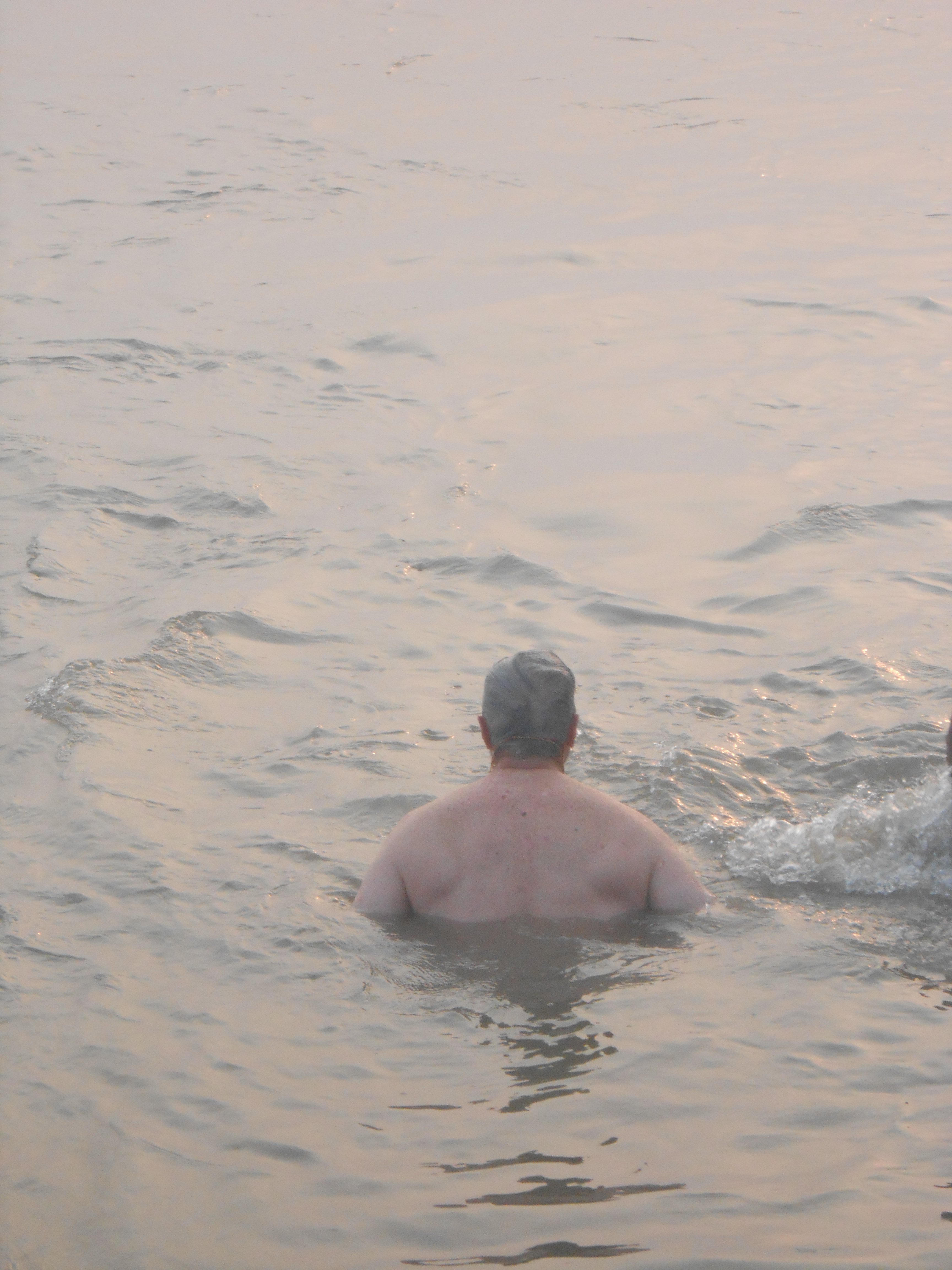
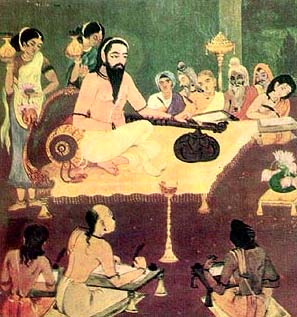

The epoch making document in the field of interfaith relations was the ‘Declaration on the Relation of the Church to Non-Christian Religions’ (Nostra Aetate). A bit of background might be useful here. In the aftermath of the ‘holocaust’ in Europe during the Second World War when some 6 million Jews were put to death, the Catholic Church felt it necessary to make an official statement concerning the attitude of the Church towards the Jews. It was then felt inappropriate not also to make a statement regarding Muslims since they, along with Christians and Jews, constitute one of the Abrahamic communities. It was further felt that something should also be said concerning Hinduism and Buddhism. What, therefore, originally began as a statement concerning the Jews ended up as a statement about all non-Christian religions.

   The declaration contains the following all-important statement:

“The Catholic Church rejects nothing of what is true and holy in these religions. …. The Church, therefore, urges her [children] to enter with prudence and charity into discussion and collaboration with members of other religions. Let Christians, while witnessing to their own faith and way of life, acknowledge, preserve and encourage the spiritual and moral truths found among non-Christians, also their social life and culture.”[1]

It recognises not only that many truths are to be found in religions other than Christianity but also that holiness is to be found there, and therefore deep religious experience and salvation.

The Declaration goes on to urge Christians to enter into both discussion and collaboration with members of these religions. Gone are the days of hostility or domination, fear or arrogance! Collaboration is specifically promoted. This is extraordinary in its consequences. It means that Catholics must cooperate with members of other religions in all respects and of course in the work of establishing world peace. The old rivalries must be put aside.

An anecdote: I was spending a few months in Varanasi, the sacred city of the Hindus located magnificently on the Ganges. In the apartment next door was an American from the Mid-west. He had come to India to evangelise. He would befriend students from the university and invite them to his apartment and speak about Christianity. Nothing wrong in that of course! However, it became quite clear, from our conversations that he had a completely closed mind. Anything I said about Christianity – and I know a thing or two – he would simply reject if it did not already form part of his outlook. He despised the teachings of Hinduism and saw them as so many errors from which the students had to be freed if they were to be saved. That attitude must go.

Another anecdote. Henri le Saux, a Catholic monk, came to India to set up the Benedictine form of monastic life in the India style. Soon after arriving in India he went to see the famous Ramana Maharshi and was thunderstruck. The mere sight of this extraordinary man – they never exchanged words – made Henri realise the depths of the Hindu faith. The years that followed saw him trying to link his Christian faith which he never abandoned with his new-found appreciation of Hindu truth. He said: “I cannot be just Christian; I cannot be just Hindu; but I don’t know how to be both Christian and Hindu.”

That may have been true in his case, but there must be some way, for human nature is one and Ultimate Reality is one. It doesn’t mean the Christians will cease to be Christian in the fullest sense or that Hindus will cease to be Hindus. There is no question of dropping one to become the other, for that would be not dialogue but monologue. The road of inter-faith dialogue is both long and exciting.

The text of Vatican II goes on to make the remarkable statement that Catholics should “acknowledge, preserve and encourage the spiritual and moral truths found among non-Christians, also their social life and culture”. These are strong words. It not is not just a matter of ‘putting up with’ but of ‘encouraging’ the spiritual and moral truths. This statement is very important and is a model for all participants in interfaith dialogue.

The dialogue is also a moment of revelation since the Truth perceived in another person shows all the more powerfully the Truth present in me. We bring each other into contact with the Truth and are thus initiated into the Truth. We are good news to each other.

Catholics and Muslims in Australia have no direct political power but the fact that we get on well together shows that there is no justification for hostility. The peace between us influences social thought as a whole. We enjoy each other’s diversity and in this way show Governments that diversity is a reason for rejoicing. Hostility between religions leads to hostility between governments and vice versa the mutual respect between religions will help convince Governments of the value of cooperation and peace.

Australia is well placed to engage in this inter-faith dialogue since we are now a highly diverse nation with people of all culture and religions, well educated and open. We are a sort of laboratory.

[1] ‘Declaration on the relation of the Church to non-Christian religions’ (Nostra Aetate), in Austin Flannery, Vatican Council II, the Conciliar and Post-conciliar Documents, Collegeville, Minnesota, The Liturgical Press, 1975. p.739.

Posted in Hindu Christian relations, Hinduism, Interreligious dialogue, Interreligious dialogue, Melbourne | Leave a comment

Bathing in the Ganges, at the Great Kumbhamela

4 John bathing 8

Bathing in the Ganges.

It was at Devipatan, in northern India near the Nepalese border. They were a group led by Matsyendranath, a Russian yogi who lives in Sydney and who had invited me to join his group of Russian speaking nathyogis. They were a remarkable group: young, happy, very committed to the spiritual path, sensible, peaceful and joyful. It was obvious that I appreciated them. In fact I was living out the recommendation given in the ‘Declaration on the relation of the Church to non-Christian religions’ (Nostra Aetate) of Vatican II, which states “Let Christians, while witnessing to their own faith and way of life, acknowledge, preserve and encourage the spiritual and moral truths found among non-Christians, also their social life and culture.” They in turn appreciated this attitude. Indeed, they were surprised, puzzled and curious.

Therefore, one evening they asked me many questions: about the selection of the books of the Bible; the Gnostic gospels; monastic life; the Orthodox ‘prayer of the heart’; the reality of eating Jesus’ body and blood; corruption in the Church; the relationship of Church and State and so on.

So there I was, in a small temple town where no one speaks English, witnessing to Russian speakers about the truths of the Catholic Church. They in turn expressed their appreciation with words of high praise. We had truly met.

We journeyed down to Allahabad for the great festival of the Kumbhamela where– some 40 million pilgrims over the space of about 2 months immerse themselves at the meeting of the Ganges and Yamuna rivers. I joined with the nathyogis and some 10 million others on that day in immersing myself in the waters. I felt something of Jesus’ emotion as he immersed himself into the waters of the Jordan and into the whole history of Israel although he was their source.

The whole experience was an authentic act of interreligious dialogue that gives much room for reflection. It was a new evangelisation, in the best sense of the word.

This short article was published in Dilatato Corde (on-line journal of Dialogue Interreligieux Monastique / Monastic Interreligious Dialogue), Volume III Number 1, January – June 2013.

Posted in Hindu Christian relations, Hinduism, Interreligious dialogue, Melbourne, John Dupuche | Leave a comment

The Kaula daily ritual (nityapūjā) in the Tantrāloka, in Adesh No. 9, 2013 pp. 14-15.

Published as: “Ежедневный каулический ритуал (nityāpūja) в Тантралоке”, Адеш №9 (2013) 14-15.

“The Kaula daily ritual (nityapūjā) in the  Tantrāloka,” in Adesh No. 9, 2013, pp. 14-15.Abhinavagupta 2

by John Dupuche

In chapter 29 of his great work, the Tantrāloka, Abhinavagupta describes many Kaula rituals, which he prefers, his commentator Jayaratha says, to the ‘tantric’ rituals described in chapters 14-37. The first is the daily (nitya) ritual, which sums up the essential content of all the other rituals of the Kula tradition given in that chapter. It reads:


śloka 18              After entering the hall of sacrifice rich with perfume and incense, facing north-east he should, by means of Parā or Mālinī, upwards and downwards,

śloka 19              perform the cleansing which consists of ‘fire’ and ‘growth’, ‘burning’ and ‘cooling’ respectively, in due order. Or else [he may do this], with the mantra Mātṛsadbhāva.

śloka 20              …    Next, by means of śakti alone he should bestow immortality on the articles to be purified.

śloka 21              [Mālinī] enclosed by Parā; or [Mālinī] enclosed even by Mātṛsadbhāva]; or Mālinī by itself: these are the [distributions of Mālinī] in all ritual actions.

śloka 22              Let him fill the vessel with ingredients, which are the fruit and the causes of joy. At that point, through an identity with the mantra that has been mentioned, he should bring himself to the state of Bhairava.

śloka 23             Consequently, he should satiate the self with its multitude [of goddesses] in the circle and sub-circle, externally by sprinkling drops upwards and downwards, and internally by drinking.

  1. The context:

śloka 18a        The place of ritual is filled with items pleasing to the senses, such as flowers and incense, for they will stimulate the practitioner, as will even more so the substances in the cup to be mentioned in śloka 22a.

In the symbolism of the ritual, the east represents life and its multiple enjoyments for that is where the sun rises to make its varied course across the sky. The north, where the sun never goes, represents that which transcends life, and therefore symbolises the realm of liberation. By facing northeast, the practitioner shows that he is ‘liberated-while-living’ (jīvanmukta).

  1. Divinisation:

śloka 18b-19 The human body represents the universe. The practitioner begins the ritual by regenerating himself / herself and the universe by means of the great mantras of the Kula tradition, which are the phonic form of the goddess and are imbued with all her powers. These mantras are Parā, Mālinī and Mātṛsadbhāva.

The phonic form of Parā is SAUḤ. The phonic form of Mālinī consists of the fifty phonemes of the Sanskrit alphabet in jumbled order such that the vowels, which represent Śiva or seed, and the consonants, which represent śakti or the womb, are united. Its abbreviated form NA-PHA consists of the first and last phonemes of that listing. Because of its mixture of ‘seed’ and ‘womb’ Mālinī is essentially sexual in nature and has a more emanative character. By contrast, the phonic form of Mātṛsadbhāva, KHPHREṂ, has a more reabsorptive quality.

By the process of ‘burning’ from the tip of the big toe to the tuft of his / her hair on his head, the practitioner experiences reabsorption (saṃhāra) into pure consciousness, for she/he is being consumed into its fire. That is, by sequentially placing (nyāsa) the mantra on the parts of his body he is progressively identified with the Self. He is then refashioned by the opposite process of ‘cooling’ or emanation (sṛṣṭi), likewise by a process of installing the mantra. The practitioner, consciousness and the universe are thus wholly regenerated and identified.

śloka 20b       The practitioner also consecrates the articles, such as flowers, the ingredients of the vessel. Otherwise they would be inappropriate for the ritual. He does this simply, without any action and just by means of the mantra called rudraśakti, which is Mālinī enclosed by Parā; or Mālinī enclosed by Mātṛsadbhāva.

śloka 21          “Mālinī enclosed by Parā” is SAUḤ-NA-PHA-SAUḤ. “Mālinī enclosed by Mātṛsadbhāva” is KHPHREṂNA-PHA-KHPHREṂ. “Mālinī by itself” is NA-PHA. The central mantra NA-PHA is the focus of this ritual, being enclosed (saṃpuṭita) by the other mantras.

śloka 22a        He prepares the vessel with its 3 M’s (makāras): namely māṃsa, meat; madya, wine; and maithuna, which is sexual union or, by extension, the sexual fluids which result from it.

It must be first noted that the Kula ritual is reserved for those who have already been initiated and who operate at the highest level, beyond ‘mental constructs’ (nirvikalpa). This reservation is alluded to in 29.99 and noted at length by Jayaratha in his commentary on that śloka where he gives a quote:

“Without a guru, without a deity, like dullards, O Parameśvarī, forever consuming wine and meat, they are ‘bonded animals’. There is no doubt about it.”

And then comments:

“… the [set of three M’s] is to be utilised by the person who has entered upon the Kula path for the reason that he is in every way committed simply to manifesting his own bliss. [The set of 3 M’s] is not [to be utilised] out of greed. If that were the case, how would [the use of the 3 M’s] differ from worldly usages?” (TĀV vol. 7, 3357)

In other words, the 3 M’s are not a means to achieving a consciousness, which does not yet exist but a way of expressing what is already present. The daily ritual is performed from a state of enlightened consciousness.

These substances are reprobate, as a quote given by Jayaratha in his commentary on 29.10 states:

“This lineage [of the Perfected Beings] is to be worshipped with ingredients that are both hated by people and forbidden according to the scriptures, that are both disgusting and despised.”

The contrast with the agreeable substances such as perfume and incense mentioned in śloka 18 is intentional. The daily ritual involves both beauty and horror, just as it involves what is forbidden and what is permitted. The non-dualist mind rejects such divisive concepts (vikalpa) and shows it by intentionally using irreconcilable opposites. The practitioner has no regard for the categories of pure and impure, pleasant or unpleasant. He transcends such divisions for he is identified with absolute consciousness itself.

Of these ingredients the last, sexual fluid, is by far the most important. The cup (pātra) contains, therefore, the meat and wine, which lead to congress and the sexual fluid, which results from congress.   The cup, therefore, represents the whole domain of bliss: all that leads to it and all that results from it.

śloka 22b       By means of the mantra, the practitioner has regenerated himself as Bhairava, the fearsome form of Śiva, and now proceeds to use the fearsome substances of the cup.

iii.       Action:

śloka 23          He now performs the act of sprinkling, which has a range of meanings. It refers in the first instance to the emanation of the universe, which proceeds from the bliss of Bhairava in union with his śakti. Secondly it refers to the reabsorption of the universe for the various faculties, or rather the goddesses of the faculties, seek their objects so as to be satisfied. By providing them with substances both fearsome and blissful, they are content and, since the lower circles are organically linked to higher circles and ultimately to consciousness, the Self is satiated. The practitioner, Bhairava, thus rests in peace.

“Moreover, having by his own nature become the sole lord of the kula, he should satiate the many śaktis by pairing [with them], he who possesses every form.” ( 29.79)

That quotation comes from a later ritual in chapter 29, but it is equally applicable to the daily ritual which is the essence all the Kula rituals.

Having acquired an expansive and blissful state of mind, the Kaula practitioner can then be involved in the busyness of everyday life.

Concluding note

The Kula daily ritual is tied to a cultural system that existed in Kashmir one thousand years ago. The ritual can scarcely be conducted in this form in our own day, at least in the West. In our modern context, the consumption of wine and meat, and maithuna with women of the lowest caste do not carry the powerful sanctions as in the time of Abhinavagupta. The antinomian element – essential to the ritual – is hardly available. The question then arises: how can the principles that underlie the Kula daily ritual be reinterpreted for our time? Need they be reinterpreted for modern use?


Posted in Hinduism, Kashmir Shaivism | Leave a comment

Verses 52-53, consuming all by fire

Vijñānabhairava-tantra, verses 52-53   consuming all by fireFire 6

 “One should focus on one own ‘fortress’ as though it were being consumed by the Fire of Time rising from the foot; then, finally, the peaceful state will arise.” (52)

कालाग्निना कालपदाद् उत्थितेन स्वकम् पुरम्।

प्लुष्टम् विचिन्तयेद् अन्ते शान्ताभासस् तदा भवेत्॥ ५२॥

kālāgninā kālapadād utthitena svakam puram |

pluṣṭam vicintayed ante śāntābhāsas tadā bhavet|| 52 ||

“In just the same way, by meditating imaginatively on the whole world as being consumed by fire, the man whose mind is indifferent to all else will arrive at the highest human state.” (53)

एवम् एव जगत्सर्वं दग्धं ध्यात्वा विकल्पतः।

अनन्यचेतसः पुंसः पुम्भावः परमो भवेत्॥ ५३॥

evam eva jagatsarvaṁ dagdhaṁ dhyātvā vikalpataḥ |

ananyacetasaḥ puṁsaḥ pumbhāvaḥ paramo bhavet|| 53 ||

śloka 52

In the Vedic sacrifice, the most ancient of Hindu sacrifices, offerings such as wood, ghee or incense are placed in the fire, which consumes them and takes them upwards to the heavenly realm, in which Agni (fire) is one of the principal gods. The ashes that are left over are a symbol of the ultimate Reality from which all comes and to which all returns. Thus ash is perfectly pure, and when it is smeared over the body transports the person into pure consciousness.

The Sanskrit word citi can refer both to consciousness and to a funeral pyre. In the way that a pyre is consumed by flames, so too all limited expressions of reality are consumed by consciousness. The fire of consciousness bring all things to their end. It is ‘the Fire of Time’ (kālāgni).

According to Kashmir Shaivism, the body is seen as a city (puram), indeed as a microcosm of the macrocosm. Every level of body, from the lowest to the highest, is linked to another world. In transforming one’s body by the process outlined in these ślokas the practitioner transforms this whole cosmos and indeed universes beyond this universe.

The big toe represents the most inert state of reality, while the tuft of hair on the crown of the head represents the fire of consciousness. The process described in this śloka starts from the big toe of the right foot (kālapadād) and extends upwards (utthitena) to the crown of the head.

The practitioner consciously moves up every level of his body, with the sense of it being consumed and being absorbed into the fire of consciousness. This act is done with full awareness (vicintayed). All that is unconscious is both appreciated and transformed. It is not rejected but changed, given a value and a dimension it did not have, giving it a brilliance and energy it did not know existed. Consciousness transforms all into consciousness. The purpose of existence has been achieved, and so in the end (ante) there is stillness (śāntābhāsas).

śloka 53

The śloka 53 broadens the scope by applying the same practice to the whole of reality (jagatsarvaṁ). The practitioner uses his imagination (vikalpataḥ) to meditate (dhyātvā) on the universe as being burnt up (dagdhaṁ). As a result the man (puṁsaḥ) who performs this act becomes the ‘supreme man’ (pumbhāvaḥ paramo), i.e. the meditator reaches the fullness of the human condition.

The Christian dimension

The act of Christ’s incarnation is to enter into a world that is ignorant of revelation, and bereft of glory. It is out of love that he comes, he is consumed by love and consumes all in love.

Jesus and Pilate 2Jesus, after he has been scourged, crowned with thorns and clothed in purple robes is presented to the people as the ‘human being’, “Behold the Man” (anthrôpos). He has achieved, in his utter debasement, the fullness of humanity. He is the true human, the supremely human, indeed the God-man. Jesus draws all to himself and transforms all into his very being. There is one perfect Man. (Eph 4:13)

That is why, when he rises from the dead, the tomb is completely empty. There are no traces left, no hair or finger nails as in some accounts in the Hindu tradition. There is no ash left, as in the Vedic fire with wood. He is totally consumed by his love. And in turn, his love transforms all things; for love is a great fire. Ultimately all is love.

Jesus speaks of bringing fire to the earth. (Luke 12:49) This is destructive not in the sense of burning things up, but on the contrary in the sense of eliminating all divisions and contradictions. All is taken up in the fire of the Spirit. Jesus is the first fruits of this process; he is completely consumed. In the end all things will be love, loving, lovable, in love, finding love, seeking to be loved, welcoming love. Every plant and grain of sand, every memory and dream, every animal and every star will be liked, appreciated, fully known, energized, made soft and welcoming.

Abhinavagupta will say in his commentary on the Parātriṃśikā[1] that by focusing on ‘he’, ‘she’ or ‘it’, in other words on whatever is limited, these become ‘you’; and by focusing on ‘you’, the ‘you’ becomes ‘I’. Thus the whole world is transformed into the supreme ‘I am’.    This resonates with the episode in the Book of Exodus where God addresses the people he has brought out of Egypt and taken to himself. They are no longer a crowd of individuals, but a people whom God addresses as ‘you’. “You are my people”. They are the object of his love. He had declared himself as ‘I am’ when he spoke to Moses from the burning bush. (Ex 3:1ff.)

[1] ‘Person-to-Person: vivarana of Abhinavagupta on Paratrimsika verses 3–4.’ In Indo-Iranian Journal 44 (2001) 1-16.

Posted in Christian tantra, Hindu Christian relations, Interreligious dialogue, Kashmir Shaivism, Vijñānabhairava-tantra | Leave a comment

Sylvia – funeral oration, 2007

Sylvia Richmond  – funeral orationresurrection 3

“We have received Sylvia into this church. We receive her whole life too, her tears and her joys, her memories and her deeds. These we receive and we rejoice in them.”

Just before the end of this funeral ceremony as the incense is being cast around the coffin, we will say the words, “Receive her soul and present her to God the Most High.”

We have received Sylvia into this church. She has been placed before the altar. We receive her whole life too, her tears and her joys, her memories and her deeds. These we receive and we rejoice in them. We rejoice above all in the illumination that was given to her, for she had the knowledge of things unseen. She had the faith.

While she was still alive she had expressed the wish to be anointed when the time had come for her to die. This wish was granted. On Friday night, ten days ago, at about 8 in the evening she was anointed with the sacred oil and signed on the forehead with the mark of the cross. Her daughter Anne had promised her that she would be anointed and Anne has fulfilled that promise. And now we proceed to honour Sylvia with Christian ceremony.

We have sprinkled the coffin with the water in remembrance of her baptism. We have heard the readings which speak of the hope given to us in Christ Jesus. In a few moments’ time, the gifts of bread and wine will be brought up by her daughter Anne and by Anne’s nephew. Sylvia’s smiles and tears, her successes and failures, the whole variety of her life will also be presented, along with the bread and wine. We will then make the prayer of blessing, as we thank God for all he has done through Christ Jesus and for all that he has done through Sylvia. Her story tells us who we are. Her humanity reveals our humanity. Her love reveals God’s love. The deepest gift in her, the fire of love: that is the real Sylvia. All other things fall away. Love is a consuming fire and transforms all into love. Love receives love and burns away all that does not belong to love.

At the very end of the ceremony we will say those words, “Present her to God the Most High.” We indeed present her to God and say: ‘Here is Sylvia who loved you and loved her family. We present her life in all its variety, the emotion of love and the trembling of fear. Look at her and see the good that is there. Recognise her as your very self. See her as a reflection of yourself. Do not refuse her, for you cannot refuse your very self. We present her to you and we present ourselves with her. We recognise her as one of us. Accept us as you accept her. She has gone before us May she receive us when we follow the same path. Sylvia hoped for love; give her the fullness of love. This is our prayer for her and for ourselves.”

St Joseph’s Church, Black Rock,  25 September 2007,

Fr John Dupuche PP

Posted in Funeral oration | Leave a comment

Cecil Clark – funeral oration, 2006

resurrection 2

Cecil Clark – funeral oration

We have come to pay tribute to Cec. There is much we know and admire. Therefore, we stand before the One who knows all things and say, ‘Look at Cec and reward him and make him flourish in a way we can only begin to imagine.’ For a funeral is not just a looking back to the past but is an anticipation of the future. Our lives in time are the programming of eternity; and each person paints their eternal portrait in the acts and emotions of their years.

Cec lived a rich life. I am speaking about the deeper dimension of things. For it is the depth of a person’s character and the quality of their spirit that make them worthwhile. Cec had perceived something of the rich mystery of God and wished to draw near to the fountain of life. He came to morning Mass most days, whether by car or later by motorised wheelchair. He attended Mass but also gathered people together in prayer in his own home. He wished to be at rights with the Maker of all and with those around him; he was sensitive and often came to confession.

He led a life of prayer and also a life of service. He was much involved in the work of the St Vincent de Paul Society both here in the parish and elsewhere. He cared for his wife in her illness and frequently visited others who were ill.

He sought for more in life than the five days of work and the two days of leisure. So, his life puts a question to us: what we are on about, what system of values is at work in us? He challenges us. He is an example to us and we honour him best by imitating him.

Therefore we pray: ‘Look on this man and love him. He lived for ninety years; give him eternity. We will lower him into the earth but we entrust him into your care, for he came from you and sought to draw close to you. We commend him and stand by him. He was a good and faithful servant; let him now share his Master’s happiness.’

Stella Maris Church, Beaumaris, 2006

Fr John Dupuche

Posted in Uncategorized | Leave a comment

Robert Broomhall, Funeral Oration at St Joseph’s Church, Black Rock,

ResurrectionRobert Broomhall, 1922-2007

We are not like those who think he simply is not, finished, reduced to nothing. We say ‘fare well’ because we know he is well and will be well.”

I always enjoyed the company of Bob. He was a regular reader at the Sunday Mass here at St Joseph’s and he read well. He was direct and warm hearted and approachable, so that I felt drawn to him. All of us have our special memories of him; for me Bob will always be linked to the Word of God.

We have come to give thanks for him. We bid him ‘fare well’. Indeed, we bid him, ‘fare very well and be full well’, for all will be well for him. We are not like those who think he simply is not, finished, reduced to nothing. We say ‘fare well’ because we know he is and will be.

We have come here to bless him and we say, like in the first reading, “May the Lord bless you, Bob, and take care of you,” for we place him in the hands of the One who alone can help him now. We say, “May the Lord be kind and gracious to you” as Bob was kind and gracious to us. We say, “May the Lord look on you with favour and give peace”, a lasting peace that nothing can take away, for Bob knew both war and peace. He feared the bombs that killed his mates in Darwin harbour. He also promoted peace by being involved in merchant banking with the Japanese after the war. He fought the good fight, that fight which above all is worth winning, to keep the faith: faithful to his family, faithful to his country, faithful to his God who will be faithful to him in return.

Bob, the reader of the Word at Mass, knew well the power of words, for during the War whole armies shifted across the globe at the command of their generals. He also knew the power of words in merchant banking where telegraphic transfers shift fabulous sums of money from one account to another. Above all he knew the power of the sacred Word. It was by this same Word that God said “Let there be light”, ‘let there be sun and moon’, ‘let there be plants and animals and humans’. It is our Christian conviction that this same powerful Word will call out to Bob, saying ‘Arise, come forth into the light which does not waver’. If someone asks you how the dead can possibly be raised to life, tell them it is by the power of the Word who commands all things into being, the loving Word who calls the loving into resurrection, Jesus the Just Judge who calls the just to himself.

Bob was a just man. He found places for migrants who came to Australia hoping for a secure and happy life. May he find us a place when our time comes to go. It was good that he walked the face of the earth and flew around the world, to the USA, to the UK, to Egypt and elsewhere. He has gone to a more secret place now. It is as though he is quoting the words of Jesus in the Gospel, “I am going to prepare you a place and after I have gone I will return to take you with me so that where I am you may be too”. His family looked after his welfare during his illness. He will return the favour and look after them when they too succumb to human mortality. May the Word of love now come to Bob and fill his heart to bursting point, giving him that joy which this world cannot contain.

Fr John Dupuche PP

Posted in Uncategorized | Leave a comment

Noelene – Funeral Homily, ‘She did not die alone but was accompanied by love.

resurrectionNoelene – Funeral Homily,

‘She did not die alone but was accompanied by love. ….’
It was very moving to sit with the family, with Noelene’s husband Geoff in the first instance, and with her son Hayden and his wife Eva, with her daughter Emilia and her husband Chris and with a couple of friends from Ireland. We sat quietly around Noelene who lay there with the calm look of sleep. We listened to a favourite piece of music which we will hear later in this Mass. We read the prayers and heard the story of Lazarus being restored to his sisters Martha and Mary. We signed her on the forehead with the mark of the cross as a promise of the great happiness which is to come.

It was moving to see the great care the family showed to Noelene during her illness, the affection that is so much part of this family. Most moving was the account given by Geoff of how he and Noelene looked steadfastly into each other’s eyes as she quietly slipped away. She did not die alone but was accompanied by love. What a blessed parting! What a lifetime of regard and affection made it possible for this to happen so simply and so naturally. Geoff gave her a pledge of his constant love and assured her of the future.

What a blessing it is to find someone who can look into the eyes and the heart. What a blessing it is to be reassured by the Christian faith, for it is our belief, as St Paul says in his famous letter to the Corinthians, that ‘at present we see as through a reflection in a mirror, but then we shall see face to face. We shall know as we are known.’ Indeed, we proclaim to the skies that there is Someone who can look into the inmost recesses of our spirit, to the very depths of our being, into our memories, into our lives. God looks, not to reprove or to condemn or but with understanding, wanting to look in wonder at our look of wonder. The look we give to each other is the sacrament of the eternal. God looks in our looking. As the disciples looked at Jesus they could see the God who sent him. As we look at each other in love we can see the Christ and his God.

So Noelene slipped away and no longer looked on this world. But as Noelene’s eyes closed they began to look on another landscape. It is the constant teaching of the Christian faith that those who die in love can see more deeply. What does she see? Those artistic eyes of hers, so aware of beauty, what do they see now? She contemplated the beauty of art because she wanted to see the eternal beauty from which all art comes. What does she sees now. What does she hope we will see?

What a pity for those who do not entertain such hope. What sadness for those who do not have someone into whose eyes they can look steadily and lovingly. What a mistake for those who say there is no one who can see into the deepest recesses of their being with affection and salvation.

We look forward to seeing Noelene again. What pleasure that will be. As we see her we will see the God who looks in her. We will see each other in each other, presence upon presence, eyes within eyes. Marvellous things are in store for us. Let us look forward to her future and ours.

Stella Maris Church, Beaumaris,
Fr John Dupuche PP

Posted in Uncategorized | Leave a comment

Audrey Hughes, Funeral Oration

Audrey Patricia Hughes

1929-2007

 Resurrection KhoreFuneral Oration, Stella Maris Church, Beaumaris,

 Fr John Dupuche

Audrey’s life has come to an end. Audrey’s life is just beginning.

The staff of Monash Medical Centre could do no more. Her mortal remains have been brought here to Stella Maris Church and placed before the altar. Her family, who went to see her every day, have now brought her before the altar and have given her into the hands of the One who alone can do something for her. They can do no more; they entrust her to the One who can do everything.

Audrey is placed now where the gifts of bread and wine will be brought. With them we offer her to God. ‘Receive her into your care. She comes from you and now she returns to you. Take care of her and transform her as you will transform the gifts of bread and wine. Restore her, change her, and bring her to that fullness of which her mortal life was only the symbol. Her life was valuable to us; may she be valuable to you. She was good to us; may she be judged good in your eyes.’

To those who did not know her she may have seemed just a ship passing in the night. To those who did know she showed a remarkable capacity for friendship which made people feel they were understood and welcomed. From her arrival in Beaumaris in 1959 she was involved in the parish in a host of ways, in fetes, in the tennis club, in the support of the Presentation Sisters. She was interested about everyone and everything in the world. But what about the moments of grace of which she was aware, dimly or perhaps even strongly, those moments of enlightenment and fervour which no words can express? These deepest moments were the unique gift to her from the One whom we dare call ‘Father’. They above all are the source of her life.

Audrey’s life has come to an end. Audrey’s life is just beginning.

We are at a moment of transition. Audrey’s mortal remains will be taken from the church and placed in the ground, not cast away but lying there as treasure in the field. She is put to rest in the earth, for a little while. It is the Christian conviction that she will be rediscovered, that treasure in the field, and raised, no longer mortal or limited. She is dead, yes, but in fact she is profoundly alive, like the seed that falls to the earth. She is made from dust and returns to dust but, by her baptism and by the moments of grace given to her, she is in fact eternally alive. The life of grace that is within her will restore her . What was mortal will be immortal, what was feeble will rise in boundless strength.

Therefore we ask her to be with us and to pray for us and to lead us to deeper knowledge. May she mother us in this way. At the moment of her death may she make us understand the purpose of our lives. And so we shall live, and live with her, in God.

Posted in Uncategorized | Leave a comment

“Renewing Christian Anthropology in Terms of Kashmir Shaivism”,

The following article John Dupuche was published in Theology@ McAuley, E-Journal, Australian Catholic University, 2004

“Renewing Christian Anthropology in Terms of Kashmir Shaivism”.

Shiva Nataraj 2Roualt Christ 1

Rev. Dr. John Dupuche was Pastor of Nazareth Parish, Ricketts Point, Melbourne. He is senior lecturer at the University of Divinity, and Honorary Fellow at the Australian Catholic University, and chair of the Catholic Interfaith Committee of the Archdiocese.  He has a doctorate in Sanskrit, specialising in Kashmir Shaivism and is particularly interested in its interface with Christianity. His book Abhinavagupta: the Kula Ritual as Elaborated in Chapter 29 of the Tantrāloka was published in 2003; Jesus, the Mantra of God in 2005, Towards a Christian Tantra in 2009. He has written many articles in these fields.
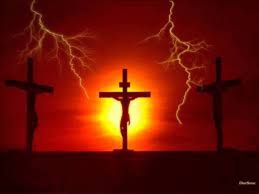
Email:    jeandupuche@gmail.com

website: johndupuche.com


Introduction:

My good friend Bettina Bäumer[1] relates the following story:

“It was a seminar in Vienna University where [Karl Rahner] also spoke and I gave my first ever paper on KS [Kashmir Shaivism] on anupāya. After listening very attentively, he took me aside after the discussion and said [Wir sind nur Waisenkinder] [which she glosses as] “we are orphans compared to what these Indians have discovered!” (Waisenkinder means we are far behind or more primitive, spiritually).”[2]

The first generations of Christians moved out of the Jewish framework into the thought-world of the Greeks and reinterpreted their faith in a new way. Now with the end of the colonial era, where the East was interesting only if it was exotic, we are witnessing a massive new shift. Rahner’s comment to Bettina Bäumer reflects his awareness that the Hindu thought must profoundly affect Christian theology, making Christians qualify categories and images that are so familiar as to be unquestioned.

Christian anthropology, as presently understood, is profoundly dualistic: God and man, heaven and earth, nature and grace, faith and reason, Church and State, sin and grace, good and evil etc. But St Paul says: “all are one in Christ Jesus”.[3] New anthropologies are needed.[4]

The method of this paper is to present some aspects of Indian and Christian thought. I will weave between Christianity and Kashmir Shaivism ending not with syncretism but reinterpretation. I will speak of consciousness in place of the word ‘God’, of emanation in place of creation, of ignorance in place of sin, recognition in place of redemption, of identity instead of faith, of universal bliss instead of eternal life.

These pairs of terms – consciousness / God etc. – are not deemed to be equivalent. Neither are they being compared but only connected. What light can one throw on the other? What questions are posed? Can the Christian experience be expounded – not falsely – in these terms, given, as we know, that Christian vocabulary cannot adequately express Christian experience? Can these Sanskrit terms become the vehicle for a theology which leads to the knowledge of the Christ who exceeds all that can be said of him?

This attempt will be the beginnings of a Shaiva Christianity or a Christian Shaivism.

It is part of the future task of theology. In the opinion of David Tracy “the inter-religious dialogue will become an integral part of all Christian theological thought.”[5]

God and consciousness:

In the Shaivism of Kashmir, consciousness, also called ‘Śiva’, is pure awareness without any object of awareness. However, consciousness is not ignorant of itself. Awareness is self-aware not dividedly but identically. This auto-illumination of consciousness is the Supreme Word (paravāc) and is expressed as “I am” (aham). This consciousness is not the impersonal Brahma as in the famous phrase “Thou art That” (tat-tvam-asi) which is found in the reflections of Raimon Panikkar. Rather, in Kashmir Shaivism the ultimate reality is supremely personal but not individual, always Subject and never object.

The divine Subject cannot, therefore, ultimately be the object of fitting discourse but transcends all that can be said. Discourse about God gives way to silence and union, not as subject to subject but as identity, one Subject, “God who is all in all.”[6]

Creation and emanation

a.   Like the mirror which can reflect any object precisely because it does not necessarily portray any particular object, so too the Supreme Word contains every expression and is limited to none. Out of freedom (svātantrya), indeed out of a sense of play (līlā) the Word is expressed in the multiplicity of the universe. This universe is therefore the expression of Consciousness who both transcends the expression and is the expression; just as the dancer is the stance he adopts and is not confined to that stance. Śiva is his work, yet at the same time transcends his work. The universe is the dance of Śiva Naṭarāja (‘Lord of the Dance’).

This dance is at the same time emanation (sṛṣṭi), maintenance (stithi) and dissolution (saṁhāra) since all is flux and change in this vibrating universe.

b.  A few words now, on the Judeo-Christian idea of creation, which may at first seem totally different from the Hindu view.

The Hebrew word ōlām first meant both heaven and earth. It is only in later Hebrew that it came to mean the ‘world’. The Greek word kosmos, for its part, refers to the order of the universe formed out of pre-existent chaos.[7] The Septuagint, therefore, in choosing the word kosmos to translate the Hebrew ōlām colours the meaning of this latter term.

The term kosmos occurs most frequently in the Johannine writings, some 105 times, which is two and a half times more frequently than in the rest of the New Testament.[8] It can have a quite neutral meaning in itself[9] although it is full of possibility because the kosmos proceeds from the logos and is essentially linked to it.[10] The word kosmos can also have a positive meaning because God loves the world.[11] Later in the Gospel it acquires a negative meaning when the world is seen as hostile to Jesus.[12]

c.   It is against this Greek view of kosmos formed out of chaos that Athanasius teaches the doctrine of creatio ex nihilo.

“Prior to the debates of Athanasius with Arius, the theory of creatio ex nihilo was propounded, if at all, with uncertainty … [but] with this assertion of creatio ex nihilo came a recognition by Athanasius of a clear and substantial distinction between God and the created order, between the uncreated, non-contingent and asomatic Creator and the contingent and somatic creation, called into being from nothing by the will of God.”[13]

This Athanasian view has become dominant even though an emanationist interpretation of creation is available in the neo-Platonic Christian tradition.[14]

The seeming opposition between Hindu emanation and Athanasian creation may not, however, be insuperable. In Hindu thought there is a distinction between the expresser and the expression but not a separation. The term ‘mantra’ can refer both to the deity and to the phonic expression of that deity, to the reciter and to the mantra she recites. The speaker both transcends her word and is her word. When the speaker fully communicates herself, she and her word are not dual but identical, distinct but not divided. The one leads to the other; the one is the other and, even if our minds construct a separation, in reality there is none. The analogue for understanding the formation of the world, therefore, can be the dancer or the poet or prophet rather than the architect. Indeed, the first account in Genesis sees creation as a prophetic act. God is his word and transcends his word. But word is work and work is word. The work of creation is God and is not God. This is all the more true in the Indian philosophical system, which is based on the word rather than on objective reality, on revelation rather than on being (esse).

Sin and ignorance:

Similarly, in the Shaivism of Kashmir the human being is the expression of Śiva and in that sense is Śiva. The human being is, therefore, essentially Śiva who in the inmost depth of human consciousness speaks the primordial Word and proclaims, “I am” (aham). To quote Jacques Dupuis,

“God has been reached from both ends, as the “Father in heaven” and as more intimate to myself than I am“ (interior intimo meo) (St Augustine, Confessions III.6.11).”[15]

However, the expression is also a limitation. The emanation of the world is both an expression of the divine Light (prakāśa) and a concealment (tirodhāna) of that Light which continues to diminish until it reaches the state of inertia (jaḍatā), just as the ripples in the pond eventually peter out. Thus Śiva delights to be his opposite, consciousness being reduced to ignorance, light being completely obscured.

The human being who does not understand these things sees herself as merely human. The individual says: ‘I am this person and not that person. I am such and not otherwise.’ This divisive attitude is an error, an ignorance (avidyā), which is not a lack of information but an absence of wisdom. It is even a lie, since in the depths of one’s being the truth is always known. This failure to understand is the primary fault or stain (mala) confusing the individual self (ahaṁkāra) with the universal Self (aham), either to inflate the importance of the individual self or to reduce the universal self to the human level.

It is said, in classical Catholic moral theology, that for a sin, either of commission or omission, to be perpetrated there must be sinful matter, knowledge and consent. The sin is grave if all three elements are grave and full; the sin is venial if one of the elements is partial. Knowledge would seem, therefore, to be a constituent part of the sinful act. However, there are many texts in the Gospel which also describe sin as ignorance. Not only the famous ‘Father, forgive them; they do not know not what they are doing’ (Lk 23.34 ), but also: ‘Blind? If you were, you would not be guilty, but since you say, “We see”, your guilt remains.’(Jn 9.41) Or again: ‘The [servant] who did not known [what his master wants], but deserves to be beaten for what he has done, will receive fewer strokes.’ (Lk 12.48) The ‘strokes of the lash’ are given, even though there is no conscious act of disobedience.

Ignorance (avidyā) in Kashmir Shaivism is a failure to know the truth; an absence of enlightenment which means that the individual cannot but perform acts which are disastrous both personally and for others. Revelation is not only concerning the good but also concerning the true nature of evil.

The acknowledgment of the Self (aham) does not involve the elimination of the individual self (ahaṁkāra). Absorption (saṁhāra) does not mean annihilation but reinterpretation: understanding that the limited self is an expression of the true self and that one is really “I am”. It is extremely difficult to cease identifying with the individual self. Indeed, in Scriptural terms it is a ‘dying to oneself’.[16] This is more than the elimination of unrighteous thoughts and actions, the abandonment of selfishness. It is a fundamental change of perception, a rebirth, and regeneration.

Even if the soul is declared to be immortal[17] it is not absolute and does not necessarily exist. It could, if God so willed, simply cease to exist. No ultimate reliance can be placed upon the soul or the will. The individual self is indeed real and not imaginary, but is essentially contingent and in this sense profoundly unreal. Only God is truly real.

This ignorance leads to acts that are absurd and divisive, bearing a harvest of unfortunate consequences (karma), which may take lifetimes to redress.

Where the Western mind distinguishes in order to understand, the Hindu mind absorbs in order to perceive the essential nature of things. The Western mind says ‘one is not the other’; the Hindu mind says that one is essentially the other: sarvaṃ-sarvātmakam

Redemption and recognition:

The purpose of the teachings of Kashmir Shaivism is to lead the disciple to the act of recognition (pratyabhijñā) where he recognises his essential truth and concomitantly understands the relative nature of his individual self. He comes to see that his individual self is essentially an expression of the divine self and that his essential reality is divine. St Paul puts it perfectly: “I live now not with my own life but with the life of Christ who lives in me.”[18] According to Kashmir Shaivism, the saving moment is essentially a change of perception. The practitioner turns away from idolising all limited things and recognises the essential nature of reality. This dying to oneself is not just a moral attitude, but also a profound change of perception, a new ontology. The individual self ceases to be the centre of focus and is reabsorbed into its origin.

Faith and identity

If faith implies devotion, and if devotion is understood to mean separation, there is no place for that sort of faith in Kashmir Shaivism. If, however, faith implies identity (tādātmya) then Kashmir Shaivism is profoundly concerned with faith, for its aim is to acquire identity with Śiva, indeed to attain the very state of Śiva (śivatā). It is a resting; not in a separate self but in one’s own true self (sva-ātma-viśrantī) identified with the divine Self.

Panikkar puts it well:


[19]

Eternal life and universal bliss:

The act of recognition leads to the divine state which is not self-absorption but universal bliss (jagad-ānanda); a state beyond action (kalpa) and thought (vikalpa), a state transcending thought (nirvikalpa) and which all thoughts and actions only partially express. The practitioner is not aloof from the world but fully present. The panoply is not something apart from her but is indeed her very self, the expression of her own being, and is therefore welcomed as she welcomes her own self.

This is the ‘attitude of Bhairava’ (bhairava-mudrā), where, if the meditator looks within, into his own heart, he sees the whole world; if he opens his eyes and looks upon the world, he sees himself, for the world and he are one. Whether the eyes are open or shut he sees the same. His eyes are both open and shut, for he is in the world as in his own body but not defined by it.

It is not a state available only after death but can be achieved in time. The practitioner is liberated while alive (jīvan-mukta), so that his every word is mantra and his every act is ritual.

St Augustine, on seeing a drunken man, said in all humility and against the Pelagians, “There but for the grace of God go I”. The outlook proposed by Kashmir Shaivism would add: ‘He is not apart from me, someone other than me. He is my very self.’

Indeed, true knowledge of an object is possible only by identification with that object. I can truly know the mountain only if I am the mountain. Only God can truly know God, only God can fully worship God.[20] That is why Jesus, the true High Priest, must be “God from God, Light from Light”. Furthermore, if God wishes to speak to humans it is only by means of the divine Word being also human. Again, if God is to be worshipped by humans it is only by humans being divine. The Christian can truly know God only be being God in a profound sense, by means of theosis,

The means of coming to recognition:

In order to achieve that result, Kashmir Shaivism proposes four means (upāya), which are based on four forms of knowledge.

a.   The forms of knowledge:

The simple statement ‘I see the mountain’ distinguishes clearly between three forms of knowledge: firstly the object of knowledge, the mountain; next, the means of knowledge, the seeing; and lastly the knowing subject, the viewer, ‘I’. Thus there is object (prameya), means, (pramāṇa) and subject (pramātṛ). However this division into three is transcended by a fourth: where all are unified as one; where the object known, the means of knowledge and the subject are one and the same, namely the knower (pramiti).[21] In other words, the Self sees the Self by means of the Self. Indeed, all is simply the Self, “I am”. All is light. [22]

b.   The four means (upāya), which was the topic of Bettina Bäumer’s paper that so impressed Karl Rahner, are based on those four forms of knowledge and each can lead to the ‘attitude of Bhairava’.

The least exalted method is based on the object, i.e. on practices that are varied according to the character of the practitioner. The next is based on the means of knowledge where, by reasoning and reflection, he comes to the act of recognition. The next focuses on the subject where the subject more directly and immediately perceives his own true nature. But that method is still imperfect because the practitioner sees himself as distinct from the means and the object of knowledge.[23]

c.   The most exalted means is really a non-means (anupāya) because in fact there is no path to follow: the goal is reached suddenly and totally, due to an intense descent of energy (śakti-pāta), an immense outpouring of grace (anugraha). Nothing more is to be done; there is no need for repeated practice or deeper understanding.

“The revelation [of this Light] is given once and for all, after which there is no means.”[24]

“The reality of Consciousness shines forth by its own radiance. What is the value, therefore of those [means to make him known]?”[25]

The anupāya is described largely in negative terms since the light of consciousness cannot be described by what is less than the fullness of that light:

“The supreme state is neither ‘being’ nor ‘non-being’, neither duality [nor non-duality], for it is beyond the realm of words. It is located on the apophatic (akathya) level. It is with energy, it is without energy.”[26]

“[The Light of consciousness] is not a mantra, not a divinity whose mantra is recited, nor a reciter of mantras. [The Light] is neither initiation nor initiator nor initiated: It is the supreme Lord.”[27]

Therefore the usual acts of religion are unnecessary:

“For them there is no mantra, no meditation, no cultic worship, nor visualisation, nor the commotion involved in ordinary initiation, consecration of the master etc.”[28]

Conflicting emotions also lose their significance:

“[For those who have attained this highest state], notions of pleasure and pain, fear and anguish, disappear completely: the knower has arrived at supremely non-differentiated thought.”[29]

The practitioner who has achieved this state is not introverted. Rather, universal bliss confers universal bliss.

“They have no other work to accomplish but to confer grace”.[30]

“The worldly person works assiduously for himself, and does nothing in favour of others, but the one who, having overcome all impurities, has achieved the divine state works solely for the benefit of others.”[31]

c.   However, according to the thirteenth century commentator Jayaratha, the term ‘non-means’ (an-upāya) can also be understood as ‘a very reduced means’ (alpopaāya)[32] or a ‘subsidiary means’ (parikaratvam).[33] He lists a certain number of the reduced means.

“The sight of the Perfected Beings and yoginīs, the eating of the ‘oblation’, a teaching, a transition (?), spiritual practice, service of the Teacher.”[34]

Any one of these is sufficient to bring a person to full realisation, suddenly and without any need to engage in practices to deepen the realisation.

Yet, the ones who receive such an immense outpouring of grace are few in number. The vast majority of beings need to follow one or other of the three lesser paths, according to the measure of grace given to them:

“However, those whose consciousness is not utterly pure receive grace only by following one of the paths.”[35]

Jesus of Nazareth

What sort of Kashmir Shaiva Christology emerges form all this?

On seeing (darśana) Jesus or hearing a teaching (kathanam), the disciple experiences his own consciousness expanding. He then knows both Jesus and his own self, and indeed realises that Jesus is his own very self, for only like can see like, only the same can see the same. In fact, not only is the self of Jesus the very self of the disciple but the whole world too is an expression of the one Self. In short, the sight and teaching of Jesus are examples of the “very reduced means” (alpopāya) noted above.

But more; in contemplating Jesus and so arriving at consciousness, the disciple penetrates to the utterly Transcendent (anuttara) so that it becomes clear to him that Jesus of Nazareth is essentially the “I am”, the Supreme Word (paravāc), the self-revelation of Consciousness.

Since from that Expression all other expressions derive, Jesus looks upon the world and sees it as the expression of his self. Jesus is the Lord of the Dance.

“He is the image of the unseen God and the first-born of all creation… for in him were created all things in heaven and on earth … all things were created through him and for him…. [36]

In the events of the Sacred Triduum Jesus knows both the depths and the height; knowing good and evil, able to descend lower than any because he knows the height. The Paschal Mystery is the moment of supreme revelation. Although the Word of God has been revealed in various ways since the dawn of time, the Word incarnate is best able to reveal to flesh, since flesh needs flesh. Flesh best reveals flesh to itself. In the fullness of his living and dying he is the perfect expression of heaven and earth. Jesus, therefore, is able to provide the knowledge, which leads to the utterly Transcendent (anuttara). He is the Light that brings all to Light. The Word made flesh makes all flesh Word.

God wanted … all things to be reconciled through him and for him, everything in heaven and everything on earth.”[37]

All is non-dual (a-dvaita). All is one.

Bibliography

Abhinavagupta          Tantrāloka      with the Commentary of Jayaratha. Re-edited by R.C. Dwivedi and Navjivan Rastogi, enlarged with an introduction by Navjivan Rastogi and reprinted in 8 volumes. Delhi, Motilal Banarsidass, 1987.

Bettina Bäumer         ‘The Four Spiritual Ways (upāya) in the Kashmir Saiva Tradition’ in Regional Spiritualities, pp. 3-22.

Brown, Raymond       The Gospel according to John. New York: Doubleday and Company Inc. 1966, Vol.1; 1970, Vol.2.

Cassem, N.H.               “A Grammatical and Contextual Inventory of the use of kosmos in the Johannine Corpus with some Implications for a Johannine Cosmic Theology,” in NTS 19 (1972-1973) 81-91.

Denzinger, Heinrich and Schönmetzer, Adolf. Enchiridion Symbolorum. Freiburg im

Breisgau: Herder, 1967.

Dupuis, Jacques         Christanitiy and the Religions. Maryknoll, New York: Orbis Books, 2002. [First published as Il cristianismo e le religioni: Dallo scontro all’incontro. Brescia, Edizioni Queriniana, 2001.]

Palamas, Gregory      Triads, Edited with an introduction by John Meyendorff,

translated by Nicholas Gendle, preface by Jaroslav Pelikan. London: SPCK, 1983.

Panikkar, Raimon      ‘On Christian identity’ in Cornille, Catherine (ed.) Many

Mansions., Maryknoll, New York: Orbis Books, 2002. pp.121-144.

Pettersen, Alvyn        Athanasius and the Human Body, Bristol: The Bristol Press, 1990.

Tracy, David               Dialogue with the Other; The inter-religious Dialogue. Louvain: Peeters Press, 1990.


[1] Prof. Dr. Bettina Bäumer, Institute of Religious Studies, University of Vienna.

[2] Personal communication, 9 April 2004.

[3] Gal. 3.28.

[4] Cardinal Ratzinger, in the recent ad limina visit of the Australian Catholic Bishops, “spoke of the need for the Church to present a Christian anthropology which opens out to the world a deeper understanding of the human condition …. A positive vision of what it means to be a human being…’Letter of Archbishop Hart, dated 1 April 2004, to all priests of the Archdiocese.

[5] David Tracy, Dialogue with the Other; The inter-religious Dialogue. Louvain: Peeters Press, 1990. p.94.

[6] I Cor.15.28.

[7] Raymond Brown, The Gospel according to John. New York: Doubleday and Company Inc. 1966, Vol.1, p. 508.

[8] N.H. Cassem, “A Grammatical and Contextual Inventory of the use of kosmos in the Johannine Corpus with some Implications for a Johannine Cosmic Theology,” NTS 19 (1972-1973) 81.

[9] Jn. 3.16. See also Jn 11.9 ; 17.5, 24; 21.25.

[10] Brown, The Gospel according to John. Vol.1, p.25.

[11] Jn 1.29; 3.16; 4.42; 6.51; 8.12; 9.5.

[12] See 12.31; 14.17, 22, 27, 30; 15.18-19; 16. 8, 11, 20, 33; 17.6, 9, 14-16.

[13] Alvyn Pettersen, Athanasius and the Human Body, Bristol: The Bristol Press, 1990. p. 5.

[14] Tracy, Dialogue with the Other. p.86.

[15] Jacques Dupuis, Christanity and the Religions. Maryknoll: New York, Orbis Books, 2002. p.123.

[16] Cf. Mk 8.35.

[17] Ecumenical Council Lateran V, Bull “Apostolici regiminis”. In Denzinger H and Schönmetzer A. Enchiridion Symbolorum, no.1440. Freiburg im Breisgau: Herder, 1967. p.353.

[18] Gal.2.19.

[19] Raimon Panikkar, “On Christian identity” in Cornille, Catherine (ed.) Many Mansions, Maryknoll, New York: Orbis Books, 2002. p.139.

[20] This is a commonplace of Hindu thought.

[21] This is fourth in the listing but in fact underlies all three separate forms.

[22] This notion of light seeing its light by means of its own light is found in the theology of Gregory Palamas, the last of the Greek Doctors of the Church. He makes a very striking analogy with the eye. After referring to St Paul (II Cor.12.2) he pictures a sun of infinite radiance and size – at the centre of which all stands but now transformed into an eye. Paul, like that eye, is in light and seeing light. There are no limits. “If [the visual faculty] looks at itself it sees light; if it looks at the object of its sight that is also light; and if it looks at the means it uses to see, that too is light; that is what union is: let all that be one.” Triads, II.3.36. London: SPCK, 1983. p. 66.

[23] “(In this method śāmbhavupāya there is still) a conception of a difference between method and goal (upāya-upeya-kalpanā), whereas (in the case of anupāya) there is not even a trace of any difference. For in the non-way, who is to be liberated, how and from what?” 3.272-273. Bettina Bäumer, ‘The Four Spiritual Ways (upāya) in the Kashmir Śaiva Tradition’ in Regional Spiritualities, pp.17-18.

[24] 2.2b.

[25] 2.10a.

[26] 2.33.

[27] 2.26.

[28] 2. 37.

[29] 2.36.

[30] 2.38b.

[31] 2.39.

[32] Tantrāloka vol.2. p.312, line 13.

[33] Tantrāloka vol.7. p.3420, line12.

[34] Tantrāloka vol.2, p.312 lines 13-14.

[35] 2.47b.

[36] Col.1.15-16.

[37] Col.1.19-20.

Posted in Christian tantra, Hindu Christian relations, Interreligious dialogue, Interreligious dialogue, Melbourne, Kashmir Shaivism | Leave a comment

“‘Jesus is the Christ.’ (Acts 9.22) Can Jesus be called Shiva?”

The following article by John R. Dupuche was published in Theology@ McAuley, E-Journal, Australian Catholic University, 2003.

 “‘Jesus is the Christ.’ (Acts 9.22) Can Jesus be called Shiva?” in Theology@ McAuley, E-Journal, Australian Catholic University, 2003.

Roualt Christ 1Shiva Nataraj 2 Rev. Dr. John Dupuche is Pastor of Nazareth Parish, Ricketts Point, Melbourne. He is senior lecturer at the University of Divinity, Honorary Fellow at the Australian Catholic University, and chair of the Catholic Interfaith Committee of the Archdiocese.  He has a doctorate in Sanskrit, specialising in Kashmir Shaivism and is particularly interested in its interface with Christianity. His book Abhinavagupta: the Kula Ritual as Elaborated in Chapter 29 of the Tantraloka was published in 2003; Jesus, the Mantra of God in 2005, Towards a Christian Tantra in 2009. He has written many articles in these fields.

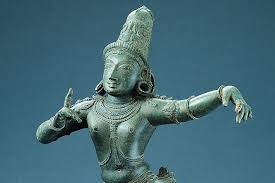
Email:   jeandupuche@gmail.com

Introduction

We welcome strangers to our land. Shall we exclude their gods? Is the Christian essentially dismissive, even in a kindly fashion? Does belief in Jesus involve a rejection of ‘strange gods’ or can Jesus who is called Christ also be called Shiva and be so worshipped?

This is not a new question. Some see the depiction of Prajapati in the Purusha Hymn of the Rig Veda[1] ‘also as a prophetic revelation about the atoning sacrifice of Jesus Christ.’[2] ‘They maintain that, according to this hymn, Prajapati … should …. Wear a crown of thorns …. [be] Bound to a tree …. [his] Bones should not be broken ….’[3] ‘They affirm that Prajapati is Jesus Christ’,[4] or that ‘Jesus is the real Prajapati’.[5] At the other extreme, some hold that ‘it is not possible to find divinely revealed truths regarding Jesus Christ in religious texts originating’[6] outside of the Holy Land. This paper wishes to avoid those two extremes and to propose an approach suggested by the fourth of the inter-faith dialogues, that of religious experience.


Part I: Asking the question:

  1. The Christ:

In his great act of faith Peter declares Jesus to be the Christ (Mk 8.29). His statement is both true and false for Jesus is not the glorious saviour of Peter’s expectation who must thoroughly reform his understanding of the word ‘Christ’. We know that the various Christologies of the New Testament cannot be reduced to one, for the term ‘Christ’ is polyvalent. Similarly, each Christian understands the word ‘Christ’ differently so that although there is one Jesus he variously resonates in the various believers. Furthermore, although Christian faith is placed in the child born at Bethlehem and in the Master who dies in nearby Jerusalem faith is placed above all in the Christ who is coming. The Christ of faith is above all the Christ of the future who is yet to be fully understood.

It is not enough to ask only what scholarship means by the term ‘Christ’. What is it that moves the heart for this is in fact what is being revealed? The notional Christ is one thing; the real Christ is another. This latter, the Christ that opens the heart, is the one whom the Spirit reveals.

  1. Shiva:

The word shiva means “auspicious”, “beneficent”. The term appears briefly and merely as an epithet in the sacred Vedas, which are concerned more with Indra, the king of the gods,[7] or Agni, the god of the sacrificial fire.[8] It is suggested that the minor figure of Rudra, ‘a storm god and embodiment of wildness and unpredictable danger’[9] is called ‘shiva’, ‘auspicious’, in order to placate his wild nature. Uncertainty surrounds the origin of the god Shiva who is thought by some to be depicted on seals of the Indus Valley Civilisation in the third millennium BCE. It is in the later writings, especially in the Puranas, which recount the sacred myths and legends that Shiva comes to the fore, such that he is now the god principally worshipped in India.

The deities of India, however, do not have the same status as the gods of Egypt and Greece, for the enlightened Brahmin considers them each to be the manifestation of that Reality, which is beyond all names. The manifestation is not false but neither is it absolute or permanent. The particular god or goddess is the form taken on by Ultimate Reality, which is beyond all forms. The deity is a passing manifestation leading the devotee to that absolute, ineffable Reality in which alone peace is found. Even if the Ultimate Reality did in fact manifest itself in the divine beings and their deeds, the devotee is invited to go beyond them to their source, the Unmanifest Void. Alain Daniélou, a noted Indianist and brother of the famous Cardinal Jean Daniélou, abandoned monotheism and adopted Hindu polytheism because for him it led more truly to the divine.

In this respect, the gods of India are somewhat akin to the understandings that

are variously given to the one word ‘Christ’. The gods and goddesses are the personified understandings of the Incomprehensible. There are as many images of Christ as there are deities in India.

  1. Jesus:

The Christian faith states that the historical figure, Jesus of Nazareth, is the Christ. Even though the meaning of the word ‘Christ’ differs among Christians, the person whom they inadequately describe is held to be one and the same. It is in the individual, more than in the appellation, that faith is placed.

However, the very notion of the individual is put into question by the philosophical system called Samkhya, which is perhaps the original philosophy of India[10] and which stands at the background of its other philosophies. The limited self is considered to be an illusion (maya). The ego is just an agglomeration of characteristics, a construct of the organising mind, like the layers of an onion, which enclose nothing.

In this sense, reincarnation is not the transmigration of an individual soul but the transfer of a set of characteristics, which are wrongly considered to constitute an individual. Liberation, moksha, the ultimate goal of all Indian religions, is found precisely in the loss of self not just as a moral quality but also as an ontological reality. The only self that really exists is the absolute Self, the Void, the absolute “I am”, aham mentioned in the Upanishads.[11]

The individual, in its atomic and monadic sense, is essentially cut off from another individual, is irreducibly other. This exclusiveness is intolerable to the inclusivist Indian mind that sees everything as composed of everything else, sarvamsarvatmakam.

  1. is’:

The word “is”, in the phrase “Jesus is the Christ”, produces difficulties. The Western mind has been profoundly affected by Greek philosophy, which, from the outset, has enquired into the constitutive nature of things.[12] Henri Le Saux, whose Indian name is Abhishiktananda, says, in regretting one of his important works:

 ‘As an unrepentant Greek I sought too much to think the mystery, India. That is why [my book Hindu Wisdom Christian Mysticism], seems so outdated to me – along with the whole of theology and all the understandings.’[13]

The Indian mind does not have a doctrine of being so much as a doctrine of revelation. The question is not “What exists?” but “What is revealed?” This attitude is subjective but not deluded. The Indian mind asks: “What is known without the constructs of the organising mind, without the delusions of limited perception?” Reality, properly understood, is not an object but a revelation. Knowledge is a relationship. Reality is essentially something known and does not exist independently from the knowing subject. The knower and the known are finally identical.

The questions arise therefore: ‘Who is Jesus to you? What does Jesus reveal to you? What happens to you when you know Jesus?’ There is no such thing as a purely objective nature of Jesus.

  1. Jesus is the Christ:

In short, the phrase “Jesus is the Christ” has little meaning in Indian terms since it seems to require exclusivism,[14] limitation, individualism and mere objectivity, all of which are seen to be illusory.

  1. Can Jesus be called Shiva?

Hindus already say that, like the Buddha, Jesus is an avatar of Vishnu. This is natural enough since Vishnu is the Preserver and Jesus is the Saviour. Gandhi, for his part, who revered Jesus as much as Krishna and Buddha,[15] considered him to be a divine manifestation among others but could not consider him to be unique and certainly not to be God in any proper sense.[16]

Jesus can be called Shiva in the sense of “auspicious” and “beneficent” since the Gospel accounts show him to be such. Jesus cannot be called Shiva in the Puranic sense since the stories of the Puranas are not the stories of the Nazarene. But there are other meanings of the word ‘Shiva’.

The recently discovered school of Indian thought called ‘Kashmir Shaivism’ places simple awareness as the Ultimate Reality and calls this consciousness ‘Shiva’. Now, consciousness (samvit) is not ignorant of itself. The self-awareness of consciousness (vimarsha) is the realisation that “I am” (aham), which is the supreme Word (paravac). Furthermore, Shiva is not static but vibrant (spanda) and, being unlimited act, takes pleasure in doing what is improbable and impossible. Shiva takes on the form of limited human beings and even the form of inanimate objects. Consciousness can be interpreted as love since consciousness states, “I am” and does not say, “I am not”. It cannot say: “I am not this wretched person” but says; “You are my very self”.

Jesus is the supreme Word, the Logos, who delights in doing what is impossible, namely to take on the form of the slave and to die. Jesus who often proclaims ‘I am’ is in this sense Shiva.

Part II              Dropping the question:

But is not this type of thinking just the act of another unrepentant Greek? Is it not just another way of saying that Jesus is Prajapati? The third form of interfaith dialogue, the dialogue of experts, has its rightful place but is not sufficient. Theology understood as faith seeking understanding gives way to the more ancient meaning of the word ‘theology’ as the contemplation of God. The fourth form, the dialogue of experience, is needed. The divine glory, doxa, is found best in paradox[17] and is certainly found in the meeting of religions.

  1. The experience of Jesus as paradox:

Jesus does not reject Peter’s calling him the Christ but immediately introduces the paradox of the suffering Messiah. Jesus is the coincidence of life and death, good and evil, sin and grace, divine and human, time and eternity, he is present and absent, come and still to come, all the paradoxes in one. “Death with life contended: combat strangely ended! Life’s own champion, slain, yet lives to reign”[18] as the Easter Liturgy proclaims   He is the paradox of paradoxes who reveals the Ineffable One. He is supremely the Logos because he suggests perfectly the Silence from whom the Word comes. The Silence is Subject and cannot be talked about or made into an object of discourse. The supreme Subject can be known only when the listener has become God who is all in all. There is ultimately one Subject, one ‘I am’.

By facing the paradox we become paradox. We enter into mystery and go beyond the contrasting truths to their source and become the source. Then we suddenly realise we have become the Christ for he is the paradox above all paradoxes. Only by becoming Christ can we truly know Christ for only Christ can know Christ. Only by becoming Christ can one place one’s faith in Christ.

The Christian experience cannot be denied. Neither can the Hindu experience be rejected. What happens when they meet?

  1. The meeting:

Shortly after his arrival in India, Henri Le Saux journeyed to Tiruvanamalai and glimpsed the famous Ramana Maharshi. They did not speak but the mere sight of this great figure revealed to Henri Le Saux the truth of Hinduism. He was profoundly affected and recognised in Ramana the reality of the Transcendent. Le Saux then began to live out his wonderful and terrible experience,[19] for he admits that he cannot be both Christian and Hindu and cannot be just Christian or just Hindu[20] and can only live with this tension until the dawn arises.[21] His admission is a wise caution in this difficult field of reflection. He felt fully the difficulty of being both ‘completely open and totally committed’, which Catherine Cornille posits as a requirement for interreligious dialogue.[22]

In the meeting of religious experience there can be no comparing,[23] no domination, no syncretism, no assimilation, no competition, no triumphalism, no despising, no ignoring, no fear, no exclusivism, no inclusivism, but pluralism[24] and more than pluralism. There is an attitude of welcome and reverence, an entry into silence and into each other’s truth. One experience throws light on another and puts it into question. The meeting is not a threat but rather a gift for it involves purification and clarification.

There is in this meeting a ‘buzz’, an inchoate sound coming from the depths, a ‘resonance’ (dhvani) of the original and supreme Word. Has this not been said long ago? In paraphrasing Justin Martyr, Dupuis states:

‘Such manifestation of God through his Word is not limited to the Christian dispensation. It took place before the incarnation of the Word, among the Jews and the Greeks; everywhere there have been people who lived by the Word and deserve to be called Christian’…[25]

 The meeting is an act of recognising the Word, which has already been tasted in one’s own faith, of dwelling in it and enjoying it without hesitation. And this even though some question ‘whether or not it is possible to penetrate into and fully understand that other person’s experience’.[26] This empathy is called metexis.[27] However, recognition, one of the key ideas in the theology of Kashmir Shaivism, goes beyond mere empathy. It is more than the teaching of Goethe to the effect that ‘in every man there dwell all the forms of humanity’[28] for it is a recognition not of shared humanity but of the shared Word or the shared Spirit. John Paul II quotes the Vatican Council II which says that ‘the Holy Spirit works effectively even outside the visible structure of the Church’.[29]

In the words of Catherine Cornille, ‘The idea of a common ground of goal of religions is one of the more debated conditions for inter-religious dialogue.’[30] The Word in this case is not so much an object of study as an experience, which is differently described in the different theologies. The Word is not a ‘neutral meeting point’.[31]

  1. No rivalry

The meeting does not involve the rivalry which has often been found in Christianity and which has also been a feature of the religions of India, each of which shows how it surpasses the others and each of which interprets the others as lesser manifestations of itself. According to the Gospel of Mark[32] the disciples were rebuked for arguing which of them was the greatest in the kingdom. The same rebuke is addressed to anyone who argues who is the greatest religious figure of the world.

Christ is not a Christian and does not belong to Christianity. The Christian Churches proclaim the Christ but do not control him.

  1. The discovery of Jesus?

According to the parable of the Last Judgment, those who are called blessed have fed the hungry simply because they were hungry. Only on the last day do they learn, to their surprise that they have been serving Jesus all along. In keeping with this parable, when Christians reverence Hindus simply because they are holy the Christians will realise, one day, that they have been worshipping Christ. The Hindus will see the Christians reverencing them and reverence the Christians in turn and come to Christ in them.

  1. Clarification:

In this meeting, the participants become aware that the Word has been expressed in the myths of Shiva and has been made flesh in the person of Jesus of Nazareth. The Nazarene will not be understood until the essence of the Shaiva myths have shed light on things still concealed from the Christians who have only begun to touch the hem of the Master’s garment. Jesus must be re-interpreted in terms of Shiva just as once he was interpreted in terms of the Biblical words ‘Christ’ and ‘Son’. Similarly, the myths of Shiva will be made most real when they are acknowledge as having become incarnate in Jesus of Galilee.

  1. The uniqueness of Jesus:

Like the myths of Genesis 1-11 the myths of Shiva are also immensely powerful and instructive both about human nature and about the Word made flesh. But flesh touches flesh most powerfully and the one who gives his body as food speaks to human heart most powerfully and he most readily takes flesh beyond flesh into the wonderful Void. No other teacher of mankind presents like this. There is no competition.

It may be noted at this point that the ‘doctrine of the incarnation has often been interpreted as a stumbling block for dialogue.’[33]

  1. The future:

Yet this kind of talk is still unsatisfactory. Justin Martyr shows a certain complacency. He states, in Dupuis’ words, that

‘while others have received from him partially, we to whom the Logos revealed himself in his incarnation have been blessed with his complete manifestation.’[34]

Justin is comparing, which is understandable since he is writing an apologia. But he speaks of a ‘complete manifestation’ whereas all things will be complete only at the Second Coming.

In the meeting of experiences, the one Word is heard. The Word, which was made the saving myth of Shiva, is made flesh in Jesus of Nazareth. Flesh speaks most powerfully to flesh such that Jesus is the ultimate saviour, not so much the Jesus who came but the Jesus who is to come, whose risen flesh speaks all the more powerfully and who is intimated intuited in the dialogue of experience. Memory is sweet but anticipation is exciting. And the anticipation will not be fulfilled without the cooperation of all truths. The Church proclaims the memory of Christ who has come but the Christ who is coming is more significant.

The focus of shared religious experience is not the past but the future, not things taught and done but things yet to come. The participants look to what will happen in their meeting and they will find to their surprise that the Christ who is coming to them will also have the appearance of Shiva and that Shiva will be seen as fully manifest in the future Christ.

This emphasis on the meeting point in the future is taken up by Process-theologians. The perennialists locate the meeting point in the past.[35]

  1. Panikkar

Raimundo Panikkar, one of the most significant exponents of inter-religious dialogue[36], proposes that the non-dual thought, the advaita of the Upanishads is the clue to finding a common form of expression between Hindu religious experience and Christian faith.[37] He states that “Not only is the object lost, the subject is no longer there” and that the ultimate experience is consciousness without self-consciousness, that it is “an awareness that it is not aware that it is aware”.[38] The Trinity, therefore, is not the ultimate Reality but a first manifestation of it.

I feel uneasy with this and with Panikkar’s separation of faith and belief, as though Jesus is the way to the Mystery only for Christians, that other religions can reach faith equally well through their own belief systems. Dupuis confesses that ‘the place held in Christian faith by the Jesus of history becomes problematic.’[39]

Panikkar has skirted the problem, which is not to find a common denominator but reconciliation between the religions. Furthermore, he has understood advaita or non-dualism in terms of the monism of Shankara and not the non-dualism of Kashmir, which notes precisely that consciousness necessarily involves self-consciousness in a non-dual way

Conclusion:

We will welcome the Hindus since they reveal aspects of the Word made flesh we have never perceived and purify us of illusions we have long held. This is the only basis on which theological dialogue can take place.

A topic of this sorts bristles with difficulties. A forum such as ACTA provides a helpful context for grappling with them.

BIBLIOGRAPHY

Byron L. Sherwin and Harold Kasimow (eds.) John Paul II and Interreligious Dialogue, Maryknoll, N.Y., Orbis Books, 1999. xiv+236 pp.

Cornille, C.      Unpublished paper provided for the symposium to be held on 25 July 2002, at Trinity College, Melbourne. No page numbers.

de Béthune, Pierre-François ‘Christian Attitudes at this Period of Religious Pluralism’, in

International Bulletin, 2002 no.1, pp.20-24, published by Commissions pour le Dialogue-intermonastique – Monastic Interreligious Dialogue Commissions.

Dupuis J.        ‘Hindou-chrétien et chrétien hindou’ in Jacques Scheuer, Dennis Gira (Eds.), Vivre plusieures religions, Paris, Les Editions de l’Atelier.

Dupuis, J.       Toward a Christian Theology of Religious Pluralism. New York, Orbis Books, 2001. xiv+441 pp.

Encarta Encyclopaedia

Le Saux, H.      Sagesse hindoue mystique chrétienne. Paris, Centurion, 1991. [First published Paris, Centurion, 1965.]

O’Flaherty, W. The Rig Veda Harmondsworth, Middlesex, Penguin Books, 1981. 343 pp.

Pereira, J.        Hindu Theology, themes, texts and Structures, Delhi, Motilal Banarsidass, 1991. [First US edition 1976]

Porte, A.         Trois Upanishad, Îshâ, Kena, Katha. Paris, Arfuyen, 2000. 111 pp.

Ivan M. Satyvrata, ‘The Holy Spirit and Advaitic Spirituality’ in Dharma Deepika 1                    (1995) 49-60.

Sherwin, B.L. and Kasimow, H. (eds.) John Paul II and Interreligious Dialogue, Maryknoll, New York, Orbis Books, 1999. xv+236 pp.

Vasanthakumar, M.S. ‘Expound Christ from Non-Christian Texts’ in Dharma Deepika, July – December 2000, pp.5-20.


[1] The 90th hymn of the 10th Book.

[2] M.S. Vasanthakumar, ‘Expound Christ from Non-Christian Texts’ in Dharma Deepika, July – December 2000 pp.5-20. p.6. But ‘the interpretation of his death as a substitutionary sacrifice finds no echo in the Indian soul’. Op.cit. p.5.

[3] Vasanthakumar ‘Expound Christ …’ p.6.

[4] ibid.

[5] Vasanthakumar ‘Expound Christ …’ p.1.

[6] Vasanthakumar ‘Expound Christ …’ p. 13.

[7] Wendy O’Flaherty, The Rig Veda, Harmondsworth, Middlesex, Penguin Books, 1981. p.333.

[8] O’Flaherty, The Rig Veda, p.325.

[9] O’Flaherty, The Rig Veda, p. 338.

[10] José Pereira, Hindu Theology, themes, texts and Structures, Delhi, Motilal Banarsidass, 1991. p.53.

[11] Alain Porte, Trois Upanishad, Îshâ, Kena, Katha, traduites du Sanskrit et présentées par Alain Porte. Paris, Arfuyen, 2000. Îshâ Upanishad verse 17.

[12] According to Thales, the original principle of all things is water, from which everything proceeds and into which everything is again resolved. Before Thales, explanations of the universe were mythological, and his concentration on the basic physical substance of the world marks the birth of scientific thought. Heraclitus believed that fire was the primordial source of matter and that the entire world was in a constant state of change. Encarta Encyclopaedia.

[13] “En grec impénitent, j’ai trop cherché à penser le mystère, l’Inde. C’est pourquoi Sagesse [hindoue mystique chrétienne] me paraît tellement dépassée – avec toute la théologie et toutes les gnoses.” Letter of 21 April 1973, quoted in ‘Préface’ by Jacques Dupuis to Le Saux, H. Sagesse hindoue mystique chrétienne. Paris, Centurion, 1991. [First published Paris, Centurion, 1965.]

[14] ‘Seen from the Indian perspective … The need to use the language of uniqueness does not arise.’ Jacques

Dupuis, Toward a Christian Theology of Religious Pluralism. New York, Orbis Books, 2001. p.199.

[15] Jacques Dupuis, ‘Hindou chrétien et chrétien hindou’ in Jacques Scheuer, Dennis Gira (eds.), Vivre

plusieures religions, Paris, Les Editions de l’Atelier. p.58.

[16] Dupuis, ‘Hindou chrétien et chrétien hindou’, p.57.

[17] There seems to be no discussion of paradox in Dupuis, Religious Pluralism.

[18] Victimae paschali laudes, Easter Sunday Sequence.

[19] Dupuis, ‘Hindou chrétien et chrétien hindou’, p.61.

[20] Dupuis, ‘Hindou chrétien et chrétien hindou’, p.62.

[21] Letter to Odette Baumer-Despeigne dated 5.12.1970 quoted in Dupuis, ‘Hindou chrétien et chrétien hindou’, p.62.

[22] Unpublished paper by Catherine Cornille provided for the symposium to be held 25 July at Trinity College, Melbourne. No page number.

[23] de Béthune, Pierre-François ‘Christian Attitudes at this Period of Religious Pluralism’, in

International Bulletin, 2002 no.1, p.22.

[24] Dupuis, Religious Pluralism p.203.

[25] Dupuis, ‘Hindou chrétien et chrétien hindou’, p.57.

[26] Catherine Cornille, Unpublished paper, no page number.

[27] Catherine Cornille, Unpublished paper, no page number.

[28] Catherine Cornille, Unpublished paper, no page number.

[29] John Paul II Crossing the Threshold of Hope (with reference to Lumen Gentium 15), quoted in Byron L. Sherwin and Harold Kasimow (eds.) John Paul II and Interreligious Dialogue p.29.

[30] Catherine Cornille, Unpublished paper, no page number.

[31] Catherine Cornille, Unpublished paper, no page number

[32] Mk 9.33 ff.

[33] Catherine Cornille, Unpublished paper, no page number.

[34] Dupuis, Religious Pluralism, p.59.

[35] Catherine Cornille, Unpublished paper, no page number.

[36] Ivan M. Satyvrata, ‘The Holy Spirit and Advaitic Spirituality’ in Dharma Deepika, p.49.

[37] Satyvrata, ‘The Holy Spirit and Advaitic Spirituality’, p. 53.

[38] R. Panikkar Myth, Faith and Hermeneutics. New York, Paulist Press, 1979. pp. 304-305 quoted in Satyvrata, ‘The Holy Spirit and Advaitic Spirituality’, p.53.

[39] Dupuis, Religious Pluralism, p.152.

Posted in Hindu Christian relations, Hinduism, Interreligious dialogue, Interreligious dialogue, Melbourne, Kashmir Shaivism | Leave a comment

Contemporary of Rumi – St Francis of Assisi


Contemporary of Rumi – St Francis of Assisi

  1. Prelude

            The seventh and eighth centuries CE allowed easy converse between Christians, Jews, and Muslims. It was only with the subsequent involvement of the state with religious questions that these relations became strained.[1] These deteriorated further when Asia Minor was invaded by the Seljuk Turks. In 1071 they routed the Byzantine army at the Battle of Manzikert. The Crusades were, in part, a reaction to these events.[2]

The words of the Great Sufi Master, Mawlana Rumi, can be applied to the Crusades and to all conflicts:

“Wars among human beings are like the quarrels of children: they are all stupid, without importance and despicable.”[3]

  1. Francis and the Sultan

The first offensive of the Fifth Crusade was the capture of Damietta on the eastern branch of the Nile in 1219, when Rumi was twelve years old. After the incredible slaughter of the battle on the 29th of August 1219 the Sultan, Al-Kâmil, proposes a truce and the Franks accept it. The moment has come. Francis of Assisi crosses the Nile accompanied by Brother Illuminatus.

Who is this poor little man, this ‘poverello’, thirty-seven years old? He is the son of Pietro Bernardone, a wealthy cloth merchant from Assisi in Umbria. Handsome, gallant, and courteous, he soon became the leader of the young nobles of his city. One day in 1208, he heard a call during Mass telling him to go out into the world and, in keeping with the teaching of Jesus,[4] to leave all and to possess nothing. He does so in three major steps. His crossing of the Nile in 1219 is in fact his third great transition. The first was when, as a young man, he met a leper in the plains of Umbria and embraced him, overcoming the barrier of physical repulsion. The second was when he was beaten in a forest by a band of robbers. He advises his companions to go live in the forest and to cross the moral divide so as to meet ‘brother bandits’ and to give them food to eat before advising them on how to live.[5] He now crosses the religious divide separating Christians and Muslims.

The Sultan, Al-Malik Al Kâmil, receives Francis with great courtesy. In his entourage there is the ninety year old Sufi, Fakhr al-Dîn Fârisi.

This scene is described by Thomas à Celano one of the earliest biographers:

“The fervour of the Spirit floods into him; he could no longer control his joy and even as he spoke he walked up and down, almost dancing … like someone who is burning with the love of God. … he makes them weep, for they were all very moved by what they saw.”[6]

Several days pass. The Sultan meets with him several times. Indeed, another biographer, the great St Bonaventure, states:

“The Sultan listed to him with pleasure and urged him to stay longer.[7]

But the truce is reaching its end. Francis must leave. The Sultan plies him with gifts, but Francis refuses, for he came in poverty and will leave in poverty. The Sultan then suggests the money be given to the poor, but Francis still refuses. The Sultan therefore asks Francis to pray for him. He goes back to the crusaders who are stupefied to see him return alive and escorted by a guard provided by the Sultan.

Several things stand out. Firstly the courtesy of the Sultan is remarkable, yet he is only observing the teaching of the Holy Koran:

“Do not argue with the people of the book except in the most courteous manner …[8]

Rumi will say:

“Love does not have the courage to enter into argument. For the loving person fears that, if he should retort, a pearl might fall from his mouth.[9]

Secondly, the Sultan wishes to fulfill through the hands of Francis and for the benefit of Christians, one of the five pillars of Islam, namely the command to give to those in need. Thirdly, the Sultan asks Francis to pray for him because he realizes that Francis a holy man who worships the same God.

In about June 1220 Francis returns to Italy. In August of the following year the Crusaders launch an attach on Cairo but the Egyptians open the sluice gates of the Nile, trapping the whole crusading army. In September the Crusaders disperse.

  1. The Mission to Marrakech

This episode of Francis and the Sultan is to be contrasted with the fate of the five Franciscans who have made their way to Morocco. When, on 16 January 1220, they insult the Holy Prophet, Muhammad (pbuh), the Sultan Yusuf II al-Mustansir beheads them with his own hands. These men are described indirectly by the Pope, Honorious III, as: “madmen, indiscreet and impetuous”. Rumi’s saying could be applied to them:

“The one who does harm always thinks ill of others; he reads his own text book as though it referred to his neighbour.”[10]

  1. Effect on Francis

4.a       Francis never again mentions his meeting with the Sultan and his silence is eloquent. Did it influence his rule called Regula non bullata, ‘the unofficial rule’ composed in 1221? Chapter 16 reads:

“The friars who go on mission should conduct themselves spiritually among the people in two manners. One manner is, that they cause no arguments nor strife, but be subject “to every human creature for God’s sake” (1 Pt 2:13) and confess themselves to be Christians. The other manner is, that, when they have seen that it pleases God, they announce the word of God, so that the [hearers] may believe in God the Omnipotent, Father and Son and Holy Spirit, the Creator of all things, (and) in the Redeemer and Savoir, the Son, and that they may be baptized and become Christians, …[11]

Two things are to be noted. Firstly, the friars should neither cause any disturbance nor disguise the fact that they are Christians. Secondly, they should bide their time, waiting till “it please God” before proclaiming the Gospel.

This unofficial rule is not approved. The official rule, by contrast, the Regula bullata, is ‘juridical’, precise, and not ‘spiritual and vague’.[12] The section now reads:

“If any of the friars … wants to go among the Saracens …, he should seek permission from the Ministers provincial. Indeed let the Ministers grant permission to none, except those whom they see to be fit.[13]

4.b       Francis far from losing his Christian faith after meeting with the Sultan, becomes particularly attentive to the specific character of Christianity, such as the Incarnation. For example, in 1223 near Greccio in Italy he builds the first crib which is such a notable feature of Christmas right around the world.

  1. The stigmata

Francis is coming to the end of his life.  In a text that gives the spirit of St Francis but dates from the 14th century, he prays:

“My Lord Jesus Christ, I beg you to grant me two graces before I die: the first is that during my life I may feel in my soul and in my body as much as possible, that pain which you, O Gentle Jesus, endured at the hour of your most cruel passion; the second is that I might feel in my heart, as much as possible, that love which, O Son of God, burnt with you and which led you willingly to undergo such a passion for us sinners.[14]

Rumi will echo this request for the totality of love.

“Everything except love, is devoured by love.[15]

Francis’ wish is granted on Monte Alverno. He receives the marks of the passion in his hands, feet and side. They can even see what seem like the black nails in his hands.   He wishes to suffer and to love as did Christ Jesus. Rumi might agree, who says:

“My life can be summed up in three phrases: “I was raw, I was cooked, then I was reduced to ash.[16]

Francis dies on 3 October 1226. Rumi is 19 years old.

  1. Sicily

The negative aspects of the crusades must be set in the context of the golden age of Sicily. During the two centuries of Norman and Hohenstaufen rule, the relationship between the Christian rulers and the Muslim subjects could not have been closer. It is characterized by a tolerance, which is utterly inconceivable for the rest of the Christian West.[17] The modern western world is born in medieval Sicily.[18]

The Emperor Frederick II Hohenstaufen and Sultan Al-Kâmil sign the Treaty of Jaffa on 18th February 1229. The concessions on both sides are extraordinary. The Sultan grants to the Emperor the land of Palestine for ten years renewable. Freedom of worship is recognized on both sides. The al-Aksa Mosque and the Dome of the Rock are to remain in Muslim hands while the Christians would retain the Holy Sepulchre, yet Christians and Muslims alike would be free to pray discreetly in the places governed by the other faith. However, this extraordinary agreement is opposed by Muslims and Christians alike. Frederick is called traitor, son of Satan, antichrist,[19] while the Saracens complain bitterly of the ‘treachery’ of Al- Kâmil.[20] The situation cannot last. In 1244 Jerusalem falls into the hands of the Kharezmiens, a Turkish group. This provokes yet another crusade.

  1. Assisi 1986

At their General Assembly in 1985 the Franciscans adopt chapter 16 of the Regula non-bullata as their charter of evangelisation.[21] The new constitution reads

“As disciples of St Francis … the brothers will take great care to go humbly and live with devotion among the nations of the Islamic faith …[22] “We are all sons and daughters of Francis of Assisi and Damietta.[23]

Assisi is the place chosen by John Paul II in 1986 for the unprecedented meeting of religious leaders from around the world. He says:

“I have chosen this town of Assisi as the place for our day of prayer for the sake of peace because of the special significance of the holy man who is venerated here. … and respected by many people in the whole world as a symbol of peace, of reconciliation and of brotherhood. Inspired by his example, his gentleness and his humility, let us prepare our heart to prayer in a true interior silence.[24]

Surely we would agree that, after the clash of arms and war of words, true interior silence is the new path we must follow.

Bibliography:

Note: all translations of quotations which derive from the following works are made by the author of this article.

Baier, K.          Yoga auf dem Weg nach Westen. Würzburg, Königshausen und Neumann, 1998. 311 pp.

J.M. Gaudel, Disputes ? ou Rencontres ?L’Islam et le christianisme au fil des siècles. Vol. 1 Survol historique, 379pp.. Roma, Pontificio Instituto di Studi Arabi et d’Islamistica, 1998.

Sigrid Hunke, Le soleil d’Allah brille sur l’Occident, Paris, Albin Michel, 1963. 414 pp.

Translated by Solagne and Georges de Lalène from the German edition Allahs Sonne ueber dem Abendland, Stuttgart, Deutsche Verlags-Anstalt, 1960.

Gwenolé Jeusset Saint François et le Sultan, Paris, Albin Michel, 2006 ; nouvelle édition revue et augmentée 2006. 296pp.

Rûmi, Paroles, Salah Moussawy: Calligraphies, Paris, Bachari, 2005. 74 pp.

[1] Karl Baier, Yoga auf dem Weg nach Westen. Würzburg, Königshausen und Neumann, 1998. p.34 footnote 40.

[2] Encarta Encyclopaedia. 1993-2004.

[3] Rûmi, Paroles, Salah Moussawy: Calligraphies, Paris, Bachari, 2005. p.52.

[4] Matthew 10:5-14.

[5] J.M. Gaudel, Disputes ? ou Rencontres ?L’Islam et le christianisme au fil des siècles. Vol. 1 Survol historique. Roma, Pontificio Instituto di Studi Arabi et d’Islamistica, 1998. p.251

[6] Thomas de Celano, Vita prima 73, Gwenolé Jeusset Saint François et le Sultan, Paris, Albin Michel, 2006. pp.100-101.

[7] St Bonaventure, Legenda Maior 9.8. Jeusset, Saint François et le Sultan, p.101.

[8] Koran 29.46.

[9] Rûmi, Paroles p.46.

[10] Op.cit. p.48.

[11] Regula Non-bullata, Jeusset, Saint François et le Sultan, p.148.

[12] Gaudel, vol. 1, p.201.

[13] Regula Bullata 12.1-2, Jeusset, Saint François et le Sultan, p.166.

[14]Third consideration on the stigmata’, Jeusset, Saint François et le Sultan, pp.153-154.

[15] Rûmi, Paroles p.54.

[16] Rûmi, Paroles p.7.

[17] Sigrid Hunke, Le soleil d’Allah brille sur l’Occident, Paris, Albin Michel, 1963. pp.255-256.

[18] Op.cit. p.303.

[19] Op.cit. p.271.

[20] ibid.

[21] Jeusset, Saint François et le Sultan, p.241.

[22] Ibid.

[23] Op.cit. p.244.

[24] Quoted in Jeusset, Saint François et le Sultan, pp.235-236.

Posted in Interreligious dialogue, Interreligious dialogue, Melbourne, Muslim Catholic relations, Muslim Christian relations | Leave a comment

THE CATHOLIC CHURCH AND ISLAM – the fundamental attitude

 THE CATHOLIC CHURCH AND ISLAM – the fundamental attitude by Rev. Dr John Dupuche

The following pages show both the fundamental attitude of the Catholic Church towards Islam and the manner in which this attitude is being lived out in practice on the Melbourne scene.

PART I:               Foundational statements:

  1. The Second Vatican Council, in a watershed statement concerning all non-Christian religions and therefore concerning Islam, proclaims that:

“The Catholic Church rejects nothing of what is true and holy in these religions. …. The Church, therefore, urges her [children] to enter with prudence and charity into discussion and collaboration with members of other religions. Let Christians, while witnessing to their own faith and way of life, acknowledge, preserve and encourage the spiritual and moral truths found among non-Christians, also their social life and culture.”[1]

  1. More particularly it states with regard to Islam:

“… the plan of salvation also includes those who acknowledge the Creator, in the first place amongst whom are the Moslems: these profess to hold the faith of Abraham and together with us they adore the one, merciful God, mankind’s judge on the last day.[2]

These texts, brief but of the highest authority, are constantly quoted in subsequent documents and speeches of the Magisterium.

  1. Furthermore, Pope John Paul II, who has played an outstanding role in promoting interfaith dialogue, has stated in terms that our Muslims brothers and sisters may not necessarily share but which show the immense respect that the Catholic Church holds for them:

“salvation in Christ is accessible by virtue of a grace which, while having a mysterious relationship to the Church, does not make [members of other faiths] formally part of the Church but enlightens them in a way which is accommodated to their spiritual and material situation. This grace comes from Christ; it is the result of his Sacrifice and is communicated by the Holy Spirit.”[3]

“God is the Father of all humanity; Christ has joined every person to himself; the Spirit works in each individual.[4]

These views inform the many and varied statements he has made during the twenty-five years of his Pontificate.

PART II:              Some key issues

The essential principle is spelt out by a telling phrase from the Second Vatican Council:

“Let there be unity in what is necessary, freedom in what is unsettled and charity in any case.” [5]

  1. A common faith

John Paul states:

“Christians and Muslims have many things in common, as believers and as human beings. We live in the same world, marked by many signs of hope, but also by multiple signs of anguish. For us, Abraham is a model of faith in God, of submission to his will and of confidence in his goodness. We believe in the same God, the one God, the living God, the God who created the world and brings his creatures to their perfection.

It is therefore toward this God that my thought goes and that my heart rises. It is of God himself that, above all, I wish to speak with you; of him, because it is in him that we believe, you Muslims and we Catholics. I wish also to speak with you about human values, which have their basis in God, these values which concern the blossoming of our person, as also that of our families and our societies, as well as that of the international community. The mystery of God – is it not the highest reality from which depends the very meaning which man gives to his life?”[6]

  1. Repentance

The Sacred Council readily admits that the relations with Muslims have not always been good:

“Over the centuries may quarrels and dissensions have arisen between Christians and Muslims. The Sacred Council now pleads with all to forgive the past, and urges that a sincere effort be made to achieve mutual understanding; for the benefit of all men, let them together preserve and promote peace, liberty, social justice and moral values.”[7]

Profoundly aware of the damage that has been done by such disputes, John Paul II, in the Year of Jubilee, 2000, led Prayers of Intercession during a Solemn Liturgy at St Peter’s in which he, on behalf of the whole Church, confessed the sins of the past and asked for forgiveness. The fifth of these Prayers was entitled ‘Confession of sins committed in actions against love, peace, the rights of peoples, and respect for cultures and religions’.

Archbishop Stephen Fumio Hamao:

Let us pray that contemplating Jesus, our Lord and our Peace, Christians will be able to repent of the words and attitudes caused by pride, by hatred, by the desire to dominate others, by enmity towards members of other religions and towards the weakest groups in society, such as immigrants and itinerants.

The Holy Father:

Lord of the world, Father of all, through your Son you asked us to love our enemies, to do good to those who hate us and to pray for who persecute us. Yet Christians have denied the Gospel; yielding to a mentality of power, they have violated the rights of groups and peoples, and shown contempt for their cultures and religious traditions: be patient and merciful towards us, and grant us your forgiveness! We ask this through Christ our Lord. Amen.”[8]

The Church wishes to recognise the damage that has been done in the past and to replace divisiveness with harmony. This sincere repentance is on going and makes the Church especially sensitive to attitudes of contempt.

3. Freedom of conscience:

It follows that dissension is not the way to proceed nor can truth be imposed. The Pope states:

“Honesty impels me to admit that Christians and Muslims have not always treated each other in ways that reflect the immense goodness of God. In some parts of the world there are still tensions between our two communities and Christians are the victims of discrimination in several countries. Muslim‑Christian dialogue still must develop before we arrive at a point of true conviviality to ensure mutual respect for freedom of conscience and worship, with equal treatment of both groups, no matter where they live. …

I repeat that appeal to you today. Let us together make a sincere effort to come to a deeper mutual understanding. Let our collaboration for humanity, in the name of God, be a blessing and benefit for all people![9]

  1. Cooperation:

The rejection of “quarrels and dissensions” and the repentance for the sins of the past lead to a policy of cooperation with Muslims in the works of peace. This theme is constantly emphasised.

“The close bonds linking our respective religions – our worship of God and the spiritual values we hold in esteem – motivate us to become fraternal allies in service to the human family. As I said to the Islamic community of Kenya five years ago: “Our relationship of reciprocal esteem and mutual desire for authentic service to humanity urge us to joint commitments in promoting peace, social justice, moral values and all the true freedoms of man” (May 7,1980).

The evils of suspicion, competition and misunderstanding spring up too easily in our modem world; in far too many places we witness violence, conflict and war. But it is never God’s will that hatred should exist within the human family, that we should live in distrust and at enmity with one another. We are all children of the same God, members of the great human family. Our religions have a special role to fulfill in curbing these evils and in forging bonds of trust and fellowship. God’s will is that those who worship him, even if not united in the same worship, would nevertheless be united in brotherhood and in common service for the good of all.”[10]

  1. No proselytism:

Consistently with this attitude, proselytism is rejected. While the Catholic Church will not deny its faith or fail to give witness to it, the Church rejects any means that would attempt to pre-empt the action of God.

“Both among Christians working for unity in obedience to Christ and among believers of different religions, there is no place for aggressive proselytism which disturbs and hurts, still less for the use of unworthy methods. For our part, we uphold our principles and beliefs, respect for the human person, respect for religious freedom, and faith in the action of the Holy Spirit who works in inscrutable ways to accomplish God’s loving plan for humanity. As Evangelii Nuntiandi reminds us: “The Church seeks to convert solely through the divine power of the message she proclaims” (EN n.18). Entrusted by her Lord with the fullness of revelation, she bears faithful witness to it in Malawi before other Christians, the members of other world religions, and those who follow the traditional religious practices inherited from their ancestors.”[11]

  1. No fundamentalism:

The Catholic Church dissociates itself from the pernicious fundamentalism, which is found both among those who profess to be Christians and among those who claim to be Muslim. John Paul warns that one fundamentalism must not be allowed to provoke another.

“The subject you have chosen for your exchange is a sensitive one: Fundamentalism in Islam and Christianity. Indeed, we notice such attitudes in various milieus; realizing this you are able to proceed to an objective analysis of this phenomenon in Islam.

… You need to take a certain distance and to remain level‑headed to carry out your mission in this context. The phenomenon of fundamentalism must be studied in all of its motivations and manifestations. The analysis of the political, social and economic situations shows that this phenomenon is not only religious but that, in many cases, religion is exploited for political purposes or else to offset social and economic difficulties.

A lasting response to fundamentalism cannot be found until the problems that cause or nurture it are resolved.

While intolerance and the violence fostered by fundamentalism must be condemned, it is of the utmost importance to look with faith and love upon the people who take these attitudes and who often suffer from them.[12]

PART III:            The Melbourne scene:

Relations between Muslims and Catholics in Melbourne are progressing on a sound and cordial basis. Some events will be mentioned that show the variety and quality of these relations; many episodes are omitted so as not to lengthen this intervention unduly. No reference is made to the extensive Muslim-Catholic dialogue fruitfully taking place in Sydney nor is reference made to the many successful activities conducted between Muslims and other Christian denominations or to the valuable cooperation between Muslims and other bodies, both governmental and societal.

Interreligious dialogue is sometimes divided into four categories:[13] the dialogue of life, where people of different faiths mingle and meet; the dialogue of cooperation, where they engage in common tasks; the dialogue of experts who explore their respective traditions in a more academic fashion; the dialogue of religious experience, where people share at the deepest level.

The dialogue of life:

In keeping with this form of dialogue the Catholic Church wishes her members to live harmoniously in the ordinary interchange of every day, in friendship and mutual respect. John Paul states the general approach:

“You share with the Christians the same citizenship, which you have acquired by living here and by participating in the life of the nation, with all the obligations and duties that this involves. In addition to your Philippine      nationality and to the other qualities and values common to all Filipinos, you are conscious of being the bearers of certain specific qualities, among which the culture of Islam is perhaps the most obvious. This is what adds to       your shared national identity an original element that merits attention and respect. Your total well-being and that of your Christian brothers and sisters requires a climate of mutual esteem and trust. You know as well as I do that in the past this climate has too often deteriorated, to the detriment of all concerned. But dear friends, we know only too well that there is no positive reason why that past should continue being written today. If at all, we should      look back with pain at the past, in order to ensure the establishment of a better future. You have the task, both enviable and crucial, of helping to   build that future, the future of your Muslim children, as well as the harmo­nious nature of the whole Philippine nation. ….

Dear Muslims, my brothers: I would like to add that we Christians, just like you, seek the basis and model of mercy in God himself, the God to whom your Book gives the very beautiful name of al‑Rahman, while the Bible calls him al‑Rahum, the Merciful One. ….

My dear friends: I wish you to be convinced of the fact that your Christian brothers and sisters need you and they need your love. And the whole world, with its longing for greater peace, brotherhood and harmony, needs to see fraternal coexistence between Christians and Muslims in a modern, believing and peaceful Philippine nation.”[14]

The Melbourne scene:

Every year, at the conclusion of Ramadan, the Archbishop of Melbourne sends greetings to the Muslim Community through the good offices of the President of the Islamic Council of Victoria, (at present Mr Yasser Soliman). In 2002 these greetings were personally presented to Mr Soliman by the then Vicar General (now Bishop) Christopher Prowse.

On 30 November, 2002, at the invitation of the Australian Intercultural Society, a Turkish Muslim group which seeks to promote relations between religions in Australia, some Catholic Priests and laity attended a banquet celebrating the month of Ramadan. This was repeated even more extensively in 2003.

On 2 February 2003, the same Australian Intercultural Society attended Mass at St Joseph’s church, Black Rock, and Stella Maris, Beaumaris. They were welcomed at the start of Mass and invited to address the congregation at the end of Mass with whom they then shared refreshments. The event was notable for its harmony and good will.

On June 18, 2003, five Catholic Priests and five Imams gathered at the North Carlton Mosque, simply to meet each other and talk about their journey of life, their forms of training and the respective pastoral activities. The meeting was a resounding success as judged by the sense of shared spiritual endeavour and mutual regard. The gathering was notably free of suspicion or animosity of any kind. Given the success of this event, another such meeting is mooted for later this year.

It can be noted in this context that the Religious Education Texts for Year 10, which are to be used in all Catholic Secondary Schools, comprise a section on Islam that was reviewed and deemed acceptable by a member of the Islamic Council of Victoria. Thus all students graduating from Catholic Secondary Schools should have at least a rudimentary knowledge of the basic tenets of Islam and so be able to contribute to social understanding and harmony.

The dialogue of cooperation:

In this dialogue, Muslims and Catholic join together for various purposes, whether in work of charity or in projects for peace.      John Paul refers to the dialogue in the following words:

“Every year it is the custom of the Pontifical Council for Interreligious Dialogue to send a message of greetings, on behalf of Catholics around the world, to Muslims on the occasion of your Feast of the Breaking of the Fast at the end of the month of Ramadan. This year, because of the tragic effect of the past months of conflict and war in the Middle East, and the continued suffering of so many, I have decided to send you these greetings myself. ….

To all Muslims throughout the world, I wish to express the readiness of the Catholic Church to work together with you and all people of good will to aid the victims of the war and to build structures of a lasting peace not only in the Middle East, but everywhere. This cooperation in solidarity toward the most afflicted can form the concrete basis for a sincere, profound and constant dialogue between believing Catholics and believing Muslims, from which there can arise a strengthened mutual knowledge a trust, and the assurance that each one everywhere will be able to profess freely and authentically, his or her own faith.[15]

The Melbourne scene:

In January 2003, members of the Islamic Council of Victoria and of the Catholic Interfaith Committee – a sub-committee of the Ecumenical and Interfaith Commission – formed the Muslim Catholic Working Group in order to explore ways in which the Catholic Church and the Muslim Community might work towards mutual understanding and support. This Group meets monthly.

At no stage in any of our frequent meetings has there been any sense of threat or any attempt to coerce. On the contrary, there has been the pleasure of stretching hands out over a great distance, so to speak, and greeting those who for too long have been separated.

  1. The result of one of the earliest meetings of the Muslim Catholic Working Group was to initiate a joint statement condemning terrorism eventually signed by heads of the Muslim Community and by the Heads of Churches associated with the Victorian Council of Churches.
  2. The Ecumenical and Interfaith Commission lent its support to the application by the Islamic Council of Victoria for a grant under the Government project Living in Harmony. The Catholic Church is happy to be a ‘stakeholder’ in this grant, which has since been approved.
  3. On September 17, 2003, at a meeting between Archbishop Hart, Mr Yasser Soliman (President of the Islamic Council of Victoria) and Sheik Rezchep Idrizi (Chairman of the Board of Imams) etc., Archbishop Hart clearly stated his wish that the Catholic Church in Melbourne cooperate with the Muslim Community to the benefit of both and to the advantage of society in general. These sentiments were reciprocated by the Muslim leaders.
  4. The dialogue of experts:

In this dialogue, scholars and informed members explore significant themes and issues in a somewhat more academic manner. The Catholic Church engages in this dialogue since it acknowledges the depth of the Muslim faith and the breadth of Islamic culture.

“The Arabs of the Mashriq and the Maghreb, and Muslims in general, have a long tradition of study and of erudition: literary, scientific, philosophy. You are the heirs to this tradition. You must study in order to learn to know this world which God has given us, to understand it, to discover its meaning, with a desire and a respect for truth, and in order to learn to know the peoples and the men created and loved by God, so as to prepare yourselves better to serve them.”[16]

Christianity also has its depth of faith and culture. The dialogue of experts can proceed only on the basis of mutual respect. The Pope states again:

“The Catholic Church regards with respect and recognizes the equality of your religious progress, the richness of your spiritual tradition. We Christians, also, are proud of our own religious tradition.

I believe that we, Christians and Muslims, must recognize with joy religious values that we have in common, and give thanks to God for them. Both of us believe in one God, the only God, who is all justice and mercy; we believe in the importance of prayer, of fasting, of almsgiving, repentance and of pardon; we believe that God will be a merciful judge to us at the end of time, and we hope that after the resurrection he will be satisfied with us and we know that we will be satisfied with him.

Loyalty demands also that we should recognize and respect our differences. Obviously the most fundamental is the view that we hold on the person and work of Jesus of Nazareth. You know that, for Christians, Jesus causes them to enter into an intimate knowledge of the mystery of God and into a filial communion by his gifts, so that they recognize him and proclaim him Lord and Savior.”[17]

            The Melbourne scene:

  1. In 2001 a ‘Conversation’ was conducted at the West Melbourne Mosque between Muslims and Catholics, Priests, Imams and laity, on the theme of ‘Journey’.
  2. On 20 April, 2002, at the Moonee Ponds Clock Tower, Muslims and Christians (many of whom were Catholics) met, at the initiative of the Australian Intercultural Society (a Turkish Muslim group) and partly financed by the (Catholic) Columban Missionary Society, to explore the topic ‘Peace and Dialogue in a Plural Society’. An eminent range of scholars, national and international, took part in this Conference.
  3. In 2002, the third International Prayer and Spirituality in the Early Church conference was held at the Australian Catholic University. A significant section of the conference was devoted to interaction between Muslim, Jewish, and Christian speakers.
  4. In 2002 another like ‘Conversation’ was conducted at ‘Dorish Maru’ within the Catholic Yarra Theological Union on the theme of ‘Living the faith in an multifaith society’.
  5. On 23 March, 2003, again at the Clock Tower, Jews, Muslims, and Christians took part in a symposium partly financed by the Columban Missionary Society and also financially supported by the Archdiocese of Melbourne, among others, on the theme of ‘Abraham’. Again, the range of scholars both from Australia and from abroad was impressive.
  6. In July 2003, at Xavier College, Kew, the Jesuit Fathers conducted a meeting attended by several hundred people, which was addressed by Prof. A. Saeed of Melbourne University and Fr Dan Madigan SJ from the Gregorian University, Rome, on the subject of relations between Islam and the Catholic Church. This meeting, chaired by Fr Brennan S.J., was repeated in the other capital cities of Australia.
  7. On 31 August 2003, a Symposium arranged by the Catholic Interfaith Committee was held at Yarra Theological Union, which drew together Hindu, Buddhist, Jewish and Muslim speakers (the Muslim speaker was Dr A.K. Kazi, former head of the Department of Islamic Studies at Melbourne University). The presentations and discussions, indeed the whole tenour of the meeting produced a notable enthusiasm for further dialogue.
  8. The dialogue of experience:

While this normally takes the form of sharing religious experience in tranquil settings, it is to be noted that the Catholic Church also rejoices to have shared the experience of martyrdom – surely among the most profound of spiritual experiences – with Muslims. Paul VI stated:

“Our pilgrimage to these holy places is not for purposes of prestige or power. It is a humble and ardent prayer for peace, through the intercession of the glorious protectors of Africa, who gave up their lives for love and for their belief. In recalling the Catholic and Anglican Martyrs, We gladly recall also those confessors of the Muslim faith who were the first to suffer death, in the year 1848, for refusing to transgress the precepts of’ their religion.

May the shining sun of peace and brotherly love rise over this land, bathed with their blood by generous sons of the Catholic, Christian and Muslim communities of Uganda, to illuminate Africa! And may this, Our meeting with you, respected representatives of Islam, be the symbol of, and first step toward that unity for which God calls us all to strive for his greater glory, and for the happiness of this blessed continent!”[18]

The question of shared prayer is difficult and will not be resolved in these pages. However, John Paul II has wished to express joint prayer to the extent that it is possible.

“I would like to close our gathering with a short prayer which reflects the spiritual aspirations which Muslims and Christians hold in common:

O God, you are our Creator.

You are good and your mercy knows no bounds.

To you arises the praise of every creature.

O God, you have given us an inner law by which we must live.

To do your will is our task.

To follow your ways is to know peace of heart.

To you we offer our homage.

Guide us on all the paths we travel upon this earth.

Free us from all the evil tendencies which lead our hearts away from your will.

Never allow us to stray from you.

God, Judge of all humankind, help us to be included among your chosen ones on the last day.

God, Author of justice and peace, give us true joy and authentic love, and a lasting solidarity among peoples.

Give us your everlasting gifts. Amen!

May the God of mercy, the God of love, the God of peace bless each of you and all the members of your families!”[19]

The Melbourne scene:

  1. On Pentecost Sunday 2000, at St Patrick’s Cathedral, in the year of the Great Jubilee, Sheik Isse Musse, Imam of the West Melbourne Mosque, took part in a Ceremony of Collaboration for Peace together with representatives of the Hindu, Buddhist, Jewish and Christian faiths. In this ceremony, hosted by the then Catholic Archbishop of Melbourne, Dr G. Pell, Sheik Isse recited from the Qur’an to which all listened respectfully in silence; he later announced a prayer intention.
  2. On 26 October 2002, at the Shiva Ashram, the East West Meditation Foundation, a largely though not officially Catholic group, initiated together with members of the Ashram an interfaith gathering in which Muslims, Buddhists, Hindus, and Christians took part in all four types of dialogue, notably the experience of meditating together. This gathering was impressive for its harmony and for the depth of experience it engendered.
  3. On 14 June, 2003, at Stella Maris Catholic Parish, Beaumaris, the Australian Intercultural Society took part in a meditative celebration entitled ‘From sound to silence’ along with Aborigines, Hindus, and Christians.
  4. On 11 October 2003, the Australian Intercultural Society hosted an interfaith gathering at Isik College, Broadmeadows.

Finally:

The above statements have been made by the Magisterium of the Church. What follows is a joint declaration by official bodies of the Muslim world and of the Catholic Church. It constitutes a joint Islamic-Catholic Statement on Terrorism and Peace.

“The Joint Committee[20] of the Permanent Committee of Al-Azhar for Dialogue with the Monotheistic Religions and the Pontifical Council for Interreligious Dialogue held its annual meeting, hosted this year by Al Azhar al-Sharîf, in Cairo 24-25th February 2003 / 23-24 Dhu-l-Hijja, 1423. Those present were Sheikh Fawzi al-Zafzaf,[21] Dr Ali Elsamman, Dr Mustafa al-Shak`a, H.E. Nabil Badr, H.E. Fathi Marie, H.E. Mons. Michael Fitzgerald,[22] H.E. Mons. Marco Dino Brogi, Mons. Khaled Akasheh, Mons. Jean-Marie Speich and the Rev Daniel Madigan.

  1. The main topic for discussion was the phenomenon of terrorism and the responsibility of religions to confront it. The following points were stressed:

— The two religions, Islam and Christianity, reject oppression and aggression against the human person, as also the violation every person’s legitimate right to life and the right to lead that life in security and in peace.

— The sacred texts in both religions must be understood in their proper context. Isolating passages from their context and using them to legitimise violence is contrary to the spirit of our religions.

— Care must be taken to distinguish between the sacred texts and teachings of our religions on the one hand, and the behaviour and actions of some of their followers on the other hand. It is the duty of religious authorities to provide an authentic explanation of the sacred texts and in so doing to safeguard the true image of each religion.

— Given the importance of the correct understanding of each other’s religions, it is proposed that meetings be arranged for lecturers in comparative religion, to provide contextualized experience of the other religion and to enable common reflection on the teaching of a religion that is not one’s own. Such meetings could also be occasions for public conferences.

  1. The current situation made it necessary for the Joint Committee to reflect on the likely consequences of the war threatening Iraq. The Committee condemned recourse to war as a means of resolving conflicts between nations. War is a proof that humanity has failed. It brings about enormous loss of human life, great damage to the basic structures of human livelihood and the environment, displacement of large populations, and further political instability.

In the present circumstances there is the added factor of increased tension between Muslims and Christians on account of the mistaken identification of some Western powers with Christianity, and of Iraq with Islam.

We strongly affirm that double standards are to be avoided. Peace, which is inseparable from justice, requires the fulfilment of all international obligations. This principle applies generally and is therefore applicable to the Israeli-Palestinian conflict. The resolution of this conflict would contribute to resolving many of the outstanding problems of the Middle East.

The Muslim members of the Committee welcomed the clear policy and strenuous efforts of His Holiness Pope John Paul II in favour of peace. The Catholic members of the Committee expressed their appreciation for Muslim religious leaders, including the Grand Imam, Sheikh al-Azhar M. Sayyid Tantawi, who have raised their authoritative voices in defence of peace.

  1. The Joint Committee was informed of the conference that was held in Vienna on the 3rd of July 2002, in which the Permanent Committee for Dialogue of al-Azhar suggested the preparation of a charter for interreligious dialogue. In this charter two points of fundamental importance for dialogue will be i) the rejection of generalizations when speaking of each other’s religions and communities, and ii) the ability to be self-critical. This proposal was welcomed by the Joint Committee.”

In conclusion:

The Catholic Church, learning from the experience of decades and centuries, has adopted an approach, which is respectful and indeed more true to the Gospel. The Catholic Church in Melbourne does not wish to see the Muslim Community, which it cherishes, adversely affected by unwarranted attitudes and approaches.

Bibliography of works cited in the footnotes:

‘Dogmatic Constitution on the Church’ (Lumen Gentium), in Flannery A. Vatican Council II, the Conciliar and Post-conciliar Documents, Collegeville, Minnesota, The Liturgical Press, 1975. pp. 350-440.

‘Declaration on the Relation of the Church to Non-Christian Religions’ (Nostra Aetate). In Flannery A. Vatican Council II, the Conciliar and Post-conciliar Documents, Collegeville, Minnesota, The Liturgical Press, 1975. pp.738-742.

‘Pastoral Constitution on the Church in the Modern World’ (Gaudium et Spes), in Flannery A. Vatican Council II, the Conciliar and Post-conciliar Documents, Collegeville, Minnesota, The Liturgical Press, 1975. pp.903-1014.

Gioia, F. (ed.), Interreligious Dialogue, the Official Teaching of the Catholic Church, (1963-1995). Boston, Pauline Books, 1997. 694 pp.

International Theological Commission, Memory and Reconciliation, the Church and the faults of the past. Strathfield, NSW, St Paul’s Publications, 2000. 95pp.

John Paul II, Redemptoris Missio. ‘On the permanent validity of the Church’s missionary mandate’. 7 December, 1990. http://www.papalencyclicals.net/all.htm

[1] ‘Declaration on the relation of the Church to non-Christian religions’ (Nostra Aetate), in Austin Flannery, Vatican Council II, the Conciliar and Post-conciliar Documents, Collegeville, Minnesota, The Liturgical Press, 1975. p.739.

[2] ‘Dogmatic Constitution on the Church’ (Lumen Gentium), in Flannery, Vatican Council II, p. 367.

[3] Redemptoris Missio, ‘On the permanent validity of the Church’s missionary mandate’. 7 December, 1990. http://www.papalencyclicals.net/all.htm para.10.

[4] John Paul II, ‘To the Plenary Session of the Secretariat for Non-Christians, Rome, March 3, 1984’, in Francesco Gioia (ed.), Interreligious Dialogue, the Official Teaching of the Catholic Church, (1963-1995). Boston, Pauline Books, 1997. p.268.

[5] ‘Pastoral Constitution on the Church in the Modern World’ (Gaudium et Spes), n.92, in Flannery, Vatican Council II, p.1000.

[6] John Paul II, ‘To the Young Muslims of Morocco, Casablanca, August 19, 1985’, in Gioia, Interreligious Dialogue, p.297.

[7] ‘Declaration of on the relation of the Church to non-Christian religions’ (Nostra Aetate) in Flannery, Vatican Council II, para.3, p.740.

[8] International Theological Commission, Memory and Reconciliation, the Church and the faults of the past. Strathfield, NSW, St Paul’s Publications, 2000. pp. 88-89.

[9] John Paul II, ‘To the Islamic Leaders of Senegal, Dakar, February 22, 1992’, in Gioia, Interreligious Dialogue, pp.478-479.

[10] John Paul II, ‘To Muslim and Hindu Representatives of Kenya, Nairobi, August 18, 1985’, in Gioia, Interreligious Dialogue, p. 296.

[11] John Paul II, ‘To the bishops of Malawi, Blantyre, May 5, 1989’, in Gioia, Interreligious Dialogue, p. 402.

[12] John Paul II, ‘To a Franciscan Group Involved in Dialogue with Muslims, Castelgandolfo, August 26, 1995’, in Gioia, Interreligious Dialogue, p.552.

[13] ‘The Attitude of the Church towards Followers of Other Religions’, in Gioia, Interreligious Dialogue, p.575-577.

[14] John Paul II, ‘To the Representatives of Muslims of the Philippines, Davao, February 1981’, in Gioia, Interreligious Dialogue, p. 236-237.

[15] John Paul II, ‘Message to the Faithful of Islam at the End of the Month of Ramadan’, Rome, April 3, 1991’, in Gioia, Interreligious Dialogue, p.451.

[16] John Paul II, ‘To the Young Muslims of Morocco, Casablanca, August 19, 1985’, in Gioia, Interreligious Dialogue, p.303.

[17] ibid.

[18] Paul VI, ‘To the Islamic Communities of Uganda, Kampala, August 1, 1969’, in Gioia, Interreligious Dialogue, p.164.

[19] John Paul II, ‘To the Islamic Leaders of Senegal, Dakar, February 22, 1992’, in Gioia, Interreligious Dialogue, p. 479.

[20] The Joint Committee was established in May 1998 to promote dialogue between Christians and Muslims. The millennium-old Al-Azhar University in Cairo is the most prestigious centre of studies and research of the Muslim world. John Paul II visited the University in February 2000.

[21] President of the Permanent Committee of Al-Azhar for Dialogue with the Monotheistic Religions.

[22] Archbishop Michael Fitzgerald, President of the Pontifical Council for Interreligious Dialogue.

Posted in Interreligious dialogue, Interreligious dialogue, Melbourne, Muslim Catholic relations, Muslim Christian relations | Leave a comment

vv. 44-45 meditation on emptiness

Vijñānabhairava-tantra ślokas 44-45       meditation on emptiness

at the beginning, at the end, and in the heart

“He should meditate on the emptiness above at the same time as meditating on the emptiness below. By means of the energy which is independent of the body, his mind achieves emptiness.”

पृष्टशून्यं मूलशून्यं युगपद् भावयेच् च यः।

शरीरनिरपेक्षिण्या शक्त्या शून्यमना भवेत्॥ ४४॥

pṛṣṭaśūnyaṁ mūlaśūnyaṁ yugapad bhāvayec ca yaḥ |

śarīranirapekṣiṇyā śaktyā śūnyamanā bhavet|| 44 ||

 “He should meditate steadily on the emptiness above, the emptiness below and the emptiness in the heart, simultaneously. Because he is free of thought, the state of freedom arises as well.”

पृष्टशून्यं मूलशून्यं हृच्चून्यम् भावयेत्स्थिरम्।

युगपन् निर्विकल्पत्वान् निर्विकल्पोदयस् ततः॥ ४५॥

pṛṣṭaśūnyaṁ mūlaśūnyaṁ hṛccūnyam bhāvayetsthiram |

yugapan nirvikalpatvān nirvikalpodayas tataḥ || 45 ||

 These two very similar verses are set within a series of verses which speak of emptiness: v. 39 ‘emptiness’ (śūnya); v. 40 ‘emptiness’ (śūnya); v. 41 ‘space’ (vyoman); v. 42 ‘emptiness’ (śūnya); v. 43 ‘void’ (viya); v. 46 ‘emptiness’ (śūnyatā); v. 47 ‘void’ (viya); v. 48 ‘nothing’ (na kiñcid); v. 49 ‘vacuity’ (ākāśa).

These two śloka 44-45 are concerned with emptiness in three different locations, base, summit and heart.

What is the void? It cannot be conceived. It cannot be described except in negatives. It is without ambition, without desire, without attachment, without craving, without any wish to control. It is free from all constraints, without obstacles, independent, not relying on anything. It is open, welcoming.

This emptiness is perceived at the very base (mūla) and at the very height (pṛṣṭa), at the beginning and at the end. The meditator thinks of himself as dependant on nothing in the past and nothing in the future. Likewise, the heart is open, without preconception or prejudice, completely ready, allowing, welcoming, giving room, and giving permission. The meditation on these foci is done simultaneously (yugapad).

Although he seems bound in so many ways, due to his bodily condition (śarīra), he is not actually constrained. As the commentary on the Tantrāloka states “I am not, nor am I another; I am only śaktis”. (na-aham asmi naca-anyo ‘sti kevalā śaktayas-tv-aham Qt 22d.1).

As a result, all pours forth spontaneously. Rituals and actions are performed with great ease, without fear or anxiety, for they spring naturally, uninhibited. Speech too comes from hidden places, not from the mind, free flowing, without inhibitions, and so all the more real. The sense of self is completely transparent, abiding in the present, without ego, present to all, free of self-image, masks and camouflage.

All this occurs because of śakti (śaktyā), the divine energy. No obstacle has been placed in her path; she can act freely, unconstrainedly, unpredictably. As a result the practitioner is liberated, with the attitude of a child who is perfectly free, without obligations, at play in the world.

This is liberation but at the same time it is enjoyment since all is given to the one who has nothing, is nothing. All is a surprise. All comes as gift; all is grace.

The very fact that these various places are meditated on at the same time means that a space has been set between them. Not only are the various foci empty, but also the space between is empty. There is no object of attention.

The mind becomes empty (śūnyamanā), unconstrained and unconstraining, without preconceptions (nirvikalpatvān) and openhearted, ready for whatever may happen. As a result, the mind is free of all limitations (nirvikalpodayas).


Posted in Hindu Christian relations, Hinduism, Kashmir Shaivism, Vijñānabhairava-tantra | Leave a comment

The Prophet Muhammad: lessons for our day

The Prophet Muhammad (pbuh)[1]: lessons for our day

Rev. Dr John Dupuche

Introduction

The Second Vatican Council (1962-65), states with regard to Islam:

“… the plan of salvation also includes those who acknowledge the Creator, in the first place amongst whom are the Moslems: these profess to hold the faith of Abraham and together with us they adore the one, merciful God, mankind’s judge on the last day.”[2]

The Council makes no statement concerning the Prophet Muhammad and therefore does not distract in any way from the supremacy of “the Almighty and Merciful One”. Similarly in the collection of documents, Interreligious Dialogue, the Official Teaching of the Catholic Church, (1963-1995),[3] no statement is made concerning the Prophet. There is value, nevertheless, in outlining the various stages of his life and in reflecting on his contribution to humanity in general.

Mecca

By the 5th century CE Mecca had superseded the Nabataean city of Petra in importance. It was at the crossroads of the caravan routes, which joined modern day Yemen and Ethiopia to the markets of the Egypt and Syria. It also had trade routes from the Persian Gulf and even from as far away as India. Although geographically isolated and outside the Roman limes[4] it was also international.

After the destruction of Jerusalem (70 CE) and the failure of the second Jewish revolt (132-135 CE) many Jews had settled in the oases of Arabia which was not altogether foreign territory since the Arabian peninsular is thought to be the homeland of all Semites: Arabs, Hebrews, Canaanites, Assyro-Babylonians, Amorites and Arameans alike. The distinction between Arabs and Jews is not racial. Christianity too flourished in Arabia, East Syria, Ethiopia and in what is now called Yemen.[5]

Mecca was also a place of pilgrimage. The various clans and tribes of the peninsular, disunited and engaged in continual warfare, had hundred of gods which they carried with them in the form of stones, some of which they placed in the Ka’abah.[6] Arabia was a land of confusion and division, both religious and political.

570 CE, Birth of Muhammad

It was in this context of turmoil that Muhammad was born, in about 570 CE, into the Hâshimite clan of the tribe Quraysh, the dominant group in the city.[7] He was, therefore, neither a nomad nor a peasant but a city dweller. His father, a merchant, died before his son was born; his mother, Aminah, died when he was very young.[8]

He is given the name muammad which according to most scholars was unknown previously.[9] Was it a surname or a given name? It is built from verbal root md meaning ‘to praise’ and, in its intensive form, ammada, can be translated as: ‘the one who is highly praised’,[10] or ‘him in who thanksgiving is made’.[11] It could also mean, ‘The one who wishes to please God.’[12] The meaning is not settled.

Taken into the care of his uncle Abû Tâlib, who is not a wealthy man, he learns the trade of caravanning.[13] The story is told that when Muhammad reaches the age of nine or perhaps twelve he accompanies his uncle to Syria. When the caravan halts at the hermitage of the Christian monk, Baḥirâ, the venerable man recognises the boy as the Prophet.[14]

610     The first revelation

Muhammad enters into the service of a wealthy widow, Khadija, and earns her trust. He leads her caravans as far as Syria.[15] In about 595 CE, when he is twenty-five years old and she is forty, they marry and have several children: two or three boys all of whom die in childhood and four girls, three of whom predecease him. He is left with the one daughter, Fatima.

He is now well off, but withdraws each year to a cave on Mount Hirâ outside Mecca. It is in 610 CE during one of these retreats and during the month of Ramaḍân, that he receives his first revelation:

Convey thou in the name of thy Lord. He created man from a clot of blood. Convey! And thy Lord is Most Generous, who taught man by the pen, taught man what he knew not. (S.96.2-6)

For the rest of his life he will continue to receive revelations from God through the Angel Jibrl (Gabriel).[16]

Lesson 1     A significant lesson can be drawn from this episode. It is first necessary to withdraw from ‘noise’ and enter into silence. In that context, the Word may perhaps come. Meditation, therefore, is as much part of the Muslim tradition as it is of the Christian tradition, for Jesus himself goes into the desert and fasts for forty days and nights. Christians and Muslims can join in silence if they cannot yet join together in verbal prayer.

613-622 the Meccan period

The years 610-613 are a period of maturation and testing, for the revelations cease for a while. It is the ‘pause’ (fatra). In 613, however, he receives the call to preach. This does not mean he was the only monotheist in Mecca. Others too, called hanif, worshipped the one true God. But it is to Muhammad that the words of God are revealed and the commission to preach is given. He is daunted by the prospect but Waraqa Ibn Nawfal, a cousin of Khadija and a Christian, supports him warmly and affirms him in his role.[17]

Lesson 2    The Christian community warmly supports the central tenet of the Islamic faith that God is one and that this faith must be preached to all.

Thus, it is only at the rather advanced age of forty that Muhammad realises his vocation as a prophet. Notice, however, that Muhammad is a messenger,[18] one who simply reports a message. In Islam, the Prophet Muhammad is understood to be the messenger of God but the Holy Qur’an is the message, the revelation. The messenger and the message are not be identified.

Lesson 3     In the Christian understanding, however, Jesus, has a different role. He is not only the messenger of God, he is also the message. The messenger and the message are one. Jesus speaks the words of God and is the Word of God. Jesus is not only an example of the Christian life, he is Christian life itself, its source and means.

Muhammad has visions; ecstatic experiences, [19]veiling his face like other visionaries.[20] Whereas the Christian monks recited their sacred texts in Aramaic or Syriac; and the Jews in Hebrew, Mohammed speaks in Arabic, in the language of the people. He does not side with either the Christianity of the Byzantines or with the Zoroastrianism of the Sassanids of Persia but gives his contemporaries an alternative, a religious faith taught in Arabic and arising in Arabia. Religion will be communicated adequately only if it is proclaimed according to the culture of its time. Here too is a lesson for our day.

His contemporaries criticised him as a soothsayer or someone possessed by djinns or as no more than a poet. Muhammad rejected these calumnies and began to see himself in the lineage of Noah and Moses and Jesus and the other great figures.[21] He trusts that God is at his side, as was the case with the other prophets.

Lesson 3     To trust insights, even in the face of opposition.

He brings unity to the tribes of the peninsular and the Arab world – faith as a unifying force for all the world.

He teaches monotheism to the polytheists who are constantly engaged in raiding and warfare. He succeeds in uniting the tribes, the cities and the entire peninsula in one faith. He will extend his mission to the Arab tribes of what is now Jordan and Syria and Iraq. He is a lesson to all. The unity of faith is the basis for unity among peoples not only in religious matters but also politically.

He also gives warning. The merchants of Mecca would do well to abandon their gross materialism and the gross gods who justified it for all will be brought to judgment. This too is a contribution to our age as the teaching of Islam acts as an antidote to its materialism.

Muhammad was not unacquainted with the teachings of the Jews and the Christians, but it is not certain exactly what he knew from these sources. The trade routes which he plied would have led him, presumably, to those parts of the Middle East in Syria and Palestine which had never been part of the Roman Empire and where the language was Syriac, a cognate of Arabic.

 Interreligious dialogue

From the start, Muhammad was engaged in interfaith dialogue.

He has a sense of unity:

… those who are Jews, and the Christians, and the Sabians, whoever believes in Allah and the Last Day and does good, they shall have their reward from their Lord, … (S.2.62)

He wishes to avoid religious disputes

And do not dispute with the followers of the Book except [in the most courteous manner], … say: We believe in that which has been revealed to us and revealed to you, and our God and your God is One, and to Him do we submit. (29.46)

He rejects all coercion:

There is no compulsion in religion; truly the right way has become clearly distinct from error; (S.2.256)

Jews and Muslims and Christians were all People of the Book (ahl al-kitâb), for they had received revelation from God. This term was extended to others, Zoroastrians, Sabaeans and even Hindus.[22]

Muhammad had hoped to be welcomed by the monotheistic Jews who also worshipped the God of Abraham, but they rejected him because he was not one of them.[23].

He had hoped also that his message would be welcomed by the Christians, but the differences concerning the role and person of Jesus are irreconcilable. They considered him to be a heretic. He in turn opposes them and declares:

They have taken their doctors of law and their monks for lords besides Allah, and (also) the Messiah son of Marium … (S.9.31) God does not beget and is not begotten. (S.112.4)

Muhammad stands his ground and says of the Muslims:

You are the best of the nations raised up for (the benefit of) men; you enjoin what is right and forbid the wrong and believe in Allah; and if the followers of the Book had believed it would have been better for them; of them (some) are believers and most of them are transgressors. (3.110)

622-630         The time in Medina

Khosrau II, Persian king of the Sasanian dynasty (590, 591-628??), invaded most of south-west Asia, including Syria and Palestine, captured Egypt in 616 and a year later advanced to Chalcedon, opposite Constantinople. In response, Heraclius (c. 575-641), Byzantine emperor (610-641), launched in 622 a great counter-attack and by 628 he had pushed into the heart of Persian territory. In 630 he recovered the relic of the True Cross, which the Persians had captured and brought it back in triumph to Jerusalem.

However, the constant wars and religious dissensions of the Empire left it unable to resist the new Muslim threat from Arabia. Thus, before the end of Heraclius’ reign, Syria, Palestine, and Egypt had fallen to the conquering Arabs[24] Similarly, despite the legendary splendour of his court, Khosrau had weakened Persia and left it vulnerable to the Arab invasions, which came 12 years after his death.[25]

The economy and the polytheism were interlaced which meant that when Muhammad eventually spoke against the gods in favour of the one God, the merchants of the city opposed him vehemently.[26]

In 622 Muhammad left for Yathrib, some 350 kilometres to the north.[27] It was not a city but a collection of villages within an oasis. It was inhabited by polytheistic Arabs, Christians and Jews. There were Jews among the Arab tribes and Arabs among the Jews. It was a complex situation. The two main tribes were Al-‘Aws and Al-Khazraj[28] and they were sworn enemies.[29] Muhammad, who had established a reputation for sagacity, was invited to come to mediate between them.

Thus Yathrib became known as Medina al-nabi, ‘the City of the Prophet’, or simply as Medinah. It was a ‘medinah’ in the sense of being the place where the leader gave judgment and issued decrees. It was a capital rather than a city.

The exodus to Medina is an act of dissociation. War was to be expected between the two cities, Mecca and Medina. The Prophet fights battles, Badr, Uḥud and Khandaq, leading his Muslim forces to victory over the Meccan coalition, and establishes his dominance in the area.[30] Thus he is both a religious and a political leader like Moses and King David. The separation of church and state, of the religious and the political, comes only with the French Revolution.

Muhammad unites the Arabic tribes by the one faith in the one God. At the same time he allowed Jews and Christians to hold their teachings and practice their customs. Muhammad set up the ‘Constitution of Madīnah’, which established each group as an umma, a community, with its rights and obligations, Muhammad being the arbiter. This was the basis for the later dispositions concerning the treatment of minorities, especially Jews and Christians.[31] This is best appreciated against the background of the turmoil occurring just to the north of Arabia.

His support of both unity and diversity constitutes one of his greatest contributions to human civilization.

Lesson 4      One could hope that modern Muslims nations followed his example The Vatican strongly supported the construction of a great mosque in Rome. Should not Catholics be allowed to build their churches in Arabian peninsular? It is a question of reciprocity.

While Muhammad is still in Medina the first attacks begin against the Byzantine Empire east of Jordan[32] for raiding parties were customary among the Bedouin. The first attacks begin against the Byzantine Empire east of Jordan.[33]

630 Return to Mecca

In the year 630 CE Muhammad leads the pilgrimage to Mecca. He has the tribal sanctuaries destroyed[34] and removes the stone idols from the Ka’aba,[35] the cubic shaped building constructed, according to Islamic teaching, by Abraham, which becomes the focal point of worship. To it, the countless millions of Muslims turn five times each day to pray. To it millions come in sacred pilgrimage: the Hajj.

Lesson 5        By this emphasis on Abraham, Muhammad binds the three monotheistic faiths together, for all in their different ways revere Abraham as their father in faith. This is not a small contribution.

As he made known the requirements of the Hajj, did he anticipate the extraordinary developments in geometry an astronomy that would be of such benefit to mankind?

The Prophet of Medina returns to Mecca in triumph.

Lesson 6  What a contrast with Jesus the Christ who according to Christian tradition is crucified ignominiously. The apparent failure is, however, supremely successful; for in Christian teaching, the whole world is saved by the outpouring of his blood.

 632 death of Muhammad

In the year 632 CE after a short illness Muhammad died in Madînah in the arms of his favourite wife ‘â’ishah. Only one child survived him, the celebrated Fâṭimah.

Some, however, refused to believe that he had simply died and proclaimed that he had been raised to heaven like Jesus.[36] To prevent this error from gaining currency Abû Bakr, the first caliph, stated clearly that Muhammad was only a messenger, nothing more.

Muhammad is no more than a messenger: many were Messengers that passed away before him. (S.3.144)

Muhammad’s sons had died in childhood. There was no dynastic succession. His mantle is inherited by the four righteous Caliphs, Abû Bakr (632-634), ‘Umar (634-644), ‘Uthmân, (644-656) ‘Ali (656-661).[37]

650     The Holy Qur’an

Abû Bakra commands that the revelations give through Muhammad should be compiled. This process was completed under ‘Uthmân about 650. The Holy Qur’an is the revelation given by God. Muhammad is its paragon and the stories given in the Hadith are powerful illustrations.

The Qur’an does not follow an historical order but consists of short sayings and exclamations which are often elliptic and held together by alliteration and powerful images.[38]

The text of the Holy Qur-ân can be fully understood only in its context. The words pronounced by the angel and communicated through the mouth of Muhammad are spoken to people of flesh and blood. Communication involves both speaker and listener. The listeners cannot be left out of the equation, with their viewpoints and situation.

Archaeology has begun in Saudi Arabia but is still in its infancy. Studies concerning the Sitz-in-Leben of Muhammad have a long way to go. The knowledge of Syriac texts is just starting. We need to understand the context if we are to appreciate the full meaning of the Holy Qur’an. His statements were copied down as he spoke or remembered accurately at a later time. The message was given in the first instance to the people of Mecca and Medina. We need to know not only what the words were but who the listeners were, for a message involves not only the speaker but also the listener.

We celebrate the birth of the Prophet Muhammad but we could equally celebrate the gift of the Holy Qur’an

Lesson 7  Christians were at first disturbed as they saw their traditional interpretations brought into question by the discoveries of science and advent of textual criticism, but this disturbance gave way to a heightened appreciation of the Biblical text. We would never want to go back.

Concluding general remarks on Christianity and Islam

  1. The essence of Islam is submission to the One who is compassionate and merciful. In Christian teaching the highest virtue is likewise understood to be the obedience of faith. Unlike Muslims, however, this faith is placed in Jesus who says, “This is doing the work of God: that you should believe in the one he has sent.” (Jn 6:29) Since faith in Jesus is ultimately faith in the One who sent him, in this sense Christians are Muslims.
  2. One truth does not discount another but complements it.       Christians will draw more closely to their essential teaching concerning the Holy Trinity if they also hear the teaching of Islam concerning the One who has no equal. At the same time, I suggest that in understanding the Christian faith Muslims will more fully appreciate how the doctrine of the Trinity preserves the loving transcendence of God.
  3. Diversity is to be celebrated. When Christians and Muslims come together they realise to what extent they both have been gifted with revelation from God. Those to whom the Word of God has been addressed are honoured. Christians delight in Muslims as a sacred place, as a Ka’aba of flesh and blood. And who have received the word and acknowledge the one who pronounces it. Judgment Day holds few fears for them.
  4. There is much vaunting of the separation between Church and State. But the separation has become a divorce leading to opposition and ultimately to the dismissal of the religious dimension. . The dualism between faith and reason, church and state, needs to be overcome. Islam has much to contribute here.
  5. It is a mark of maturity to be able to hear what one does not agree with. It is only possible to disagree wholeheartedly if the disputed matter is clearly understood.

Epilogue

It is hardly surprising that the Muslim armies had such success. The Byzantine Empire was deeply unpopular for its aggressive fiscal taxes and its harsh oppression of different doctrinal views. Islam wished to dominate the Red Sea and the trade with India.

Once the Caliphate moves to Damascus, Medina ceased to be politically significant.[39]

John of Damascus, or John Damascene, (c. 675-749), theologian, writer, scholar, and Doctor of the Church, was born in Damascus. Although a Christian, he served as a high-ranking financial officer to the caliph of Damascus. However, because of the caliph’s hostility to Christians, he resigned his post about 700 and retired to the monastery of Mar Saba, near Jerusalem. He is a good example of the ambiguous situation of Christians at that time. He could on the one hand occupy a high position and on the other hand experience hostility. Although he was not allowed to possess a copy of the Holy Qur’an, he knew it well. The following quotation shows a different view of the person of the Prophet.

“He was called Mameth. Having acquired by chance some knowledge of the Old and New Testaments, he met an Arian monk; as a result of this he elaborated his own form of heresy. After having falsely given to the people the impression that he was a man of God, he spread the rumour that a Scripture came down to him from heaven. Thus, after having put into writing in his book a compilation of statements which merit nothing but ridicule, he gave these to them for their observance.[40]

The polemical nature of this text, so often imitated, must give way in our own day to a more balanced view.

Bibliography

Flannery, Austin.                    Vatican Council II, the Conciliar and Post-conciliar Documents Collegeville, Minnesota: The Liturgical Press, 1975.

 Gallez, Edouard-Marie          Le messie et son prophète, Aux origines de l’Islam. Versailles: Editions de Paris 2005.

Gaudeul J.M.                           Disputes ? ou rencontres ?, L’Islam et le Christianisme au fil des siècles. Rome : Pontificio Istituto di Studi Arabi e d’Islamistica (P.I.S.A.I.), 1998.

Gioia, Francesco (ed.)            Interreligious Dialogue, the Official Teaching of the Catholic Church, (1963-1995). Boston: Pauline Books, 1997

 Küng, Hans, J.Van Ess, H. von Stitencron, H. Bechert. Le Christianisme et les religions du monde: Islam, Hindouisme, Bouddhisme, Paris: Edition du Seuil, 1986. translated from the German Christentum und Weltreligionen; Hinfürhrung zum Dialog mit Islam, Hinduismus und Buddhismus, München: R. Piper & Co. Verlag, 1984.

Newby, Gordon D.                 A Concise Encylopedia of Islam. Oxford : Oneworld Publications, 2002.

Sourdel, Dominique.             L’islam mediéval, Religion et civilization, Paris : Presses Universitaires de France, 1979.

[1] It is Muslim customary to add the phrase ‘peace be upon him’ after mentioning the name of a prophet. This custom will not be repeated each time in this paper.

[2] ‘Dogmatic Constitution on the Church’ (Lumen Gentium), in Flannery, Austin.           Vatican Council II, the Conciliar and Post-conciliar Documents Collegeville, Minnesota: The Liturgical Press, 1975. p. 367.

[3] Francesco Gioia (ed.), Interreligious Dialogue, the Official Teaching of the Catholic Church, (1963-1995). Boston: Pauline Books, 1997.

[4] Küng, Hans, J.Van Ess, H. von Stitencron, H. Bechert. Le Christianisme et les religions

du monde: Islam, Hindouisme, Bouddhisme, Paris: Edition du Seuil, 1986. p. 27.

[5] Indeed there was an episcopal see in the oasis of Najrân in the deep south of modern day Saudi Arabia. Küng. Le Christianisme et les religions du monde. p.27.

[6] Newby, Gordon D. A Concise Encylopedia of Islam. Oxford : Oneworld Publications, 2002. p. 6.

[7] Newby, A Concise Encylopedia of Islam, p.154.

[8] Newby, A Concise Encylopedia of Islam, p.154.

[9] Gallez, Edouard-Marie    Le messie et son prophète, Aux origines de l’Islam. Versailles: Editions de Paris 2005. Vol 2. p.335.

[10] Gallez, Le messie et son prophète, Vol 2, p.336.

[11] Antoine Moussali.

[12] Gallez, Le messie et son prophète, Vol.2, p.340.

[13] Newby, A Concise Encylopedia of Islam, p. 154.

[14] Gaudeul J.M. Disputes ? ou rencontres ?, L’Islam et le Christianisme au fil des siècles. Rome : Pontificio Istituto di Studi Arabi e d’Islamistica (P.I.S.A.I.), 1998. Vol. I, p. 6.

[15] Küng. Le Christianisme et les religions du monde, p.26.

[16] Newby, A Concise Encylopedia of Islam, p.154.

[17] Gaudeul, Disputes ? ou rencontres ?, Vol. 1. p.7.

[18] The term ‘messenger’ (??) is different in meaning from nabîy ‘prophet’, although in practice the terms are interchangeable.

[19] Küng, Le Christianisme et les religions du monde, p.29.

[20] Küng, Le Christianisme et les religions du monde, p.30.

[21] Küng, Le Christianisme et les religions du monde, p.3.

[22] Newby, A Concise Encylopedia of Islam, 21.

[23] Küng. Le Christianisme et les religions du monde, p. 32.

[24] Microsoft ® Encarta ® Premium Suite 2005. © 1993-2004 Microsoft Corporation. All rights reserved.

[25] Microsoft ® Encarta ® Premium Suite 2005. © 1993-2004 Microsoft Corporation. All rights reserved.

[26] Newby, A Concise Encylopedia of Islam, p7.

[27] Küng, Le Christianisme et les religions du monde, p. 31.

[28] Newby, A Concise Encylopedia of Islam, 133.

[29] Küng, Le Christianisme et les religions du monde, p. 32.

[30] Newby, A Concise Encylopedia of Islam, 154.

[31] Newby, A Concise Encylopedia of Islam, 133.

[32] Küng p.32.

[33] Küng, Le Christianisme et les religions du monde, p.32.

[34] Küng, Le Christianisme et les religions du monde, p.33.

[35] Newby, A Concise Encylopedia of Islam, p. 7.

[36] Gallez, Le messie et son prophète, Vol.2, p. 351.

[37] Gaudeul, Disputes ? ou rencontres ?, Vol. 1, p. 25.

[38] Küng, Le Christianisme et les religions du monde, p.30.

[39] Newby, A Concise Encylopedia of Islam, 134.

[40] Migne, PG 94.764P. Own translation from French. Gaudeul, Disputes ? ou rencontres ?, Vol.2, p.16.

Posted in Muslim Catholic relations, Muslim Christian relations | Leave a comment

Vijñānabhairava-tantra, V. 35, meditating on the the void in the central channel (suṣumnā)

Vijñānabhairava-tantra śloka 35      the void in the central channel (suṣumnā)

“The central channel stands at the centre like the stem of a lotus. By meditating on this space within, the God shines forth, because of the Goddess.”

मध्यनाडी मध्यसंस्था बिससूत्राभरूपया।

ध्यातान्तर्व्योमया देव्या तया देवः प्रकाशते॥ ३५॥

madhyanāḍī madhyasaṁsthā bisasūtrābharūpayā |

dhyātāntarvyomayā devyā tayā devaḥ prakāśate || 35 ||

This śloka is concerned with the context in which the Goddess can be effective. She is the major operative force in his śloka. It is because of her that the God becomes evident.

sushumna 4

The first line of the śloka gives a set of balances.

  1. The first is between the left (iḍā ) and right (piṅgalā) channels of the body. Iḍā is described as ‘white’, ‘feminine’, ‘cold’, and represents the ‘moon’ while piṅgalā is described as ‘red’, ‘masculine’, ‘hot’, and represents the ‘sun’. The channels start from the base chakra (mūlādhāra), cross from side to side of the body, and finally meet at the point between the eye-brows (ājñā). The subtle-breath (prāṇa) circulates through them.

Between iḍā and piṅgalā is the central channel (madhyanāḍī) which is called  suṣumnā. It is where the left and right channels balance their energies.

The Spandakārikā, another of the texts of Kashmir Shaivism, associates the practice of this śloka with the outward (prāṇa) and inward (apāna) breaths. The contrasting forces of exteriority and interiority are balanced. Persons with an extrovert nature, if not balanced by a sense of interiority, become bombastic. Likewise persons with an excessively introvert character lose touch with reality. A balance of outward (prāṇa) and inward (apāna) is necessary. A balanced personality will be both self-aware and outer-aware.

From another yogic viewpoint, the balance of the prāṇa and apāna lead to the from of subtle breath called samāna (‘equality’, ‘evenness’) and from this comes the ‘upward rising subtle-breath’ (udāna) which in turn leads to the vyāna and the full flowering, the energizing of the all the centers, and faculties, so that in the end the whole person is empowered.

It is also the state of bhairavamudrā where inner and outer coincide. When Bhairava looks within himself he sees the whole world, since all things proceed from him. If he looks at the world outside he recognizes it as his very self.

  1. The second balance is between upper and lower. The image is that of the lotus stalk (bisa-sūtra), which comes out of the mud, rises and flowers on the surface of the water. The stalk links lower and upper, immanence and transcendence, the transience (saṁsāra) of water and the infinity of space. Both upper and lower are present, neither is rejected.

The stalk is a tube, and therefore is empty in its inmost core. This is the suṣumnā, the central channel, which is not anatomically visible but is experienced in the body, particularly along the spine.

The first half of second line of the śloka describes the practice

The practitioner meditates (dhyātā) on the emptiness (vyoman) of the ‘stalk’ within himself (antar), located between right and left, between base and height. In this way he ensures there is openness and freedom; he makes sure there is neither rejection nor control.

The second half of second line of the śloka describes the result

As a result the Goddess is free to function. She becomes active and energetic, and under her influence (devyā) the suṣumnā becomes a place of movement, as the energy unfurls from the base (mūlādhāra) to the highest level, to the thousand-petalled lotus (sahasrāra) at the crown of the head. The goddess rises spontaneously and brings the practitioner to fullness of knowledge. Because of her (tayā) the God (devaḥ) shines forth (prakāśate).

It is then that the practitioner realizes he is not just like Śiva but is Śiva. He is full of light, he is light.

The Christian dimension

cross 4

This śloka adds further meaning to the cross, the major symbol of Christianity. The arms of the cross can represent the balance between interiority and exteriority, ‘left’ and ‘right’ with all its meanings. His open arms embrace all realities, good and evil, joy and sorrow, times past and future, all peoples, all religions and all cultures. Nothing is rejected. The vertical ‘stem’ (sūtra) represents the balance between heaven and earth. He is the divine Word made flesh, the God-man, coming from the heights and entering into the depths. Jesus hangs in the middle (madhya) of these four directions. He is completely open, becoming sheer space (vyoman). He receives all.

It is precisely by entering into this nothingness, that he arrives his glory, receiving a name above all other names. (cf. Ph 2:5-11)

Christians make the sign of the cross frequently, as a sign that they join with Christ in all the meaning of the cross.


Posted in Christian tantra, Hindu Christian relations, Hinduism, Kashmir Shaivism, Vijñānabhairava-tantra | Leave a comment

The body: both sacred and profane: review of a book

Bronze sculpture south IndiaReview of

Dehejia, Vidya. The Body Adorned: dissolving boundaries between sacred and profane in India’s Art. (New York: Columbia Press, 2009), xii + 238 pp. hdbk.

Vidya Dehejia holds the Barbara Stoler Miller Chair in Indian Art at Columbia University. Other recent publications include: Chola: Bronzes from South India and Delight in Design: Indian Silver from the Raj.

In her Preface, Dehejia states the thesis of the book: “the primacy of the richly adorned human body.” She studies this primacy not only in the plastic arts but also in literature, inscriptions and devotional poetry. Indeed, “Word and image appear as twins so that it is difficult to say which was rendered into the other.” (p.10)

It is a “body-centre imagination” (p. 8) where the world itself is seen in terms of the body. While her study focuses on the post-Vedic period she finds the “body-centre imagination” in the Veda itself which depicts the absolute Purusha “in anthropomorphic forms as a glorious all-embracing body.” (p.18) This pluri-millennial tradition continues throughout the Muslim period, and it is only with the arrival of the British that a certain embarrassment is felt, who considered the sculpture of the partly naked forms as “indecent”. (p.11)

Dehejia ranges widely over bronzes, stone sculptures, architecture and painted manuscripts, from across the whole subcontinent and throughout its history, in Hindu, Buddhist and Jain traditions. She does so in considerable detail, providing 72 illustrations as well as extensive notes, bibliography, and index. Her style is flowing and easily accessible. She is occasionally prolix, especially when quoting literary texts, but her observations are stimulating.

She importantly explains the meaning of ‘adornment’ (alamkara), which does not mean ‘superfluous’ but ‘effective’: a figure is all the more powerful through being adorned. It protects the viewer from the over-powering impact of the image. It also protects the wearer from outside danger. It is thus necessary. Even lovers, otherwise naked in their intercourse, are portrayed with their ornaments. In short, ornamentation enhances the object; it grants both auspiciousness and protection to sacred and secular spaces. Note also that both men and women are adorned.

She also considers those acts whereby various items – sacred places, temples, tilakas, mantras etc. – are ‘placed’ (nyasa) on the body; or how, in the course of worship, the statue is dressed in glorious robes, festooned with garlands etc. The king too, in order to show his power, must be adorned with jewels when he takes his seat upon the throne. The true Buddha is evidenced by distinguishing marks (lakshana): the webbed fingers, whorls etc. She considers also how the body is itself an adornment on temple walls.

The author gives interesting observations on the connection between women and trees, and on the mithuna couples which are found even in places of Buddhist meditation. “The auspiciousness associated with the themes of women, couples, and foliage was a common sentiment crossing religious boundaries and language barriers, and hence used to adorn a wide range of the monuments of India.” (p. 98)

Dehejia gives significant space to studying the Buddhist carvings of Sanchi and Bharhut and to the Jain architecture of Mount Abu and the recently (1986) discovered Queen’s Stepwell from the Hindu tradition.

She concludes that the distinction between ‘sacred and secular’, or ‘sacred and profane’ is blurred. “… sensuous beauty, delineated and emphasized in physical form, was an indispensable clue to the presence of the formless beauty and perfection of the spirit. … the experience of the one – external beauty of bodily form – would become the path to the other – beauty of the spirit and the inner self.” (p. 158)

In order to make her point all the more clearly, Dehejia then considers the Rajput painted manuscripts of the 17th century and the texts on which they are based. If the distinction between sacred and profane is blurred in the other arts, it is abandoned altogether in those manuscripts. The god Krishna is depicted entirely in terms of the courtly hero. She might have considered more fully whether this abandonment is in fact a loss of a spiritual sense.

Dehejia has shown how the ‘Western’ dichotomy between sacred and profane does not apply in Indian art. Her study, therefore, raises interesting issues for theology, spirituality and life-style. Her book is not just a fine study of the past but asks probing questions of the present.

John R. Dupuche,

Interreligious Dialogue Network,

Australian Catholic University


Posted in Hindu art, Hinduism | Leave a comment

Getting it all wrong! A review of: Sculley DLS, Max. Yoga, Tai Chi, Reiki; a Guide for Christians.

Tai Chi Getting it all wrong! A review of: Sculley DLS, Max. Yoga, Tai Chi, Reiki; a Guide for Christians. Ballan Vic.: Connor Court Publishing, 2012. ISBN 9781921421716 (pbk.). 180 pp.

This book fails on two counts: it misrepresents the three systems, Yoga, Tai Chi, Reiki, and puts Christianity into a poor light. The weaknesses with regard to these systems are so numerous this review can only tackle a few.

With regard to Yoga: Sculley states: the “numerous branches of yoga can may be broadly classified under two categories: hatha yoga and raja yoga”. (pp. 14-15). Thus he ignores the many other very different forms of yoga: the yoga of devotion (bhakti-yoga), the yoga of work (karma-yoga), the yoga of wisdom (jnana-yoga) etc.

He then gives “the thesis of his book” (p.15):

“1. Yoga imported from India is inextricably linked to the religious beliefs of Hinduism.”

This is simplistic in the extreme to the point of being false. Let me explain. Our decimal system (numbers 1-10 etc.) is imported from India via the Arabs, but no one who uses it would consider that they are engaging in “the religious beliefs of Hinduism”. Yoga, whether of devotion, of exercise, of wisdom or meditation, is like the decimal system. It can be applied to the various religious traditions. This was point was made long ago by J.-M. Déchanet O.S.B.[1] “Olivier Lacombe, a noted Indologist, points out that ‘in itself the method of yoga is independent of any specific metaphysical or religious context’ [2] since it is used by a whole variety of mutually opposing Indian philosophies. Yoga, like language, is not tied to any specific system but must be tied to some system. Of itself it is neutral. Yoga can therefore be given a Christian base,[3] which, in terms of classical Christian theology, is constituted of infused grace, which can make use of all and any human means.”[4] Karl Jung, the famous psychologist, forecasts that: “Over a period of several centuries the West will produce its own yoga which will be erected on the basis of Christianity.” [5] Sculley takes no account of the discussions that have surrounded yoga over many years.

Where does Sculley get his information from? He does not quote the Yoga-Sutras of Patanjali (circa 180 BC), the foundation text on yoga nor the Hathayogapradipika a famous commentary on hatha-yoga written in the 15th century. It would seem that much of his information comes from Encyclopaedia of New Age Beliefs [6] since many of the footnotes he gives to chapter 1 and 2 on yoga are taken from that work. But what is the reliability of that work which is primarily concerned with New Age? He does not seem to have done his own research or checked his information. Is Sculley confusing Yoga, Tai Chi and Reiki with what is found in some versions of New Age? If he is really speaking about the New Age reformulation, he should say so. He is not then speaking about the classical formulations of these systems. As a result the reader ends up being misled.

Despite his assertion that “Yoga imported from India is inextricably linked to the religious beliefs of Hinduism” he also acknowledges that yoga is found in other traditions. He refers to “all forms of yoga including Buddhist, Sufi, Bede Griffiths’ Hybrid Yoga and Dechanet’s so-called Christian Yoga” (p.18).

The next item in his basic thesis is:

“2. The key beliefs of Hinduism class head-on with the beliefs of Christians.” (p.14). It is well known that the different religious systems are theologically incompatible. But why does Sculley use the belligerent term “clash head-on”. It does not have the openness of ‘Declaration on the Relationship of the Church to non-Christian Religions’ which states that “the Catholic Church does not reject what is true and holy in these religions”.[7] Thus Vatican II does acknowledge that both truth and holiness can be found in other religions. This is not to say that necessarily all is true and all is holy in these religions, but the phrasing is more balanced that Sculley’s aggressive tone.

Sculley’s presentation of Hinduism has many errors. Here are only a few. He says: “the philosophy based on the Vedas, the oldest scriptures of Hinduism dating back to 1500BC, [is] referred to as “Vedantic philosophy”.” (p.14). He confuses the Vedas with the Vedanta which begins about 4th century BC and consists most importantly of the Upanishads which differ markedly from the world view of the Vedas. This error is shown more clearly in the glossary on the term Upanishads which he says is “The final and fourth book of the Vedas”. (p.179) This is simply not the case. The fourth book of the Vedas is the Arthavaveda. The glossary contains many other errors. He says: “Sannyasin: An initiated disciple of a guru”, which is so simplistic as to be incorrect. The sannyasin is when a person, at the fourth stage (ashrama) of life, leaves home to live in simplicity and utter poverty, and is applied only by extension to certain initiates. He says: “Sutra: the written teaching of a spiritual master”. This is so simplistic as to be inaccurate. “Swami: a yogi that belongs to a particular Hindu religious order characterised by celibacy” is again simply incorrect. The glossary term “Yogi” is misplaced and confused. And so on it goes.

Do these errors matter? If Sculley does not get the facts right, how reliable is his interpretation? Is he working from emotion or from information?

Sculley’s third point states:

“3. Altering one’s consciousness, a practice common to all yogas, is highly dangerous as it can easily open up the mind to demonic influences and may result in occult powers….” (p.14). The phase “altered state of consciousness”, which Sculley abbreviates to ASC so often does he use it, is given a sinister meaning. He does not appreciate that Christianity is also concerned with developing an “altered state of consciousness” namely the “new mind (Romans 12.2). “In your minds you must be the same as Christ Jesus” (Philippians 2.5).

The fear of demonic influences is a major theme in this book. It is true that the Prince of this World is at work, but it is also true that he has been defeated. (John 12.31)

Sculley goes on to describe Hatha Yoga in a way that is skewed. How refute his far-reaching misrepresentation? He says: “The peak of achievement is reached when the mind becomes a void for extended periods”. (p.15) He does not understand what is meant by “void”. Yoga is not a nihilistic philosophy. The ‘void’ does not mean nothingness. The term ‘void’, a term which is found in Hinduism and above all in Buddhism, means that which is free of definition, infinite, free, beyond all human control, indescribable. True, it is not personal but that does not make it demonic. In the Christian tradition, Gregory of Nyssa (4th century), a Father of the Church and the ‘father’ of Christian mysticism, says in his seminal work The Life of Moses “When, therefore, Moses had progressed in gnosis, he declares that he sees God in darkness, that is to say that the divinity is essentially what transcends all gnosis and all comprehension.”[8] This experience of knowing God in darkness and ignorance is found throughout Christian mystical teaching, as for example in the medieval work significantly entitled The Cloud of Unknowing or in the term ‘Dark Night of the Soul’ famously described by St John of the Cross. The ‘void’ is not the same as ‘the learned ignorance’ (docta ignorantia) of the Christian tradition but it bears comparison.

Sculley objects to the state of “becoming aware that (s)he is divine” (p.15). Yet the aim of becoming divine has been fully received into Christianity. St Athanasius (4th century) famously states: “God became man so that man might become God”. St Peter himself speaks of becoming “partakers of the divine nature”.[9] When Sculley says: “the realisation of one’s own divinity, [is] a concept utterly at odds with Christianity”, he is ignoring the long tradition of theosis (divinization) found in the greatest Christian writers, especially in the Orthodox tradition.

I am not trying to say that all is perfect in yoga and in the yoga practitioner. There are worthy and unworthy teachers, true and skewed doctrine, fine insights and limitations. But the same is true of all religious traditions.

In chapter 4, which bears the insulting title “Monkeying with Minds in the Monastery”, Sculley dismisses Bede Griffiths osb, Thomas Merton ocso and Centering Prayer promoted by Thomas Keating ocso. Why does Sculley not also oppose ‘Christian Meditation’ promoted by John Main osb and Laurence Freeman osb especially as John Main’s debt to an Indian guru is publicly acknowledged? Sculley quotes Father Dreher in support of his views against C.P., although Fr Dreher is not a reliable guide.[10] In the glossary Sculley says that Centering Prayer is “a technique of entering into an ASC through the repetition of a sacred word.” (p. 168) That is a travesty of C.P. How can Brother Sculley be so sweeping? Is he like John Dreher, setting up straw figures which he can easily shoot down?

Sculley refers to the ‘Letter to the Bishops of the Catholic Church on some aspects of Christian meditation,’ published by the Congregation for the Doctrine of the Faith on October 15, 1989.

He supposes the letter condemns all forms of Eastern meditation. It does not. On the contrary Cardinal Ratzinger (later Pope Benedict XVI) explains the purpose of the letter. It is published in order that “the many different forms of prayer, including new ones, may never lose their correct personal and communitarian nature.” He is not opposed to the use of new methods but only wishes to maintain the essential Christian character of all prayer.

Sculley cites many horror stories as though these can justify his overwhelming rejection of yoga. Such anecdotes prove nothing. One could tell many stories about the misuse of Christian teaching in our own day also. Scandal obscures the truth of the Christian faith but does not destroy it. Similarly for other traditions.

Sculley goes on to talk about ‘kundalini’ and describes it simplistically as “a Hindu goddess ….. at the base of the spine. [She, like a snake] is metaphorically pictured as rising up the spine and being finally united at the crown chakra with her consort, the Hindu god Shiva.” (p.18) The presentation is misleading, for Sculley confuses the undoubtedly Hindu description with the experience itself. Could one not express a similar experience in Christian terms as follows: in the context of prayer, one’s whole being, from its very foundation to its highest point, is filled with the power of the Spirit? One thus brought into unity with the Triune God and with all creation. I do not mean to say that the kundalini experience is the same as the Christian experience, but that we must not confuse the description of an experience with the experience itself. One must not be misled by the imagery of the description.


In Part B of his book, Sculley turns his attention to Tai Chi which is not my field. On page 79 he gives his thesis which is identical with the thesis on yoga (except that he uses the phrases Tai Chi and Taoist philosophy).

He speaks of knndalini again (p. 88) although it does not form part of the vocabulary of Tai Chi. And again there is the fear of the void. (p. 98) He sees a difference in that the Christian God is personal while Chi is impersonal. Yes, that is a difference, but it must not be demonized. Sculley is right in opposing those Christians who do not see the differences and interpret Chi simplistically in Christian terms (cf. p 101). But in opposing this misinterpretation he feels he must demonize Tai Chi. Why? We would ask him to have a more measured and educated tone.

In Part C he tackles Reiki. I refer readers to my earlier composition on Reiki.

On page 148 Sculley refers to the statement released in 2009 by the Committee on Doctrine of the U.S. Conference of Catholic Bishops entitled Guidelines for Evaluating Reiki as an Alternative Therapy. This document establishes that:

·            Reiki is not a scientific method of healing

·            Reiki is not Christian healing.

·            Reiki contains elements of a religion.

·            In the underlying belief system of Reiki, there are both monistic and pantheistic tendencies.

This is undoubtedly correct. However, it is a measured statement. Why the wild hostility of Sculley to every aspect of Reiki? Is there not some good here? Sculley notes that some forms of Reiki involve spirit-guides to assist in the healing process and quotes the Guidelines which say that “this introduces the further danger of exposure to malevolent forces of powers”. Yes, in some forms of Reiki, but is this the case in all? Is there not a mixture of good and bad in Reiki as in all religious practitioners of religion.

The document gives the directive that “It would be inappropriate for Catholic institutions …. to promote or provide support for Reiki therapy”. It is a statement about the proper focus that should exist in Catholic institutions. It is not a wholesale condemnation of Reiki. On the information supplied by Sculley, therefore, the Guidelines are a measured and balanced statement.

Sculley’s work, in short is an uneducated presentation of Yoga, Tao Chi and Reiki. It confuses the doctrines of these traditions with the vagaries of New Age. It is an emotive response which sounds fearful and in the end is rather laughable and a bit crazy. It thus brings discredit on the Catholic faith since Brother Sculley is a member of the respected De La Salle congregation. His book is a regrettable work.


The following statement on Tao is from: Pontifical Council for Interreligious Dialogue, Journeying Together; the Catholic Church in Dialogue with the Religious Traditions of the World. Citta del Vaticano: Liberaria Editrice Vaticano, 1999. pp. 58-59.

“The Tao is a mystery which is at once transcendent and immanent. Spiritual cultivation of the self is emphasized in Taoism. One achieves this by awakening oneself to the virtue of wu-wei, non-action or non-striving. Non-action does not mean passivity but rather acting without hypocrisy, acting without becoming a slave to one’s actions. When, through various interior practices, one refines one’s physical purity (ch’i), one is awakened to the inner self and become an immortal, new self in union with the Tao. This is how one preserves one’s integrity even in situations of disorder.

The Tao is beyond name and form, and yet inherent in all things, permeating heaven, earth and humans. This becomes the basis for unity between human beings and nature. By quietly surrendering to the way of Tao, by respecting the natural course inherent in all things (which means respecting the laws of nature), being unconcerned with self-interest and by practising detachment, the sage follows the Tao and cultivates perfect harmony.”

Rev. Dr. John Dupuche is Pastor Emeritus, and formerly Parish Priest of Nazareth Parish, Ricketts Point, Melbourne. He served for ten years as the coordinator of the Australian commission for Monastic Interreligious Dialogue. He is senior lecturer at MCD University of Divinity, and Honorary Fellow of the Interreligious Dialogue Network at the Australian Catholic University, and chair of the Catholic Interfaith Committee of the Archdiocese.  He is on the executive of the School of Prayer within the Archbishop’s Office for Evangelisation. He has a doctorate in Sanskrit, specialising in Kashmir Shaivism and is particularly interested in its interface with Christianity. His book: Abhinavagupta: the Kula Ritual as Elaborated in Chapter 29 of the Tantraloka was published in 2003; Jesus, the Mantra of God in 2005; and Vers un Tantra Chrétien in 2009 (translated as Towards a Christian Tantra). He has written many articles in these fields. He lives in an interfaith community.

[1] Christian Yoga. London, Burns Oates, 1960. 196 pp. Translation and additions by Roland Hindmarsh. [First published as La voie du silence. Paris, Desclée de Brouwer, 1956.]

[2] Olivier Lacombe, ‘Experience du yoga et christianisme’, in Vie spirituelle, Suppl. 10 (1957) 111-126.112.

[3] Lacombe, ‘Expérience du yoga p.112.

[4] ‘Yoga and Hesychasm’, in Orientale Lumen: Australia and Oceania 2000 Proceedings. Lawrence Cross and Edward Morgan (eds.) Australian Catholic University, Melbourne, 2001. pp.69-80.

[5] Pie-Raymond Régamey, ‘Un yoga chrétien?’, in La Vie Spirituelle, 93 (1955) 135-151. p.150.

[6] Encyclopaedia of New Age Beliefs by John Ankerberg and John Weldon Harvest House Publishers, Oregon, 1996.

[7] Vatican Council II, Nostra Aetate, paragraph 2.

[8] The Life of Moses II.162-163.

[9] 2 Peter 1.4.

[10] Here is part of a letter I wrote some years ago on an article by John D. Dreher.

“Fr John D. Dreher is pastor of the Parish of Our Lady of Czenstochowa in Coventry, Rhode Island, USA. He has written an article on ‘The Danger of Centering Prayer’ in The Rock vol.8 no.11, November 1997. (The Rock seems to be an electronic journal.)

In The Rock vol.9 no.2 1998, there were four responses to this article. Richard J. Vattuone of La Jolla in California says, among other things: “After reading Fr. John Dreher’s critique of centering prayer [“The Danger of Centering Prayer,” November 1997], I had to dig up my retreat notes and books to see if he could possibly have been discussing the same contemplative prayer preparation method I have experienced. After scouring the books of Fr. Thomas Keating, I was unable to locate any of the “bogeyman” dangers identified by Fr. Dreher. Nothing is easier than to build a straw man and then knock it down. I was relieved to discover that Fr. Dreher was obviously referring to some imaginary construct of his own making rather than the prayer method taught by Fr. Keating.”

Richard J. Venezia of Islamorada, Florida, in another letter to the editor in the same volume says: “I was absolutely flabbergasted to read the article on centering prayer. Sadly, Fr. Dreher is guilty of misrepresenting what centering prayer is in order to come to his predetermined conclusion. For instance, he identifies the “sacred word” with a mantra, which it clearly is not. He argues from the particular to the general. He attempts to denigrate those in the forefront of the movement. He concludes that centering prayer is guilty by association with or similarity to Eastern spirituality. Neither his excellent command of English nor the sheer weight of the length of the article can overcome his lack of knowledge of the facts.”


Posted in Controverted questions, Hindu Christian relations, Interreligious dialogue, Reiki and Christianity, Tai Chi and Christianity, Yoga and Christianity | Leave a comment

Weight training

barbellsI understood, therefore, why I did weight-lifting and understood the important I attached to the body. At the moment of lifting, there is a sort of explosion. The lifter takes hold of the bar and identifies with the weight. Without forcing, quite naturally, almost involuntarily, he lifts it. There is an exchange: the body stiffens like the metal whereas the inert weight moves. It is a victory; the lifter accomplishes what seemed to be impossible and beyond his strength. The dead weight is transformed and does what also seemed impossible: it moves. As a result, the lifter feels linked to all things in each part of his body. For the same reason I had done a four week week course of yoga at the Satyananda ashram near Melbourne.

Posted in John Dupuche | Leave a comment

Dennis McCarthy, 10 February 2007,

Isle of Innisfree 2Dennis McCarthy,    Funeral Oration, 10 February 2007,

“I will arise and go now, and go to Innnisfree”.

These are the openings words written by the Irish poet W.B. Yeats in hectic and bustling London. The poet expresses his wish to leave for Innisfree, a small island in Lough Gill near Sligo in the north of Ireland. Dennis recited the poem on Justin and Patrick’s last visit a few weeks ago and its opening line has been placed on the cover page of the order of service.

It is as though Dennis is saying to us, “I will arise and go now”. He has left us, he has departed. He will arise out of the limitations of this world, from the cancer which had dogged him for so long, out of ignorance into knowledge, out of pain into beatific vision. He has not gone into the dark or into annihilation. He is free. It is we who live confined by time and space and doubt.

Some would say that Dennis cannot “arise and go now” because they think he exists no more. The unwise would say that he is trapped in his mortality and locked into death. This was certainly not the way he felt. In his last days he quoted St Paul literally and said “Death where is thy sting”. Dennis knew something about death. The military medals displayed near his coffin show that he had known it at close quarters as a young man in the Middle East and in the Pacific. He knew that death did not count, it was an empty thing; it had no sting.

He had also fought the good fight. He had shown courage both in battle and in the wounds he received. He had fought the good fight of everyday life. He kept the faith: faithful to his comrades in arms, faithful to his wife, his children and grandchildren, he kept faith with his God.

He will go now to his Father because of Jesus who says to his disciples: “If you loved me you would rejoice because I go to the Father”. We love Dennis and we rejoice that he has now gone to the One in whom he placed his ultimate faith. He has crossed, not the waters of Lough Gill but the waters of death. Today we celebrate his great journey to the eternal isle where all is peace. Dennis is arising and going to Innisfree.

Already in his garden at home, as he fed the birds, he could hear the deep sound, “in the deep heart’s core”, as the poem says. Those who are deafened by the shouts of desire cannot hear the “lake water lapping”, but Dennis had the sensitivity of the Spirit who gave him ears to hear the Word which God whispers tirelessly within us.

This is the Christian conviction: that those who have lived in God will be free. As St Paul says: “I will tell you a mystery: “perishable nature will put on the imperishable, mortal nature will put on immortality”. Dennis is being refashioned and restored. He beckons to us from across the waters, inviting us to join him in the blessed isle. May we follow where he has led.

by Fr John Dupuche PP

The Lake Isle of Innisfree             W.B. Yates

I will arise and go now, and go to Innisfree,

And a small cabin build there, of clay and wattles made;

Nine bean-rows will I have there, a hive for the honey-bee,

And live alone in the bee-loud glade.

And I shall have some peace there, for peace comes dropping slow,

Dropping from the veils of the morning to where the cricket sings;

There midnight’s all a glimmer, and noon a purple glow,

And evening full of the linnet’s wings.

I will arise and go now, for always night and day

I hear lake water lapping with low sounds by the shore;

While I stand on the roadway, or on the pavements grey,

I hear it in the deep heart’s core.

Posted in Uncategorized | Leave a comment

In defence of Centering Prayer; in response to Margaret Feaster’s book

Response to Feaster, Margaret A,   A closer look at Centering Prayer

Preliminary remarks:

Johnette Benkovic gives retreats and seminars in the USA. She runs a TV program called “Living His Life Abundantly”, and has run a series on New Age as part of her program. She has also written a book, The New Age Counterfeit, where she devotes one whole chapter to the ‘problem’ of Centering Prayer (CP). She identifies it with Transcendental Meditation (TM) which is linked to Hinduism.

Margaret A. Feaster seems to rely significantly on Benkovic. In her article ‘A closer look at Centering Prayer’, she holds that Centering Prayer is basically a New Age form of spirituality. The question arises: how dependent is Feaster on that one chapter in The New Age Counterfeit? What is her expertise in this whole field?

Some personal details are available at the end of her article:

“Mrs. Margaret A. Feaster is a housewife and mother of three children. She and her husband live in Lilburn, Ga. She is on the leadership committee for the Catholic Charismatic Renewal in Atlanta, and is in formation for the Discalced Carmelite Secular Order. She belongs to a Rosary Cenacle, and heads up the parish telephone prayer line. She is also a writer for her parish newsletter.”

Critique of the article

The clue to Feaster’s argument is found in the summary on the last page of her article:

“If we want to pray we can think about [Jesus] during our prayer time. We can meditate on the Passion, practice virtues and ask him to take us up into authentic contemplation one day if so desires. We can remind others that Jesus is the Way, the Truth, and the Life”.

It is clear that Feaster has missed the essential point of Keating and Pennington’s goal, which is to show a valid way of entering into “authentic contemplation” which Feaster proposes as an ideal.

Her summary points on the last page of her article provide a useful way to arrange the following comments:

Summary point 1)       “Christian prayer always involves the mind and the heart. Even in preparation for contemplation, St. Teresa of Avila advises people to meditate or “think about” the Sorrowful mysteries.”

Summary point 2)       “Mind-emptying techniques are not Christian prayer, but rather practices of Hindus, Zen Buddhists, and New Agers. The Pope says this type of prayer “makes no sense in Christianity.”

Response a:                 Feaster seems particularly concerned with “mind-emptying techniques” which she refers to again and again by many terms such as “mental void”, “pure consciousness”, where all thoughts and feeling disappear.

She is concerned, even though the process of moving beyond thoughts is a common-place in the Christian tradition. For example, in Isaiah 55.8-9 God proclaims:

My thoughts are not your thoughts, nor are your ways my ways, says the Lord. For as the heavens are higher than the earth, so are my ways higher than your ways and my thoughts than your thoughts.

In other words, those who seek to enter into the mind of God need to go beyond the human mind and human thinking. Indeed, the great mystical moments in the Bible are associated with movement into profound silence. For example, when Moses hears the voice of God at the burning bush he cover his face with his cloak (Ex 3.6), as does Elijah when he hears the sound the gentle breeze (1 Kings 19.13). The comparable theme of sleep or inactivity is also found: Adam is put into a deep sleep because he cannot observe the act of God in forming the woman from his side (Genesis 2.21); the Temple is filled with smoke such that the priests cannot perform their duties (I Kings 8.10); above all, in the episode of the Transfiguration the disciples fall asleep as they see the glory of the Lord (Luke 9.32). In other words, the darkening of the faculties, the deep sleep and the inactivity of the mind coincide with the great moments of revelation. This is because human thought is overwhelmed in the divine Presence.

This point is clearly made in one of the principal passages from The Life of Moses by Gregory of Nyssa, who is at the fountainhead of Christian mystical writing. He says, in referring to the episode on Mount Sinai where Moses enters the dark cloud:

“What does it mean that Moses entered the darkness and then saw God in it? What is now recounted seems somehow to be contradictory to the first theophany, for then the Divine was beheld in light but now he is seen in darkness. Let us not think that this is at variance with the sequence of things we have contemplated spiritually. Scripture teaches by this that religious knowledge comes at first to those who receive it as light. Therefore what is perceived to be contrary to religion is darkness, and the escape from darkness comes about when one participates in light. But as the mind progresses and, through an ever greater and more perfect diligence, comes to apprehend reality, as it approaches more nearly to contemplation, it sees more clearly what of the divine nature is uncontemplated. For leaving behind everything that is observed, not only what the sense comprehends but also what the intelligence thinks it sees, it keeps on penetrating deeper until by the intelligence’s yearning for understanding it gains access to the invisible and the incomprehensible, and there it sees God. This is the true knowledge of what is sought; this is the seeing that consists in not seeing because that which is sought transcends all knowledge, being separated on all sides by incomprehensibility as by a kind of darkness. Life of Moses II.162-163.

Thus Gregory teaches that God is best known in darkness. That text is foundational for many later Christian mystical writings, such as Mystic Theology by Dionysius the Areopagite (6th century, Syria), The Cloud of Unknowing (14th century, England) or The Dark Night by John of the Cross (16th century, Spain).

The entry into the darkness and the suspension of all human thought is not the end of the process, however, but a necessary and essential step. As a result of entering into the mind of God and taking on his thoughts and adopting his ways, the mystic then returns to the world with his whole being transformed. For that reason, the Transfiguration is immediately followed by his cure of the sick boy.

In short, Feaster shows a lack of awareness of the mystical tradition of the Catholic Church which teaches that the mind, and indeed every faculty, must enter into ultimate stillness of God before returning to activity; must enter into the silence of Jesus’ tomb before sharing in his resurrection.

As Feaster rightly notes, the Catechism of the Catholic Church (CCC) (#2726) warns against a variety of errors. It states that

“Some people view prayer as a simple psychological activity, others as an effort to reach a mental void. … Still others reduce prayer to ritual words and postures”.

The term ‘mental void’ refers to mental vacuity, a psychological state. It does not refer to the darkness which the greatest mystics have known when, in the overwhelming Presence of the Almighty, their faculties cease to function. This cessation, as noted above, is due to the fact that the overwhelming light ‘blinds’ their weak human faculties. Feaster has not understood the different between ‘mental void’ and the ‘dark night’ of the mystics.

Response b:                With regard to techniques:

Referring to St Teresa of Avila, Feaster objects to the mantra as a technique, as though Christianity did not use techniques to draw close to God, such as the rosary, pilgrimage, fasting, etc. Indeed, the disciples ask the Lord for a technique when they say: “Lord, teach us to pray” (Lk 11.1). He first gives a warning, “do not babble”, and then recites the ‘Our Father’ (Mt 6.7-13). The issue, therefore, is not whether the prayer form of the mantra is a technique but whether it is inspired by God. The Catechism notes this explicitly: “prayer comes from the Holy Spirit and not from [oneself] alone.” (#2726) The mantra is just one technique among others, and the practitioner must judge whether it is useful or whether another technique should be used.

Summary point 3)       There are dangers involved in going into altered levels of consciousness.

Response:       Feaster says that ‘pure consciousness is an altered level of consciousness’. This is not accurate. Pure consciousness is not a level of consciousness but is rather the basis of all consciousness. The classical imagery in Hinduism is that of the mirror, which can bear any image on its surface precisely because of itself it does not bear any image.

The aim is indeed to reach the ‘void’, but this term ‘void’ (Sanskrit: shoonya) must be properly understood. It is a negative term used to express a positive reality. It is an example of negative theology. It is equivalent to the term ‘infinite’ which means ‘without finitude’. In other words, both ‘void’ and ‘infinite’ are forms of negative speech: saying what is a thing is not, rather than saying what it is. This negative theology is common in mystical writings, for human thought cannot comprehend God. Those who know God more fully realise all the more powerfully how little they know Him. Ultimately we are reduced to speaking in negatives, and then to silence before the Divine Mystery.

Summary point 4)       The True Self is not God. The human soul is inferior to God. It is separate from God because it is stained with sin, and it is created by God himself.

Response:       Feaster confuses the True Self and the human soul. The nature of the Self (atma) is one of the major topics of Hindu and Buddhist theology. In Hinduism the ‘Self’ is generally taken to refer to the Ultimately Reality. But the Self and the human essence are essentially related: the Self is the basis of the individual self; the limited self is an expression of the ultimate Self. This idea is not altogether foreign to Christianity. The Gospel of John 1.4 states: “All that came to be had life in him and that life was the light of all men [sic]”. St Paul says: “I live or rather not I but Christ lives in me.” (Galatians 2.20) Thus God is the foundational centre of each human being. The Heart of God is at the heart of each individual. Or to use Hindu terminology, the True Self of every human being is God. (Note again that Hinduism does not say that the True Self is the human soul.)

Summary point 5)       Involvement in the occult practices listed in Deuteronomy 18 is grave sin.

Response:       Feaster’s closing remarks add: They have demonstrated a lack of discernment, and therefore are not reliable sources of information for spiritual growth.

Feaster quotes Ralph Rath in his book Mantras who says that

“in a forward to Kundalini Energy and Christian Spirituality by Philip St Romain, Keating calls kundalini “an enormous energy for good” and does not point out that uncontrolled kundalini can kill or drive a person mad or that some cults use kundalini in an extremely debased ways.”

Feaster concludes, therefore, that Keating does not show discernment.

I have read Kundalini Energy and Christian Spirituality for which Fr Keating has provided a foreword. The provision of a foreword does not mean that the writer of the foreword agrees with every element of the book. St Romain’s book is hardly a masterpiece.

Feaster holds that Keating and Pennington have endorsed the book Meditations on the Tarot, a Journey into Christian Hermeticism. Once again, a foreword does not signify endorsement but is an invitation to the reader to consider the work and judge for themselves. Feaster goes on to identify tarot with divination which is condemned in Deuteronomy 18. Tarot can be used in many ways, not all of them divinatory.

Summary point 6)       Hinduism, Zen Buddhism and New Age do not mix with Catholicism. These ancient religions contain grave error, and their beliefs are contrary to the Catholic faith.

Feaster’s closing remarks add: some readers are unaware that they are being exposed to Hinduism through these books [of Keating and Pennington]. …. As Christians, we are not to practice non-Christian religions or mix them in with ours (syncretism). When we practice syncretism, the line between truth and error becomes blurred. The pleasant experiences that result from these techniques can gradually start to replace the sacraments, and a person can lose sight of God as Creator and Savior.

The Lord loves the Hindus, Buddhists, Jews, Muslims, and all people. However, he wants us, as Christians, to look for opportunities to bring them to the True Faith. If we want to “center,” we can center our lives on Jesus Christ.

Response:       A number of comments can be made:

a.      Feaster is troubled by the influence of Hinduism which she refers to many times in her article. She says that New Agers borrow many of their beliefs from that religion. Yes, New Agers are indeed eclectic. This does not mean that they necessarily reflect Hinduism in an accurate way. She states that “They [the New Agers] believe …. that we are part of this god.” Perhaps the New Agers do, but Hinduism does not believe humans are part of god since god is ‘without parts’ (Sanskrit: nishkala). Feaster concludes: “so we too are god”. Hinduism does not teach that the human individual is god. Hiinduism is based on an altogether different anthropology and metaphysics with which Feaster seems unacquainted. However, it is not possible in this short critique to speak at length about Hindu metaphysics.

Feaster also says: “[Hindus] do not worship a God who is superior to them”. This shows a misunderstanding of Hinduism and of the worship that takes place in the temples of India. Indeed, the term ‘god’ in Hinduism does not have the same meaning as in Christianity.

b.      In her article Feaster compares CP and TM, referring to Benkovic’s book The New Age Counterfeit. Benkovic has interviewed people who have done both CP and TM and who claim that CP and TM are basically the same. The only difference would be that in TM the mantras are the names of Hindu gods, while in CP the sacred word is usually “Jesus, God, peace or love.” The people she interviewed may well have said these things, but are they right? There is a world of difference – indeed the fundamental difference between Christianity and Hinduism – between uttering the name of Jesus and uttering the name of a Hindu god; a world of difference, therefore, between TM and CP. Feaster is confusing style and content.

One wonders whether Feaster really understands the place of the mantra in CP. It is clearly described as

“the symbol of [the meditator’s] intention to consent to God’s presence and action within” (cf. Open Mind, Open Heart, Chap. 5)

It is a covenantal word, a word expressing relationship and obedience, and springs from the heart of Christianity.

c.       Feaster goes on to quote the document ‘Letter to the Bishops of the Catholic Church on Some Aspects of Christian Meditation’ (dated 1989).

“We find ourselves faced with a pointed renewal of attempt, which is not free from dangers and errors, to fuse Christian meditation with that which is non-Christian”

Yes, this fusing is dangerous. There have indeed been errors. The criticisms given in the document are valid, but they do not simply say the meeting of East and West is impossible. There is indeed the “risk of immersion in the indeterminate abyss of the divinity, abandoning the Triune God”. The process “can lead to syncretism”. There is the danger of “a leaving aside of the humanity of Christ”. These are real dangers. One cannot, however, conclude that there can be no sincere dialogue between Christianity and other religions. The warnings are timely. They are an invitation to prudence and reflection; they are not a prohibition.

In fine:             Feaster’s article often misses the point such that almost every sentence would need a more extensive commentary than is possible here. This must suffice.

by Fr John Dupuche


Posted in Meditation in the Christian Tradition | Leave a comment

Nancy Bruce 1932 – 2007

Nancy Bruce 1932 – 2007, at Stella Maris Church, Beaumaris,, 14 June 2007, Fr John Dupuche PP

We are all grieving. It seems impossible that Nancy should be dead. Her temperament seemed eternal. Yet now she has gone.

I first knew Nancy at Burwood, when Fr Barnett engaged her as a housekeeper. Together with Sister Pat De Coek we made a foursome and enjoyed the four or five years together immensely, for Nancy had the gift of making people feel comfortable.

When I was appointed to East Doncaster I asked her to come as housekeeper, which she did after a quick phone call to Tracey. She became a close friend of Olive who spent one year living in the presbytery till her new unit became available. It was at East Doncaster also that Nancy met Bev and Eileen, and what a trio they were, sparking off each other.

It was at East Doncaster that Nancy finally decided to request baptism, which I celebrated, plunging her head into the large earthenware pot three times then confirming her with the oil of chrism and sharing with her the Bread of Life. Nancy found consolation in her Christian faith.

There was a constant stream of visitors to see Nancy who sat in the kitchen and regaled people with her good nature. Humour is a sign of salvation; and leads to the perception of deeper things.

It was at East Doncaster also that Nancy began to become interested in the meeting of religious traditions. She had travelled often to the British Isles and to Scotland in particular where her late husband had family. In the early nineties she went on a parish pilgrimage, first to Calcutta then down in the south to the ashram at Shantivanam, then to Delhi, Agra and Varanasi. I remember vividly the occasion in Calcutta when we had taken the wrong train and found ourselves bound for Bangladesh. We got off the train. When I returned after finding out some information there was Nancy surround by a sea of dark faces and even darker hair. It was as though she had come from another planet. She regaled them with her words which no one understood. They laughed because she laughed. She was immensely happy to be with them in this most unusual situation.

She was a sort of mother figure and many parishioners came to her for words of wisdom and just to have someone to talk to. The various boarders in the house, Tony Duncan and my nephew Philip among others, had long chats with her.

She became involved in meditation and would tell me of her experiences which she noted down in a diary. She formed part of the East-West Meditation Foundation. Some of the members are here this morning: Charlotte Hain-Sharlow, Patricia Chaves and Gwenda Rait. We will spend a little time today in meditation in memory of her practice.

Nancy’s later years were dogged by illness. She damaged her leg in a car accident. The healing took a long time. She had retired to a unit in Elsternwick and was inevitably alone a lot of the time. In all the difficulties she never lost her equanimity and her sense of humour. She could say with St Paul, “I am certain of this: neither death nor life, no angel, no prince, nothing that exists now, nothing still to come, not any power or height or depth … can every come between us and the love of God made visible in Christ Jesus.”

We are not here just to remember the good times. Nancy was capable of seeing the deeper side of things although she was not given to putting it into words. It is this deeper side of things that should be emphasised in particular.

Her death has come as a shock to us all and we feel lessened by it. This is the way she would have wanted to go. Apparently she did regain consciousness in the hospital and there were tears in her eyes. Were they tears of sorrow or tears of joy? Were they tears of sorrow at having to leave this life, which she enjoyed so much, or tears of joy at the sight of her children who were with her. We too feel a sorrow at her parting. We will miss her. Good bye Nancy. We shall see you gain, and then what stories we will tell. You can say those same words to us that Jesus said to his disciples when he was about to leave: “I am going now to prepare a place for you, and after I have gone and prepared you a place I shall return to take you with me so that where I am you may be too.” Goodbye, till we meet again.

Posted in Uncategorized | Leave a comment

Funeral homilies

Funeral homilies in the Christian tradition are not eulogies where friends and family say how much they have appreciated the loved one who has gone before them. Nor are they panegyrics, which describe the achievements of the deceased.

The funeral homily situates the departed in the context of hope, within the bigger picture of Christ’s death and resurrection. These homilies are just a few from the hundreds of funerals I have celebrated.

May the deceased rest in peace and rise in joy.

Posted in Uncategorized | Leave a comment