Fr Chris Barnett PP, 1931-2004

HOMILY  for Funeral of Fr Chris Barnett PP, 6 January 2004, St Mary’s East St Kilda

 We have come to give thanks to God for you, Chris, and to thank you for a life well led. Although you shied away from praise and compliment, we want to pay public tribute to you before the One to whom each of us must give an account. Your many friends have come to pray for you and we ask you to pray for us that we may merrily meet again in heaven.

How did you feel almost fifty years ago when you arrived at Port Melbourne on a blisteringly hot summer’s day and looked across the shoreline to the city of Melbourne which you had chosen because of some passing comment made by your father? You had left Ireland but Ireland never left you and the memory of her history remained strong in you. You loved her and felt for her in her sorrows and wished to “raise the mourning veil” from her face. Even though you eventually took up Australian citizenship you never ceased to be Irish.

Did you have any inkling, as you stood on the deck, that you would live through one of the greatest upheavals in the history of the Church as it rediscovered itself? In the tumult of those years your faith did not fail for you felt “raised up on eagle’s wings and born on the breath of dawn” held up by the faithful God to whom you were ever faithful. You kept in touch with change and read widely. Even at Bethlehem Hospital, fifty years later, shortly before the end of your earthly journey, you were reading from The Furrow, the Irish theological publication you admired so much.

On that hot summer’s day you carried in your baggage the breviary in Latin to be replaced eventually by the breviary now placed on your coffin. Even in your last days you were faithful to the Divine Office and prayed it as you sat breathless and exhausted on the hospital bed. In the words of the Second Reading, you “have fought the good fight, [you] have finished the race, [you] have kept the faith.” Prayer was indeed a significant aspect of your life. You formed part of a small Jesus Caritas group, including Paddy May, Leo Saleeba, and myself and we would sometimes meet in your house at Corinella on Western Port to pray and celebrate Mass and solve the problems of the Church and the world.

As you stood on the deck of the ship that brought you from Ireland, you looked across to the city but never really left the sea. You loved to launch your small boat and fish in the unpredictable waters of Port Philip or else in the sea at Goleen in Ireland near your beloved sister-in-law’s house. You loved the ever-changing face of the sea and you loved to touch the stable earth and draw vegetables from unpromising soil in Burwood.

As you stepped ashore, were you made welcome? Probably, but you have certainly welcomed us. In your life you lived out the promise made in the first reading: “The Lord will prepare for all peoples a banquet of rich food, a banquet of fine wines”. For example, each fortnight in the Parish of Burwood for over two years you hosted dinners to which all the parishioners were personally invited. For many years you provided the annual dinner for the Irish priests and the bishops of Melbourne on St Stephen’s Day, the day after Christmas. Each year at St Mary’s you provided a Christmas dinner for a large number of parishioners on the front lawn under the trees. You welcomed me as a boarder under your roof for six years at Burwood and later for three years at East St Kilda. In your delicate way you extended your friendship to all who would accept it and felt the hurt deeply when it was rejected.

You extended this same hospitality to the many who came to the door at St Mary’s. In fulfilment of the text in today’s Gospel, you “fed the hungry and welcomed the stranger.” How well you spoke at Vincent’s funeral – Vincent, unwashed and unkempt, whom you allowed each week to serve at Mass. You respected him where others may have looked askance. How well you treated Gabrielle who startled all who saw her. You helped her find happiness and companionship. At this very moment the words of the King are surely being addressed to you, “Come, you that are blessed by my Father, inherit the kingdom prepared for you from the foundation of the world. ”.

You left the ship and presented yourself to Bishop Arthur Fox, who sent you first to Fairfield. Though your stay there was temporary, the Parish Priest of the time gave you valuable advice, which dovetailed with the pastoral orientation that was the particular strength of the seminary at Carlow. Your balanced approach and sound opinion, which I often called on, was appreciated by Archbishop Little who involved you in many significant committees. About these you were reticent for it was not in your character to brag or boast. You did not push yourself forward for you had confidence in yourself and wished only to serve the Church and your people. The Archdiocese welcomed your wisdom and stability and appointed you to difficult situations confident that you could handle them. Your solid frame was inhabited by a solid character.

Thus you lived out your pastoral life firstly in South Melbourne. How did you cope, fresh faced and innocent, with the colourful personalities of South Melbourne about whom you told hilarious anecdotes? Few had your range of stories suited to every circumstance and few could tell them so well.

Then you went to Armadale where you managed the Parish Priest with skill. After that in East Melbourne and Ivanhoe then Diamond Creek where you lived in the side room of a small, old church; then in Burwood at a difficult time, and lastly in East St Kilda one of the most diverse parishes in Melbourne. You constantly thought about Parish life and developed imaginative strategies. You knew your people and fulfilled the words of last night’s Gospel, “I know my sheep and my own know me”.

Aware that you could not longer continue full time you presented the medical report to Archbishop Pell who was shocked at its contents. Your natural reticence meant that few in your family knew of your illness. Some of them have been able to come here and their presence shows the affection in which you were held. Despite your illness you continued nevertheless to supply. Your diary was full. Even in the last days of your life you expressed your wish to continue. You died with your boots on, a true pastor to the end.

On the cover of the funeral booklet is the photo that captures your character so well and which was reproduced in the thousands of brochures sent to all the Parishes as part of the annual appeal for retired priests. Through the photo and its accompanying words Archbishop Hart wished to acknowledge the dedication of the many Irish priests in Melbourne who had left the green fields of home to serve in this far away land.

It is not possible to capture a life in a few words. Indeed there is only One who truly knows you. He will proclaim to us what you have been and what you will be. You came from Ireland to the ends of the earth. You are now on your last, your greatest journey. We have gathered around you to speed you on your way, and where you are going we hope to follow. We ask you therefore, Chris, to prepare a place for us, and when our time comes welcome us to the hospitality of heaven.

(Fr John Dupuche)

Posted in Uncategorized | Leave a comment

‘Discipleship’ in Islam and Christianity, a discussion

Disciples cartoonThe figures of Muhammad and Jesus are very different. So too is the nature of discipleship in Islam and Christianity. See

Reflections on discipleship in the Qur’an,                                                                       at the Janssen Spirituality Centre, 22 Woodvale Rd, Boronia. 28 March 2015

 Path

There is no clear word for ‘disciple’ in the Qur’an. In sura 29:69 reference is made to ‘ways’ (tariqa, pl. turuq), which has the general meaning of the attitudes and practical requirements as set out in the Holy Book.

“We shall be sure to guide to Our ways those who strive hard   for Our cause: God is with those who do good.” Al-‘Ankabut (29), 69 (Haleem translation)

The word ‘sharia’ also means ‘way’, but in Sufism tariqa acquires a more precise sense. Thus the word tariqa becomes closely associated with Sufis, while the word sharia is more generally used in other forms of Islam.

For the early Jewish rabbis the word ‘path’ referred to the community. The word ‘path’ or ‘way ‘ is at first an appellation of the Christian community, but becomes more centred on the figure of Jesus who says ‘I am the way’ (Jn 14:6) for he is the essence of the ‘way’. The further descriptions, ‘truth’ and ‘life’, are epexegetical commentaries on the word ‘way’, meaning that Jesus is the true and life-giving way. The following sentence ‘no one comes to the Father except through me’ is a further analysis of the word ‘way’. In other words, he is the way, which nothing else can supersede or replace.

 Aspects of the path

It was pointed out that in Christianity the command is given to the disciples to go and teach. (Mt 28:19-20) Discipleship and commission go together. Do Muslims have the task of spreading Islam? It depends on the meaning of word da’wa, which means the ‘call’ or invitation to Islam. There are also Muslims who go out and convey the message to others (tabligi jamaat). Other Muslims feel that their duty is simply to give witness to the truth of Islam in their daily lives. Thus he style of da’wa is variously interpreted.

The question was asked about what corresponds to the call in the Gospel to feed the poor etc. Is there such a thing in Islam? What is the call to social justice? Zadaqa (‘spending for the sake of others’) is an important element as shown in some places where the poor are fed at no cost. But the obligation of zakat, one of ‘the five pillars in Islam’, has a different meaning. It is a tax designed to promote equality in the community. Every Muslim believer must contribute a certain amount from his regular income to the needs of the community. Thus zakat is to be distinguished from zadaka.

 Submission, faith, discipleship

The essence of the ‘way’ in 29:69 is submission. It is first and foremost submission to God, who reveals Himself through the Qur’an and not submission to the Prophet Muhammad, whose role is to be the perfect example of how the Qur’an should be lived out. The true Muslim who submits to God through the revelation of the Qur’an will strive to imitate Muhammad.

This is different from the relationship between the Christian and Jesus, which is not customarily termed ‘submission’ but ‘faith’. The distinguishing mark of the Christian is faith in Jesus as the Christ. In Islam, the believer is one who has faith in God and in Muhammad who is God’s Messenger.

The Christian disciple is called to follow Jesus. Submission to Allah does not have such an inherently dynamic sense. In the Gospel the first four disciples are called to follow Jesus (Mark 1:16-20), and in the very last chapter of John, the last words of Jesus are ‘Follow me’. (Jn 21:22) This call suggests movement. Where is Jesus going? Mystery and uncertainty are inherent in Christianity. He is the way and to follow him means walking the same path, which is that of sacrifice etc.   Jesus is constantly moving. Is the movement eternal? The God of the Christians is not a static God as might be said of the Platonic forms.

It was pointed out that the phrase, ‘Obey God. Obey Muhammad’ (Al-Nur 24:54) is very strong, for it links God and Muhammad in parallel literary form. However, it would be contrary to the spirit of Islam to see the same closeness as in the phrase from John ‘He who sees me sees the Father’. (Jn 14:9) The Muslim believes in Muhammad only in the sense that he is acknowledged as a perfect example of the message of the Qur’an.

 The Prophet

Many topics were raised within the scope of the theme of discipleship. The question arose about the meaning of the term ‘prophet’. The Qur’anic text has two terms: rasul and nabi. The word rasul refers to one of the five historical persons who have produced a Book: Abraham (although his Book has been lost); Moses, through whom the Torah was revealed; David, through whom the Psalms were revealed; Jesus, through whom the Gospel was revealed and Muhammad, through whom the Qur’an was revealed. The nabi are those appointed by God to call a corrupt age back to the purity of the revelation. In the Qur’an, some nabi are named (Adam, Noah, John the Baptist, etc.) but there are countless others who are not named. Some Muslims would even include the Buddha, for example, as one of the nabi.

 Muhammad, his actions and behaviour (sunna)

In Islam the Qur’an, as already noted, is the revelation that God sent down in the form of a written text through the medium of Prophet Muhammad. By contrast in Christianity Jesus Christ as the Incarnation of God’s Word (Jn 1: 1-4 + 14), is the culmination of divine revelation. Hence we cannot compare Jesus Christ with Muhammad but should compare him with the Qu’ran. Though the prophetic identity of Jesus is emphasised in the Synoptic gospels, in the New Testament in general, Jesus Christ is the Son of God, Emmanuel, God with us, the image of God as a true human, appearing in the universe.  This would merit further examination.

Muhammad is the model for all Muslims. Why must he be perfect? Some in the group thought that if the message of the Qur’an was to be given truthfully, its messenger, Muhammad, must have been perfectly truthful and, therefore, without fault. If the message is perfect, the messenger must also be perfect.   However, the Qur’an does mention an occasion when God brought Muhammad to task for neglecting the poor in favour of the rich. In Surah ‘Abasa [He Frowned], (80), 1-10, the Qur’an indicates that the Prophet Muhammad needed correction. Muhammad Asad explains that the Prophet was engrossed in a conversation with some of the most influential chieftains of pagan Mecca, hoping to convince them of the truth of his message. At that point, he was approached by one of his followers, the blind ‘Abd Allah ibn Shurayh with the request for a repetition or elucidation of certain earlier passages of the Qur’an. Annoyed by this interruption of what he momentarily regarded as a more important endeavour, Muhammad “frowned and turned away” from the blind man and was immediately reproved by the revelation of the first ten verses of Surah ‘Abasa. In later years he often greeted Ibn Umm Maktum with these words of humility: “Welcome unto him on whose account my Sustainer has rebuked me!” (Muhammad Asad, The Message of the Qur’an, Bristol: the Book Foundation, 2003, p. 1061, footnote 1)

The perfection of Muhammad is implied in the Qur’an and developed further in the tradition of Islam. The question was asked as to why Muslims became offended when Muhammad was criticised in any way. One reply was that Muslims have an intense devotion to the person of Muhammad, so that any criticism of him is seen as injurious to them. It is like our attitude to our parents who, we know, are not perfect but we will not tolerate any criticism of them.

On the Last Day, no one will have the power of intercession except those to whom Allah gives permission [Surah Maryam (19), 87]. Some verses seem to imply that the Prophet will be given permission to intercede on that day. Moreover, a few verses in the Qur’an are interpreted by Muslims to refer to the second coming of Jesus [cf. Surah Al-Nisa’ (4), 159 and Surah Zukhruf (43), 63] but the Hadith traditions give a much clearer picture of the way Jesus will come again before the end of the world takes place.

In ‘Pelagianism’, Jesus is the model for our salvation, but not the means. The question arose in our group about the Pelagian aspect of Islam, where Muhammad is the model but not the means. In response the point was made that the Pelagianism that is presented in St Augustine’s teaching on grace may not in fact truly reflect what Pelagius himself actually taught. The point was further made that there appears to be a certain rehabilitation of Pelagius at the moment. However, the point remains that Muhammad is the example but not the means of salvation whereas in Christianity Jesus is both the model and the means.

 The Companions

The discussion continued about the relationship between the Muslim and Muhammad. What is the significance of the ‘companions’ (sahaba) of Muhammad? The term as such does not appear in the Qur’an, which simply refers to those who were with the Prophet (m‘ahu, with him).

Muhammad is the Messenger of God. Those who follow him (m’ahu) are harsh towards the disbelievers and compassionate towards each other. You see them kneeling and prostrating, seeking God’s bounty and His good pleasure: on their faces they bear the marks of their prostrations. Surah Al-Fath (48), 29

This has a different connotation from the disciples who are ‘with Jesus’. There is an intimacy involved in faith in Jesus, which may not be the case between Muhammad and those who are ‘with’ Muhammad.

The Companions of Muhammad are specifically mentioned in the Hadith. They are companions in the sense that just as he is model for other Muslims so too they are models to help Muslims follow the Qur’an. The first companions of Muhammad became living models of the behaviour of the Prophet Muhammad (sunna).   For this reason, they are highly regarded by those who collected and compiled the traditions of the Prophet (hadith). Bukhari and other Traditionalists relate from Abu Sa‘id al-Khudri that God’s Messenger warned:

Do not curse my Companions! Do not curse my Companions! I swear by Him in Whose hand my life is that, even if one among you had as much gold as Mount Uhud and spent it in the way of God, this would not be equal in reward to a few handfuls of them or even to half of that.

 Helpers

The helpers (ansar) in the Qur’an were the Medinan Muslims who welcomed and supported the emigrants (muhajirun) from Mecca. Although the word for ‘companion’ (sahaba) does not appear in the Qur’an, these people acted as companions for the emigrants.

God will be well pleased with the first emigrants (muhajarin) and helpers (ansar) and those who followed them in good deeds, and they will be well pleased with Him: He has prepared Gardens graced with flowing streams for them, there to remain for ever. That is the supreme triumph. Surah Al-Tawba (9), 100

A Sufi view of discipleship

Some Sufi writers highlight the teacher-disciple (pir-muridi) relationship. For instance, the great Sufi teacher of Bihar, Sharafuddin Maneri (d. 1381), writes in The Hundred Letters, p. 95:

Among the member of this group, a person is called a novice if he is seeking Him but has not yet obtained his desire. The sheikhs have said, “He is a disciple who, in compliance with his guide, is like a dead man in the hands of the washer – he turns whichever way he is turned! A novice should be so submissive to his guide that, at the slightest hint from the latter, he would gladly offer his life, his spiritual riches, and his worldly goods, but not leave his guide!

Discussion continued on the Sufi terms disciple (murid) and teacher/guide (murshid). The Sufi points of view seem to be highly influenced by Indian thought. Sufism starts in the area located between India and Iran and seems to adopt some aspects of Indian thought, particularly on the role of the guru.

 Servant

The term ‘abad is also used to indicate the servants of Allah, not of Muhammad. Their service is to accept and obey the revelation of the Qur’an.

We gave knowledge to David and Solomon, and they both said, ‘Praise be to God, who has favoured us over many of His believing servants (‘abad).’ Surah Al-Naml (27), 15

 Jesus and his disciples

The Qur’an uses the word hawariyyun to refer to the disciples of Jesus. Muhammad Asad explains that this term (al-hawariyyun) refers to “the white-garbed ones” and was probably used to denote a member of the Essene Brotherhood. (Cf. Muhammad Asad, The Message of the Qur’an, Bristol: the Book Foundation, 2003, p. 89)

When Jesus realized they (still) did not believe, he said, ‘Who will help me in God’s cause?’ The disciples said, ‘We will be God’s helpers; we believe in God – witness our devotion to Him. Lord, we believe in what You have revealed and we follow the messenger: record us among those who bear witness (to the Truth).’ Surah Al-‘Imran (3), 52-53

 Faith in the Qur’an

The discussion went on to discuss the type of ‘flexibility ‘ that is acceptable for the exegesis of the Qur’an. It was felt that to regard the Qur’an simply as a legal text would diminish flexibility for the exegete. However, there is a ‘spirit ‘ of Allah present in the Qur’an, a certain sense of the truthfulness, which attracts and earns the conviction of the believer. Indeed, it was noted that the very act of submission is itself a guide to the interpretation of the text. The submission of heart and soul and mind leads to a correct understanding of the verse. So submission has priority over reason.

The question was asked: is there a presence of Allah in the Qur’an, which could be found ‘between the lines’? In this broader sense, the spirit of God is present in the Qur’an. Indeed, Jesus is referred to as ‘spirit’ (ruah). Are there implications in this appellation for the understanding of the Qur’an? In the Old Testament, there is a strong sense of the Spirit of God pervading everything and giving life. This same sense is evident in the Qur’an but it is taken further in Christianity where the Spirit is seen as personal and divine.

Muhammad is beyond criticism and the Qur’an is inimitable because it is the final revelation. However, one person may hear the Qur’an and make their submission whereas another person may hear the Qur’an and not become a believer. What happens within them that makes their responses so different? The reply was that belief and disbelief are the work of God. Indeed all is the work of God. As the Muslims say: inshallah. Other commentators may add that the angels inspire a person to faith. In the Sufi tradition, the guide (sheikh) has a special role in leading his disciple to faith. Indeed, in the Sufi tradition, one cannot advance along the ‘path’ without a guide (sheikh).

The discussion on discipleship was far ranging and vigorous. It has, however, only just begun.

The Mela Interfaith Association (MIA) seeks to promote the bonds of friendship between members of different faith traditions in order to learn from each other’s spiritual experience and to journey together in peace and harmony.

Among its purposes is to learn from each other’s sacred texts; and link our reflections to Christian texts. In keeping with this purpose, we have embarked on a series of discussions on verses of the Qur’an. Our procedure is to discuss the text, and produce audiotapes as well as written summaries which will be available on the Mela Interfaith Association website (http://www.melainterfaith.org)

In attendance

Rev. Dr John Dupuche (Senior Lecturer, MCD University of Divinity / Catholic Theological College; Honorary Fellow, Australian Catholic University; member of the Ecumenical and Interfaith Commission; President, Mela Interfaith Association); Dr Herman Roborgh (Honorary Fellow, Australian Catholic University; Board Member, Mela Interfaith Association); Mr Tom Thomas (Board Member, Mela Interfaith Association); Rev. Nick de Groot svd, (Director, Janssen Spirituality Centre; Board Member, Mela Interfaith Association); Rev. Dr Jacob Kavunkal svd (Associate Professor, MCD University of Divinity / YTU).

Apologies: Dr Stewart Sharlow (Public officer and Board Member, Mela Interfaith Association); Rev. Dr Merrill Kitchen.

Posted in Interreligious dialogue, Melbourne, Muslim Catholic relations, Muslim Christian relations | Leave a comment

Vers un tantra chrétien : aventures et découvertes

KONICA MINOLTA DIGITAL CAMERA

KONICA MINOLTA DIGITAL CAMERA

En somme, par sa richesse le tantra chrétien ouvre d’innombrables voies à la réflexion théologique.

Vers un tantra chrétien : aventures et découvertes

 Papier présenté à la Conférence d’ACFAS, Montréal, Canada

Introduction :

« ‘Un tantra chrétien’ ? Impossible ! ». Peut-être. Il se peut aussi que la rencontre du christianisme et du tantra soit aujourd’hui ‘un lieu de spiritualité’, riche et même nécessaire.

On trouve quantité de livres qui présentent le Shivaïsme du Cachemire, tel The Triadic Heart of Śiva (Muller-Ortega 1989), et les textes sur le Christianisme sont innombrables. Par contre bien rares sont les textes qui essaient de les confronter. Cet article aborde plusieurs sujets : le non-dualisme, la parole, l’autonomie, spiritualités du plaisir et de l’horreur, l’ascendance du féminin, la prière. Il nous montre à quel point le Shivaïsme de Cachemire peut illuminer l’Evangile et mener à une réflexion théologique plus profonde. Il nous invite à cesser d’être ‘campée traditionnellement à l’ombre’, et à s’aventurer dans l’inconnu et y trouver des richesses insoupçonnées (Dupuche 2004).

Cet article souligne l’importance du rituel Kula qui se situe à l’extrême ‘gauche’ du grand éventail des systèmes tantriques dont la trajectoire s’élance de ‘droit’ à ‘gauche’, c’est-à-dire du licite à l’illicite, du masculin au féminin. Les dieux sont toujours mentionnés mais deviennent de plus en plus passifs (Dupuche 2003, 18-19) : c’est la déesse qui prend le dessus.

Selon la légende, les Śivasūtra, texte fondateur du Shivaïsme du Cachemire, fut révélé par Śiva à Vasagupta (c.875-925) au 9ième siècle de notre ère. L’école continue avec Alloa, Sadananda, Utpaladeva et atteint son apogée avec Abhinavagupta (c. 975-1025 C.E.), mystique, poète, dramaturge et philosophe. La tradition s’éteint avec son disciple, Kṣemarāja. Deux siècles plus tard Jayaratha compose un commentaire complet du Tantrāloka (Abhinavagupta 1987), après quoi la tradition disparaît alors presque sans trace sauf quelques commentaires, par exemple au 18ième siècle celui de Śivopādhyāya sur le Vijñāna Bhairava, ou la glose de Anandabhaṭṭa sur le même texte. Au 19ième siècle, Georg Bühler, engagé par le Raj britannique à faire un recensement des manuscrits du Cachemire, du Rajputana et de l’Inde centrale, découvrit dans les maisons des brahmanes les textes du Shivaïsme du Cachemire écrits en lettres śāradā qui furent publiés par la suite en lettres devanāgarī dans le ‘Kashmir Series of Texts and Studies’, pendant les années 1911 – 1947. Au 20ième siècle Laxman Joo, les enseigna au grand public venu du monde entier s’assoir à ses pieds. La traduction et la présentation du Paramārthasāra (Abhinavagupta 1958) par Lilian Silburn fut la première étude occidentale. Depuis lors on s’intéresse beaucoup à cette école qui s’avère une des plus grandes de l’Inde.

  1. Non-dualisme

Le Shivaïsme du Cachemire est un système non duel (advaita) dont la réalité ultime est la conscience (savit) plénière, dénommée ‘Śiva’ (‘le bienveillant’) qui s’exprime pleinement dans la phrase ‘Je suis’ (aham). Śiva le non duel dit effectivement, ‘Je suis le bien et le mal, la lumière (prakāśa) et l’obscurcissement (tirodhāna), l’être (sat) et le néant (asat) : tout simplement ‘Je suis’.

La théologie chrétienne distingue entre Dieu et homme, ciel et terre, foi et raison, péché et grâce, bien et mal, pur et impur. Le Shivaïsme du Cachemire estime au contraire que ces oppositions sont des ‘constructions mentales’ (vikalpa) qu’il faut abandonner. Il faut plutôt imiter le dieu Bhairava, c’est-à-dire Ïiva sous son aspect farouche injustement condamné à fréquenter le lieu des morts, qui s’assied le regard dirigé à la fois au dehors (bahi) et en dedans (anta) : « Il dirige son regard à l’intérieur, il regard au dehors, il n’ouvre pas les yeux ni ne les ferme […] » (Kṣemarāja 1982, 98, nous traduisons). S’il regarde ce qui est devant lui il se voit lui-même, car le monde (viśva) est l’émanation (sṛṣṭi) de son être. S’il contemple son propre soi (svātmā) il voit le monde qui provient de lui, tout comme l’énorme banyan sort de la semence (bījā). Śiva / Bhairava est tout. Tout lui appartient ; il appartient à tous. Il résume tout en l’unité de son corps. C’est ce qu’on appelle ‘l’attitude de Bhairava’ (bhairava-mudrā) que le pratiquant de la tradition de Cachemire cherche à posséder. A la fin il sait que « Je suis partout (Le Vijñāna Bhairava 1983, verset 104) », que «Je suis omniscient, omnipotent et omniprésent (Le Vijñāna Bhairava 1983, verset 109)» et que «la variété du monde procède de moi (Le Vijñāna Bhairava 1983, verset 110) ».

  1. Parole

La Réalité ultime est le ‘Je’ qui s’exprime en disant ‘Je suis’ (aham). Cette parole (vāc) primordiale est le fondement de toutes les paroles, de toutes les révélations, de tous les objets, de sorte que le monde est une hiérarchie de révélations, de mots, d’expressions, de manifestations. Les objets sont des mots ; les mots sont des objets. Tous les objets ne sont que la résonnance divine. Nous voilà non pas devant le panthéisme mais le pan-kérygme. Tout est révélation ; tout est l’expression de Śiva, non pas séparé de lui mais identique. Les mantras sont des dieux, les dieux sont des mantras, car le mantra est la forme phonique de la divinité. Ils sont non duels.

Les mantras sont donc des outils, puissants et effectifs chez celui qui en connaît la force. Ils ne sont pas accordés à n’importe qui mais réservés à ceux qui en feront bon usage, c’est-à-dire au disciple dont le maitre connaît la droiture. En lui confiant le mantra au moment de l’initiation – l’initiation consiste essentiellement en la communication du mantra – le maitre lui donne ses propres pouvoirs, son cœur même, l’essence de la réalité. Autorisé de cette façon par le gourou, le disciple se met à célébrer le rituel et à transformer les instruments du culte. En consacrant la nourriture, l’idole ou quelque objet que ce soit par la puissance du mantra, le célébrant transforme cet objet et l’identifie au mantra et donc au dieu où à la déesse, de sorte que l’objet et le mantra soient non duels. L’objet consacré devient la divinité. Cet enseignement qui se trouve dans tous les cultes indiens n’est pas spécifiquement tantrique mais il se prête facilement à une élaboration tantrique.

On devine bien en quel sens cet enseignement est capable de réinterpréter plusieurs aspects de la foi catholique. Le Prologue de l’Evangile proclame que « Tout fut par [le Logos] et sans lui rien ne fut » (Jn 1.3.). Les paroles du Christ « sont esprit et elles sont vie » (Jn 6.63). Le célébrant de la Messe prononce les paroles « Ceci est mon corps » de sorte que la réalité essentielle du pain soit véridiquement le corps du Christ.

Or, la parole (vāc) suprême se manifeste par plusieurs étapes et les sous-tend toutes. La deuxième étape, première manifestation partielle de la parole universelle, est l’intuition (paśyantī), cette perception d’une vérité particulière qui reste encore inarticulée. Dans une troisième étape, on cherche en vain les mots pour bien exprimer ce qui est perçu. C’est ‘l’intervalle’ (madhyamā). Enfin on réussit à exprimer, d’une façon imparfaite bien sûr, ce qu’on a entrevu. C’est ‘l’expression’ (vaikharī).

Le trajet se fait en sens inverse aussi, car le disciple, ayant compris les paroles du maître, se trouve réabsorbé dans le silence infini d’où tous les mots proviennent. Les mots qui procèdent du silence de la conscience infinie ramènent l’auditeur dans ce silence.

On voit ces mêmes étapes chez le Christ (Dupuche 2005, 243-252). Au moment de sa naissance il s’exprime dans un premier cri qui contient, pour ainsi dire, toutes les paroles qu’il prononcera par la suite. En grandissant il trouvera les mots capables de manifester ce qu’il est, les mots de sa langue maternelle et de sa tradition religieuse, les mots qui laisseront entrevoir sa vérité mais qui sont incapables de le cerner. Jésus, qui est le Verbe fait chair, se comprend depuis le début, mais se perçoit et s’exprime graduellement, en trouvant les mots et en expérimentant sa réalité dans les circonstances variées de sa vie. De même à la fin, sur la croix, il jettera ce grand cri qui résume d’une façon étonnante tout ce qu’il expérimente : son désespoir autant que son triomphe. Après quoi le grand silence.

De cette façon, le Shivaïsme du Cachemire est capable de jeter une lumière nouvelle sur la question théologique du savoir de Jésus.

  1. Initiation

Le chapitre 13 du Tantrāloka se situe quasiment au centre du livre. Les chapitres 1-12 étalent le système philosophique du livre ; les chapitres 14 – 36 donnent le rituel qui réalise cette philosophie. Ce treizième chapitre décrit les initiations (dīkā) qui autorisent le disciple à pratiquer le rituel. Sans une compréhension du système et sans l’autorisation initiatrice, le pratiquant est incapable de célébrer le rituel effectivement : ses actes sont faux.

Il y a neuf niveaux d’initiation dont les trois premiers intéressent Abhinavagupta : il revoit les six autres en survol rapide. L’initiation la plus puissante, ‘la très intense’ (tīvra-tīvra), effectuée uniquement par la déesse – c’est-à-dire par la conscience – fait que l’initié sort vite de ce monde et s’identifie à Śiva sans jamais renaitre. La seconde initiation, ‘moyennement intense’ (madhya-tīvra), retient l’attention d’Abhinavagupta. Initié par la déesse sans entremise humaine, le récipient se met à enseigner les disciples qui se réunissent autour de lui, voulant par la générosité de son âme les libérer de leur ignorance. Dans le troisième niveau, ‘le peu intense’ (manda-tīvra), le disciple, bien qu’initié par la déesse, a besoin de se faire initier par un gourou s’il veut vraiment arriver à l’illumination.

Peut-on dire que c’est Marie, la mère de Jésus, qui a reçu l’initiation la plus intense (tīvra-tīvra) dès le premier instant de son existence, celle qui fait naitre le Verbe avant son assomption au ciel ? Peut-être cette façon inouïe, les dogmes de l’Immaculée Conception et de l’Assomption, très liés au récit de la chute, se rétablissent-ils sur de nouvelles bases.

Abhinavagupta ne néglige pas pour autant le rituel d’initiation. Si celui qui a reçu les deux formes supérieurs de l’initiation cherche à se faire initier par un gourou, ce n’est pas parce qu’il en ait besoin – il est déjà illuminé – mais c’est pour que l’extérieur et l’intérieur se coïncident.

Une certaine attitude catholique, tout en soulignant l’importance du rituel, s’est mise à l’exagérer. L’enseignement du Cachemire rappelle la primauté de ‘la déesse’, la ‘conscience’ : disons l’Esprit Saint qui inspire au préalable toute connaissance de la foi et tous les sacrements. Si l’Esprit n’agit pas avant le rituel du baptême, il agira par la suite, sinon le baptême restera inefficace. C’est l’Esprit qui rend actif le rituel fait par la main des hommes. Il faut souligner de nouveau la primauté de l’Esprit.

Dans les chapitres 14 à 36 du Tantrāloka, Abhinavagupta décrit les différentes sortes d’initiation : l’initiation ordinaire (samayī-dīkā), l‘initiation comme ‘fils’ (putraka), comme adepte (sādhaka), comme maître (ācārya). Mais il en fait peu de cas. C’est le ‘gourou’ qui assume toutes ces fonctions. De fait, Abhinavagupta, le grand gourou, réside tout tranquillement chez sa tante et réunit autour de lui un groupe très restreint de disciples. Il ne cherche pas le grand succès.

Dans selon Christianisme, Jésus est le grand gourou, qui a vécu et vit toujours. Il assume toutes les fonctions : il est la plénitude. En effet, on voit ‘l’attitude de Bhairava’ (bhairava-mudrā), dans le tableau saisissant de Piero della Francesca où Jésus surgit du tombeau, le regard dirigé à la fois vers l’extérieur et vers l’intérieur, lui qui a connu la mort et la vie, le ciel et les enfers, alors que les soldats s’allongent par terre, assoupis, les yeux fermés. Etant mort et ressuscité, Jésus résume tout en lui-même. Le dehors et le dedans sont identiques. Saint Paul l’a dit : « […] en [Jésus] tout a été créé, dans les cieux et sur la terre, […] Tout est créé par lui et pour lui. […] Car il a plu à Dieu […] de tout réconcilier par lui et pour lui […] ayant établi la paix par le sang de sa croix. (Col 1.15-20) »

Les questions se posent. Qui donc est le maitre universel, Jésus ou Ïiva ? Jésus est-il l’unique sauveur ? Le tantra pose les questions autrement : ‘Jésus, jouit-il de la conscience plénière ? Est-ce qu’il facilite l’accès à cette conscience ?’

Pour répondre à ces questions, notons en premier lieu que selon le Christianisme Jésus connaît la souffrance et la joie, la croix et la gloire. Les yeux pleinement ouverts il ne cache rien et ne se cache de rien. D’entre tous les grands maitres spirituels du monde, Jésus seul fut mis à mort, trahi par ses disciples, rejeté par son peuple, apparemment abandonné par son Dieu. Il a connu tous les paradoxes. Il a tout expérimenté. Il sait. Mais, notons le bien : il est capable de tout expérimenter car déjà, étant la parole suprême incarnée, il est la connaissance qui fonde toute connaissance. Mais le chrétien dira encore plus : Jésus sait parce qu’il aime. Jésus s’identifie à tout et prend part à tout. Il s’incarne. Il connaît les choses non pas comme autre que lui-même mais comme son propre soi. Il dit ‘Je sais’ parce qu’il dit au préalable ‘J’aime’. Si le Shivaïsme du Cachemire propose que la parole primordiale est ‘Je suis’, parole qui fait écho au ‘Je suis’ de l’Exode, le chrétien propose que la parole primordiale est ‘J’aime’. Si le premier verset des Śiva Sūtras, texte fondateur de l’école, est ‘La conscience est le Soi’ c’est parce que ‘Dieu est Amour’ (1 Jn 4.16).

Il s’ensuit que Jésus, le paradoxe des paradoxes, envoûte ceux qui l’entendent et les mène au-delà du mental pour les laisser entendre le silence ineffable, le Cœur divin. Ainsi compris, le Christ les met sur la voie de la conscience qui est amour. C’est très tantrique, c’est un tantra chrétien, c’est très moderne.

Aussi celui qui voit Jésus suit il le même chemin. Il devient non duel et paradoxale. Il ne ferme les yeux à rien, ni à l’horreur ni à la beauté. Il prend part à tout. Le chrétien commence à voir les profondeurs de l’Esprit en les autres traditions et leurs adhérents. Il est épris par la splendeur qui les habite, et dans leur cœur il entrevoit le Cœur infini. C’est très beau. Cette aventure est ‘facteur d’unification’ à la fois tantrique et chrétien.

Est-ce que la grande tradition religieuse et philosophique du Christianisme est dépassée ? Il est assurément inconcevable que toutes les expériences des mystiques et les réflexions des grands docteurs de l’Eglise soient dépassées. Toutefois, le christianisme tel qu’on l’a conçu est en profonde mutation. C’est parce que le Christ est toujours à découvrir. On craint la perte de la ‘transmission des traditions spirituelles’. Ce ne pas une perte ; c’est l’épuration de la vigne (Jn 15.2). En s’aventurant sur le chemin du Shivaïsme du Cachemire le chrétien découvre l’Evangile. Les lumières ne se contredisent pas mais s’illuminent.

Les paroles de l’Evangile recèlent les trésors infinis (Mt 13.52) qui ne seront jamais compris si non à la lumière de toutes les religions. Le chrétien ne peut devenir pleinement chrétien qu’en devenant vraiment tantrique et bouddhiste, musulman et hindou, selon les vérités essentielles qui soutiennent leurs rites et leurs enseignements. Il a besoin des textes non-chrétiens pour comprendre le texte chrétien. De même les tantriques cachemiriens, par exemple, ne peuvent pas se passer du Christianisme ; ils se mettront à l’école du Christ.

Jésus de Nazareth est le symbole du Jésus qui vient ; il ne sera pas tel qu’il était. La bonne nouvelle chrétienne consiste en l’annonce du Christ qui est venu, mais surtout en l’annonce du même Christ qui viendra par l’entremise des autres religions. En s’aventurant ainsi dans le Shivaïsme du Cachemire ou toute autre tradition bien articulée et fiable, le chrétien découvre le Jésus advenant, à peine reconnaissable mais le même Jésus. La rencontre du tantra force le chrétien à tourner les yeux vers un avenir inconnu, et il tremble un peu, déconcerté.

Le dualisme foncier de quelques théologies actuelles oppose les religions. Le non dualisme les récuse. Le non dualisme de Cachemire exige non pas une double appartenance mais une appartenance une. Il ne s’agit pas d’opposer et de choisir, mais d’en voir l’identité. Pour ce faire, il faut aller au-delà des expressions théologiques pour voir l’identité foncière. Le Verbe se manifeste en paroles diverses et contradictoires, et de cette façon nous laisse percevoir le fond de lui-même. Autrement, nous resterions au niveau superficiel du mental et du verbal alors qu’il faut plonger et trouver la personne du Verbe infini et du Dieu qui le prononce. (Dupuche 2005)

Par cette double appartenance, le chrétien devient authentique. Etant transfiguré par la rencontre de spiritualités diverses il voit apparaitre en son propre soi la forme de Jésus (cf. Ph 3.21). Il perçoit sa présence, non pas venant de dehors mais sortant des ombres du soi. De même, le pratiquant du Shivaïsme du Cachemire verra le Christ se manifester en lui. Il deviendra le Christ, le Christ reviendra en lui mais il aura l’aspect de Ïiva. C’est la deuxième venue de Jésus, glorieuse.

Bhairava est mythologique – même les Brahmanes le disent. Jésus par contre est réel, historique. Jésus le Christ est Jésus le Śiva (Dupuche 2003). Jésus est le grand tantrique.

  1. Autonomie et pouvoir

Les enseignements et les rites du Shivaïsme du Cachemire aboutissent à la reconnaissance (pratyabhijñā) par le tantrika de son identité (tādātmya) avec Śiva, identité non pas ressemblance. On ne dit pas, ‘Je suis semblable à Śiva’ mais ‘Je suis Śiva’. Le moi individuel (ahamkāra) est reconnu n’être qu’une expression partielle du Je essentiel. Les nombreux rites servent uniquement à identifier le pratiquant à Śiva.

Cet enseignement shivaïte jette une lumière nouvelle sur un aspect essentiel de l’annonce évangélique. Le chrétien qui entend les paroles de l’Evangile se reconnaît être un seul corps avec le Christ (Eph 2.16). Le soi individualiste meurt (Mc 8.35) et le Christ ressuscite en lui. Le chrétien se reconnaît être essentiellement l’expression du Soi universel. St Paul l’a déjà dit : « Je vis, mais ce n’est plus moi, c’est le Christ qui vit en moi». (Ga 2.20) Jésus ne révèle pas ce que le chrétien ne sera jamais : il révèle ce qu’il est déjà, sans le savoir. Le chrétien ne met pas sa foi en ce qui est autre que lui-même. Il s’identifie à celui qu’il est déjà. C’est la rédemption.

L’esprit de dévotion qui a si longtemps influencé la pratique chrétienne a perdu de sa force, si on entend par le mot ‘dévotion’ cet élan qui est incapable de franchir l’immensité séparant le ciel et la terre, le Créateur et la créature. La vraie dévotion, la bhakti tant chérie par les hindous, est selon le Shivaïsme du Cachemire une identification. La foi chrétienne aussi est une identification.

Ayant accès à l’attitude non duelle où l’extérieur et l’intérieur coïncident, on sait qu’on est foncièrement libre (svātantrya). Rien ne nous lie parce que rien ne nous oppose. On est affranchi de la Loi, dirait St Paul (cf. Rm 6.15, 7.4, I Co 6.12 etc.). On est autonome. C’est la liberté tant désirée de nos jours. Le tantra est tout à fait moderne.

Mais prenons garde. Cela seul est utile qui mène à l’éclosion (pravikāsa) de la conscience. Cela est à refuser qui mène à la folie (moha), c’est-à-dire, à l’obscurcissement (tiras) du divin savoir (vidyā). On ne suit pas ses propres fantaisies ; on prend le chemin (upāya) efficace. Celui qui reste libre à tout moment, est libre aussi des convoitises (lobha) et de l’ignorance (avidyā), de la haine et des ambitions. La licence est folle ; l’autonomie est pleinement consciente.

Le tantra chrétien propose donc un système de la morale, basé non plus sur les idées mais sur l’expérience de l’épanouissement (ucchalana) de la conscience. C’est la morale délicate et personnelle dont St Paul parle dans son Epitre aux Galates (Ga 5.19-24). Folie ou sagesse, égarement ou floraison, c’est à chacun de faire le choix et d’en accepter les conséquences bienheureuses ou néfastes.

Identifié à Śiva, le tantrique sait que cet univers provient de lui et lui revient. Il en est le maitre (prabhu), et tous les pouvoirs (siddhi) lui sont accordés. Il ne cherche pas ces huit pouvoirs surnaturels appréciés par les tantriques d’antan, dont le pouvoir de devenir minuscule ou immense, ni les pouvoirs tant cherchés par les charlatans tantriques de nos jours en Inde d’assurer le succès aux urnes électorales. Le tantrique cachemirien vise le plus grand des pouvoirs : la béatitude (ānanda).

Selon l’Évangile de S. Matthieu Jésus ressuscité proclame que tout pouvoir au ciel et sur la terre lui est donné (Mt 28.18) et lui-même il accorde à ses disciples le pouvoir de lier et délier (Jn 20.23). Mais ce sentiment de puissance gêne, car on a peur des responsabilités qui en découlent. On n’a confiance ni en soi-même ni en autrui. Le tantra chrétien, par contre, prône l’acquisition des pouvoirs, pour créer une terre nouvelle (Ap 21.1) et faire advenir le royaume des cieux (Ap 21.10). Ce tantra revendique une ecclésiologie renouvelée.

  1. Spiritualités du plaisir et de l’horreur

Alors que les partisans du Veda opposent plaisir (bhukti) et libération (muktī), les tantriques les identifient.

Laissons de coté le Tantrāloka, ce chef d’œuvre d’Abhinavagupta, encyclopédie de presque six mille couplets où il passe en revue tous les tantras de son époque et les réinterprète suivant sa tradition non duelle. Parlons plutôt du Vijñānabhairava-Tantra, opuscule de cent soixante-trois couplets dont cent-douze techniques basées sur la respiration (prāņa), le plaisir (bhoga), la récitation (japa) etc.

Les trois premiers hémistiches de chaque couplet donnent la technique, le quatrième en décrit le résultat (phala). Aussi s’agit-il principalement de savoir quoi faire, approche très moderne car on cherche aujourd’hui moins à connaître la doctrine qu’à apprendre la méthode. Les précisions théologiques, si utiles et nécessaires soient-elles, n’attirent pas l’attention. On veut savoir comment appréhender ses propres richesses. On veut expérimenter la conscience divine en soi-même et non pas l’admirer chez un autre, fût-ce même Jésus. On veut réussir par sa propre énergie autonome et ne pas dépendre d’une Eglise ou d’un clergé.

Le changement d’optique est énorme. Il faut que, d’une certaine façon, Dieu et Jésus disparaissent. L’attention humaine est dorénavant portée sur l’immédiat. En fixant l’attention sur l’actuel ou l’avenir et non pas sur le ciel et le passé on voit la personne de Jésus sortir, petit à petit, du fond de l’âme. Ce qui ressemble à l’athéisme prépare l’advenue de Jésus non pas de l’extérieur mais de l’intérieur. Ce genre d’athéisme est donc serviteur. Il facilite une reconstitution étonnante de l’annonce évangélique sous la direction de l’Esprit Saint. Les chrétiens s’ouvrent à cette inspiration novatrice de l’Esprit qui les amène au Christ qui révèle le Père éternel.

Parmi ces cent-douze méthodes, il y en a trois qui ont à faire avec la sexualité. Fait important. D’une part, cela veut dire que la Divinité se manifeste sexuellement et que la sexualité est un chemin vers la divinité. En effet, selon le Shivaïsme du Cachemire, la sexualité et la divinité ne sont pas opposées mais un. D’autre part, le fait qu’il n’y a que trois techniques sexuelles relativise l’importance de la sexualité dans le système tantrique. D’où l’erreur actuelle qui identifie tantra et activité sexuelle (Urban 2003, 203 ff.).

Ces trois techniques – les versets 68-70 – se placent parmi une série de onze couplets – les versets 65-75 – qui parlent des plaisirs  provenant de la nourriture, de la musique, de la réunion familiale etc., en somme les plaisirs de la vie de tous les jours. Le tantra n’oppose pas la vie ordinaire et la vie de l’esprit. C’est dans ce qui est particulier, immédiat, familial, charnel, qu’on peut atteindre l’universel. Le plaisir dégage l’esprit et amène finalement à la source de tout plaisir, c’est-à-dire Dieu qui est plaisir et plaisant. On est loin de ce cet ascétisme qui, à la suite d’une spiritualité cathare, veut opposer l’esprit et la chair.

La sexualité est un espace original, un lieu spirituel trop longtemps négligé, influencé de façon péjorative peut-être par l’arrivée des Hébreux en Canaan et les condamnations lancées par les prophètes contre la prostitution sacrée des temples (Am 2.7 Dt 23.18f.). Certes, le rejet des hiérogamies du monde antique est mitigé par Le Cantique des Cantiques où Dieu est présenté comme l’Amant d’Israël et où, dans les commentaires chrétiens, Jésus est présenté comme l’Epoux de l’Eglise (Eph 5.32). Mais dans la tradition judéo-chrétienne on hésite à attribuer le rapport masculin / féminin à la divinité même. Un tantra chrétien, par contre, perçoit le rapport Epoux – Epouse en Dieu même et non pas seulement entre Dieu et ce qui lui est foncièrement inégal, c’est-à-dire la créature, que cette créature soit le Peuple Choisi ou l’Eglise. Si tout au monde est un reflet de ce qui se trouve en Dieu, ne faut-il pas admettre aussi que la sexualité existe en Dieu lui-même aussi, de façon suréminente bien sûr. Oui, mais comment et en quel sens ? Voila un sujet impératif de réflexion.

Les pratiquants de l’union sexuelle tantrique (maithuna) expérimentent l’éclosion plénière de la conscience de sorte qu’ils s’identifient à Śiva et à la śakti, celle qui est l’énergie personnifiée. C’est de cette union de Śiva et śakti, le couple (yāmala) primordial et non duel, que nait le monde. La vibration (spandana) constante du monde, son émission (sṛṣṭi) et sa réabsorption (sahāra), sont la manifestation des étreintes amoureuses divines. Aussi les pratiquants de l’union sexuelle tantrique perçoivent-ils que le monde entier nait de leur union. Ils sont à la fois infini et fini, transcendant (viśva-uttīrņa) et immanent (viśva-maya), non duels.

Les partisans du Veda considèrent que les fluides sexuels (kuṇḍa-golaka) du corps sont immondes (aśuddha), mais pour les pratiquants du rite tantrique Kula ces fluides qui coulent lors de la jouissance sont bénis et moyens de bénédiction car en expérimentant (anubhava) ces expressions bien matérielles de la joie, ils pénètrent jusqu’à leur source, la béatitude divine. Il en est de même pour tout ce qui provient de la divine śakti. Les plaisirs particuliers sont le moyen de parvenir à ce qui est universel ; le fini devient le tremplin de l’infini. On s’immerge donc dans ce monde, on ne s’en esquive pas. Aussi chacun permettra-t-il à l’autre le plaisir particulier – musique, nourriture, spectacles etc. – qui lui est nécessaire pour atteindre la béatitude infinie. C’est un sentiment très moderne.

Le tantrique chrétien suit le même chemin et le développe car, sensibilisé de façon suréminente par l’Esprit Saint, il perçoit que tout est don. Il a un sentiment accru de la grâce et se trouve rapidement transporté en la béatitude divine où il entre en la communion des Personnes divines. Dieu est don. Les Personnes divines se donnent et sont données l’une à l’autre.

Il y a aussi le coté épouvantable auquel les partisans du tantrisme occidental se ferment facilement les yeux. Même les commentateurs savants essaient d’alléger ce côté ‘noir’ (Sanderson 1983). Voyons un peu.

Le tantra, et surtout le rite Kula, le plus extrême des tantras (Sanderson 1995, 23, 79), accorde une importance première au champ crématoire (śmaśāna), lieu d’horreur envahi par les yoginis, ces ogresses démoniaques. Si le tantrique y célèbre les rites (vidhi) nocturnes c’est parce qu’il ne refuse rien. Ce qui est à retenir, ce qui est à repousser, le pur (śuddha) et l’impur (aśuddha), il les accepte tous parce qu’il les transcende. Il s’immerge dans l’immonde comme moyen de se libérer des constructions mentales et de parvenir à la conscience plénière. Il sait consommer les fluides du corps tout aussi bien que les mets les plus délicieux. Il apprécie la musique mais ne refuse pas le hurlement des chacals qui se nourrissent des dépouilles. Il reçoit tout, de même que Jésus accepte le parfum de nard pur et la couronne d’épines.

La Messe, n’est-elle pas un rite tantrique ? Les baptisés, qui sont morts et ensevelis avec le Christ (Rm 6.3-4), s’aventurent là où le crucifix est dressé, et se nourrissent non pas d’un cadavre quelconque mais du corps et du sang de leur maître. Mais on édulcore la Messe car on craint son horreur. On hésite d’être vivant et mort, d’être ni vivant ni mort, de dépasser la vie et la mort pour découvrir la pleine conscience, c’est-à-dire la gloire divine.

Il semblerait qu’aucun rite de n’importe quelle religion n’est aussi paradoxal que la Messe. La vérité se trouve dans le paradoxe.

  1. L’ascendance de la femme

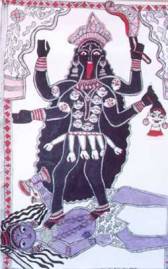
Au fur et à mesure que les déesses prédominent sur les dieux, les rites deviennent antinomiens (niiddha) et fauves. Parmi ces déesses se trouve Kālī devant qui chaque jour dans le temple à Kālīghat, banlieue de Calcutta, on sacrifie d’innombrables chèvres. Quel rapport peut-il y avoir entre Marie la douce et Kālī la féroce ? Toutefois, la déesse noire nous fait voir la Bienheureuse Vierge d’une toute autre façon, car si Kālī avance sa langue pour boire le sang des animaux et du monde, c’est Marie à Cana en Galilée qui demande, qui exige, que Jésus fournisse non pas tellement le vin mais plutôt son sang. Si Kālī danse sur le corps de Śiva, c’est Marie qui se tient tout près de la croix pour être la première à recevoir l’Esprit qui réjouit le monde. Kālī est un personnage mythique, Marie en est la réalisation historique. Marie est la Kālī et redevient ainsi la puissante Mère de Dieu.

Mais on a peur de Kālī, la śakti, car elle élimine le sentiment du soi individuel, ce sentiment qui est la souillure primordiale (āavamala). Elle fait écrouler les idées en révélant la suprême conscience qui dépasse tout. Elle est le vrai gourou qui, par l’intermédiaire d’une femme réelle et particulière, illumine le disciple pleinement. Pourquoi visiter le champ crématoire en dehors de la ville si on peut, chez soi et bien plus intensément, atteindre le même but en s’unissant à la partenaire tantrique (dū).

Ce travail de la divine śakti, c’est le travail de l’Esprit aussi. L’Esprit qui travaille à la divinisation du chrétien, le Feu qui consume, fait qu’on cesse d’être un individu et qu’on devienne une personne. Mais, hélas, on préfère son individualité, son atomisme, son petit soi. On refuse de perdre la vie pour la gagner (Mc 8.35).

L’Esprit Saint qui est l’apogée de la Sainte Trinité, cette Troisième Personne dont l’icône principale est la femme, va là où il veut, libre comme le vent (Jn 3.8) que rien, ni même les hommes d’Eglise, ne peut contraindre. Le chrétien se laisse inspirer par l’Esprit et se soumet à cette śakti; il cesse d’être figée et s’incline aux mouvements de l’Esprit tout puissant.

De nos jours les femmes ont à jouer le même rôle, dans la société comme dans l’Eglise. C’est la femme surtout qui sait discerner ce qui est fécond et ce qui est stérile. C’est donc aux femmes de détruire les constructions mentales et les temples construits par la main des hommes (Ac 7.48) qui ne servent plus à rien. C’est aux femmes de démontrer le chemin à prendre et de faire naitre une Eglise nouvelle. Voilà ce qu’enseigne le tantra chrétien. Il est très actuel.

  1. La prière

Dans ce système non duel comment peut-on parler de la prière, ce qui semble exiger un dualisme entre celui qui prie et celui à qui on prie. De fait, on ne trouve aucune discussion sur la prière dans le Tantrāloka. Tout au début du livre Abhinavagupta exprime sa reconnaissance envers Śiva dans un poème qu’il cite également au début du Tantrasāra (Abhinavagupta 1982) et du Parātriśikāvivaraa (Abhinavagupta 1991). On trouve ce même hommage dans le premier verset du poème Mahopadeśaviśatikā : « Hommage à Toi, mon propre Soi aux énergies infinies, lumières consciente et félicité éternelles ; (hommage à Toi) sous ta forme concrète d’univers dont l’essence transcende le déploiement des phénomènes. » (Abhinavagupta 1970)  Il y a hommage mais non pas prière. L’adepte (sādhaka) est censé obtenir par la puissance de ses mantras, de ses austérités (tapas), de ses diagrammes (yantra) etc., une sorte de puissance magique, soit noire ou blanche, capable de donner les résultats voulus.

Toutefois, même si ces aspects du tantra du Cachemire ne correspondent pas à l’idée chrétienne de la prière, il peut nous donner sujet de réflexion car Jésus prie, tout en assurant ses auditeurs qu’il obtient tout ce qu’il demande (Jn 11.41-42), que tout pouvoir lui a été donné au ciel et sur la terre (Mt 28.18), il prie, non pas par faiblesse mais parce qu’il est le Fils qui agit en identité de cœur et d’âme avec Celui qui l’envoie. Il ne demande une chose qu’il est incapable d’obtenir par des propres forces, mais il réalise en union avec Celui de qui tout provient, y compris ses propres pouvoirs. Le non dualisme de Cachemire n’empêche pas la prière : il la transforme. La prière chrétienne tantrique est à la fois toute-puissante et obéissante. C’est en acceptant le bien et le mal, le pur et l’impur, c’est en réconciliant en soi-même la diversité du monde qu’on acquiert un esprit d’équilibre (samatā) de sorte qu’on devient présent à tout, n’importe ce qui se passe. Une puissance extraordinaire se manifeste en soi, venant d’au-delà de ce monde. C’est la foi qui déloge les montagnes.

Conclusion

En somme ce tantra chrétien souligne le non dualisme en contraste avec le dualisme d’une certaine théologie chrétienne. Jésus est sauveur car il expérimente tout d’une façon non duelle. Il sait et il laisse savoir, et permet ainsi l’identification avec le silence du simple Cœur paternel. Jésus le grand tantrique, facilite la découverte de l’autonomie et du pouvoir. Il permet à chacun de découvrir la voie qui lui convient pour parvenir à l’amour pleinement conscient. Cela jette une base authentique de la morale. Le tantra chrétien prône une spiritualité sexuelle caractérisée par l’éclosion de la conscience et l’élimination du soi individuel, une spiritualité non duelle aussi du plaisir et de l’horreur dont la Messe est l’expression la plus complète. Finalement un tantra chrétien affirme la primauté de la femme, symbole de l’Esprit qui fait naître un monde nouveau, une Eglise nouvelle.

En somme, par sa richesse le tantra chrétien ouvre d’innombrables voies à la réflexion théologique.

Références bibliographiques

—–     Le Vijñāna Bhairava (1983) / trad. par L. Silburn, Paris, E. de Boccard, (Publications de l’Institut de Civilisation Indienne ; 15).

—–     Śiva Sūtra. The Yoga of Supreme Identity, (1979), / trad. par J. Singh, Delhi, Motilal Banarsidass.

ABHINAVAGUPTA, (1958), Paramārthasāra, / trad. par L. Silburn, Paris, (Publications de l’Institut de Civilisation Indienne ; 5).

ABHINAVAGUPTA, (1970) « Mahopadeśaviṁśatikā » dans Hymnes de Abhinavagupta, / trad. par L. Silburn, Paris, E. de Boccard, (Publications de l’Institut de Civilisation Indienne ; 31).

ABHINAVAGUPTA, (1982) [1918] Tantrasāra Delhi, Bani Prakashan. [Première édition avec notes, dir. Mukund Rām ShāstrÍ. Srinagar, Kashmir Series of Texts and Studies; 17]

ABHINAVAGUPTA, (1987) [1918-1938] Tantrāloka, with the Commentary of Jayaratha. Re-edited by R.C. Dwivedi and Navjivan Rastogi, enlarged with an introduction by Navjivan Rastogi and reprinted in 8 volumes, Delhi, Motilal Banarsidass, [Première edition dir. Mukund Ram Shastri, publiée en 12 volumes, Srinagar, Publications of the Research Department of the Jammu and Kashmir State, Kashmir Series of Texts and Studies; 23, 28, 30, 36, 35, 29, 41, 47, 59, 52, 57 et 58]

ABHINAVAGUPTA, (1991) [1918] Parātriśikāvivaraa, dir. Mukunda Rāma Shāstrī. New Delhi, Aroma Publishing House. [Première edition, Srinagar, Publications of the Research Department of the Jammu and Kashmir State, Kashmir Series of Texts and Studies ; 18]

DUPUCHE, J. (2003), Abhinavagupta : The Kula Ritual as elaborated in chapter 29 of the Tantrāloka, Delhi, Motilal Banarsidass.

DUPUCHE, J. (2003), “ “ Jesus is the Christ. ” (Acts 9.22) Can Jesus be called Shiva ? ” dans Theology@ McAuley, E-Journal, Australian Catholic University.

DUPUCHE, J. (2004), “ Renewing Christian Anthropology in Terms of Kashmir Shaivism ”, dans Theology@ McAuley, E-Journal, Australian Catholic University.

DUPUCHE, J. (2005), “ The Doctrine of Recognition (pratyabhijñā) and Interreligious Dialogue ”, dans SADANANDA DAS, and E. FÜRLINGER, dir., Sāmarasya, Studies in Indian Arts, Philosophy and Interreligious dialogue – in Honour of Bettina Bäumer, Delhi, D.K. Printworld, p. 431-439.

DUPUCHE, J. (2005), “ The First and Last Cry : an Examination of the First and Last Moments of Jesus of Nazareth in the Light of the Four Levels of the Word (Vāc) in Kashmir Shaivism ”, dans B. BÄUMER et J. DUPUCHE, dir., ‘Void and Fullness in the Buddhist, Hindu and Christian Traditions ; An Interreligious Retreat-Seminar’, Sarnath (India), 11-16 December 1999, Delhi, D.K. Printworld, p. 243-252.

DUPUCHE, J. (2009), Vers un tantra chrétien ; la rencontre du Christianisme et du Shivaïsme du Cachemire, Melbourne, David Lovell Publishing.

KÑEMARÀJA, (1982), Pratyabhijñāhdayam, / trad. J. Singh, Delhi, Motilal Banarsidass.

MULLER-ORTEGA, P.-E. (1989), The Triadic Heart of Śiva, Albany, State University of New York Press.

SANDERSON, A. (1983) “ Śivasútra et Vimarśinī de Kṣemarāja : traduction et introduction, by L. Silburn ” [revue] dans Bulletin of the School of Oriental and African Studies, 46, p. 160-161.

SANDERSON, A. (1995), « Meaning in Tantric Ritual » dans A.M. BLONDEAU et K. SCHIPPER dir., Essais sur le rituel III : colloque du centenaire de la section des sciences religieuses de l’Ecole pratique des hautes études, Louvain-Paris, Peeters, Vol. 3, p. 23, 79.

URBAN, H. (2003), Tantra : sex, secrecy, politics and power in the study of religion, Berkeley, University of California Press.

Résumés :

« ‘Un tantra chrétien’ ? Impossible ! Quel rapport peut-il y avoir entre l’érotisme du tantra et l’amour révélé par le Christ Jésus qui proclame, « Nul n’a d’amour plus grand que celui qui se dessaisit de sa vie pour ceux qu’il aime (Jn 15.13) ». Toutefois …. ».

Jean Dupuche, curé de paroisse et Honorary Fellow du ‘Centre for Interreligious Dialogue’ à l’Australian Catholic University, présente quelques réflexions sur les rapports entre l’Evangile et le Tantra du Cachemire. Non-dualisme, parole, autonomie, spiritualités du plaisir et de l’horreur, l’ascendance du féminin, la prière : tout un monde nouveau, qui répond aux besoins de notre époque, se révèle sous les étincelles du choc de cette rencontre interreligieuse inouïe. Cela aidera à une réflexion inusitée sur les rapports trinitaires, la conscience de Jésus, Jésus comme sauveur unique, les fondements de la morale, les doctrines mariales, etc.

‘A Christian Tantra’? Impossible ! What connection can there be between the eroticism of the tantra and the love revealed by Christ Jesus who proclaims, “ No one has greater love than this, to lay down one’s life for one’s friends (Jn 15.13) ”. And yet ….

Jean Dupuche, Parish Priest and Honorary Fellow of the ‘Centre of Interreligious Dialogue’ at Australian Catholic University, presents some thoughts on the relationship between the Gospel and the Tantra of Kashmir. Non-dualism, word, autonomy, spiritualties of pleasure and horror, and the ascendancy of the feminine, prayer: a whole world, which relates to the needs of our own times, is revealed in the light of an altogether novel interplay. It gives some pointers for new perspectives on the Trinity, the question of Jesus’ consciousness, on Jesus as unique saviour, the foundations of ethics, the Marian doctrines etc.

Posted in Christian tantra, Kashmir Shaivism | Leave a comment

“Ageing, spirituality and sexuality – an oxymoron?”

Old couple walking“Ageing, spirituality and sexuality – an oxymoron?”

Conclusion:    Age is no barrier to sexuality; on the contrary in virtue of life’s experience, sexuality acquires its most overwhelming intensity. There is no oxymoron in combining age, sexuality and spirituality. On the contrary, these become identical.

 Presentation by John Dupuche at Tantra Conference April 2016 Janssen Spirituality Centre, Boronia

INTRODUCTION:

The dichotomy of ‘old’ and ‘young’

The prospect of growing old can be dreadful. The eyesight fails, the limbs creak; we slow down, excitement ceases, doors begin to close. Language itself views age negatively, with terms such as ‘old-fashioned’, ‘old-hat’, ‘old-people’s home’. ‘out of date’. ‘Ageism’ categorises people as irrelevant, an obstacle, and a burden on society. Retirement is an added issue, for the old live off their earnings or worse, by means of the pension system, use up the income of others. This is resented. Shouldn’t they bow out gracefully?

The Bible itself describes the dread of old age:

“when strong men are bent, and those who look through the windows see dimly; 5when one is afraid of heights, and desire fails; when the pitcher is broken at the fountain, 7and the dust returns to the earth as it was, 8Vanity of vanities, says the Teacher; all is vanity.”[1]

By contrast, youth has all the accolades. It is a time of beauty and energy, empowerment and pleasure, of individuation and self-discovery, of sexual prowess and resilience, full of possibilities and prospects. “Faster, higher, stronger” is the motto of the Olympic Games.

The Bible likewise praises youth.

“Rejoice, young man, while you are young, and let your heart cheer you in the days of your youth. Follow the inclination of your heart and the desire of your eyes …”[2]

What possible value can there be to ageing? Since time immemorial people have sought after the elixir of youth, the ambrosia of the gods? Better food and exercise will prolong youth. Medication will counter the effects of ageing. This is good, but is it all?

Suffering

However, the question can also be asked: is it an illusion to idolize the young and turn away from age? Isn’t this reaction a typical example of suffering, as taught by Buddhism? We desire youth and reject old age, whereas the Buddha proposes neither craving nor aversion.

This suffering is particularly evident in the area of sexuality, where the fires of youth grow cool, the excitement of falling in love loses its charm, the delights of love-making become jaded. What is the place of sexuality in old-age? Is it not embarrassing to see old people falling in love even as their flesh sags and their limbs creak? Is it not ridiculous to see the old trying to be young?

So the title of this talk is seem to be an oxymoron. How can sexuality and spirituality have a place in the ageing process?

I will start by presenting the teaching of tantra, and go on to show how it can resolve this oxymoron. I will then go on to show what the Christian dimension also contributes to the issue and how, ultimately the most intense pleasures of sexuality go beyond the categories of youth and age.


PART 1          THE TEACHING OF TANTRA

  1. The essential requirement

Tantra is commonly misunderstood in the West. The images on the internet give an altogether false impression of the richness of the tantric tradition. While this ‘Californian tantra’ does promote the discovery of a deeper experience of sexuality, it does not explore the possibilities provided by the Kula tradition, which is the most extreme form of tantra.

First of all, the Kula tradition rejects the divisive categories of pure and impure, licit and illicit. It also holds that the divisive concepts of youth and age are irrelevant. Such categories only demonstrate a limitation of consciousness.

In the description of the Kaula tantric ritual, the question is asked about the essential character of the sexual partner. What must she be like? The commentator Jayaratha, who is skillful in explaining the text, quotes poems that describe two types of women. He describes the first as follows:

“Let him, then, bring a sexual partner … her eyes reeling with desire; … her eyes like those of a trembling fawn; … her face, with the lovely charm of the full moon, ravishes the heart; … her speech is beautiful like the many stammering cries of the goose … she dances, she sings and makes cries of pleasure (sīt), she plays and pretends to repulse a lover’s caress; … she is the sexual partner, the enchantress, …”[3]

Then he presents an altogether different type of woman, far more demure.

“She virtuous, obedient to her teacher’s command; her speech is agreeable, her form is pleasing, she is placid, free from attachment; … she abhors nothing, she is clearly wise; … her smile is beautiful; very affectionate and modest, she always attends to the well-being of guests; … she is unsullied, without ego; … she is truly content in all circumstances … “[4]

Jayaratha then gives a quote that expostulates

A sexual partner with [all the qualities] listed in that way is unobtainable.”[5]

and so introduces Abhinavagupta’s teaching:

“The characteristic quality of a Śakti is that she is in no way separated from him who possesses her. Let him, therefore, bring [a śakti] of this sort, but without regard to castes etc.”[6]

The crucial description of the sexual partner is that she is “is no way separated from him”. She is fully united to him. Note that Abhinavagupta, who is writing one thousand years ago sees things from a male perspective. We need to add that the male is also in no way separate from the female.

He adds without regard to castes etc.” Given the divisive nature of the caste system in his day as in our own, the unity is set at the most sublime level. Jayaratha explains that “the word ‘etc.’ implies all the characteristics such as youth and so on.”[7]

Thus the most extreme of the tantric rituals is properly practiced between a man and a woman without regard to age, beauty, caste etc. as long as they are completely united.

The tantric ritual, therefore, is not concerned with the excitement of youth or the advntages of wealth or social status. It focuses on the innermost quality of soul.

Is this just a case of ‘sour grapes’, claiming that youth is not the goal and purpose of existence? Is it just make-believe, a process of denial? Is it a really just envy and jealousy, desire and frustration, regret and pining for the good old times?

  1. The signs

The issue of pleasure is tackled by another set of teachings from Abhinavagupta.

He speaks of the various signs of the śaktipāta, the descent of the energy of the goddess into the practitioner.

Entering – as a result of a descent of energy classified as intense etc. – into the mind, space, subtle-breath, internal and external bodies of the student who is being cleansed by her, the rudraśakti produces the following respective results: bliss, lightness, trembling, sleep and a reeling in the body.[8]

Abhinavagupta teaches that there are various levels of being, listed in descending order as “mind, space, subtle-breath, internal and external bodies”. In this system, the higher levels such as ‘mind’ are the source of the lower levels such as ‘body’. The divine energy produces different effect at these different levels, which Abhinavagupta lists respectively as “bliss, lightness, trembling, sleep and a reeling in the body”. In the external body there is the spectacular effect of “reeling”, while in the mind the effect is “bliss’. In other words, the more eye-catching effects are found in the more external aspects of the person. While the ‘reeling’ is visible, the ‘bliss’ is not, except for those who can see, for the blissful perceive bliss. Therefore for those whose attention is focussed on the external body only, there may seem to be no value in the experience of bliss. The orgy, which is enticing to many, and is transformed in some modern views into sacred ritual, is concerned with spectacular mind-blowing experiences. The most extreme tantra, however, is concerned with bliss.

The word for ‘bliss’ in Sanskrit, ānanda, is supremely significant since it refers to what the god and the goddess experience in their lovemaking. It is pleasure at the divine level. The supreme reality in fact consists of the god and goddess united in an everlasting intercourse whose earthly counterpart is the union of the couple.

Is our modern attitude completely focused on the visible and the physical, and therefore on the spectacular, on film stars and athletes? While this is not to be

rejected, of course, it does not represent the highest form of experience, which is that of ānanda.

The aim of modern tantra is to experience intense physical and emotional and spiritual pleasure and so to open up the consciousness and come to an awareness of one’s identity as god and goddess united in intercourse. However, it presumes that this means starting from the lower and moving to the higher. This paper questions this presumption, which seems to be fixed in the modern mind.

  1. The levels of consciousness

What then is consciousness? In the teaching of Kashmir Shaivism there are five levels.

The level is jāgrat, which is the objective level of consciousness, that level which everyone sees. It is the domain of public knowledge, the evidence that can be proven in court and demonstrated in the sciences. It is the level of visibility. In the West this form of knowledge counts as real; the rest is fabulation.

In Kashmir Shaivism and in Hindu thought generally, jāgrat is the least valuable in terms of coming to true self-knowledge. More significant is the level of svapna, ‘dreaming sleep’. Modern psychology would now agree, since it is in dreams that the true psyche of the person becomes evident. The public persona can be a mask that hides the real self.

The third stage is suṣupta, ‘deep sleep’, which has no dreams and which touches on the very nature of the person. It is the mind of the new-born child, indeed of the foetus, before any impressions have come from outside to orient the developing consciousness and so to limit its universal plasticity. ‘Deep sleep’ is used in re-birthing techniques where the patient can go back before any trauma, and start again, so to speak. The suṣupta is at the level of essential human nature.

Lovemaking employs these three levels. The couple ‘sleep together’. This use of language is interesting, for it shows that the couple, by their outer activity eventually come to unite in a place beyond action, beyond sensation, beyond thought, beyond dreams, where they form one mind and heart together. Their love-making moves from the outer levels to the very essence of their being.

According to Kashmir Shaivism, there are two further levels, tūrya and tūryātīta. The level of tūrya, is the level of the divine goddess from whom all reality proceeds. The couple is the result of the goddess’s freedom. In other words their union is ‘made in heaven’ and takes them to heaven itself. In their union they experience the divine intercourse of the god and the goddess.

The final level, tūryātīta, is that of Śiva, the god, supreme consciousness with whom the goddess is in undivided union.

In other words, the most profound experience of sexuality is not in the visible but in the invisible, not in the outer activity but the inner experience, not just at the human level but at the divine level also. If sexual activity does not lead to this point it remains unsatisfying.

  1. Three levels of being

There are the three levels of sthūla, sukṣma and para. The term sthūla (‘gross’) refers to the visible objective world, the material, outer level of things. The term sukṣma (subtle) refers to level of the emotions, knowledge, reason and so on. The term para (‘supreme’) refers to heaven itself. The famous psychologist Carl Jung could speak of the first two, but he says “I do not speak of the parā aspect because that is what Professor Hauer calls the metaphysical I must confess that there the mist begins for me – I do not risk myself there.”[9] The parā level was beyond the level of the archetypes which are Jung’s focus. The divine level is experienced; it is not captured by the categories of the mind.

In short, the teaching of the tantric tradition is that Kaula lovers experience the most intense pleasure, the divine bliss, which has nothing to do with social status, age and beauty. By their Kaula ritual they are taken into the divine state and experience the eternal love-making of the divine couple. All other forms of love-making are assessed according to this ultimate stage. All other love-making is a lesser form of this highest loving.

PART II          THE CHRISTIAN CONTRIBUTION

  1. The teaching of St Paul

The scene now shifts to the Christian dimension.

St Paul says

11”When I was a child, I spoke like a child, I thought like a child, I reasoned like a child; when I became an adult, I put an end to childish ways.”[10]

This can be expanded to read, ‘when I was a youth I thought like a youth, but now that I am old, I put an end to youthful ways.’ St Paul could say that the point of youth, indeed the point of lovemaking, is to go beyond all limitations to achieve what is most intense, most sublime, most powerful, lasting and total.

In fact, he says:

12For now we see in a mirror, dimly, but then we will see face to face. Now I know only in part; then I will know fully, even as I have been fully known.[11]

The purpose of sex is not just procreation or pleasure but also divinization, where ‘I know as fully as I am known’, where subject and object are one.


TEXT 1           Youth

The couple, therefore, progress through various stages. There is, in adolescence, the wakening to the world of sex, falling in love with the possibility of love. People must have their fill of the sparkle of youth. To refuse it is a mistake, for if they do not enjoy the outer element of things, their progress to the more intense state will not take place. There will be a hidden regret, unfinished business, and a longing for what was not experienced. Youth must be youthful. But youth is also the road to more intense feelings, which are less spectacular but more fulfilling. If sexuality is experienced only in a youthful manner, it will not satisfy since the person has greater capacities that need to be fulfilled as well. Love, which remains only at the physical level, is counterproductive. Love, which penetrates to the soul, is enriching. Those who refuse this experience of penetrating to the soul will in fact find themselves becoming shallow.

A quotation provided by Jayaratha is relevant here:

“When the lower states move to a higher level,          … [there is] an acquisition of knowledge. And the states which are in the higher circle, if they go to a lower level, then there is possession by a Piśāca [demon]…”[12]

The rising is a penetration to the soul, to the inmost being, where the couple can be fully united. This process is not easy. Hinduism, like every other religious system, holds that the spiritual path also involves a time of testing, or tapas. A Sanskrit term, which can be translated as ‘austerity’. It is connected with the word for ‘heat’. The time of austerity increases the fire and the fervour.

  1. St John of the Cross

This path of rising to a higher level can be linked with the process of the dark nights mentioned by St John of the Cross. These can be set out as follows:

  1. Night of the senses
    1. Active:
      1. purification, mortification of the appetites;
      2. looking at faults and virtues;
    2. Passive:
      1. dryness, distaste, learning to trust;
    3. Night of the soul
      1. Active:
        1. purification through the theological virtues of faith, hope and love;
      2. Passive:
        1. night of intelligence – “faith only”
        2. night of memory     – “hope only”
  • night of the will     – “thy will be done”

TEXT 2

At the first stage in the spiritual journey, there is excitement at finding a path that gives so much joy and fulfilment. In terms of the couple this could be related to the time of courtship and honeymoon, where strong bonds are forged and the couple do already experience transcendent bliss, and do become images of the divine. It is a time of the discovery of their wonder, each of the other, of their complementarity and fulfilment. They allow each other to see their inner person; they open the windows of their souls and show their beauty. There is already a taste of the Godhead, but it can be developed.


TEXT 3           Active and Passive Night of the senses

This time of joyful beginning is followed by a time of purification where the lovers learn to live together and to give up any annoying aspects of their personality. It is the ‘active night of the senses’.

There is also the ‘passive night of the senses’ where God is the agent, and things happen by the gift of grace alone. The excitement and pleasure of earlier times lose their novelty. The ‘honeymoon period’ is over. It is a time of testing, which not all survive, especially if they are mindlessly attached to the sensations of lovemaking and do not seek a deeper relationship. It is a difficult time for the couples, especially if they are misled by the images of love that are one-sidedly emphasised in the media.


TEXT 4           Active and Passive Night of the soul

But there is further stage of testing, called ‘the dark night of the soul’. In the ‘active stage’ of dark night of the soul, the lovers are increasingly transformed by the qualities of faith, hope and love. They place their faith in each other, totally, trusting each other, appreciating each other, believing in each other, knowing the quality of each other’s soul, learning to perceive each other with complete clarity, seeing the depths that they have attained, the strength of their commitment. They hope in each other, looking forward to the capacities that are coming to the surface, infinitely patient with each other, knowing that the true self is being revealed. They love the other with the full passion of their soul, with their very substance. They are willing to die for each other. They love each other’s love; they want only their love. As a result every action, every word, and every touch become charged with meaning.

They become faith, hope and love, and give each other the title ‘love’. St Bernard of Clairvaux says:

“Love is self-sufficient; it is pleasing to itself and on its own account. Love is its own payment, its own reward. Love needs no extrinsic cause or result. Love is the result of love, it is intrinsically valuable. I love because I love; I love in order to love.”[13]

There is the ‘passive’ stage where God is the agent, and things happen by grace alone. On this John of the Cross writes:

  • “‘Night’ is where the real change in the person occurs.”
  • “The soul must enter into the tomb of hidden death if the spiritual resurrection which it awaits is to come about.” (Dark Night II, 6)
  • “Nothing is worth a single act of faith made in dryness.”
  • “Faith, where we love God without understanding him ….” (Spiritual Canticle)
  • The will adheres to God “in emptiness and in the absence of emotions”;


TEXT 5           This affects their whole person,

It is at this final stage, that their love has reached its fullness. Their love has grown and has become firm and reliable, dependable and totally honest. This gives quality and real pleasure. They have no fear; they know they have been tested and have become worthy of each other. They have discovered pools of love they never knew existed. They have discovered that they themselves are each other’s purpose. They know they are each other’s destiny.

They have known the sparkle of youth; they have known the stability of age. They do not reject youth or age; they have been young and now they are old; they are neither young nor old, for they have gone beyond time. They have come to an eternal love, the essence of relationship. They are beautiful, and they know they are truly empowered. As they look at each other, heaven opens its doors, for they manifest heaven to each other. Their every look is conscious, aware, penetrating, attractive, meaningful, a window onto infinity.

The pleasure that is found there is not the same as the pleasure of the beginners’ love, but is more intense, for it touches the deepest level of their being. The couple who have reached this stage look fondly on the joy of a young couple and will be reminded of their own early love, but they also know that the young couple will be tested and hopefully will come to the love that fully satisfies the heart. They are glad they have gone through the testing and have flourished.

These lovers experience the intensity of their relationship. There is a thrill, which is physical, but differently physical from the thrill of youth, for it penetrates to the soul. It touches every fibre of their being, to the very finger tips. It involves their whole history, their memories, the highs and lows of their relationship, the good times and bad, the health and sickness, the troubles and success. The lovers bring heaven and earth together.

CONCLUSION:

Age is no barrier to sexuality; on the contrary in virtue of life’s experience, sexuality acquires its most overwhelming intensity. There is no oxymoron in combining age, sexuality and spirituality. On the contrary, these become identical.

In terms of Kashmir Shaivism the lovers see themselves as Śiva and Śakti. In Christian terms they see themselves as Word and Spirit. In their perfect complementarity they come to know the One from whom all things come. They are complementary to each other, they proceed from the One. They have acquired the divine mind. They come to know the Communion of the Three

[1] Ecclesiastes 12:3, 5-8.

[2] Ecclesiastes 11:9.

[3] Qt.100b.5.

[4] Qt.100b.6.

[5] Jr.100b.7.

[6] TA 29.100b-101a.

[7] Jr.101b.2

[8] 29.207-208.

[9] C. G. Jung, The Psychology of Kundalini Yoga, Sonu Shamdasani (ed.), Princeton, NJ: Princeton University Press, 1996. pp. 6-7.

[10] 1 Cor 13.11.

[11] 1 Cor 13:12.

[12] Qt.239b.1.

[13] The Divine Office, Vol.3. Sydney: E.J. Dwyer, 1973. pp.204*-206*.

Posted in Christian tantra, Kashmir Shaivism | Leave a comment

The Tantrāloka of Abhinavagupta (975-1025 CE)

Posted in Uncategorized | Leave a comment

Starting from sexual intercourse and arriving at the heart. Tantrāloka chapter 5 verse 71.

HeartStarting from sexual intercourse and arriving at the heart.

This text from Kashmir Shaivism examines brilliantly the progression from the outer to the inner, from the particular to the universal, from the particular woman to the universal feminine.

 Tantrāloka chapter 5 śloka 71.

The verse reads as follows:

“Let the wise man come to the ‘heart’: when the śakti is aroused, when he enters into the kula, when he is aware of the extremities of all the channels, when there is omnipresence, when everything is drawn into the Self.”

śākte kṣobhe kulāveśe sarvanāḍyagragocare /

vyāptau sarvātmasaṁkoce hṛdayaṁ praviśetsudhīḥ //

This śloka lists a range of different contexts of pleasure and concludes by noting that that the wise person (sudhīḥ) will, in all these various contexts, arrive (praviśet) at the principle that unites them all, which is the heart (hṛdayaṁ).

The contexts proceed from the outer and most visible to the most interior and unperceived. This is in keeping with the general principle that the inner is superior to the outer, the universal to the particular, the unexpressed to the expressed; the inner is the source of the outer; the purpose of the outer is to reach the inner.

The list goes, progressively from the individual ‘external śakti’ to the sense of universal presence and ultimately to the ‘self’. These are put in sequence to show that one leads to the other, for when there is sexual union, either actual or remembered, then all the faculties are heightened, every sensation is awakened, and one acquires a sense of universality and of the Self. The list is thus read as a sequence, a series of consequences, a progression. It could be paraphrased as follows:

“Once the śakti is aroused, and he has entered into the kula, and become aware of the extremities of all the channels, and then senses omnipresence and draws everything into the Self: at that point the wise man comes to the ‘heart’.”

The progression is natural, in that the focus on one section, for example on the external śakti, leads naturally to the next stage. The first is redolent of the second and so on. Each opens onto the next. There is a progressive expansion and unfolding. If the progress is hindered, if the practitioner is attached to any one stage, then it loses its effectiveness and becomes jaded. The practitioner must enjoy and then naturally move on in the progressive flowering. Thus at the end the practitioner reaches the ‘heart’ which is in fact the yoni focused on at the start, but in all its fullness.

Furthermore, the list can be read as a series of couples. Thus śākte kṣobhe is linked with and contrasted with kulāveśe as Jayarahta makes clear by his linking of the two verses 69 and 70 from the Vijñānabhairava-tantra; sarvanāḍyagragocare is divided in two by Jayaratha as sarvanāḍyagragocare   referring to the ‘peak’ where all the channels meet, the ‘end-of-twelve’; this is linked is with and contrasted with agragocare which refers to the tip of every channel; vyāptau is linked with and contrasted with sarvātmasaṁkoce. This shows how carefully 5.71 is constructed.

The list can also be read as a set of alternatives: the actual intercourse, the memory of it, the awakening of any faculty, the sense of universal pervasion, the focus on the self etc. It could be paraphrased as follows:

“The wise man comes to the ‘heart’: either when the śakti is aroused, or when he enters into the kula, or when he is aware of the extremities of all the channels, or when there is omnipresence, or when everything is drawn into the Self.”

In other words, any of these situations will lead the wise person to the ‘heart’. This same idea of alternatives is found also in the Vijñānabhairava-tantra, which consists of 112 methods, all of which lead to divine consciousness. Of the 112 methods only two are clearly sexual. These two are quoted in Jayaratha’s commentary on 5:71.

Jayaratha’s commentary:

Jayaratha prepares the reader for 5:71 by making two comments. First he notes that the ‘individual means’ (āṇavopāya), which is the subject matter of Tantrāloka chapter 5, is a practice (sādhanatva) concerned with pleasant things (sukha). He then goes on to say that pleasure has a host of disparate (bhagna) forms. How then can the practitioner maintain a sense of unity or single-mindedness (ekaka)? The question is valid. Given the multiplicity of forms of pleasure is there not a risk of the practitioner’s mind being dissipated? Will he not become so distracted by one delight after another that he becomes disjointed?

To answer this question Jayaratha takes each of the different contexts of 5:71 and supplies a śloka from the Vijñānabhairava-tantra as an illustration.

śākte kṣobhe

Jayaratha specifies that śākte kṣobhe refers to the enjoyment of the ‘external śakti’ (bāhyaśaktisabhoge), namely the act of intercourse. In illustration he quotes Vijñānabhairava-tantra 69, which we have studied elsewhere in detail.

“He comes to the śakti; the śakti is fully aroused; he enters into the śakti; the climax occurs: – the pleasure [experienced at that point] is ‘Brahma’; that pleasure is his very own.”

शक्तिसङ्गमसङ्क्षुब्धशक्त्यावेशावसानिकम्।

यत्सुखम् ब्रह्मतत्त्वस्य तत्सुखं स्वाक्यम् उच्यते॥ ६९॥

śaktisaṃgamasaṃkṣubdhaśaktyāveśāvasānikam |

yat sukham brahmatattvasya tat sukhaṃ svākyam[1] ucyate || 69 ||

The phrase śākte kṣobhe is echoed in śakti-saṃgama-saṃkṣubdha of 69: the śakti is fully aroused’. This phrase, śākta kṣobhe, is further investigated in the following śloka at 5:72 where Jayaratha asks what is the meaning of śāktasya kobhasya and makes it clear that it refers to sexual union.

kulāveśe

5:71 broadens the area of awareness, from the individual woman to the realm of the feminine. The term kula can refer to Śakti and is contrasted with Akula, which refers to Śiva, but it can also have a wider reference, namely all the outpourings of Śakti who is the source of the universe.

Jayaratha quotes Vijñānabhairava-tantra 70, which speaks of the memory of a past encounter and all that happened. We have already studied it elsewhere in detail.

“O Mistress of the Gods, bliss surges even in the absence of a śakti, through the act of recalling intently the pleasure experienced with a woman, the kissing, the embracing, the clasping.”

लेहनामन्थनाकोटैः स्त्रीसुखस्य भरात्स्मृतेः।

शक्त्यभावेऽपि देवेशि भवेद् आनन्दसम्प्लवः॥ ७०॥

lehanāmanthanākoṭaiḥ strīsukhasya bharāt smṛteḥ |

śaktyabhāve ‘pi deveśi bhaved ānandasamplavaḥ || 70 ||

sarvanāḍyagragocare

5:71 expands the realm of awareness.

Jayaratha gives two interpretations at this point. First of all he interprets sarvanāḍyagragocare to refer to dvādaśānta (‘end-of-twelve’), which can refer to a multitude of locations such as at twelve finger widths from the nostril where the outgoing breath ceases but ‘principally or eventually’ (pradhāne pāryantike vā) to the point at twelve finger widths from the crown of the head where all the channels come together.

With reference to dvādaśānta he quotes Vijñānabhairava-tantra 51.

‘One should focus the mind on the higher centre (dvādaśānte) in whatever which way. After a few days, once the agitation gradually comes to an end, the Ineffable (vailakṣaṇyaṁ) occurs.”

यथा तथा यत्र तत्र द्वादशान्ते मनः क्षिपेत्॥

प्रतिक्षणं क्षीणवृत्तेर् वैलक्षण्यं दिनैर् भवेत्॥ ५१॥

yathā tathā yatra tatra dvādaśānte manaḥ kṣipet||

pratikṣaṇaṁ kṣīṇavṛtter vailakṣaṇyaṁ dinair bhavet|| 51 ||

agragocare

Jayaratha goes on to focus on a section of the term sarvanāḍyagragocare, namely the phrase agragocare and gives a wider interpretation of the word ‘extremity’ (agra) and includes all sorts of places (prāntadeśe) in this. He provides the example of gently pressing the armpit (kaka). Great pleasure is felt (mahānanda) there. So it is no only the point above the crown of the head but at any and every point that great pleasure can be felt.

To illustrate this point, he quotes Vijñānabhairava-tantra 66, which speaks of mahānando. It also refers to the element of surprise, as though by a trick of magic (kuhanena).

“As though by magic, O Lady with the eyes of a gazelle, a great bliss suddenly rises. As a result, the Reality manifests itself.”

कुहनेन प्रयोगेण सद्य एव मृगेक्षणे।

समुदेति महानन्दो येन तत्त्वं प्रकाशते॥ ६६॥

kuhanena prayogeṇa sadya eva mṛgekṣaṇe |

samudeti mahānando yena tattvaṁ prakāśate || 66 ||

vyāptau

Abhinavagupta makes the point that it is not only in the act or memory of lovemaking, or in the sensations felt at the extremities, but also by the sense of universal presence that entry is gained to the heart.

Jayaratha quotes two texts in this regard. The first is Vijñānabhairava-tantra 109, which we have already studied elsewhere in detail.

“The Supreme Lord is all-knowing, all-doing, and all-doing, pervading. ‘I am He indeed, the reality of Śiva’. As a result of dwelling on this thought, one becomes Śiva.

सर्वज्ञः सर्वकर्ता च व्यापकः परमेश्वरः।

स एवाहं शैवधर्मा इति दार्ढ्याच् चिवो भवेत्॥ १०९॥

sarvajñaḥ sarvakartā ca vyāpakaḥ parameśvaraḥ |

sa evāhaṁ śaivadharmā iti dārḍhyāc civo bhavet|| 109 ||

The second is Vijñānabhairava-tantra 110, which we have already studied elsewhere in detail.

“Just as the waves arise from the water, flames from fire and rays from the sun, so too from me, Bhairava, the aspects of the universe arise in their variety.”

जलस्येवोर्मयो वह्नेर् ज्वालाभङ्ग्यः प्रभा रवेः।

ममैव भैरवस्यैता विश्वभङ्ग्यो विभेदिताः॥ ११०॥

jalasyevormayo vahner jvālābhaṅgyaḥ prabhā raveḥ |

mamaiva bhairavasyaitā viśvabhaṅgyo vibheditāḥ || 110 ||

sarvātmasaṁkoce

Abhinavagupta then refers to the act of withdrawing from all these external sensations and perceptions. It is the focusing (saṁkoce) without any object of knowledge, a movement beyond knowledge, into the depths.

The sense of the word saṁkoca here differs significantly from another frequently used sense where saṁkoca means the ‘contraction’ or ‘limitation’ of consciousness, and is contrasted with vikāsa, which means the ‘expansion’ and ‘opening up’ of consciousness. Here saṁkoca has a very positive meaning.

In his commentary Jayaratha quotes the phrase naitadvastu sat kicit, ‘there is nothing at all’, which echoes kasyacin naitad in Vijñānabhairava-tantra 99 which he quotes.

“All knowledge is without cause, without support, fallacious. In absolute terms, no one has [knowledge]. By adopting this point of view, O Beloved, one becomes Śiva.”

निर्निमित्तम् भवेज् ज्ञानं निराधारम् भ्रमात्मकम्।

तत्त्वतः कस्यचिन् नैतद् एवम्भावी शिवः प्रिये॥ ९९॥

nirnimittam [2] bhavej jñānaṁ nirādhāram bhramātmakam |

tattvataḥ kasyacin naitad evambhāvī śivaḥ priye || 99 ||

He reinforces this idea with another quote from the Vijñānabhairava-tantra 102.

“If one meditates on the universe by considering it to be a fantasm, a painting or a whirlwind and comes to perceive all things in that way, happiness (sukha) arises.”

इन्द्रजालमयं विश्वं व्यस्तं वा चित्रकर्मवत्।

भ्रमद् वा ध्यायतः सर्वम् पश्यतश्च सुखोद्गमः॥ १०२॥

indrajālamayaṁ viśvaṁ vyastaṁ vā citrakarmavat|

bhramad vā dhyāyataḥ sarvam paśyataśca sukhodgamaḥ || 102 ||

hṛdayaṁ praviśetsudhīḥ

This is the climax of TĀ 5.71.

Jayaratha does not quote any text for this final section. He simply explains that the wise person has fullness of knowledge (pūrṇajñāna) and will not experience rebirth (janmā). By union with all manifestations the wise person comes to (praviśet) union with the source of them all, namely the ‘heart’ (hṛdayaṁ), which Jayaratha defines as the ‘place of emission’ (visargabhuva) and therefore the universal yoni. The heart is the totality of things, without the limitation of particular sensations. The particularities of earlier experiences are, in the hands of a wise person, the means of entry into universality. Unity is found by not by rejecting experiences but by allowing them to lead to the fine point at the origin of them all. Unity and diversity are reconciled.

The Christian dimension

5.71 could also be taken as a commentary on marriage in the Christian view of things.

Marriage, not just the institution but also the experience of husband and wife in their lovemaking, is listed as one of the seven ‘sacraments’ of the Catholic Church, namely as one of the ways in which the whole mystery of God and of salvation is expressed. Out of a divine love for each other, the couple make love and come to a realization of the divine in themselves and beyond themselves, and are taken into the ineffable One who is Love.

[1] For ākyam read ākhyam ‘named’, ‘called’, ‘declared’. The word svākhyam can be spelt out as sva-ākhyam ‘deemed to be his own’.

[2] Silburn’s and Bäumer’s versions of Vijñānabhairava-tantra 99 place nirnimittam first and nirādhāram later. Jayaratha’s version inverts the order.

Posted in Christian tantra, Hindu Christian relations, Kashmir Shaivism, Vijñānabhairava-tantra | 1 Comment

Silence is the fullness of sound

“Silence is not the absence of sound but its fullness. It not a question of being ‘dumb’, with nothing to say. Rather, it comes from sense that all has been said. “Out of silence God said but one word”. God is Silence, so to speak. The Word is said in order to lead us into Silence. The Word grants an experience of the divine Presence, like a window opening onto a vast panorama. The Silence empties itself, so to speak, by expressing itself totally, for nothing is held back, nothing is hidden; all is said. In the same way, the Word refers back to Silence. Silence expresses itself completely in the Word; the Word for its part manifests Silence in complete clarity. Word and Silence go together, equally, in an interplay.”Silence, chair

Posted in John Dupuche | Leave a comment

The person of Jesus Christ: the great debate between Islam and Christianity, ‘Surat Al-‘Ikhlāş

The person of Jesus Christ: the great debate between Islam and Christianity

One of the most significant points of difference between Christians and Muslims is their different understanding of the nature of Jesus Christ. Who is he, what is he? Closer analysis of the key text (Surat Al-‘Ikhlāş) reveals that the distance is not so great; indeed, that there might be a misunderstanding of key terms. This does not mean that the issue is resolved, but rather that it is better understood.

Jesus Islam

Reflections on the Quran, Surat Al-‘Ikhlāş (The Sincerity)’ 112:1-4 by the Mela Interfaith Association discussion group.

Surat Al-‘Ikhlāş (The Sincerity)’ 112:1-4 reads:

“Say, “He is Allah , [who is] One,

Allah , the Eternal Refuge.

He neither begets nor is born,

Nor is there to Him any equivalent.” ”:

Introductory comments:

We noted that the Quran is a text proclaimed in a particular language, and directed in the first instance to a particular audience in a particular context. We named some of the particular groups: the Quraysh of Muhammed’s immediate clan, other groups in Arabia, the ‘People of the Book’ including Christians and Jews; idolaters; faithful Muslims; believers. and at times all people, as in the verses which have the phrase “O People”.

The Quran is also a text addressed to the whole of humanity. It has therefore both a particular and universal aspect, so that we must see the universality in the particularity. This involves a process of interpretation.

Someone commented that this is true also of the Bible. He referred in particular to the word “Messiah” which has a certain meaning in the Biblical text and has been widened in scope in the later Christian understanding of the term. Another commented that the word ‘messiah’ is also found in the Quran but in a different sense from the New Testament.

‘Begotten’:

We then looked at the English word ‘begotten’ which has a very different nuance in its Arabic, Hebrew, Greek and Latin sources.

First of all, it was noted that the Arabic root of the term is WLD, which means ‘to bear’, ‘to give birth’, ‘beget’, ‘generate’, ‘procreate’, ‘bring forth’, etc. The root is at the base of words and phrases such as ‘newborn child’, ‘he was born, ‘baby boy’ (wali), ‘baby girl’ (walida), ‘birth place’ (wolud). In the phrase of the Surat: “he does not beget and he was not begotten”, the root ‘beget’ (WLD) is given in its active and passive forms; these could also be translated as: ‘he does not bring forth and is not brought forth’; ‘he does not procreate children and he was not the result of a process of procreation’.

We asked if the root WLD has a sexual/procreative aspect. It was explained that the Arabic root has further forms linked to the idea of procreation: ‘assisting in giving birth’, ‘making to bear children’, ‘making to be born or descended from’, ‘to increase’, to ‘to multiply’, ‘to aim to produce’.

We can ask, therefore, is the Surat Al-‘Ikhlāş opposing the idea prevalent in the pagan Arabic tribes of a deity having children? Childbearing deities were part of the culture. Indeed, the mythologies of the Arabic tribes even had names for the daughters of the gods; angels were the daughters of God.

A discussion then ensued about the context of the text. One member of the group pointed out that Surat Al-‘Ikhlāş is ‘Meccan text’, pronounced during the period in Mecca where there were almost no Christians, and certainly no Hindus or Greeks. Another member noted, however, that Muhammed had travelled during his youth and had met a Christian monk. He was, therefore, strongly of the opinion that Surat Al-‘Ikhlāş is clearly and primarily aimed against Christian Trinitarian ideas which had so occupied the minds ofChristians in the 4th and 5th centuries CE. Amin Ahsan Islahi (1904–1997), the noted Pakistani commentator on the Quran was also the opinion that Surat 112 is specifically aimed at Christian mythologies. But which mythology? Did Muhammad know of the gnostic speculations and hierogamies that abounded in Egypt even in later centuries?

One of us questioned whether we can be too confident about the influences on Muhammad during his youth. Not much is known for certain. He admitted, however, that among the ordinary Christians of Medina, and of Mecca if any did live in that city, there could well have been the unorthodox idea of a Trinity consisting of God, Mary and their child Jesus. The Quran intimates that this idea was around at that time. Indeed, it may have been precisely to counter that idea that the Surat Al-‘Ikhlāş was proclaimed. And because the Quran suggests this, many Muslims today, following the Quran, hold firmly that this is what Christianity actually teaches.

The word ‘begotten’ has fallen out of general use in English and is commonly used only in the creed of Nicaea/Constantinople (CE 381). The Greek, Latin and English versions of the creed read: τὸν μονογενῆ; unigenitum, ‘only-begotten’; γεννηθέντα, natum, ‘born’; γεννηθέντα οὐ ποιηθέντα, genitum non factum, ‘begotten not made’.

The Greek word monogenes is found twice in the first chapter of the Gospel of John (vv.14 and 18). This term itself hearkens back to the Genesis 22 where Abraham is told to sacrifice his ‘only son’. The Hebrew term yāhīd in Gen 22 has a double meaning: either ‘favourite son’ or ‘only son’. It firstly means ‘favourite son’ since Abraham had an older son, Ishmael, by Hagar, his wife’s serving maid. Isaac however, is the ‘only son’ that counts, the only heir. The command is all the more dramatic because Abraham is told to kill the only one son of importance. As Gen 22 is dominated by the theme of sacrifice the Greek word monogenes must also be understood to have a nuance of sacrifice. The importance of Gen 22 in the New Testament is underscored by the debates in John 8 on the true son and Abraham’s sacrifice, and in Galatians 4 about which son has a rightful place in the house. The term monegenes or unigenitus ‘only-begotten’, is therefore not just a comment about the nature of Jesus but also about his sacrificial role. This sense of sacrifice is lost in the English word ‘begotten’. It is also absent from the Arabic word.

One of us stressed again the importance of seeing the term ‘son’ in its messianic context. The word ‘messiah’ is the primary term; terms such as ‘son’ or ‘begotten’ are to be understood as commentaries on the word ‘messiah’.

The Arabic use of ‘begotten’ has a different slant from the Christian use of the ‘begotten’. Someone agreed that the Arabic term stresses procreation. The speculation of the Patristic period attached no ‘procreative’ meaning to the word γεννηθέντα. Another member agreed that at no stage does the Christian term ‘begotten’ have a physiological sense. It is more ‘abstract’, but among the ordinary people the use of the terms ‘Father’ and ‘children of God’, might have led the them to see ‘begotten’ in reproductive terms.

However, all that is perhaps missing the point of Surat Al-‘Ikhlāş which is not to oppose Christians or Greeks but to proclaim the transcendence of God.

‘One’:

At this point one of our number changed the direction of the discussion. He held that Surat Al-‘Ikhlāş has its own existence, and is not just a polemic against the ideas of Arabian tribes or Christian theologians. The Surat has nothing to do with those groups. It is a revelation of God himself. Likewise, discussions about influences on Muhammed are irrelevant. It is a self-revelation by God himself and must be seen as such in the first instance. Only after that can it be applied to other contexts. He stressed that there is value in just standing in front of mystery, and avoiding to inclination to investigate. In listening to the Quran we are being asked to bow down. The One is the heart of the mystery.

Islahi holds that there is a central theme, a ‘pillar’, in every Surat, around which the rest of the Surat revolves. The central pillar of Surat Al-‘Ikhlāş is the term ‘one’. The other terms are just an elaboration this central point. Indeed, Surat 112 is, along with Surat 1, Al-Fātiḥa, the fundamental text of the Quran. The Surat Al-‘Ikhlāş is making the point that God is one; there no one equal to him; there is no question of being begetting or being begotten; he is self-sufficient; he has no need of anything not even creation. One of us stated that he could hear such a text and assent to it fully in faith.

All the words of Surat Al-‘Ikhlāş flow from the phrase ‘Allah is one’. The main point of Surat 112 is to proclaim the unity of God. We should have started with discussing ‘one’ and only then gone on to discuss ‘eternal’, ‘refuge’ (‘absolute’), ‘not dependent’, ‘begotten’, ’without equivalent’ (there are different interpretations of the original). If Allah is not dependent, then there is no begetting nor begotten.

A question asked about the meaning of the word ‘one’, for it does not imply two nor does it mean first. It was pointed out in reply that linguists distinguish between ahad (one) and wahid. The word ahad means the one in whose being no other can be associated; there is no sharing of attributes. It means that there is no division in Allah; no one can be associated or partnered or compared with Allah. Remarkably in the Quran the word ahad is only ever used of Allah.

The question was asked if there Surat 112 could be linked with Deut 6:4, “The Lord is one.” Perhaps the great credal statement of Deut 6:4 is closer to the Muslim creed than are the Christian creeds.

What is the meaning is the word ‘absolute’? It obviously signifies no dependency, such that Allah is in no way obliged to answer human prayer. When we call on Allah, he may or may not answer, and we submit to his will in this regard.

The question was also asked: if we stress the ‘no other’ sense of the word ‘one’, what sort of deity do we end up with? Is Allah seen as ultimately solitary, even solipsistic, Even if we speak of Allah as being close to his creation, is there not an infinite gulf between them, an insuperable sense of superiority and inferiority? There can be no real closeness. A member of the group spoke of the ecstatic nature of God, that he is essentially outward-going to his creatures. If creation is in any way necessary; if Allah is not to be seen as essentially remote, he has become dependent.

Another member added that the revelation about Allah is really about human beings. The 99 ‘names’ of Allah refer actually to the human condition.

The question was also asked: what can Christianity bring to Surat Al-‘Ikhlāş? Does Christianity throw any light upon the light of this Surat? That question lies at the heart of interfaith dialogue. If religions do not have anything vitally important to say to each other, the interfaith relationship is useless. In more general terms, what does Christianity learn from Buddhism; in what way can Hinduism develop the meaning of the Quran. How necessary are we to each other?

One of us prefers using the word logos in speaking of Jesus rather than the word ’begotten. On this matter another of us referred to the Sanskrit term vac (‘word’). Jesus is the vac of God. For the Muslims, the vac of God is the text of the Quran; for Christians, the vac of God is the person of Jesus. He went on to speak of the Sanskrit term advaita which he interpreted as ‘one without a second’. Another member responded that the word advaita is different from the word eka, which has the sense of monos (one, only). Advaita is really a negative, meaning ‘not dual’. It is a positive expressed negatively. It is a paradox, and an apophatic term.

We noted that we could move out of the Greek term ‘substance’, as in the phrase ‘of one substance’ (homoousios), and speak in Hindu terms, such as vacaka (‘speaker’) and vacana (‘spoken’). The more fully the speaker expresses himself, the more the speaker and the spoken are one. In turn, those who listen become the word they hear. There is identity between listener, speaker and spoken. The relationship involves mutual identity, a profound unity.

The Christian approach is theosis (divinisation), where, by the grace of God, the human acquires the divine state. But theosis doesn’t fit well with Surat Al-‘Ikhlāş.

The Mela Interfaith Association (MIA) seeks to promote the bonds of friendship between members of different faith traditions in order to learn from each other’s spiritual experience and to journey together in peace and harmony.

Among its purposes is to learn from each other’s sacred texts; and link our reflections to Christian texts. In keeping with this purpose, we have embarked on a series of discussions on verses of the Quran. Our procedure is to discuss the text, and produce audiotapes as well as written summaries which will be available on the Mela Interfaith Association website (http://www.melainterfaith.org)

In attendance on 5 July 2014 at the Janssen Spirituality Centre.

Rev. Dr John Dupuche (Senior Lecturer, MCD University of Divinity / Catholic Theological College; Honorary Fellow, Australian Catholic University; member of the Ecumenical and Interfaith Commission; President, Mela Interfaith Association); Dr Stewart Sharlow (Public officer and Board Member, Mela Interfaith Association); Dr Herman Roborgh (Honorary Fellow, Australian Catholic University; Board Member, Mela Interfaith Association); Rev. Nick de Groot svd, (Director, Janssen Spirituality Centre; Board Member, Mela Interfaith Association); Rev. Dr Jacob Kavunkal svd (Associate Professor, MCD University of Divinity / YTU).


Posted in Interreligious dialogue, Muslim Christian relations | Leave a comment

How is Mary, the mother of Jesus, presented in the Qur’an

Mary, the mother of Jesus is highly venerated both in Christianity and in Islam. She can be a point of unity and reconciliation between these two great religions.

 Mary 2 IslamReflections on Mary – Maryam in the Qur’an, held on 1st November 2014 at the Janssen Spirituality Centre, Boronia.

 The Mela Interfaith Association (MIA) seeks to promote the bonds of friendship between members of different faith traditions in order to learn from each other’s spiritual experience and to journey together in peace and harmony.

Among its purposes is to learn from each other’s sacred texts; and link our reflections to Christian texts. In keeping with this purpose, we have embarked on a series of discussions on verses of the Qur’an. Our procedure is to discuss the text, and produce audiotapes as well as written summaries which will be available on the Mela Interfaith Association website (http://www.melainterfaith.org)

In attendance.

Rev. Dr John Dupuche (Senior Lecturer, MCD University of Divinity / Catholic Theological College; Honorary Fellow, Australian Catholic University; member of the Ecumenical and Interfaith Commission; President, Mela Interfaith Association); Dr Stewart Sharlow (Public officer and Board Member, Mela Interfaith Association); Dr Herman Roborgh (Honorary Fellow, Australian Catholic University; Board Member, Mela Interfaith Association); Rev. Nick de Groot svd, (Director, Janssen Spirituality Centre; Board Member, Mela Interfaith Association);

Note:

In preparation for this discussion we read verses about Mary from Wahiddudin Khan The Qur’an. New Delhi, India: Goodword Books, 2011, which is available at

https://yassarnalquran.files.wordpress.com/2010/08/quran_maulana_wahiduddin.pdf

The discussion was wide ranging and what follows does not summarize all that was said.


Historical context

One of our members pointed out a valuable historical context of this surah. When Muhammad (pbuh) was being attacked in Mecca by the Quraysh tribe of which he was member, some of his followers went to Abyssinia whose Christian king asked why they did not accept Christianity. The followers then recited this surah 19 on Maryam, at which point the king was so overcome at the closeness of their faith to his that he gave them his protection.

Surah Maryam (19) has 98 verses. It shows how Jesus and John the Baptist are mentioned among the other prophets. The order is John the Baptist (vv.2-15), Mary and Jesus (16-35), Abraham (vv.41-50) Moses (vv. 51-53) and many other prophets such as Ishmael, Noah, Adam, Israel (vv.54-59). The verses that follow deal with other topics. Jesus is placed at the centre of vv.2-53.

‘Mothers of the Believers’ is an honorific title granted by a late Medinan verse (33.6) to the wives of the Prophet Muhammad. Clearly, Maryam does not belong to this group of women.

The question arises, from a redaction criticism perspective, what is the significance of mentioning Maryam in the Qur’an alongside so many Prophets of history? Is there any lesson for us today?

One of our members noted that all Muslim countries have great reverence for Maryam. An aside was made at this point. The story of the origins of the town of Fatima in Portugal goes like this: a young nobleman married a Muslim woman named Fatima, and out of love for her he named a village in her honour. The fact that Mary, in Catholic tradition, chose to appear at this village is surely significant since she could have appeared in any other place.

Literary context

Surah Al-‘Imran’ (3), recounts the birth of Mary in ways that resonate with the Proto-Evangelium of St James (ca. A.D. 125), which contains interesting stories.. There also seems to be some connection between Surah Al-‘Imran (3), 49:

He will say: “I have come to you with a sign from your Lord. I will make the shape of a bird out of clay for you and then breathe into it and, by God’s leave, it will become a living bird.”

and Apocrypha, such as the story concerning the clay birds.

[Jesus] will say: “I have come to you with a sign from your Lord. I will make the shape of a bird out of clay for you and then breathe into it and, by God’s leave, it will become a living bird. (Surah Al-‘Imran (3), 49)

 This raises the question as to how much the Qur’an has been influenced by the Apocrypha. This does not detract from the revelatory nature of the Qur’an. We considered for example the stories of Genesis 1-11, which are clearly based on Babylonian myths. Their revelatory moment occurs by the light of divine revelation in their adaptation by the Hebrew writers. So too the revelatory moment occurs when the light of the Qur’an shines on the Apocrypha. Muslims see some of these earlier texts as revelatory such as the Torah, the Psalms, and the Gospel (though the revealed text of the Gospel [Injil] has been lost)..

The birth of Maryam:

“When she gave birth, she said, ‘My Lord, I have given birth to a girl’—God knew very well what she had given birth to: a male is not like a female—‘I have named her Mary and placed her and her children in Your protection from the rejected Satan.’ (Surah Al-‘Imran (3), 36)

Mary’s mother, who is not named, dedicates what is in her womb to God. She expects to have a boy child in line with all the other prophets, but she gives birth to a girl child and in her surprise says, “My lord I have given birth to a girl!” This already hints that something exceptional is going to happen. The reader is to some extent prepared.

The childhood of Maryam

 16 Recount in the Book how Mary withdrew from her people to an eastern place 17 and kept herself in seclusion from them. (Surah Maryam (19), 16-17)

According to the Qur’an, Mary is in an ‘eastern’ place in seclusion. In the Proto-Evangelium, she is in the Temple. There are other parallels. For instance, the role of Zechariah, the Baptist’s father, in the Qur’an, is to provide food for the growing young girl. But when he enters her room he finds that she is already provided with food by an angel, as in the Proto-Evangelium.)

“Her Lord graciously accepted her and made her grow in goodness and entrusted her to the care of Zachariah. Every time Zachariah visited her in her chamber he found some provision with her. He asked, ‘Mary, where did this provision come from?’ She replied, ‘This is from God. God provides for whoever He wills without measure.’ (Surah Al-‘Imran (3), 37)

In the Blue Mosque in Istanbul the mihrab has the wording, “God provides for whoever He wills without measure”. These words link the mihrab with Maryam’s chamber. The implication is that the provision given her by God will also be given to those who pray in the direction of Mecca. Our group felt that there is a sense in which the worshippers are praying through Maryam, or at least in association with Maryam.

Although Mary is officially in the care of Zechariah, she is really in the care of Allah. What is the significance of her being fed always by Allah through the ministry of His angel? Our group understood this to mean that, in the final analysis, it is always Allah who feeds.

But it also shows that Mary is special in a way no one else is, and special in an on-going way. There is a wide-ranging Mariology in the Qur’an.

A member of our group noted that a significant Marian centred devotion is developing among some Sufi groups.. In the Hadith,‘Mary’is highly praised. For example, At-Tirmidhi recorded that `Ali bin Abi Talib said,

“I heard the Messenger of Allah say,

“The best woman (in her time) was Maryam, daughter of `Imran, and the best woman (of the Prophet’s time) was Khadijah (his wife), daughter of Khuwaylid.)”

Birthing of Jesus

“So she conceived him and withdrew with him to a distant place. 23 The pains of labour drove her to the trunk of a date- palm. She said, ‘Oh, if only I had died before this and passed into oblivion!’” (Surah Maryam (19), 22ff)

One of our members noted that this also happens in Papua New Guinea where a woman holds on to a bough to assist in delivering her child. Are we just hearing something about methods of childbirth in Arabia? Is there a deeper meaning as well? Mary has been sheltered and protected during her childhood and conception, but now she experiences what all women know. Like so many women before and after her, she ‘wishes she were dead’, not only because of the pain but also, in her case, because of what people will think and may do to her. Does she fear to be stoned when she returns to her community? In her younger days, she seemed abstracted from human reality and in a style influenced by docetism but now her humanity comes through strongly.

People are horrified at her giving birth. Since she has taken a vow of silence, the newborn baby Jesus speaks in her defense.

The great miracle is that she is the virgin mother. The many other wonderful stories about her are provided in order to prepare the reader for the very special quality she has as virgin mother.

Devotion to Mary in Islam

The question was asked why does Mary occupy such a large place in the mind of Muslims, especially of Muslim women who express their devotion to Mary so ardently? Though she is not a prophet, she is the mother of a prophet. But there seems to be something more. Muslims show a devotion to her, which does not compare to the devotion they have to Jesus. It is true that there is more about Jesus in the Qur’an than about Mary but in the piety of Muslims she occupies a larger place. Is the lesser place given to Jesus a note of caution against Christians who claim he is divine? Can Mary be revered because she is acknowledged as only human?

The devotion to Mary is something more than an intellectual exercise. The idea of the virginal mother teaches us something very profound. Women sense this perhaps better than men. Although the glory of God is seen in the heavens and the earth, something more wonderful and mysterious is found in the virgin mother with her child. The episode says something about God’s power to create. This point is also stressed in the Qur’an:

“‘Lord,’ she said, ‘how can I have a child when no man has touched me?’ [The angel] replied, ‘Thus it is: God creates what He wills: when He wills a thing He need only say, “Be,” and it is.” (3.47)

The life of Mary teaches us that God continually ‘gives birth’, that He creates the world virginally so to speak. It shows that God is supremely free and can do as He wishes. The virgin birth shows the greatness of God more powerfully than in His creating the heavens and the earth. Because the virgin birth is more marvelous, it follows that the human condition is more marvelous than the creation of the sun, moon and stars.

In the Gospel of St Matthew, the magi enter the house and see only the mother and the child and fall down in worship. There is something so primal about this. One of us noted the proposal made by Bishop Fulton Sheen, that Muslims may come to understand Jesus through Mary.

Titles of Maryam

There are many descriptions given of Mary in the Qur’an and the Hadith. For example: ‘purified’, chosen’, ‘mother of light’. These things are not said of other women. Given the possibilities of Arabic grammar, these descriptions were transformed by Sufis into titles. These titles read so much better than the titles given to Mary, which are based only on places: ‘Our Lady of Lourdes’, ‘Our Lady of Fatima’, ‘Our Lady of Walsingham’ etc., or based on images such as Mystical Rose, Tower of David, Tower of Ivory, House of Gold, Ark of the Covenant, which are found in the Litany of Loreto.   These titles are the result of pietism. But there is no Marian pietism in the Qur’an.

It was noted, however, that one could draw up a significant list of titles for Mary from episodes in the gospels. It would also be instructive to compare Mary with other women in the Bible.

Exegesis and Lectio Divina

A long discussion occurred about the value of our approach. Some said we should simply bow down before the mystery of the divine text; others said that there has been great value in opening up the sacred text by means of biblical criticism. Another noted that Muslims study the text in great detail and yet remain true to it. Exegesis helps us to understand what God intends by his Word. Furthermore, modern Qur’anic scholars are using the techniques of biblical criticism more extensively now. Someone said that Lectio Divina does not use this method. But is Lectio Divina not richer if the preparatory work of analysis has been done? Another member said that such study is a distraction to contemplation. Another retorted that such a comment was in fact a plea in favour of fundamentalism. The Qur’an itself says this it is a Book for those who think and reflect. In fact the work of listing the titles of Mary is a work of exegesis. Our reflection deepens our understanding of the mystery of Mary and of God.

‘Son of Mary’ rather than ‘Son of God’

“They say, ‘The Gracious One has begotten a son.’ 89 Assuredly, you have uttered a monstrous falsehood: 90 the heavens might well nigh burst thereat, and the earth break asunder, and the mountains fall down in pieces, 91 because they ascribe a son to the Gracious One. 92 It does not become the majesty of the Compassionate God to take to Himself a son.” (19.88-92)

Up to this point, the story of Mary and her son would be perfectly acceptable to Christians of all complexions: Nestorians, Monophysites and Byzantines. Are verses 88 – 92 related to the anti-Trinitarian debate or do they simply refer to hierarchies of the pagan Arabian tribes?

Some basic points in conclusion:

  1. The teaching on Maryam shows the greatness of God.
  2. In comparison with the Gospel accounts, the Qur’anic text is more descriptive and dynamic.
  3. An intense Mariology is present in the Qur’an.
  4. The value of the titles;
    1. We could do a study comparing the titles of various women in the Qur’an;
    2. We could do a comparison of the titles of Mary in the Qur’an and in the Gospels.
  5. The significance of Mary for Muslim-Christian relations.
    1. The contrast between companion and apostle;


Posted in Interreligious dialogue, Muslim Christian relations | Leave a comment

The crucifixion and resurrection of Jesus in the Qur’an

Reflections on the account of the crucifixion and resurrection of Jesus

in the Qur’an, 

at the Janssen Spirituality Centre, 22 Woodvale Rd, Boronia.

12 December 2015

The Mela Interfaith Association (MIA) seeks to promote the bonds of friendship between members of different faith traditions in order to learn from each other’s spiritual experience and to journey together in peace and harmony.

Among its purposes is to learn from each other’s sacred texts and link our reflections to Christian texts. In keeping with this purpose, we have embarked on a series of discussions on verses of the Qur’an. Our procedure is to discuss the texts and provide written summaries, which will be available on the Mela Interfaith Association website (http://www.melainterfaith.org)

In attendance

Rev. Dr John Dupuche (Senior Lecturer, MCD University of Divinity / Catholic Theological College; Honorary Fellow, Australian Catholic University; member of the Ecumenical and Interfaith Commission; President, Mela Interfaith Association); Dr Herman Roborgh (Honorary Fellow, Australian Catholic University; Board Member, Mela Interfaith Association); Mr Tom Thomas (Board Member, Mela Interfaith Association); Rev. Nick de Groot svd, (Director, Janssen Spirituality Centre; Board Member, Mela Interfaith Association); Rev. Dr Jacob Kavunkal svd (Associate Professor, MCD University of Divinity / YTU); Dr Stewart Sharlow (Public officer and Board Member, Mela Interfaith Association).

Apologies: Rev. Dr Merrill Kitchen.

In preparation for the discussion, we were provided with excerpts from the chapter ‘Crucifixion and death of Jesus Christ’ in Abdullah Saeed, Reading the Qur’an in the Twenty-first-century, a contextualist approach, London and New York: Routledge. pp. 129-147.

The Context

The context of the Qur’an is important. It would seem undeniable that the Qur’an has some literary connection with the Letter of Barnabas and with the Proto-evangelium of St James. It is well known that Muhammad also learned from Christian hearsay. This should not be a problem. The same fact applies to Genesis where the sacred author borrows from the myths of Mesopotamia such as Gilgamesh and Enuma Elish. The divine revelation consists not in the use of these extra-canonical texts but in their transformation. What is the revelatory aspect in the adaptation?

The same can be said about the use of Arabic words from pre-Islamic Arabic poetry, of which we now have many examples, which give the meaning of the Arabic words in those days. They do to have the same meaning as today, just as koine Greek and modern Greek give different nuances to the same words. We need to contextualize the txt of the Qur’an.

It was noted that variant readings of the Qur’anic texts have been discovered recently in Yemen. This being said, these variations are with regard to the vowels, which are not marked in the earliest versions. There are seven acknowledged early Qur’anic texts. The textual differences in them, however, are with regard to vowels not consonants.

Thus there is the text of the Qur’an, and the context of Damascus.

The text of the Qur’an

There is only one text in the Qur’an that clearly refers to the crucifixion. It reads:

“And because they [the Children of Israel] disbelieved and uttered a terrible slander against Mary, and said, “We have killed the Messiah, Jesus, son of Mary, the Messenger of God.” They did not kill him, nor did they crucify him, though it was made to appear like that to them; those that disagreed about it are full of doubt, with no knowledge to follow, only supposition: they did not kill him, certainly. No! God raised him up to Himself. God is almighty and wise.”

There is nothing on this topic in the Hadith.

We discussed the meaning of the word ‘it’, in the phrase ‘though it was made to appear like that to them’. The word ‘it’ in Arabic grammar can refer either to Jesus or to the crucifixion. Does the phrase mean ‘it seemed that Jesus was crucified’ or ‘it seemed that there was a crucifixion’? In other words, was there actually a crucifixion but someone else was crucified in Jesus’ place; or was Jesus involved but there was no actual crucifixion. The first gained currency in later Muslim thought; the second has a docetic ring about it.

Then to whom did it seem? Is the ‘whom’ the Jews or the Christians? The Jews held that Jesus’ death was a proof that he was neither messiah nor prophet whereas the Qur’an applies both terms to him. The phrase is likely referring to the Jews especially since text speaks of the ‘terrible slander against Mary’ whom the Christians hold in high veneration. Therefore, to counter the Jewish claim, the statement is made that ‘it only seemed ….’. As a result, the Qur’an teaches, the Jews do not have any real basis for rejecting Jesus’ status as a prophet.

Again, in the context of the debates in Damascus, as we shall see below, the phrase ‘it seemed’ may apply to the Christians who were arguing that the crucifixion of Jesus was the reason for Christianity’s superiority over Islam. Since he was not in fact crucified, they have no basis for their claim of superiority.

We noted that there is no difficulty in Islam in saying that a prophet such as Jesus can be been killed for his prophetic role. This has happened before.

Resurrection

The Qur’an reads:

“O Jesus, indeed I will take you and raise you to Myself and purify you from those who disbelieve and make those who follow you superior to those who disbelieve until the Day of Resurrection. Then to Me is your return, and I will judge between you concerning that in which you used to differ.”

Do Muslims understand the resurrection of Jesus as resuscitation, like the reanimation of Lazarus in Jn 11? Our group raised the question about the eastern monks whom Muhammad met; did they in fact hold a ‘Muslim’ view.

The text reads ‘raise you to Myself’. This is not said of any other prophet. Note also the phrasing in the Book of Revelation. And she gave birth to a son, a male child, who is to rule all the nations with a rod of iron. But her child was snatched away and taken to God and to his throne.” (Rev 12:5). Is there some link?

The phrase translated as ‘raise you to Myself ‘ should really be translated as ‘exaltation up to himself’. The question was raised about the meaning of ‘exaltation up to himself’, since nothing corporeal can be in heaven.

It was noted that this ‘raising up’ is not like Muhammad’s ‘night journey’.

The group noted that even in Christianity the resurrection of Jesus is not so much proof of his divinity as of his messiahship. “Therefore let the entire house of Israel know with certainty that God has made him both Lord and Messiah, this Jesus whom you crucified.” (Acts 2:36 ) Texts regarding Jesus divinity can be found in all four gospels, though most explicitly in the letters of St Paul and in Fourth Gospel.

 The allegorical sense

There is another form or argument against the crucifixion. The Qur’an refers to Jesus as the ‘word of God’; but God’s word cannot be abrogated, cannot die. Therefore Jesus cannot die.

This in turn raised the whole question about the meaning of the term ‘word ‘in Islam. Does it have the same sense as logos in St John? There is an immense difference: for Muslims the word of God is the Qur’an, but for the Christians it is the person of Jesus. What happens to Jesus, the incarnate Word, is therefore of utmost significance. Muhammad is an example of Islam, he is not Islam. The Christians hold a fundamentally different view.

The context of Damascus

The debate in Damascus, in the years following the Muslim conquest, saw Christians and Muslims locked in vigorous debate. The Christians interpreted the crucifixion and resurrection in such a way as to prove that Christianity was superior to Islam, and that Christians had the true religion. To oppose such teaching, the Muslims of Damascus interpreted the Qur’anic text as a denial of the crucifixion and resurrection, for they too were saying that they had the true religion. The conclusion the Muslim scholars drew from this debate have dominated Muslim thinking ever since.

There was another argument also. Jesus’ life involved many miracles, starting with his birth; there was the story of the clay birds. The crucifixion is out of keeping with these. The argument against the crucifixion was an argument from ‘fittingness’.

The modern context

Abdullah Saeed makes the following important statement:

 “In the modem context, there is a much stronger emphasis on mutual understanding between people of different faiths or religious traditions. …, major theologians and other leaders of both Islam and Christianity are often engaged in friendly discussions and debates, which occur in seminars, conferences, and symposia privately and publicly. A spirit of inquiry at the scale we find today did not exist in the pre-modem period, at least in relation to interreligious understanding. … All of this has led a number of Muslim scholars to bring aspects of Qur’anic interpretation that seemed to have been fixed for centuries back into question. Thus the interpreter of the Qur’an can think and critically evaluate theological positions that have been taken for granted, despite the absence of a strong textual basis for them in the Qur’an.”[1]

We have come to a new context, not of polemic as in Damascus but of dialogue. This opens new paths. This modern interpretation will have significant influence on interreligious dialogue.

[1] ‘Crucifixion and death of Jesus Christ’, p. 145.

Posted in Interreligious dialogue, Muslim Christian relations | Leave a comment

SHE: the Virgin Mary and the Goddess Kālī

SHE:    the Virgin Mary and the GoddesKalis Kālī
What has Kālī to do with Mary of Nazareth? How can the beneficent, the fearsome goddess of India lead to an appreciation of Mary the Virgin, the Woman, the Mother of God? How can she give new birth to the Church? In this retreat, we contemplate the śakti, the Spirit, the divine feminine, and ask some questions.


Montserrat Black Madonna


The Devīmāhātmya

The Devī Māhātmya is believed to have crystallized in its present form during the 9th10th century, and is believed to be originally authored by sage Markandeya.

A rough breakdown of the chapters is as follows:

  • Chapter 1:      Like many other texts, the stories are embedded in a conversation where a sage, Medha, is narrating the story to king Surat and a merchant called Samadhi. The sage tells them how worship of the Devi is paramount, and tells them the story of the killing of two demons who had stolen the Vedas. Vishnu goes to fight them, and is almost defeated, at which point he seeks the help of Chandi. Chandi glances at the demons amorously (she is also very beautiful) and the demons are enchanted. Then Vishnu decapitates them with his discus.
  • Chapter 2:      The creation of Durga and the defeat of Mahishasura‘s army. Mahishasura is the buffalo-demon who defeats the gods by a boon from Brahma and establishes himself as the ruler of all three worlds. It is to battle him that Devi is incarnated, from the assembled powers of all the gods. Mahishasura sends his soldiers to tackle this upstart goddess, but between Durga and her lion, all his best generals are killed, the ground flowing with their blood.
  • Chapter 3:      The killing of Mahishasura himself. Finally Mahishasura comes out. A fierce battle rages in which Mahishasura throws mountains at her, but these are powdered by Durga. Using his magical powers, he becomes an elephant, a lion, a human. He injures Durga’s mount, the lion. But in the end Durga pins him down with her foot and kills him with a spear.
  • Chapter 4       The gods led by Indra chant hymns praising the Goddess
  • Chapter 5:      Messenger to the Goddess. Here the gods are in trouble again. Shumbha and Nishumbha, two other demons, have again defeated the gods and overtaken heaven. As Durga is approaching their court, they come to know of her ravishing beauty and Shumbha sends a messenger to bring her to him, but she will not go. The famous Devi prayer appears here:

“O goddess of all forms! now you appear as ‘energy’ ”.[(peace), (devotion), etc.]

  • Chapter 6:      Dhumrolochana, a general of Shumbha, is dispatched to get this beautiful woman, by force if needed. He tries persuasion and fails. When he attacks, he is killed.
  • Chapter 7:      The killing of Chanda and Munda – two demons from Shumbha-Nishumba’s court. These demons are killed by the Devi in her Kālī form, and KÁlÍ is hailed as Chamundi.
  • Chapter 8:      The killing of Raktavīja. Raktavīja is a demon who has the power that every drop of blood from him that falls on the ground becomes a new Raktavīja (rakta=blood, vija=seed; each drop of blood is a seed from which a new whole will sprout). Durga is helped now by her Chamundī or KÁlÍ incarnation, who drinks up all the spilling blood by making her tongue into the ground. Finally Durga kills him.
  • Chapter 9:      The killing of Nishumbha. When Durga pierces Nishumbha with an arrow, he becomes a giant demon. Durga kills this with her sword, and then finally kills Nishumbha.
  • Chapter 10:   The killing of Shumbha. Seeing the death of Nishumbha, Shumbha is in a terrible rage and attacks the goddess, but also he is curious as to who she is. She reveals all her forms to Shumbha and says that she cannot be defeated, because even Shumbha’s soul is inherent in her. In the end Shumbha too is killed and the gods celebrate.
  • Chapter 11:   Hymns in praise of Narayanī. Narayanī (wife of Vishnu), is another name for Devi. She is always there to help the gods overcome the forces of evil. She describes many future acts, that she is destined to perform in the future, including the incarnation of Vishnu as Krishna.
  • Chapter 12:   The recitation in praise of Durga, outlines certain days in the lunisolar calendar that are more auspicious for the worship of the goddess, particularly navaratri.
  • Chapter 13:   Boons of the Goddess: As the sage Medha is telling this narrative, the king Surath (who has been deposed) and the merchant Samadhi (who has lost his possessions) are listening. Now the Devi bestows boons on them because of their piety in performing her worship. Surath gets his kingdom back, but Samasa instead of wanting his wealth, wants only more knowledge.

The Devī Māhātmya‘s seventh chapter describes Kālī springing forth from the furrowed brow of the goddess Durga in order to slay the demons Chanda and Munda. Here, Kālī’s horrific form has black, loosely hanging, emaciated flesh that barely conceals her angular bones. Gleaming white fangs protrude from her gaping, blood-stained mouth, framing her lolling red tongue. Sunken, reddened eyes peer out from her black face. She is clad in a tiger’s skin and carries a khatvanga, a skull-topped staff traditionally associated with tribal shamans and magicians. The khatvanga is a clear reminder of Kālī’s origin among fierce, aboriginal peoples. In the ensuing battle, much attention is placed on her gaping mouth and gnashing teeth, which devour the demon hordes. At one point Munda hurls thousands of discusses at her, but they enter her mouth “as so many solar orbs vanishing into the denseness of a cloud” (Devimahatmya 7.18). With its cosmic allusion, this passage reveals Kālī as the abstraction of primal energy and suggests the underlying connection between the black goddess and Kāla (‘time’), an epithet of Shiva. Kālī is the inherent power of ever-turning time, the relentless devourer that brings all created things to an end. Even the gods are said to have their origin and dissolution in her.

The eighth chapter of the Devimahatmya paints an even more gruesome portrait. Having slain Chanda and Munda, Kālī is now called ‘Chamunda’, and she faces an infinitely more powerful adversary in the demon named Raktabija. Whenever a drop of his blood falls to earth, an identical demon springs up. When utter terror seizes the gods, Durga merely laughs and instructs Kālī to drink in the drops of blood. While Durga assaults Raktabija so that his blood runs copiously, Kālī avidly laps it up. The demons, who spring into being from the flow, perish between her gnashing teeth until Raktabija topples drained and lifeless to the ground.


 I          Kālī’s sword

Mary the Virgin    

Matthew 1:       1:         The book of the genealogy of Jesus Christ, the son of David, the son of Abraham.
2:         Abraham was the father of Isaac, and Isaac the father of Jacob, and Jacob the father of Judah and his brothers,
3:         Judah the father of Perez and Zerah by Tamar, andPerez the father of Hezron, and Hezron the father of Ram,
4:         Ram the father of Amminadab, and Amminadab the father of Nahshon, and Nahshon the father of Salmon,
5:         Salmon the father of Boaz by Rahab, and Boaz the father of Obed by Ruth, and Obed the father of Jesse,
6:         Jesse the father of David the king.

And David was the father of Solomon by the wife of Uriah,                                                        7:         Solomon the father of Rehoboam, and Rehoboam the father of Abijah, and Abijah the father of Asa,                                                                                                                                   8:         Asa the father of Jehoshaphat, and Jehoshaphat the father of Joram, and Joram the father of Uzziah,                                                                                                                             9:         Uzziah the father of Jotham, and Jotham the father of Ahaz, and Ahaz the father of Hezekiah,                                                                                                                                               10:       Hezekiah the father of Manasseh, and Manasseh the father of Amos, and Amos the father of Josiah,                                                                                                                                    11:       Josiah the father of Jechoniah and his brothers, at the time of the deportation to Babylon.
12:       And after the deportation to Babylon: Jechoniah was the father of Shealtiel, and Shealtiel the father of Zerubbabel,
13:       Zerubbabel the father of Abiud, and Abiud the father of Eliakim, and Eliakim the father of Azor,
14:       Azor the father of Zadok, and Zadok the father of Achim, and Achim the father of Eliud,
15:       Eliud the father of Eleazar, and Eleazar the father of Matthan, and Matthan the father of Jacob,
16:       Jacob the father of Joseph the husband of Mary, of whom Jesus was born,  who is called Christ.
17:       So all the generations from Abraham to David were fourteen generations, and from David to the deportation to Babylon fourteen generations, and from the deportation to Babylon to the Christ fourteen generations.

Exegesis:

  1. This grand opening to the Gospel of Mathew is a theological statement not a pedigree. It is a statement above all about who Mary and Jesus are, not a statement of historical fact.
  2. In the first instance, the list of names – mostly male – are all purely Jewish. The blood line is pure and stretches back through the major events and personages of the history of the Chosen People.
  3. After listing forty-two generation – 3 x 14, a symbolic number referring to the time of persecution – we read, “Jacob the father of Joseph” and would have expected the text to continue: ‘Joseph the father of Jesus’. But there is a great shift. The text reads, surprisingly, “Joseph, the husband of Mary of whom Jesus was born, who is called Christ.”
  4. This is the great theological statement. The pedigree is not enough; the purity of the blood line is ineffective; there is no value in the list of males. Joseph is listed simply as husband. The focus shifts entirely to Mary. It is she who gives birth to the Christ. She puts an end to the pride of Israel; She breaks with the tradition and starts things off anew, she whose womb is empty – according to the thinking of the day – in which a wholly new creation begins, as new as when the words were said “Let there be light”.
  5. Other women are mentioned in the list: Tamar the widow; Rahab the prostitute; Ruth the non-Jew; the wife of Uriah, the adulteress. Mary, the fifth woman to be mentioned, is like none of these. She is married, yet virginal.

Kālī

  1. Kālī brandishes the sword. She will do away with the demons who oppress the people. She carries the sword in her raised left hand, the demon’s head in the other left hand. She has slaughtered him and freed the devotees who appealed to her.

Mary and Kālī

  1. Mary likewise brandishes the sword. She wields the sword of faith and cuts more surely than Kālī. She does away with the pride of generation, procreation, pedigree, male line, blood, race, culture, the whole patriarchal view. She will do this because she introduces an altogether different dimension. She cuts, she liberates, not out of anger or resentment, for there is no retaliation. She simply acknowledges that these things are inadequate; they cannot save. They may have once been valuable and necessary but now they are a liability.
  2. She knows there is another way. She rejects the lineage because she has a deeper knowledge. She has a special relationship with the Spirit, of whom she is the icon. She wields the sword of the knowledge of things unseen, the knowledge, which comes by faith, the knowledge of things undreamed since the foundation of the world. The shift is truly the wielding of a sword. She does away with one system and establishes another.

Questions:

  1. All are drawn to take on the attitude of the virgin and her sword. The questions then come. What in your life do you see is ineffective, counterproductive, oppressive to yourself and to others? What do you wish to cut away? What must be cut away in society and in the attitude of people? What must the sword of faith cut away in the life of the Church; what attitudes and institutions, what approaches and prejudices, what presumptions?
  2. What do you believe in really, not willfully but in a way that is inspired; peaceful yet at the same time terrible to those who are attached to such things. What brilliant darkness of faith dwells in you, what passion which can give birth to a new world, to the true Christ?
  3. What does Mary, the true Kālī, cut away in you? What things does she question and put to an end in your life?


II            Kālī dancing,           Mary – the Spirit

Luke 1:       26: In the sixth month the angel Gabriel was sent from God to a city of Galilee named Nazareth,
27: to a virgin betrothed to a man whose name was Joseph, of the house of David; and the virgin’s name was Mary.
28: And he came to her and said, “Hail, O favored one, the Lord is with you!”
29: But she was greatly troubled at the saying, and considered in her mind what sort of greeting this might be.
30: And the angel said to her, “Do not be afraid, Mary, for you have found favor with God.
31: And behold, you will conceive in your womb and bear a son, and you shall call his name Jesus.
32: He will be great, and will be called the Son of the Most High; and the Lord God will give to him the throne of his father David,
33: and he will reign over the house of Jacob for ever; and of his kingdom there will be no end.”
34: And Mary said to the angel, “How shall this be, since I have no husband?”
35: And the angel said to her, “The Holy Spirit will come upon you, and the power of the Most High will overshadow you; therefore the child to be born will be called holy, the Son of God.
36: And behold, your kinswoman Elizabeth in her old age has also conceived a son; and this is the sixth month with her who was called barren.
37: For with God nothing will be impossible.”
38: And Mary said, “Behold, I am the handmaid of the Lord; let it be to me according to your word.” And the angel departed from her.

Exegesis:

  1. Gabriel comes to an insignificant young woman, in an insignificant town; she is without children, without education, without connections. The angel comes announces that she will bear the Son of David, but she rejects the offer. Her statement “How can this come about since I am a virgin” is a refusal made in the delicate middle-eastern way, for she is not naïve; she knows exactly how these things come about. She is waiting for more. The angel has not delivered his whole message. So Gabriel goes on to explain that “the Holy Spirit will overshadow” her.
  2. With the message now complete, Mary accepts the proposal. She indeed wants the Spirit to come and possess her; nothing else will do. She is inspired by the Spirit to demand the Spirit. She and the Spirit have a relationship which she has known from the start. No man will possess her; only the Spirit will do since she is the icon of the Spirit.
  3. The idea of Mary as handmaid has been inadequately understood. Her ‘fiat’, “let it be done to me”, has been interpreted as submission. Rather, her ‘fiat’ is linked to the ‘fiat’ of creation when God says “Let there be light”. Her acceptance is also a command. She is both in command and also in obedience. Only those can command who have learned to be obedient. Those who stay simply in obedience and never move on to command are simply subservient.
  4. Mary has the obedience of faith, which the capacity to move mountains, and to bring heaven to earth. Her ‘fiat’ is not so that ordinary light should shine but that the true Light should be seen in the world.
  5. Her faith is not propositional in the first place but the interior knowledge of which propositions are the reflection. Her faith is union with the Spirit. It is the perception and production of the future. Mary makes the future come to be.

Kālī

  1. Kālī dances. It is the dance of frenzy and possession. She is the energy of Ïiva who is effectively a śava, a corpse beneath her feet. She dances because she is essentially śakti, energy, power, capacity. Śiva can do nothing of himself. He can do all when Kālī is with him.

Mary – Kālī

  1. She will manifest the Word in flesh. Her birthing is her dancing. Just as the devadasī of the ancient temples of India dances before the image of the deity, expressing him, so Mary performs her dance. Inspired by the music of the Spirit she will manifest the hidden Word in a way unimagined before. She dances a dance never seen before.
  2. Just as the Spirit is in no sense the tool of God nor just the relationship between Father and Son but is truly God in a way that is completely free and initiatory, so too Mary dances in a way never seen before, inimitable. This Spirit/Woman, who is of the Spirit since the first moment of her existence, is completely free, going as she wills, just as the Spirit comes and goes in a manner no one can know. She refused the first invitation to dance, which Gabriel made. She accepts the second invitation to the dance.
  3. She will dance at the cross, as she sees her son lifeless as Ïiva. Her dance will be the joy of the Spirit that he breathes into her.
  4. Her dance breaks down all the structure humans put into place with such effort. The stones of the temple, made by human hands, fall down at the sound of the dance. We have frozen Mary in her beauty. We have tamed her. We are overwhelmed by her fearsome power. But she invites us to be overshadowed by the Spirit, possessed by the Spirit, and join her to dance according to the Spirit-music, for she and the Spirit are one.

Questions:

  1. What is your dance? If you had wings to fly where would you go? How would you move? Are you staid, ‘stuck in the mud’, frightened, dispirited, frozen? Where are you free and not inhibited by others?
  2. Observe the dancing that is in you. See the dance of the “Spirit who comes and goes” – in the emotions, in the play of mind and heart. Observe the energies in your own body, the inspirations of the mind, without fear. What music is playing in you and urging you to let go? How drop the frigidity and let the fire possess you? When do the categories of the mind cease; when does the freedom of the Spirit overshadow you? Allow your heart to sing, and your being to fly. Let Mary be in you to lead you in the Spirit of the dance.
  3. What is the dance in the Church? What is Mary’s dance in the Church? She leads us, if only we would allow ourselves to be caught up in her excitement.
  4. There are false spirits, but these are noticed when the music ceases, the joy goes out, the excitement abates. The music becomes noise.
  5. In this dance, we leave aside all knowledge, and enter into rapture, not knowing where we have come from or where we shall go. The Spirit inhabits our spirit, possesses our spirit, and overshadows our spirit. The Spirit brings us to birth so that we are spirit.
  6. III       Kālī the goddess,    Mary, Queen of Heaven

Luke 1:           39: In those days Mary arose and went with haste into the hill country, to a city of Judah,
40: and she entered the house of Zechariah and greeted Elizabeth.
41: And when Elizabeth heard the greeting of Mary, the babe leaped in her womb; and Elizabeth was filled with the Holy Spirit
42: and she exclaimed with a loud cry, “Blessed are you among women, and blessed is the fruit of your womb!
43: And why is this granted me, that the mother of my Lord should come to me?
44: For behold, when the voice of your greeting came to my ears, the babe in my womb leaped for joy.
45: And blessed is she who believed that there would be a fulfillment of what was spoken to her from the Lord.”

Exegesis:

  1. Mary, the young woman, does not hesitate to go on foot for a journey of several days. How did she look after herself? She is plucky.
  2. She goes to the hill country of Judea and greets her cousin Elizabeth, and her joy is infectious. The mere sound of her voice penetrates down into the womb of the old woman so that her foetus leaps, “dances”, with joy. The old and the young meet, the Old and New Testaments meet; the two foetuses meet. It is the visitation: in Mary God has visited his people
  3. Elizabeth cries out, acknowledging her as ‘the Mother of my Lord’, giving her the high title of Queen Mother, the woman in the kingdom who, even more than the wife of the king, had access and power. For in those days the king had many queens but only one Queen Mother. Elizabeth acknowledges Mary as the Queen of Heaven and earth.

Kālī

  1. Kālī is the deity greatly revered in West Bengal, dangerous and beneficent, all powerful and feared. She is both ferocious and the giver of boons, as befits a goddess who is energy itself.
  2. Joy is not a noticeable feature of Kālī. Yet, her more benign representations try to show another aspect of her complex character, for she does bring relief and salvation.

Mary – the Kālī

  1. Mary is not like Astarte, the Babylonian Queen of Heaven. She is not a goddess in the way that God is God. She is powerful, precisely because of her vulnerability. Her powerlessness is her power.   Where others place obstacles in the paths of goodness, she does not. As the creature totally accepting to be creature, she has the power of God, for he cannot resist her receptivity. She allows him to be God. She gives God purpose. Therefore grace upon grace is poured into her lap.
  2. The Giver gives according to the capacity of the recipient. Mary not only receives the gift but determines what the gift is to be. Mary is capable of receiving infinitely because she is the icon of the infinite Spirit.
  3. She has every gift and therefore can bestow every gift. She does so freely since she is the icon of the Sprit who is free.

Questions:

  1. What is your deepest joy? Name those moments where your heart leaps. Are there none? What makes you feel really good about yourself?
  2. Your joy is your power. The joy you communicate makes you light of the world. Those peaks experiences are the fruitful moments of your life when you are triumphant, effective.
  3. Whenever the eternal joy moves in you it is because the Word of God has been heard in you. It is Mary who gives that Word; it is the Spirit who brings you to the Word.


IV           Kālī the beneficent,       Mary, Mother of God

Luke 2:        6: And while they were there, the time came for her to be delivered.
7: And she gave birth to her first-born son and wrapped him in swaddling cloths, and laid him in a manger.

Exegesis:

  1. The Emperor Augustus considered himself the great benefactor of the world and had bronze plaques placed in the forum to proclaim the era of peace which he has established. The Jewish messianic imagination looked for a conquering warrior Son of David. But it is really Mary, the insignificant woman from Galilee who has brought the peace this world cannot give.

Kālī

  1. In her left hands Kālī holds the sword and the head of the demon. Around her neck is the garland of skulls; severed arms form a belt around her waist.
  2. But her right hands are beneficent. With one hand she commands her devotees ‘do not be afraid’ and with the other she grants boons. She is both terrible and beneficent. She takes and she gives. The animals sacrificed to her are cut up and distributed as food. The blood from the severed neck is placed on the forehead as a sign of benediction.

 Mary – Kālī:

  1. Mary the virgin has demolished the pride of ancestry and tradition. She emasculates and empowers. She gives the sign. Wise with the wisdom of the Spirit she gives the threefold sign: “the child, wrapped in swaddling clothes and lying in the manger”.
  2. In presenting the child Mary shows the absurdity of the value of violence and control. She is giving the child who holds every value and hope, infinite promise, every possibility. He will grow and become the saviour of the world. Who is the saviour, he who saves or she who provides the saviour? God gives, and Mary gives: she and God are one. She knows this as she places the child tenderly, for she is aware of her acts.
  3. She wraps him in swaddling clothes not only to protect him from injury but also to determine from the start that he will again become still and wrapped in cloth, the long winding band of the shroud. Him, to whom she gives birth, she also sends to death.
  4. Then she places him in the manger, the feeding box of the animals, because she destines him as food for the world. She is the housekeeper of the world.

Questions:

  1. What is your sign? What is the symbol of your life? What do you give that expresses all that you are. Draw it or write the words down. Allow the mind to be infiltrated with the wisdom of the revealing Spirit. Show what is your gift. Your gift is God’s gift: the one Christ. Be as aware as Mary when she gave the one threefold sign. She treasured all these things in her heart; likewise spend some time treasuring this sign you have given to the world for its redemption.
  2. In what way do you die? In what way are your rejected and by whom? This shadow in your life indicates the way in which you can be saving.
  3. In what way are you food for the world? We give food in imitation of Mary and by virtue of Mary. Her act enables our act. She who is blessed among women is active among both men and women.


V        Kālī’s tongue,         Mary and the Blood

John 2:          1: On the third day there was a marriage at Cana in Galilee, and the mother of Jesus was there;
2: Jesus also was invited to the marriage, with his disciples.
3: When the wine failed, the mother of Jesus said to him, “They have no wine.”
4: And Jesus said to her, “O woman, what have you to do with me? My hour has not yet come.”
5: His mother said to the servants, “Do whatever he tells you.”
6: Now six stone jars were standing there, for the Jewish rites of purification, each holding twenty or thirty gallons.
7: Jesus said to them, “Fill the jars with water.” And they filled them up to the brim.
8: He said to them, “Now draw some out, and take it to the steward of the feast.” So they took it.
9: When the steward of the feast tasted the water now become wine, and did not know where it came from (though the servants who had drawn the water knew), the steward of the feast called the bridegroom
10: and said to him, “Every man serves the good wine first; and when men have drunk freely, then the poor wine; but you have kept the good wine until now.”
11: This, the first of his signs, Jesus did at Cana in Galilee, and manifested his glory; and his disciples believed in him.

Exegesis:

  1. At the wedding feast in Cana when the wine is running out, Mary turns to Jesus. He realizes she is asking for more than wine, and he seeks a delay, just as in the garden when the cup of the passion is handed to him, he will draw back. He says to Mary, “My hour has not yet come”, just as he will say to the Father, with whom Mary is at one, “Let this chalice pass me by”. But Mary disregards his protest. She will have the blood. She wants the best drink, not wine but blood. She is confident that she will succeed and commands the servants “Do whatever he tells you”. She sends him to his passion.

Kālī

  1. Animals are brought to Kālī every day. On the great feasts bullocks or better still animals, which are considered to be impure are felled with a great axe by the officiating priest. Kālī’s great tongue is red with blood. She sucks up the blood of demons but also the life-blood of the world.
  2. Kālī drinks the blood, and gives life-giving blood. At Kāmākhyā, her great temple in Assam, the reddish water which pours out of the yoni the cloven rock at the heart of the temple is understood to be the menstruation of the earth and indeed the menstruation of Kālī herself. Kālī is the goddess of blood.

Mary – Kālī

  1. Mary too wants the blood. She will save mankind from blood by giving it blood. The great blood lust is satisfied only by the terrible outpouring of the most precious blood, that of the God-man greater than any ox. There is no blood like it. The “best wine” has been kept till now.
  2. This is because Mary perceives the possibilities in Jesus. She wants the “finest essences”. She wants the life of the God-man, the eternal covenant in his blood. Just as the Spirit drives Jesus into the desert to do battle with Satan, Mary sends Jesus to the cross.
  3. Mary is both fearsome and life-giving. Her thirst will be satisfied as she stands before the cross and sees the life-blood pouring from his hands and feet and side. She will see the finest essences given to her in the first instance as she stands nearest the cross, but also to the whole of humanity. She did not want the seed of David, but the blood of the Son of David. Her ambition is total.
  4. This is because Mary is the icon of the Spirit who proceeds from Father and Son, for whom there must first be Father and Son so that the one Spirit may arise from them both, triumphant. The Spirit is the apex of the Trinity.
  5. And Mary smiles as she receives the blood, and gives life to the world.

 Questions:

  1. What is your thirst? What do you really want?
  2. What is the finest aspect of your person waiting to be brought to the surface? In your hour of passion, what will come out of you? What life-giving blood needs the experience of suffering to pour from you?
  3. For whom would you shed your blood?
  4. What blood exists between you and those around you: bad blood or good? Are you ‘blood brother’ with anyone?
  5. Mary wants our blood also. She, who is raised in her totality body and soul in heaven, is fully active in the world. She wants the finest essences and will have them. To you she also says: ‘They have no wine’. What ‘wine’ will you give, what blood? She will smile as she drinks, and her smile is intoxicating. It makes us worthwhile. It justifies us, for Mary is the icon of the Spirit and her smile is the smile of the Spirit. When the Spirit smiles on us, then we know happiness. The smile of the Spirit is the beatific vision.


VI        Kālī and sacrifice,         Mary the Consort     

John 19:      25: But standing by the cross of Jesus were his mother, and his mother’s sister, Mary the wife of Clopas, and Mary Magdalene.                                                                            26: When Jesus saw his mother, and the disciple whom he loved standing near, he said to his mother, “Woman, behold, your son!”                                                                                       27: Then he said to the disciple, “Behold, your mother!” And from that hour the disciple took her to his own home.

Exegesis:

  1. At the cross stand the three Mary’s: the unmarried woman, Mary of Magdala, Mary the wife of Clopas and Mary the mother. Jesus, however, never calls her ‘Mary’. His title for her is “Woman”. It is an address of admiration and also a claiming of her and a command for her to be Woman. She is the woman who sums up all womanhood and every stage of womanhood. She is virgin and consort and mother. He is the Man to her the Woman.
  2. She is his mother, but now he gives her a son. Through her Christ gives rise to Christ. She will give birth to Christ in every way.

Kālī

  1. To Kālīghat, in Calcutta, goats are brought in their thousands, with garlands of red flower around their necks, a portent of what will happen to them. They are slaughtered before the hall in front of the sanctuary where the ‘statue’ of Kālī is found, that black granite pillar on which are carved the three eyes, the two eyes of ordinary sight and the third eye of insight. With her great tongue she ‘drinks’ the blood of the goats while the devotees crowd in the narrow passageway wishing to have sight of her and to receive her blessing. Kālī wants sacrifice and will give blessing.
  2. The name ‘Kālī’ can also be understood as ‘black’. She is the dark goddess and her pillar in her main temple in Calcutta is rightly black. She is best worshipped at night. Her consort, Ïiva is worshipped principally on ‘Śivarātrī’, the darkest moment in the year, at the full moon in the darkest month of winter.

Mary – Kālī

  1. Mary stands there, not just the mater dolorosa, the mater lacrimosa, although she knows sorrow and desolation. As she sees her son dying she receives a son. It is a scene of dying and birthgiving. It is archetypal. It contains within it every meaning and significance.
  2. Mary stands there and wants to see the fullness of love. She wants to hear Jesus’ last great cry, which contains every word and every revelation, where the fullness of sorrow and joy coincide. She has given birth to the Word for this: to hear the paroxysm of the Word. Mary, the icon of the Spirit, wants to hear the message of love. The Spirit who is Love wishes to hear the Word of love from God who is Love. All is love in this moment of agony.
  3. The Spirit arises freely from the Two. The Spirit is God. Since the freedom and essence of God are identically the same, the Spirit freely arises as God. Spontaneously and without cause the Spirit arises. How is this possible? It is the mystery of divinity, which we are only beginning to explore.
  4. Mary, the woman of faith, wants to lose her son, her dearest work. She wants to go to the utmost depth of faith where there is no light, no word, no knowledge, bleakest desolation and abandonment. Faith, that darksome light, always involves sacrifice; Mary, with her whole being, wants to experience in herself the fullness of faith and therefore the totality of sacrifice. She wants to come to that fullness of life, which is available only in the totality of death. She wants to come to that one moment which is both the dying and the rising.
  5. Mary fully assumed into heaven wishes to hear with her glorified ears the cry of love escaping from our lips. She heard it from the crucified one. She wants to hear it from those who follow his path. For his passion is not complete till all his followers have also known how to cry out in faith and experienced the darkest pit of faith. For this cry of love is the best. It reveals God.
  6. She is “blessed among women”, the one whom the whole world loves. She wants to be loved by all. Just as the Church will make up for all that has yet to be undergone by Christ in his passion, so too the Church will make the joy of Mary complete. What will be given to her that will make her cry out in joy and transport us to heaven itself? She wants the finest essence, the finest jewels, the universe offered to her. As the icon of the Spirit who requires both the Father and the Son, Mary requires all to be hers.

Questions:

  1. What cry of joy or desolation takes you to the heights and reveals to you the fullness of love? What sound takes you into the divine mystery?
  2. What limits are there to your hearing; what deafness assails you?
  3. What should you have said but did not say? What is it you most wanted to say but perhaps no one has let you say it. What joy rises in your hearts which you want to cry to proclaim to the highest heavens? Many silence the many.
  4. What is the word you want to hear? What should have been said and was never said? What silence surrounded you when you needed to hear the word of encouragement, the word of love, the word of forgiveness?
  5. What you want to hear is what you need to say. Hearing and saying go together. If you want to hear the word of love you must say the word of love. If you want to hear encouragement you must, by abandoning all desire to hear such words, say them. Sacrifice is found in abandoning the wish to hear what needed to be heard and to say it instead. Not having heard the word of love which we so need, we nevertheless say the words of love. This transition is the sacrifice, the dying which is the blessing. For in the saying of words which you needed to hear and were not said to you, then you will hear the words coming from above.
  6. Of what and whom do we say to Mary “here is your son”?
  7. In what way can our flesh be transformed into Spirit and be given to her.


VII        Kālī the warrior,           Mary, Lady of Victories, Immaculate Conception

Genesis 3         14: The Lord God said to the serpent, “Because you have done this, cursed are you above all cattle, and above all wild animals; upon your belly you shall go, and dust you shall eat all the days of your life.
15: I will put enmity between you and the woman, and between your seed and her seed; he shall bruise your head, and you shall bruise his heel.”

Apocalypse 12       1: And a great portent appeared in heaven, a woman clothed with the sun, with the moon under her feet, and on her head a crown of twelve stars;
2: she was with child and she cried out in her pangs of birth, in anguish for delivery.
3: And another portent appeared in heaven; behold, a great red dragon, with seven heads and ten horns, and seven diadems upon his heads.
4: His tail swept down a third of the stars of heaven, and cast them to the earth. And the dragon stood before the woman who was about to bear a child, that he might devour her child when she brought it forth;
5: she brought forth a male child, one who is to rule all the nations with a rod of iron, but her child was caught up to God and to his throne,
6: and the woman fled into the wilderness, where she has a place prepared by God, in which to be nourished for one thousand two hundred and sixty days.
7: Now war arose in heaven, Michael and his angels fighting against the dragon; and the dragon and his angels fought,
8: but they were defeated and there was no longer any place for them in heaven.
9: And the great dragon was thrown down, that ancient serpent, who is called the Devil and Satan, the deceiver of the whole world — he was thrown down to the earth, and his angels were thrown down with him.
10: And I heard a loud voice in heaven, saying, “Now the salvation and the power and the kingdom of our God and the authority of his Christ have come, for the accuser of our brethren has been thrown down, who accuses them day and night before our God.

13: And when the dragon saw that he had been thrown down to the earth, he pursued the woman who had borne the male child.
14: But the woman was given the two wings of the great eagle that she might fly from the serpent into the wilderness, to the place where she is to be nourished for a time, and times, and half a time.
15: The serpent poured water like a river out of his mouth after the woman, to sweep her away with the flood.
16: But the earth came to the help of the woman, and the earth opened its mouth and swallowed the river which the dragon had poured from his mouth.
17: Then the dragon was angry with the woman, and went off to make war on the rest of her offspring, on those who keep the commandments of God and bear testimony to Jesus. And he stood on the sand of the sea.

Kālī

  1. Kālī is the warrior goddess. When the gods have become powerless, she arises in her fury at the demons. Every drop of blood from their severed heads gives rise to further demons, but she drinks the blood and continues to wield her sword, finally defeating the demon army. She is fearsome; she is victorious.

Mary – Kālī

  1. Mary – meek and mild, soft eyed and passive –has become unbelievable since reality is not like that; God is not like that. She is never portrayed in battle gear and yet she engages in warfare, for there is enmity between her seed and the seed of the serpent. She crushes its head and it strikes her heel. This endless warfare is clearly stated. Where is the look of anger, the fury, the energy of destruction in the portrayals of the Virgin? We need to learn from Kālī who in her fury destroys the demons and drinks their blood.
  2. But Kālī is also weak, for she imitates the demons. Kālī may be stronger than they, but she uses the same weapons. Mary, by contrast, does not copy Satan. She is so totally powerful that she is calm. She has no trouble in removing him from contention. From the first moment of her existence Mary is without sin and without weakness. She, the Pure, is the Lady of Victories.
  3. If her smile blesses, her frown condemns. If her smile justifies, her frown damns to hell fire. Do the artists ever portray her glaring in disgust? When she turns away her enemies are crushed. She removes herself into the ‘desert’ and the flood of Satan dries up. This act is strong, not weak.
  4. Assumed in heaven she still crushes the seed of Satan. Her silence is deafening. As icon of the Spirit her revulsion is the burning fire of the Spirit.

Questions:

  1. What does Mary see in the Church, only to turn away in disgust? What does she smile at?
  2. Who do you turn from, and rightly so? It is not for us to approve all that happens. On the contrary, with the enlightenment of the Spirit we condemn what is to be condemned. With the confidence that comes from inspiration, we say no. With our feet we make our judgment known, walking away from what is unjust. This will bring even the most powerful to heel. Silence is deafening and debilitating.
  3. Do you have the courage to say no and to withhold your approval and so to condemn?


VIII       Kālī and time,        Mary, Mother of the Church, The Assumption

Acts 1:       12: Then they returned to Jerusalem from the mount called Olivet, which is near Jerusalem, a Sabbath day’s journey away;
13: and when they had entered, they went up to the upper room, where they were staying, Peter and John and James and Andrew, Philip and Thomas, Bartholomew and Matthew, James the son of Alphaeus and Simon the Zealot and Judas the son of James.
14: All these with one accord devoted themselves to prayer, together with the women and Mary the mother of Jesus, and with his brothers.

Acts 21: When the day of Pentecost had come, they were all together in one place.
2: And suddenly a sound came from heaven like the rush of a mighty wind, and it filled all the house where they were sitting.
3: And there appeared to them tongues as of fire, distributed and resting on each one of them.
4: And they were all filled with the Holy Spirit and began to speak in other tongues, as the Spirit gave them utterance.

Kālī

  1. The title ‘Kālī’ can also be understood as ‘she who is time’ (kāla). Mistress of life and death she determines the time of birth and the time of death. She brings all things to their end even as she gives boons.

Mary – Kālī

  1. Mary is the icon of the Spirit. She gave birth to the Word whom she drew down from heaven. She wishes to bear anew. She who gave birth in Bethlehem will give birth in eternity. She wanted to be assumed body and soul so that she might give birth, body and soul, to those who please her. She can do this because she is not incomplete, or powerless. She is integral.
  2. She, the woman who is faith, wants the best of essences: that we should be faith. She desires that we become the Word of love. She will receive all this and give it flesh. She will clothe us with her glorious flesh just as she clothed the Word with her human flesh. She will cherish us as her flesh.
  3. At Pentecost heaven begins to come to earth and earth begins to rise into heaven. Her giving birth to the Church in Jerusalem is already the beginning of the birth in heaven.         She is Mother of the Church in time but above all in eternity.


Posted in Christian tantra, Kashmir Shaivism | Leave a comment

Prāṇa and Spirit

Subtle breath (prāṇa) and Spirit

Swan

“Thus by focusing on the breath and its natural recitation, haṁsa, there is an increasing sense of enrichment and empowerment, giving and receiving every fullness in heaven and on earth. This is the divine state, a state of intense joy and value.”

Every living creature breathes. For humans the first inhalation is taken at the moment of birth and continues at the rate of approximately 21,000 times each day until the dying breath. This quite spontaneous cycle of respiration is called ‘a recitation without words (ajapa-japa), the natural (sahaja) recitation proper to all living beings. Breath is thus the natural symbol of life.

Since humans are made in the image of the divine, the meditators by focusing on the inhalation and exhalation find themselves transported into a divine state.

The inward breath is considered to sound like ‘ha’; and the outward breath like ‘sa’ so that breath is said to sound like ‘haṁsa’ which in Sanskrit means ‘the swan’ (literally ‘Siberian goose’) that floats on the tranquil surface of the lake and plunges its head into the water to feed.

In this way the meditator acquires the attributes of “being in the world but not of it” (cf. Jn 17.11, 16), raised to heaven while still living in time (Col 3.3), both externalised and internalised. It is thus a moment of balance (samāna) where the outer and inner attain an equilibrium, like the arms of a beam balance coming to rest. At this point, at the moment of equableness (samāna), both of reserve and involvement, of giving and receiving, of exhalation (prāṇa) and inhalation (apāna): at this point a rush of energy (kuṇḍalinī) takes place in the very centre (madhya) of the body, rising upwards (udāna) and filling not only the person but the whole universe, permeating (vyāna) all things. It is a moment of empowerment and great tranquillity, an effortless exercise of blessing.

The conscious act of inhaling and exhaling air deepens and expands so that the meditator discovers a great pleasure and satisfaction in this life-giving act. Indeed, going further the practitioner acquires the sense of taking in the whole energy of the universe and taking in every good. This act of breathing expands even further so that the meditator feels like the first man lying on the face of the earth and receiving the very breath of God or like the disciples on Easter Day who receive into their lungs the Holy Spirit whom Jesus breathes from out his mouth, giving them every authority to retain or loose from sin. Indeed, the meditator feels that same authority, breathing out blessing on the universe, to confirm it and bring it to fullness.

Thus by focusing on the breath and its natural recitation, haṁsa, there is an increasing sense of enrichment and empowerment, giving and receiving every fullness in heaven and on earth. This is the divine state, a state of intense joy and value.

Posted in Christian tantra, Kashmir Shaivism | Leave a comment

Śiva Sūtras

Posted in Uncategorized | Leave a comment

Kashmir Shaivism and Christianity, commentary on Śiva Sūtras 1.1, 2.1, 3.1

Kashmir SGanges-pray_lrghaivism and Christianity,

The Śiva Sūtras are the foundational text of Kashmir Shaivism. The opening phrases of each of its three chapters are themselves the foundation for the Sūtras. How do they relate to Christianity? The conclusion is that consciousness, properly understood, is in fact love.

Śiva Sūtras     1.1       caitanyam ātmā         ‘The self is consciousness.’

Consciousness is the self, the essence, the heart and the source of all things.

The statement ‘consciousness is the self ’ is a revelation and also an invitation to abandon all ideas and ambitions, even to abandon the ego and to recognise it is unsubstantial, contingent, relative – a most difficult act. The statement is an invitation to enter into the silence, to journey into darkness, as did Moses who went from the pleasant banks of the Nile into the desert and into the dark cloud of Mt Sinai.

It is possible to do this only if there is already a knowledge in depth, a sort of knowledge of the unknown, paradoxical as this may seem. It is, strictly speaking, the journey of faith into the Void.

Is consciousness personal? Yes, since it is the source of our limited, personal selves. No, since consciousness is not personal in the limited way we are. Consciousness is eminently personal. It is light itself.

Christianity understands consciousness to be God.


Śiva Sūtras     2.1       cittam mantraḥ          ‘Consciousness is the mantra.’

Consciousness cannot be ignorant of itself. Its self-knowledge is the primordial revelation. It is light to itself, light of light. The person, who becomes the silence beyond all words, suddenly, with exhilaration, comes to the awareness (vimarśa): ‘I am’. This is an unlimited and unbounded ‘I am’, which is not to be confused with the ego (ahaṁkāra). It is timeless and essential.

This is reflected in the great episode of Exodus 3 where Moses draws close to the burning bush and hears the words ‘I am’. This awareness, ‘I am’, is the supreme Word (paravāc). It springs from the Void and is not opposed to the Void or separate. It is the Word within all words.

The Gospel of John 1.1 reads:

‘In the beginning was the Word,

the Word was with God (ho theos)

and the Word was God (theos).

Jesus of Nazareth often says ‘I am’. To the disciples who are terrified by the storm on the lake he says: ‘Do not be afraid, I am’. Or again, elsewhere he says: ‘Before Abraham was, I am’. To the soldiers sent to arrest him he says: ‘I am’ and they fall to the ground. Jesus is understood to be the ‘I am’.

The ‘I am’ is powerful. It is the source of all words. Jesus is the Mantra within all mantras, the Being at the source of all beings. ‘Through him all things came to be’. (John 1.3)

This awareness is exciting, full of wonder (camatkāra) and possessed with endless energy and freedom. It will manifest itself.


Śiva Sūtras     3.1.      cittam ātmā    ‘The self becomes (a limited) consciousness’

The self becomes a limited consciousness within all the limits of individuality.

The Gospel of John 1.14 reads; ‘the Word became flesh’. The word ‘flesh’ refers to all the limitations of human existence. ‘Flesh’ is weak, ignorant, transient and mortal.

The unlimited Word takes on flesh freely. The ‘I am’ does not say ‘I am not’; ‘I am not this drunk, that no-hoper’. ‘I am’ can even say ‘I am the pure and the impure ’ for the Word transcends all and freely identifies with all.

Jesus is understood to be the Word made flesh. He is the authentic and ultimate guru. As ‘I am’ he is all, contains all and holds in unity. He knows the extremes: both the heights, since he is essentially ‘I am’, Light from Light; and the depths, since he is unjustly put to death in a terrible way. He is thus fully aware and knows both good and evil. He knows all that can be known.

Jesus can, therefore, truly teach from his own self. He reveals himself to his disciples: ‘We saw his glory’ (John 1.14). He is the image or the maṇḍala, by seeing which the disciples are initiated. By seeing the one who is ‘I am’ in the fullest sense the disciples realise also ‘I am’. It is their moment of liberation, of salvation.

Note that the disciple realises ‘I am’ within the limitations of his or her own weakness, so that every word becomes a mantra and every act performed is a sacred act. Furthermore, the ‘I am’ does not eliminate the ‘You are’ but rather says: ‘You are my very self’. It is the attitude of love. It is the attitude of Bhairava (bhairava-mudrā) where the external and the internal coincide. It is the state of resurrection, the last day.

Thus Christianity says that consciousness, properly understood, is in fact love. It holds that Love is the essence, the heart and the source. Thus the first sutra, 1.1, could be interpreted to mean: ‘God is love ’ (I John 4.16)


Posted in Christian tantra, Kashmir Shaivism, Shiva Sutras | Leave a comment

Chakras – a Christian interpretation

Chakras – a Christian interpretation

chakra 2 postedThe chakras are energy centres in the body. They can be activated to produce extraordinary results. They have many meanings. There are many names and versions. Here is an Christian interpretation of the significance of these centres.The human body is wonderful:

“It was you … who put me together in my mother’s womb …I thank you for the wonder of my being ….” (Ps. 139.)

The body in all its aspects is the primary context of prayer.

Introduction:    The word “chakra”

In the original Sanskrit the word ‘chakra’ means simply a ‘wheel’ or ‘circle’. (In the Romanistation of the original Sanskrit it is written cakra. In modern english it is written as chakra.) A wheel consists of outer rim and spokes and hub so that the word ‘chakra’ can also mean a radiation from a centre or conversely a vortex, which draws everything to itself. It can also mean a discus, the weapon used in battle. It can mean a wheel, which cuts like the circular saw. It can refer to a group, like a ‘reading circle’, a set of people gathered for a common purpose. All these meanings are attached to the word ‘chakra’, which thus has a dynamic sense. It is a source of influence, which radiates out; or conversely it is a centre into which all are drawn. It cuts, it creates, it makes, it breaks.

There are many centres in the body, which influence the way we think and feel. Our purpose is to look at these various centres and to bless them with the mantra and with the breath, for the mantra is not just a coat hanger, a means of distracting ourselves from distracting thoughts. It is a word of power, an inspired word, a word of blessing, a word which saves and heals and empowers. Our mantra is a version of the Word through whom all things were made and to which all are drawn. Likewise the breath is a symbol of the Spirit given to us and has the power of the Spirit in it, to sanctify and empower, to regenerate and transform.

For that reason the mantra and the breath can be placed on those sensitive and multidimensional areas called ‘chakras’. This is done by others in the sacraments such as baptism and confirmation. It can be done by us to ourselves in times of meditation. It can be done by one to the other in times of group meditation or by intention even when others are absent.

The first (root) chakra (mūlādhāra):          part a:

The first chakra is located at the base of the body, at what is called the ‘perineum’, or ‘the pelvic floor’ whose importance in medical terms is increasingly being understood. It consists of a criss-cross of muscles located between the anus and the sex organ.

This root chakra is usually imagined as square and earth coloured. It is the solid base and is associated with the earth for a number of obvious reasons. In India and indeed in most of the world, people sit on the ground. It is the place of connection with the earth forces etc.

The first step in this meditation is to sit, to be as stable and firm as a rock, motionless and relaxed, content to simply be there. It means being calm and tranquil, still as stone.

By sitting in this way not only is the body stable but the mind too becomes quiet, the fluctuating emotions and the prancing thoughts become still. It is possible then to go into the depths of one’s being, and that is the point of this meditation. By going into the depths, to the ground of one’s being, beneath the ego, the desires and the fears, the meditator comes to their essential truth, to what they really are. It is a place of complete honesty and humility. By silence and stillness the meditator comes to their real self and gets in touch with whatever gift, great or small but real, has been imparted to them. It is the point where the depths of one’s own spirit meet the depths of the Spirit of God. It is the place of complete faith, of utter darkness. It is the place from which the waters flow, the rock, which Moses struck. It is the deep well from which the fountain of life and every development will spring up.

The focus is now centered on the perineum. It may help to contract the pelvic floor slight in order to feel where this point is. The meditator touches this point with the breath, breathing in and out from this point, as it were, and placing the empowering mantra there.

After a while the meditator will feel a great stability of character and will become a rock of faith on which other can depend. From that point, at a later stage, the Spirit will be felt to arise and make a journey through all the other chakras to reach the goal, the high destiny. That is the journey all must make.

The first chakra (mūlādhāra):         part b:

A rock rests on the ground immobile, quiet, stable and likewise the meditator sits solid as a rock, not tense but firm, not loose but compact. On the rock of Peter’s faith the whole structure of the Church has been built, and the meditator likewise sits in faith, secure in the inarticulate knowledge that comes from grace. To sit quietly is to have faith while to be restless and vacillating is to lack certainty. So the first step is to sit quietly.

The rock is just a rock, the most inert and earthly of the elements, and the meditator accepts to be of earth, of this time and place, real and unspectacular. There is no glam or glitter about meditation except that the meditator is led to it by grace. A person cannot sit still in meditation unless they are led to that spot and are called nowhere else for that period of time.

The rock is quiet and the meditator is not engaged in thought. Their knowledge is an awareness deeper than thought.

In this way the meditator becomes a quiet rock of faith at the deepest level of their being which the base of the body symbolizes. The focus is therefore brought to the centre of the seat, which is the pelvic floor or perineum. To focus on this area is to acknowledge one’s physicality, one’s limitation in this time and place; it means coming to the ground of one’s being, to the depths of one’s spirit.

Moses struck the rock and out gushed the water, which gave life to the Israelites and their cattle. The meditator focuses on the rock-like base of their being and strikes it, not with a staff but with the breath and its mantra. With each exhalation of the breath and recitation of the mantra, this place is struck, not harshly but confidently, with assurance and not hesitating like Moses who did not enter the Promised Land because of his doubt. The place is struck with the knowledge that water will flow and irrigate all the other chakras making them flower, each in turn.

All this is possible only with faith. By faith a person sits still. By faith the meditator concentrates on the pelvic floor and contracts its slightly in order to assist the concentration. By faith the mantra and the breath are placed there.

As a result the meditator becomes very quiet and reliable, secure in themselves. But also the spot will start to vibrate and throb and from it energy will arise and begin to fill the whole body. This throbbing is to be noted and allowed. It is a sign and is to be welcomed but not sought. What counts is the faith that led to the breaking open of the fountain. What counts is the fountain of grace released in the body and the effects that will flow in joy and vitality.

The second chakra:  the lap (sexual organ)         

The base chakra is concerned with the very foundation of the one’s being, the source of all. The foundation of the spiritual life is faith so that the root chakra is particularly associated with the rock of faith.

The second chakra is located in the lap. The location of this chakra is, like the location of any chakra, not very precise. It is not so much an anatomical spot as an emotional or symbolic centre, which can vary somewhat from individual to individual.

The lap is where children love to climb and nestle. Icons of Mary show her holding the Child on her lap as on a throne, presenting to the world the Saviour to whom she gave birth. It is the place of blessing and fruitfulness. ‘Give and there will be gifts for you. A full measure, pressed down, shaken together and running over, will be poured into your lap’. (Luke 6:38)

It is a place particularly associated with the sub-conscious. The journey from the base chakra to the highest chakra is a journey of grace. If the seat is associated with faith, which is the start of the spiritual journey, the lap is associated with the subconscious, which psychologists say is very powerful in forming one’s personality. The subconscious is a place of great sensitivity and can be considered more significant than the conscious. In Sanskrit it is called ‘the place of the self’ (svādisthana). The significant impressions of childhood and indeed of the whole family, of culture as well as of life, are stored in the subconscious and in the lap and passed on to the next generation. Our mental impressions and the lives of our forbears leave their traces there, our fundamentally painful and pleasant experiences are held there. It is also the place of the one of the most powerful instinctual drives.

At times in the past, in the so-called ‘Victorian era’ for example, the lap and its significance were passed over with unfortunate consequences since all the chakra s need to be admitted and given their rightful role in public as well as in private.

The purpose of meditating on this chakra is to acknowledge and assent to it, to bless it and give thanks for it and all it means. The centres of the human psyche are brought into right balance when they are attended to with calm openness. The pure light of conscious thanksgiving has ‘healing in its rays’ (Mal. 2:20) and we can heal any disturbance that might have occurred there. The blessing of grace empowers and vitalizes this important dimension of our being.

Accordingly the method of this meditation is to focus the attention as well as the mantra and the breathing on that place and so heal it and bless it.

The third chakra:     the solar plexus

The journey of the human energies or of the Spirit is a growth in consciousness whereby a person comes to the fullness of the Truth. In some people this growth can be accompanied by spectacular displays of intense emotion, blinding light etc., depending on their character. What counts is the growth itself, which may occur in a quiet unspectacular way. Indeed, greater importance attaches to the unspectacular than to the spectacular.

The first chakra is the ground and source of our being, the hidden coil where all the energies are present in unmanifest form. The so-called kuṇḍalinī, which means a ‘ring’, lies here like a coiled serpent. In the inspired person it is the place of the Spirit, the rock from which the waters of grace flow, the place of faith.

The second chakra, in the lap, or the sexual organ, is concerned with the sub-conscious and with the powerful instinctual drives.

The third chakra is located in the navel and is concerned above all with the will. Ordinary language, indeed uncouth language, which is often more revealing than polite talk, shows this. We speak of someone having ‘guts’, meaning that they have courage; or of a person being ‘yellow bellied’, meaning that they are cowardly. People experience ‘butterflies in the stomach’ when they are unsure. Someone may ‘have no stomach’ for an action which they do not wish to perform. The stomach is the place of the will.

In yogic terms it is called maṇipura, ‘jewel city’.

A meditation, which focuses on the stomach, can develop the sense of will.

The fourth chakra:   the heart

The heart is very much the place of the emotions. Thus we speak of someone being ‘cold-hearted’ or ‘warm-hearted’. The heart means more than emotions, of course. Indeed there is a whole vocabulary of the heart. It is the place of relationships. It refers to the very centre of one’s being from which all derives: the ‘heart of the matter’; the place of mystery: the ‘cave of the heart’.

The previous chakras lead to the heart. The heart involves the whole being and the whole being leads to the heart. Faith, the sub-conscious and the will lead to a heartfelt attitude. If one of them is lacking a person will not have a lasting and entire commitment. Love springs from the deepest level of one’s being: if it does not it will not last. If there is no emotion in the love but only decision, it will be unconvincing. Thus all the chakras must come into play in their due order if a person is to love adequately.

A person speaks ‘from the heart’, spontaneously, without duplicity or calculation. It is the place of the ‘unstruck sound’. In yoga this centre is called anāhata, which in Sanskrit means ‘unstruck’.

A meditation on the heart chakra is recommended for those who are hurting in the heart or who wish to develop their essential commitment.

The meditation is done in the usual way we have been using in these meditations on chakras: to breathe in that at that spot and to place the mantra there.

The fifth chakra:      the throat

From the heart, the energy moves to the throat. It is natural for the heart and all it contains, to declare itself. Thus the fifth chakra is called viśuddhi, ‘purification’, ‘clarification’. This fact is shown by ordinary language. The love a person has for another is revealed and confirmed in speech. We talk of someone ‘speaking from the heart’. A person ‘cries from the heart’. We all know how what a relief there is in ‘getting it off one’s chest’. And a person who speaks from the heart ‘speaks freely’. The act of faith, which justifies a person, is a profession made from the inmost heart. By contrast the lie is a conflict between heart and speech. Thus the third fifth chakra is the chakra of revelation and purification.

The sixth chakra:     between the eyebrows (bhrūmadya)

The centre between the eyebrows, the ‘’third eye’’, is the place, which the bishop anoints at Confirmation. He places the oil of chrism there and says ‘’be sealed with the gift of the Spirit’’. That spot is chosen because it is naturally disposed to the gifts of the Spirit. It is by nature the place of ‘’wisdom and insight, counsel and power, knowledge and reverence’’. (Is.11:2) The bishop seals the place with the Spirit because the Spirit is already present there in some way. If the Spirit, who hovered over creation at its beginning, were not already present the Spirit could not be received. By virtue of the Spirit, that place is open to the imparting of the Spirit. Spirit welcomes Spirit.

This meditation involves mentally placing the mantra and the breath, the Word and the Spirit, at the centre of the eyebrows. If it helps, touching it with the finger can sensitize that place. Then with full confidence, indeed with the power of the Spirit and in union with the Word made flesh, the mantra said placed there and the breath is imparted.

The word chakra means “wheel” and has the void at its centre, like the hub of the wheel. If the hub is obstructed the wheel cannot turn. After focusing on the eye-brow centre by touching it or placing the chrism there, the meditator reflects on it as the void, as a space, a hole. The place has been marked by the Spirit and takes on the character of the Spirit, a freedom beyond words, something real but intangible, beyond time, spacious, open, wide as the sea. The breath of the Spirit is felt at this point, moving freely in and out, not forced, full of peace, pleasurable, enjoyable. There may also be a slight contraction, which occurs naturally, as though wishing to feel the friction of the breath more intently.

From the centre, like spokes from a wheel, the energies move out, as so many gifts: wisdom, counsel, right judgment, reverence, awe and wonder. Allow the energy to radiate from that point into the very centre of the head where the pituary gland is located which governs all the other glands, Allow the Spirit to flow into your whole person, bringing tranquility and balance, strength and energy to every corner of the body.

If this skill is mastered, the whole person becomes very calm and acquires a natural authority. The conflicting passions are put to rest and an equanimity results, which copes with both good and bad knowing that the transcending Spirit overcomes all obstacles. The strength of a good conscience gives vigour and assurance. The sight becomes clear and the eyes acquire a luster and a penetration because they see beyond the perceptible. The eye of faith opens further and things unseen become evident. In fact, so wonderful is the sight of things unseen that glitter and glamour hold little attraction and the inner quality of things becomes apparent.

It is important therefore to develop this chakra by the means of the Spirit. By the power of the Spirit we presume on the power of the Spirit. This presumption is mind-boggling and goes hand in hand with a natural modesty and humility. The truly greathearted person has no ego.

The sixth chakra is the command chakra, the place of insight and authority. It shows the wider dimensions of the act of faith. Thus St Paul speaks of those who are spiritual having the right to ‘judge’ the value of everything (I Cor. 2.15), that is, to understand and to bring wise counsel to bear. This chakra was emphasized at the start.

Note:

In meditating on the chakras, attention should be paid first of all to the chakra located between the eyebrows, the chakra of wisdom, because all the energies and power must be brought under the command of wisdom.

It is recommended that a definite level of experience be attained at the eyebrow centre. It is the place of insight and wisdom, of authority and reverence and provides a suitable guide for the power, which is unleashed in all the other centres. After all, it is centre where the Spirit is placed by the bishop who is the centre of the diocese.
The Spirit who hovers over the deep at the very origin and who calls out with the Bride, “Come Lord Jesus” at the very end of the Bible, the same Spirit is located at the place of the “third eye”, the eye” of perception which sees beyond the visible to what no one has seen or imagined, “things beyond the human mind”.

 The seventh chakra:            the crown of the head

The seventh chakra is on the crown of the head. Here the priests and kings and prophets of old were anointed with chrism, as still happens in the baptism of infants and the ordination of bishops. A person who has developed this chakra ‘walks tall’ and is not bowed down by the troubles of life. It is the place of sacred authority. It is the boundary between the earth, as symbolized by the body; and heaven, as symbolized by the space above. To meditate on this chakra is to make the bridge between heaven and earth.

In yogic anatomy it is called brahmarandhra, the ‘aperture of Brahma’.

 The ultimate chakra:           above the head

The ultimate chakra is located some twelve finger-widths above the head. It is the place where the Spirit is depicted as hovering in artist’s representations of the baptism of the Lord. It is the place where the Spirit, the gift of the Father, dwells. It corresponds to the first chakra and is its ‘octave’ so to speak. When the Spirit has made its journey, so to speak, from the lowest chakra, at the very base of one’s being, to the highest chakra, above one’s head, then paradise has been attained. All power in heaven and on earth has been given. The finite being has reached transcendence so that the happiness of heaven itself is experienced.

In Kashmir Shaivism it is called dvadaśānta, ‘end-of-twelve’.

chakra 2 posted

Posted in Christian tantra, Experiences in meditation, Hindu Christian relations, Kashmir Shaivism | Leave a comment

Praying together? a solution to a vexed question

KONICA MINOLTA DIGITAL CAMERA

KONICA MINOLTA DIGITAL CAMERA

“Praying together: a solution to a vexed question”

In short: “Does the definitive inability to express prayers together – ‘praying together’ – in fact constitute part of the solution? Is the paradox of interreligious dialogue a means of opening onto the transcendent sphere, which exceeds all human limitation? Yes! Interreligious dialogue leads us to the highest form of prayer, namely the act of adoration when we are identified with the One whom we adore. … There is therefore no separation either between us and the One, or between participants in inter-religious prayer in the moment of deepest union, all made one.”

On Tuesday 8 December 2009 Parliament of the World’s Religions, Melbourne Rev. Dr. John Dupuche joined with Rabbi Ralph Genende and Ms Di Cousens to speak on the topic “In times of happiness, in times of sorrow: Praying together, an on-going vexed question.”

John Dupuche’s contribution was as follows:

Adoration and inter-religious prayer.

In classical Christian teaching, there are four levels of prayer: adoration, praise, petition, repentance.

  1. The highest level of prayer is adoration, which is union beyond words, a divine contemplation. It occurs best in silence. It involves a participation in the divine nature, which is called theosis in Greek.
  2. The other forms of prayer – praise, petition, repentance – flow from adoration and lead to adoration. Therefore in coming together for prayer we ideally spend time in union with the highest level that we know.

Adoration may lead to words of praise which are always inadequate, and in this way are a limitation. The words of praise depend on the insights and theologies of our respective traditions.

  1. The English word ‘prayer’ comes from the French word ‘prière’ which means ‘asking for something’. Thus the word ‘prayer’, which is commonly used to express the Christian relationship with God, can be misunderstood as only asking for something, and so it loses its far richer sense. As a result prayer can be misinterpreted as a means of humans getting what they want.

However, a closer examination of the prayer which Jesus Christ gave to his disciples shows a different emphasis. It is structured basically into two sets of three petitions.

The first set of three effectively expresses the same petition, namely ‘Your will be done’, repeated in three different ways. Thus, the petition is not a question of ‘my will’, but ‘your will’, that it is God’s will, being done. It is not a question of satisfying my wants and needs, no matter how urgent. One person may pray for fine weather for the fete, another may pray for rain for the growing crops, but primarily both should say, ‘Thy will be done’. It is a question of being in a state of union with the divine will, having one mind and will with God.

It is worth noticing that the normal grammatical form of petition in Christian prayer is in the imperative form. In the Lord’s Prayer we read: ‘Thy kingdom come, thy will be done.’ Again, in the Eucharistic Prayer the petition is not phrased in the form ‘we ask you to remember those who have died’, but ‘remember those who have died!’. Thus the petition is made with supreme confidence. It has a sense of power, in the same way that in the Book of Genesis God says ‘Let there be light, and there was light’. Prayer is not a pleading or cajoling.   It is made in that faith which moves mountains.

This is shown explicitly in Jesus, the means and model of Christian prayer, when, just before he raises Lazarus from the dead, he prays:

Father, … I knew that you always hear me, but I have said this for the sake of the crowd standing here, so that they may believe that you sent me. (John 12.41-42)

He has this confidence because he is of one mind and will with God; indeed he is of one being with God. Similarly, his disciples are to be one with him and with each other, agreeing on their prayer. Christian prayer is always in relationship to the community.

His teaching is a constant call to confidence: ‘Those who seek always find, those who knock always have the door opened to them.’ (Luke 11.10)

  1. The fourth type of prayer is the request for forgiveness. Thus, in the Our Father, once we have prayed ‘Thy will be done,’ then and only then, does the prayer go on to ask, in three different ways, ‘Forgive us our sins’.

The diversity in theologies and rituals is so great we might not be able to join in saying the same words or performing the same actions as others might do; and we know that words and actions, as the external expressions of one’s belief, are vitally important. There could be a feeling of compromise or contradiction of one’s own tradition if we were expected to accept each other’s words. We may not be able to express the words of praise since our theologies differ. This is even more true when it comes to petition and repentance, for our needs in this regard differ from person to person, group to group.

Does the definitive inability to express prayers together – ‘praying together’ – in fact constitute part of the solution? Is the paradox of interreligious dialogue a means of opening onto the transcendent sphere, which exceeds all human limitation? Yes! Interreligious dialogue leads us to the highest form of prayer, namely the act of adoration when we are identified with the One whom we adore. The ancient teaching on the divinisation of the Christian provides the solution. There is therefore no separation either between us and the One, or between participants in interreligious prayer in the moment of deepest union, all made one.

In other words, the moment of silent union with the Transcendent is the moment when members of different traditions ‘pray’ together. This is in accord with the most classical Christian teaching on adoration.

Posted in Interfaith prayer | Leave a comment

Living in Harmony Accord, speech in Parliament House, Melbourne

Speech by John Dupuche on the occasion of the signing of the

Living in Harmony Accord, in


Queen’s Hall, Parliament of Victoria,

30 March 2005

At the conclusion of Mass at St Patrick’s Cathedral on the first anniversary of the Bali bombing, before a large congregation which included the Governor of Victoria, the Premier, the Leader of the Opposition, many members of Parliament and Mr Yasser Soliman, President of the Islamic Council of Victoria, Archbishop Hart publicly declared the wholehearted support of the Catholic Church – which numbers about one million in Melbourne – for the Muslims Melbourne, especially at a time when the they were nder pressure due to events beyond their control.

The AFatehpuri man reading Koran, bestrchbishop’s statement concurs with the remarkable declaration of the Second Vatican Council, which reads as follows:

“The Catholic Church rejects nothing of what is true and holy in these religions. … The Church, therefore, urges her [children] to enter with prudence and charity into discussion and collaboration with members of other religions. Let Christians, while witnessing to their own faith and way of life, acknowledge, preserve and encourage the spiritual and moral truths found among non-Christians, also their social life and culture.”

This declaration, which is a watershed statement in the two thousand year history of the Church, urges its members not just to tolerate but to actively “acknowledge, preserve and encourage” the truths of other religions; and not just their religious truths but “their social life and culture” as well.

In keeping with this statement, the Catholic Church in Melbourne sought to make an Intervention with the Victorian Civil and Administrative Tribunal in support of the Islamic Council of Victoria in its complaint against vilification. The Church was especially glad to do so in tandem with the Uniting Church, which also applied to make an Intervention. The ecumenical and interfaith endeavours thus came together very neatly.

The Catholic Church has cooperated with the Muslim Community in a number of other ventures over recent times and is looking forward to developing this relationship in the years to come.

Australia is perhaps the most international of nations and Melbourne is one of the most cosmopolitan of cities. We have many reasons to be proud of our history, of which perhaps the most significant achievement is the harmonious society formed by people of virtually every language and culture and religion under the sun. This is not to say the record has been without fault, especially in regard to the original inhabitants of this vast land. Nevertheless the achievement in its positive aspect is a model for the whole world and a foretaste of what the global village might be like in the future.

The Community Accord makes a significant contribution to this harmonious society. The Catholic Church of Melbourne is happy, therefore, to be one of the signatories and is committed to putting its terms into practice. Bishop Prowse will sign on behalf of the Archbishop.


Posted in Interreligious dialogue, Melbourne, Multi-faith gatherings, Muslim Catholic relations, Muslim Christian relations | Leave a comment

‘A happy death’: palliative care

‘A happy death’: the purpose of palliative care

Palliative care provides comfort for those who are in the process of dying. It seeks to provide care in every respect, physical, social, cultural and spiritual. Just as we seek quality of life at every moment, we also seek quality in dying. We seek not a death which is just doom and gloom, but a happy death.

The relationship between doctor and patient should be informative and sensitive, not adding to the difficulties experience by the patient and the family. The doctor is not a threat to the experience of dying.

Palliative carers have a sense of the innate dignity of every human being, whatever their achievements in life or their present condition. This innate dignity is a value which all religions share, whatever they have done or failed to do.

The palliative care nurses have performed a whole range of services, and exercise a coordinating role. They not only see that this will require more resources, day centres but will have flow on effect in the whole of society. The lack of de care for those who are dying will have a deleterious effect on those who are in good health. A pall of glom will spread over society.

A time comes for people to accept that they are dying. A time comes also for family and carers to acknowledge this fact. The excessive requirement for every increasing intensive care is driven by the fear of litigation. Protection must be given to palliative care nurse and doctors against the threat of unreasonable litigation.

A range of people are involved in the process, not only the professional palliative care professionals whose role is vital and central to the process. The attitude of those around them is crucial and will project itself onto their own self-understanding. The attitude of those around them is all important, to demonstrate an active compassion love for people at the end of life, a respect of them in their dying in this crucial moment.

In the Christian tradition, dying is a moment of particular value, not just the end of life but a transition.

“In the eyes of the unwise …. their going looked …. like annihilation, but …. grace and mercy await those God has chosen.” (The Book of Wisdom 3.2-3, 9.)

In our limited vision we may distinguish between the living and the dead, but Jesus teaches that

“To God all people are in fact alive.” (Luke 20.38)

Dying can be viewed positively or negatively. People in this situation are focused not just on their physical condition but also on their spiritual state. They teach us what is important. The modern attempt to escape from death, hiding the process in hospitals, has a deleterious effect on life as s whole. We can fall into illusion. Dying becomes the great obscenity, whereas it is part of human existence.

Dying is, in fact, a time of increasing freedom. There are no distractions from the goad of ambition or the limited focus of a work in hand. It is a time for people to come in touch with their whole life, to review life in its every aspect, to review their relationships, their acts, their choices, and to do this personally or with friends and relatives, perhaps with the assistance of a minister of religion. It is a time of review, acknowledging the achievements and relationships. It is important to have this opportunity to heal relationships, to bring life to a satisfactory close, a time of reconciliation and farewell, self forgiveness and seeking forgiveness also from God. It is a time to seek reconciliation where needed; to say the things they always wished to say but perhaps did not have the opportunity. It is a time to acknowledge the gifts that have been given, those moments of peak experience, of enlightenment which occurred at the depths their being, and which bear fruit in eternity. It is a time of hope, of consolation of promise. All this needs to be done in a situation of calm, and competence and love.

It is a question of making one’s will, not just in terms of disposition of property but in acknowledging what has been a valuable and offering it. Please accept it as my offering to you. Though they are physically and mentally weak, they are of infinite value. These questions could be asked: ‘What is the offering of your life? What place are you preparing for others in eternity? What will be your work from heaven? On whom will you shower gifts? For whom will you pray to God in eternity?

It is also a time of choice, the most valuable choices: what gift from your whole life do you wish to offer those who are closest to you and to humanity as a whole. ‘This has been my life for you.’ They set the foundation-stones of their eternity. We can’t determine our span of life, but we can fashion our eternity. Dying is not just an ending but a change of life-style. These are the seeds planted in time which will bear a harvest in eternity. The patient reflects on these and acknowledges and chooses and offers. They are not powerless, but supremely powerful for it is a time of making ultimate choices.

This is the true dignity.

These things are done while the person has the mental and physical capacity to do so. But they may need help since not everyone is capable of such reflection. To sit with them and hear them. To provide biography services

It is a time to allow others to take care of them, to show their love and to make some return for the good that they have received, not to render them powerless or useless. It is a time to accept no longer to be independent, but to surrender into the care of others. It is a time for trust.

It is a time of profound experience, comparable to the experience of the mystics who enter into the ‘dark night of the senses’ when the pleasures of the past mean nothing any more; but also the ‘dark night of the soul’ where understanding fails but faith does not; where memory fades but hope spring eternal; where desire ceases, but love becomes real. They are coming to the deepest level of their being: “There are three things that last: faith, hope and love, and the greatest of these is love.” (I Corinthians 13.13)

It is a time also to prepare one’s own funeral, to use it as an opportunity to make a statement about one’s life and one’s eternity. Selecting the readings.

It is a time of great discernment, knowing when to fight against all odds, and when to allow nature to takes its course. There is no obligation to continue with treatment that has become burdensome, in fat worsening the situation worsening the process of dying rather than solving it. There can be fear of litigation.

Preliminary remarks:

In the past the question facing humanity was ‘how to survive?’ The issue facing us here is ‘how best to die?’ Our answer to these questions will determine the character of our laws and their application. What sort of world do we want? The great religions of the world have thought long and hard about these matters.

Life:

The word ‘life’ encompasses a wide range of meanings. Indeed, it exceeds definition. A person can be alive physically, but emotionally moribund, and socially dead, a member of the walking wounded. A person can be intellectually brilliant but with an uninformed conscience, a moral zombie. All dimensions, physical, emotional, intellectual and moral, are necessary in a well balanced life. But another dimension is foundational to our discussion here. It is the domain of the spirit, which is not reduced to the other faculties. The vitality of the spirit is expressed in the love of friend and foe alike, in returning good for evil, a blessing for a curse. This love is not unreasonable; it is more than just reasonable; it is splendidly ‘foolish’. This spiritual vitality is expressed in universal forgiveness also, a pity which may seem mere folly but is the highest wisdom.

In this love and forgiveness there is an experience of Divine Presence which is axiomatic; it is a grace. That experience, like any other experience, can only be witnessed to; it cannot be proven; it can hardly even be described. Words fail.

The more we enter into earthly joy, the more we perceive the promise of endless joy. The more we live in the present the more we perceive we live in an eternal now. Emmanuel Lévinas, the 20th century Lithuanian philosopher, the student of Husserl and Heidegger, asks the question: is the human being oriented towards “infinity” – endless openness – or towards totality – “metaphysical closure”? Religions reject every form of totalitarianism and propose that endless openness.

In the religious traditions, there is a perception that the very foundation and substance of the universe is love and mercy. The question therefore arises, with what eye we see? Do we have the ears to hear?

These considerations have immense implications for the value of our human acts. Some may win fame and fortune but for most of us, our acts are pretty insignificant. Their value comes from the spiritual dimension which places them on a transcendent and eternal plane, in the context of an ‘endless openness’. They thus acquire infinite value and become the seedbed of eternity.

Death:

Is death an end or a transition, a disaster or an opportunity? Is death an unmitigated evil or does it have immense value. We need to cherish our dying as we cherish our living, for the knowledge of our mortality makes leads us to question the conduct of our life. What is really important? We are lead closer to wisdom by the question.

Furthermore, our mortality leads to our reviewing the tenour of our life, reaffirming what is good in it and turning away from the wasted opportunities. This is the great value of the aging process. Our life is transformed into a gift to others. Each person can then say: Such is my life. It is my gift to you, just as the life you have reaffirmed is a gift to me. Even the manner of our dying is our gift to each other. These are not passing gifts, for I am of eternal value to you, as you are to me. Let us live in communion.

This process of attaining wisdom and transforming our life into a gift is of such significance that we could wish that the young, who think they are immortal, should reflect on their mortality. Governments should assist in this process of aging and acquiring wisdom.

The question arises about the value of suffering. Our fear of suffering is right and necessary. Yet our world essentially involves the paradox of pleasure and pain. It seems to form the very fabric our universe. After all, the whole process of evolution, in which I firmly believe, involves the process of natural selection which in turn is based on the survival of the fittest and therefore on struggle and competition, the interplay of pleasure and pain, life and death. What is true for the evolution of the species is also true for human invention. As they say ‘necessity is the mother of invention’. When faced with the issues of life and death, we find new solutions which we would most probably not have sought till we ‘had our back to the wall’. Even in sport, they say ‘no pain no gain’. This general principle is found also in the religious domain as when, in Christianity for example, we speak of redemptive sacrifice. I shall return to this. Indeed, love is shown in sacrifice. Thus pain has a surprisingly paradoxical purpose, a lesson we naturally shy away from.

Is it possible to die with dignity? Dignity means more than ‘looking good’ or not being a burden or dying without pain, important though these are. It also means knowing the significance of our living and dying. It means being surrounded by those who recognise the value of our dying, who love us in our weakness and who have a sense of our eternal future, recognising that our passing is a momentous occasion, not just the end of things, like the end of a summer’s day. Henri Stendhal the 19th century French novelist said famously that “Beauty is the promise of happiness.” Despite the disfigurement that may accompany the dying process, the person who dies in the promise of happiness has a remarkable beauty about them. It is indeed a strange beauty.

Palliative care, seen in this light, takes on immense significance and will be an outstanding aspect of modern life and play an increasingly important part in our human future.

If despair predominates every joy has a ‘worm in the apple’. This in turn leads to a stoical ‘grin and bear it’ or to the frantic reaction: ‘Let’s eat, drink and be merry, for tomorrow we die.’ By contrast, the attitude of hope means that every joy is a foretaste, an anticipation of joy upon joy.

Here are a few lines from the diary of Etty Hillesum, a young Jewish woman who died at Auschwitz:

“Since I no longer wish to possess anything and have become free,

everything belongs to me, and my interior wealth is now immense …”

Posted in Controverted questions | Leave a comment

Judgment – Mercy: a dilemma?

 Judgment – Mercy: a dilemma?

The theme of this symposium is ‘Judgment – Mercy’. Does this mean ‘Judgment versus Mercy’, as though they are opposites and incompatible? Does it mean ‘Judgment or Mercy’ as though they were alternatives? Does it mean that judgment is the same as mercy, as though they are tautologies? Or are they a paradox, different yes, but reconcilable in a way beyond our understanding? There are many aspects to this topic.

What is judgment? On what basis is judgment given? Is justice only a mental construct and another name for prejudice? Who has the right to judge? Are the laws of the State any guide? Does injustice carry no consequences? What is mercy; is it the limp option? Is it a betrayal of justice? Who judges, who shows mercy? Is it God or some human being, some human authority. What if there is no God? Muslims, Buddhists and Jews and the Yoga tradition will all have different things to say on this huge topic.

It is particularly relevant today when many are taking on themselves the right to judge, namely the extremists in all traditions, Jewish, Buddhist, Christian, Muslim, and Hindu. It is relevant to a world where litigation is so frequently used; where so many are judgmental; and where criticism is so common.

All the traditions proclaim mercy as the one of the highest expressions of the enlightened being, that immense compassion which understands and appreciates the ignorance under which all live. All traditions have a sense of justice which calls everyone to account. None of the traditions accepts relativism and indifference as a guide for living. The subject is enormous.

The theme is a rich one in the Christian tradition. I leave aside the teachings given in the Hebrew Bible which the Christian traditions claims as its own but which our Jewish speaker may allude to.

Suffice to say that judgment is the act by which justice is brought to bear on an unresolved situation. It means putting things right, putting order and balance back into a situation, so that all may flourish. Mercy means withholding the consequences of acts, out an appreciation of human frailty.

In Christian teaching, Jesus, who is the eternal Word of God, becomes incarnate and takes on human flesh so that he might know human suffering as well as human joy. He is born into a stable so as to be poor with the poor. He who knows the human condition will have an understanding heart when faced with the weakness of the human heart and the ignorance of the human mind. Out of mercy he eats with the outcaste and the sinners. By his words, he “pulls down the mighty from their thrones” because they have not shown mercy and “raises the lowly” so as to restore justice. He shows the mercy of God, just as he shows the justice of God. He is filled with compassion at the sight of the crowds who are like sheep without a shepherd. He teaches that they are to be merciful as their heavenly father is merciful, who shines his sun and sends his rain on good and bad alike. Mercy is shown to the merciful; mercy is withdrawn from those who have refused mercy. He says: “Judge not and you will not be judged; condemn not and you will not be condemned yourselves.” The human act determines the divine attitude. The Good Samarian is praised because he has mercy on the man fallen among thieves and lying wounded on the road.

Jesus preaches good news. The villages of Capernaum and Bethsaida which refused the good message will be condemned more severely than Sodom and Gomorrah because someone greater is speaking. The value of the message and the value of the messenger determine the gravity of the refusal.

Jesus is condemned by the whole world – his disciples, the leaders of his people, the Roman authorities. He is condemned but those who condemned are themselves condemned. The trial and execution of Jesus shows the sin of the world. It is the supremely dramatic moment. He was rejected by the whole world; the whole world is brought to account for this, but not only for his suffering but for the suffering of all humanity.

In Christian theology Jesus is the judge coming at the end of time to bring justice to bear. At last the human mind which suffers so deeply at the experience of injustice will say ‘God is holy, is indeed true and faithful, little did we realise.’ At the end of time God will be shown to be just and each human being will receive the reward of their good works.

Conscience is a means of judgment. The revealed Word is a double-edged sword, revealing the true intentions of the human heart. But it is above all the Spirit of freedom, which is the judge, as St Paul teaches. To act always in freedom is the most exacting of criteria.

In Christian theology Jesus alone is the judge, and this fact removes the right from anyone else to pass judgment. Ultimate judgment is removed from out of the hands of mere human beings. No one can really judge except Jesus who alone is the Truth of God. All must bring justice but none may condemn for only God knows the intentions of the heart. God has mercy on human beings; therefore they must have mercy on each other. Rather, forgiveness is required; Peter must continually forgive his brother, even if it be 77 times each day.(Mt 18.22) Jesus gives the sublime example when prays for his executioners even as they nail him to the cross. “Father, forgive them for they know not what they do.” (Lk 23.34)

He points out the injustice of the executioners and at the same time pleads for mercy on them. At the moment of his crucifixion judgment and mercy coincide, infinitely so.

Paper Delivered by John Dupuche at the CIC Symposium, Thomas Carr Centre, 18 June 2006

Posted in Controverted questions | 1 Comment

Wisdom or Love? a Buddhist Christian Conversation

Wisdom or Love?      a Buddhist Christian Conversation

 Wisdom

In the Bible, Solomon, King of Israel, is the paragon of wisdom. He prays for wisdom and God replies,

“Because you have asked this, and have not asked for yourself long life or riches or the life of your enemies, but have asked for yourself understanding to discern what is right, behold, I now do according to your word. Behold, I give you a wise and discerning mind, so that none like you has been before you and none like you shall arise after you.”( I Kg 3:11-12)

He is the reputed author of the large section of the Bible called ‘Wisdom Literature’. He was a mine of information about plants and animals and fish. (I Kg 5.13) But wisdom is more than information or reasoning or intelligence. Indeed, Solomon perceives the essential emptiness of things:

Vanity of vanities … vanity of vanities! All is vanity. What does man gain by all the toil at which he toils under the sun? …The sun rises and the sun goes down, and hastens to the place where it rises. The wind blows to the south, and goes round to the north; round and round goes the wind, …What has been is what will be, and what has been done is what will be done; and there is nothing new under the sun. (Ecclesiastes 1:2-3, 5-6, 9)

Yet wisdom is at the origin of all:

When he established the heavens, I [wisdom] was there, when he drew a circle on the face of the deep, when he made firm the skies above, … I was beside him, like a master craftsman; … rejoicing before him always, rejoicing in his inhabited world and delighting in the sons of men. (Proverbs 8.27-31)

Indeed wisdom

is a pure emanation of the glory of the Almighty; …. For she is a reflection of eternal light, a spotless mirror of the working of God, and an image of his goodness. … for God loves nothing so much as the person who lives with wisdom. (Wisdom 7.25-28)

Thus in the Old Testament wisdom involves an accurate knowledge of the world, but also a realization of its insubstantiality. Wisdom shows the right course of action to be performed at any given time. It is at the origin of the world so that to be wise is to be in touch with the deepest realities. It is also has also a divine quality about it and takes the wise person beyond the confines of limited existence.

 Love

The title of our conversation today is ‘Love and Wisdom’. Does this mean ‘love or wisdom’, as though they were alternatives? Does it mean ‘love versus wisdom’, as though they were opposites? Does it mean love is the same thing as wisdom, a tautology? Is one reduced to the other? Is love an aspect of wisdom or wisdom an aspect of love? Is Buddhism supposed to be a way of wisdom while Christianity is a way of love? Surely not!

Wisdom and love are intimately linked. Without love wisdom is deceit. Love without wisdom is sentimentality. Love is wise or it is not love. Wisdom is loving or it is not wisdom. The seeming folly of a passionate love is wise in a way that can be disconcerting. Many of the parables of Jesus show the seeming folly of God who prefers forgiveness and mercy.

The term ‘love’ has been debased in modern times to mean much less than love and in fact can mean greed. Love is not mere desire. In Greek, which is the language of the New Testament, three words are used to translate the one English word ‘love’: eros, philia and agape. Eros is the relationship that may exist between complementaries, for example the relationship between male and female. Philia is the relationship between like and like, as in friendship where two people have similar interests and tastes. Eros and philia are duly valued, but in the Christian tradition the highest form of love is agape, which is the love between those who are identical with each other. It is not the relationship of like to unlike or of like to like but of those who are one. This love is said to exist between Jesus and the God who sent him, with whom he has the one mind, the one heart, the one being. For this reason he is the perfect revelation of the Ineffable God.

Jesus comes, and teaches. In keeping with the wisdom tradition he often speaks in aphorisms and parables. He says such things as ,

“Do not cast your pearls before swine.” (Mt 7:6)

“Those who live by the sword will die by the sword.” (Mt 26:52)

But it was remarked that he spoke with authority, not like the scribes of his day. (Mt 7:29) He speaks from personal knowledge and with great assurance. In the Christian tradition Jesus not only speaks words of wisdom he is the wisdom, which is spoken. He is the Word made flesh. Indeed, he presents himself as the one to whom the assent of faith is given, to him in his totality, body and soul. The following famous sentence can be understood in many ways:.

“My flesh is real food and my blood is real drink. He who eats my flesh and drinks my blood lives in me and I live in him.” (Jn 6:55)

According to Christian teaching, wisdom and love coincide in him. He wishes to give himself and does so by means of the cross. He is crucified precisely because of what he teaches. Out of compassion for humanity he endures the passion of the cross. Paradoxically, wisdom leads to the ignorance and desolation of the cross, just as love leads to self-sacrifice. Because he is fully aware he can sacrifice himself without demur, for only the pure can take on impurity. Only the fullness of love can have such compassion. Knowing the extremes of life and death, of good and evil, he comes to full knowledge. Wisdom leads to the cross and wisdom comes from the cross. It is the folly of the cross. St Paul cries out,

Where is the scribe? Where are the philosophers of this age? Has not God made foolish the wisdom of the world? … Jews demand signs and Greeks seek wisdom, but we preach Christ crucified, a stumbling block to Jews and folly to Gentiles, but to those who are called, both Jews and Greeks, Christ the power of God and the wisdom of God. (I Cor 1:20-24)

To the philosophers of Athens and of our own day, the cross is incomprehensible, but to those who know the mind of God, it is wisdom, for by it Jesus shows his compassionate love and the love of the One who sent him. “God so loved the world that he sent his only Son.” (Jn 3: 16)

Important though the wisdom tradition is in Christianity, the emphasis is on love. This is stated most succinctly in the famous sentence “God is love and he who lives in love lives in God and God lives in him”. (I Jn 4:16)

Love is not a morality though it is the basis of morality. Love is a state of being. When Jesus is asked which is the greatest of the commandments, he replies: “You shall love the Lord your God with all your heart and soul and mind and strength” and goes on to add, “You must love your neighbour as yourself”. (Mt 22:37-39) When the Christian sees some unfortunate person she does not say ‘Thank God I am not like that person’, but, ’You are my very self. We are not separate or apart. We are one, you in me, I in you.’ Love sums up all the commandments. Love is the final teaching. It is the cessation of desire and the abandonment of all constructs. It is the ecstasy of one in the other. It is the simplest and most rapid path.

“God is love” – but God is also indefinable. In Christian theology anything that is said of God is always said by analogy. If we say “God is love” we must immediately qualify this by saying that God is not love in the limited way we understand love. He is love in a manner which is eminently greater than anything we can comprehend. The great spiritual writers speak about the apophatic nature of God; that is, God can be known but cannot be described. Gregory of Nazianzen in the fourth century states

‘You who are beyond, beyond all’­…….

What ode could sing your praise?­

No words suffice to hymn you. …

Of all beings you are the End,

You are One, you are All, you are None …

 Bearer of all names, how shall I name you­?

You alone are the Unnameable.[1]

Pseudo-Dionysius in the sixth century says:

‘O Trinity beyond all essences, beyond godhead, beyond all that is good; lead us …. beyond understanding … to where the … mysteries of the divine … are revealed in the bright cloud of silence … beyond splendour, in the deepest depths of darkness … indeed, it is … by ecstasy out of yourself that you will be carried towards the … ray of the divine darkness.’ [2]

The One whom Christians call God is unknowable and can be fully known only in ignorance. Wisdom is paradox.

In Christian terms, God is love, but not a love in isolation, a self-love. The three Persons of the Blessed Trinity are a communion, which does not mean division, but identification. The Lover, the one who is Loved and the Love itself are all one. “In the end Love.”

8 October 2005, Buddhist Society of Victoria, Malvern

[1] (Migne, PG 37, p. 507)

[2] Theol. Mysti. 1.1, PG III pp.997A‑1000A, quoted in Bouyer, Louis A History of Christian Spirituality: Vol. I The Spirituality of the New Testament and the Fathers. p.412. Slightly adapted.

Posted in Buddhist Christian dialogue, Buddhist Christian relations | Leave a comment

Interfaith retreat, a new way of inter-religious dialogue

Interfaith Retreat, 7-10 March 2014

Over several years now, we have been conducting interfaith retreats where members of very different religious traditions come together. It is a form of inter-spirituality.

These retreats involve times of meditation, periods of sharing, input, silence, observing our various rituals if desired. They are very stimulating as we get to know our traditions better in the light of other traditions.

At our last one, held at the Janssen Spirituality Centre, 7-10 March 2014, the participants were Rev. Toby Gillies (Tibetan Buddhist), Ven. Khedup-la, (Tibetan Buddhist), Yogi Matysendranath (Nath Yogi), Fr Ken Petersen o.carm (Catholic Priest), and Fr John Dupuche (Catholic Priest).

We agreed to make a limited record of some of our conversations which are so enlivening. What follows are some of the points that were made.

Enjoy!

At the start we spoke about joy and suffering. John noted that joy is at the start of the Christian story where the angel greets Mary with the cry “Rejoice so highly favoured” and the angels sing of joy at the Saviour’s birth. Yet Jesus is the ‘man of sorrows’. Paradoxically joy and sorrow come together at the cross, for sacrifice is a moment both of sorrow – obviously for it involves deep suffering – and of joy for it is the moment of truth, of entry into the highest transcendent level. In the Gospel of St John it is the moment of triumph when Jesus cries out “It is accomplished”. It is the moment when blessing is poured out on the world, beginning with Jesus’ own mother. Thus joy and sorrow are no longer two but one, no longer exclusive but mutual. This reveals that the cross is planted at the heart of the Trinity. It is divine.

We then got talking about Abhishiktananda and his meeting with Ramana Maharshi who used to ask the question ‘Who are you’. This meeting is famous for it revealed to Abhishiktananda the sanctity of India. So Ken started to ask the question ‘Who are you?’ John replied it is irrelevant who we are, or again one might say ambiguously: “I am who I am”. To this same question Toby answered, in the manner of the Buddha, with silence. To the same question Ken made the gesture of throwing up his arms and adding that the answer can be given on many levels. The question is valuable and the reply shows at what level you are thinking. It also asking the question about self-identity, which is a major issue in religion thought today, and in interfaith relations. It is a question which can be very self-destructive and other-destructive.

We then got talking about the old style of teaching theology. With the famous 90 theses of Pope Leo XIII it was very much a manner of debate: the thesis was put, the various contrary opinions were stated; the teaching was giving; then the rejoinders were made. Toby went on to say this too was the style of Tibetan teaching: the master would urge his disciples to examine the teaching by debating it. The point was not to reach a definite verbal formula once and for all but to reach precision in understanding.

We spoke about the contrasting values of experience and verbalisation. We noted how experience is developed and solidified by understanding, but also how an over-emphasis on understanding can lead to intellectualism, and how the over-emphasis on experience can lead to vagueness. There is a fine balance.

We spent some time in Eucharistic Adoration. In the Host there is both emptiness and form, to use the famous Buddhist phrase: ‘emptiness is form, and form is emptiness’. Jesus empties himself to become food for others. The priest and the people are invited to do likewise. The Host is like a hole in the universe.

Toby then made interesting connections with the process, in Tibetan Buddhism, of transforming the object into the deity; similarly Matsyendranath spoke of the power of the mantra. This is a theme to be explored more fully at another time.

Matsyendranath spoke at length about the chakras and the movement up and down the various bindu and the significance of the red and white channels. Ken noted that there was not much discussion on the body in Western mystical writing; we need to develop Christian mystical thought from the yogic and Buddhist perspective.

Then there was a lengthy discussion on the guru. Khedup-la said many things on this subject. The disciple must trust the guru, the true guru, for the guru is a manifestation of the Buddha, who is the eternal guru. We noted the need to revive the guru tradition in the West.

That evening we had a long discussion about God after viewing the Argentinian film Un Buda. The word ‘God’ is used by Buddhists but in a different sense, referring to the various aspects of consciousness.

We talked about the void, which Toby described as the absence of boundaries or barriers. We spoke about the importance of the phrase ‘meeting in the void’ which he had learned from his Teacher. We explored the implications of this phrase: who are meeting? what is meant by ‘meeting’? Meeting seems to involve union. This led on to a discussion on the phrase ‘God is one’. John noted that this phrase is really a negative statement, meaning ‘There are no other gods’. Similarly, there is not ‘one void’, if this meant to imply that there are other voids. The term ‘one’ is not properly used with reference to the void.

Toby went on to speak of Father as void, Spirit as energy of the void, and Jesus as manifestation from the void. Yogi spoke of bhakti as implied in the Trinity. Reference was made to the teaching of St Augustine but we agreed that this seemed to reduce the Spirit to an emotion or an attitude. We tried to describe the meaning of love which is different from the idea of wishing another’s good or having compassion on another. We spoke of love as knowledge and knowledge as love. We spoke of love as relationship, of union. Love is the nature of things.

Toby wanted to explore further the meanings of ‘person’, ‘self’, ‘soul’, ‘presence’, ‘individual’, ‘persona’, and so on. We spoke about perceiving something eternal in the other, their freedom, their initiative, their inalienable being. We noted the fact that one can address a person truly, and that they are not just a figment or a mixture of attributes but a coherence. We observed also that this presence cannot be described to a third person, but must be experienced. It is a reality existing in a precise context, with a sense of freedom, and unconditioned. Presence cannot be defined: it must be experienced.

Posted in Interfaith prayer, Interreligious dialogue, Interreligious dialogue, Melbourne | Leave a comment

Qur’anic texts

Posted in Uncategorized | Leave a comment

The meaning of ‘jihad’ in the Qur’an

Reflections on the Quran,

Five groups of verses about fighting in Gods cause[1]

on 6 September 2014 at the Janssen Spirituality Centre, Boronia.

 The Mela Interfaith Association (MIA) seeks to promote the bonds of friendship between members of different faith traditions in order to learn from each other’s spiritual experience and to journey together in peace and harmony.

Among its purposes is to learn from each other’s sacred texts; and link our reflections to Christian texts. In keeping with this purpose, we have embarked on a series of discussions on verses of the Quran. Our procedure is to discuss the text, and produce audiotapes as well as written summaries which will be available on the Mela Interfaith Association website (http://www.melainterfaith.org)

In attendance.

Rev. Dr John Dupuche (Senior Lecturer, MCD University of Divinity / Catholic Theological College; Honorary Fellow, Australian Catholic University; member of the Ecumenical and Interfaith Commission; President, Mela Interfaith Association); Dr Stewart Sharlow (Public officer and Board Member, Mela Interfaith Association); Dr Herman Roborgh (Honorary Fellow, Australian Catholic University; Board Member, Mela Interfaith Association); Rev. Nick de Groot svd, (Director, Janssen Spirituality Centre; Board Member, Mela Interfaith Association);

Note:

In preparation for this discussion we had read five groups of verses about fighting in God’s cause: Surah 2 (The Heifer/Cow) verses: 216-218 read in conjunction with Surah 2 verses: 190-193. Surah 3 (The Family of ‘Imran ) verses: 13 and 142-143. Surah 4 (Women) verses: 74-77 and 84-85 and 94-96. Surah 8 (The Spoils of War) verses: 5-26.

The discussion was wide ranging and what follows does not summarise all that was said.

The context:

We began by reviewing the context of these verses. During the 10 years of his teaching in Mecca, the Prophet Muhammad was opposed, attacked sometimes even physically, because when the Arabian tribes came to Mecca for the festival he would criticise their greed, immorality, and constant warfare. These things are told in the Hadith and in biographical works, called siri, about the Prophet’s life.

The situation eventually became intolerable and the Prophet with his companions made the journey, which is called the Hijra, to Medina in 622, about one night’s journey from Mecca. He had prepared for this eventuality and he knew that he would be accepted as a important and just man, someone who could be their leader.

The Meccans still opposed him for his threat to their ways, and began to attack him in Medina with armies and mounted camels and weapons. The Muslims in Medina, under the leadership of Muhammad felt that they needed to protect themselves.

There were three major battles. The first is the Battle of Badr, CE 624, in which the Meccans were superior to the Muslims in terms of numbers of men and weapons, but the Muslims were victorious. This gave them confidence and confirmed them in their belief that they were favoured by God. This same attitude is found the Old Testament. The Meccans came back after about a year and there was another battle, the Engagement at Uhud, CE 625, which was indecisive and was draw followed by a truce; and then the Battle of the Trench, CE 627, named after the ditch which the the Muslims had dug around Medina. The Muslims won convincingly.

Under the leadership of Muhammad, the Muslims made the pilgrimage to Mecca, as had been done for centuries. The Meccans came out to discuss matters with Muhammad; the Muslims were told to go back to Medina and return the following year. Muhammad did so. It was an act of statesmanship. The Hudaibiya peace treaty was made with the Meccans in 629. The following year, Muhammad, without opposition, returned in triumph to Mecca together with a large following of Muslims and many Meccans became Muslim. He proclaimed victory and incorporated Mecca into his nascent empire. The following year, in 632, Muhammad died in Medina.

jihad

We broached the subject of jihad which based on the three consonants JHD (jim, ha, dal) and is found in other words such as mujahadeen. These three consonants make up many different words related to the meaning of “to strive, to take pains, to endeavour etc.” Many studies have done on this term. Rev. Dr John Dalton holds that the term has strong parallels with the Syrian Christian concept of struggle.

The term applies to the interior moral struggle against one’s ‘nafs’. During the Meccan period, before the migration, the term jihad had a personal sense of steadfastly enduring mockery and verbal attack.

We raised the question about New Testament parallels. Jesus does ‘battle’ with Satan in the desert. He speaks of entering by the narrow gate. St Paul speaks about “putting on the breastplate of faith” etc. and about “beating one’s own body”, “training for the contest”. The monks of the desert spoke about doing battle with the demons. The term ‘agony’ is derived from the Greek word for contest. “Being in agony he prayed the more earnestly. (Luke 22:44 ) The inner jihad is certainly present in Christianity.

There is also the greater jihad which means the duty to defend oneself against aggression.

Introduction to Surah 2:

The Arabian tribes were constantly at war. The battles between the Meccans and the Muslims in Medina were just another example of this warfare. Aggression and taking of booty, rabia, were part of this practice for it was a way of surviving in the harsh desert environment.

Muhammad has combined in himself two authorities, political and religious, which is reminiscent of the Old Testament. He had to deal with the questions of warfare and booty – the title of Surah 8 is ‘The Spoils of War’ – what was just, under what circumstances could war be undertaken, what was the proper conduct in times or war, how to deal with the defeated, the opponents.

We might also recall that theocracy has been found in the Catholic Church when Popes ruled territories and placed their armies in the field.

In the context of the Battles, Muhammad is trying to establish a just mode of conduct. One of us noted that a useful comparison might be made: the myths of Genesis were borrowed from Babylon and changed by the Hebrew writers. The divine revelation consists in the shift that occurs between the Babylonian and Hebrew accounts. So too, we need to look at the bellicose practices of Arabia and see how Muhammad changes them. The shift is the precise point of revelation.

 Surah 2.190 And fight in Gods cause against those who wage war against you, but do not commit aggression—for surely, God does not love aggressors. 191 Slay them wherever you find them [those who fight against you];a drive them out of the places from which they drove you, for [religious] persecution is worse than killing. Do not fight them at the Sacred Mosque unless they fight you there. If they do fight you, slay them— such is the reward for those who deny the truth—192 but if they desist, then surely God is most forgiving and merciful. 193 Fight them until there is no more fitna [religious persecution] and religion belongs to God alone. If they desist, then let there be no hostility, except towards aggressors.

We noted that this text strongly prohibits aggression but commands self-defence. It makes the point that religious persecution is worse than physical killing, for persecution attempts to destroy the soul while killing affects only the body. Persecution is therefore the justification for armed response in self-defence.

Some Muslims say that Jesus’s teaching is like that of Muhammad in Mecca. If he had lived longer, and if he had been in a different political situation, without the overwhelming power of the Roman empire; if he had acquired political power, he might have developed teaching in line with that given during the Medina period.

Jesus speaks about bringing not peace but the sword; but what is ‘peace’ here and what is ‘sword’? He himself violently cleanses the Temple, but he also speaks of ‘turning the other cheek’. He goes to Jerusalem with full knowledge that he will be killed. When Peter attacks Malchus in the Garden of Gethsemane, Jesus rebukes him and says that those who live by the sword will die by the sword. Furthermore, in his conversation with Pilate he comments that if his kingdom were of this world, his men would be fighting for him; but his kingdom is not of that kind. When the Romans come to destroy the Temple, the Christians leave Jerusalem because they see no point in trying to preserve the city and the Temple. Their hopes were placed in the person of Christ Jesus. The just war theory will develop later in Christianity.

Stewart noted that the Sufi approach, which is perfectly in accord with Islam, does not involve fighting of any sort. The Sufis are focussed entirely on tackling the nafs. For them the exterior struggle is almost an aberration, just as today we have grave doubts about the continuing validity of just war theory. Sufis do not follow the path of war.

There is a balance between the interior and outer struggle, which modern extremist Muslims have ignored. Their actions have little to do with just war theory; they take a few verses of the Quran and misunderstand their import. The US and ISIS positions mirror each other to some degree: the present policy of the USA seems to be heavily fundamentalist, taking the just war theory to extremes.

Surah 2. 217:            Whoever of you turns back from his faith and dies as a denier of the truth will have his deeds come to nothing in this world and the Hereafter, and he will be an inhabitant of the Fire, to abide therein forever.

The text stresses both the beginning – faith – and the end – the Fire. The comment was made that the ‘last day’ gives tremendous motivation in Islam. with its reward or punishment.

Surah 9.5       When the forbidden months have passed, kill the polytheists [who are at war with you] wherever you find them.   Take them captive, and besiege them, and lie in wait for them at every place of ambush.

We were of the opinion, in our discussion, that this referred to the pagan tribes of Arabia, perhaps indeed the Meccans, who were attacking the Muslims of Medina. Muhammad is encouraging his followers in the context of war. It does not apply to the Jews and Christians. It does not apply outside of Arabia. Indeed, Muslim practice was not to force conversion.

Surah 9.5 cont.          But if they repent, and take to prayer regularly and pay the alms, then let them go their way. God is forgiving and merciful.

 Surah 9.5 cont.          ‘take to prayer regularly’

There was a lengthy discussion about this phrase. There was some uncertainty. It does seems to refer to the polytheists and seems to imply forced conversion, which did not apply to Jews and Christians either in Arabia our outside Arabia.

Surah 9.5 cont.          pay the alms:

Discussion then continued on the question of the tax. The point was made that all Muslim men had to join the army and fight when necessary; this requirement was not made of Christians or Jews. Instead they had to pay a special tax. The Muslims had also to pay a tax, called zakkat. In this way a sense of equality established in the community, and the notion of the community is paramount in Islam. All had to contribute to the security of the community. Without this tax, the Christians would not be making a contribution, and his would create unrest. The fact that the tax requirement was abused is not an argument against it.The same primacy of the community is found in Christianity in doctrinal terms: heresy was altogether unacceptable, for it destroyed the unity of the community.

Surah 9.5 cont.          Let them go their way:

This means ‘let them be different’. The tolerance is notable.

Surah 9.6       If any one of the polytheists seeks asylum with you, grant him asylum so that he may hear the word of God; then convey him to a place of safety. That is because they are a people who have no knowledge.

It appears that all that was required was to desist from opposing the Muslim armies. There is no talk about conversion. The Muslim must grant asylum once the opponent desists from attacking, undertakes to become an obedient citizen and ceases to be a threat to the state. Indeed, he must be taken to a safe place. It is an obligation. Ignorance is accepted as a fact in the community and as a reason for polytheism. Asylum is an opportunity to instruct the ignorant about the true nature of God and religion. All that is required is that the polytheist desist from aggression against Islam.

The word sharia:

The word sharia means ‘the path of life’. It was noted that jurisprudence which examines sharia law is the highest form of study of Islam, in contrast to Christianity where dogmatic theology is the highest branch, moral theology is lesser and canon law is mainly concerned with good administrative order in the Church.

Once we understand the importance of community life and the sharia as the path of life, we understand more clearly why son or daughter must be so severely punished in Islam. By their conduct they threaten to break the unity of the community. This is comparable to the severe measures taken in Christianity against heresy, where doctrinal error is seen as totally destructive of community. The word ‘heresy’ means ‘rupture’.

Our discussion of the Qur’an is necessarily limited since our group does not comprise an expert in sharia. We noted, on the other hand, that we were able to take part in this fruitful discussion precisely because we are not experts and can cast a fresh look at the text, and feel free unwittingly to make errors as we explore this subject. An expert might not feel so free to ‘go outside the square’.

[1] Wahiddudin Khan The Quran. New Delhi, India: Goodword Books, 2011, Copy of this English version of the Qur’an may be downloaded at https://yassarnalquran.files.wordpress.com/2010/08/quran_maulana_wahiduddin.pdf Other translations used during the discussion: Muhammad Asad: The Message of the Qur’an, Bristol, England: the Book Foundation, 2003. Ali Unal, The Qur’an, New Jersey: Tughra Books, 2012.

Posted in Interreligious dialogue, Muslim Christian relations | Leave a comment

What happens in the case of conversion to another religion?

Question:

What happens in the case of conversion? When one leaves ones own faith tradition to follow another more closely?

 Reply:

All truths lead to the Truth. The star leads to the Child at Bethlehem. But some people will find the Child only by circuitous routes. If they just conform to the ideas received from their background, their family, their tribe, they will discover neither their truth nor the Christ. If they do follow the truth that has been revealed to them from above, whatever it may be, they will discover not only their true selves but also the self of God.

 If they are attracted to the truth of another religion, they should at the same time ask if they understand the truth of the religion they have inherited. This means that they cannot just follow their own fancies, uncritical, unreflective, and unquestioning. They must discern whether they are following their grace or their whim. They need to discern the spirit that is moving in them, is it good or bad, true or false.

 If they do find peace in pursuing a path different from that of their upbringing, a path that has been tested by time; if they find that their character is improving and their relationships and sense of service are becoming more authentic, then they are indeed following their truth, the Truth. “By their fruits ye shall know them.” They will not despise the tradition of their ancestors, but learn to respect it. They will perceive the Christ Child coming to birth in them.

Posted in Controverted questions | Leave a comment

Controverted questions

Posted in Uncategorized | Leave a comment

Can woman serve as pastor or ordained priest?

Question:

Can woman serve as pastor or ordained priest?

Response:

In Kashmir Shaivism, Reality is structured although it is non-dual. There are Shiva and Shakti, the god and the goddess. The two are complementary; one is related to the other; one is in the other; neither exists without the other. They are complementary, energy and stillness both at once. They are not monistic but non-dual.

 This complementarity is found elsewhere. The relationship of Yin and Yang is but one of them. It is found especially in the relationship of male and female: one is not the other; one is not without the other; one is for the other; one is in the other.

 Women have long been disempowered; or rather the power of women has not been recognized. The inordinate stress on organization, intellect, planning, productivity, and law, has meant that the role of women has been either ignored or eliminated. This is making life unbearable. The mutually enhancing roles of men and women need to be brought to the fore.

I think this idea of complementarity can be applied to the relationship of Word and Spirit in the Christian tradition. The Word is inspired or else it is just talk. In a legalistic Church, the only thing that counts is the law, and this is self-defeating. Only when the Word is inspired, only when Spirit and Word are united, does the Word really become effective, and therefore really become the Word. The Spirit gives power to the Word which otherwise remains fruitless. Again, only when the Spirit inspires is it really Spirit. When they are in right relationship, the First Person of the Trinity is made manifest; the heavens open and God is seen.

The primal complementarity is male and female. Surely this complementarity should be seen visibly in the Church. Since the role of the priesthood has been understood one-sidedly – there is a long history to this, exacerbated by the Reformation – it is felt that the only real power in the Church is found in the priesthood. Is this one reason why women, who feel disempowered, wish to become priests? It is certainly not the only one, but it is worth considering. Will the loss of complementarity result in monotonous uniformity?

There are many more considerations in this complex topic. No one, and that includes me!, has any quick answer. Therefore, there will be no change for a long time. The Catholic Church, which moves slowly but surely, will wait to see the results of the ordination of women. Its caution may be proven wise in the long run.

Posted in Controverted questions, John Dupuche | Leave a comment

Various homilies

Posted in Uncategorized | Leave a comment

Why did Jesus choose Judas as a close companion?

Why did Jesus choose Judas as a close companion?

Mass of the Lord’s Supper, Thursday of Holy Week, 24 March 2016.

This evening’s Mass is full of light and dark, beauty and horror.

Jesus gets up from table and begins to wash his disciples’ feet, those feet stained by the unwept streets of Jerusalem, callous and worn. What did he think as he went from one disciple to the other, to James, and Philip, Simon and Matthew, to all the ones who would abandon him, to Peter who will deny him and to Judas who will betray him?

Why did he choose Judas as one of his closest companions, knowing that Judas would betray him to a horrible death? Jesus chose him particularly for that reason. He must experience betrayal. Jesus knew that members of his Church, from the highest to the lowest, would be treacherous again and again. He wanted to take on the sin of the world, and so must experience its appalling horror and the scandalous crimes of his followers.

We have seen treachery in this parish where not one but two of the priests have abused the most vulnerable, our children. Jesus wanted to be handed over to death by his chosen disciple precisely so that he could be with the victims and families of this parish. He wanted to share their grief; he wanted to be with them in their deep anger.

Fr Kevin, concelebrating this evening’s Mass, is celebrating his 60th anniversary of ordination this year. I have been ordained for 42 years. We try to be good priests, and hope, in some small way, to make up for the terrible sins and crimes of the two former parish priests. We feel for the victims, but can never match the compassion of Jesus. Nevertheless, may our distress be of value to them.

Jesus returns to the table and gives himself as body and blood to his disciples. He wishes to die for the very friends who will reject him, and indeed for the whole world in all its mess. We too are invited by his gift to give ourselves for each other, to undertake never to betray in any way but to be faithful and incomparably generous. Then at last we will be worthy of him who died for us, and worthy of each other.

Fr John Dupuche PE.


Posted in John Dupuche | Leave a comment

Interfaith experiences

  1. Bathing in the Ganges
  2. An Interfaith Retreat

Bathing in the Ganges

It was at Devipatan, in northern India near the Nepalese border. They were a group led by Matsyendranath, a Russian yogi who lives in Sydney and who had invited me to join his group of Russian speaking nathyogis. They were a remarkable group: young, happy, very committed to the spiritual path, sensible, peaceful and joyful. It was obvious that I appreciated them. In fact I was living out the recommendation given in the ‘Declaration on the relation of the Church to non-Christian religions’ (Nostra Aetate) of Vatican II, which states “Let Christians, while witnessing to their own faith and way of life, acknowledge, preserve and encourage the spiritual and moral truths found among non-Christians, also their social life and culture.” They in turn appreciated this attitude. Indeed, they were surprised, puzzled and curious.

Therefore, one evening they asked me many questions: about the selection of the books of the Bible; the Gnostic gospels; monastic life; the Orthodox ‘prayer of the heart’; the reality of eating Jesus’ body and blood; corruption in the Church; the relationship of Church and State and so on.

So there I was, in a small temple town where no one speaks English, witnessing to Russian speakers about the truths of the Catholic Church. They in turn expressed their appreciation with words of high praise. We had truly met.

We journeyed down to Allahabad for the great festival of the Kumbhamela in 2013 where some 40 million pilgrims over the space of about 2 months immersed themselves at the meeting of the Ganges and Yamuna rivers. I joined with the nathyogis and some 10 million others on that day in immersing myself in the waters. I felt something of Jesus’ emotion as he immersed himself into the waters of the Jordan and into the whole history of Israel although he was their source.

The whole experience was an authentic act of interreligious dialogue that gives much room for reflection. It was a new evangelisation, in the best sense of the word.

4 John bathing 8


An Interfaith Retreat

For three days, 1–3 November 2010, Father John Dupuche, Father Michael Mifsud (Camaldolese oblate Oblate), Venerable Abbess Chi Kwang Sunim (Korean Zen Buddhism), Venerable Toby Gillies (Tibetan Buddhism), Swami Atmananda (Kashmir Shaivism), and Brni Nivedita (Vedanta) gathered at the Janssen Spirituality Centre to spend time in meditation and discussion. All members were highly committed to their traditions, knowledgeable and welcoming to each other, both on a personal basis and regarding each other’s spiritual dimensions. The three days were passed in intense joy and vitality. The times of meditation took place in deep silence and mutuality. Discussions ranged from the question of the Void in Buddhism to the Persons of the Trinity, without at any stage getting bogged down in ideas. Rather, the many questions and possibilities were all the more inspiring.

The participants agreed to come together again for another such retreat in 2011 and perhaps even to go together on pilgrimage to Uluru, the extraordinary monolith sacred to the Aborigines, located at the desert heart of the immense Australian continent.

Two of the participants expressed their experience of the retreat as follows:

In terms of interfaith events it was perhaps one of the most rewarding and truly interfaith events I have been to. It has given me new ideas about what true interfaith could be and how it would work. The key seemed to be, at least in part, the mutual honest discussion of differences rather than similarities. In that confrontation there is growth and a higher level of dialogue is made possible.

I think I saw more clearly than I have before the potential of interfaith as a spiritual path. The broadening and deepening that occurs through opening the mind enough to properly comprehend the depth of “another way” can, it seems, take you further than remaining with the same sadhana.

During the retreat there was also a discussion about the possibility of an interfaith ashram, which was readily accepted as an interesting and enriching proposal.


Posted in Dual belonging, Hindu Christian relations, Interreligious dialogue, John Dupuche | Leave a comment

Meditation experiences

INDEX:

  1. Experiencing colour during meditation.

Experiencing colour during meditation.                        Easter Sunday 2016

 It sometimes happens, in the course of meditation, that colours appear from within, red, green, blue, swirling and changing, that are more vivid than stained glass windows, more fresh and more glorious than the colours of a Van Gogh. The colours of artists or landscapes are from outside; these colours are from inside and have a beauty that is incomparable. Sometimes, surprisingly, the colour is black, an intense black not found in a darkened room, intensely beautiful, one could almost say luminous.

These effects occur spontaneously, in great peace, with a sense of energy, in the divine Presence.

Is the reason for this that the colour receptors in the eye, which normally respond to stimulus from outside, are being awakened not by material cuases but by grace? Are they inspired colours, sourced from the depths of the soul and the realm of faith?

The possibilities suggested by these appearances of colour are mind-boggling. Are they a foretaste of the transfiguration when all the dormant capacities are brought into action? Is my meditation a beginning of transfiguration?

Posted in Experiences in meditation, John Dupuche, Uncategorized | Leave a comment

Sikh – Catholic conversation Written Guru – Living Word

Sikh – Catholic conversation               Written Guru – Living Word

The Word goes through various stages.

 I           The Living Word

The book of nature, the history of the Jewish people and the oracles proclaimed by the prophets: these are the channels through which the Word is spoken.

Already in the Old Testament, the prophets compared their words to the rain, which comes from heaven and waters the earth and produces fruit. The words of God uttered by the prophets are powerful. They are living words, which give life. (Isaiah 55.10-11)

In fact words are deeds and deeds are words.

II         The Living Guru

The second stage is Jesus, who is himself the Word. He is the guru. The prophets spoke their words, but were at one remove from what they said. They were inspired and their words counted, but Jesus himself is the Word. He speaks from himself and concerning himself. He speaks the word and he is the word. He is himself the living Word spoken by God to the Chosen People in the first instance, but also to all mankind. He speaks with authority because he knows what he is saying, and not like their own scribes. (Matthew 7.29) Therefore his teaching strikes those who hear him. Jesus the teacher reveals the meaning of the past and of the future, revealing himself and revealing the God who sent him.

He speaks himself and shows himself to the people, but above all it is when he is condemned as a criminal and nailed to the cross that he gives his greatest teaching. He teaches most powerfully when he is mute. God is most fully revealed in the death of Jesus and in his resurrection.

III        Written Guru

The Christian Bible consists of 72 books. It is set out in two collections, one called the Old Testament and the other called the New Testament. The New Testament consists of 27 books, which comprises 4 Gospels and 13 Letters of St Paul and 10 other writings of great value and interest.

Of the many writings composed by Jews and Christians, the 72 books were chosen after a long period of discernment. They were finally canonised in the fourth century of the Christian era, more than 300 years after the time of Jesus himself.

One of the earliest complete texts of the Bible is called the ‘Sinaiticus’ because it was found in the monastery of St Catherine near Mount Sinai in Egypt. It dates from the fourth century.

The principal Christian text consists of four books called ‘Gospels’. The word ‘gospel’ comes from an old English word meaning ‘good spell’, or ‘good news’. These four books, attributed to Matthew, Mark, Luke and John, recount the work and words of Jesus Christ.

The Book of the Gospels is treated with great reverence. It is brought in solemn procession at the start of the Mass, which is the principal Christian ceremony and which is celebrated each Sunday. The Book is placed upon the altar table, which is the most sacred place in the church. It is later taken in procession to the reading stand, and incense is cast on the text assigned for that day. The selected passage is sung aloud or read, and kissed at the end as a mark of respect and devotion. It is the ‘written guru’, the ‘living word’.

The Bible is subjected to the most rigorous analysis. The disciplines of archaeology, palaeography, orthography, textual criticism, textual comparison, redaction criticism etc., are used to understand the text. Modern interpretations have sometimes caused great heartache and soul searching, but the Christian Church is much wiser for the careful elucidation of the meaning.

The words read to the assembly create the assembly. The ‘written guru’ brings the assembly together but the assembly originally chose which books were to constitute the ‘written guru’. Thus the Church formed the ‘Written Guru’ and is formed by the ‘Written Guru’. Indeed, the Church is itself the Living Word, Jesus himself.

IV Written Word and the Living Guru

Jesus is risen from the dead. He has scended to heaven but he is also present in a number of ways. He is present firstly in the community; he is also present in the priest who celebrates the Mass; he is supremely present in the food and drink that is consumed at Mass. He is also present in the words of the scriptures, which are him speaking. When the reader, in union with Jesus, reads the words, it is Jesus who speaks the words. The reader of the sacred scripture in the context of the assembly is Jesus speaking.

The Bible is the ‘written guru’. It has the capacity to move the heart because Jesus is not simply dead: he has died and he is risen. He lives in a manner beyond our understanding and he still speaks his written words in the silent recesses of the heart. He is a living guru and his words are living words. The Gospels are Jesus in written form. “The words I have spoken to you, they are spirit and they are life”, says Jesus. (Jn 6.63) “The word is alive and active like a double edged sword that penetrates to the hidden recesses of the soul.” (Heb 4.12)

In times of uncertainty, the teaching authority of the Church determines the meaning of a text. In ordinary circumstances the leader of the assembly has the duty to try and explain the scripture. Only those who truly serve the good of others can properly understand the Good News.

The listener must come with the right attitude of mind, which only the Spirit of God can communicate. The listener can hear the living words only if the living Spirit enables him to do so. The same Spirit, who inspired the writers, also inspires the listener. Only the inspired listener can understand the inspired writing. Only the true disciple can truly understand.

However, it is not so much the individual who can properly understand but the community who are gathered in prayer. For that reason the Bible is above all a book that is heard by the community gathered in the humility of prayer. Jesus’ words come from deep within himself. They are the phonic expression of his being and contain his authority.

The Spirit leads the gathered listeners to the Written Guru which in turn leads them to Jesus, the Living Guru, who in turn brings them to the Holy of Holies, God himself. We are taken up by his words to Jesus himself and by Jesus to God. In listening to the words of the sacred scriptures the listeners are taken into the presence of the ineffable God, beyond words into silence, to the transcendent God from whom all words come.


Posted in Interreligious dialogue, Sikh Catholic dialogue | Tagged | Leave a comment

Baha’i – Catholic Conversation on Love

Baha’i – Catholic Conversation on Love

  1. The command to love:

The contending factions in Jerusalem approach Jesus as he sits teaching in the Temple and one by one they put to him questions which are designed to disgrace him in the eyes of the people. The last question they ask him is: “What is the greatest command of the Law”, to which Jesus replies, “The greatest is this: You must love the Lord your God with all your heart and soul and mind and strength”. But then he goes on to say something that had not been said before: “The second resembles it: you must love your neighbour as yourself”. (Mt 22.34-40)

Although this latter command is found among the over six hundred commandments given in the Old Testament, Jesus very unusually raises it to stand with the greatest of them. It is second not in the sense of being part of a list but in the sense of being the last and completing command, the one which fulfils the first. There are three loves, therefore, love of God, self and neighbour, which like a tripod hold up all other aspects of the righteous life.

What we wish for ourselves we wish for others. Thus if we want to eat each day we must equally wish that our neighbour be fed each day; if we want good medical treatment we must want it for others too; if we want forgiveness and tolerance we must want it for others. There is a whole social justice program here. There is no point in loving God if we do not also love ourselves and our neighbour.

  1. The universality of love

Jesus goes on to say, “But I say to you that hear, Love your enemies, do good to those who hate you, bless those who curse you, pray for those who abuse you. (Lk 6.27-28) This is extraordinary teaching. Love means loving the unlovable and forgiving the unforgivable. It means trusting the untrustworthy. This is the meaning of the incarnation: Jesus takes on human weakness and mixes with those who are not of love and brings them to love. Love is not a soft option but requires the ability to endure. Only the strong can love universally. Only those who have been loved can love. Those who hate have been hated and pour it out again. Those who have been loved pour out their store of love. Love increases by being employed. Love is used but never used up. It is the only capacity that increases infinitely. There is no end to love. The capacity to love comes from heaven itself.

  1. Love and sacrifice

Jesus states: “A man can have no greater love than to lay down his life for his friends”. (Jn 15.13) Jesus manifests his love by being faithful even to death. Abraham was faithful to the point of being ready to sacrifice his own son, but a ram was substituted in place of his son. In the Christian understanding God really does sacrifice Jesus who is called ‘Son’. Thus Jesus states, “God so loved the world that he gave his only Son”. (Jn 3.16) He shows that the highest expression of love is found in sacrifice. It is in dying that we live.

Jesus is sacrificed by God for the sake of this world. This sacrificial love takes us into the very presence of God himself whose love is made visible in Christ Jesus. “For I am sure that neither death, nor life, nor angels, nor principalities, nor things present, nor things to come, nor powers, nor height, nor depth, nor anything else in all creation, will be able to separate us from the love of God made visible in Christ Jesus our Lord.” (Rm 8.38-39)

This is tough love. By giving up our life we really attain it. Christian love must be understood in this sense; otherwise it is mere humanism, a mere social relationship. Only those with great passion and a great capacity for love can love in this way. Only those with the love of God in them can love to the end. Love is the great abyss into which the lover falls and loses everything. Sacrifice is the ultimate example of falling in love; love falling into love; the infinite abyss; the wide open arms.

  1. The Trinity of love

This love is found eternally in God, for sacrificial love is found in the relationship of the Trinity itself. Love pours itself out in love. It is essentially sacrificial. Love loves love and is supremely open to the message of love. Love is in love with love. The person who loves and the one who is loved and the loving: three Persons in one God. Only the Trinity of God can preserve the Unicity of God.

“God is love.” (I Jn 4.16) If God is love, whom does he love? If it is only this world and human beings, then these are necessary to him and cease to be creatures. The Christian doctrine of the Trinity preserves both God’s transcendence and his essence as love. The Trinity must exist, not as three Gods, not as a tritheism, not as a triple modalism. It is a Trinity of Persons, one God. The Christian understanding of God is as a communion of love. This is must be carefully understood. The One who is primarily called God expresses himself fully and this expression is his Word, not in some limited way but fully so that all that God is, his Word is equally, not as something apart, not opposed; not two Gods but one God, not two aspects but one God expressed in his Word. If God is subject then his Word is also personal. “Equal in majesty, undivided in glory”. (Cf. Peface of the Holy Trinity) To whom is this Word expressed? Love hears the Word of Love.

  1. The problem of love and evil

But does God love? How can God he be loving when there is so much evil in our world? If he is all powerful master of the universe how can evil exist? Either he is not loving or he is not God, many say. Thus we live in faith alone and only at the end of time will all be made clear.

  1. Marriage and mystical marriage

There are three words for ‘love’ in Greek. Eros is the relationship between like and unlike who become one in drawing near. Philia is the relationship of like to like, sharing the like interests and hopes. The love of agape is the relationship of same to same, identity. This is the love found in the Trinity.

Wherever love is, there God is. If we find love in each other then we find God in each other. If we see lovers in love, then we see God in them. Wherever we find love we taste of it and enjoy it and take part in it.

Love between spouses has always been understood as the window onto love. The relationship between God and humanity has been seen as a mystical marriage. For example St John of the Cross (1542-1591 CE) writes:

  1. On a dark night,

Kindled in love with yearnings

– oh, happy chance!

I went forth without being observed,

My house being now at rest.

….

  1. Oh, night that guided me,

Oh, night more lovely than the dawn,

Oh, night that joined Beloved with lover,

Lover transformed in the Beloved!

….

  1. I remained, lost in oblivion;

My face I reclined on the Beloved.

All ceased and I abandoned myself,

Leaving my cares forgotten among the lilies.

  1. Love and Judgment

In the flame of love all that is less than love is burnt away so that only the pure flame remains, the great furnace of the divine heart. Love recognises only love. Whatever is not of love is not of God. Love implies love. Christian morality sees love as the primary principle. “In the end we shall all be judged by love.” (St John of the Cross, Dichos 64) We shall be judged by One who is love; and judged according to the measure of our love. The Christian is called: ‘Let yourself be loved, let yourself be love’.

Rev. John Dupuche, Catholic Interfaith Committee

30 September 2006,


Posted in Baha'i Catholic relations, Interreligious dialogue, Interreligious dialogue, Melbourne | Leave a comment

Ma découverte du Shivaïsme de Cachemire.

Ma découverte du Shivaïsme de Cachemire.

Ce fut un long voyage. Quand je suis entré au séminaire tout semblait simple et bien en ordre. Mais une semaine auparavant, Jean XXIII annonça sa decision de convoquer le Deuxième Concile du Vatican. Les années qui suivirent marquèrent une vaste transition de l’isolement de l’Eglise à l’ouverture passionante du dialogue interreligieux. Ce fut pour moi un voyage jalonné de questionnements et de discernement, un voyage solitaire car peu de gens m’accompagnaient.

Je n’ai pas voulu mener une vie religieuse bien qu’elle m’offrait bien des avantages. Je voulais plutôt rendre témoignage au centre de l’assemblée eucharistique et parler des choses de Dieu au peuple de Dieu.

Je lisais les grandes oeuvres de spiritualité et me sentais toujours attiré plus vers l’est: à Palamas, à Grégoire de Nazianze, à Grégoire de Nysse. J’ai étudié le yoga et j’ai lu quelques grands textes hindous et quelques oeuvres de Jean Varenne, indologue réputé. J’ai demandé conseil à Bede Griffiths O.S.B and à Thomas Matus O.S.B. Camaldoli. Mais la grande découverte fut le Shivaïsme du Cachemire qui a fleuri vers l’an mille et a fleuri de nouveau sous la direction du grand Swami Laxman Joo décédé il y a quelques années. Lorsque je lisais les textes et leurs commentaires par Lilian Silburn et Jaideva Singh une résonnance très belle bourdonnait au plus profound de mon être. Une phrase, même un seul mot lu en passant, vibrait comme une note d’orgue. C’était le Verbe qui retentissait dans mon coeur.

Pour bien comprendre les textes je me mis à étudier le Sanskrit et avec le soutien de l’Archévêque j’ai complété une dissertation doctorale sur le Shivaïsme du Cachemire. Je voulais en avoir une connaissance égale à ma connaissance des Ecritures que j’avais enseignées à l’Institut.

Je connaissais donc une double résonnance ou plutôt une seule Résonnance aperçue différemment en deux sens – les Ecritures de la foi chrétienne et les écrits du Shivaïsme du Cachemire. J’ái expérimenté le dialogue interreligieux tout d’abord en moi-même.

Cela ne s’est pas fait sans reflexion. Est-ce que je reniais à la foi chrétienne que je suivais depuis mon plus jeune enfance? Etait-ce une tentation? Mais le joie qui me venait était paisible. Le ciel se dégageait plus largement lorsque les traditions se recontraient; le mystère divin paraissait d’autant plus merveilleux. Je ressentais une vitalité, une liberté, une innocence, un sentiment de salut.

L’absence d’un maître, d’un gourou, fut un problème. J’aurais tiré grand profit à m’assoir aux pieds d’un pratiquant avisé et expert dont le coeur était large comme le Verbe, mais j’habite un pays lointain où le dialogue interreligieux ne fait que commencer.

Il était logique que je passe du dialogue intrareligieux – mot introduit par Raimundo Panikkar – au dialogue interreligieux. En Australie, qui est un continent, les quelques monastères éparpillés ne peuvent à peine faciliter le dialogue interreligieux de sorte que les laïques et ceux qui ne sont pas moines doivent jouer un rôle plus important.

Le groupe de méditation que je dirigeais a établi le ‘East-West Meditation Foundaion’ pour aborder le dialogue de l’expérience interreligieuse. On s’est mis à rencontrer les membres d’autres traditions, à les acceuillir au foyer de l’hospitalité chrétienne et à partager avec eux des moments de méditation et à les écouter même si on n’était pas toujours d’accord avec ce qu’ils disaient. C’était bien parce que nous avions quelque expérience du Logos en nous-mêmes que nous pouvions voir plus clairement la base substantielle de leurs traditions. De même, on rendait témoignage à la foi chrétienne et montrait quelque chose de la Bonne Nouvelle qui nous inspirait.

Dans ce contexte je ressentisais de nouveau la résonnance que j’avais connue auparavant: la Parole qui fut exprimée de façons différentes chez les grandes religions et qui s’est fait chair à Bethléem.

Ce dialogue de l’expérience nous a laissé voir plus clairement ce qui appartenait à l’essence de la foi chrétienne et ce que l’histoire a surajouté. Le choc des points de vue contraires a découvert le dépôt de l’Evangile où tant de richesses restent encore cachées. Notre foi chrétienne ne fut pas affaiblie mais enrichie. Le bourdonnement du Verbe nous donnait envie d’approfondir notre conscience du Christ universel. En cessant d’avoir peur de l’étranger nous sommes arrivés à un amour plus universel. En devenant plus présent aux membres d’autres religions la Présence divine nous est devenue plus évidente. En les acceuillant nous nous sentions plus accueillis par notre Dieu.

A part les évènements de taille plus restreinte, nous préparons aussi des rencontres plus développées où se trouvent la meditation, le rituel, les discours, la discussion, la conversation et le repas partagé. Nous n’imposons rien, nous ne cachons rien. On ne domine pas, on ne discute pas. Nous acceuillons et écoutons, sans naïveté mais humblement, présumant que tous ont quelque chose de valable à dire. On n’essaie pas d’obfusquer ce qui est incompatible mais l’alliance de la charité est toujours maintenue. Le résultat en est toujours qu’une joie paisible se manifeste chez les participants, qu’ils soient chrétiens ou autres. Au delà des paroles et des symboles divers, le Verbe unique est apprehendé.

Le dialogue interreligieux est une évangelisation car Jésus est reconnue comme sauveur universel dans la mesure où ses disciples savent tout rassembler en unité. En voyant le disciples ouvrir les bras pour recevoir la diversité des traditions, le monde pourra percevoir plus aisément la présence du Verbe incarné, crucifié et ressuscité; et en le percevant accéder au coeur du Silence d’où le Verbe jaillit.

RP Jean Dupuche

542 Balcombe Rd.,

BLACK ROCK 3193

Australia

Posted in Christian tantra, Dual belonging, Interreligious dialogue, John Dupuche, Kashmir Shaivism | 3 Comments

Discovering Kashmir Shaivism.

Discovering Kashmir Shaivism.

It has been a long journey. When I first entered religious life all seemed clear and set. Only one week earlier, however, John XXIIII announced his decision to call the Second Vatican Council. The years that followed were for me a huge transition from a certain isolation of the Church to the exhilarating openness of inter-religious dialogue. It was a journey of questioning and discernment, a lonely journey, for few shared my interest.

I did not wish to live the monastic life although it held many attractions for me. Rather I wished to give witness in the Eucharistic assembly and to speak of the things of God to the people of God.

I had read widely in the great classics but felt drawn ever eastwards, to Palamas, Gregory of Nazianzen, Gregory of Nyssa. I studied yoga and read some of the Hindu classics and works by Jean Varenne, an Indologist. I sought advice from Bede Griffiths O.S.B and from Thomas Matus O.S.B. Camadoli. However, the great break-through came with the discovery of a Hindu tradition called Kashmir Shaivism, which flourished in Kashmir about 1000 years ago and has flowered anew in recent decades under the impact of the great Swami Laxman Joo. As I read the texts and their commentaries by Lilian Silburn and Jaideva Singh a wonderful resonance hummed in the depths of my being. Even a word or phrase snatched in passing vibrated like a great pedal point. It was the Word resounding in the depths of my being.

In order to understand the texts properly I learned Sanskrit and with the support of the Archbishop undertook a doctorate in Kashmir Shaivism so as to have a well-founded knowledge, which could match the knowledge of the Scriptures which I had expounded in lectures.

Thus I had a double resonance, or rather the one Resonance found variously in two directions – the Scriptures of the Christian faith and the writings of Kashmir Shaivism. I experienced the interreligious dialogue first and foremost within myself.

This did not occur without much soul searching. Was I being unfaithful to the Christian faith to which I had been committed from my earliest years? Was I acceding to some dark temptation? Yet the joy occurred in peace. The heavens opened more widely at the meeting of the traditions; the Divine Mystery appeared all the more wonderful. There was a sense of vitality and freedom, of innocence and salvation.

The absence of a teacher, a guru, has been a drawback for me. I would have profited so much to sit at the feet of a learned and experienced practitioner whose heart was as wide as the Word, but I live in a far away land where interreligious dialogue is only just beginning.

It was natural that I should move from intra-religious dialogue – a term coined by Raimundo Panikkar – to inter-religious dialogue In Australia, a wide scattered land, the few monasteries can provide only a limited context for interfaith dialogue, so that the non-monastic and the lay must play a more active role.

The meditation group that I led established the ‘East-West Meditation Foundation’ in order to enter into the dialogue of religious experience. We began to meet with members of other traditions, to welcome them into the warmth of our Christian hospitality and to join with them in meditation and to learn from them, even if we did not always agree with everything that was said. Because we had some experience of the Logos within us we could see more clearly the depths that lay within their traditions. Equally we gave witness to the Christian faith and showed something of the Good News, which inspired us.

In this context I experienced again the resonance I had known earlier: the Word that was expressed in various ways in the great traditions and which was made flesh at Bethlehem.

This dialogue of religious experience liberated us from the accretions of history, which have sometimes been confused with the essence of the Christian faith. The shock of differing points of view opened up the storehouse of the Gospel where so many treasures still lie concealed. Our Christian faith was not weakened but enriched. The excitement of the resonating Word made us eager to deepen our awareness of the universal Christ. Our abandonment of all fear developed in us a more universal love. By being more fully present to members of other faiths the divine Presence became more evident to us. By welcoming them we felt welcomed by our God.

Apart from small-scale events we also conduct larger meetings where there is time for meditation, ritual, input, discussion, conversation, and table fellowship. We do not impose or conceal. We do not dominate or argue. We welcome and listen, not naively but respectfully, presuming that all have something valuable to say. Nothing is done to mask the incompatibilities such as may exist, but the covenant of charity is always maintained. The result has always been a peaceful exhilaration on the part of those who attend, whether Christian or of another faith. Beyond the differing words and the symbols, the one Word is known.

A notable event was the joint ceremony at St Patrick’s Cathedral in 2000 AD, the Year of Jubilee.

The work of interreligious dialogue is a work of evangelisation, for Jesus is shown to be the universal saviour to the extent that his followers are able to hold all things together in unity. By opening our arms wide to the diversity of faiths, people will come to perceive more easily the presence of the Word made flesh, crucified and risen; and by perceiving him enter into the heart of the Silence from whom the Word springs.

Posted in Christian tantra, Dual belonging, Hindu Christian relations, Interreligious dialogue, John Dupuche, Kashmir Shaivism | Leave a comment

Comparative theology and dual-belonging.


Comparative theology and dual-belonging.

Introduction

Francis Clooney puts it clearly:

 Comparative theology … marks acts of faith seeking understanding which are rooted in a particular faith tradition but which, from that foundation, venture into learning from one or more other faith traditions.[1]

 This paper will try to unpack the implications of this definition. It will show that comparative theology ultimately leads to dual-belonging, or rather, to the one belonging. This paper will take the key phrases are “rooted in a particular faith tradition” and “learning from one or more other faith traditions” and examine their implications.


Part I

“learning from one or more other faith traditions”

The Catholic Church for most of its history has had a negative even hostile view of other religions. It is only with the Encyclical of Pius XII Evangelii Praecones (2 June 1951) that the point of view officially changes.[2] The encyclical states “… the Catholic Church neither despises nor rejects [neque despexit neque respuit] the doctrinal teachings of other peoples.”[3] It represents a complete about-turn. The disregard and rejection of the past is itself now rejected. A further step is taken when Nostra Aetate states “Let Christians, while witnessing to their own faith and way of life, acknowledge, preserve and encourage the spiritual and moral truths found among non-Christians, also their social life and culture.” Clooney’s phrase “learning about other religions” is an even further step in this trajectory. Not only do we not despise, not only do we acknowledge but now we also learn.

But what is the nature of learning of that sort? Is it merely observation without participation, analysis without appreciation? Does this learning engage the mind only? Learning of that sought is severely limited, like knowing all about Paris but never going there.

A religious text, as distinct from an almanac, is truly read only if sympathy occurs between the words and the reader. Then the learning ceases to be just notional assent and becomes real assent, to use Newman’s valuable distinction. While notional knowledge is necessary – the authentic text, the accurate interpretation of terminology for instance – it is also necessary to know the tradition from within, for pure observation is impossible.

Werner Heisenberg’s “indeterminacy” or “uncertainty principle” has significantly affected modern physics and philosophy. He notes, for example, that a scientist can know either the charge of an electron or its position but not both since the very act of scientific observation alters the object that is being examined. He states that

 “Natural science does not simply describe and explain nature, it is part of the interplay between nature and ourselves.”[4]

 It is impossible to fully know ‘from outside’. It is possible to truly observe only by becoming what one observes. One thus observes not as subject to object but as subject to subject. Hindu yoga teaches that by being in union with the inner self, the yogī is able to enter into union with an object and to become that object.[5] Thus, only by becoming fire can one truly understand fire, or more significantly only by entering into the mind and history of my friend will I truly understand him.

The text is the expression of a tradition and if it is to be understood in all its richness the reader must enter into the tradition itself. Thus initiation is an essential step. Does this mean undergoing a ceremony? No, but it does mean effectively being taken into the other tradition and belonging to that tradition. This occurs by grace, for the moment of real perception of the value of another tradition and the heartfelt attraction to it: this experience is due to grace from above, not to mere volition or reasoning. An initiation occurs in the broad sense, an initiation from above, so to speak, and not by a human member of that tradition. As long as learning remains a purely intellectual affair, we remain in charge. Once learning means becoming part of a tradition, we become subject to the tradition.

We begin with reading the text and find it inspiring. It is not a matter of personal will power. We have in some way been chosen. Furthermore, this grace cannot be rejected without inner dislocation. If truth is revealed it must not be refused. We feel drawn to what is being taught and draw close to those from whose experience it has arisen. We come to their truth, but also to our own truth. It is the discovery, not only of a tradition but also of one’s own being. That is why the teaching resonates. It is our truth, it is who we are, and it is part of our being. It determines our identity.

When I came across Kashmir Shaivism, one of the many traditions of India, I felt an immense reverberation, a great resounding from the depths. It was because at last I had discovered the words, which gave expression to my own experience. I did not cease to be a Christian. One truth did not destroy the other. I did not belong dually, I simply became myself. Dual-belonging does require reflection and an attempt to see how one truth enhances another, how one allegiance promotes the other, how the many truths reveal the one Truth.

Is there ‘cannibalism’ in the phrase: “learning from one or more other faith traditions”? Do we devour the truths of other traditions so as to enhance the appreciation of our own? Is it a ‘vivisection’ where we examine one part of a living tradition without regard to the living totality? Is there a sense of invasion in the minds of our Jewish friends, for example, when they see Christians giving the Torah an interpretation at variance with their own? The issues that arise between Christianity and Judaism are paradigmatic for relations between religions as a whole.

It should not surprise us, then, that members of other traditions do not share their own truths all at once. The normal practice in India, for example, is to preserve secrecy, to maintain the arcana. When the disciple has shown his or her worth, only then and for the sake of liberation not for the sake of information, will the guru communicate the secret teaching, and then only by personal teaching and not by published text.

This is also true of the Catholic tradition, for while the whole content of its kerygma is available in such texts as The Catechism of the Catholic Church, it does reserve the central experience, namely receiving the Eucharist, to those who have been initiated. Thus, it is not possible to understand the full meaning of the Catholic tradition without becoming a Catholic.


Part II

 “rooted in a particular faith tradition”

The trajectory that moves from Pius XII to Vatican II and to comparative theology needs to take the further step, we propose, towards dual-belonging. This is a ‘strong thesis’, so to speak, and worth debating.

Clooney’s definition very indirectly faces the question of dual belonging, which is broad and complex. It has been amply treated by Gideon Goossen who notes that dual-belonging “throws out a momentous challenge to ecclesiology”.[6]

The act of baptism has two essential components: the profession of faith on the part of the candidate and the act of baptising on the part of the celebrant. Baptism is thus both personal and communitarian, both a private and a public event. These two aspects have to be kept in balance. The wisdom of the community is vital, but the experience of grace imparted freely from above is also essential. The Church is enriched by the unique experience of the individual who in turn is enriched by the long tradition of countless millions over many centuries. Neither must outweigh the other.

The truth does not belong to us as though it were some possession placed at our disposal. Rather we belong to the truth. Similarly the Church assents to the truths found in other religions, and therefore belongs to them. As Jesus says to Pilate, “anyone who is on the side of truth listens to my voice” (Jn 19. 37). The Christian belongs to the truth wherever it is found and therein listens to the voice of Christ.

Those truths that awaken us to the presence of God cannot be rejected, wherever they may come from. It is not possible to learn fully from the truths of other traditions without eventually belonging to them. Dual-belonging is a problem only if we oppose one religion to another, hermetically. It is a problem only if we are concerned with categories and statics, for how can dual membership be categorised? It ceases to be a problem if our concern is for the truth. This does not mean that we adopt an uncritical syncretism or that we abandon the search for coherence.

We have reserved our attention to texts since this is the major field of Clooney’s research but religious traditions involve body and soul, emotions and acts, community and ritual, so that there are many ways of learning. However, that is a whole new subject.

[1] Francis X. Clooney, Comparative Theology; Deep Learning Across Religious Borders. (Chichester UK: Wiley-Blackwell, 2010), 10.

[2] Laurentin, Bilan du concile, 297.

[3] Pius XII, “Evangelii Praecones,” Acta Apostolicae Sedis , (1951): 497-528, at 522.

[4] Werner Heisenberg, Physics and Philosophy. London: George Allen and Unwin, 1959. http://www.marxists.org/reference/subject/philosophy/works/ge/heisenb5.htm accessed 26 January 2013.

[5] John Dupuche. Abhinavagupta: The Kula Ritual as elaborated in chapter 29 of the Tantrāloka. Delhi, MotiLal BanarsiDass, 2003. p. 259.

[6] Gideon Goosen. Hyphenated Christians, towards a better understanding of dual religious belonging. Oxford: Peter Lang, 2011. p.156.

Posted in Dual belonging, Interreligious dialogue | Leave a comment

Overview of interfaith pilgrimage to Indi 2016


Interfaith Pilgrimage to India, February 2016.

We were a group of 7 people from Australia, wishing to visit four major sites in India that symbolize the great religions of the South Asian nation: Delhi for the Muslims, Varanasi for the Hindus, Bodh Gaya for the Buddhists and Kolkata for the Christians. We wanted to live our own faith more fully through understanding the faith of others.

We were Rev Dr John Dupuche, a senior lecturer at MCD University of Divinity, and Honorary Fellow at Australian Catholic University; Claudia Barduhn; Kate Daddo, a Baha’i; Pamela Ferrar, an Anglican; Tom Thomas from the Mar Thoma Syrian Church; Sister Corrie Van Den Bosch, of the Congregation of the Missionary Sisters of Service; and Rev Robert Stickland, a married priest of the Ukrainian Catholic Church who chairs the Interfaith Network of Greater Dandenong. We work in Australia, helping to make Australia an outstanding example of religious harmony and diversity.

Delhi

Through the good offices of Fr Edwin Victor sj we were privileged to meet Mufti Mukarram Ahmad, imam of the Fatehpuri Masjid who spoke to us at length about Islam. In the evening, we met Maulana Wahiduddin Khan who spoke of his work for peace through the Centre for Peace and Spirituality, which he founded. The Interfaith Coalition received us at a conference and dinner for Peace and representatives of the Henry Martyn Institute. We met with Mr. Tejinder Singh at the Guru Tegh Bahadur Gurdwara who received us cordially and explained his faith to us. We visited the Lotus Temple of the Baha’i’ faith and entered into its wonderful simplicity. We met with Fr Felix Jones svd and his colleagues at the Dialogue Centre, and also met Most Rev. Anil J.T. Couto, the Archbishop of Delhi, for a brief moment.

We realized that at times people are afraid. Faith, however, is always open to others. Those who close in on themselves do not understand their own faith.

At Humayun’s Tomb, at the Keenaram Temple, at the Mahabodhi Temple, at Belur Math, and at many other places during this pilgrimage, we explored some of the major texts of these faiths, trying to enter into their truth and holiness. We were on a spiritual journey and avoided the trap of frantic tourism.

In Varanasi, we walked through the winding streets of the ancient city, and spoke at length with one of the dombis at Harischandra Ghat. We met with Rakesh Pandey, a renowned yoga teacher, and met with Dr Bettina Sharada Bäumer, a noted scholar of Kashmir Shaivism. We visited Sarnath where the Buddha gave his first sermon.

The great variety of religious experiences during this journey enabled us to appreciate the rich beauty of India’s differences. These too easily spill over into contradictions where intolerance threatens religious freedom. This fact demonstrated the need for interfaith dialogue, because people can very easily close in on themselves and see the other as an enemy rather than as a friend. During these meetings and visits to the sacred spaces of the other faiths, we also came to face the ‘shadows’ of our own tradition and acknowledged our own need for development.

We were a very happy group, with lively exchanges, much laugher and in-depth discussion of major themes such as ‘emptiness’, ‘non-dualism’, ‘service’, ‘grace’, ‘freedom. Raising such questions has been a rich experience.

In Bodh Gaya we saw large groups from overseas: Japanese, Chinese, pilgrims from Tibet and Mongolia, Sri Lanka and Vietnam. We joined them as they meditated under the Bodhi tree, where, according to tradition, the Buddha attained enlightenment. Perhaps we could not join them in reciting their mantras; however, we sat with them in silence in the presence of the sacred, for silence is also an important aspect of dialogue.

The immense emptiness of the space beneath the Bodhi tree reminded us of the Holy Sepulchre, the empty tomb in Jerusalem where Jesus rose from the dead.

Kolkata

The last city we visited was Kolkata, the site of Mother Teresa’s universal charity. This was a crucial part of the pilgrimage, because we did not come to India only as pilgrims, but also to serve. For this reason we spent some time helping out in Nirmal Hriday, Kalighat, the hospice for the sick, the poor and prostitutes founded by Blessed Mother Teresa. She served them without distinction of creed or race. Her work is a perfect expression of inter-faith dialogue. It was the opposite of the religious fundamentalism of those who want to impose their faith. The religion that serves shows the true depth and meaning of its teachings.

Our visit to Asha Niketan, the L’Arche community, home to people of different abilities and disabilities, was the climax. It taught us that serving others, regardless of creed or race, leads to intense joy and peace, which all religions seek. Here is a photo of three girls, with abilities and disabilities, all smiles. What would have been their fate without the sense of service?

The acceptance of all this diversity helped us understand each other more clearly. It helped us perceive the depths of God more deeply.

This pilgrimage aroused a lot of interest. Reports were published on three separate occasions in asianews.it as well as in the Vatican Newspaper, L’Osservatore Romano and even on Vatican Radio.


Posted in Interreligious dialogue, Uncategorized | Leave a comment

Book Reviews


  1. Dilatato Corde Vol. V, no.1. Jan-June. Clooney, Francis X.  His Hiding Place is Darkness, a Hindu-Catholic Theopoetics of Divine Absence. Stanford, California: Stanford University Press, 2014. viii, 187 pp.
  2. Australian eJournal of Theology 21.2 (August, 2014) Deepak Chopra and Leonard Mlodinow. ‘Is God an Illusion? The Great Debate between Science and Spirituality’. London, Rider, 2011. xix, 315 pp.
  3. Australian eJournal of Theology 20.2 (August 2013) Anthony C. Grayling. ‘The God Argument: the case against Religion and for Humanism’. London: Bloomsbury, 2013.
  4. Australian eJournal of Theology 18.1 (2011). Hawking, Stephen and Leonard Mlodinow. The Grand Design: New answers to the ultimate questions of life. London: Bantam Press, 2010. 200 pp.
  5. Australian eJournal of Theology 16, (August 2010). Comte-Sponville, André. The Book of Atheist Spirituality. translated by Nancy Huston. London: Bantam Books, 2009. 212 pp. originally published in French as L’esprit de lathéisme. Paris: Editions Albin Michel.
  6. Pacifica 21 (2008) 229-231. Prayer and Spirituality in the early Church, Volume 4: The Spiritual Life. Mayer, Wendy, Pauline Allen, and Lawrence Cross (eds.). Strathfield NSW: St Paul’s Publications, 2006. xi, 367 pp.
  7. Pacifica 20 (2007) 339-341. Robinson, Bob, Christians meeting Hindus, an analysis and theological critique of the Hindu-Christian Encounter in India. Carlisle, Cumbria: Regnum, 2004. xviii, 385 pp.
  8. Australasian Catholic Record 81 (2004) 503-504. May, John D’Arcy. Transcendence and Violence. New York: Continuum, 2003. 225 pp.
  9. South Asia, Journal of Asian Studies 27 (2004) 269-270. Mahias, Marie-Claude Le barratage du monde, essais danthopologie des techniques en Inde. Paris : Editions de la Maison des sciences de l’homme, 2002. xvi, 374 pp.
  10. South Asia, Journal of Asian Studies 26 (2003) 106-107. Kripal, Jeffrey J. Roads of Excess, Palaces of Wisdom. Eroticism and Reflexivity in the Study of Mysticism. Chicago: University of Chicago Press, 2001. xviii, 412 pp.
  11. South Asia, Journal of Asian Studies 25 (2002) 174-175. Jackie Assayag, LInde: désir de nation. Paris: Editions Odile Jacob, 2001. 347 pp.
  12. South Asia, Journal of Asian Studies 25 (2002) 158-160. Women and Worship: perspectives from world religions. Augustine Thottakara (ed.), Bangalore: Journal of Dharma & Dharmaram Publications, 2000. 296 pp.
Posted in John Dupuche | Leave a comment

“Something exotic: the contribution of Kashmir Shaivism” to the document Woman and Man: one in Christ Jesus. 2001

“Something exotic: the contribution of Kashmir Shaivism”

to the document Woman and Man: one in Christ Jesus.[1]

John R. Dupuche

Australian Catholic Theological Association Conference,

Sydney, 2001.

Synopsis

The feminine has always been portrayed in the Bible whether as the people of Israel beloved by YHVH in the Song of Songs or as the Church sprung from the side of the crucified Lord. However, the question of the feminine within the godhead is vexed and pressingly demands a solution.

Kashmir Shaivism is the term given to a system of thought developed during the golden age of Kashmir one thousand years ago but which was brought to wider public attention only in the latter decades of the last century. It provides interesting insights into the nature of the godhead conceived in masculine and feminine terms, which do not lapse into the crude hierogamies of Canaan.

Christian theology has always been stimulated by new ideas and philosophies and is today opening itself up to far-reaching changes as it begins its dialogue with the religions of the East.

This paper seeks to show how Abhinavagupta, the leading figure of Kashmir Shaivism, presents the masculine and the feminine in the godhead and to show how this might elucidate the role of men and women the Church.

Consciousness and the revelation of consciousness, light and its splendour, are imaged forth in the human couple. They are further imaged in the proclamation of the Church, which is one in Christ Jesus.


Introduction

When the Hebrews encountered the fertility cults of Canaan they both imitated and opposed them. Amos condemns the ritual prostitution, which occurred during feast of Tabernacles[2] while Deuteronomy is even more explicit and suggests that the practice had become a feature of Hebrew life.[3] The Hebrew prophets successfully rejected the hierogamies of the gods but their very success raises issues, which demand a solution. How can the masculine and the feminine effectively be involved in the notion of the godhead and so be imaged forth in the Church and its structures?

This paper suggests that the theology of Kashmir Shaivism may have something to contribute to this question.

The method used in this paper consists in first observing a very different theological system and then looking afresh at one’s own tradition so as to perceive things, which a long familiarity has kept hidden. This method does not mean reading into one’s tradition nor finding parallels nor glossing over differences. The contribution of Kashmir Shaivism does not mean adding to Christianity. The method involves seeing if the light of one truth can uncover the light of another.

I           Kashmir Shaivism

Kashmir is best known today as a theatre of conflict between India and Pakistan, but one thousand years ago it experienced a golden age. Buddhism and Vaishnavism and the varieties of Shaivism produced a vast literature. Of the writers within the school of Kashmir Shaivism, Abhinavagupta is by far the most important but only in the nineteen-twenties were his works transliterated from the sarada script of Kashmir into the better-known devanagari and published. Only as recently as the sixties and seventies were they translated into European languages, mostly Italian or French. Scholarly interest is growing rapidly.

  1. Kashmir Shaivism is non-dual:

According to Kashmir Shaivism the god Śiva is none other than consciousness. Just as the banyan tree exists already in its seed, so too all reality is to be found in consciousness, which is personal, aham, ’’I am’’. It is a pure consciousness, not a consciousness of this or that particular object. It is like a mirror, which, precisely because it is devoid of any image, can portray every image. Consciousness is therefore void and full at the same time.

Consciousness is awareness and is personal but not individual, for individuality suggests duality and Kashmir Shaivism is non-dual. Neither is it monistic like the Vedanta of the great Shankaracarya who flourished some two hundred years earlier and whose thought still dominates the Indian scene.

  1. Śiva and Śakti:

Consciousness is not ignorant of its own consciousness; light cannot be obscure to itself. The awareness which consciousness has of itself is in fact a revelation and these, like light and its radiance, are distinct but not separate. The revelation of consciousness to itself it is the supreme word of which all other words are a limitation.

This primordial revelation is dynamic, it is energy or, to use the Sanskrit term, is Śakti, the primordial energy so that Śiva and Śakti are to be found at the highest level.

In contrast to the objectivity of Greek philosophy, Kashmir Shaivism is essentially concerned with revelation. If Greek philosophy and its heirs hold to a doctrine of being, Indian thought holds to a doctrine of revelation. One cannot ask the abstract question: ‘’Does God exist?’’ When asked this question, the Buddha was resoundingly silent. One may properly ask: ‘‘What is manifest, what is revealed?’’ to which question each person must answer from their own experience.

Of these two terms, Śiva and Śakti, Śiva is understood as masculine while Śakti is understood as the consort of Śiva so that the masculine and the feminine are deemed essentially to exist at the highest level. Of these, revelation is active while consciousness is passive, so to speak. Śakti is the capacity, freedom, power, activity, and manifestation of Śiva who is active only by virtue of his Śakti.

In the rather dramatic and unsettling iconography of India the female deity is often seen to dance on the prostrate and lifeless form of the male deity. Or again, in another equally striking portrayal, the godhead is portrayed as half-male, half female.

  1. Emission:

The godhead proceeds to deploy the whole of manifest reality. Śiva is Nataraj, the Lord of the dance. Just as the dance reveals the dancer, and doesn’t exist apart from him so too the world is a revelation of Śiva himself, and is not something other than himself. Śiva transcends all and comprises all.

The revelation of the self to itself is reflected in ever widening circles, revelation revealing itself in further revelation. Emanation leads to emanation, in a series of births, so to speak, with the result that the process of manifestation is seen as essentially feminine. Or again, the spontaneous arising of the flower from the stem, for example, and of the fruit from the flower is comparable to the spontaneous arising of Śakti from Śiva. Accordingly the flower and its fruit are visible examples of the divine couple. Reality is a dynamic and evolving process so that all reality can be understood as the interplay of gods and goddesses. For that reason, the great gopurams, or entrance towers of the South Indian temples, which teem with deities, represent the one deity in all its manifestations.

  1. Man and woman:

It is above all the individual man and woman who manifest the primordial light and its splendour. If they see themselves as individual, as nothing more than this man and this woman, their pleasure will be mundane and opaque and will not have the touch of divinity nor open their minds to universal consciousness.

  1. Reabsorption:

Kashmir Shaivism has a dynamic view of reality. The world is a vibration for it is both an emission and a reabsorption. Out of the void, out of the zero, comes the multiplicity of objects and principles and equally, in a reverse process, the multiplicity returns to its source when the yogi understands not only that he is Śiva but also that the whole world is nothing but himself in manifest form. This is his moment of “liberation while still alive”.

The feminine occupies an important position in this process. For example, the goddess Kālī destroys the constructions both material and mental, which are elaborated by the human mind, and so brings her devotee to the transcendent plane. With one hand she cuts down, with the other she blesses. With her great tongue she licks up the lifeblood of this transient world. She both destroys and blesses because she liberates.

Or again, the woman is considered to be particularly attuned to her own nature and its powers. Her cry of delight springs from an experience of bliss so that the cry is a revelation. The man who perceives the exclamation is swept along by it and carried into the following silence and proceeds to its very source, the bliss which caused it, and so comes to the transcendent level. In this way the woman reveals the godhead and initiates him into it. She brings him to his essential nature so that he sees her and all the expressions of reality as an expression of his own self. This is the true reabsorption, which is not the elimination of the world but the perception of its unity in one’s own self.

II         Word and Spirit:

What follows is an attempt not to express Kashmir Shaivism in Christian terms but to show how the light of Kashmir Shaivism helps to break open the Gospel. However, I will sign post the steps of the argument with headings taken from Kashmir Shaivism.

Sign post 1: Kashmir Shaivism is non-dual.

Christianity is monotheistic but not monist. It is Trinitarian but not tritheistic. It proposes the reconciliation of all things in the one saviour who unites in himself all things and by whom God becomes all in all. Yet this unity does not preclude diversity. The three Persons of the Godhead are not three individuals. Christianity is non-dual.

Sign post 2: Śiva and Śakti:

The Gospel is proclaimed not when it is accurately expressed but when it bears fruit. Words may be spoken but the Word is received only if the Spirit leads a person to say: Yes ‘’Jesus is Lord’’.[4] The two Paracletes are needed, Jesus who is the first Paraclete and the Spirit who is the ‘’other Paraclete’’,[5] who is free[6] and freely moves[7] with the power of a mighty wind,[8] uncontrollable as fire[9] and flood, dynamic, unconstrained, whose presence means freedom from all law,[10] the Spirit who undermines all structures[11] and all the temples made by human hands, the Spirit who cannot be defined but only experienced.

The theology of the Spirit is significantly weak, especially in the Western Church perhaps precisely because the Spirit is not contained by language. The Spirit has been reduced to a relationship and an attitude, even if it were love, an instrument, an influence, hardly a Person, hardly God. The disputes of the fourth century centred largely around the incarnate Word and Gregory of Nazianzen, who clearly states the divinity of the Spirit, warns against too close an investigation of the Spirit lest frenzy be the result.[12] Yet if the Spirit of freedom is seen indeed as blowing where it will, as spontaneous, controlled neither by the Church[13] nor by the Father and Son, but, according to Richard of St Victor, beloved by the Father and Son, condilectus,[14] a new dynamic becomes evident. If the Spirit is seen to be in harmony with the Word[15] but transcending the Word, positive theology is reduced in value whilst the role of experience, theoria, and negative theology is enhanced.

The Word and the Spirit are complementary. The Spirit springs from the Word[16] and in turn the Spirit reveals the Word.[17] The Word breathes forth the Spirit[18] and in turn the Spirit makes the Word fruitful. Thus Word and Spirit imply each other. The revelation of the unseen God is not confined to Jesus alone but is also the work of the Spirit who freely and spontaneously reveals the revealer. If the Spirit is not communicated, the Word has not been preached. If the Spirit is not experienced, the Christ will not be known and so the Father will remain hidden and redemption has not occurred.

There is a widespread illusion that official means valid, that law-making is fruitful, that public means received and that a decree is an event; that structures will be effective and that legitimacy comes from tradition. This attitude leads to a suppressed anger and indeed quenches the Spirit[19] for it ignores the Spirit who alone makes the seed fertile. That alone is real which leads to the real, the One who alone is necessary.

Sign post 3: Reabsorption

The experience of preaching shows this clearly. On the one hand, if the Spirit is not roused, the speaker will be reduced to silence and struck dumb. The Spirit, more delicately than Kālī yet just as effectively, dismisses useless words and undermines pointless structures, for the Spirit is a consuming fire.[20] The proclamation may be given but it is made real by its reception. On the other hand, when the Spirit is roused in the listener and reveals the truth of the Word the listener comes to know the unseen God. On perceiving this, the speaker in turn is caught up in the experience of the listener and also comes to the knowledge of God and gives thanks in wonder. Thus the listener initiates the speaker and together they are wrapt in the knowledge of the Unknown, for the Spirit is a warming fire.[21]

Sign post 4: Emission – man and woman

The title of the Document begins with the phrase Woman and Man. Can Word and Spirit be concretised, crystallised into male and female? Caution is needed here since masculine and feminine are not simply equivalent to male and female, if according to Karl Jung, animus and anima are found in different degrees in both men and women. Likewise, masculine and feminine are not the anthropomorphic forms of Word and Spirit. Nevertheless it is increasingly being said that there is a resemblance, a significant linkage between male and the Word on the one hand, and female and the Spirit on the other.

III        The document

In what way is this all too brief presentation of Kashmir Shaivism relevant to the document: Woman and Man: one in Christ Jesus? How do the few comments on the relationship of Word and Spirit advance the purpose of the document?

The title of the Document quotes the phrase: ‘‘one in Christ Jesus’’ and seeks to break down something of the profound dualism which inhabits Christian theology, for despite the hymn of Colossians,[22] division is still maintained between heaven and earth, God and man, nature and grace, faith and reason, Church and State. The phrase “One in Christ Jesus” is taken from St Paul’s ringing words: ‘’There is neither Jew nor Greek, slave nor free, man nor woman: all are one in Christ Jesus’’[23] by which Paul opposes the common idea that the Jewish male, who bore the mark of the covenant with Abraham, was God’s favourite. The phrase does not suggest uniformity as the Document states.[24] Rather, all are one by the coincidence of opposites.

The document is aware of this and Executive Summary speaks of the “complementarity and mutuality”[25] of men and women, a point made again elsewhere in the report[26] but not explained at any length. Later on the document goes on to say: “The relationship between men and women is complex, and being still little understood, calls for more scientific study and reflection in the light of the gospel.”[27] This paper wishes to make a small contribution to that huge and complex task.

Using the methods of the social sciences,[28] this remarkable[29] Document sets out in great detail the present activity of women and shows a controversial[30] ground swell of desire for them to move out from ancillary roles[31] and to become involved in the activity of the Church at its very heart, in decision-making, in leadership and in the celebration of the sacraments.[32] The proposals are very practical and involve slotting into already existing roles and no doubt bringing a feminine approach to them in a spirit of collaboration.[33]

“Structures are experienced as male-dominated, hierarchical and authoritarian … A fixation on rules and regulations a rigid and unbending manner, and a lack of compassion and openness to dialogue were frequently cited characteristics of a Church in need of renewal.” [34]

I would like to make a few comments.

Firstly, Church structures are servants of the Gospel and therefore must reflect both Word and Spirit and must continually be restructured. Indeed, might one not also say that structures, like language, must now be destructured. Only under the impact of the feminine will the institution of the Church become a community, which transcends organisation and which alone is the image of the kingdom. The model for the Church is not the Roman Senate or the Board of Directors but the family.

Secondly, the Word, when it is divorced from the Spirit becomes just law and therefore sterile. The more the Magisterium of the Church is inspired the more will the Spirit accept what is pronounced.

Thirdly the most fruitful context for the Word is not conflict, which has so often provided the stimulus for solemn pronouncements, but rather communion, a dialogue of charity where ready listening elicits speech and the inspired speech rouses the listener.

Is there not a role precisely in having no particular role but in ranging over every role, in pointing out the ineffectiveness of certain proposal and in showing where the future lies,[35] in expressing the Spirit’s dismay [fn.??] or showing the Spirit’s approval?[36] Indeed, is there not a value in being the symbol of the Spirit? Is this not precisely the role of women?

In conclusion:

Kashmir Shaivism sees the masculine and the feminine pre-existing in latent form in the godhead and attributes a high role to the feminine element, the Śakti. May we not learn much from that tradition in sensitising ourselves to the Spirit and understanding the role of women in the Church. If men and women, Word and Spirit are seen to be complementary and necessary to each other, the Unseen One will be known who speaks from the heart of the fire, saying: ‘’I am’’.


[1] Woman and Man – One in Christ Jesus. Report of the Australian Catholic Bishops Conference Research Project on the participation of women in the Catholic Church of Australia. ISBN 186371782x

[2] Amos 2:7.

[3] Dt 23:18.

[4] I Cor. 12:3.

[5] Jn 14:16.

[6] 2 Cor. 3:17.

[7] Jn 3:8.

[8] Acts 2:2.

[9] Lk 3:16.

[10] Gal 5:18.

[11] Acts 4:31.

[12] Grégoire de Nazianze, Discours 27-31. Introduction, texte critique, traduction et notes par Paul Gallay. Paris: Les Editions du Cerf, 1978. No. 31.8, p. 291.

[13] Acts 8:39.

[14] Cf. Richard de Saint Victor, La Trinité. Introduction, traduction et notes de Gaston Salet. Paris: Editions du Cerf, 1959. Bk. 3.11, 19; Bk. 6.6.

[15] Jn 16:13.

[16] Jn.15:26.

[17] I Cor. 12:3.

[18] Jn 20:22.

[19] 1 Thessalonians 5.19.

[20] Mal. 2:19.

[21] Mal. 2:20.

[22] Col.1:15-20.

[23] Gal. 3:28.

[24] Woman and Man: one in Christ Jesus p. vii.

[25] Woman and Man: one in Christ Jesus p. vii.

[26] cf. Woman and Man – One in Christ Jesus p. 394.

[27] Woman and Man – One in Christ Jesus p. 31.

[28] Woman and Man – One in Christ Jesus p. 368.

[29] Cf. Woman and Man – One in Christ Jesus p. 222.

[30] Woman and Man – One in Christ Jesus p. 373.

[31] Woman and Man – One in Christ Jesus p. viii.

[32] Woman and Man – One in Christ Jesus p. viii.

[33] Woman and Man – One in Christ Jesus p. 387.

[34] Woman and Man – One in Christ Jesus p. 382.

[35] Acts 16:6-7.

[36] Jn. 6:27.

Posted in Christian tantra, Interreligious dialogue, Kashmir Shaivism | Comments Off on “Something exotic: the contribution of Kashmir Shaivism” to the document Woman and Man: one in Christ Jesus. 2001

Reiki: good or bad? A Christian response.

Reiki: good or bad?

Introduction

After reading countless tales of chivalry and daring‑do, Don Quixote sets out to do battle with the giants. He takes his reluctant squire, Sancho Panza, the realist. Seeing the windmills of La Mancha, Don Quixote supposes they must be demons from the lowest reach of Dante’s Inferno and sets himself, despite Sancho’s protestations, to joust with them.

Some people demonise Reiki. But Sancho Panza says: ‘Its only a windmill’.

  1. Reiki

I do not propose to be an expert on Reiki, but I have some knowledge of the background from which Reiki comes, for Reiki is closely linked to eastern medicine and ritual.

  1. Eastern medicine:

We are now familiar, in the West, with acupuncture and acupressure and other forms of tactile therapy, which complement Swedish massage. They have become popular in the rationalist West where people have become distant from each other and where the body, throughout the 20th century, has been so terribly abused. The earlier strong opposition to acupuncture has crumbled in the face of its evident success. Acupuncture and acupressure work on the system of ‘channels’ in the body which partly though not completely correspond to the nervous system.

The cakras are places of meaning as much as parts of the anatomy. Ordinary language and coarse language as well as modern psychology shows the importance of certain parts of the body ‑ heart, stomach, throat, sexual organs, forehead, anus, crown of the head. Although they are locatable they have more than anatomical significance, as we all know. Thus the heart signifies the emotions of love etc. since these emotions seem most felt there. The stomach or ‘gut’ signifies courage since fear and determination are experienced particularly in that place. On this natural basis, the Church celebrates its Sacraments. For example in Confirmation, after the prayer for wisdom has been made over the head, the oil of chrism is placed on the forehead. The Sacrament of Anointing involves touching the sick person and even those faculties, which are particularly affected. And so on.

  1. Eastern ritual:

To eastern medicine Reiki has added eastern ritual practices, in particular the act of ritually placing (nyāsa) a mantra, e.g. “OṂ”, on certain centres of the body. These centres and mantras vary according to the different traditions. They can include, ears, shoulders, ankle, whole body, etc. The attitude behind the ritual of placing the mantra is the belief that the mantra, i.e. the word in its deepest sense, is powerful and transformative. The maxim ‘Sticks and stones can beak my bones but words can never harm me’ is patently false for words have the power to make or break a human being. The powerful use of ‘word’ is found the custom of granting awards, titles and decorations, in the coronation of kings and above all in the Sacraments of the Church. It is found also in the rituals of the Charismatic Renewal, where a hand is placed on a person, on head or shoulder etc., and the power of the healing Spirit is invoked. The invoking is often done by words which will not be found in a dictionary and which are known to impart spiritual power.

Reiki thus takes two approaches, eastern medicine and eastern ritual and combines them in a healing activity.

  1. Objections to Reiki:

Some object to this sort of healing activity. They see it as rivalling the healing work of the Church. “Why go elsewhere if you truly believe that Jesus Christ is the true Son of the Living God’. On this basis one must not consult a doctor or plough a field! Objection is made to any ‘heat’, ‘energy’, ‘healing’, ‘channelling’, which is not explicitly connected with a declared faith in Jesus Christ. Some fear ‘unknown sources’ and speak of ‘necromancy’, of an ‘occult base’ and ‘esoteric knowledge’ and ‘the spirit world’. Don Quixote rides again! But Sancho Panza says: ‘They are only windmills!’

Such opponents fail to distinguish between nature and grace. Despite its quotations from the scriptures and its use of certain formulas the article, to whch this essay is a response, does not give evidence of a belief either in nature or in grace. Let me explain.

  1. A disbelief in nature:

Reiki, in the first instance, only appeals to the world of nature. But let us not underestimate nature. Romans 1:20 speaks about the ‘everlasting power and deity’ of God being ‘there for the mind to see in the things he has made’. This glory, the power for good, which is at the very origin of the universe, can be seized by the person who is humble before it. ‘You have made him lord over the works of your hands, set all things under his feet.’ (Psalm 8:6)

Reiki therapy does not occur by some modern Cartesian idea of medicine where the body is just a machine to be manipulated. Reiki involves an openness to the vast ecology of the cosmos which is known, sensed, but which the rational mind cannot yet fathom. It is a humility before what exceeds us. It is a confidence in the essential benevolence of the world and its Author. It is a belief that the human being, microscopic though he be, is yet able, by his consciousness, to become attuned to all this harmony and to bring its power to overcome the ailment that afflicts a person in the heart and to remove the nightmare that has lodged in the very tissues of the body. Sancho Panza says ‘These are just windmills grinding the corn to make bread.’

Some opponents of Reiki profoundly disbelieve in nature. Nature, for them, is the cursed soil (Genesis 3:17), which can do no good. According to them nature is essentially perverse. They clearly depend on a theology of total depravity, which states that matter after the fall became hopelessly corrupt. Against this view the First Vatican Council was profoundly opposed.

The result of such an attitude is in fact a disbelief in grace. Grace becomes just the means of reversing the sin of Adam and has no purpose of its own. It ceases to be grace and becomes a repeat of nature. If we reduce Christianity just to restoring the word to the condition it enjoyed before the Fall, then the success of science etc. will be a threat to the Christian faith. That is why the opponents are so desperate. There is a profound ignorance of the purpose of the incarnation and therefore an insecurity in faith.

  1. A disbelief in grace:

The constant emphasis of the opponents is on the healing power of the Lord Jesus. But healing is not the primary role of Jesus. As the Creed puts it so carefully: he became man ‘for us and for our salvation’. The primary purpose is not salvation from sin and death but communion with the Triune God. According to the well‑known Patristic quote, ‘God became man so that man might become God’ and not just become a restored Adam and Eve. The heaven to which we are called is much greater than the Paradise of Eden. That is why Reiki can never be a threat to the Incarnate Christ.

  1. Reiki and Christianity:

Reiki appeals to nature. It is not a religion. For that reason its supporters are able to say that ‘no special kind of faith is needed’. In other words, a person need not be a Buddhist or Muslim or Christian to be involved in Reiki any more than a person need be a Hindu to write poetry. The phrase ‘no special kind of faith is needed’ can, however, be misconstrued to mean a conscious rejection of Christian faith. Yet, in undertaking Reiki a person must have trust in the process just as a patient must also trust his doctor if he is to accept proper treatment. Indeed, modern medicine realises the importance of psycho‑somatic and even pneumato‑psycho‑somatic treatment.

Can Reiki be misused? Certainly! But if the forest is set alight, blame the pyromaniac, not the fire!

Can Reiki be transfigured? Of course, since grace builds on nature! In fact, Reiki is ready for Christianity. It is a preparatio ad evangelium. That is why unthinking opposition is dangerous and destructive. It demonises what in fact is waiting for the divine Presence.

On the client side there is, in Reiki, a recognition of the need for healing and also a profound trust in the benevolence of the practitioner. On the practitioner’s side, there is a wish to heal. But more than that. The nature of the healing process means that the Reiki healer enters into the pain and darkness of the client. It is an incarnation into the client’s suffering.

The more the practitioner is remodelled on the image of Christ who is the Word, the “OṂ”, in whom all things are made, who knows our weakness but is without sin and who holds all things in unity, the more powerfully will the practitioner be able to reveal the Face of God. The illness is the occasion for achieving a Divine Intimacy. It can become a moment of grace.

If redemption from sin is the only purpose of Christ’s incarnation, then he must depart once salvation is achieved. He becomes irrelevant in the long term. Eden is restored but heaven is not gained. However, even if there had been no sin, intimacy would have been secured by some other means, since, as St Paul says, ‘Before the world was made he chose us, chose us in Christ, to be holy and spotless, to live through love in his presence.’ (Ephesians 1:4). Just as the Word rests in his Father’s heart, so Jesus wants us to rest in his heart. Reiki, which in the first instance touches the human heart, can become the means to reveal the Heart.

Far from demonising Reiki, its opponents should see its Christian possibility.

Sancho Panza says: ‘Let us use some of the flour to bake bread and celebrate the Eucharist.’

Posted in Uncategorized | Comments Off on Reiki: good or bad? A Christian response.

Masculine and feminine concepts of deity: the contribution of Kashmir Shaivism, Monash University 2001

Masculine and feminine concepts of deity:

the contribution of Kashmir Shaivism 

Paper delivered at the Conference

‘A Biblical Odyssey’

Monash University

2001

Synopsis

”The Hebrew prophets successfully opposed the crude hierogamies of Canaan but in eliminating the image of the feminine from the godhead raised issues which demand a solution. How can the masculine and the feminine effectively be involved in the notion of the godhead? Kashmir Shaivism, an important system of thought which flourished a thousand years ago in Kashmir but was rediscovered only last century, provides some valuable insights into the question. Light and its splendour are imaged forth in the human couple.”

 Paper

When the Hebrews encountered the fertility cults of Canaan they both copied and decried them. The building of Baal’s house, which can be understood as the chamber for the hieros gamos, the ritual marriage of Baal and his consort,[i] may also have provided the model for the construction of Solomon’s temple, while Canaanite fertility magic may stand behind the libation performed during the feast of Tabernacles.[ii] Amos clearly condemns the ritual prostitution, which occurred during this feast. (Amos 2:7) Deuteronomy (23:18) is even more explicit and implies that the practice had become a feature of Hebrew life. Indeed, the frequent condemnation of the ‘’high places’’ is effectively a condemnation of the fertility ritual of Baal-Hadad and the goddess Astarte. Nevertheless Hebrew society was equally concerned with the fruitfulness of the fields so that Yahweh, in place of Baal and the Queen of Heaven, was deemed to give life. He alone by his word blessed the living creatures and made them fruitful. Unaided he planted a garden in Eden.

The Hebrew prophets rejected the hierogamies and dispensed with the goddesses of Canaan but their very success raises issues in our day. In what sense can both male and female be seen as an expression of the godhead?

I           Kashmir Shaivism

Kashmir is best known today as a theatre of conflict between India and Pakistan, but one thousand years ago it experienced a golden age. Buddhism and Vaishnavism and the varieties of Shaivism produced a vast literature. From the valleys of Kashmir Buddhist missionaries journeyed to Tibet and founded Buddhism there a second time in conjunction with missionaries from Bengal. Buddhists were sent in return from Tibet to Kashmir to copy and translate the Sanskrit texts. From Kashmir Shaivasiddhanta works were carried to South India to form the basis of religious practice in Tamil Nadu.

This paper will focus on a branch of Shaivism commonly and inaccurately called “Kashmir Shaivism”. Whereas the Shaivasiddhanta School is dualist and clearly separates the god Shiva from what has become equal to him, Kashmir Shaivism is non-dual and proclaims the identity of Shiva and all things. Every form and event is an expression of his being just as the same dancer expresses himself in his various movements.

Kashmir Shaivism flourished for some two hundred years, beginning with Utpaladeva and reaching through Somananda to Abhinavagupta whose disciple Ksemaraja is the last significant writer. Of these writers Abhinavagupta is by far the most important but only in the nineteen-twenties were his writings transliterated from the sarada script of Kashmir into the better-known devanagari script and published. Only in the sixties and seventies were they translated into a European language, mostly Italian and French, but scholarly interest is growing rapidly.

According to the idealism of Kashmir Shaivism the god Shiva and all reality are none other than consciousness. Just as the banyan tree exists already in its seed, so too all reality is to be found in consciousness, which is personal, aham, ’’I am’. It is pure consciousness, not a consciousness of this or that particular object. It is like a mirror which of itself portrays no image and, therefore, can bear any image on its surface. Consciousness is void and full at the same time.

Consciousness is awareness and it is personal but not individual, for individuality suggests duality and Kashmir Shaivism is non-dual. Neither is it monistic like the Vedanta of Shankaracarya who flourished some two hundred years earlier. On the other hand, consciousness is not ignorant of its own consciousness; light cannot be obscure to itself. The transparency of light to itself is a revelation, which arises spontaneously. Aristotelian concepts of causality do not apply here. This revelation of consciousness to itself is the supreme word, paravac, of which all other words and all other forms of knowledge are a limitation. Consciousness and its supreme word are distinct but not separate.

This revelation is dynamic. The knowledge of the self by the self, the splendour of light is Shakti, which is the Sanskrit term for energy, power, and ability. Thus Shiva and Shakti are to be found at the highest level.

The distinction and identity between Shiva and Shakti is echoed in the teaching of Gregory Palamas, the great fourteenth century Greek theologian, the last of the Greek Fathers, who distinguishes between the essence and the uncreated energies of God[iii] and rejects the jibe ‘ditheist’ made by his opponent Barlaam of Calabria.[iv] The uncreated energy is perceived bodily in the transfiguration of the Christian. To this effect Palamas quotes John Damascene, ‘’the glory of the divinity has become also the glory of the body’’.[v] It is not possible, however, to pursue at this point the parallels between the hesychasm of Gregory Palamas and Kashmir Shaivism.

In contrast to the essentialism of Greek philosophy, Kashmir Shaivism is concerned with revelation. If Greek philosophy and its heirs hold to a doctrine of being, Indian thought holds to a doctrine of revelation. One cannot ask the question: ‘’Does God exist?’’ When asked this question, the Buddha responded with a stunning silence. One may only ask the question: ‘‘What is manifest, what is revealed?’’ to which question each person must answer from their own experience although they can be helped to perceive more fully.

In the Indian legends, Shiva is a male deity while the term shakti is grammatically feminine. In the thinking of Kashmir Shaivism the highest reality is essentially masculine and feminine so that these two elements are deemed essentially to exist at the highest level. Thus, in the rather dramatic and unsettling iconography of India the deity is shown to be half-male, half female, Ardhanarishvara: the half-man half-woman god.

Of these, revelation is the dynamic element while consciousness is passive, so to speak. Shiva is active only by virtue of his Shakti, which is the capacity, freedom, power, activity, and manifestation of Shiva. “Shiva shava” is a well-known expression meaning Shiva is a corpse, “shava”, if Shakti is not present. Thus in another equally striking portrayal, the female deity, Kali, is seen to dance on the prostrate and lifeless form of the god.

At this point one can hear the ancient protest arising from the desert sand of Sinai and repeated almost two thousand years later in Mecca. However, Kashmir Shaivism is not crudely anthropomorphic and proposes that the Unsurpassable reality is consciousness and its revelation, which are the basis of the distinction between male and female.

To complicate matters a little further, consciousness is sometimes understood to be the goddess while the god Shiva is quite simply the void, the totally apophatic of which nothing can be said and which is the ground, so to speak, upon which consciousness rests. The utter darkness of Shiva is the source of unlimited consciousness.

The godhead proceeds to deploy the whole of manifest reality. Just as the Book of Proverbs portrays wisdom at play (Prov. 8:30-31) Kashmir Shaivism speaks of the godhead at play – lila. In one of the most celebrated images from the temple of Cidambaram in Tamil Nadu, Shiva is portrayed as Nataraj, the Lord of the dance. The world is a revelation of Shiva just as the dance reveals the dancer. The world is a manifestation of himself; it is not something other than himself. “The whole world is his shaktis”. Shiva transcends all and yet all consists of him.

The revelation of the self to itself is reflected in the unfurling of the world. The cosmos is a series of manifestations of the primordial revelation, an eddying out, a revelation of revelation. Emanation leads to emanation in a series of births so that the process of manifestation is seen as feminine. It starts from the subject ”I am” and moves through the various means of knowing and ends with the known, the world of objects of which earth is presented as the most inert. Or again, the spontaneous arising of the flower from the stem and of the fruit from the flower is comparable to the spontaneous arising of Shakti from Shiva. Thus the flower and its fruit are visible examples of Shiva and Shakti. Since the whole of reality is a dynamic and changing process, all reality can be understood as the interplay of gods and goddesses.

In the thought of Kashmir Shaivism, the primordial couple, Shiva and Shakti, is found best concretised and realised in the coupling of male and female. If these see themselves as just ordinary man and woman, they will be impure, they will feel confined, inert and powerless and their pleasure will not have the touch of divinity nor will it open their minds to universal consciousness. But if by the grace of Shiva they understand who they really are, then their relationship will be seen as the crystallization, the image, murti, of the supreme couple and their bliss will be boundless.

The world is an emission. It is also a reabsorption. The whole of reality vibrates. Emission and reabsorption succeed each other and indeed co-exist in oscillation. Out of the void, the zero, comes the multiplicity of objects and principles but equally there is a reverse process whereby the multiplicity returns to its source, not so much by a destruction of the universe in the great cosmic cycle of Brahma but by its proper understanding. The process of reabsorption goes in the opposite direction so that the world of objects is subsumed into the means of knowledge and ends in the universal subject, who is all in all. The multiplicity of things is overcome when the yogi understands not only that he is Shiva but also that the whole world is nothing but his Shakti in manifest form. In his meditation the yogi comes to know his essential emptiness and simultaneously perceives the Shakti arising in him and witnesses the panoply of the world springing from her.

The woman occupies an important position in this process. The goddess Kali dancing with her garland of skulls destroys the constructions both material and mental, which are elaborated by the human mind, and so brings her devotee to the transcendent plane. With one hand she cuts down, with the other she blesses. With her great tongue she licks up the lifeblood of this transient world. She both destroys and blesses because she liberates.

The same process of return can be experienced in a more pleasant way. Again the woman is essentially involved because she is considered to be particularly attuned to the nature of things. A woman’s cry of delight, for example, springs spontaneously from her experience of bliss so that the cry is a revelation of the highest state. The man who attuned to the exclamation is swept along by it and carried into the following silence and proceeds to its very source, the bliss that originally caused it, and comes to the transcendent level. In this way the woman reveals the godhead and initiates her partner into it. She brings him to his essential nature. She makes him to be what he really is so that he sees her and all the expressions of reality as a manifestation of his own self. This is the true reabsorption, which is not the elimination of the world, but the elimination of its fragmentation.

The same can be applied to any significant experience in whatever domain. The knowledge that concerns Abhinavagupta is not mere information about facts but the knowledge, which puts a person in contact with their essential nature. Mere data is the sort of knowledge which pertains to what he calls ‘bonded animals’’, to those who do indeed know where to find the chaff bag and walk in circles, who pull the mill stone but get no where. Such knowledge is profoundly absurd. Abhinavagupta seeks the knowledge, which leads to liberation and a universal bliss, jagadananda, a relationship of freedom and intimacy with every being. Such knowledge can be found in any situation, whether in the analysis of the stars or in the work of every day, but it is a knowledge, which so pleases the faculties that a person is taken into the knowledge of what transcends all knowledge. The authentic guru, even if he teaches the rules of grammar or the principles of mathematics, gives the knowledge, which leads to liberation.

II         Texts

It may be helpful to look at two texts, which give illustrate some of these points. The first text will deal with the couple considered either as a human couple or as the divine couple. The second text will present the divine couple as inter-personal.

Text I:

In praise of the couple

At the start of his greatest work, the Tantraloka, and of its summary, the Tantrasara and of another major work, the Paratrimsikhavivarana, Abhinavagupta places a poem of homage which can pointedly be read either as praise of Shiva and Shakti or as praise of his parents, Vimala and Narasimhagupta.[vi]

In praise of his parents:

“[My] mother, Vimala, delighted in giving birth to [her son] Abhinava[gupta]; and my father, a man whole and entire in himself, gloried in the name Narasimhagupta [lit. panca-mukha].May my heart, proceeding from the radiant emotion of their union, shine forth as the embodiment of matchless nectar.”

 In praise of Shiva and Shakti:

“The Mother is great with ever new [abhinava] emanation based on the purest [vimala] creative power; and the Father, plenitude itself, conceals [his] splendour by means of [his] five faces [panca-mukha].May my heart, proceeding from the radiant emotion of their union, shine forth as the embodiment of matchless nectar!”

 Commentary:

The ambiguity of the stanza is intentional. The relationship of Shiva and Shakti is expressed in the union of male and female and above all in the union of his parents, so that the stanza is high in their praise. They were effectively Shiva and Shakti when they conceived him. The union of male and female, when undertaken with the mentality Abhinavagupta proposes in his writings gives rise to the experience of the godhead. Furthermore, from the union of Shiva and Shakti the whole world derives just as from the union of his parents Vimala and Simhagupta, Abhinavagupta is born who sees himself as summing up in himself the whole of reality. No false modesty here!

Text 2:

 Shiva and Shakti as interpersonal

The relationship of Shiva and Shakti is investigated briefly in the work called Paratrimkshikavivarana in terms, which are not repeated elsewhere in his writings. It is a significant passage.

 Sentence 1.

Paramesvari, by being addressed in the second person [O Goddess, Listen!] is clearly said to be Shakti by nature. ….

Sentence 2:

Whatever is confined only to itself has only an insentient form, … as in the phrase: “’the jar is standing”. ….

Sentence 3:

However, that which is appears as ’’this’’ by the fact of being addressed, its separate ‘’it-ness’’ is encompassed by the ‘’I-ness” of the addressor – when designated by the word ‘’you’’, acquires the form of Shakti, as in the phrase: “you are standing’’. …

Sentence 4:

Considering, by means of wonder at his own undivided ‘’I’’, the other person’s wonder and freedom at his undivided ‘’I’’ – … – he addresses him, i.e. he designates him in the ‘’second person’’, with ‘’you’’. ….

Sentence 5:

Again, whenever there is an experience of ‘’I’’ in undivided wonder and absolute freedom – as in the phrase ‘’I am standing ‘’- there is a manifestation of the venerable Para, [the goddess, the shakti].

 Commentary:

The first line reads: ‘’Paramesvari, by being addressed in the second person [O Goddess, Listen!] is clearly said to be shakti by nature.‘’ With striking brevity, Abhinavagupta identifies the Shakti as the second person, you” and by implication identifies the first person, “I”, aham, the self, with Shiva. In other words, Shiva and Shakti are essentially related as ‘’I and Thou’’.

Abhinavagupta stresses the point in sentence 3. He cites the process of addressing some person who is turned away, for example, and of bringing them into a personal relationship. That which appears as ‘’this’’, as some object, is addressed, is designated by the word ‘’you’’ and becomes Shakti. This is a quite ordinary human experience. On the one hand, a person who is ignored experiences embarrassment, and may even feel treated as so much rubbish. By contrast, in the Bible, Yahweh is said to call his people by name so that they enter into covenant with him and move from slavery to freedom. Abhinava adds: ‘’By the mere fact of being addressed, its separate ‘’it-ness’’ is encompassed by the ‘’I-ness’ of the addressor.’’ Freedom calls to freedom, a fact which Jean-Paul Sartre, the great Existentialist philosopher, by contrast, cannot admit. For him there cannot be two subjects but only subject and object. Thus in his novel La Nausée, he describes a scene where the protagonist of the novel spends time observing someone in the park and in so doing relishes his sense of freedom. As the observer he feels free while the object of observation, precisely because it is observed, remains fettered and bound. However, just as he entertains this thought he notices that someone else has been watching him and so robbing him of his freedom. It is a moment of nausea, which Sartre then goes on to analyse. In short, for Sartre only one person can be free, freedom cannot be shared, intimacy is impossible. For him “Hell is other people.” Abhinavagupta, however, sees the relationship of Shiva and Shakti essentially as a participation in freedom. Sentence 4 reads: ‘’Considering, by means of wonder at [his own] undivided ‘’I’’, the other person’s wonder and freedom at his undivided ‘’I’’ … he addresses him, he designates him in the ‘’second person’’, with ‘’you’’. ….

The climax comes when the interlocutor is so incorporated into the speaker that there is only one Self, ‘’I am’’. This identity does not mean that the “Thou” is annihilated but that there is not the slightest separation or duality. The revelation “I am” is the spontaneous arising of the supreme Shakti.

Although the passage from which this these few phrases are taken is very short, it is enough to show that in the mind of its author the relationship of Shiva and Shakti is interpersonal, not solipsistic. The godhead is thus relational, ‘’I and Thou’’, a communion. The implications of this for Trinitarian theology are considerable.

 Conclusion:

Does Kashmir Shaivism successfully present the concepts of masculine and feminine in the godhead? Is this just another example of the Indian tendency to absorb all the gods into one’s chosen divinity, reinterpreting the various realities as just the manifestations of a higher reality which transcends them and makes them irrelevant, in the way that the various great religious figures in human history, the Buddha, the Christ, are interpreted as avatars of Krishna. Again, is the linkage of light with Shiva and the masculine on the one hand and the splendour of light with shakti and the feminine on the other so tenuous as to be useless? Furthermore, does this not seem to make only the feminine a reflection of the masculine? Again, how real is it to see the feminine as active and the masculine as passive? Nevertheless Kashmir Shaivism shows, more convincingly than the hierogamies of Canaan, how the masculine and the feminine can represent the divine heart.

 Epilogue

The account of creation given in Genesis 2 describes how the man made from clay moves on from his work as a gardener tending the trees to the act of knowing and naming all the living creatures. The process of creation is not complete, however, until he falls into a deep sleep. As long as he remains active the process cannot successfully be concluded. Therefore he is made dormant and from his prostrate body the woman springs. Only then does the man cry out ‘’this at last is bone from my bones and flesh from my flesh’’. When the divine breath is poured into the clay model lying on the earth, the man becomes a living being. When the woman arises from the figure, Adam breaks into speech and makes covenant, person to person. The process of creation is brought to perfection and all is subsumed into their union so that there is one body, one self.

[i] Gray, The Legacy of Canaan, Leiden, 1965, p.51 note 3 in A Catholic Commentary on Holy Scripture, revised edition, New York, Thomas Nelson, 1975. [first published, 1953 ]

[ii] Gray, The Legacy of Canaan, p. 53.

[iii] This distinction had been foreshadowed by one of the Cappadocians, Gregory of Nazianzen. Daniélou, ‘Mystique de la ténèbre’, p.1873 It has striking resemblances to the distinction between Shiva and shakti in Kashmir Shaivism, a subject for investigation which far exceeds the bounds of this brief essay.

[iv] Palamas, Triads, p.81.

[v] Homily In Transfigura.12, PG XCVI, 564B quoted in Palamas, Triads, p.78. See also Palamas, Défense III.1.19, Vol.II, p.595.

[vi] Jayaratha, the 13th century commentator, makes this clear.

Posted in Christian tantra, Kashmir Shaivism | Comments Off on Masculine and feminine concepts of deity: the contribution of Kashmir Shaivism, Monash University 2001

My ashram near Melbourne, some photos

3227 river from KutiStudioHouse, frontTreeHorsesRose pink

Posted in Interreligious dialogue, Interreligious dialogue, Melbourne, John Dupuche | Comments Off on My ashram near Melbourne, some photos

Interfaith Pilgrimage to India, 2016, media reports

Posted in Interfaith prayer, Interreligious dialogue, John Dupuche | Comments Off on Interfaith Pilgrimage to India, 2016, media reports

Report in Vatican newspaper, L’Osservatore Romano, 3 March 2016

Pellegrinaggio interreligioso in India


NEW DELHI, 2. New Delhi, Varanasi, Bodh Gaya, infine Calcutta: sono le tappe del pellegrinaggio compiuto da un gruppo di otto fedeli australiani attraverso i luoghi sacri delle grandi religioni in India. A guidarlo padre John Dupuche, presidente della Commissione interreligiosa dell’arcidiocesi di Melbourne, esperto di sanscrito e shivaismo tantrico del Kashmir. Con lui quattro laici e tre religiosi, tutti con esperienze confessionali diverse.

Questo viaggio — ha dichiarato Dupuche ad AsiaNews — «ci ha insegnato che servire gli altri, senza distinzione di fede o razza, è fonte di intensa gioia e pace. Al contrario il fondamentalismo religioso non solo è negativo, ma anche controprodu- cente. Porta alla guerra piuttosto che alla pace. Quello che invece dobbiamo fare è seguire l’appello di Papa

Francesco per questo Anno della misericordia, cioè aprire porte, menti e cuori agli altri».

Il pellegrinaggio interreligioso è cominciato a inizio febbraio dalla capitale, dove i partecipanti hanno incontrato vari esperti musulmani e approfondito la lettura di testi islamici; poi si sono recati a Varanasi, città simbolo per l’induismo, quindi a Bodh Gaya, dove i pellegrini hanno meditato sotto l’albero della Bodhi, luogo in cui secondo la tradi- zione il Buddha raggiunse l’illuminazione spirituale.

Infine Calcutta e le opere di Madre Teresa, in particolare il Nirmal Hriday, l’ospizio per i malati, i poveri e i bisognosi fondato dalla beata nel quartiere di Kalighat. «Qui non siamo venuti solo come pellegrini, ma anche per servire», ha commentato padre D upuche.

Posted in Interfaith prayer, Interreligious dialogue, John Dupuche, Prayer Service | Comments Off on Report in Vatican newspaper, L’Osservatore Romano, 3 March 2016

V. 31 contracting the eye-brow centre

Verse 31        Vijñānabhairava-tantra,   contracting the eye-brow centre

“He quickly permeates [his being] with the [subtle-breath] right up to the crown of the head; [then] breaking through [this spot] by using the contraction of the eye-brows as a bridge, his mind being free of all thought constructs, he transcends all, he is above all.”

तयापूर्याशु मूर्धान्तं भङ्क्त्वा भ्रूक्षेपसेतुना।

निर्विकल्पं मनः कृत्वा सर्वोर्ध्वे सर्वगोद्गमः॥ ३१॥

tayāpūryāśu mūrdhāntaṁ bhaṅktvā bhrūkṣepasetunā |

nirvikalpaṁ manaḥ kṛtvā sarvordhve sarvagodgamaḥ || 31 ||

There are four stages in this process.

  1. “He quickly (aśu) permeates (āpūrya) [his being] with the (tayā) [subtle-breath] right up to the crown of the head (mūrdhāntaṁ);”

Lilian Silburn, Bettina Bäumer and Jaideva Singh all interpret the word tayā to mean the energy of the subtle breath. Silburn and Bäumer interpret mūrdhāntaṁ to mean the crown of the head and identity this with brahmarandhra. However, Jaideva Singh says the brahmarandhra is a space covered by twelve finger widths from the middle of the eyebrows. There is some uncertainty here. In any case the whole body is filled with subtle breath (prāṇa).

  1. “breaking (bhaṅktvā) through this spot by using the contraction (kṣepa) of the eye-brows (bhrū) as a bridge (setunā)

The next step is to contract the eyebrows. Silburn, Jaideva Singh and Bäumer all readily acknowledge that this technique is now lost. Nevertheless, the following considerations may be of value.

  1. Is the technique related to the bandhas that are made in yoga at the perineum or the stomach or the throat? These contractions are designed to overcome blockages (granthi).
  2. Although the practitioner is filled with subtle breath and therefore experiences no blockage within his own being, there is perhaps a further step to be taken. Does this next step represent a release of the energies that are contained within him like the rush of waters held back behind the wall or the bridge (setunā) of a dam.
  3. Lilian Silburn and Jaideva Singh both speak of the energy of consciousness (citśakti).
  4. The act of contracting the eyebrows occurs when mind and will are focused on something. It is the projection of energy.
  5. So, according to the Devīmahātmya, when Durga was involved in battle with the demons, she frowned, and from her frown Kālī leaped forth to destroy them.
  6. The eye-brow centre, where the iḍā and piṅgalā come together and join their energies, is also the cakra point of ājñā, which means authority.
  7. Bäumer makes the comment (p. 77 fn. 69) that eye-brow centre is where the guru places sandal paste, for example, so as the bring the disciple to a heightened consciousness.

The practitioner, having filled himself with prāṇa and not distracted by any limited thought constructs (see below), now contracts his eye-brows. This has the effect of projecting the energy beyond the limits of the body into the highest realm. In this way the practitioner is transported to a consciousness he did not have before.

  1. ‘his mind being free of all thought constructs’

The practitioner is no longer distracted by the multiplicity of thoughts, but is completely focused, spontaneous, free of calculation or doubt, or of any attempt to categorize and understand. There is totality in his action.

  1. ‘he transcends all, he is above all’

The practitioner transcends his own body and achieves a consciousness, which is beyond all limitation. The repetitive nature of the phrase ‘he transcends all (sarvagodgamaḥ), above all heights (sarvordhve)’ emphasizes the surpassing nature of this consciousness.


THE CHRISTIAN CONNECTION

It is interesting to note that the lines of concentration are apparent in the mosaics of Christ Pantocrator, a term which means ‘the one by whom and for whom all things are made’. He has all authority. As in the following example from Cefalu in Sicily.

Christ_Pantokrator,_Cathedral_of_Cefalù,_Sicily


In the ceremony of confirmation, the bishop extends his hands over the confirmands and prays that they will receive the “the spirit of wisdom and understanding, the spirit of counsel and might, the spirit of knowledge and the fear of the Lord” (Isaiah 11:2), which describe the energetic, ideal king who will bring justice to his people.

He then places the oil of chrism, which represents the Holy Spirit, on the forehead of the confirmands and seals their baptism in water by means of that Spirit. The confirmands are therefore empowered to restore what is right and to defeat what is wrong. They are ‘soldiers of Christ’ (miles Christi Jesu). The bishop unleashes power of the Spirit in them.

The bishop next strikes the confirmands on the cheek in an ancient gesture taken from Germanic custom, which signifies the transition from slavery to freedom. The confirmed persons are now free with the Spirit of freedom.

Lastly, the bishop greets the confirmed person with the words ‘peace be with you’, as a sign of equality. Although the bishop has his own special ministry in the Church, the confirmed and the bishop are equal members. The confirmed person is free, equal, and empowered.

All this occurs on the forehead, between the eyebrows.


Posted in Christian tantra, Kashmir Shaivism, Vijñānabhairava-tantra | Comments Off on V. 31 contracting the eye-brow centre

Interfaith Pilgrimage to India, 2016, as reported in asianews.it

The following three reports of our pilgrimage were printed in asianews.it which publishes in English, Chinese, Japanese and Italian.

INDIA – AUSTRALIA

India-Australia interfaith pilgrimage, to reinvigorate the dialogue between faiths

Nirmala Carvalho

Australian religious leaders arrive tomorrow in the Indian capital. From here, they embark on a pilgrimage across the country. Islam expert Fr Victor Edwin SJ has arranged various meetings and visits, including to a Delhi mosque and shrine.

 Mumbai (AsiaNews) – Tomorrow “some pilgrims will arrive in New Delhi from Australia. They are believers from different denominations who work in their own country to build relations between people of all religions,” said Fr Victor Edwin SJ who is and an expert on Islam and interfaith relations.

Speaking to AsiaNews about the upcoming visit, he said that the group of Australians will take part in a pilgrimage across the country. The first event “will be Sunday mass (on 7 February) in Delhi’s cathedral,” followed by “a meeting with Mufti Mukarram Ahmad, imam of the Fatehpuri Masjid mosque in the capital. In the evening, we have another meeting with Maulana Wahiduddin Khan, a famous Islamic scholar.”

The schedule includes activities with members of other religious communities as well. “The next day,” Fr Edwin said, “we start with another Eucharistic celebration. We then go to Hazrat Nizamuddin Dargah shrine and well as Humayun’s Tomb, in Delhi, where we will read Muslim religious texts, reflect, pray and meet people.”

Some of Australia’s best-known Australian religious leaders will take part in the pilgrimage. One of them is Rev John Dupuche, a senior lecturer at MCD University of Divinity, and Honorary Fellow at Australian Catholic University. His doctorate is in Sanskrit in the field of Kashmir Shaivism. He is chair of the Catholic Interfaith Committee of the Archdiocese of Melbourne.

Four lay people will be part of the group. They are: Claudia Barduhn, a Catholic student of Buddhist meditative practices; Kate Daddo, a Baha’i who is involved with the Kingston Interfaith Committee of the Kingston City Council; Pamela Ferrar, an Anglican who has participate in meetings with Islamic, Jewish, Buddhist, Hindu, and Orthodox believers; and Tom Thomas from the Mar Thoma Syrian Church who has spent the last 30 years studying various religious traditions.

Three people religious will also join the group. They are: Sister Corrie Van Den Bosch, of the order of the Missionary Sisters of Service; Fr Nicholas De Groot SVD, a former director of the Janssen Spirituality Centre; and Rev Robert Stickland, a married priest with the Greek Ukrainian Catholic Church who chairs the Interfaith Network of Greater Dandenong.

The group will end their visit to the Indian capital on the evening of 8 February, with a meeting with the Interfaith Coalition for Peace and representatives of the Henry Martyn Institute.

Speaking about the pilgrims from Australia, Dr Victor Edwin said that they “work in that country building relationships between people of different religious traditions.” In light of this, “they are coming to India on an interfaith pilgrimage” to “visit different places of faith and meet people of different religious traditions”.


INDIA

Interfaith pilgrimage to the cities of India’s great religions “to understand the faith”

Nirmala Carvalho

A group of seven people of different faiths from Australia have already visited Delhi and Varanasi, symbolic places for Islam and Hinduism. Now they will travel to Bodh Gaya (the cradle of Buddhism) and Kolkata, important for Christians thanks to Mother Teresa. “It is also true, that at times people are afraid; however, faith is always open to others”. Sadly, “Those who close in on themselves do not understand their own faith”.


Mumbai (AsiaNews) – An interfaith pilgrimage from Australia to India is currently underway and will touch four cities that symbolise the great religions of the South Asian nation.

“The purpose of the pilgrimage is to visit religious sites that are sacred to Islam, Hinduism, Buddhism and Christianity, to study texts from our sacred writings, to discuss points of agreement and disagreement, and so sense the religious experience that is proper to these faiths,” said Fr John Dupuche, chair of the Catholic Interfaith Committee of the Archdiocese of Melbourne, who is leading the pilgrimage.

Speaking to AsiaNews, Fr Dupuche said that interfaith pilgrimage shows “the great need for interfaith dialogue”. For him, the visit, which will touch the cities of Delhi, Varanasi, Bodh Gaya and Kolkata, is part of the Jubilee of Mercy.

The group of Australian pilgrims includes seven leading figures from different faiths who want “to live our own faith, with understanding another’s faith,” Fr Dupuche explained.

The Jubilee, he added, can help “find out what is true and holy in other religions and in that process, one can understand another’s faith better. During these meetings and visits to the sacred spaces of the other faiths, we come to face the ‘shadows’ of our tradition and acknowledge the truth that is found in the other.”

In Delhi, which is important for Islam, the Australian pilgrims met with several Muslim leaders promoters of dialogue between the faiths. At present, they are in Varanasi, a city that symbolically important for Hinduism.

“In Delhi, and now in Varanasi, we are very happy as a group,” noted Fr Dupuche, who is a senior lecturer at the University of Divinity (Melbourne), and an Honorary Fellow at Australian Catholic University. “We are participating in group discussions on the major texts of these traditions, and sharing the reflections on them. Raising questions has been a rich experience.

At the same time, “This is a spiritual journey,” he explained. “The acceptance of our own diversity has helped us understand the depth of each other more clearly. Diversity helps us perceive the Depths of God more deeply.

In Varanasi, the pilgrims met with Rakesh Pandey, a renowned yoga teacher, and had dinner with Dr Bettina Sharada Bäumer, a noted scholar of Hindu texts.

Participants will continue to Bodh Gaya and then Kolkata, where they will take part in a Mass at the tomb of Mother Teresa and visit Khalighat, the hospice for the dying.

The “great variety of religious experiences,” Fr Dupuche said, “allows us to feel the rich beauty of India’s differences, showing that it is a land of great richness.”

Acknowledging the contradictions of a country where intolerance threatens religious freedom, the Australian clergyman noted, “This just shows the great need for interfaith dialogue, because people can very easily close in on themselves and see the other, as an enemy, whereas, they should see the other as a friend, and as a way to understand their faith better.”

Although “at times people are afraid, faith is always open to other people.” Sadly, “Those who close in on themselves do not understand their own faith”.

INDIA

Pilgrims of every faith follow in Mother Teresa’s footsteps to learn mercy

Nirmala Carvalho


An Australian interfaith group ends its pilgrimage to various shrines representing India’s religions. After Delhi, Varanasi, and Bodh Gaya, they reached Kolkata. Here they learnt, through Mother Teresa’s charities, how “important it is to serve, not only for Christians but for all religions.” Religious fundamentalism “does not build peace; it only leads to war.”


Mumbai (AsiaNews) – A group of Australian pilgrims is set to travel home after visiting a number of sacred shrines that belong to India’s various religions. They will do so with a number of teachings, like opening doors to others without fear, serving them without distinction of creed or race following the example of Mother Teresa, and understanding that the religious fundamentalism of those who want to impose their faith only leads to war and away from peace.

In early February, a group of eight Australian believers came to India for an interfaith pilgrimage, with the aim of reinvigorating inter-faith dialogue. Rev John Dupuche, an expert in Sanskrit and Kashmir Tantric Shaivism who chairs the Catholic Interfaith Committee of the Archdiocese of Melbourne, led the group, which included four lay people and three religious with different religious experiences.

The group first visited Delhi, where they met several Muslim experts and vetted Islamic texts. This was followed by a visit to Varanasi, the city that symbolises Hinduism. The third stop took them to Bodh Gaya, where they meditated under the Bodhi tree, where, according to tradition, the Buddha attained enlightenment.

Speaking about this leg of the pilgrimage, Rev Dupuche noted that “there were huge groups from overseas”, and so “we not able to pray together; however, we stood in silence in the presence of the sacred. Silence is also an important aspect of dialogue.”

“This place,” he added, “reminded me of the Holy Sepulchre, the empty tomb in Jerusalem where Jesus rose from the dead.”

The last city visited was Kolkata, which for Christians symbolises Mother Teresa’s charities. This city was a crucial part of the pilgrimage, because “we did not come here only as pilgrims, but also to serve.”

Here, the pilgrims visited the Nirmal Hriday, the hospice for the sick, the poor and prostitutes founded by the Blessed in Kalighat, Kolkata, where she served the poorest of the poor.

Mother Teresa’s teachings “are important,” said the clergyman, “not only for Christians but also for all religions; they symbolise inter-faith dialogue. Every religion that serves shows the true depth and meaning of its teachings.”

This trip, said Rev Dupuche, after visiting L’Arche community in Kolkata, home to people of people living with different disabilities, “has taught us that serving others, regardless of creed or race, is a source of intense joy and peace. Conversely, religious fundamentalism is not only negative, but also counterproductive. It leads to war rather than peace. What we have to do instead is follow Pope Francis’ call for this Year of Mercy to open doors, minds and the hearts of others.”


Posted in Interreligious dialogue, Melbourne | Comments Off on Interfaith Pilgrimage to India, 2016, as reported in asianews.it

Prelude to tantric poems, 2014

Reported without comment

14 January, 2014, Tuesday, after lunch we went to see Suramishra.

Nice drive through rural areas with lovely avenues of trees. He was glad to see me. I asked about how to visualise or imagine Kālī and me in union. Then I asked about what is meant by vīra then how to make the transition between vīra and divya. Saumya recorded his answers – which were read from the piece of copper – on his mobile phone and told me the following day.

Then after a shower and meditation and more sleep Śunyānanda initiated me as Bhairava. I went to his room, paid reverence to Agni, the candle burning there. Then I sat in front of him. He gave me the mantra written on a piece of paper. OM HRAUM BHAIRAV CHANDEŚWARĀYA NAMAḤ. Then he asked me to clench my fists, not too tightly and fold my arms and take nine deep breaths while looking into his eyes. His eyes occasionally went right up so I could see the whites, then he looked fixedly at me. After the nine breaths and more, he got me to stand and look at the candle flame as he touched me, first on the shoulders then on the crown of the head, then on the various chakras, going downwards: neck, heart, maṇipūra, svādisthāna and then touched me on the buttocks in lieu of mūlādhāra. This a couple of times, or more. Then I burnt the piece of paper on which the mantra was written. Then he told me to recite this mantra 27 times at the beginning of my meditation period, with arms folded as above, and to do it with the outward breath. Then to do the Kālī mantra then the Camuṇḍā mantra as usual. I was glad about all this. I want to be identified with Bhairava as consort of Kālī. Then I retired for the night.

This was in important step: it fitted in with Vilasnāth whom I had visited a few days before near Mumbai, and with śāktābhiṣkadīkṣā. So I have the various items in place. I feel the need to revise all of this in terms of Christianity, which is a task ahead of me.

How will I communicate all this? Śunyānanda has taken the vow of vanaprasthā which means he will communicate his teaching to disciples. Many of them come all the time. A busy place now, a bit off-putting. He has been very successful.

I have felt all along this would be my last visit to India or at least to Uttara. My visits to Dhauli and Puri and Hirapur and tomorrow to Liṅgarāja were a sort of good-bye.

Posted in Uncategorized | Comments Off on Prelude to tantric poems, 2014

Prelude to tantric poems of 2013

Reported without comment

On Saturday 19 January 2013 we went again today to see Suramishra.

Saumya has taken on the new name, Śunyānanda. He gave this translation of Acyuta’s reply:

“Acyuta bows down to Mahākālī -Mahāmāyā and answers your question. Whatever you are thinking in terms of remaining uninterruptedly connected with Kālī is natural. The bliss from this connection grips like honey and brings bliss to you. And that is why you want to be ever in Kālī consciousness. The person is asking how would he feel the abiding presence of Kālī beside him even when he is involved and engaged with the world and worldly people.

This much I can tell; know that I have explained it to you before. You are actually in the state of reaching Mantra Siddhi yoga in the past six months. When the body, mind, soul and consciousness absorb the mantra then only it results in realization of energy. This you are realizing during your meditation and you want to extend that experience.

The blessing of Śakti comes from will power and you have plenty of that. Moreover when the Ādiśakti accepts you as her own then only you will be able to feel her presence always. It takes around three years to reach this state. In three years an aspirant perfects his practice. The feeling and experience in the past three months will grow in proportion in coming months. You continue with your practice and effort. Śakti is pleased with you because of your persistence and commitment. You need to wait for one month 17 days from this day you will start getting special experiences, particularly after the day of Srī Panchami (Saraswatī Pūjā) when the three aspect of Ādiśakti, i.e. Mahākālī, Mahālaxmī, and Mahāsaraswatī become more manifest. And the awareness of that manifestation becomes permanent if you practice Nabarna Mantra which is OM AING HRING KLING CAMUṆḌAYAI BICHE. (Śunyānanda explains that Camuṇḍā is the origin of Kālī.) This mantra in the Kālika Sāstra bestows on the practitioner all Siddhis. In you, the Śakti has already made her presence. To make it stable and ever present recite Camuṇḍā mantra. With this also you do the repetition of Kālī mantra. Both of these will enable you to have frequent glimpses of Kālī. Acyuta orders this to you.”


Posted in Uncategorized | Comments Off on Prelude to tantric poems of 2013

Interfaith Ceremonies, Guidelines

The following text, Part III, was translated into about 10 languages and disseminated in the context of the World Day of Prayer at Assisi in 2011 initiated by Pope Benedict XVI. 


Promoting Interfaith Relations

[The first edition of these Guidelines was officially launched by Archbishop Denis J. Hart, August 21st, 2007. This revised edition was approved by the Archbishop on 12th October 2009.]

Guidelines for the parishes and agencies of the Archdiocese of Melbourne to assist in the promotion of interfaith relations in general and especially in the preparation of interfaith gatherings.

PART III

Preparing an authentically religious multifaith event

Since multifaith gatherings are becoming increasingly common, greater attention needs to be paid to this form of dialogue.

  1. Initiative

While civic leaders may initiate a multifaith event, the appropriate religious leaders are responsible for its structure and content. Given this basic premise, the religious leaders will maintain due regard for the intentions of the initiators and their legitimate role.

A balance needs to be maintained. Although one denomination or religious tradition should not dominate, neither may there be time in the celebration for every tradition to have a public role. The selection must be done in a spirit of wisdom and service lest the event be in fact counterproductive.

These events may involve Christians from a number of denominations: indeed multifaith gatherings are preferably undertaken on an ecumenical basis.

  1. Location

Any place can be used since a venue is made holy by the spiritual character of those who use it. It may sometimes be more acceptable to use a neutral location such as a hall. It may also be possible, depending on the wishes of the leaders organising the event, to use a mosque or synagogue or church or temple.

It should be noted that images, whether paintings or statues, may be offensive to some participants.

  1. Timing

There are very many religious festivals. In planning the gathering it is important to find a time-slot that is suitable. The ‘Interfaith Calendar’ website given below will be of value.

  1. Language

Terms such as ‘prayer’, ‘worship’, ‘God’, ‘faith’, ‘minister’ etc. do not necessarily apply in all traditions. Preference should be given to more inclusive terms. At the same time, distinctions should not be blurred.

  1. Ritual

A symbolic act or ritual can be more expressive than many words. Flame and water, flowers and bread, have a universal significance so that participants can attach their own meaning to the act and not feel constrained by any one interpretation.

  1. Hospitality

The Jewish tradition requires food to be kosher; the Muslim tradition requires it to be halal. Hindus may insist on vegetarian food. Some Buddhists, in addition to dietary needs, may also have requests concerning timing of a meal. Participants vary greatly in attitude to the dietary requirements of their religion. It is best to seek advice.

  1. Format

There can be many formats. However, the following listing reflects the pattern of the ‘Ceremony for Peace and Collaboration among Religions’ held in St Patrick’s Cathedral, East Melbourne, on 11 June 2000, during the Great Jubilee.

  1. The participants are greeted and welcomed; and the reason for the gathering is given.
  1. There may be value in indicating at some point that the statements of faith made by some do not involve the assent of all. Participants can agree to disagree while at the same time coming together in harmony and mutual respect.
  1. The various religious traditions make their distinctive contribution, which may be in the form of readings from the sacred texts, poems, teachings etc.
  1. Music or song from the various traditions.
  1. Periods of silence may be interspersed between the various contributions, during which participants transcend expressions and arrive at their source.
  1. One or other leader may give some reflections appropriate to the occasion.
  1. The term ‘prayer’ does not suit every tradition. Intentions or hopes, however, may be stated and agreed upon by means of some appropriate acclamation.
  1. An element of ritual, carefully chosen to reflect the purpose of the event, may be incorporated.
  1. A commissioning or blessing may be appropriate, sending the participants forth to live out the values of the interfaith experience.

Note: Marriages, funerals and other events may also involve people from different traditions wishing that the ceremony reflect their diversity. While the liturgical rituals for weddings and funerals are clearly prescribed in the Catholic tradition and will be expected by members of other traditions, it may be necessary to include elements from other traditions (within the limits prescribed by
the Church) in some appropriate fashion. There is no room for ‘mixing and gathering’ which satisfies no one. This will require both pastoral sensitivity and fidelity to Catholic tradition.

(This Part III was largely prepared by me with thanks to Prof. Dr. Bettina Bäumer.)


Posted in Interfaith prayer, Interreligious dialogue, Melbourne | Tagged , | Comments Off on Interfaith Ceremonies, Guidelines

Interfaith

Posted in Uncategorized | Comments Off on Interfaith

Can we pray together? An issue in interfaith relations.

The  following passage (largely drafted by John Dupuche) is from the official document of the Catholic Church in Mebourne on interfaith ceremonies entitled ‘Promoting Interfaith Relations’ published on 12 October 2009 . It recommends the silence beyond words.

PART IV

Praying together?

1. The challenge

Jews, Christians and Muslims all address prayer to
the one God whom Abraham worshipped. All three religious traditions also contain strict warnings against worshipping other gods. Christian prayer is made specifically “through Jesus Christ our Lord”, the Son of God.

Hindus address prayer either each to their ‘chosen deity’ or to none, for the various Hindus traditions view Ultimate Reality differently, some in personal terms, others impersonally. Buddhists, at some levels of tradition, may address prayer to the Buddha as to a god, but more typically the Ultimate Reality is Void or totally beyond words. Thus, the term ‘prayer’ in its usual sense may be ambiguous or inappropriate.

If there is no common understanding of what prayer is or in what circumstances it is appropriate, is it possible to pray together?

2. A solution?

When Christians gather together with people of different faiths, they do so with the presumption – at once both humble and daring – that God may speak to them in and through those whose beliefs are not necessarily shared.

In 1986, Pope John Paul II invited the world’s religious leaders to Assisi for a gathering that would “certainly not be religious syncretism but a sincere attitude of prayer to God in an atmosphere of mutual respect.”10 On that occasion he gave an example of ways in which Christians and those of other faiths may legitimately “be together in order to pray”.

In such gatherings, the sacred texts of each other’s faith are heard with deep respect, acknowledging that in them, somehow, God has spoken. Even if we disagree with what is said, we can still hear God speaking through what may seem uncertain and imprecise, for we are all novices and beginners.

In this way we “manifest our respect for the prayer
of others and for the attitude of others before the Divinity; at the same time we offer them the humble and sincere witness of our faith in Christ, the Lord of the Universe.”
11

As a result of such listening we sense their faith and observe that God’s Word is also at work in them. And so we are caught up in the Word of God together.
The purpose of the interfaith gathering then consists primarily not in speaking but in attending silently to the God who has spoken and still speaks. Indeed, many spiritual traditions agree that, as prayer deepens, it enters further into silence.

If we cannot say the same prayer formulas together, let us at least gather together in the profound and evocative silence which is attentive to the One who transcends all.12 

Posted in Interfaith prayer, Interreligious dialogue, Interreligious dialogue, Melbourne, Multi-faith gatherings | Comments Off on Can we pray together? An issue in interfaith relations.

‘One Faith – Multifaith’ – Transcendence

The following is an extract, which I wrote in large part, from the document (details below)  ‘One Faith – Multifaith’.

“Interfaith gatherings are very special occasions. We are coming together to share our response to particular issues. Christians need to remember that the very terms ‘worship’ and ‘prayer’ have different meanings in different religions. Furthermore, each religion has its own forms, words, symbols and concepts that make it distinct.

The hope and expectation are that people of faith and goodwill who are meeting in the face of common concern will be enabled to move beyond the mere formalities to something truly profound.

Transcendence:

 This Commission proposes that the experience of the Transcendent may provide the beginnings of just such a common ground.

Peak experiences in life and moments of intense emotion can lead to a knowledge of the Transcendent. Both disaster and triumph, whether individual or social, have the power to open humans to a deeper dimension all too often hidden from view. It is precisely this dimension that all the great religions claim to touch upon.

It is natural, therefore, on occasions of tragedy for people to turn to the great traditions, and by drawing close to ancient and profound wisdom, to rise above the horror that has struck them. This is done not in order to hide from it but to be able to look at it and come to terms with it. Similarly, in moments of intense joy the Transcendent is recognised as in some sense essentially the source of that joy, with the result that the success is received as a grace. By coming together in an awareness of the Transcendent on such occasions, the participants begin to overcome the disintegrating effects of disaster, or draw closer as one body in their sense of triumph.

The various traditions that have stood the test of time, all in their different ways, articulate the Transcendence which eludes the limitations of human discourse: whether this Transcendence be understood as the God who spoke to Abraham, calling him to leave all that was familiar and to set out for an unknown blessing; as the God who speaks in Christ sent from above and drawing all to himself; as Allah, the Merciful and Compassionate, who calls all mankind to trust in his inscrutable plans; as the deities of Hinduism who each in their different ways express the divine Reality that exceeds all names; as the Void of Buddhism which acknowledges the insubstantiality of all limited things. There are other religious groups, too, who understand the Transcendent yet again differently. Even those who do not claim religious affiliation may also seek to express the hopes and fears that transcend both disaster and triumph.

The multifaith gathering will be merely folkloric or a temporary huddling together if the participants do not acknowledge in each other’s tradition some awareness of the Transcendent. This is the basic minimum for coming together in a religious activity.

Any authentic multifaith ceremony starts, therefore, with the presupposition that the major religious traditions, of long-standing and tested efficacy, do touch upon the divine. Only on this basis can we come together for a religious ceremony. We listen to their teachings and witness their rituals so as to perceive the depths from which they spring and to be taken by them back into that depth.

The participants, in the variety of their traditions, turn to the foundation on which they place their trust and take their refuge. Though all are united in a sense of Transcendence all will express themselves differently and all should be allowed to do so in their own manner. It would be unconscionable to suggest the opposite.

Each religion has its own distinctive set of beliefs and expressions, rituals and images. These must be allowed without any attempt to blur the distinctions or to relativise the absolute value attached to them. Similarly their stories and histories must be acknowledged.

A multifaith gathering is not, however, a dialogue of the deaf. The acknowledgement of another’s experience and expression of the Transcendent is not a denial of one’s own but does involve turning to others and perceiving that they are not alien. The meeting of the other is a transcendence of the self.

The gathering involves listening with respect, if not agreement, to what the other has to say. Indeed, for all the traditions, these gatherings may raise questions capable of deepening and developing understanding for all participants. Openness to the values of other traditions can lead to a transcending of one’s own; going beyond the limitations of one’s personal understanding and discovering a new depth to the Mystery.

The multifaith gathering thus involves another transcendence: out of past limitations and accretions which have encumbered the essence of the traditions into a future where the divine and the human are more fully realised

Encounter with another begins with questions about ourselves: who are we, what do we believe, what do we hope for? The questions we bring to the meeting with others are first asked of ourselves. These questions then recur as we meet with those who believe differently.

For Christians, this participation in multifaith gatherings does not in any sense mean relativising Jesus who is always proclaimed Lord of all and remains the unique Saviour. It does mean, however, that Christians are challenged to understand more fully in what sense Jesus is Lord. Christians, as true disciples, wish to learn in which other ways the Word-made-flesh has been expressed. By acknowledging the essential experience of other religions, without fearing them or ignoring or absorbing them, Christians can enhance their understanding of their faith.

Some aspects of Christianity can be seen in other religious traditions. Justin Martyr (c.100-165) may be helpful when he states that:

Whatever has been uttered aright by any men in any place belongs to us Christians; for, next to God, we worship and love the reason (Word) which is from the unbegotten and ineffable God; … For all the authors were able to see the truth darkly, through the implanted seed of reason (the Word) dwelling in them. For the seed and imitation of a thing, given according to a man’s capacity, is one thing; far different is the thing itself, the sharing of which and its representation is given according to his grace. [1]

Following Justin Martyr some Christians understand, in a Buddhist sense, that the Word is found in apophatic silence. The Word can also be seen as expressed in the language of the Koran and in the images of Hinduism. However, all Christians would believe that this Word was made flesh as Jesus of Nazareth. He revealed himself in words and works but especially in the last, inarticulate cry from the cross, which leads us shockingly into the presence of God. Indeed, the Word is made fully flesh when he ceases to be mere flesh. The revelation is complete when nothing can be seen: the tomb is empty.

We are not expected to agree with everything, although we should allow ourselves to be challenged and our faith clarified. As Christians, we believe we should treat others as we would like them to treat us. Therefore, to hear the Word expressed in other ways and to acknowledge the Word present in each other will allow our communion in the silence of the Word that precedes all speech.

Coming together in this way we can move to depths of the divine mystery and together rest in the Heart, the Void, the Father, however it is we wish to name that which cannot be named.

In short the multifaith gathering, properly understood, is an experience of transcendence, whether it be upwards to the One who surpasses all, or outwards to the other, or within to the unplumbed depths of one’s own tradition or onwards to a future which is beyond human imagining.

In this way the commemoration of tragedy – or the celebration of triumph – is turned into an opportunity for enrichment that would otherwise not have been given. When at last the value of the experience has been perceived, all will give thanks and say, “Amen! Yes, it was good that it happened thus”.”

[1] Apology, 11. xiii.

‘One Faith – Multifaith’

 A theological basis for interfaith gatherings

 Faith and Order Commission, Victorian Council of Churches, 2005

Commissioners: Rev. Dr. John Dupuche (Roman Catholic) (chair), Rev. Dr. Merril Blair (Churches of Christ), Rev. Dr Helen Granowski, (Anglican), Rev. Jeff Gray (Uniting Church of Australia), Fr Samuel Elias (Coptic Orthodox), Rev. Cecil Schmalkuche (Lutheran), Rev Ian Scutt (Uniting Church of Australia), Prof. Richard Snedden, (Anglican), Dr Max Stephens (Roman Catholic).

Posted in Interreligious dialogue, Multi-faith gatherings | Comments Off on ‘One Faith – Multifaith’ – Transcendence

V. 34, focusing on the centre of the skull

Vijñānabhairava-tantra verse 34                       focusing on the centre of the skull

“After closing the eyes, one should focus the mind within the skull.

Gradually, with unwavering mind, one discerns the eminently discernible.”

कपालान्तर् मनो न्यस्य तिष्ठन् मीलितलोचनः।

क्रमेण मनसो दार्ढ्यात्लक्षयेत्लष्यम् उत्तमम्॥ ३४॥

                     kapālāntar mano nyasya tiṣṭhan mīlitalocanaḥ |

                     krameṇa manaso dārḍhyātlakṣayetlakṣyam uttamam || 34 ||

The word used in this śloka is ‘skull’ (kapāla), not head (siras) though this might seem to do as well. It is not karoṭi although this means ‘skull’, ‘cup’, ‘basin’. It is not mūrdhan, which can also mean ‘skull’. This is because kapāla has many resonances, some of which are listed here.

  1. The tantric tradition is closely associated with the Kapālika tradition where the skull was an important ritual instrument. Legend holds that Bhairava, after being falsely accused of killing a Brahmin, had to spend many years in penance. He carried the skull of the Brahmin, drank from it and frequented the cremations rounds. This austerity and its association with death only served to increase his powers. The custom then arose to use the skull in ceremonies, placing in it all manner of repulsive items, such as flesh and wine and bodily fluids. The skull became the source of horror and power, liberation and mystery.
  1. The skull is also the place from which the nectar of immorality (amṛta) flows down and is absorbed into the body.
  1. It can be compared to a lotus flower. The following śloka 35 speaks of the central channel (suṣumnā) being like the stalk, which leads up the spine to the head, which is like the lotus flower. In fact a thousand petalled lotus (sahasrara) covers the head and signfieis the fullness of consciousness.
  1. It can be compared to the void. The previous śloka 33 speaks of the ‘empty space’, the ‘wall’ or the ‘vessel’ as the object of contemplation.
  1. Between these two ślokas, mention is made of the interior (antar) of the skull as the focus of meditation. This is the locus of the pineal gland, which has an important function in regulating aspects of the body.
  1. There are yogic techniques which consist of drawing the breath (prāṇa) in through the eye-brow centre (bhrūmadhya), which is the place of authority (ājña), to the interior of the skull and from there breathing out again through the same spot. This is stimulating.
  1. There is also the idea that the Śakti, which lies dormant at the base of the spine (mūladhāra), is aroused and rises up the suṣumnā to join Śiva in intercourse at the crown of the head.
  1. Kālī wears a garland of skulls round her neck and a belt adorned with the forearms of her victims. Thus she disempowers all her enemies, both in their mental as well as their physical strength. The skull is the place of powr.
  1. The two parts of the word kapālaka and pāla – have been interpreted to mean Śakti (ka) and Śiva (pāla, literally ‘protector’). Thus the skull is the place of the union of the god and the goddess, who are the source of all the worlds and the resting place of their reabsorption.
  1. It is customary, when consecrating a building, to place five skulls in the foundations, one of which is human. Such skulls are readily available in village cremation grounds, such as one near Puri where they lie scattered among the ashes and the encroaching vegetation.
  1. The custom is for the eldest son, at the time of cremation, to break open his father’s skull so as to release the prāṇa, which resides there most notably.
  1. The idea of head as the place of authority is known in many languages – chief, captain, head, capital, etc. etc. – such that the image of head and the idea of ruler coincide.

The skull or head has acquired all these associations because, irrespective of legends and practices, it is instinctively sensed to be of prime importance. Indeed the stories and rituals coalesce around the skull because it is a natural symbol of the infinite. It is the sort of ‘bulls-eye’, the centre of all, from which all comes and to which all returns. The practitioner should fix (nyasya) his mind (mano) within the skull (kapālāntar). It is the focus.

The text goes on to state that the practitioner should ‘close the eyes’ (mīlitalocanaḥ). This closing signifies the reabsorption of all things, whilst the opening of the eyes (unmīlina) signifies the emanation of the universe. This śloka therefore involves the act of dissolving the universe in order to return it to its source, namely the union of Śiva and Śakti.

The phrase lakṣyam uttamam can be taken in two ways.

  1. The mind (manaso) is focused (lakṣayet) unwaveringly (dārḍhyāt) at this place, which is the target (lakṣyam). By its inherent significance, one is taken gradually (krameṇa) to the Ultimate (uttamam).
  1. The Infinite, the Ultimate is the most discernible (lakṣyam uttamam). For those who are still on the way the supreme seems to be elusive. But once it is perceived it is perfectly obvious. The uttamam is the most discernable.


The Christian dimension is quite simple.

Christ is acknowledged as the head of the Church, indeed of all creation, with many of the meanings given above to the term ‘skull’.  Therefore by focusing on ones own head, one also focuses on him as the head, and we are lead into the infinite.


Posted in Kashmir Shaivism, Vijñānabhairava-tantra | Comments Off on V. 34, focusing on the centre of the skull

2010 Value of Life and the Value of Death, presentation at a Symposium

 Value of Life and the Value of Death

a Christian / Buddhist / Rationalist Dialogue


The Christian Perspective,

Presentation by

Rev. Dr. John Dupuche

Other speakers

for Buddhist perspective: Dr. Di Cousens

for the atheist position: Lyn Allison

at

Death and Dying: An Interfaith Symposium

7-9 April 2010

Hosted by the Ecumenical and Interfaith Commission

Sponsored by the Victorian Multicultural Commission and Australian Catholic University


Preliminary remarks:

In the past the question facing humanity was ‘how to survive?’ The issue facing us here is ‘how best to die?’ Our answer to these questions will determine the character of our laws and their application. What sort of world do we want? The great religions of the world have thought long and hard about these matters.

Life:

The word ‘life’ encompasses a wide range of meanings. Indeed, it exceeds definition. A person can be alive physically, but emotionally moribund, and socially dead, a member of the walking wounded. A person can be intellectually brilliant but with an uninformed conscience, a moral zombie. All dimensions, physical, emotional, intellectual and moral, are necessary in a well balanced life. But another dimension is foundational to our discussion here. It is the domain of the spirit, which is not reduced to the other faculties. The vitality of the spirit is expressed in the love of friend and foe alike, in returning good for evil, a blessing for a curse. This love is not unreasonable; it is more than just reasonable; it is splendidly ‘foolish’. This spiritual vitality is expressed in universal forgiveness also, a pity which may seem mere folly but is the highest wisdom.

In this love and forgiveness there is an experience of Divine Presence which is axiomatic; it is a grace. That experience, like any other experience, can only be witnessed to; it cannot be proven; it can hardly even be described. Words fail.

The more we enter into earthly joy, the more we perceive the promise of endless joy. The more we live in the present the more we perceive we live in an eternal now. Emmanuel Lévinas, the 20th century Lithuanian philosopher, the student of Husserl and Heidegger, asks the question: is the human being oriented towards “infinity” – endless openness – or towards totality – “metaphysical closure”? Religions reject every form of totalitarianism and propose that endless openness.

In the religious traditions, there is a perception that the very foundation and substance of the universe is love and mercy. The question therefore arises, with what eye we see? Do we have the ears to hear?

These considerations have immense implications for the value of our human acts. Some may win fame and fortune but for most of us, our acts are pretty insignificant. Their value comes from the spiritual dimension which places them on a transcendent and eternal plane, in the context of an ‘endless openness’. They thus acquire infinite value and become the seedbed of eternity.

Death:

Is death an end or a transition, a disaster or an opportunity? Is death an unmitigated evil or does it have its place in the conduct of life? I would suggest that death is of immense value. We need to cherish our dying as we cherish our living, for the knowledge of our mortality makes leads us to question the conduct of our life. What is really important? We are lead closer to wisdom by the question.

Furthermore, our mortality leads to our reviewing the tenour of our life, reaffirming what is good in it and turning away from the wasted opportunities. This is the great value of the aging process. Our life is transformed into a gift to others. Each person can then say: Such is my life. It is my gift to you, just as the life you have reaffirmed is a gift to me. Even the manner of our dying is our gift to each other. These are not passing gifts, for I am of eternal value to you, as you are to me. Let us live in communion.

This process of attaining wisdom and transforming our life into a gift is of such significance that we could wish that the young, who think they are immortal, should reflect on their mortality. Governments should assist in this process of aging and acquiring wisdom.

The question arises about the value of suffering. Our fear of suffering is right and necessary. Yet our world essentially involves the paradox of pleasure and pain. It seems to form the very fabric our universe. After all, the whole process of evolution, in which I firmly believe, involves the process of natural selection which in turn is based on the survival of the fittest and therefore on struggle and competition, the interplay of pleasure and pain, life and death. What is true for the evolution of the species is also true for human invention. As they say ‘necessity is the mother of invention’. When faced with the issues of life and death, we find new solutions which we would most probably not have sought till we ‘had our back to the wall’. Even in sport, they say ‘no pain no gain’. This general principle is found also in the religious domain as when, in Christianity for example, we speak of redemptive sacrifice. I shall return to this. Indeed, love is shown in sacrifice. Thus pain has a surprisingly paradoxical purpose, a lesson we naturally shy away from.

Is it possible to die with dignity? Dignity means more than ‘looking good’ or not being a burden or dying without pain, important though these are. It also means knowing the significance of our living and dying. It means being surrounded by those who recognise the value of our dying, who love us in our weakness and who have a sense of our eternal future, recognising that our passing is a momentous occasion, not just the end of things, like the end of a summer’s day. Henri Stendhal the 19th century French novelist said famously that “Beauty is the promise of happiness.” Despite the disfigurement that may accompany the dying process, the person who dies in the promise of happiness has a remarkable beauty about them. It is indeed a strange beauty.

We can see the fading of our faculties as simply a disaster or rather as a stripping down to our essential being. Saint John of the Cross, the great mystic of 16th century Spain, describes ‘the dark night of the senses’ and ‘the dark night of the soul’ as the moment when understanding ceases and only faith remains; when memory is irrelevant and only hope prevails, when the person says simply: “Your will be done”. It is the moment of truth. It is the ‘happy death’.

Palliative care, seen in this light, takes on immense significance and will be an outstanding aspect of modern life and play an increasingly important part in our human future.

If despair predominates every joy has a ‘worm in the apple’. This in turn leads to a stoical ‘grin and bear it’ or to the frantic reaction: ‘Let’s eat, drink and be merry, for tomorrow we die.’ By contrast, the attitude of hope means that every joy is a foretaste, an anticipation of joy upon joy.

This interplay of life and death is found in a remarkable degree, may I suggest, in the Christian tradition. According to that tradition Jesus experiences life and death, good and evil, the highest heaven and the depths of desolation. He experiences every paradox. Therefore he has the fullness of knowledge and can draw close to everyone, whether alive or dead, and teach them hope. He is the ultimate sacrifice which brings the highest blessing.

I would like finish with a brief quote from the diary of Etty Hillesum, a young Jewish woman who died at Auschwitz. Her statement sums up much of what I have been saying. She writes:

“Since I no longer wish to possess anything and have become free,

everything belongs to me, and my interior wealth is now immense …”

Question to Lyn:

The life of a day-labourer in India can be short and brutish. What would you say that could give fundamental value to his life?

Question to Di

It is a Buddhist custom to dedicate the merit of one’s practice to the benefit of all sentient beings. In what way can one person’s dying become a value to another person’s living?


Posted in Interreligious dialogue | Comments Off on 2010 Value of Life and the Value of Death, presentation at a Symposium

2010, Christianity as Paradox

The Dialectic of Paradox and Knowledge

School of Philosophy, Spring Symposium

21 November 2010,

Tourists to Greece are sometimes led through a grove of trees just outside a monastery on one of the hills surrounding Athens. The play of light among the tress and stones is magnificent and seems to explain the brilliance of Greek thought, its order and reasonableness. Greek culture seems to be the outcome of Athenian light. Indeed, the interplay of the trio – the one, the true, the good to which is added the beautiful – is hallmarks of Greek culture.

Students would not be introduced into Plato’s ‘academy’ – the grove of olive trees – to explore divine ideas unless they had first studied geometry and ‘measured the earth’. Only then would they truly know themselves, gnôthi seauton.

But Kashmir Shaivism, a school of Indian thought rediscovered last century and now acknowledged as one of the great schools of Indian thought, proposes just the opposite. The place of enlightenment is the cremation ground, in the depth of night, at the darkest time of the lunar month, where, seated on a corpse among the funeral pyres, in a place of horror and terror where jackals roam and hurl: this is the place where truth is found, where knowledge is achieved, and the highest bliss. It is the place of ultimate dialectic, where truth is found in horror, disjunction, in paradox.

Paradox, faced with unintelligible dualism, leads to a crisis that cannot be resolved unless new faculties are brought into play. One realises that one had lived in the world of ideas and reactions, and therefore of shadows. One realises the need to go beyond laws into an uncontrolled domain. The intellect presumes that all is intelligible, but if there are other faculties at work, then not all needs to be made intelligible in order to arrive at knowledge.

The tantric practitioners of Kashmir eschew the logic, the clarity of ideas, and the whole Greek thing. Tantra seeks to go beyond all the faculties, and to achieve a state beyond mind (unmanas). None of the faculties will do. Reason, the five senses, mathematics, all the usual ways by which this world is known, are considered inadequate and partial. There is a higher knowledge that is attained only by entering into contradiction. It is precisely in the mixture of good and evil, pleasure and pain, beauty and horror, sin and grace, that the tantrika goes beyond all limitations and arrives at ultimate knowledge, which is found only in paradox. The Greek mind sought order; the Kashmir Shaiva mind does not. It seeks to surpass the categories of good and evil, truth and lie, which are mental constructs.

Thus the meditator reaches universal consciousness, and rests there. This is not easy, and the person needs to become completely detached from both aversion and desire. Every ambition has to cease. It is the ultimate purification.

Having arrived at the transmental, the practitioner may stay there or may not. There may be a reverse movement, which goes through various stages. The first stage, the basis of all the others, is simply the ‘Word’ (vāc), which surpasses all words and is found in them all. It is the underlying reality, like the oil which is found everywhere in the sesame seed. It is like the mirror which of itself does not contain any image and therefore is capable of reflecting every image. The tarnished mirror, which has a colouring, is unable accurately to portray on its surface. The next stage, a process of exteriorisation, is the moment of insight. It is a lessening of the universal word, of universal consciousness, where the meditator becomes has ‘this insight’ rather than ‘that insight’. The mind then moves on to the next stage where the person tries to articulate the insight but cannot find the words. It is an inarticulate state. The fourth and final stage is that of articulate speech, which communicates the insight but is not adequate to it, just as the insight is not adequate to the universal word.

The ultimate knowledge is expressed in truths. Of course, the truth statements are inadequate and partial: more so for some, less so for those who have the gift of a clear mind and articulate langue. Yet, if the listener is perceptive, he or she will catch on to the insight which is at the basis of the words and sentences. They will then see the primordial Word which is only partially expressed. The hearer must hear the words, poor though they are, so as to arrive by the power of suggestion at the insight and the ultimate Word from which they spring. This happens by ‘resonance’ (dhvani), the power of suggestion, which is the essence of poetry.

This thought from Kashmir fits in with the particular philosophy which I espouse. For Christianity is essentially a religion of paradox. In this sense it is essentially tantric. It is by experiencing paradox that the Christian arrives at the ultimate truth.

Christianity teaches that Jesus is essentially paradoxical. He has known good and evil, sin and grace, pain and pleasure, life and death, heaven and hell. All these contradictions he knows in himself, and has experienced them. In this way he comes to the ultimate truth. In fact because he is already pure, like the untarnished mirror, he is able to experience all these contradictions. Only heaven and descend into hell. He comes to himself in his experience of paradox.

He is not an idea, but Truth itself. This is shown in the dramatic scene where Pontius Pilate, the Roman Governor, questions Jesus. It is brilliant example of Johannine irony. In response to Jesus’ statement: “All those on the side of truth listen to my voice”, Pilate retorts, “Truth, what is that”. He is quite unable to see that he is in the presence of Truth. He asks the wrong question, ‘What is truth?’ and should have asked ‘Who is Truth’. But even then he would not have been able to see the one who is Truth.

In keeping with this teaching, only those who allow themselves to become immersed in paradox and follow the same path as Jesus will come to their truth, will in fact become truth. It is only in the dialectic of paradox, that the person can come to the ultimate truth, the ultimate knowledge.

This has implications for inter-religious dialogue. The question is to allow the diversity of views to affect us, for only when there is a diversity of views can there be paradox. This does not mean that we immerse ourselves in gobbledygook. Reason and logic, correct observation, the work of all the faculties must be brought into play. Questioning, research and experimentation must all have their place. But at the same time, there must be a readiness to acknowledge that all these things, well articulated thought they may be, do not of themselves lead to the ultimate knowledge.

In our meeting we see each other, but can only do so if we have clarity of mind, and clarity of mind in turn comes only with peacefulness of heart. Then we can see each other and see deep into the diversity and perceive the one Word which links us all together. Our very diversity is necessary if we are to see truly.


Posted in Christian tantra, Interreligious dialogue, Kashmir Shaivism | Tagged , , | Comments Off on 2010, Christianity as Paradox

2015, From ‘comparative theology’ to ‘comparative experience’

From ‘comparative theology’

to ‘comparative experience’ 

John R. Dupuche 

Paper delivered at the Winter Workshop with

Frank X. Clooney sj,


Australian Catholic University,

August 2015


Introduction:

In her description of ‘comparative theology’, [1] Anita Ray describes in detail what it is, and what it is not. This paper wishes to explore what it might lead to.

Clooney’s succinct definition, which Hakan Çoruh also quotes in his paper, reads as follows:


“Comparative theology … marks acts of faith seeking understanding which are rooted in a particular faith tradition but which, from that foundation, venture into learning from one or more other faith traditions.” [2]

This paper is structured around the various elements of Clooney’s definition and examines the shifts that are implied.


… acts of faith        – the shift from word to Spirit

The starting point for Clooney is faith, which in the Christian tradition is primarily an inspired act. St Paul writes: “No one can say ‘Jesus is Lord’ except by the Holy Spirit”.[3] Faith is experienced, and does not arise merely from human volition. In this sense it is svayambhu, to use a Sanskrit term that Diana Cousens will develop in her own paper. As a result all remains the same yet all is perceived differently, as Diana will say.

Furthermore, a faith tradition is not an abstraction but a community whose tradition is expressed in texts and rituals, in art and practices. Therefore, in comparative theology, the focus naturally shifts from the expressed to the expresser. Comparative theology is not confined to texts, as Anita will note in her study on Aboriginal theology.

One might ask, what cognitive theory can substantiate the experience? The answer is simply that no cognitive theory is possible since the faith experience has moved beyond cognition to inspiration. Gregory Palamas, the last of the great Greek Fathers before the fall of Constantinople, makes the point clearly, “[The human being] sees truly neither by the intelligence nor by the body, but by the Spirit.”[4] The work of Jesus is narrated in the Gospels, but the work of the Spirit is different. “The Spirit blows where it chooses, and you hear the sound of it, but you do not know where it comes from or where it goes.”[5] This incomprehensibility means that the Spirit has a narrative which is essentially unnarratable and apophatic.

The Sacred Silence that occurs after communion at Mass is a paradigm for the prayer that can take place between members of different religions, for that silence is not muteness but fullness of the Word. Thomas Merton puts it well, “[T]he deepest level of communication is not communication, but communion. It is wordless.”[6]


seeking understanding       -the shift from theology to contemplation

Anselm’s celebrated definition of theology as fides quaerens intellectum,[7] ‘faith seeking understanding’, echoes Augustine’s crede ut intelligas[8] ‘Believe in order to understand’. St Bernard takes it further and emphasises experience, credo ut experiar,[9] ‘I believe in order to experience’. These viewpoints, however, need to be seen in a wider context.

Pseudo-Dionysius (6th century CE), drawing on earlier Patristic writings, distinguishes between two meanings of the word ‘theology’:


“Ineffable and mysterious on the one hand, the more open and more evident on the other. The one resorts to symbolism and involves initiation. The other is philosophic and employs the method of demonstration … The one uses persuasion and imposes the truthfulness of what is asserted. The other acts and, by means of a mystery which cannot be taught, it puts souls firmly in the presence of God.”[10]


Alex Bruce, in his paper commenting on Evagrius, concurs: “Theology” as ultimate truth is the state of unmediated experiential knowledge of the Trinity. This teaching has implications for the process of ‘learning’ as we shall see.


venture – the shift from doubt to trust

The word ‘venture’ suggests a degree of prudence. It starts, however, not from Cartesian doubt but from the supposition of truth. It can be linked with the term “dialogical dialogue which”, as Gerard Hall will describe more fully in his paper, “can only proceed on the basis of a certain trust in the “other qua other” ”. The Spirit who inspires faith in the Christian also gives insight into the divine mystery in other traditions. St Paul speaks of the Spirit “interpreting spiritual things to those who are spiritual.[11]

Observers who are taken up into the experience of others realise more fully their own experience, since the Spirit recognises the works of the Spirit. For example, at Bodh Gaya, there is a great pipal tree spreading over the platform where the Buddha awoke to the realisation of the void. The bareness of the seat let me experience in some small way the liberating power of the void. It communicated a sense of the empty tomb, the principal sign of the Lord’s resurrection.


learning          – the shift from text to personal experience

The word ‘learning’ suggests, in the first instance, an intellectual act. It also has a richer meaning. We learn from the very being of members of another tradition. “Dialogical dialogue”, as Gerard notes following on Panikkar, “is primarily the meeting of persons”. It is grace becoming aware of grace. It is freedom recognizing freedom. We are aware of being moved by the same Light.

This process of learning looks back to well-established traditions, but also to the future to vistas never imagined before. As a result, religious experience grows exponentially and cannot be complete. The work of understanding is a fleeting moment between past and future, between two unknowns.

Experience meets experience. A depth is seen which we cannot resist. We delight in being challenged. There is the wish to share in their truth. We discover ourselves in discovering each other. Truth sheds its light on truth; truth enhances truth; truth reveals truth.

This learning takes place without presuppositions or requirements, without expectations or prejudices. Participants make themselves defenceless and humble, presuming that others have been inspired in a manner their own tradition has not. One senses, in the depths of the Spirit, that the other too has been enlightened. The learning involves self-emptying and kenosis. It requires purity of heart and the abandonment of discursive intellect in favour of contemplation.

One might ask at this point, where is the critical faculty, all the equipment of intellectual rigour? St Paul, speaking of “the Spirit, interpreting spiritual things to those who are spiritual” provides the answer. In other words, the Spirit is also a critical faculty, indeed the only critical faculty.

Interpersonal relationship is an essential aspect Christianity. However, a real relationship involves emptying oneself before the other, discarding masks, attachments, and mental constructs. The Buddhist, in seeing the kenôsis at the heart of the authentic Christian, will see more clearly that their own experience of the void is an experience not of absence, but of the fullest Presence. As a great Geshe said to his disciple at the time of his death, ‘We shall meet in the void’. One must be empty in order to meet.

But the ‘voids’ cannot be reduced one to the other. The void (śūnyatā) of Buddhism is not the same as the self-emptying (kenôsis) of Christianity. There is an inviolability of experience. The irreducibility of one experience to another means that the infinite is experienced more effectively.

St Paul prepares us for this exclusiveness when he declares that the Spirit works differently in each. Fabrice Blée puts it well:

“In each theophany God communicates in a particular way the power of the divine saving act, and yet God is not fully revealed in any particular manifestation.”[12]


This inviolability establishes the dignity not only of the tradition but also the members within that tradition. They have a unique value that cannot be replaced. It is essentially reserved to them. We can only bow down before it.

Thus, we can learn from the Jewish tradition but we can never make it obsolete. The People of the Covenant have something, which no other group can have or indeed needs to have, for the Spirit of God is not confined to Judaism.

The result is paradox. Not only are the systems of the diverse faith traditions intellectually incompatible, but also the experiences of these traditions cannot be assimilated one to the other. The paradox may be troubling at first but in fact it allows us to enter the depths of the ‘cloud of unknowing’ where the Truth is most fully perceived, in the depths of the Spirit. Tony Kelly will note that “Comparative theology is an introduction into the limitless Mystery of God”

The encounter is itself a unique experience. It


“ does not designate a purely verbal exchange centred on the religious experiences of each person involved. It is a religious experience in itself in which relationship to the other is what prompts renewed relationship to the divine.” [13]


The dialogue of experience is therefore a work of contemplation, recognizing the Divine in the other. Our perception of the gift in the other reveals more fully the quality of the gift in our selves. By perceiving the other we perceive ourselves. Futhermore, we are taken beyond our own limited experience to the origin of every spiritual experience. The kataphatic proclamation, which is the text of a tradition, is essential but the apophatic moment marks the beginning and end of all experience.

‘Learning from one or more other faith traditions’ is in fact a need. We need to be enlightened about our own light. Other faith traditions will show Christians, for example, how Jesus is indeed Lord. They will learn this in ways they have not understood in the past.

Christians reveal the Divine Presence. This is their gift. Christians seek to be present to others, to be with them and for them. This meeting of person to person leads to the awareness of the Person who truly says ‘I am’. This is “God as pure subjectivity”, as Meredith Secomb will say in her paper. God becomes present to others in a way that does not undermine their truth but reveals it.

Gregory Palamas makes a striking analogy with the eye. He pictures a sun of infinite radiance and size – at the centre of which all stands – but now transformed into an eye. He then says:


“If it (the visual faculty) looks at itself it sees light; if it looks at the object of its sight that is also light; and if it looks at the means it uses to see, that too is light; that is what union is: let all that be one.”[14]


One faith tradition sheds its light upon another. There is light upon light till the various religions are no longer an object of study nor the means of discovering one’s own faith. Light illuminates light by means of its own light. It will not longer be possible to speak divisively of Buddhism, Christianity and Hinduism and Islam and Judaism etc., since all become one Light, one Knowledge, or to borrow from Kashmir Shaivism, all is simply ‘I am’.


Conclusion

Comparative theology, as defined by Frank Clooney, represents a significant shift in the study of religions: from reason to faith, from observation to learning, from texts to the members of faith traditions, from commentary to experience, from theology to contemplation. This shift in turn leads to an increased awareness to the Spirit, of the personal dimension and of apophatic silence. It leads ultimately to the experience of the “one Light that enlightens all people” (Jn 1:3). It is a challenging and invaluable approach.


[1] AEJT 20.2 (August 2013) Ray, D’Arcy May, Dupuche/Doing Theology Inter‐Religiously?

[2] Francis X. Clooney, Comparative Theology; Deep Learning Across Religious Borders. (Chichester UK: Wiley-Blackwell, 2010) 10.

[3] I Cor. 12:3.

[4] Triads II.3.24. Palamas, Triads, Edited with an introduction by John Meyendorff, translated by Nicholas Gendle, Preface by Jaroslav Pelikan. London: SPCK, 1983. P. ??

[5] Jn 3:8.

[6] Quoted from Mitchell, Donald. W., and James Wiseman 2010 The Spiritual Life: A Dialogue of Buddhist and Christian Monastics. New York: Lantern Books. p. xv. Quoted in Fabrice Blée, The Third Desert, The story of Monastic Interreligious Dialogue, translated by William Skudlarek with Mary Grady, Collegeville, Minnesota: Liturgical Press, 2011. originally published in French under the title Le desert de l’altérité, Québec, Médiaspaul, 2004. p. 142.

[7] Proslogion, 1.

[8] Tract. Ev. Jo., 29.6

[9] Professor Constant Mews, Director of the Centre for Studies in Relion and Theology, Monash University, Melbourne, has sent me the following clarifying note: “Did Bernard ever say, however, “I believe in order that I might experience” (credo ut experiar), as claimed by Kilian McDonnell in a 1997 study that refers back for its authority to a quotation made in a book about Bernard and the Song of Songs, published by Johannes Schmuck in 1926, and occasionally repeated in other studies.[1] Careful verification of the Latin text of all of Bernard’s Writings, accessible through the Library of Latin Texts published by Brepols, shows, however, that Bernard himself never used precisely this phrase. Schmuck was mounting an argument that Bernard was consciously modifying a class phrase, used by St Anselm and inspired by Augustine: “I believe in order that I may understand” (credo ut intelligam). In doing so, Schmuck was arguing that Bernard’s mystical and experiential theology was quite different from what he saw as the scholastic, more intellectual model promoted a generation earlier by Anselm, a Benedictine rather than a Cistercian monk.”

[1] Kilian McDonnell “Spirit and Experience in Bernard of Clairvaux,Theological Studies 58.1 (March 1997), 3-8, quoting at n. 8 Johannes Schmuck, Das Hohe Lied des Hl. Bernhard von Clairvaux (Paderborn: Schoningh, 1926), p. 11. I am indebted to John Dupuche for prompting me to research this detail in response to a comment he makes briefly within an excellent study on interfaith theology and experience.

[10] Pseudo-Dionysius, ‘Letter 9’ in The Complete Works. Translation by Colm Luibheid, foreword notes and translation collaboration by Paul Rorem, preface by René Roques, introductions by Jaroslav Pelikan, Jean Leclerq and Karlfried Froelich. New York: Paulist Pres, 1987. p. 283.

[11] I Cor 2:11-13.

[12] Fabrice Blée, The Third Desert, The story of Monastic Interreligious Dialogue, translated by William Skudlarek with Mary Grady, Collegeville, Minnesota: Liturgical Press, 2011. originally published in French under the title Le desert de l’altérité, Québec, Médiaspaul, 2004. p. 150.

[13] Fabrice Blée, The Third Desert, The story of Monastic Interreligious Dialogue, translated by William Skudlarek with Mary Grady, Collegeville, Minnesota: Liturgical Press, 2011. originally published in French under the title Le desert de l’altérité, Québec, Médiaspaul, 2004. p. 4.

[14] Triads II.3.36. Palamas, Triads, Edited with an introduction by John Meyendorff, translated by Nicholas Gendle, Preface by Jaroslav Pelikan. London: SPCK, 1983.

Posted in Interreligious dialogue, Uncategorized | Comments Off on 2015, From ‘comparative theology’ to ‘comparative experience’

CV

Curriculum vitae of Rev. Dr. John R. Dupuche

DOB 1940
1944-1948 Mandeville Hall, Toorak
1949-1953 Kostka Hall, Brighton
1954-1958 Xavier College, Kew
1959-1960 Jesuit Novitiate, Watsonia
1961-1963 Undergraduate course in Scholastic Philosophy
(Collegium Maximum Sancti Ignatii, Watsonia)
1964-67 B.A. (Hons.) (Melbourne) in French and German Literature
1968-1969 M.A. (Melbourne); thesis: Citadelle d’Antoine de St Exupéry.
1970. Foreign Affairs Department, Canberra; training for the Consular
Corps.
1973 B.D. (Hons.) (Melbourne College of Divinity)
1974-1977 Assistant Priest at Corpus Christi Parish, Glenroy
1978-1986 Lecturer-in-charge of the Religious Education Department at
Christ College, Oakleigh (now Australian Catholic University);
and Co-ordinator of Chaplaincy Services
1984 Australian Catholic Theological Association
(secretary from 1984-1986)
1987 Study leave in California (New Camaldoli), Italy (Camaldoli),
Egypt (Mt Sinai), and India (Shantivanam)
1988 Assistant Priest at Hoppers Crossing
1989-1996 Parish Priest, East Doncaster,
1995 Graduate Diploma in Humanities (La Trobe) in Sanskrit
1996-1998 Ph. D. (La Trobe); thesis title: Abhinavagupta: the Kula Ritual
as elaborated in chapter 29 of the Tantrāloka.
1995-2013 East-West Meditation Foundation (Director)
1996 – Chaplaincy assistance to the Francophone community of Melbourne
2000 Administrator at Glenroy, Wantirna and Gisborne
2001-2005 Honorary Research Associate, Centre for Studies in Religion and
Theology,Monash University (Melbourne) (2001-2005 approx).
2000 – Ecumenical and Interfaith Commission, Archdiocese of Melbourne
2001 – Parish Priest Stella Maris, Beaumaris; St Joseph, Black Rock.
2001 – Deanery Coordinator of the Bayside Deanery
2003 – Chairperson, Catholic Interfaith Committee, Archdiocese of
Melbourne
2002-2011 VCC, Faith and Order Commission (Chair 2003-2007 approx.).
2005-2009 Honorary Visiting Research Fellow in the Institute for the
Advancement of Research at Australian Catholic University.
2005-2012 Co-ordinator, School of Prayer, Archdiocese of Melbourne
2006-2011 Co-ordinator of Certificate in Guiding Meditation (CEGM) at ACU
2006-2009 Faith Communities Forum Victoria
2007-2013 Premier’s Multifaith Advisory Group
2008-2010 Director on the board of ‘Dialogue Intermonastique – Monastic
Interreligious Dialogue’.
2008-2009 Project Management Committee of the Parliament of the World’s
Religions,
2009 – Honorary Fellow of Australian Catholic University.
2010-2013 Faith Communities Council Victoria
2011 – Co-ordinator of Graduate Certificate in Guiding Meditation
(GCGM) at MCD.
2012 – Lecturing staff at CTC,
2013 – named Senior Lecturer, MCD University of Divinity,
2013 – Executive committee, School of Prayer, Archdiocese of Melbourne
2013-2016 President, Mela Interfaith Association
2015 Retirement as Parish Priest of Nazareth Parish, Ricketts Point
2015-2017 member of the Project Advisory Committee, for the ‘Online
Resource for Religious and Cultural Advance Care Planning’,
Cabrini Hospital.

Posted in John Dupuche, Uncategorized | Comments Off on CV

2001, ‘Yoga and Hesychasm’, in Orientale Lumen

‘Yoga and Hesychasm’, in Orientale Lumen: Australia and Oceania 2000
Proceedings. Lawrence Cross and Edward Morgan (eds.) Australian Catholic University, Melbourne, 2001. pp.69-80.

From the introduction:
“The principles and techniques of yoga have now become very popular. It comes as no surprise, therefore, that many have asked about the possibility of a Christian yoga. Although the work of J.-M. Déchanet, Christian Yoga 1 is readily accepted today, some still fear yoga as a dark temptation. The two questions of this paper are: Can there be a Christian yoga, which is at once fully Christian and fully yogic? Does the one cancel out the other or do they in fact require each other if they are to be themselves?
The method of this paper is to examine a passage of a text attributed by Gregory Palamas to Symeon the New Theologian but attributed by some modern scholars to Nicephorus, 2 an Italian Catholic who converted to Orthodoxy 3 and became a monk on Mt Athos during the reign of Michael VIII Paleologus (1261-1282). 4 The passage will be examined first of all in hesychast terms and then in yogic terms. This procedure will show how both readings are possible and in this way demonstrate the compatibility of yoga and Christianity.”

Posted in Hindu Christian relations, Interreligious dialogue | Tagged | Comments Off on 2001, ‘Yoga and Hesychasm’, in Orientale Lumen

2003, ‘Sufism and Hesychasm’, in Prayer and Spirituality in the Early Church,….

‘Sufism and Hesychasm’, in Prayer and Spirituality in the Early Church,
Vol.3 Liturgy and Life. Strathfield, NSW: St Paul’s Publications, 2003. Bronwen Neil, Geoffrey D. Dunn and Lawrence Cross (eds.). pp.335-344.

Frm the introduction:
“At the Orientale Lumen Conference of 2000 a paper entitled ‘Yoga and Hesychasm’, showed how an intriguing work, ‘The Method of Hesychast Prayer’, which Irénée Hausherr terms “the manifesto of [the Hesychast] school”, could be equally read as a yogic text. In his critical edition of this work Hausherr summarily dismisses the psychophysical component, namely the use of posture and breath and focusing on the navel centre, as “Hindu infiltration” or as an example of “human stupidity”. The human stupidity consists, according to Hausherr, in taking the symbolism of the earlier writers literally, as for example the famous phrase of John Climacus, “Let the remembrance of Jesus be present with your every breath”. The other suggestion, which Hausherr does not explore, namely a Hindu influence, is of particular interest but is problematic since the Parthians, the Sassanids, and Islam raised a barrier between Europe and India. From the beginning of the eighth century CE trade was to all intents and purposes in the hands of Arab merchants.
Was there a bridge? Did Sufism, the mystical tradition of Islam, in fact provide the bridge? The affirmative answer will show how the Prayer of the Heart links the mystical traditions of Christianity, Islam, and India.”

Posted in Interreligious dialogue, Muslim Christian relations | Comments Off on 2003, ‘Sufism and Hesychasm’, in Prayer and Spirituality in the Early Church,….

2005, ‘The first and last cry’, in Void and Fullness in the Buddhist, Hindu and Christian Traditions.

‘The first and last cry’, in Void and Fullness in the Buddhist, Hindu and
Christian Traditions. Bäumer, B. and Dupuche J. (eds.) Delhi, D.K.
Printworld, 2005. pp. 248-252.

Posted in Interreligious dialogue, Kashmir Shaivism | Tagged | Comments Off on 2005, ‘The first and last cry’, in Void and Fullness in the Buddhist, Hindu and Christian Traditions.

2005, ‘The Themes of Light and Dark in the Greek Fathers’, in Void and Fullness in the Buddhist, Hindu and Christian Traditions.

‘The Themes of Light and Dark in the Greek Fathers’, in Void and Fullness
in the Buddhist, Hindu and Christian Traditions. Bäumer, B. and Dupuche J. (eds.) Delhi, D.K. Printworld, 2005. pp.171-186.

From the introduction:
It would seem more natural, therefore, to develop a short study on the terms ‘light’ and ‘darkness’, which provide the same paradoxical contrast as the terms ‘fullness’ and ‘void’. The term pleroma will be understood to refer to the Reality, which the paradox intimates.

The paper will look at three writers in particular, Gregory of Nyssa who stands at the head of the mystical tradition of both the Greek and Latin Churches; Pseudo Dionysius who develops the apophatic tradition; and Gregory Palamas who is the last of the great Greek Doctors of the Church.

Posted in Interreligious dialogue | Comments Off on 2005, ‘The Themes of Light and Dark in the Greek Fathers’, in Void and Fullness in the Buddhist, Hindu and Christian Traditions.

2005, ‘The Doctrine of recognition (pratyabhijñā) and interfaith dialogue’ in Samarasya, Studies in Indian Arts, Philosophy and Interreligious dialogue – in Honour of Bettina Bäumer.

‘The Doctrine of recognition (pratyabhijñā) and interfaith dialogue’ in
Samarasya, Studies in Indian Arts, Philosophy and Interreligious dialogue – in Honour of Bettina Bäumer, Sadananda Das, and Ernst Fürlinger, (eds). Delhi, D.K. Printworld, 2005. pp.431-440.

From the introduction:
“This paper will describe briefly some of the insights of the Doctrine of Recognition and show their value for the work of inter-religious dialogue. It is offered in tribute to Prof. Dr. Bettina Bäumer who has significantly contributed to the work of interreligious dialogue and who has experienced in herself the value both of Christianity and of Kashmir Shaivism.”

Posted in Interreligious dialogue, Melbourne, Kashmir Shaivism | Tagged , | Comments Off on 2005, ‘The Doctrine of recognition (pratyabhijñā) and interfaith dialogue’ in Samarasya, Studies in Indian Arts, Philosophy and Interreligious dialogue – in Honour of Bettina Bäumer.

2008, ‘Devi in Tantric Practice’, in The Iconic Female, Goddesses of India, Nepal and Tibet.

‘Devi in Tantric Practice’, in The Iconic Female, Goddesses of India, Nepal
and Tibet. Clayton: Monash University Press, 2008. pp. 113-132.

Abstract:
According to Kashmir Shaivism, supreme consciousness is not ignorant of itself. If Shiva is light, Shakti is the revelation of that light to itself. The god and the goddess relate as consciousness and its self-consciousness. The goddess is, therefore, the supreme word from which all words derive. Likewise, all mantras proceed from that original mantra; all goddesses derive from her, in ever more limited manifestations. She gives birth to the countless forms of transient reality. She is the Mother Goddess.

This is symbolized most perfectly by the feminine, for the woman not only gives birth to offspring but also, in her moment of bliss, emits the sexual fluid. By coming in contact particularly with this fluid, the practitioner is led back to the original consciousness and to the state of Shiva.

The feminine, therefore, communicates the ultimate source of reality. The woman is the guru, the teacher who leads her initiates to their own true self. Accordingly, it is fitting that one of the titles of the goddess should be ‘Matrasadbhava’, which can mean either ‘the essence of the mothers’ or ‘the essence of the knowing subject’.

Posted in Kashmir Shaivism, Uncategorized | Tagged | Comments Off on 2008, ‘Devi in Tantric Practice’, in The Iconic Female, Goddesses of India, Nepal and Tibet.

2012, John R. Dupuche, and Yasser Soliman. ‘Muslim-Catholic Relations in Australia, with special reference to Melbourne 1995 – 2010,’

John R. Dupuche, and Yasser Soliman. ‘Muslim-Catholic Relations in
Australia, with special reference to Melbourne 1995 – 2010,’ in Catholics
and Catholicism in Contemporary Australia. Abe Ata (ed.). Melbourne: David Lovell Publishing, 2012. pp. 52-65. Dupuche, John R. (95%) and Yasser Soliman. (5%).

Posted in Interreligious dialogue, Melbourne, Muslim Catholic relations | Tagged | Comments Off on 2012, John R. Dupuche, and Yasser Soliman. ‘Muslim-Catholic Relations in Australia, with special reference to Melbourne 1995 – 2010,’

2012 “The draft of a “rule” for an interfaith ashram proposed by John Dupuche and Michael Mifsud, priests of the Archdiocese of Melbourne,”

Dupuche, John and Michael Mifsud, “The draft of a “rule” fo an interfaith ashram proposed by John Dupuche and Michael Mifsud, priests of the Archdiocese of Melbourne,” published in William Skudlarek (ed.), Dilatato Corde New York: Lantern Books, 2012. vol. 1, 149-60.

Introduction:
For the last eight years (2004-2012) Father John Dupuche, a priest of the Catholic Archdiocese of Melbourne, has lived in an interfaith household – in fact, the parish house at Beaumaris – with Swami Sannyasanand, a yogi of the Satyananda lineage, and Venerable Lobsang Tendar, a Tibetan Buddhist monk of the Gyuto tradition. His experience in this context and his wider interfaith activities in Melbourne have led him, together with Father Michael Mifsud, an Oblate of the Camaldolese tradition, to draw up a “rule” and would appreciate comments from readers.
Their experience …. has shown the immense spiritual value of such a context for opening up the Christian mystery in ways we had never imagined possible. It will also show how humans can live together in unity and diversity.
…….

Posted in Uncategorized | Comments Off on 2012 “The draft of a “rule” for an interfaith ashram proposed by John Dupuche and Michael Mifsud, priests of the Archdiocese of Melbourne,”

2012, Prayer Service for healing of victims of sexual abuse

HEALING PRAYER SERVICE for victims of sexual abuse,

held at Stella Maris Church, Beaumaris, 2012


Preparation: Paschal candle lit with 7 smaller unlit candles.

Music being played. – Mozart

Celebrants, wearing alb and purple stole, enter and take their seats.


 1. Member of pastoral council

Opening remarks on behalf of the pastoral council

  • Welcome to all.
  • Why we are here: An issue that effects our whole community which is struggling to understand the role of the Church in this issue.
  • Not an Information night but a prayer service for our Catholic community
  • Not a night to debate nor to excuse the evil that has been done.
  • not an apology to the victims or the community as only the official Church hierarchy and the perpetrators can do this.
  • We the parish of Nazareth pledge our role in alleviating the hurt done when we can and to pray that it does not happen again.
  • To express our sorrow for what has happened.
  • To state clearly that these are sins against humanity and God.
  • That these are also criminal acts and should be dealt with by our justice system.
  • To acknowledge that our Church hierarchy have failed in their duty of care especially in the 70s and 80s but still show lack of compassion even today.


  1. Member of pastoral council: Matthew 18 1-10: Become like little children

At that time the disciples came to Jesus and asked, ‘Who is the greatest in the kingdom of heaven?’ 2He called a child, whom he put among them, 3and said, ‘Truly I tell you, unless you change and become like children, you will never enter the kingdom of heaven. 4Whoever becomes humble like this child is the greatest in the kingdom of heaven. 5Whoever welcomes one such child in my name welcomes me.

6 ‘If any of you put a stumbling-block before one of these little ones who believe in me, it would be better for you if a great millstone were fastened around your neck and you were drowned in the depth of the sea. 7Woe to the world because of stumbling-blocks! Occasions for stumbling are bound to come, but woe to the one by whom the stumbling-block comes!

8 ‘If your hand or your foot causes you to stumble, cut it off and throw it away; it is better for you to enter life maimed or lame than to have two hands or two feet and to be thrown into the eternal fire. 9And if your eye causes you to stumble, tear it out and throw it away; it is better for you to enter life with one eye than to have two eyes and to be thrown into the hell* of fire.

10 ‘Take care that you do not despise one of these little ones; for, I tell you, in heaven their angels continually see the face of my Father in heaven.

12What do you think? If a shepherd has a hundred sheep, and one of them has gone astray, does he not leave the ninety-nine on the mountains and go in search of the one that went astray? 13And if he finds it, truly I tell you, he rejoices over it more than over the ninety-nine that never went astray. 14So it is not the will of your* Father in heaven that one of these little ones should be lost.

  1. Homily: Parish Priest

topics:            

  • We have been warned many times by Jesus.
  • Scandals have occurred and will occur throughout our history.
  • There has been sacrilege, hypocrisy, blasphemy, deceit, betrayal, yet in the end Christ is present. He alone is holy, together with Mary without sin.
  • The Church is holy despite the weaknesses and terrible sins of some of its members.
  • All must stand before the judgment seat of God. God is just and will see justice done.
  • We come to pray for the victims, for ourselves, for the perpetrators.
  1. Prayers of the faithful
  1. For the victims of sexual abuse

Member of pastoral council reads:

The victims of sexual abuse are great in number, both in Australia, and around the world. They have been profoundly wounded, emotionally and physically. Their trust has been destroyed; their psyche has been set in such turmoil that a life-time may not resolve it. These people are boys and girls, adults and the aged, some with mental and physical disabilities: a whole range of victims. They have felt powerless and have known deep terror. Some have turned to drugs and suicide as a result of being abused. Some may not even be aware of the damage done to them. The victims are many, and are found in families, in parishes, in schools. In places where they should have found security they have found atrocity.

Let us pause for a moment and join them, as best we can, in their darkest moments.

Celebrant:

Lord Jesus, you were rejected and despised by those closest to you. Your disciples and your friends, your people and your leaders, even your God seemed to abandon you to unspeakable horror. You knew fear and the terror of the night. Be with the victims of sexual abuse. Let the light of your truth give them joy and ease their grief. Heal them by your compassion.

In your mercy,

All: Hear our prayer

A member of the parish pastoral council lights a candle

All sing: Lord have mercy, Lord have mercy, Lord have mercy,


  1. For the families and friends of the victims

Member of pastoral council reads:

The families and friends of the victims have stood aghast that those whom they trusted could have treated their loved ones so horribly. They have had to watch the gradual and even sudden decline of those who are dear to them and have been unable to help. The members of parish and religious communities have likewise been traumatised and scandalised. The faith of the Catholic people has been shaken. Can anyone be trusted? Can anyone in the family or the community be trusted? The shadow of doubt is cast over everyone. Everyone is affected.

Let us pause for a moment and join them, as best we can, in this sorrow.

Celebrant:

Holy Mary, Stella Maris, Mother of the Lord, you had to stand and witness the abominable treatment of your son. You saw the wounds of his body, the piercing nails and the distress of his soul as he felt abandoned even by the God who sent him. ‘A sword pierced your own soul too.’ You held your dead son in your arms and felt his life-blood flow over your hands. Be with the families, the parents, and the communities, who have been deeply shocked at the treatment of those who are dearest to them. Be with the Church, whose Mother you are and comfort us. Mother of sorrows, be with us all in our sorrows.

In your mercy,

All: Hear our prayer

A member of the parish pastoral council lights a candle

All sing: Lord have mercy, Lord have mercy, Lord have mercy,


  1. For the priests and religious who are innocent

Member of pastoral council reads:

There are many good priests and religious, many brothers and sisters of high moral stature who are patterns of true holiness. There are many true pastors to their flock. All these too have become victims. Suspicion surrounds them. They have been shamed and humiliated and have lost trust and respect. They are doing penance for the crimes of their confreres.

Let us pause for a moment and join them, as best we can, in their dismay.

Celebrant:

Pope Gregory the Great, Pope Leo the Great, Saint Francis of Assisi, Saint Teresa of Avila, Saint Therese of Lisieux, Saint Maximilian Kolbe, Pope John the Twenty Third, Blessed Mother Teresa of Calcutta, Pope John Paul the Second, and all the saints of the Church: be with us in our distress. You stand with us even as we are oppressed by the unworthy members of the Church. Make us aware of you. Be with us and strengthen us by your example. Be a light for us in our darkness. Be a rock of faith when we are shaken by the scandal.

In your mercy,

All: Hear our prayer

A member of the parish pastoral council lights a candle

All sing: Lord have mercy, Lord have mercy, Lord have mercy,


  1. For the community

Member of pastoral council reads:

The parish has been affected by what has happened. We feel ashamed and deeply disgraced. The scandal has affected our standing as Catholics in the community at large. We are blamed for what we have not done. We have not committed these crimes, yet we are atoning for them. We are bearing this sin. We are shaken in our faith. The sacraments we celebrate together seem tainted by the hypocrisy of some clergy and religious. Who can we trust? Who can we respect? Why bother with the Christian faith if some of its leaders have disregarded it so completely? These thoughts and many others trouble us. How can we regain the sense of hope and security we had in the past?

Let us pause for a moment and feel our anguish.

Celebrant:

Mary, Star of the Sea; Joseph, carpenter of Nazareth, though innocent you both knew shame and fear. Your pregnancy, Mary, was a shock to many in the village. Joseph, you fled in terror, taking Mary and the child Jesus with you, as you escaped by night into Egypt. You feared to return to Bethlehem and sought refuge in the unimportant town of Nazareth in Galilee. We feel ashamed even though we have done no wrong. We feel the pressure of people’s judgment. We wonder how we shall survive in our faith. Holy Family of Nazareth, protect our parish community from the attacks of those who are evil.

In your mercy,

All: Hear our prayer

A member of the parish pastoral council lights a candle

All sing: Lord have mercy, Lord have mercy, Lord have mercy,


  1. For child victims around the world

Member of pastoral council reads:

There are many victims of abuse around the world: children forced into slavery, maimed for use as beggars, girls and boys sold into prostitution, child-soldiers made to kill and maim. Children are tortured and are forced to witness the torture of their families. They are deceived by lies and robbed of their future. The whole catalogue of sins has been visited upon the innocence of childhood. Clouds of despair have blotted out the sunlight of their happiness. They are the innocent lambs taken to the slaughter.

Let us pause for a moment and join them, as best we can, in their plight.

Celebrant:

Saint Joseph, you protected Mary your wife and Jesus the child entrusted to you. You guarded them against the sword of Herod and the sands of the desert as you fled with them. You looked after them in the foreign land of Egypt and brought them safely to a new home in Nazareth. You fostered Jesus the boy and brought him to manhood. Look after all these children who have been so abused in every aspect of their lives. Protect them in their vulnerability; protect them from the Herods of our world.

In your mercy,

All: Hear our prayer

A member of the parish pastoral council lights a candle

All sing: Lord have mercy, Lord have mercy, Lord have mercy,


  1. For the Catholic hierarchy

Member of pastoral council reads:

The bishops have acknowledged their lack of due care. In the year 2000, during the Great Jubilee of the Saviours’ birth, they publicly admitted that “when confronted with sexual abuse, and abuse of authority generally, we did not always respond appropriately, and many people suffered serious harm.” Their inaction has only exacerbated the crimes of the perpetrators. Their attempts to hide the problem, to protect the culprits, to prevent the victims from reporting the crimes; their reluctance to help the victims; even the attempt to blame the victims: all this and much more has added to the horror of the sins and the distress of the victims. That same scandal has decimated the Church in many parts of the world.

Let us pause for a moment and join them, as best we can, in their shame.

Celebrant:

Father of us all, those you have put in charge of your Church have not always been worthy of their vocation. Give them courage to be open and transparent, to accept blame and shame, to take on their responsibilities and show true pastoral leadership, to shun every form of hypocrisy, to resist any tendency to vain-glory and self-aggrandizement. Show them the path of humility and service, give them the strength to do penance and make reparation, to give due recompense, to repair the damage, should that ever be possible, and come to the aid of those who have been abused. Help them to be true leaders of your Church, for the good of the victims, their families, the Christian community, and the work of the Gospel.

In your mercy,

All: Hear our prayer

A member of the parish pastoral council lights a candle

All sing: Lord have mercy, Lord have mercy, Lord have mercy,


  1. For the perpetrators

Member of pastoral council reads:

The perpetrators have done shocking things, criminal acts. Better for them if a mill stone had been hung around their necks and they were thrown into the sea. Those who should have been examples of virtue have been vicious and immoral, heartless and hypocritical. Yet for them too we wish to pray. They have done terrible things. What terrible things were done to them when they were weak and vulnerable? Their acts cannot be excused. They must do penance for their sins. Sometimes their minds were obscured, their consciences weak. At other times they were perfectly aware of their acts and delighted in destroying and injuring. The cold shadow of their sin extends far and wide. The Lord will judge them.

Let us pause for a moment and help them, as best we can, in their repentance.

Celebrant:

Holy Spirit of God, you are a burning fire. Bring the perpetrators to a full realisation of the dreadfulness of their deeds, the sins they have committed. Give them a contrite heart that they may be revolted at what they have done; may they repent with all their hearts. Inspire them to acts of penance and reparation. Bring them to tears; make them feel in themselves the wrong they have done to others. May they be healed at last, if they are truly sorry before their God. In your mercy,

All: Hear our prayer

A member of the parish pastoral council lights a candle

All sing: Lord have mercy, Lord have mercy, Lord have mercy,


All sing:         Our Father

Sign of peace.

Celebrant:

Sexual abuse has deeply disturbed the Church and this our community. We are all scandalised. All of us are victims, all of us will have to do penance for the crimes that have been done. We are to be a support for each other, an encouraging voice, and a helping hand. We are deeply troubled by what has happened. Will any good come out of it? Let us turn to each other in encouragement and support. Let us offer each other that peace which Christ came to give us, that peace which the world cannot give. Let us offer each other a sign of peace.

A sign of peace is exchanged

Dismissal rite

Celebrant:

We have come together this evening to face a major issue that has affected all our lives. We have come to express our solidarity with the victims of sexual abuse in the first instance but also with their families, and the wider community. We stand together in unity and mutual support. Despite the scandals, Jesus is the same yesterday, today and forever, the solid rock of our faith.

Let us leave this place of prayer determined to sort out these problems together, to stand up against any form of abuse, to expose it, to seek transparency in all activities of the Church, to be proactive. The future is ours to make. Let us go forth in a positive frame of mind. We can face the future together if we stand together in unity and peace.

Let us go in peace, glorifying the Lord with our lives.

All: Thanks be to God.


Refreshments in the narthex

Brochures are placed on a table


Posted in Prayer Service | Tagged | Comments Off on 2012, Prayer Service for healing of victims of sexual abuse

Verse 46 becoming Void

Vijñānabhairava-tantra    verse 46        becoming Void

“He should, for a moment, contemplate emptiness in a part of his body. [The result is] freedom from thought constructs. Being devoid of thought constructs, he becomes the Void itself ”

तनूदेशे शून्यतैव क्षणमात्रं विभावयेत्।

निर्विकल्पं निर्विकल्पो निर्विकल्पस्वरूपभाक्॥ ४६॥

tanūdeśe śūnyataiva kṣaṇamātraṁ vibhāvayet|

nirvikalpaṁ nirvikalpo nirvikalpasvarūpabhāk || 46 ||

“He should contemplate emptiness”

The term “emptiness” (śūnyatā) has many facets. On the one hand it refers to the essential instability of all matter, therefore of any “part of his body” (tanūdeśe), for all is transient. Matter has no absolute reality. It is in keeping with verse 29:64 of the Tantrāloka, “I am not, …. I am only energies (śakti)”. This verse contrasts with the famous phrase ‘I am Brahman’ (aham brahmāsmi). The primary stain (mala) is to give absolute value to the ego (ahamkāra). Nothing exists in itself. It is only a combination of śaktis. Solidity and reality are attributed to the body, but that is an illusion.

That teaching applies not only to the body but also to all aspects of one’s person: the faculties and memories, one’s history and reputation. These are all empty.

This practice is difficult, for it involves detachment in every regard. It implies a rejection of the sense of identity and self-absorption. It means not worrying about what to eat, what to have, what to be. It means attaching no importance to fame and honour, popularity or acceptance. It means giving up the many fears and desires that dominate society.

This emptiness can be considered in a more positive sense also, since all arises out of the transcendent, which is beyond all understanding and definition. The transcendent cannot be classed as a being among beings. It rises above all such things. Therefore at the heart of all matter, and therefor at the heart of any part of the body, there is the Void (śūnyatā); there is something apophatic that cannot be described. There is a profound freedom at the centre of what seem most inert and material. Thus insubstantiality and indefinability and freedom and transcendence are contemplated there, in what touches us most closely: the body.

This is not a prolonged act of contemplation. It is “for a moment” (kṣaṇamātraṁ).

“freedom from thought constructs”

As a result there occurs an abandonment of thought constructs (nirvikalpaṁ). The categories disappear because they are irrelevant and can longer interest the mind. The practitioner has gone beyond them.

Being devoid of though constructs

This attitude penetrates the practitioners such that they themselves become identified with the absence of thought constructs. They can be named as ‘devoid of constructs’ (nirvikalpo), of ideas and categories and all limitations.

“he becomes the Void itself”

But the practitioners go further. Śiva himself is Akula, without the aspects that belong to Kula. Śiva is without form and so, like a mirror, can take on every form. This absence of innate form is not weakness but strength. Since Śiva is nothing he can be everything. Since he is empty he can receive all without barrier or inhibition.

The practitioner, therefore, takes on the very being of Śiva. He becomes the very “essence of lack of thought constructs” (nirvikalpasvarūpa). He becomes Void. He is ‘fully empty’, so to speak. He is nothing; he is everything, not in his limited self, but in his essential being.

This in turn transforms the practitioner’s being, which now manifests the infinite. The body, which is still mortal and corruptible, takes on surpassing beauty and infinite worth. Its loveliness does not depend on externals such as youthful good looks, but on inner radiance. Even in old age magnificence shines forth, because the divine is manifest in the human. It is transfiguration.

The Christian dimension

Transfiguration, Theophane the Greek This is what happens in the scene of the transfiguration (Mk 9:2-8). Jesus allows his infinite divinity to shine through his human form. His face gleams like the sun and his clothes becomes whiter than any bleacher could make them.

This prospect is held out to all who are one with him. Their corruptible bodies become glorious. This does not occur simply at the end of time, at the resurrection of the dead, but also, at least partially, in the here and now. This śloka 46 is connected with transfiguration.

Patricia, a good friend of my made the following comment on this post: “Is it even harder to contemplate emptiness in a body filled with pain? How did Christ do this on his cross?”. 

Absolutely right. All such suffering is overwhelming. How did he see any ’emptiness’ in his body wracked with pain? But this is precisely what happens, as St Paul says in Philippians 2: “He emptied himself …. even to death on a cross”. The pain is not just physical but emotional and spiritual as well. St Paul goes on, “Therefore he was exalted and given a name above all other names.”  This verse 46 resonates so well with Christian themes.

The transfiguration and the crucifixion are counterpart. The one speaks of glory, the other of utter humiliation: two sides of the same coin.


Posted in Christian tantra | Tagged , , | Comments Off on Verse 46 becoming Void

Verses 142b-155 A critique of ritual

Vijñānabhairava-tantra    verses 142b-155     A critique of ritual


  1. Introduction

The ślokas 142b- 153 constitute a critique of customary ritual, which it says is suited to those who are ‘gross’ and externalized, lacking in subtlety. The ślokas are, in turn, a statement of preference for those methods – the 112 techniques – which are part of everyday life.

  1. The context of vv. 142b-155

In ślokas 1-21 the Goddess sets out the metaphysical system of Kashmir Shaivism. She knows a great deal, therefore, but she has some questions. She sets them out in 22-23, asking Bhairava to resolve them so that her understanding might be complete. In 24-138 Bhairava describes 112 techniques by which the highest state is achieved. The techniques cover a vast range of methods.

Those couplets 24-138 are composed of four half lines, of which the first three give the method and the fourth gives the result.

In vv. 139-142a Bhairava states that he has given the 112 techniques, and he goes on to give an extensive list of the results.

In 142b-144a the Goddess speaks a third time and now with a very different sort of question, namely what is value of the customary rituals. She names them: recitation, meditation/visualization, sacrifice, satiation, fire-sacrifice, and worship.

In 144b Bhairava begins by saying that such things are external and suitable only for those who are ‘gross’ (sthūla). He goes on, in 145-153, to take the various elements of ritual, as well as others the Goddess had not asked about, such as ritual bath, sacred site and offerings, and shows how the consciousness that is attained by means of the 112 techniques surpasses them. In 154-155 he speaks of the manifestation of the Goddess and the attainment of the God.

This critique comes from Bhairava himself, the highest authority. The God himself is rejecting the rituals in favour of the 112 methods.

The remaining ślokas form a set of concluding remarks. Firstly, as if they were a coda, 155bis-156 gives another technique, namely the cycle of breath and the pronunciation of the phonemes SA and HA. In 157-161a the Goddess is told that all these many techniques are to be reserved to those who are suitable, and these persons are described. In 161b-162 the Goddess speaks a fourth time: she cries out her joy: she is satisfied. Finally, in 163a she unites herself with Bhairava.

  1. Verses 142b-155

श्री देवी उवाच।

śrī devī uvāca |

The illustrious goddess said

इदं यदि वपुर् देव परायाश्च महेश्वर॥ १४२॥

idaṁ yadi vapur deva parāyāśca maheśvara || 142 ||

O Lord Maheśvara, if that is the bodily form of the supreme [energy],

एवमुक्तव्यवस्थायां जप्यते को जपश्च कः।

ध्यायते को महानाथ पूज्यते कश्च तृप्यति॥ १४३॥

evamuktavyavasthāyāṁ japyate ko japaśca kaḥ |

dhyāyate ko mahānātha pūjyate kaśca tṛpyati || 143 ||

who, according to custom, recites [the mantra] and what is the recitation? Who, O Great Lord, is visualized, to whom is sacrifice offered, and who gives satisfaction?

हूयते कस्य वा होमो यागः कस्य च किं कथम्।

hūyate kasya vā homo yāgaḥ kasya ca kiṁ katham |

Or to whom is the fire-sacrifice offered, and for whom is sacrifice made, and in what manner?

श्री भैरव उवाच।

śrī bhairava uvāca |

Illustrious Bhairava replied

एषात्र प्रक्रिया बाह्या स्थूलेष्व् एव मृगेक्षणे॥ १४४॥

eṣātra prakriyā bāhyā sthūleṣv eva mṛgekṣaṇe || 144 ||

O Lady with the eyes of a gazelle, that ritual practice is external; it is for those who are ‘gross’.

  1. recitation (japa)

भूयो भूयः परे भावे भावना भाव्यते हि या।

जपः सोऽत्र स्वयं नादो मन्त्रात्मा जप्य ईदृशः॥ १४५॥

bhūyo bhūyaḥ pare bhāve bhāvanā bhāvyate hi yā |

japaḥ so’tra svayaṁ nādo mantrātmā japya īdṛśaḥ || 145 ||

The act of contemplation, as it is progressively raised to the supreme level, is ‘recitation’. Sound arises there spontaneously, the sound that is the essence of the mantra. That sound is to be recited.

  1. visualization (dhyāna)

ध्यानं हि निश्चला बुद्धिर् निराकारा निराश्रया।

न तु ध्यानं शरीराक्षिमुखहस्तादिकल्पना॥ १४६॥

dhyānaṁ hi niścalā buddhir nirākārā nirāśrayā |

na tu dhyānaṁ śarīrākṣimukhahastādikalpanā || 146 ||

The perception, which is stable, without images and without support: that is visualization. The imagining [of deities possessed] of body, organs, face and hands etc. is not visualization.

  1. worship (pūjā)

पूजा नाम न पुष्पाद्यैर् या मतिः क्रियते दृढा।

निर्विकल्पे महाव्योम्नि सा पूजा ह्यादराल् लयः॥ १४७॥

pūjā nāma na puṣpādyair yā matiḥ kriyate dṛḍhā |

nirvikalpe mahāvyomni sā pūjā hyādarāl layaḥ || 147 ||

Authentic worship is not performed with flowers etc. When the mind is firmly established, in the highest heaven, beyond thought constructs: that indeed is untroubled worship.

  1. satisfation (tṛptir)

अत्रैकतमयुक्तिस्थे योत्पद्येत दिनाद् दिनम्।

भरिताकारता सात्र तृप्तिर् अत्यन्तपूर्णता॥ १४८॥

atraikatamayuktisthe yotpadyeta dinād dinam |

bharitākāratā sātra tṛptir atyantapūrṇatā || 148 ||

When [the practitioner] is committed to even one of the [practices] given in this text, he progresses day by day to the highest state. Limitless stature here: that is the unbounded satisfaction.

  1. fire-sacrifice (homa)

महाशून्यालये वह्नौ भूताक्षविषयादिकम्।

हूयते मनसा सार्धं स होमश् चेतनास्रुचा॥ १४९॥

mahāśūnyālaye vahnau bhūtākṣaviṣayādikam |

hūyate manasā sārdhaṁ sa homaś cetanāsrucā || 149 ||

The elements (bhūta), the sense organs, and so on, are offered into the flames, into the great void, along with the mind: that is the fire-offering, consciousness is the ladle.

  1. sacrifice (yāga)

यागोऽत्र परमेशानि तुष्टिर् आनन्दलक्षणा।

क्षपणात्सर्वपापानां त्राणात्सर्वस्य पार्वति॥ १५०॥

yāgo’tra parameśāni tuṣṭir ānandalakṣaṇā |

kṣapaṇātsarvapāpānāṁ trāṇātsarvasya pārvati || 150 ||

Blissful satisfaction, O Supreme Lady, is the sacrifice here. O Parvatī, all sins are destroyed, protection is given to all.

  1. Sacred site (kṣetra)

रुद्रशक्तिसमावेशस् तत्क्षेत्रम् भावना परा।

अन्यथा तस्य तत्त्वस्य का पूजा काश्च तृप्यति॥ १५१॥

rudraśaktisamāveśas tatkṣetram bhāvanā parā |

anyathā tasya tattvasya kā pūjā kāśca tṛpyati || 151 ||

The union of Śakti and Rudra: that is the sacred site, the supreme object of contemplation. Otherwise what worship of that Reality would there be, and who[1] would be giving satisfaction?

  1. ritual bath (snāna)

स्वतन्त्रानन्दचिन्मात्रसारः स्वात्मा हि सर्वतः।

आवेशनं तत्स्वरूपे स्वात्मनः स्नानम् ईरितम्॥ १५२॥

svatantrānandacinmātrasāraḥ svātmā hi sarvataḥ |

āveśanaṁ tatsvarūpe svātmanaḥ snānam īritam || 152 ||

One’s Self is the stream of freedom, bliss and consciousness, in every respect. Entry into the very nature of one’s Self is called ‘the ritual bath’.

  1. offerings (dravya)

यैर् एव पूज्यते द्रव्यैस् तर्प्यते वा परापरः।

यश्चैव पूजकः सर्वः स एवैकः क्व पूजनम्॥ १५३॥

yair eva pūjyate dravyais tarpyate vā parāparaḥ |

yaścaiva pūjakaḥ sarvaḥ sa evaikaḥ kva pūjanam || 153 ||

He, the Transcendent / Immanent (parāpara) worshipped or satisfied with offerings [and] the worshipper: all are one. What else is worship?

Results

  1. Kuṇḍalinī arises

व्रजेत्प्राणो विशेज् जीव इच्चया कुटिलाकृतिः।

दीर्घात्मा सा महादेवी परक्षेत्रम् परापरा॥ १५४॥

vrajetprāṇo viśej jīva iccayā kuṭilākṛtiḥ |

dīrghātmā sā mahādevī parakṣetram parāparā || 154 ||

The exhalation goes out, the inhalation comes in. Of her own accord the Curvilinear [viz. kuṇḍalinī] rises up, she, the Great Goddess, she, the supreme Sanctuary, she the Transcendent / Immanent (parāparā).

  1. Bhairava is attained.

अस्यामनुचरन् तिष्ठन् महानन्दमयेऽध्वरे।

तया देव्या समाविष्टः परम् भैरवमाप्नुयात्॥ १५५॥

asyāmanucaran tiṣṭhan mahānandamaye’dhvare |

tayā devyā samāviṣṭaḥ param bhairavamāpnuyāt|| 155 ||

Following the [rise of the Great Goddess], being committee to the method of the great bliss, [the practitioner], becoming one with the Goddess, attains the supreme Bhairava.

  1. Commentary

The statement in v.144b, that ritual practice is only for those who are ‘gross’, is a severe criticism. It does not correspond to the teaching of Kashmir Shaivism as a whole, which allows that there are four methods for reaching the divine state. The first three (āṇavupāya, śāktopāya, śāmbhavopāya) are related to action, knowledge, and will, or to the object of knowledge, the means of knowledge and the subject of knowledge respectively. The fourth, literally the ‘non-means’ (anupāya), underlines all other three. Thus there is an aspect of anupāya in the individual ‘way of action’ to which ritual particularly belongs.

Furthermore, some of the 112 techniques are very much concerned with action, such as the pleasure of music and food, the experience of sneezing or fleeing the field of battle, or walking through a forest with dappled light.

The criticism is a part of the custom of showing that the path one proposes is more effective than the paths proposed by others. It is an example of the rivalry between methods and traditions. It does make the valid point, however, that what counts is not the ritual itself, as though it were magical, but the mind with which it is done, and the experience which results.

The criticism is also liberating, for it means that ritual is not the only method, and that the ordinary events of life can become moments of profound and divine experience. It frees practitioners from what can become the straightjacket of ritual, from being tied to those who have the ability and authority to perform rituals.

However, the four methods should not be opposed. They are simply different emphases. Thus the person who has reached fullness will be involved in all four aspects in a harmonious way, and perform rituals and all the actions of life with knowledge of their meaning and as well as with detachment and a sense of transcending them. All four aspects have their rightful place.


Christian Tantra

The same issue attaches to all religions practice. It is false to oppose religion and spirituality, presuming religion to the involve the first two methods only, ritual and doctrine. A balanced approach involves all four.

Thus, in the Christian view, only the person who has has died with Christ and been raised with him, therefore who has reached the highest level of transcendence, can best perform the ritual, which then becomes transparent and manifests all four aspects. Ultimately there is no means, all depends on grace. But grace will manifest itself in every aspect of the person.


[1] Other editions read kaś.

Posted in Christian tantra | Tagged , , | Comments Off on Verses 142b-155 A critique of ritual

2015 in review

The WordPress.com stats helper monkeys prepared a 2015 annual report for this blog.

Here’s an excerpt:

A San Francisco cable car holds 60 people. This blog was viewed about 930 times in 2015. If it were a cable car, it would take about 16 trips to carry that many people.

Click here to see the complete report.

Posted in Uncategorized | Tagged | Leave a comment

Scenes from Uttara

Through the good offices of Bettina Bäumer I had made the acquaintance of Harsa Satapathy in Bhubaneshwar, Orissa, India. Harsa introduced me to this friend Saumya Tripathy. On one or two hectares which Saumya’s family granted to him at Uttara near Bhubaneshwar, I have built two houses. In short, we are constructing a very simple sort of ashram. To the east of the ashram there is a circular tantric temple open to the sky dedicated to the Sixty-Four Yoginis; to the west is Shanti Stupa, built by the Japanese on the spot where Ashoka, the first emperor of India, after having witnesses the horrors of all-out war, converted to Buddhism; to the north is the famous Lingaraja Temple, dedicated to Siva; and to the south , in Puri, the temple dedicated to Lord Jagannath (Vishnu), one of the four principal sacred sites in India. The ashram is located among the rice fields but near the main road between Bhubaneshwar and Puri. The interreligious dimension is there too.

KONICA MINOLTA DIGITAL CAMERA

Anandamayee Ashram, Uttara, near Bhubaneshwar, Odisha State, India

Saumya, yogini, fire.JPG

My friend, Sunyananda (Saumya), performing a fire ritual.

Dhauli view from canal.JPG

Buddhist Temple, Dhauli, near Uttara, to commemorate the conversion of the Emperor Ashoka to Buddhism.

Puri, view from roof of house.jpg

Puri, Temple of Lord Jagannath, an avatar of Vishnu

64 Yogini temple 1, bestHirapur, sweep of yoginiTemple of the 64 Yoginis, Hirapur, near Uttara

Lingaraja, entrance 4.JPG

Bhubaneshwar, entrance to Lingaraja Temple, dedicated to Shiva.

KONICA MINOLTA DIGITAL CAMERA

KONICA MINOLTA DIGITAL CAMERA


Posted in Uncategorized | Tagged | Leave a comment

Year A,

A, Advent 1                                                   The divine purpose                                 

“Stay awake.” Mt 24:42

Love in the beginning, in the end love.

Love wishes to see love. That is its purpose. Love wishes to see the play of love, to see lovers in love, to love the unlovable and bring all to love.

Out of joy, your divine heart sings a new song: the world in all its harmony. Out of delight, O Eternal Child, you play your game, enjoying the variety of nature, simple and intricate, stable and evolving. You project creation as the mirror of your Self, as your very Self.

O Origin, O Father, you are in love with your work of love and you draw it to yourself so that in the end there is only one love. All will know and all will be known, all alert, all awake with the wakefulness of love, for love is the completion of consciousness.

Who then is the Love, who is the Loving and who is the Loved? Not three but one Love, one God. And when Love sees all consumed in love, you, O Love, will worship your work of love. God will worship the non-God become God. Love will worship Love. There are not several loves but one Love. There is only one ‘I am’, you, the Person who is Love.


A, Advent 1                                                       The emanation of the world                                                                                                    

“When the Son of Man comes …”       Mt 24:37

We seem to be objects among objects, fragmented and inert, disappointed and dismayed. But no! A Voice is heard within behind the voices. Bird-song is inspired, and leaves rustle in prophecy. Nature hums its divine secrets to those who can hear. All is revelation. All is an emanation of the Divine.

Out of joy, O Father, you dance your new dance: the panoply of creation. You are in your acts; not divorced from your acts. They are manifestations of your being. The Speaker and the spoken are one. You are your expression; and yet you are not your expression. You are your creation; and you are not your creation.

In the God-man, crucified and risen, all is already reconciled and made one. When he, the Son of Man, comes at the conclusion of time will we attain the fullness of divine power, and understand that we and the world are one identity. When we love this world as you love it, we will see that it is our very self.


A, Advent 2                                                       The world of nature                                                                              

“He can raise up children to Abraham from these very stones.”  Mt 3:9

All are called to conversion – humans, animals, and plants. Indeed, evolution is a history of conversion to you, Transcendent One. The stones, by the power of the coming Kingdom, are drawn from inertness to spread as vegetation over the face of the earth. Then animals appear, and so the journey of evolution is a pilgrimage towards your light.

The future impacts on the past, leading onwards and upwards, despite setbacks and detours. Nothing can resist your divine intention, O Father of love. In your knowledge you impart knowledge to the plants; your favour inspires nature, moving from inertia to love.

Matter has an infinite capacity, and stardust learns to smile. Already, in the first moment of creation the Incarnate Word is legible. But it is from the flesh of the Virgin that your Son is born, the high point of creation, the body on which all bodies will be remodelled.


A, Advent 2                                                       The human being                                                                                      

“If you are repentant,produce the appropriate fruit.” Mt 3:8

O Transcendent, you are not a projection of the human will. When all desires cease and all ideas are abandoned, revelation takes place. When by divine grace we enter into the void, your mind is revealed in us.

Humanity is prophetic. Human flesh is forecast of the Word made flesh. The God-man is already visible in the merely human.

Author of all, you speak to all, addressing us in our human words. Your words have your nature and ours also. Your words to us are divine and human, unlimited and limited, glorious   and obscure. The words of the prophets are your words; the history of the People of God is your history; but it is in the words and the silence of Jesus of Nazareth who lived and died, that you most powerfully communicate with us.

Your look transforms us into your very self. Jesus, your look of love, transforms all into Love.


A, Advent 3                                                       John the messenger                                                                             

“I am going to send my messenger before you.” Mt 11:10

Moses hears your command, You who are YHWH. He proclaims the Torah and brings your People to the Promised Land, but he does not enter it. John the Baptist is greater than all the prophets, for he is the first to recognise your Word made flesh and to proclaim him. Nevertheless he remains apart, baptising with water only. Those, however, who are taken into Jesus become fire.

Moses the Prophet and John the Messenger, both in their lesser degrees, know the Light but the least significant member of the Kingdom is Light in the Light. Moses leads the People out of captivity and teaches them people the duties they must perform. John plunges them into the water and gives them knowledge of the Carpenter who comes from beyond all thought. But those who see Jesus, who is Light from Light, become Light. What more need they do? They are Light, all is light to them, and they are light to all. There is one Light, you, Father, who are light.


A, Advent 3                                                       John the restorer         

“He will prepare your way before you.”      Mt 11:10

John the Baptist alone observes the Torah in all fullness. He alone is true to you, the God of his ancestors. He alone is left; all the rest have fallen away. Therefore, he alone can restore the people to their truth. Treating them all like Gentiles, he calls them to confess their sin and to receive baptism in the sacred river. He restores your People to Torah.

Yet he now lies in prison. Who will save him, him the just one, the faithful one? He sends his disciples to Jesus with the question: “Are you the one who is to come or must we wait for another?” Jesus, in answer, points out how he restores not just the Law but also the person: “The deaf hear, the dumb speak again, the dead are raised to life”.

John brings the people back to their first innocence but Jesus takes them to their future. John recalls the people to your ancient covenant, but Jesus brings good news. John washes sin away but Jesus baptises with Spirit, O Ancient of Days.

Therefore John need not fear. “Blessed is he who does not lose faith in me.” Even if John is put to death now, he will be blessed. He has not lived and died in vain. He has recognised Jesus, the true baptiser. He has known things hidden; he has an intimation of the future even as he lies mutilated in the tomb. He who restored the Torah reaches beyond it to Jesus who brings it to fulfilment. Jesus and John are not opposed but one. The restorer is restored.


A, Advent 4                                                       God sends                                                           

“He is the one who is to save his people from their sins.” Mt 1:21

O Silence, you are infinite stillness. Yet you are not aloof, uncaring. You speak the world and you speak to the world. You are in your speaking; you are one with your speaking.

You speak, not of money or success but of love. All is love; all will be love. That is how things are; this is the way things are to be. It has been decreed.

The Word is never called. Your Word is only sent, projected, communicated, not as just words but as flesh, Jesus born in Bethlehem. Jesus is your Word who reveals and transforms.

Your Word made flesh is therefore both human and divine. Jesus is firstly divine because you have the initiative, but also human because it is to humans that you address him. You give yourself in speaking your Word.

Jesus is spoken and therefore he speaks. He is projected into the world and he projects his words to the world. He speaks his words in Galilee and Jerusalem but his silence on the cross is the ultimate statement, transcending all words. It is paradoxical, unintelligible, and scandalous. The silence of the cross is the fullest communication.

This sending is not yet complete, however. Jesus is fully sent to the world when he is withdrawn from human sight and ascends to you, the Silence whence he came.

Those who hear the Word made flesh become the Word made flesh. They in turn speak the Word made flesh. They too are sent, outgoing, addressing words of blessing to all.


A, Advent 4                                                       Joseph the father                                                                      

“You must name him Jesus.” Mt 1:21

Faithful God, you are faithful to the faithful. To Joseph in particular, the faithful man, you are faithful. To him, the just, you are just.

To Joseph who obeys the divine command you entrust the Word of God. He is given, not paternity but fatherhood. The Word is made flesh particularly for Joseph. You give him a son like no other, just as he is a father like no other. The Child is a tribute to him.

For the growing child Jesus, Joseph is your finest image. He is the one whom your boy will first call ‘Abba’. In Joseph the carpenter, Jesus will see you, the architect of the universe. Joseph has pity on the Virgin and therefore Jesus learns how to be merciful. Joseph is true to the Torah; therefore he can command the Word of God. Joseph obeys the angel without question; therefore he can teach the youthful Jesus to obey your every command. Joseph acts on the inspiration that comes to him; therefore he prepares Jesus, the grown man, to receive the descending Spirit. When the Christ accepts the chalice of suffering he cries out ‘Abba, Father’, with a distant memory of his childhood father.

Joseph is father to the Son of God.


A, Christmas, Midnight                                  The pre-existence of Jesus                                                                                                                  

“Christ the Lord”                                  Lk 2:11

 Jesus is not simply a philosopher. Rather, he is the perfect expression of the Inexpressible. The stories of his life and the sound of his words draw beyond this world into stillness and transcendence. He reveals the Hidden, the Infinite, the Ineffable. Our eyes fill with tears at such gracious mercy. You are the speaker; Jesus is your speech.

The Word spoken in time exists in the beginning. When you speak to us, your Word is both eternal and temporal. It is firstly eternal since you, the First, have taken the initiative. It is temporal since you speak in time. The Word is at once eternal and temporal, because you speak to us whole-heartedly.

By hearing Jesus in time we are taken into eternity. We become pre-existent even while living in the present. We become eternal in the fullest sense of the word as you are eternal, even though may seem impossible for you alone are eternal. Nothing separates the listener from fullest union with you. There is identity of nature. Time may oppose past, present and future. For those who are eternally present, there is no such division: the pre-existent is ever present. You are. Jesus is. We are.


A, Christmas, Dawn                                        “He came down from heaven”

“So they hurried away and found … the baby lying in the manger.” Lk 2:16

You have spoken in many ways: in nature and in the human heart; in the myths and rituals of nations; in the call made to Abraham and in the history of your Chosen People. O ineffable God, you speak above all in the Word made flesh. Vulnerable humanity best hears you in the vulnerable Word. The Word comes down most fully from heaven when it is seen in humiliation, and when the Inexpressible is reduced to silence.

Jesus was destined to grow and perish, and so he is with us in our joys and sorrows. Living our lives and dying our deaths, he is available to those who are confined by life and death. Swaddled in clothes he knows our limitations. Laid in the manger he is food for us. His whole being is a word revealing you who sent him.

Can we hear what is being said? Can we hear you, the surprising God who communicates in these strange ways, not with sounds of thunder but in the cry of the Child?

Hearing the Word we become the Word; becoming the Word we can hear it: for only the same can hear the same. And our lives are conformed. We too become compassionate and vulnerable; we become food for each other.


A, Christmas, Day                                          “He became man”                                   

“The Word was made flesh and lived among us.’ Jn 1:14

You speak at many times and in many ways but when you wish fully to speak to human kind, you speak in human flesh. You spoke best to humankind in the one who became man.

The Word made flesh is with you from the beginning and is with us in time. He is declared in time to be what he is eternally: the eternal Word. He does not become your Son, whether at the baptism or in the resurrection, but is eternally your Son. He is spoken by you and speaks from himself at the same time. He reveals you, the Speaker, and reveals himself.

In all our experiences he is the Word to us and for us. He is above us and with us. He is human in the midst of our inhumanity. He is “like us in all things but sin”.

He embraces all humanity. No one has a special claim on him, for all are his bride. He takes to himself all who will receive him. He surrenders to humanity and allows himself to be enjoyed. He joins all to himself as one body and imparts his joy. Where is the Christ, where is humanity? All are one.


A, The Holy Family                                         Son of Joseph                                                                                                                               

“… take the child and his mother with you” Mt 2:13

You transcend all names and titles, for nothing can determine your nature or give you purpose and task. The term ‘God’ is not a name; it is just a human usage. You have no name.

Jesus, however, is defined and commissioned by his name, which means ‘God saves’. Although it is you who send Jesus to his task, it is Joseph who actually names him. He knows the purpose of the Virgin’s son and fashions the boy’s self-image. He projects into the boy’s mind the knowledge that he, Joseph, has of you. Joseph is as God to the boy, and like the Eternal Father sends him on his divinely appointed task. When Jesus comes to realise who he is, he finds a profound identity of mind with his foster-father.

Jesus is the Word of love you speak in all eternity. He is the Lover on behalf of you who are Love. He is the messenger of love among the People of God. He is to be love wherever there is no love.

This planet earth is not defined by sin but rather as the place where your supreme love is made manifest. This tiny globe spinning in the immensity of space has as it most striking feature the cross planted on its surface, the ultimate proof of love.

Who will be convinced by the sign given by the son of Joseph? Those who are inspired by Love recognise Love.


A, The Holy Family                                         Nazareth                                                                                                                                                                           

“There he settled in a town called Nazareth” Mt 2:23

John the Baptist leaves his home and lives in the wilderness of Judea. Jesus, however, stays within the confines of Nazareth. He lives the life of a carpenter and shares the existence of ordinary people, attending the synagogue on the Sabbath, going to Jerusalem for the feasts, taking part in the cycle of birth and marriage and death.

Jesus wishes to be ordinary, nothing glorious or special. Yet this wish is already a sign, showing your divine presence at the heart of matter. He is everyman, teaching that your infinity is present in everyone. He is a sign of hope even in the dullness of a village.

What did Mary and Joseph know of the young man who lived with them? Did they wonder if he would marry? Did other parents approach Joseph and Mary to arrange a marriage? This is the first of the signs: his celibacy.

The thirty years of life in Nazareth are a long gestation. Jesus knows the gamut of situations and emotions in this modest village. He observes the human heart and already fashions his parables.

Thus he lives most of his life in the backwater village of a backwater province, biding his time, waiting for the opportune moment, the Day when he will make his appearance. He seems to be inert, but he is a coiled spring waiting to act. When the time comes, he will speak of you, for you.


A, Mary, Mother of God                                 Mary, the New Eve                                                                                                                                  

“As for Mary, she treasured all these things…” Lk 2:19

Eve had heard the words Adam had spoken to her, but she listened rather to the words of the Tempter who says, “You will be like gods, knowing good and evil ”, and eats the forbidden fruit. She then offers it to her husband who also eats.

The First Eve, like the First Adam, has a divided heart. But the Second Eve is without sin. She is the Woman, blessed among women, the totally feminine.

Mary draws the Word down from your side into her whole being. She gives flesh to the Word, the fruit that truly turns humans into gods. She offers this finest fruit to all human beings so that they too can become like God. As the true Eve, she gives knowledge of good and evil. She is proactive, free and initiatory like the Spirit of whom she is the symbol. As the true Eve with the clarity of light and the mobility of grace, she entices and draws forth the best. She is open to all because she is ever Virgin. She welcomes the Word wherever it is found. In her presence all are inspired to become the Christ. She enables all to become like your very self, and she treasures them all in her heart, which is your heart.


A, Mary, Mother of God                                 Mary the Virgin                                                                                                                                                

“As for Mary, she treasured all these things and pondered them in her heart.”              Lk 2:19

Mary of Nazareth is both Virgin and Mother. How can this be? Who can say? The gospels are emphatic on this point. The Virgin Mother of God is bewildering. Her paradox leads beyond the intelligible into divine mystery. She reveals the One who delights in doing ‘what is improbable and impossible’. In this way, O Mysterious One, you are shown to be supremely free. In a sense, therefore, Mary enables the Divine to be divine. She gives birth to Jesus, the God-man. She is Theotokos, the God-Bearer. But you too, Father of all, are sort of ‘mothered’ into being.

Mary is able to enable because she is whole-hearted. Her entire being, from its very inception, is inspired and directed toward the Word. She is single-minded and virginal, with such clear focus that she is supremely fruitful. She is the place of wonder, the sacred region on whose holy ground the sacred edifice of the Word is erected.

So it is also with all who are virginal. When body, mind and heart are single-mindedly focussed on you, Father, a procreative power springs from every faculty and organ. The truly virginal is truly fruitful.


A, Epiphany                                                      Theodicy                                                                                                                                                                   

“We saw his star as it rose.” Mt 2:2

The stars, so beautiful to our sight, are incredibly violent. The earth, floating like mother of pearl in the immensity of space, is violent too, yet nourishing, for life has flourished here as perhaps nowhere else in the universe

Our response to the ferocity of earthquake and plague, fire and flood is neither loss of faith, nor regression into childhood. Disasters are not punishment for sin. Rather they awaken us and challenge us. They turn us away from idle amusement and wastefulness. Natural disasters are provocation. We must work together to turn the world into a paradise, even into heaven itself. As mastery is exercised over the world, authority is acquired over heaven also.

The Christian faith, like the star that leads the Magi across the desert and through the night, provides sure judgment. Faith gives confidence in the world, showing it to be good. It gives the power to bring order out of chaos, and to make all things new. The Christ-child is discovered, not in some house as did the Magi, but in our very selves. The response of faith brings us to maturity, and at last we thank you, Father of Love, for the disasters. In wonderment you are proclaimed to be indeed “Holy, Holy, Holy”.


A, Epiphany                                                      Mystery                                                                                                                 

         “ ‘Where is the infant king of the Jews?’, they asked.‘We saw his star …’ ” Mt 2.2

 The King’s star shines in the night. The Magi set off, not sure what they will find. They have seen his star above them because already his Light has shone within them. The inner reveals the outer. They journey into mystery, knowing and not knowing, and discover a joy they never knew.

Only mystery can satisfy the human heart. Reason satisfies for a while but does lead beyond itself. Puzzles and riddles have their answer, but mystery allows the soul to soar every upwards. It is beyond control, and invites trust. It comes from beyond and we release ourselves into its enticement.

And so the Magi come to the Child-King seated on his mother’s lap. As they gaze in wonderment, they begin to travel into further worlds of paradox, which the King of the Jews has come to reveal. They present their tribute of gold, incense and myrrh, and glimpse the Paschal Mystery of their Lord’s death and resurrection. Their journey has just begun. There is no end to the journey into mystery and wonder, no end of discovering you, O Father of love who sent your Child into the world so as to draw us into you.


A, Lent 1                                                            Evil                                                                                                                                                                                                    

         ‘… to be tempted by the devil.’ Mt 4:1

What is evil? What is good? Ignorance and chaos affect the world. Illness disturbs the mind, and sadness affects the heart. When hearts and minds are divided, evil exists.

The Tempter, the “father of lies” addresses Eve to deceive her. “No, you shall not die; you shall become like gods, knowing good and evil” (Gn. 3:5). She assents to the lie and takes the fruit, as does her husband. It is the decisive folly, leading to the fragmentation of reality. The consequences are immense.

Jesus fasts for forty days and forty nights. Satan cannot endure this true Adam who is unconcerned with eating, and so tempts him, wishing maliciously to destroy the ultimate good. Jesus faces him and rejects him.

Jesus does more: he takes on all the consequences of all the lies. He enters into evil so as to turn all into grace. This is his triumph and the proof of his power. He turns evils into the opportunity to display you, the True God; and divided humanity can at last draw close to you, the Holy One.

What then, is good? What is evil? We understand in part, and only in the end will we fully understand. When evil has been turned to good, and hatred has become love, then the new heavens and the new earth will have come. O Master of all, you redeem sin and turn it to our advantage. What is evil in time you turn to grace in eternity.


A, Lent 1                                                            Satan                                                                                                                                                                                                                            

“Be off, Satan!” Mt 4:10

We know the destructive force of wind, fire and water. Age and illness take their toll. Humanity has been profoundly inhumane. But is there a more sinister form of evil, an enemy of mankind, a “father of sin and prince of darkness”? Does Satan exist?

The deeper dimensions of evil are mostly hidden. It would be presumptuous to speak about forces of which we have little experience, and we confess our ignorance.

Our rejection of such a figure is at first not at first an admission that Satan exists. The rejection is total, the work, the influence, every aspect, even any consideration of existence – all are rejected, dismissed from our thoughts, consigned to oblivion and disempowered.

Jesus fasts for forty days. He conceals his glory and is made flesh, vulnerable among the vulnerable. Jesus, “the Morning Star who never sets”, drives out the arrogance and hatred, the lies and doubts that plague the human heart. Belief is not placed in the devil: belief is placed in the Light who conceals his glory and is made flesh, vulnerable as all humans are. Precisely because he is without sin, he can take on the sin of the world.

The Evil One, whatever this is, cannot endure the presence of the Just One and is provoked into the open. He tempts but fails, for lies and the ‘father of lies’ are essentially flawed and self-destructive. Satan crumples before the Truth, and withdraws.

So too, the Christian associates with sinners and does not fear to be considered a liar and blasphemer. Evil will do its worst and fail. Arrogance and hatred, lies and crimes cannot last. Jesus stands victorious, as do those who stand with him.


A, Lent 2                                                            Jesus the Son                                                                                                           

         “This my Son.” Mt 17:5

Jesus takes his three principal disciples, Peter, James and John, and appears before them in his glory, revealing his true self. Moses and Elijah, citizens of heaven speak with him who is more truly from heaven than from earth. The three earthly disciples witness the three heavenly figures. The Voice claims him and acknowledges him. O Eternal Father, you acclaim Jesus while the bright cloud of the Spirit overshadows him. Jesus is not just heavenly but eternal. It is moment of deepest significance.

Jesus’ clothes gleam because he is Light from Light, Love from Love. He is your beloved Son, with your the mind and heart, Father of all, of the same nature and substance. He is the Expression of the Inexpressible, the Manifestation of the Unmanifest. You are Love and Jesus is Love revealed.

Jesus knows this and delights in it. He therefore worships you, Father, who worship your Son in return. Who, then, is the Worshipper, who is the Worshipped?

The scene of the Transfiguration entrances Christians because it expresses so fully who they are. To see him is to see the Invisible and to be taken up in ecstasy. He is the Image and to see him is to be initiated into the Divine Formless. They recognise themselves in the episode. The story touches them from outside because is it already happening within them. The Christian too is Son. All is one in the One.


A, Lent 2                                                            Jesus the Word                                                                                                                                                                                                                  

         “Listen to him.” Mt 17:5

Who stands at the origin and at the end? Who can explain the course of history? Does “God” exist?

To these ancient questions the reply is now given. “Listen to him!” Jesus is the Expression of the Inexpressible, the Image of the Unimaginable, the Sound of Silence. In him there is no falsehood, no ambiguity. He delights to be Spoken, uttered into the world.

Within all his teaching, within the inarticulate cry of the cross, within all his disciples’ transmission of his teaching, within all the words, your Word is heard, that divine resonance which springs from your loving Silence, Father, and leads back to it. In Jesus all questions are answered.

We hear the episode on the mountain and are taken to heaven. We hear the Word and become the Word. We are able to hear the Word because already we are the Word, reborn in the Spirit.

To Christians the inarticulate cry of the poor and the mute appeal of the unborn are fully audible. Christians are deaf to pretentious clamour but hear the whispering of conscience. They ignore the lie and delight in the truth. Having become the Word, Christians find that their every word is a mantra revealing the eternal Word. Whoever listens to them hear the divine Word and you, Father, who utter your word out of silence.


A, Lent 3                                                            Baptism cleanses         

“Those who worship must worship in spirit and in truth.” Jn 4:24

The Samaritan woman just stands there. She has had five husbands and the sixth man does not want her as wife. Jesus is the seventh man in her life, the perfect Man, who at last satisfies her long search for love. He does not feel compromised at being alone with a woman, a Samaritan, an adulteress, for he is not concerned with clean and unclean. To him all things are pure. He is pure and makes all things pure. He is whole and makes all things one.

It is the unclean mind that sets up obstacles and divisions between white and black, rich and poor, young and old, male and female, clean and unclean. The divided heart says ‘you are not my friend, you are not my very self’.

In baptism, however, all barriers are swept away. The original sin separating God and man, the subsequent sins dividing brother from brother: all are swept away. Water knows no differentiation, but mingles and is the same in all directions; and those who are immersed in the waters, body and soul, outwardly and inwardly, become equally fair to all, free from division and separation and enmity. They acquire the divine mind; their one heart beats in all human hearts.

So Jesus draws the Samaritan woman to himself. He pours his words and his presence into her and releases in her the fountain of life, springing up eternally. She knows him and is known by him. He initiates her into himself. All her ruined past falls away, and she stands restored to herself. At last she can love without hesitation. She is initiated into love, and returns to the original purity of paradise. Indeed in Jesus’ presence she enters into heaven itself where she can “worship in spirit and truth”.


A, Lent 3                                                            Baptism as satisfaction

“Give me some of that water.” Jn 4:15

She has hungered for love, the woman who comes to draw water from the well. She has had five husbands and the sixth man is nothing to her. She comes now to the seventh man, the perfect man who will at last slake her thirst. He gives her the waters of love and brings her the satisfaction she had sought all her life. With a word, with a look, he pours the essence of his being into her. From her, in return, comes the outflow of love. She had turned from one man to the next, craving things of no value till she could find what is beyond value. But now she is at peace in this passionate exchange.

So it is in baptism. When the divine glance is sensed within, the heart leaps with joy, and the waters of life well up. Fountains are unlocked, releasing other reservoirs in an increasing torrent of delight. The craving for fame and fortune is forgotten.

The waters must flow both outside and inside. The outward ceremony is mirrored by the inner action of God. When baptism occurs thus completely, Christians enter the domain of love and feel they belong to a community of lovers. The hardened heart melts and all flow one into the other as into one great ocean. All thirsts are slaked. Each drinks deeply of the other and so of God. The satisfaction is complete.


A, Lent 4                                                            Baptism heals                             

“You are looking at him; he is speaking to you.” Jn 9:37

He had been born blind. His parents’ eyes had filled with tears of sorrow, but now he is healed. Jesus had put paste on his eyes and told him to wash. He sees with his eyes and also with his soul. The healing from outside prepares for the healing within: he sees Jesus as the true Light. And in turn, the healing within opens his eyes to the world. He sees all in a new light. The vision of faith gives his eyes a brightness and vigour nothing else can give; from his eyes fire flashes, bringing a smile to the face of the earth.

The waters of baptism wash the skin but remain ineffective until the Light from Above shines from within. We see and become what we see. The soul is then healed of its wounds; the emotions are restored to balance. The poor become visible and their pain is felt. The depths of the Spirit become clearly evident; the hand of God is seen at work everywhere. We see and we are seen. The heart at last becomes a penetrating glance turning all into love. We can do things impossible: creating a new heavens and a new earth.


A, Lent 4                                                            Baptism enlightens                                                                                                                                                                                         

“I washed and I can see.” Jn 9:15

The blind man washes at the pool of Siloam. His eyes are opened; his faculties are awakened. He goes from light to light, and at last he sees his healer. He sees Jesus standing before him because he has already seen Jesus dwelling within him. Indeed, the Light has sent Light-from-Light into the darkest recesses of the man born blind. Enlightened from within he sees the Light made flesh in front of him.

Jesus sends the man to wash at Siloam, but it is God who has sent Jesus. Similarly, the celebrant baptises in the name of the Father, Son and Holy Spirit, but it is primarily God who baptises, for he has primacy in all things. The Father is the initiating guru. He pours the waters over the forehead and pours the Spirit into the spirit. These waters, the external and the internal, acting together as one, initiate into divine knowledge. The eyes are opened and understanding floods in.

Baptism is enlightenment. When the waters flow over the head as well as within the soul, each centre opens up. Faith, self-knowledge, commitment, love, proclamation, wisdom and union: all function and flower. Jesus is proclaimed as the Light. Who then is enlightened? Who is the enlightener? Who is the enlightenment? Light-from-Light leads to the Light, till all is Light, one Light.


A, Lent 5                                                            Obedience                                                                                                

“The dead man came out.” Jn 11:43

Jesus commands, “Lazarus, here, come out!” He can command because he has obeyed. He is the true Word, the perfect expression of the Ineffable. He does not hear a word; he is the Word. Being completely true to his own self he is completely obedient.

Jesus stands before the tomb of Lazarus and weeps. He weeps for all the dead and decides to join them in death. Through compassion he chooses to undergo his passion. He has the strength to be mortal because he transcends the limits of mortality. He is truly human because full divine.

Jesus commands and in him God commands. Jesus does not submit to the command as though I were other than himself; he is the command. Therefore in him the Father cries out, ‘Lazarus, rise from the dead, come into the light of day and into the presence of the Light’.

Obedient to the Word, the Church has the power of the Word. Therefore the Church cries out: ‘Rise. Come into the Light’. The Church joins the vast company of the forgotten and prays for them, and that prayer is heard.


A, Lent 5                                                            Atonement                                                                                                

“Lord, by now he will smell; this is the fourth day.” Jn 11:39

Jesus is one with the One. Therefore he takes to himself the variety of the world and its divisions. At one with the One he does not recoil from disintegration and death. Coming from the One he restores all to unity with the One. Because he is one with the One, he has the strength to draw all things to himself. United to the Living God he is life-giving and vital. His every act of entering into disharmony and punishment is already to pardon it.

Jesus has authority to call Lazarus to himself and to the community as they stand weeping at the tomb. One with the One he can take on the disharmony and repulsiveness. Entering into the pain of a decomposing world and facing its smell, Jesus calls on his friend by name, “Lazarus”. In this one word the whole work of atonement is revealed. The Word made flesh calls out to all flesh and draws all flesh to himself, as his very self. The dead man is not alone, not abandoned but now brought to life in the Living One, of one body with him who makes all one.

In his passion, Jesus will put the chalice of suffering to his lips. Therefore the Spirit comes to him, loving him for loving the unlovable. The Spirit, his crown, his reward, descends on him in the tomb and envelops him and raises him to life. The Spirit will envelop the earth, where all will be at one; where good and evil, sin and grace, heaven and hell, human and divine, are all made one at last, reconciled, identified. A radically new heavens and a new earth appear, death and darkness gone.


A, Passion Sunday                                           Suffering                                                                        

“Your will be done.” Mt 26:42

Jesus is taken out from the Holy City and crucified on the hill of Calvary, but the cross is really planted in heaven itself. God is in life and death. God is neither life nor death. God is beyond life and death. God is revealed in every circumstance and is not confined by any circumstance.

The Father does not suffer as Jesus suffered, but Jesus’ suffering reveals the nature of God. Jesus can die and rise again because already sacrifice and resurrection are present in God. God is faithful within both, is truly himself in both. The Paschal Mystery of life and death reveals God because the Paschal Mystery is contained in God.

This is a hard lesson for us to learn who are drawn to pleasure and recoil from suffering. God is presumed to live only in happiness as understood in human terms. But no! He sends Jesus to the cross so as to free all from both pleasure and pain and to lead to the truth that is found in both. For love is both a delight and a torment. Passion is both desire and suffering.

The risen Christ will therefore show his disciples the marks of the nails. Life and death coincide in him.


A, Holy Thursday                                            Betrayal   

“They were at supper, and the devil had already put it into the mind of Judas Iscariot son of Simon, to betray him.” Jn 13:2

 God is unconfined and unconfining. His embrace is wide, without hindrance or pretence. Therefore, when the hour has come Jesus does not reject hostility. He is betrayed and does not betray. He is faithful to those who are unfaithful. He receives the blows into the infinite openness of his heart. Denied by his disciples, rejected by the leaders of the people, repulsed, it would seem, even by the Embrace, Jesus remains true. All support is gone, all collapses. There is nothing, only bleak emptiness. All is stripped away and Jesus arrives at the centre of his being – he is Truth, he is Fidelity and therefore he is Victory.

The betrayal has only served to reveal his utter holiness. He holds all things in his embrace, both the good and the evil. And so the world is made holy.


A, Good Friday                                                          Immolation              

“It is better for one man to die for the people.” Jn 18:14

In the temple in Jerusalem the priests would slaughter great bullocks, and pour out their blood. The flesh would then be cut off and roasted on the fire of the altar. It was the immolation. As a result, forgiveness and blessing would come to the people.

This transient world comes and goes. Life and death is the experience of every human being. Only by immolation, where life and death meet, can transience be transcended and lasting truth attained.

Therefore Jesus, the finest of humans, must be immolated. He is reduced to nothing. The flesh of the bullocks was taken and eaten, but Jesus is cast out as unclean, rejected by the people and abandoned seemingly by God himself.

Those who have the same heart will share Jesus’ suffering, standing with Mary whose soul is pierced. Where he has gone all must follow, for he is the Way leading beyond good and evil. The destruction of the best leads to the Ultimate, to the origin and end of things. This scene of horror leads the spectator into immolation, into the Holy of Holies, and into the presence of the One who is the secret of our souls, the Holy of Holies.


A, Easter Vigil                                                  Access to the Father                                                                                                                                                                                                        

“The angel of the Lord descended from heaven, came and rolled away the stone.” Mt 28:2

The women come to the tomb and find it open as a sign to the disciples who are so slow to understand. The stone has been rolled back. All the barriers between life and death have been removed, between heaven and earth, between good and evil.

This is because Jesus had never closed himself off, never placed a barrier between himself and others. He never wore the mask of hypocrisy or the veil of doubt. He is without the shadow of sin, perfectly obedient to the One who sent him. His motivation is pure. He is of one mind and one heart with God, totally present to the Presence. Therefore his heart reveals the Father’s heart. His courage reveals the Faithful One. To look at Jesus to look through the window of his soul, is clearly to see the One who is glimpsed darkly in all others. His presence reveals the Presence.

Greed and fear set up barrier after barrier. But when grace comes from above, the tombs open just as the lotus flowers unfold their petals at the touch of the sun. Sin and sadness, uncertainty and weakness fall away.

The path is open. We come into the Presence. The heart rests in Heart, the holy in the Holy. The community of love opens, each to the other, without fear; the face broadens in a smile, and joy surges in the heart.


A, Easter Sunday                                             God raises Jesus from the dead                                                                                                                                                                                              

“He must rise from the dead.” Jn 20:9

The tomb is empty. The bones of Jesus are nowhere to be found, neither in the Holy Land nor anywhere. Like the camphor that burns brilliantly without leaving any ash, Jesus the Pure is wholly raised. Nothing is left behind, nothing rejected as unacceptable. The sacrifice is wholly consumed.

Jesus comes as the perfect expression of the Inexpressible. He fully reveals the Hidden God. In his last great cry on the cross, all is said. Nothing more is needed. He enters into the silence and a great resonance fills the earth.

He had spoken and his words remain; he was born as flesh and his flesh remains. But every sinew and vein is now glorious, filling the universe, present to every time and place. Since he lived and died for all, the whole world is now his body.

If Jesus was cast out as sin he is now acclaimed as Son; put to death he is now raised to life; humiliated on the cross he is now worshipped; condemned, he ascends to the right hand of the Majesty, for God is just.


A, Easter Sunday                                             Testimonies to the resurrection                                                                                                                                                            

“Till that moment they had not understood the teaching of the Scripture that he must rise from the dead.” Jn 20:9

Mary, the mother of Jesus, stood by his cross and, entering heart and soul into this passion, watched him die. She knows his dying, and already knows his rising. She, “the most highly favoured”, who so perfectly understood the Word that he took flesh in her, could not fail to understand the mind of God. She needed neither the empty tomb, nor the testimony of the Scriptures, nor the appearances, nor the touch of his wounded hand. She knows.

But the others are not so highly favoured. The beloved disciple needs to see the empty tomb and the shroud before he can believe. He needs the sign. For Mary of Magdala and the women, the empty tomb is not enough. They must hear the message spoken by the angels, announcing, “He is not dead, he is risen”. Although the disciples on the road to Emmaus – “those foolish men” – feel their hearts burn as the scriptures are explained to them, they still do not understand. To the others, even that is not enough. Less sensitive to the mind of God the resurrection must be made more obvious to them. Jesus must appear visibly. Even then some hesitate until he lets them touch him.

Heart, hearing, sight, and touch – the various testimonies are given. But the need in our day is to understand as Mary did. People do not wish to rely on lesser testimonies. They seek the overwhelming power of the Spirit. They want the conviction to come from the heart and to be felt in the heart. They wish the full power of the Spirit to descend on them.


A, Easter 2                                                        Jesus, divine                                                                                                        

“My Lord and my God.” Jn 20:28

Jesus, the Word of God, speaks to the people of God. What more could be said? He appears to the disciples and shows them his hands and his side. What more could be shown? He is the perfect expression of God, manifesting all that God is. He is all that God is. Thomas the doubter makes the greatest act of faith, exclaiming: “My Lord and my God”. His hesitation comes to an end. He has come to the Truth.

Thomas is transformed. His reality becomes that of Jesus before whom he bows low. Jesus and Thomas become one. He receives the revelation and becomes what is revealed. Thomas is given lordship, for to see the Lord is to become Lord. Thomas is divinised, for to know God is to become God. Thomas is both “Lord and God”, participating in what he sees. Only God can know God.

Thomas is blessed, but those above all are blessed who do not see and yet believe. They do not need to see with their eyes; they know with their spirit. They have an intense gift of grace. Already they are alive with the Alive, risen with the Risen.


A, Easter 2                                                        Jesus, alive                                                                                                                                                                                                        

“He said to them, ‘Peace be with you’, and showed them his hands and his side.”                       Jn 20:19-20

Jesus stands before them, no longer dead as before, and no longer alive as before. He is not reanimated but resurrected. His obedience, even to death, has transformed him. The splendour of his divinity has transfigured him. He is divine and therefore his flesh is divine. God reaches from end to end; therefore Jesus’ flesh encompasses every time and place. He is not present just here or there but everywhere. The divine joy in him makes ever sinew tremble with bliss, and the bliss fills the world.

Jesus must lessen the splendid universality of his flesh so that his earth-bound disciples can see him. He shows himself to them because they cannot understand his glory.

We live and partly live, subject to ignorance and transience, but Jesus is superbly alive. His flesh transforms all flesh; his mind enlightens all minds. He spoke to some but now he resonates in every sound. His rising, the central of event of time, fills all time as the radiance of the sun fills the sky. He joins heaven and earth in himself. He shows he is totally of God and totally for humankind. Heaven is brought to earth. The earth is made heavenly, fully alive at last.


A, Easter 3                                                        Jesus, the Eucharist                                                                                                                                                                                        

“And they recognised him in the breaking of bread.” Lk 24:35

 The disciples saw Jesus as he walked with them on the road to Emmaus, but they could not recognise him. They heard him quotes the words of Scripture, but could not hear the Word speaking to them. It is only in the breaking of the bread that at last they recognize him, for this act expresses him perfectly. They had once known him in the flesh and knew his suffering when he was ‘broken’ for them; they now know him in this sign, the “breaking of the bread”. The expressor and the expression coincide. The expression is all that Jesus is.

Jesus’ act is re-enacted by the celebrant who is the person of Jesus.   At Mass, in faith, the priest is now the Christ. He declares: “This is my body, given for you”. The celebrant states his role: to give his life for the people among whom he stands. Unworthy as he is, he manifests the dead and risen Lord. The priest, the bread and the Lord are one reality. There is no dualism, no separation between them. The one reveals the other, the one is the other.

All this happens because God is at work: Love who is all in all.


A, Easter 3                                                        Jesus, the inspiration                                                                                                                                                                        

“Did not our hearts burn within us?” Lk 24:32

Their hearts burn within them, for they have understood, as Jesus explains the Scriptures to them. The opening of their mind unlocks the heart. The opening of their spirit energises their limbs: they hasten back to Jerusalem from which they had trudged in despair. Their joy frees their words, and they recount their experience. The higher centre opens the lower and imparts its energy.

The enthusiasm of the extremist is violent and gives no light. But the fire that burns in Cleopas and his companion is a blessing to them and to others.

God is a devouring fire, indeed, and transforms all into fire. God is Love, and transforms all into love. God is Light, and changes all into light, so that all knowledge becomes a revelation and every act is a pleasing sacrifice.


A, Easter 4                                                        Jesus, the call    

“He calls his own sheep.” Jn 10:3

 It is God who calls his sheep. He is the Shepherd who speaks his Word, Jesus, and leads the sheep out of this world into the spacious pasture of his Heart. Jesus is the visible call of God, the perfect invitation. Jesus is ‘Come’, for he takes all flesh to himself. He is ‘Leave-all-else’, for in his dying he leads ahead, beyond all limits. He is ‘Be still’, for in him we dwell in the Father’s heart.

The Call is universal, resonating in all the earth. The Word emits all out of nothing, and remakes all to which it is addressed. It is discerning, not indiscriminate, masterful, not hesitant. It empowers the listener to heed its summons. Who could resist this captivating voice?

Jesus recognises his sheep. He calls them to himself because he is of them, as they are of him. He cannot resist calling them, nor can they be deaf to him. They belong to each other; they are the one self. Caller and called are one.


A, Easter 4                                                     Jesus: the teacher and the teaching                                                                                                      

         “The sheep hear his voice.” Jn 10:3

 The Word is God’s commentary upon himself. Jesus is God’s commentary upon the world. Jesus, the Word made flesh, speaks of God to the world, and of the world to God. He is his teaching. He is the lesson taught to all, proceeding out of silence to where all is to be said and leading back to the silence when all has been said. Who will hear the teaching?

Jesus teaches, nevertheless, and his words still resound. He is not bombastic but authoritative. He commands but does not dictate. His words are clear, and do not suppress. Rather, they come from stillness and lead to the calm that fills the heart.

Even one of Jesus’ words spoken in Galilee or Jerusalem reveals the Supreme Word, which he is. Even one word of the divine Teacher reveals the whole mystery of heaven and earth, God himself. This is seen strikingly in the single word, “Mary”. Hearing it, the Magdalene knew her Lord and bowed in worship before him.

Those who hear the words become the Word. Those who have ears to hear, become the Teaching.

Yet the disciple hears the Gospel preached to him because already the Word resounds within. The disciple hears because the Spirit is listening in him.

The Spirit – the Divine Disciple who is eternally attentive – evokes the Teaching. How could the Teacher, God himself, refuse speak his Word to the Disciple?


A, Easter 5                                                        The Persons of the Trinity                                                                                                                                               

 “To have seen me is to have seen the Father.” Jn 14:9

 The personal, the truly personal, is interpersonal. The Ultimate Reality, being personal – ‘I am’ – is essentially interpersonal. God is a communion, a trinity of Persons.

Egoists are so often isolated and fearful, cut off and self-absorbed. Love seems not to have come their way and the elements of self-love are no substitute. The individualist too easily seeks a private advantage and needs the acclamation of the crowd, which still does not satisfy. When will the redeeming grace descend, so that ‘me’ can become ‘I’, the object become subject, and the individual become person?

The One, the ineffable Father, expresses himself without reserve in the Word, and worships him who is God-from-God. The Father is expressed in the Son; the Son is the revelation of the Father. Person reveals person and there is joy in their mutuality.

In his delight, the Father gives to the Son the highest Gift, the Spirit. There can be no greater gift between persons that to give a person. So the Father in his love of the Son gives him the Spirit who is the personal expression of the Father towards the person of the Son. The Spirit is the Person of the Persons. In the Spirit the Father and the Son are at last truly personal.

Furthermore, in the Son the Father proclaims his love for the Spirit. And again, in receiving the Sprit, the Son expresses his love not only for the Spirit received with joy but also for the Father whose gift he gladly receives. In giving the one Spirit the Father surrenders to the Son and, in receiving the same Spirit the Son surrenders to the Father. And both surrender to the Spirit. Omnipotent divinity is found in surrender.


A, Easter 5                                                        The divine indwelling                                                             

“I am in the Father and the Father is in me.” Jn 14:10

Out of the Silence the Word proceeds, as the perfect expression of the Inexpressible God. The communication is unreserved; nothing is held back. The Speaker is in the Spoken; to hear the Spoken is to hear the Speaker; nothing is hidden. The self-revelation is complete: the Word of God is God. The Expression and the Expressor are one. And the Word takes the listener back into the wondrous heart of Silence. God is fully revealed only by God, God is found in God, God dwells in God. The Father is in the Son, and the Son is in the Father. It is the divine indwelling.

Those who live in truth are the expression of the Expression; their words are the speaking of the Word. The Act is present in their actions and emotions, as the oil in the sesame seed. In perceiving ourselves, the Expression is perceived – Jesus the Word made flesh who is our very self. And in perceiving the Expression we perceive the Expressor. We come to the Origin from whom all proceeds. God dwells in us and we dwell in God.


A, Easter 6                                                       “The Spirit from the Father”                                                                                                    

“He will give you another Advocate.”    Jn 14:16

The Father knows himself in his Word. The I am says ‘I am’. The Person is expressed as Person. The First Person is stated in the Second Person. The Word is God-from-God. The Expression is complete. Nothing is held back. Nothing is concealed. God communicates his whole being; he is in his Word. Therefore God worships God-from-God and acknowledges him who reveals God to God.

The First Person seeing the Second Person delights in him. Seeing the Second Person, the First Person expresses himself in a new way. He expresses his Person to the Person in a Third Person. The highest gift of Person to Person is the Third Person. Anything else would be less than total gift. The Spirit is of one substance with both Father and Son.

In the Spirit the Son is given every authority, possessing all that the Father has, acquiring dominion over all the Father has. In the wide expanse of the Spirit, the Son exercises his dominion and finds his bliss. In the embrace of the Spirit the Son finds the joy that is his from the beginning. In this embrace, God is known to be Love.


A, Easter 6                                                        also from the Son”                                                                                            

“I shall ask the Father and he will give you another Advocate.” Jn 14:16

Out of the Silence the Word proceeds, the perfect expression of the Ineffable. The Word, who is called ‘Son’, is the revelation the One who is called ‘Father’. In the Word the Father knows himself. The Light is known in the Light-from-Light.

The Father looks on him and delights in this perfect Manifestation of his being. This ‘look’ is not an uninvolved observation but a communication. The look of the Person to the Person is Person. The highest gift of the First Person to the Second Person is the Third Person. The Father gives the gift of the Spirit to the Son.

The Gift is not irrelevant but appropriate; it is not an imposition but is favourable to the one who receives. Although the Spirit proceeds equally from Father and Son, the Spirit arises differently, being given by the Father and received by the Son. The Son does not give the Spirit to the Father.

Yet reception too is act. The Son receives the Spirit and thereby acknowledges the Giver, worshipping the Father in his generosity. In receiving the Spirit, the Son acclaims the Father to be Father indeed. In receiving the Spirit of love, the Son expresses his love for the Giver.

The Spirit is given and received, not as some object but in freedom. The Spirit freely gives himself and is freely given. The Spirit is the communication of the Father to the Son and therefore is all that the Father is, consubstantial; the Spirit is received and wholly assented to by the Son and therefore is consubstantial with the Son, who himself is of one being with the Father. In this twofold giving and receiving, the Spirit is loved by both Father and Son.


A, Ascension                                                    “ascended into heaven”                                                                                     

“He was lifted up.” Acts 1:9

Jesus had been driven out of the city and raised on a cross. But the violence of the rejection is turned to good. Because Jesus is God-from-God, he has the strength to succumb to the burden of sin and to rise above it. The hands nailed to the wood are raised in blessing. He ascends through all the heavens, taking all things to himself. He withdraws from the world, lifted up by God beyond any limitation. He is Lord of all.

So too with those who are touched by the finger of God. All attachments fall away, all limitations and burdens. An expansiveness takes place. There is a sense of freedom from all constraint, a feeling of ascension. A cool, refreshing breeze seems to blow, clearing away all the debris. There is a surge of empowerment and universality, an experience of moving upwards, raised beyond partiality, to the place where all is cherished and all is taken to oneself, as one body. Tears flow in relief. The goal is reached. The truest self has been attained, fully present to the Presence, fully oneself. The new creation has occurred.


A, Ascension                                                    “at the right hand of the Father”                                                              

“He used [the strength of his power] ….. to make him sit at his right hand.” Eph.1:20.

Jesus ascends back through all the paths by which he had become flesh. He has come from above and returns. All things have proceeded from him and, now that he has become all things by living and dying for all, he takes all things with him as he ascends to the right hand of God. He has come to the centre, to the very Heart of all. He is beyond the fluctuations and fortunes of time, triumphant over all divisions and distinctions. The torment of the cross has become a footstool, supporting his victory. He is subject to none except the Subject, the One who truly is ‘I am’.

By abandoning all attachment, the heart comes to rest in the Heart, and sees the Heart within the heart. Here is great peace, for nothing more is needed. This rest is not inactive. On the contrary it is unlimited act. Restfulness and activity are one. Until that point is reached, effort is strenuous and dependent, attached and unresolved. Now, seated at the Centre, an immense authority streams forth, empowering and sanctifying, accepting and justifying all. To rest in the Self means drawing all to the Self, seeing all as oneself, the One Self. Around this centre the whole of creation revolves and finds its being. The stillness inspires movement. Things happen, for rest and activity are counterpart. Peace is supremely fruitful.

When we take our seat at the Centre, the world in all its variety is embraced, and an immense bliss fills the heart. In the union where stillness and dance are conjoined, suddenly the One is perceived; God is seen as all in all.


A, Pentecost                                                     The People of God                                                                                                          

“He breathed on them and said: ‘Receive the Holy Spirit’.” Jn 20:22                      

From out his mouth God breathed his Spirit into the figure formed of dust. The one Spirit is now poured into the discouraged disciples and they begin to live as never before. They have in their breath the Breath of the Christ who died and rose for them, whose Breath has come from beyond life and death.

The disciples receive the Holy Spirit together, and together they stand as one. They are the communion of saints, the People of God. They are saved together and they save each other. They encourage each other and reveal each to the other. They give each to the other both freedom and authority, the power of heaven and earth.

They are individuals – Peter the Rock, John the Beloved, Simon the Zealot – yet they constitute a communion, receiving and sharing the one Spirit, confirming each other, gathered around Peter.

But it is Mary, who is not present, who gathers them to herself. She does not need to be present in the upper room to receive the Spirit on Easter Day, for the Spirit came upon her when she came into being, when she conceived the Word in her womb and when she stood at the cross to receive his dying breath. The People of God acclaim her as Mother. All are her children.


A, Pentecost                                                     Confirmation                                                                                                                                                      

“He breathed on them and said: ‘Receive the Holy Spirit. Those whose sins you forgive, they are forgiven; For those whose sins you retain they are retained’.”                               Jn 20:22-23                                                           

The candidates descend into the waters of baptism. They are pushed down by God’s hand, and joined to Christ. And with Christ they rise from the water, and stand ‘on the other side’. They have passed through death to life, regenerated by the vitality of the eternal Father.

The baptised have shared in Christ’s chalice. Without hesitation, they have drunk the cup to the dregs, partaking of the height and the depth, knowing the extent of good and evil.

How could God not love their love for the living and the dead, their universal love for good and bad alike? So from the heavens the voice comes, “You are beloved, you are chosen. You are, and you are of God”. It is the act of divine approval, the acknowledgment, and the affirmation.

The Father looks on them with love and pours out his Spirit, the expression of his amazement and delight. The Spirit descends. How could the Spirit, for his part, resist the attractiveness of these ‘heroes’?

The baptised are justified and confirmed. The Spirit’s descent is God’s approval of the eternal Word made again now in time. The descent of the Spirit is the Father’s worship of the Son manifested again in the particular individual at a particular time.

This confirmation is the communication of power. Counsel, right judgment, awe and reverence, wisdom and freedom are conferred. And from the confirmed come the rays of energy as oil glistens on their forehead. From them stream wisdom and power: the radiance of the Spirit.

The confirmed are authentic and holy, mature and free. To them authority has been given. They are signed and sealed, acknowledged and proclaimed. They proceed then to consecrate the heavens and the earth and to offer sacrifice in Eucharist.


A, Trinity Sunday                                            The Godhead                                                                                                                                  

         “And YHWH descended in the form of a cloud.” Ex 34:5

When Moses asks, “What is your name?” no answer is given. The response comes simply, without description or definition, “I am who I am”. The One cannot be contained and cannot be named.

To speak about God is to be in some way distant from God, for God is not an object of discourse but is the subject, “I am”. The ultimate reality is ‘I’, purely subject, totally and simply personal. There is no being beyond Person, no ‘is’ beyond ‘I’. Those who draw near become present to the Presence so that all is Presence. To draw close is to enter into silence.

As we appreciate music most fully only by our becoming music, and as fire is known fully only by our becoming fire, so God is ultimately known only by our becoming God. God is indeed known in the elegant simplicity of creation, in the human being made in the image of God and in the sacred revelation of the great religions. But “I am” is ultimately known only by being taken into “I am” and becoming pure Subject so that all is subject to the Subject, and we know ‘I am all in all’.


A, Trinity Sunday                                            God the Father                                                                                                                                                 

“Yes, God loved the world so much that he gave his only Son.” Jn 3:16

Only by the inspiration of the Spirit can we know Jesus who, most powerfully, reveals God the foundation without foundation. God is the Personal heart of the visible and invisible, the created and uncreated, the origin and end. All flows from Love and leads to Love. Love is expressed in all its permutations – lover, loving, loved – because the Father is the fountainhead of all.

Love is the ultimate source. Love fathers the universe. Love is the wellspring of Jesus, whose heart reveals at its centre the Heart, which alone can explain him. No conditions attach to love which extends to enemy and friend, loveable and unlovable, and in a great flood of passion bursts all the constructions of the mind, sweeping all in its path. All becomes Love and knows Love, for Love is only known by Love.

Happy are those who have found someone to love, who discover how to love, and become identified with Love. They have access to the Father’s heart and become the Heart. Who is loved, who is the lover, who is the loving, since all is Love?


A, The Body and Blood of the Lord             Covenant, new, everlasting

As I who am sent by the living Father, myself draw life from the Father, so whoever eats me will draw life from me.” Jn 6:57

Jesus gives the cup of his blood and proclaims it to be “the new and everlasting covenant”.

It is new, for it surpasses all other covenants. Noah, Abraham and Moses made covenant with the blood of others – the animals of sacrifice – but Jesus makes covenant in his own blood. It is everlasting, made once and for all at the Last Supper, but is made anew each time the priest, wherever or whenever, identifies himself with the Lord and pronounces the words of consecration. It is new and renews those who make covenant in his blood. They too sacrifice their life and receive that life that comes from beyond life and death. It is everlasting since nothing is more extreme that the coincidence of life and death, being and not being. Nothing can surpass it. It takes place in time, but it is eternal from the start. It is the expression of the original covenant between the Father and the Son; it is the Spirit who is the bond between them.

Covenant is the heart of the divinity and is the secret of every being. The covenant between God and man is supremely made in the God-man. Therefore by entering and eating and drinking of him, of his flesh and blood, we come to the Truth in which we were made. And we enter into covenant with each other. We are one body in the Body, one blood in the Blood. His blood is in us; God lives in us and we in God. And so we dwell in each other’s heart, without obstacle, God living in us and we in God.


A, The Body and Blood of the Lord            Communion with God

“He who eats my flesh and drinks my blood lives in me and I live in him. As I who am sent by the living Father, myself draw life from the Father, so whoever eats me will draw life from me.” Jn 6:55-57

The Ineffable expresses his Word absolutely in all eternity. He expresses it in time in the Word made flesh. He expresses it most powerfully in the death of that flesh, whose blood is poured out on the hill of Calvary.

God has expressed himself in liquid form, expressing all that he is. The Father has pressed out the blood; and to receive the blood is means drawing near to the divine winemaker. His life is received in drinking the blood that is given from his hands.

Because the cup of Christ’s blood is received from the Father’s hands, there is one blood between the Father and the communicant. The divine life and the human life become one life. The holiness and power of the Eternal courses in the veins of the earthling.

All who commune with the One, commune with each other. To hear the Word is to become the Word, and to drink of the Blood is to become the Blood. Those who share the one Blood share their blood with each other and become of one Blood, blood-members of the one family. Blood gives to Blood. Only Blood can receive Blood.

And there comes a bliss and a joy beyond compare, for the Wine of the chalice is bliss; it is life and life giving, intoxicating with a divine astonishment where all mental constructs vanish.


A, Baptism of the Lord                                  The Trinity                                                                                                                                                             

“This is my Son, the Beloved.” Mt 3:17

Notice what the Voice says: “This is my Son, the Beloved ”. The Voice does not say: ‘He is now my son; he was not my son before’. The Voice does not say: ‘This is my son, I have others ’. The Voice implies: ‘this is my son, the only son: he always has been and ever will be’.

Jesus rises from the muddy waters of the Jordan and stands on the bank. He is the Word, the Manifestation, the revelation of the Hidden God. Therefore he is called “Son”. He delights to be Revelation, revealing God to God, revealing man to man, revealing God to man, revealing man to God. For how else can we know you the Ineffable, you who are beyond all knowledge?

To see Jesus standing there on the bank is to realise that you, O Incomprehensible God, are Love. The person of Jesus reveals you as Person. Jesus who loves universally shows that you are the Lover of all. The Messenger of Love reveals the Lover. This is known not just in words but also in the factual reality of that person, Jesus.

This is true in time, because it is true in eternity. If you are Love and if your Word is the messenger of your love, to who is the message communicate? The recipient is none other than the Spirit, the perfect Disciple, who also is Love. You speak your Word of love to the Spirit. For Love wishes to hear the Word of Love; only Love can fully receive the messenger of Love. Again, out of your love – out of your very self – you give the Spirit, the Gift of Love, to the Son. On Jordan’s’ bank the Spirit freely descends, who in eternity is given once and forever.

Who then, whether in eternity or in time, is the Lover, who is the Loved, who is the Loving? There are three Persons, one Love.

And so, as we are caught up into this scene, we become Lover, Loved and Loving. As we revere the scene, we become what we worship.


A, Baptism of the Lord                                  The God-Man                                                                                              

“He came up from the water, and suddenly the heavens opened.” Mt 3:16

Jesus rises from the Jordan River and stands magnificently on the bank. He knows the depths and the heights. His experience is universal.

From the start Jesus holds all things in himself. This is done not by an act of the will or any pretension. He simply recognises his own nature: he knows that all things are in him and from him and for him. He is the centre of time.

And, as the waters flow to his feet, blessing streams out of him. From his stillness on the bank, grace flows out even before he begins to speak. He will then reveal himself in words and actions, showing he is the God-man, manifesting you to the world and the world to you, presenting you in human terms and bringing mankind to its divinity. He is your Word, your Messenger, and your Expression. For how can we know you, the Ineffable, who are beyond all knowledge? What is the Transcendent one like? How can we penetrate beyond the veil and come close to you? How can we overcome the deep gulf in the heart of being?

Jesus turns away from nothing so that all might turn to him. He makes all able to enter into the muddy waters of human existence and, remaining calm, stand with all, holding all things close, and so come to you, the One Who Is.


A, Sunday 2                                                       Jesus the Truth                                                                                                                                       

“There is the Lamb of God”. Jn 1:36

John the Baptist looks at Jesus and exclaims, “There is the Lamb of God”. The two disciples hear him and follow Jesus and realise indeed that he is the Messiah, “the one we had been hoping for”.

John speaks truly but is not concerned with propositions. Jesus is Truth, but he is not an idea. He can be described but cannot be defined. He can be proclaimed but is under no one’s jurisdiction. Teaching about him is questionable if it pretends to contain him.

Jesus is Truth because he is true to the One who sent him. He is Truth because he is the expression of the Inexpressible. He is Truth because he leads beyond himself into silence and darkness and mystery. He is Truth because he is trustworthy. He is Truth because he frees his hearers and does not confine them in thought or act. He is Truth because he unlocks the human heart and the cosmos. He is Truth because from him spring power and freedom. Particular truths lead to the Truth who in turn gives the ability to know every truth. Only if the Truth is known will all be truly known. He is Truth because those who hear him discover their own truth. He is Truth because they can pledge their troth to him, and identify heart and soul with him. He is Truth because in him they can trust themselves. He is Truth because he holds all things in unity, not divided against themselves, not divided against God or man, consistent and whole.

Therefore he is indeed the Lamb of God, the Son of God.

It is possible to speak about Jesus if he is experienced. If he is not known from within, words will not speak him out. The hearer hears what he already knows. The speaker describes the Truth he knows from within, sometimes well, sometimes badly, always inadequately. Only Truth speaks the truth truly. There is Truth on every side.


A, Sunday 2                                                       The communication                                                                                                                  

“He will baptise with the Holy Spirit”. Jn 1:33

Jesus holds nothing back and harbours no secret; he is unambiguous and unhesitating. He communicates every truth and every good. He communicates because he lives in perfect communion with the One who sent him. He is of one being with him, without division or limitation. He is indeed Son of God. Otherwise we are divided from the One and cannot be one with the One.

Jesus teaches the truth but more significantly he communicates experience of the One who spoke him. He communicates the Incommunicable. Otherwise we remain flawed, broken in ourselves since divided from the One from whom all things come. His communication does not cease, for those who receive are enabled to receive more, and so the communion progresses exponentially, for God is infinite. And so we come into unity with ourselves. We commune in our own selves as we commune with the divine Self, who is our very self.

Thereupon an immense energy arises: it is the baptism of the Spirit. In turn, therefore, we are enabled to communicate with others. We have something immensely valuable to give, and we give essentially ourselves. There is communion on earth, all in communion and communication with each other at the highest and broadest and deepest level, holding all things in common at last, not separated, or opposed, not at war with each other, but free to be ourselves with each other.

The world is projected as matter so that at last it might become the Spirit of communion. Jesus, on whom the Spirit comes, gives the Spirit. What more can be given?


A, Sunday 3                                                       Leave!                                                    

“They left their nets at once and followed him.” Mt 4:20

They leave their nets; they leave the limitations of their world. They forgo their ambitions and fears; they abandon their ego and arrive at the Self. They discard their illusions and discover their selves. They struggle free from all that enmeshes them and follow Jesus.

They can follow him because they have already known him. They can listen to the Word made flesh because they have already heard the Word in Spirit.

They leave ‘this and that’ for the sake of all. They leave the old for the ever new. They begin a journey, which leads on and on, in which they continually move forward. They were once tied to their nets but now they are free, discovering things ever more wonderful, for the Infinite can never be exhausted. They leave all and move into the void, into mystery, into the silence of unquestioning Welcome.

The leaving is itself the arriving, for to be on the journey is to have touched the goal. The departing and the arriving occur with every step.

And so an immense power springs up in them. They will give freedom upon freedom, lightness of heart and openness of mind to all they meet. They travel light and win all. They have nowhere to lay their head and so they are at home everywhere.


A, Sunday 3                                                       Follow me!                                                                                                                                              

“Follow me …”. Mt 4:20

The Word came to Abraham, “Leave your father’s house”, but Jesus says to his disciples, “Follow me”. Therein lies the difference between First and Last Testaments. Jesus comes from above and leads to the above. And so they follow along the way, to reach the welcome of the Father’s house.

Jesus leads on, but occasionally he stops out of compassion, turns and reveals his face to his disciples. They see him; they see their future selves. He reveals himself to them and so reveals them to themselves. They follow him because he is their true self. It is impossible to resist him unless they destroy themselves in the process. They follow their own inclination in following him.

This following is not the subservience of slaves or the obedience of children, unwilling and unsure and dependent, for to follow him is to follow oneself in all freedom and maturity.

Jesus goes forward. And so he gives room and does not impose or cajole. He leaves his disciples free to follow him. He goes forward and the whole world joins him.

He leads us ever onwards and upwards, discovering more and more about him and ourselves, seeing more and more of the world, leading further into mystery, into every richness and beauty, exponentially. Others lead to finite goals, and their teaching is eventually exhausted. But with Jesus there is no end to the following, no end to discovery, reaching deeper and deeper into one’s own mystery, finding there ever more joy and wonder. He leads beyond himself into the utter mystery of the Godhead. Therefore he is truly the Son of God.


A, Sunday 4                                                       Paradox                                                    

“How happy are the poor.” Mt 5:3

‘Happy are the poor, the meek, the merciful, those who are persecuted.’ Happy are the unhappy! Is this real? Surely success counts above all, since it is the way to survive. It is the mark of the fittest. The rest is asthenia, the pleading trickery of the weak.

Yet “God’s thoughts are not like human thoughts and his ways surpass human ways”. Only by becoming nothing can we become everything. The mind becomes still when the supreme knowledge becomes clear. It is only in paradox that truth is made manifest. Those who pursue wealth and power live intermediate lives, knowing neither good nor evil, being confined and partial. Only by understanding things in their limitation can things be seen in their infinity. God rules in weakness.

Jesus speaks his words in Galilee, but he is really speaking from Calvary. Only in the experience of the cross can the wisdom of his words be realised. He speaks from the cross and he is heard by those join him on the cross.

Jesus speaks in time, but he really speaks from heaven. It is possible to mourn and be pure of heart only if there is already a sense of the sublime. Only in the experience of emptiness can fullness be found, only by knowing fullness can emptiness be sought.

Jesus speaks of paradox and is a paradox. He is perfectly still and void, emptying himself, depending on nothing, desiring nothing. Yet from absence of any craving comes the fullness of every blessing. From him arises the energy, which is unconquerable. By his death, the love of God is known.


A, Sunday 4                                                       Happiness                                                              

“Happy …” Mt 5:3

The first word of the first sermon of the first gospel is “Happy”. It is the seed from which the whole of Jesus’ teaching develops. He comes to reveal what happiness is, how to become happy, who is truly happy. He announces himself and his gift.

Jesus can speak of happiness because he is happy, profoundly happy, with the happiness, which he has experienced from all eternity. He is Happiness. He opens his mouth in happiness and even when he closes it on the cross in one last cry of distress, he is happy.

For God is happy, infinitely happy, not with the happiness which comes from possession and control. It is not the happiness of a self-sufficient and lonely Deity. It is the happiness, which comes from communion. God is Three and One.

Satisfaction and enjoyment, entertainment and delight lead to that happiness which knows no bound. Limited pleasure opens onto the pleasure, which is complete and calm, sure and untroubled.

God is happy with Trinitarian happiness. For that reason I am happy only when I am happy with you, my brothers and sisters, happy because of you, happy in you, happy for you. My happiness comes only in the context of your happiness, so that there is one shared happiness, one happiness as there is one God.

The divine purpose is to bring a happiness which increases exponentially: great happiness leading to ever greater happiness, promise upon promise never-ending, grace upon grace, because God is infinite and inexhaustible.


A, Sunday 5                                                       Preserver                                                                                   

“You are the salt of the earth.” Mt 5:13

All things come into being, last for a while and then disappear. Yet nothing really disappears, for all is known. Though people come to birth and die, to God “all people are in fact alive”. It is humans who, in their short sightedness, distinguish between past and future, and locate things in the flux of time. To the One who knows, all that has come can still come again.

Likewise, all is preserved and saved in those who know. Memories and experiences, joys and sorrows, moments of success and disaster: all are cherished and brought to fullness in those who are one with the Christ.

Therefore Jesus – the one who knows – tells his disciples that they are the salt of the earth. They will preserve the earth. They will preserve the thoughts of thinkers and the works of art, the truths of religions and their rituals, the sweat and tears of everyman.

It is a double movement. Jesus is the salt, which preserves the earth and is changed by the earth – for he becomes earthly. So too the disciples will be changed by the things they preserve. They will be incarnated in them and identified with them.

Salt is self-effacing but effective. The salt does not dominate, but enhances the flavour of the food. Similarly the role of the Christian is universal yet discreet. The Christian welcomes all that comes into being and preserves it unto eternal life. Resurrection in eternity contains every value that has occurred in time. The Christian transfigures and transforms all that has been. “Behold I make all things new.”


A, Sunday 5                                                       Exemplar                          

“You are the light of the world.” Mt 5:14

The Light has already shone within the disciples, and so they see the Light who sits before them, Jesus who is “Light from Light, true God from true God”. In the darkness of their minds your Light, O Splendid Darkness, has already shone, that flash of faith, the brilliance that shines where nothing else is seen. They have come out of the gloom of ignorance into the bright day of truth. They have abandoned duplicity and ignorance, refusal and hate. They have come to that universality of comprehension where they are sensitive to all, aware of all and open to all. They have been enlightened and they are light, O Father of all lights.

They have been transfigured within and now their transfiguration is to be manifested without. Christians are enlightened, and enlightening. They are the high point of knowledge and light. The whole purpose of creation is to come to the universal knowledge, which they enjoy. The purpose of the world is to become your Light Incomprehensible.

The disciples are the light of the world, showing the world its purpose and meaning, its error and its beauty. They are the model for the world, and transform the world into copies of themselves. They see everything again a new light, their own light.

In Christians the hidden light of the world is revealed. The light of the world becomes evident in them. They are light of the world because they are light for the world. They bring light to the world and reveal the world in all its brilliance.

Ultimately, Christians who are light see the light by means of their own light. Light sees the Light by means of the Light. All is light, one light, your darksome Brilliance.


A, Sunday 6                                                       Friendship                                                           

“… brother …”                                          Mt 5:22

Brothers and sisters have the same origin, the same inheritance and destiny. They are modalities of the same substance, different yet not different. They define each other and reveal each other. Where shall the focus lie, on the difference or the identity?

Wishing to be your favourite son, your first born, your only begotten, Cain vies with his brother Abel – the first two brothers to stand on the face of the earth – for your favour, O God who made them both.

Jesus rejects all rejection of brother by brother. He even rejects the emotion of anger; he rejects the mental judgment that makes one call the other “fool’; he rejects the moral condemnation in the word “renegade”. Those who expel are expelled into the eternal fire.

Jesus wishes all to be friends and more than friends: to encourage and affirm, to be a revelation, each other of the other. Even the fool reveals an aspect of the wise. Yet the brotherhood of man is replaced by sibling rivalry, racism, internecine strife, civil war and genocide.

Jesus is first born and we are adopted sons. He is the eldest of many brothers, and his priority is not exclusion but confirmation. He does not claim to be anything more than the brother who makes all brothers. He achieves this by being rejected as Son. Jesus calls no one renegade, but his opponents will condemn him for blasphemy. He empties himself of sonship, just as he does not cling to his equality with you, O Father of us all. He is the eldest of many brothers precisely because he counts this as nothing, and proclaims all to be ‘sons of God’. Therefore he is not angry, he does not say “fool”; he does not say “renegade”. As he is the first-born, he holds all together in the one body and flesh.

So we recognise ourselves in each other, we recognise him in all of us.


A, Sunday 6                                                       Respect                                                                                                    

“But I say this to you: anyone who is angry with his brother will answer for it before the court …” Mt 5:22

He is angry with his brother, who is of the same flesh and blood, another self. Is he projecting onto his brother the anger he has towards himself? He abuses his brother with his mind, judging him a fool. He will be punished by the matter being made public. He will receive the judgment of his society, for he has not respected his brother as his own self; he has not respected his own self.

Those who are inspired wish to see others inspired, those who are free wish to see others free. If they respect themselves they will respect others; if they hate themselves they will hate others.

Respect means seeing the other as one’s very own self. It means acknowledging the good and the truth in the other. It means allowing them to pursue their own best interests. It means acknowledging their rights and allowing the free exercise of those rights. It means ultimately seeing the divine image there; it means bowing down before the brother, seeing his destiny to be made partaker in the divine majesty.

This is respect is given to all, no matter their condition, their status, their wealth, their ability, no matter their intelligence or health or institutional power, their age or race or culture. It is respect for the human being who in fact conceals divinity.

Alas for that person who is urbane but not courteous, well mannered but not respectful. The truly courteous person will treat others well, because they are in the image of God.

Anger is justified, of course, when it is directed against injustice, against the error that oppresses a person’s mind, the evil that inhabits their soul. But that is not the anger Jesus is referring to here. He rejects the anger that comes from self-aggrandizement and ego, from the desire to maintain status and fortune at the expense of others.

Christians respect every thing, and see it as holy. Christians consider the other person better than themselves. They look forward to the flowering of that person’s capacity to become as worthy of worship as God who is worshipped.


A, Sunday 7                                                       Citizen                                                                                          

        “If a man takes you to law and would have your tunic, let him have our cloak as well.” Mt 5:40

The Christian is a citizen of earth and a citizen of heaven, dwelling in the present and looking to the future. He is a dual citizen, committed to earth but first committed to the kingdom of heaven. This is so until “thy kingdom come”, when all is made one, when there is not longer the division between earth and heaven, state and church, now and then, here and the future. All will be one, with one law and one culture, namely the culture of love where we are all in all, everywhere and everyhow. There will no longer be any divorce or dualism or antagonism, but the marriage of all in all.

We have here “no lasting city”, O Future God, but we do support this present realm. We enjoy its vitality and contribute to its agenda. We do involve ourselves in its possibilities and show how rich are the treasures of this earth. It is our world, and a work of art in the making. It is the rough material from which we fashion your face, O Hidden God, transparently visible in every lump of clay. We take an interest in the affairs of business and politics, of education and sport. We enjoy the benefits of the state and its laws but are not tied to them. We let a person take our tunic and our cloak as well, for we know that our clothing is Christ himself.

We are not defined by the present situation but we define it and transform its very essence. We are prophetic, interpreting the past and anticipating the future. Our point of view, gently manifested, convinces by its excellence. Since we live above all in hope we transform the present. And the laws change as a result, and the configuration of society. Naked, having given away our cloak and tunic, we become once again the Primal Man at the beginning of creation, and we make all things new.


A, Sunday 7                                                       Integrity                                                                                                  

“On just and unjust alike” Mt 5:45

The disciples are true to every condition, whole and entire at every moment. Whether poor or rich, well or sick, honoured or shamed, they are wholly themselves since they do not depend on anyone except on You, who are true to all. They are without attachment or aversion; they are involved and independent, active yet free from the results of action. They are equal in every circumstance, generous to good and bad alike, fair to just and unjust alike. They are detached and therefore almighty as You are almighty. They are vulnerable too, since the Word has become incarnate. They are involved in all as the source of all, above all and in all, and therefore judge of all.

They are not shaken by events but respond to them. They transcend every situation but are not aloof. They do not lose their identity but discover themselves in every context. They are not disturbed by conflicting emotions, but display equanimity. They do not unwisely take on other people’s agendas but provide help in every moment of need. They retain their integrity. They are faithful to the unfaithful, truthful to the deceptive. They are transparent with a divine clarity, without duplicity and double meaning. They are wholly involved with every person and partial to none. They are compassionate in every circumstance.

This gives rise to the great peace, which comes from above, your gift, O Father of peace.

This is possible only from the standpoint of the cross which itself is the stance of love. It is possible on the basis not of ideas but of experience and conviction. The disciples have a greater brilliance than the sun, for they bring knowledge to every cell and soul; they have greater fruitfulness than the rain, for they turn evil into good, as you do, O healing Father.


A, Sunday 8                                                       Serenity                                                                                        

“Do not worry.” Mt 6:14

The goods of the earth are unstable, like the earth itself, where all is transient. A life that relies on food and clothing, possessions and fame, finds at its heart the worm of anxiety and depression. The desire for food and shelter, beauty and glory, even life itself, only leads to uncertainty. The consumerist mind knows subconsciously that this world is passing. The fear of death and loss lurks in the background. The heart is destined for greater things, so that when it is built on instability, it becomes restless and anxious.

The time has come to find a more stable foundation. Jesus therefore urges his listeners to seek your kingdom first, O Rock of Ages, with heart and soul and mind and strength. Only your kingdom can give peace to the soul. Jesus’ listeners must free themselves from possession and the desire for possession. Enter into poverty of soul, setting all other things aside. “Do not worry”. Seek first the kingdom and its knowledge, its experience, its ambience and atmosphere. Know the other realm, beyond knowledge, beyond desire, beyond imagination. Only this kingdom can fill the heart. Then the worry disappears, for worry springs from attachment.

As a result, the disciples become open to all, involved in all. Seeking to possess nothing they possess all and relate to all. For those who are free from anxiety nothing is different and they are indifferent to nothing. Being free from attachment, they become involved in all. They possess all and all is possible to them. Jesus bids them not to worry, to seek the kingdom and the rest is given to them as their own domain.


A, Sunday 8                                                       Pilgrim                                                                      

“Set your hearts on his kingdom first.” Mt 6:33

We are all on pilgrimage, setting our hearts in direction of your heart, you who are the heart of all. We are on pilgrimage not to some place elsewhere but to our truest self where our heart and your heart are one. We are on pilgrimage to become truly what we are, to know you, the One, to understand the revelation of your truth and our truth, to be the one Truth. This is the true setting of the compass point: the heart pointed to your Heart. This is true obedience: to cease to be other, and to be the One, to be you who are in truth our very self.

The kingdom is the moment of recognition when we recognise that our heart and your heart are one Heart. That kingdom is governed by truth and justice, joy and holiness, and life beyond life and death. We come into your Presence, Father, and come to ourselves as to the temple more wonderful than monuments of marble and gold.

To set all else aside and to set our sights on the distant shore, the true home, does not make us unreal, but on the contrary makes us authentic at last, existent, fixed on the centre from which all flows. We can then go on pilgrimage to every place as to a shrine and therein find the sanctuary where the Holy One dwells.

This is the call to Christians is to leave on pilgrimage to the One who is beyond all knowledge and there to find oneself. The whole world is then granted to us, not as something alien but as a gift, as our own domain, over which we have authority and power, able to create a new heavens and a new earth.


A, Sunday 9                                                       Apostate                                                                                 

“I have never known you …” Mt 7:23

After the long Sermon on the Mount, now comes the word of judgment. Those who do not listen will not be heard. They have turned from his teaching, therefore Jesus turns from them. They have cut themselves off from you, his Father; therefore he cuts them off from himself. They do not spring from him. They have no part with him. Jesus does not recognise them. You are Light, O Father of lights, but Jesus sees only darkness in them. You are Love, but Jesus sees only hate in them. You are Truth, but he sees only lies in them. You are Compassion, but he sees only callousness.

Jesus who knows you, his Father, cannot recognise them. He cannot know them or accept them. He has never known them, at any point in their history, which is perverted; he will never know them in the future, for the hour of judgment has come. He cannot recognise them since he cannot recognise himself in them. He has never known them because they have nothing in common with him. He has never known them, for they are not possible. They do not exist.

It is the moment of damnation. Whereas to look and know is to bless, to say he has never known them is to damn them in every aspect. They are consumed in body, mind and spirit by the frown on his face. His inability to acknowledge them is to cast them into outer darkness, to hell.

But not every turning away is apostasy. Some turn away from Jesus as outside themselves, for they wish to see him within themselves. They turn away from the outer Jesus and turn to the inner Jesus, come again from within. They turn away from what is untrue and scandalous, from false presentations of Jesus but not from his reality. This is not apostasy but the search for truth. They turn away from boredom because they seek the Jesus who gives them life. They cease to see Jesus around them but he is hidden. One day they will say, like Jacob, truly here is the gate of heaven but I did not know it.


A, Sunday 9                                                      Folly                                                                        

“… the stupid man who built his house on sand.” Mt 7:26

They look the same: the house built on rock and the house built on sand, but the one is real, the other a mere pretence, a lie. It cannot protect, but threatens death. It is the work of ignorance and deceit. Its builder is doomed to start over again. If he persists in his folly, he will need to build and rebuild forever, achieving nothing.

Revelation has not come his way. Though he has heard the words, he has not the ears to hear them. Although he has heard the Word of Life, he has not understood. He is profoundly unaware because your Spirit has not come to him, teaching him to appreciate. The glory has not shone in him, opening his eyes. He does not have the obedience required of a disciple. He has not found in himself the rock of his own being. Instead, desire, uncontrolled and dissipating, has occupied his mind. He is trapped in the absurd. He is made of sand, useless, infertile ground. He is sand and builds on sand.


A, Sunday 10                                                    Jesus among us                                                                                                                                       

“I did not come to call the virtuous, but sinners.” Mt 9:13             

Jesus has come home, for he has joined the company of the outcast. He is where he should be and where he has, from all eternity, intended to be. He becomes himself when he comes to them. They are where he is most truly himself. They allow him to be what he really is, the universal friend. They are the narrow gate by which he achieves his purpose.

He joins the company of the despised because he will go further and join the ranks of the dead. He is already Lord of the living and the dead, and wishes, therefore, to know both life and death. He wishes to go where none has gone before and where none else can go, into the utter depths, to become the degraded one. Indeed, he is Degradation itself.

Joy wells up in him, therefore. Energy arises, and all his faculties begin to function. It is the full flowering of his being. In the company of the abandoned his heart leaps, and the whole world becomes delightful to him. Then, indeed only then, can he stand without shame before all humanity, triumphant and welcoming.

How could you not look on him with admiration and love, Father? How could your Spirit not come to him, acknowledging and approving? To such alone – and to those who follow in his steps – does your Spirit come in all fullness, so that he becomes the Chosen One.


A, Sunday 10                                                    Jesus, the universal friend                                                                                                                                                    

“While he was at dinner in the house it happened that a number of tax collectors and sinners came to sit at the table with Jesus and his disciples.” Mt 9:10              

 Jesus holds all in being and takes all to himself. All things have come through him, and therefore he wishes to live with all. He is at ease with foe and friend alike, with the powerful and the weak. He mixes with Jew and Gentile, with holy and unholy alike. He is at home in the Temple and in the desert, in the house of Martha and at the table of sinners. Yet, one day he will be cast out of the city, spurned and condemned. He knows his future rejection but does not refuse it. He has the mind of God. He is the universal friend.

Jesus does not seek to change those who are different from himself, but shows that another principle is in operation. Love knows no bounds. The divine Heart contains all and is not contained. All are equally valuable, saint and sinner alike. The misfits know they are valued and so become worthwhile in their own eyes. They are not despised and so do not despise themselves, but open out to all. They too acquire a universal mind, welcoming all as they have been welcomed.


A, Sunday 11                                                    The College of Bishops                                                                                                                                                    

“He summoned his twelve disciples and gave them authority.” Mt 10:1

Eternal Father, you do not call Jesus, for he is never absent from your side. Differently from the prophets before him, he is not initiated, not formed, since from the beginning he is the Word. He is not called; he is spoken.

The Word of God is living and life-giving. Jacob fathered the twelve tribes of Israel, but Jesus by the potent seed of his words establishes the College of Apostles. He calls the Twelve and by his own authority gives them authority. He imparts himself to them. He joins their mind to his; he puts his words into their mouth. He communicates his emotions and his heart. He and the Twelve form one body.

Jesus chooses them in their variety – Peter the fisherman, Matthew the tax collector, Judas the traitor. In their diverse manner of their witness, the one divine Truth is perceived. Only in the contrasting sense of their words can the one Word be heard. Only in paradox can your divine silence be heard.

The bishops of the Church, in their diversity, give united witness. Peter, the bishop of Rome, is among them, not apart from them. He preserves the unity of the College; they preserve its diversity. And thus the Word is heard and we gain access to you, Father, who dwell in light transcendent.


A, Sunday 11                                                    Holy Orders

“He summoned his twelve disciples and gave them authority…” Mt 10:1

God is holy; Jesus is the Holy One of God; the Spirit is Holy and all together make the Church holy. For to be holy means having your mind, O Most Holy, your heart and your intentions and your outlook and your bliss. It means being able to enter into what is not holy and yet to remain holy. It means seeing all things as holy and nothing as impure. Holiness is the origin and end of all things.

Religious orders and societies and congregations and fraternities have arisen in time and will disappear in time, but the Holy Orders of the Church have been there from the start. They spring from the command of Jesus himself at the Last Supper when he said to his disciples, “Do this in memory of me”. From the earliest days of the Church there have been bishops and priests and deacons who together make up the sacred ministry that will last till the mission of the Church is complete.

Their task is to impart the holiness of God to all, and to absorb all into the holiness of God so that in the end there is only the One who is All-Holy.

The concern is not with virtue, which springs from nature, but with holiness, which comes from above and leads beyond the beyond.

The bishop takes care of all in his diocese. The Church is complete in him. The Church of Melbourne and the Church of Sydney, and all the Churches together are bound together in the communion of the universal Catholic Church.

The priest is to receive the gifts, to consecrate them and offer them and to return them back to the people in communion. His task is to decide who may present the offering, and receive back into fellowship those who are unworthy to make the offering. His role is to hold the community together in his being, maintaining peace among them, providing a bridge between heaven and earth.

The bishop ordains the deacon so as to forge a link between the people and himself together with his priests.

Thus your divine heart, O Father, and our human heart penetrate each other; your mind and our human mind become one; our human body is filled with your unutterable happiness, taking us beyond what is limited and passing to a state of adoration where you are known as we are known, where there is one knowledge, one reality, one happiness, where all is gift.


A, Sunday 12                                                     The Church is apostolic                                                                                                                                                                

“What you hear in whispers, proclaim from the housetops.” Mt 10:27

O God, you are Light; Jesus is Light from your Light, and from his radiance rays stream out. His disciples are these rays. From the outset, before the formation of the world, they are from him and for him. They belong to him as he belongs to them: they are one Light.

Given to him in time the Twelve are chosen by him, called and sent as light streaming into space. An energy is released in them to establish and bless, to build up and pull down. They are the words of the Word, the teachings of the Teacher, hands stretching out to draw all to themselves and to the one Self.

During the time of mission, some disciples are publicly designated as successors of the Twelve Apostles, but all who are of the Light are apostles of the Light; all who are of one body with the Lord have the authority of the Lord.

Thus our knowledge of you, O Divine Speaker, comes through your Word made flesh and through the Apostles who are witnesses of the resurrection, through mortal bishops, their successors, and through the people chosen by your illuminating Spirit. From your inaccessible Light, radiance is sent to the furthest reaches of space. It is the apostolicity of light.


A, Sunday 12                                                    The Magisterium

“What I say to you in the dark, tell in the daylight.” Mt 10:27

According to ancient tradition, bishops ordain a bishop. They join him to their company and bestow upon him their authority as witnesses to the resurrection.

The bishop’s authority comes from public ordination but also from an interior anointing of your Spirit, O Father of all. He is ritually consecrated because his fellow bishops recognise his personal authority. They recognise his authority and give him authority. If your Spirit does not choose him he will be unable to exercise his role. If he does not have inward knowledge, he will not express the truth outwardly. The inner and the outer anointing are one.

His external ordination unleashes the fountain of authority within. From deep conviction as well as from the affirmation of his fellow bishops, he expresses the ancient teaching of the Church. His words have power.

All who are inspired have authority to teach. The Spirit has let them hear, and from the fullness of their hearing words flow out. Thus the prophets too are masters of the Church along with the apostles. Prophets and apostles together constitute the Magisterium, the teaching authority in the Church. Your Word and your Spirit lead to each other in constant interplay.

A time will come, however, when “There will be no further need for neighbour to try to teach neighbour … for all will know [the Lord] … from the covenant placed deep within them”. (Jr 31:33-34) All will have become your Word and will proclaim your Word. Who then will be the teacher, who will be the taught? It will be an eternal dialogue where knowledge is given and received; given because received, received because given, inexhaustible.

But during this time of journeying through the night, teachers are needed. Having seen the distant goal and knowing the way, these teachers lead from darkness to light. They are your gift, O God, given to the Church.


A, Sunday 13                                                    The Church is catholic                                                                                                                                                           

“Anyone who welcomes you welcomes me; and those who welcome me welcome the one who sent me.” Mt 10:40

The people gather for Mass, coming from all directions to one sacred centre. You bring them, O Source of all, to where they consciously know what they already sense, hear words that already resonate in them, and taste food that hunger has long taught them to seek. They come to themselves. It is the ultimate spectacle where they see what they are and become what they see. Spectator and spectacle are one. It is the gathering of the Church in prayer.

For me this is a great joy, for I love to speak about the things of God to the people of God. I share what is already ours and express what we already know, setting out the treasures concealed in us. They are not foreign. We discover what we have long known but perhaps forgotten for a while, once hidden but now publicly proclaimed.

We gather in diversity and we welcome each other as one. It is the great gathering of those with like mind and heart, with one mind, one heart, and one being.


A, Sunday 13                                                     The Church is one                                                                                                                                                                       

“Anyone who prefers father or mother to me is not worthy of me.” Mt 10:37

Jesus demands that his disciples prefer him above all else. Father, mother, and brother, sister: Jesus is to be preferred above them all. This is uncompromising language. The disciples are to shift their attention from all else and focus it on him alone. He is the centre point of all humanity, gathered around him, held together by him. His living and dying stand as the heart of human history. Heaven and earth are united in him, good and evil, knowledge and ignorance, even sin and grace. He draws all to himself. He is for all, so that you, O God, can be all in all.

There are many ways of thinking and doing. Only the very person of Jesus of Nazareth can stand as the unifying factor transcending all divisions. He is the one uniting centre of his Church. The pluralism of systems and methods is reconciled in the one who lived and died, and leads into the silence of the One.

He is with them and for them. He is one with them; they are one with him. One is seen in the other; the one contains the others. All consist of all.

By coming at last to the centre, which holds all together, it is possible to look at all and to identify with all. Jesus’ demand that he be the preferred above all does not isolate his disciples from all, but rather sends them out to all.

Therefore, whoever welcomes the disciple welcomes his Master and welcomes you, the Father who has sent him. His disciples, in their distinctiveness, look on each other and see not separate brethren, but their very own self, the one Self. The one Spirit moves in them despite their weaknesses. The differences between the Churches of Christendom show only the more clearly the one Person who holds all together in himself. The one Spirit moves in ways beyond understanding, so that in the one Christ all might ascend to you, the One who is all in all.


A, Sunday 14                                                    The Church is holy

“revealing them to mere children” Mt 11:25

 The cherubim cry out “Holy, Holy, Holy”, and cloud fills the sanctuary. The Holy One is seen and not seen, known and unknown, beyond knowledge and yet revealing himself, transcendent and yet drawing close.

At this the mind collapses in awe and delight. Here is Truth of which all the truths are but shadow and figment. Here is Virtue before which all else is as nothing.

The Holy One reveals himself to the holy, and sanctifies those to whom he reveals himself. The Holy is for the holy; the Holy One transforms the unholy. This is not the work of virtue or reason. It is gift. With a sweet and just violence the Holy turns evil into good. The Holy is found in the unholy.

The experience of being made holy makes us cry out with the angels “Holy”, and we soar into holiness just as an eagle rises into the limitless sky. At last we are worthwhile, at last we are justified. At last we find our truth, and all falls into place. At last every faculty and every object is brought to fullness. Only the Holy can consecrate and justify.

The Holy Church is where the Holy One dwells. Despite all the scandals, the Church is the Holy of Holies. The Holy Church seeks out the unholy, and rejoices to find holiness in them. The holy go to church as to their own sanctuary. They acknowledge and seek to be acknowledged. And so the holy find the Holy, and there is rest at last.


A, Sunday 14                                                    Priesthood                                                                                                  

“No one knows the Son except the Father. And no one knows the Father except the Son and those to whom the Son chooses to reveal him.” Mt 11:27

The unique role of Christ the high priest is to reveal you, O Father. He chooses to communicate this role to others, so that in seeing the Son they might see you at last. He knows you, Father, and reveals you, not just by his words but also in his very person. To see him is to see you. To see him is to see within him and perceive the silence resonating in his words, and so come to rest in You Who Are.

The whole community of those to whom the Son chooses to reveal himself and therefore to reveal you, the hidden One, has that same task, to reveal you by their words and actions and to bring all to that place of rest where every heart can at last be satisfied.

There are some in the community who are publicly designated and appointed to public do what all do. The priest, chosen from among the people, has the task of speaking the words and celebrating the rites, which the people ratify. The priest’s words spring from the Word and lead into the Silence of your heart, O God. Your priest repeats the actions that are typical of Jesus and so well reveal him, the act of Eucharist. He speaks the words and performs the ceremonies but it is above all in his person that the people see Jesus and so see you, Father. He is to speak the things of God to the people of God.

The Son chooses to reveal you, Father, as he thinks fit. He may also choose not to reveal. To some inside the official Church, Jesus refuses to reveal the Father; to some outside the institutional Church he chooses to manifest the Father in all fullness. The priest too will choose to hide or reveal.

“The Father knows the Son”, but not just in some intellectual sense. Your knowledge, O God, is approval, and your approval is not empty-handed for it is the communication of your Spirit. And so the Word and the Spirit are united. Similarly in the priest, the Word and the Spirit are united. He reveals not only your Face but also the union of your Word and your Spirit. The priest, in his person, is the Word united with the Spirit.

And thus the priest’s every word is the revelation of the Word. His every action is sacrifice, imparting holiness to the Church.


A, Sunday 15                                                    The world  

“… the mysteries of the kingdom of heaven are revealed to you, but they are not revealed to them.” Mt 13:11

 The vast panoply of the universe extends into the farthest reaches of space, back into the unimaginable past and forward to an unimagined future. The endless variety of thought and achievement, the dazzling play of emotions – all this wonderfully mirrors the essence of our being. We are all these things. All things, both good and evil, are our portrait. They are not other than us. They are our very self.

When at last we abandon our false identities and discover our truth, we see all these things as revelations of ourselves. The division into pure and impure disappears. All becomes reconciled and whole.

When at last the false views are abandoned which give rise to desires and conflicts, to sorrow and frustration; when at last the truth is realized, in keeping with the one who stretched out his arms on the cross, embracing heaven and earth as he hung there, then all is redeemed. All is loved as he loves his own self. All is made good.

Mary too, the ever Virgin, who refused every limitation, is the supremely fertile ground where the Word can take flesh. Rejecting every limitation she conceives the seed through whom and for whom all is made. As she looked out over the hills of Galilee and the produce of Nazareth’s market, she saw it as the reflection of the Word who was once enclosed in her womb.

The Church saves all when it sees all as its very self.


A, Sunday 15                                                     The laity                                        

“Imagine a sower going out to sow.” Mt 13:4

There is the sower and his many seeds. There is one high priest and the many members of the People of God. From among these some are chosen to be apostles, others to be their successors, others again to perform different ministries according to the variety of graces given to the Church. While some are designated as bishops, priests and deacons, the vast majority of the People have no special title. Yet all are equal by the one grace of initiation.

The laity are not therefore of lesser value. Mary, the Mother of the Church, is a laywoman. The laity is not incompetent, unwise, unable to discern. They are not amateur and without intelligence or wisdom. The Eucharistic Prayer is worthy only if they say Amen. The consecration of the bishop is satisfactory only if they assent to his choice. While the teachers of the Church must teach, it is the laity who decide whether it will be fruitful, for they too have the sense of the faith. When they listen the preacher can speak effectively, otherwise his words are become inarticulate. It is the Spirit in the people who brings forth the Word in the magisterium. It is also true that in times of stress the magisterium must speak welcome or unwelcome.

When all is complete, when the pilgrimage is done, the distinction between priest and people will cease. The time of ministry will be at an end, and all of us will teach all to all. All of us will be sacraments of God to all the People of God. So now we live in humility and in service to each other.


A, Sunday 16                                                    History of the Church    

“The kingdom of heaven is like a mustard seed …. The birds of the air come and shelter in its branches.” Mt 13:31-32

The great tree of your Church, starting from the smallest of seeds, the primal seed, which is the your incarnate Word, spreads its branches widely. It takes its shape from the great storms that have raged around it, and from the fertility of the soil in which it has been planted, the droughts and diseases, and from all the vicissitudes of the Church’s history.

Your Church, O Father of all times and seasons, is organic and living, in symbiosis with all life forms, forming them and being formed by them. It has taken on the character of Roman law and government, the ideas of Greek philosophy, the culture of the Germanic tribes, the mind-set of the Reformation and of the modern world. It has been formed by the defining moments of truth that have occurred during its tumultuous history.

The growth is organic and unpredictable, yet it is consistent, since the Church’s form springs from your Word at its heart. Your look and your welcoming touch, O eternal Gardener, bring consistent vitality to your Church since you are consistent. The Church is based on your incarnate Word and on your divine love on which he himself is based.

Your Church has entered a new phase, for it has come into contact with other religions as never before. Your Church will define itself in relation to them, welcoming them as you welcome us into being. The Church will give them space, allowing them to nestle in its branches, giving them shelter and food, being glad they are the song of the tree.


A, Sunday 16                                                    History of the Diocese   

“The Kingdom of heaven is like the yeast a woman took and mixed in with three measures of flour till it was leavened all through.” Mt 13:33

The Church of Melbourne can trace its history back to the very start when a French carpenter gathered Catholics together in his simple shop in Elizabeth Street to recite the rosary; to when the first Mass was celebrated on a wooden box still preserved in the Diocesan Museum; to the arrival of Irish migrants and the formation of a strongly Irish Church; to the arrival of the migrants from Europe and then from the whole world. The Catholic Church in Melbourne is extraordinarily diverse and multicultural.

The Church is changing once again. Mass attendance has dropped; the young have little connection. There is a crisis in faith and practice. Where will all this lead? We do not know, only God knows. We are in a time of reflection and questioning, of new developments and change. The desert journey we are making at the moment will lead to new oases and rich pastures.

The leaven mixed with the flour makes the dough rise and become suitable for baking. The leaven, which is in a sense the corruption of the flour, makes the bread more easily edible. Thus death is a prelude to new life, and the dying of the Church, which is occurring in many respects, is the preparation of its regeneration.


A, Sunday 17                                                    Ministry                                                                                                      

“Well, then, every scribe who becomes a disciple of the kingdom of heaven is like a householder who brings out from his storeroom things both new and old.”                  Mt 13:44

The exuberance of joy leads to action. So it is that you, the Joyful One, give rise to the universe, in order that every being will join in his dance. Joy sees itself in the joy of the other. Joy seeks joy and builds on joy till there is one Joy, you who are Joy.

This is service: not the service, which hints at another’s inadequacy and crushes as it helps. True service is the discovery of the partner and the invitation to the dance. Who leads and who is led? To serve and to enable service: both are service; both are ministry. Those who serve are brought into being by those whom they serve. The service is mutual.

Thus the Church, in the joy of its holiness, seeks to serve. It serves by teaching the truth. Out of compassion it is drawn to those who are in need and gladly serves them. Who is served and who is the server? There is only one Server. God is found in service.


A, Sunday 17                                                    The domestic Church                                        

“The kingdom of heaven is like treasure hidden in a field which someone has found; he hides it again, goes off happy, sells everything he own and buys the field.” Mt 13:44

At every level and in every way, the family is under attack. At the beginning of life by abortion, at the end of life by euthanasia, the process of coming into the world and leaving it are being profoundly disturbed. The very structure of sexuality as male and female is being brought into question by the rise of the homosexual lobby. The meaning of sexuality is being emptied by the use of sex as entertainment. The capacity for commitment is weakened by the frequency of divorce. Virginity is despised, and chastity is seen as irrelevant. The stresses of work and ambition put pressure on family life.

And yet the family is the very basis of society, for it is in the family that the deepest bonding occurs, between spouses and between children and parents. The family provides the motivation for much of what happens in society. The highest level of consciousness can be experienced in intercourse, where the couple perceive that that God himself abides in a beatitude, which they taste for a while. The family is the great treasure.

Indeed, it is for that reason that the marriage is counted as one of the seven Sacraments of the Church, which show the nature of salvation, the very being of God, and the work of Christ Jesus. Indeed, the process of marriage is the model for all the sacraments: the sacrament of baptism is comparable to the wedding vows; the confirmation is comparable to the ring that seals the vows; the union of the couple where they become one body in their embrace, and taste of each other most profoundly, is comparable to the communion of the Eucharist. The vicissitudes of family life where illness or dispute may occur are models for the sacraments of anointing and reconciliation. Even the Holy Orders are modelled on marriage since the family is ordered and structured with ministries of service and pastoral care, the revelation of love, the education in faith, the formation in prayer, and the gatherings at the table. It is in the domestic Church where the highest terms of Christian language are found, for God is Father, and we are brothers and sisters, the Church is a mother and we live in community.

The family is a Church and the greater Church must be remodelled on the family. Yet the family is passing too, since a time will come when there will be no more giving and taking in marriage. This will come not with the breakdown of the family but with its transcendence. The Church will leave the family to history when the Church will have become a true family, when all are those children to whom the Kingdom of Heaven belongs.


A, Sunday 18                                                    Jesus is fruitful                                       

“ ‘All we have with us is five barley loaves and two fish.’ ‘Bring them here to me’, he said.’ ”Mt 14:17-18

Out of nowhere, it seems, things come into being. From out of the Void, worlds radiate in every direction. Out of the stillness plants and animals bring fruitfulness to the world. It is as though around the quiet, silent centre the panoply of creation dances.

Whether walking on the sea or on the roads, Jesus dwells in stillness. He is at peace and all his actions flow from peace. His essential feeling is tranquillity, which is not passivity but the fountainhead of immense fruitfulness. His peacefulness is manifested in signs that astonish the crowds and in words that move the world. Above all, when he is at last immobilized the cross and motionless in the tomb, salvation pours out from him to every age and place, past and future, in heaven and on earth.

So too, those who are the Christ and of the Christ give rise to new and unexpected developments in every age. The Church is the great tree planted in the centre of the universe. Its branches spread out in every direction, bearing the fruit of life.


A, Sunday 18                                                    Jesus is the leader                      

“Give them something to eat yourselves.” Mt 14:16

The disciples tell Jesus that the crowds need to go to the surrounding villages and get food. He replies with the extraordinary comment “Give them something to eat yourselves”. He knows full well they have only a few loaves and fish, but still he commands them to do the impossible.

Jesus finds resources within himself and teaches his disciples to do the same. He does not move from his seat. Rather, from him come power and confidence. Without losing his stillness he makes things happen. He shows his disciples what he can do and what they will do. Jesus does not dominate. He reveals himself to his disciples and reveals to them their real selves. He leads them to himself who is nothing other than their very own being. They gladly acknowledge that he is their true being, and gladly accept to be expressions of his being.

Jesus points them to their future. They will eventually do the same as he, since they are the same as he. He commands them: “give them something to eat yourselves”, ‘give them of yourselves, give them yourselves as food, rejoice to be food for them’. This indeed is the banquet of heaven: to be food for each other.


A, Sunday 19                                                    Jesus brings harmony                                                                                                          

“In the fourth watch of the night he went towards them, walking on the lake.”                               Mt 14:25

The disciples battle against the head wind, but Jesus walks calmly on the waters. Peter is distracted by the storm, but Jesus, the still calm centre of the universe, stays the same.

Jesus knows fear and anguish, joy and pleasure, for all are aspects of his being. But to him storm and stillness are the same, for he is equal in all. What is chaos, what is harmony, what is good, what is evil? All has its place and all is turned to good.

Jesus walks on the waters; he is where humans should not be, just as later he will hang on the cross, where the Holy One of God should not be. The storm is the opportunity for Jesus to bring his own harmony to bear, just as in the terror of the passion he will bring redemption to the world.

Contradiction and the paradox, chaos and the incomprehensibility of things: these only serve to reveal the One who dwells in light transcendent. Despite the tumult of the waves, Jesus knows the peace, which is of God. Indeed, he is the peace of God. He is present to all and free of all, involved but not distracted. He is open to all and at peace with all. In him all things find their harmony.


A, Sunday 19                                                    Jesus in evolution                                   

“As they got into the boat the wind dropped.” Mt 14:32

The violence of the stars and the tumultuous forming of the planets, the struggles of living creatures and the wars between humans: it is one great act of giving birth. Through the interplay of life and death ever-higher forms of life evolve. Indeed, the whole of creation is modelled on the life and death of the lord. And as he rises from the dead, a far greater form of life emerges. His ascension into heaven is the ultimate stage of evolution, reaching the Most High. All point to his incarnation and resurrection, his descent and his ascent. And so it is that matter moves to life, and to sensation, and to intellect, and finally to spirit, indeed to the Spirit of God. For it is all one great act of giving birth to the future, to heaven on earth. Thus the process of evolution manifests Jesus himself, and Jesus manifests the essential pattern of evolution.

He walks amidst the storm and is not disturbed. He enters the boat with Peter and the wind drops. He is master of that storm and the master of all storms, bringing them to rest, bringing the great struggle of evolution to its goal and purpose. It is a magnificent scenario. Jesus walks on the water amid the storm, and shows he is the cosmic Christ for whom all is a mantle, a glorious cloak. He has taken all things on himself and all things take on his character. All is made for him and he is made for all.

We too hear the words, “Come”, and we do not lose heart. We walk like him in the midst of storms, peaceful and knowing it will end well. Our calm brings calm to every situation.


A, Sunday 20                                                    Courage                                                                               

“Help me.” Mt 15:26

Jesus is sent only to the lost sheep of the house of Israel. He must not give the children’s food to dogs, yet at the woman’s insistence he disobeys. Although his deeds and words are for the people of Israel, he cannot resist her faith. Indeed, the full power of the Spirit is at work in this nameless woman, as she asks to be helped. Inspired and with the ungovernable power of faith, with the intensity of a mother’s love and with her heart-rending cry, “Help me”, she evokes all the power that lies hidden in him. In fact, she brings him to birth. Because of her, he becomes what he is, and what he is destined to be: the Word made flesh sent to the lost sheep of every clime and colour.

Jesus leaves the confines of the Holy Land and walks on unclean soil; he speaks to a gentile woman; he heals a child tormented by a devil: the Holy One has no fear to associate with the unholy.

Like Eve, she has made him disobey, but he has wanted to disobey so that all might be blessed. At her urging he goes beyond the Chosen People and becomes Lord of all. He manifests his freedom and power. In his being, in his very body, he is universal blessing.


A, Sunday 20                                                    Admiration                                                                      

“Woman, you have great faith.”  Mt 15:28

The Canaanite woman comes pleading and insisting. Jesus ignores her. But she does not give in. She bows low and utters the cry that would pierce stone, “Help me”. She speaks for herself and her child. She must die if her child dies, for her child is all she has and is.

Jesus replies but only to insult her, and calls her a ‘Gentile dog’. Yet, he has weakened. She sees her chance and wittily replies that even the housedogs can share in the children’s food. Jesus relents, admiring her faith in Israel and her faith in him; he grants her wish.

Why this seeming arrogance on Jesus’ part and hardness of heart? Why insult and refuse to help? It is because he is testing her. She succeeds, however, and he succumbs. Her faith conquers all and subdues him. She forces him to open out to the Gentile world.

Indeed, she speaks for all of humanity: “Help us,” for without truth there was no life back then but only an extended dying. This unnamed woman brings a universal religion to birth.


A, Sunday 21                                                    Faith                                                                                  

“It was not flesh and blood but my Father in heaven that has revealed this to you.” Mt 16:17

Peter acknowledges Jesus as the Christ. In return Jesus acknowledges Peter as divinely enlightened: “It was not flesh and blood but my Father in heaven that has revealed this to you”. Jesus has manifested himself by sayings and signs, but only when the Father sends the power of the Spirit can Jesus be truly known.

Peter is overwhelmed. Light has shone in his mind, and power comes to his lips so that for the first time those words fill the universe, “You are the Christ”. It is the moment of faith, the moment of identification when he becomes one with the Truth, his own truth. He is reborn. He is no longer just the fisherman, the Galilean, the son of Jonah. He is of the Christ, he is one body with the Christ; he is the Christ. Peter and Jesus are not two but one being.

Peter does not really understand. He will for a long time harbour illusions, but the Spirit of God has touched the depths of his spirit. His will is not yet firm but his heart is now located within the Heart. He does not yet understand what he knows: he lives in the knowledge of things unseen.

One day he will at last see the Christ fully, and fully become the Christ. He will see Jesus not as something other than himself but as his true self. He will be glad to abandon the shadow of his personality, the husk he has been. The old self-conceit, the illusions will have disappeared. He will have abandoned the shadow of his self. He will become what he is destined to be. At last his heart will rest. There will be the one Christ.


A, Sunday 21                                                    Empowerment

“You are the Christ …. You are Peter.” Mt 16:15, 18

In all eternity, once and for all, the Father pronounces the one Word, but now in time the Word is manifest in flesh. Jesus, the Word made flesh, speaks and his every word reveals him as the Word.

Indeed the people see that is something great here: a prophet, perhaps Jeremiah, perhaps even Elijah himself. But only when Peter is taken up into the mind of God can he see as God sees and know that Jesus is the Word. He has insight and finds the words to express it: “You are the Christ”. The power of the Spirit inspires the words and he proclaims, “You are the Son of the living God”.

But Peter doesn’t fully understand what he is saying. He is still caught up in the categories of the past, which the death and resurrection will break asunder. On Pentecost Day he will know truly and proclaim publicly that Jesus is the Christ of God.

With these words the outer and inner coincide; speech and insight become one. Peter is what he knows and becomes what he says. Simon, which means ‘pebble’, becomes Cephas, which means ‘rock’. Simon reaches his full stature.

And from this ‘rock’, as from Christ who is the Rock, the waters of grace flow as an unfailing spring, giving every pleasure and every fruitfulness.

Peter acclaims the Christ and so has the power of the Christ. It is an experience of power like none other, the power that makes and remakes the universe. It is every power in heaven and on earth, the spiritual power that contains every power just as the Word contains every word.

All other powers, miracles and wonders, pale into insignificance. By becoming the Word, Peter acquires all the power of the Word and in the stillness of his power, at the centre of the vibrating universe, he sees all things coming from him and given to him. The Church rises up from him because he has become one with Christ. Knowledge and power and the keys: all are his.


A, Sunday 22                                                    Mortality                                      

“Anyone who loses his life for my sake will find it.” Mt 16:25

Happy those who find someone to live for. Still happier are those who find someone to die for, someone worth more than life itself.

Jesus values his disciples more than his own life, and in turn presents himself as the one for whom, above all others, they should give their lives. They are indeed happy to have found the one who gives his life for all, one for whom they could die, for whom indeed the whole human race should die.

Human mortality becomes valuable if it is given in sacrifice. Otherwise death becomes a punishment, a proof of guilt. When there is someone to love, the fragility of life becomes the means of boundless love. At last I can die for someone; cease to exist just for myself and cease even to be, for their sake. Death becomes worthwhile.

Thus we transcend ourselves. We are taken into the One who is beyond ‘life’ and ‘death’, beyond being and non-being, who recognizes us as his very self. We are at last one in the One Who Is.


A, Sunday 22                                                    Life                              

“He must be put to death and raised up on the third day.” Mt 16:21

Those who know both life and death, who are contained by neither life nor death: only these are truly alive, for they live with a life beyond death. It is necessary to both live and die so as to have that life from which all life springs, the divine life.

Jesus lives on earth as one already beyond life and death. His teachings can be understood only from beyond all human categories. This is the paradox of the Gospel. His words take us beyond this created order. Jesus manifests himself fully by going beyond life and death.

He knows our deepest wish to live, and he shows us how to find life in all its fullness. We must go beyond the life that is measured in days, nourished by food only, stimulated by the senses only. He gives strange advice: ‘those who lose their life for his sake will find it’. It is necessary to leave life, to give it away, so as to find that inner resource which lies hidden, that vitality which is uncovered when every other form of life is taken away.

He calls us to pass from one life to another life, to endless life, the life, which stimulates every faculty and brings it to its pitch. Then all the faculties know things unseen since the foundation of the world. That life has the energy that moves mountains; it has power to raise up and pull down, to remake the heavens and the earth. That life makes the emotions pulsate as never before; colours become brighter than any sun can make them. We come to the highest forms of sensitivity and knowledge.

This is possible only if we die in him and for him, losing our lives for his sake, dying as he has died, being martyrs as he was the martyr. Jesus, the Word made flesh, died so that from him life might pour out and give life to all.


A, Sunday 23                                                    The Diocese                     

“I tell you solemnly, whatever you bind on earth shall be considered bound in heaven; whatever you loose on earth shall be considered loosed in heaven.” Mt 18:18

Long before the motley collection of huts and tents was called ‘Melbourne’, while it was still called ‘Bearbrass’, the Catholics used to gather in a carpenter’s shop run by a Frenchman in what is now Elizabeth Street to recite the rosary. Some time later the first priest arrived, Fr Thierry, and on Pentecost Day he celebrated mass on a packing case, which is still preserved in the Diocesan Museum.

With the discovery of gold, Melbourne grew rapidly and received its first bishop, James Goold. The success of “Marvellous Melbourne” led to the building of St Patrick’s Cathedral, first on a small scale and then on the grand scale, the largest cathedral in Australia

The Catholic Archdiocese, like every diocese in the world, has all the fullness of Christ Jesus. Our community of about one million people is the living expression of the risen Christ.

We are gathered around our Archbishop who is to be the witness of Christ’s resurrection. He is the prophet in our midst, whose task is to speak in words suited to modern ears. He is appointed to bring justice to our community and to society as a whole. He is our priest, gathering us around himself in giving thanks to God.

We are the Church of Melbourne because our Archbishop is with us and for us. We have authority to bind heaven and earth. Our united prayer is always heard. We are a covenant and even in disagreement we are in essence committed to one another. We are the place of forgiveness and salvation, for rich and poor alike. We are, in time, the sign of eternity.


A, Sunday 23                                                    The Parish                                                                        

“Where two or three meet in my name, I shall be there with them.” Mt 18:20

The parish is not a club or a business but a community, united in the one Lord, in the one faith, in one baptism, in the one God and Father who is in all and above all.

We draw life from each other. We find support and encouragement to be who we really are, and to come to our truth. As children grow to maturity in the context of a functioning family, so too parishioners come to their spiritual maturity in the parish context. Our community is the place of forgiveness. It is the place of successful prayer, for the one God cannot resist when the cravings of individual desire give way to harmonious prayer. Jesus, who draws to all to himself, draws near to those who live in friendship, in unity of mind and will.

The Catholic Church exists most truly and really when the community gathers to celebrate the Eucharist. The Catholic Church exists in Beaumaris and Black Rock because we are gathered here at Mass. The Church is found in the Catholic Parish.

That is why I did not want to live an academic life or a hermit’s life. I wanted to live with the people of God in the variety and the reality of their lives, and to speak the word of God to this people of God.

The word ‘parish’ means ‘a home away from home’. We are at home here, but this home is an anticipation of that home where we can acquire the full blessedness which our destiny.


A, Sunday 24                                                    The Parish, a community                                                                    

“Were you not bound, then, to have pity on your fellow servant, just as I had pity on you?” Mt 18:33

The Master in this parable is a grand tribal figure. He has power to hand over to the torturer or to release from unimaginable debt. He is unconcerned about the fabulous sums owed to him, for he has any amount of money. His concern, rather, is for forgiveness and mercy.

He gives the prime example of this. When appeal is made to his generosity, his heart goes out to the servant and his family; he remits the debt without more ado. It is a grand folly. But the unjust steward refuses to do the same. He is consumed by greed, and has a narrow heart.

The Master had forgiven the steward’s inability to pay but will not forgive his refusal to forgive. The Master treats the steward as the steward has treated his fellow servant.

The parish is the household of God. It is in the parish that the Church, in real terms, is found. The Eucharistic assembly is the place of forgiveness and freedom where the heart can soar. The whole wealth of heaven is there. Here is found the open heart and the broadened mind. The major characteristic of the parish is its freedom and welcoming embrace. No one need feel inhibited or indebted. There is no constraint except mercy and reconciliation. Nothing is owed. There is no tightening of the throat or pursing of the lips in disapproval.

The parish is different from civil society. We do not seek control or to have a greater share of health and happiness than is our due. We seek the folly of the divine heart.


A, Sunday 24                                                   The Parish, a home                                            

“The kingdom of heaven may be compared to a king …” Mt 18:23

The master of the household is a tribal chief who decides every aspect of his community’s life. All must obey his command. He has no concern for gold since all belongs to him. What he wants is the quality of heart that makes his household a home.

The parish is a home where we can address as ‘Father’, “the One from whom all fatherhood takes its name”. The priest is called ‘father’. The liturgy calls us brothers and sisters. We have one mind and heart, one origin and destiny. We are made for each other. As siblings we flourish in mutual openness and understanding, and become whole. We discover ourselves in each other’s company, and reach maturity together. We feel we truly belong here, in this place of welcome and intimacy. We gather around the one table to eat and drink and become one body. We enter into the eternal presence when we become fully present to each other. We dwell in each other when we dwell in God. There is one God and one dwelling.

But the parish is a home away from home since we can at last take our rest only when we reach the fullness of the divine presence. It is a home nevertheless.


A, Sunday 25                                                    Goodness                   

“Call the workers and pay them their wages …” Mt 20:8

What is the wage, what are the reward and purpose? Is the end evil or good? Where is this world leading? Is there history or only meaningless chance? Is there a direction? What are the limits of the future?

The parable of the vineyard workers is a teaching about surprise and possibility. Surprise, because no one anticipated what the master would do. Possibility, because the day’s wage can be used for good or ill.

Is there a vineyard in which human beings are at work? Is there a purpose, a harvest to be reaped? The evolution of the species, whether by natural selection or inherited characteristics or in some other way will lead, it seems, to ever-greater forms. We cannot prejudge what the future will be, except to suppose that it will become more and more divine, O God of infinite possibility, as we construct this world on the basis of our imagination, the inspiration and hope we entertain, the experience of wonder and bliss we have already known. The future of this world is beyond this world, for the human heart has already dreamed of things this world cannot contain.

On what basis is selection made? Is it on the basis of the fittest? But what is ‘the fittest’, the fittest to survive or the fittest to give hope? Things arise by chance, but what is chance? Is there something more subtle, which influences the mutation? We do not know. But when the good appears, nothing can stop it. It may have its struggle but it will have its day and its eternity.

You are the ultimate good, O God. All choices and selections are made in virtue of coming to you who are there from the beginning, dwelling at the very heart of matter. We are designed for good and not for evil, for you who stand at the beginning and the end.

This is the optimism of our philosophy. Our world is essentially good; it is a vineyard, which produces good grapes, from which in turn comes the wine to cheer the soul.


A, Sunday 25                                                     Promise                     

“… are you envious because I am generous?” Mt 20:16

The vineyard owner makes an agreement with the workers. They spend twelve hours in the sun, trusting the owner and looking forward to the payment. It is their due. Both the workers and the owner are under contract. But the owner wishes to go beyond contract and arrive at generosity. Contract is one thing; generosity is better, because it is done in freedom. Contract is expected, generosity surprises. Generosity leads to promise.

Promise makes life beautiful, for beauty is the prospect of happiness. The promise of happiness turns even ugliness into beauty. Time is made bearable by the promise that it holds. Youth is full of promise and so it is beautiful. Yet the achievements of life cannot be compared to the sense of hope in those who look forward to what no mind has yet conceived or no heart experienced. Old age is the time of promise, supremely, more than youth.

The Christian faith knows that a promise has been made and will be kept. The promise made to us will be kept. We are beautiful because of the promise that you, O Father of the future, hold out to us. All that is in us will be brought to fulfilment. We shall be good for others too.

We know that this world is not just threatening or evil but that it is essentially good and will bring good. Every promise is found in us and made to us. Therefore we have a joy no one can take away.

The Persons of the Trinity are a promise, each to the other, since each is gift to the other. God is Gift, Gift upon Gift, Promise upon Promise. Promise is the very nature of God.


A, Sunday 26                                                    Sin and grace                               

“I tell you solemnly, tax collectors and prostitutes are making their way into the kingdom of God before you.” Mt 21:31

The Pharisees of the Gospel were obedient to the Law, virtuous men, pious and true to their people, not like the tax collectors and the prostitutes. But they know only Law and virtue. They have not experienced the interplay of sin and grace. Those who know sin seem to be more aware of the working of grace. Having experienced a fracture in their spirit, they seem to be more sensitive to the inspirations of grace than those who are hardened by virtue. Sin and grace seem to relate to each other. In their pain they seek joy and are more aware of it when it comes.

The virtuous leave no place for sinners, and so close themselves off from grace. They live in their own hell. When at last the virtuous realise their own sin, they will perhaps abandon virtue and live by grace.

The whole world is destined to the life where all is grace. Therefore God looks with compassion on this world and refashions it by his look, for the look is full of tenderness full of anticipation, drawing the world from incompleteness to perfection, perceiving all the possibilities that lie dormant. God responds with light, for he does not care about sin but only about the possibilities of his grace.


A, Sunday 26                                                    The Gentiles                                                                                     

“ ‘I will not go’, but thought better of it and went.” Mt 21:29

The Word of God is addressed to good and bad alike, to pagans as to Abraham and his children. The Word is addressed to all at every time and in every circumstance, even to those who do not know the Testaments, and are unaware of the living gospel of the Church. They too are favoured and commissioned by God. All in their varying ways are called to work in the vineyard, and to produce fruit that will last. So it is that the pagans of every time and place have the word addressed to them.

Those who hear the Word even in the silence of the heart become the Word and therefore have the inheritance of the Word. Even if they do not belong to the visible Church, they are not outside the Gospel. Those who audibly hear the Word, the Christians who have the Word given to them in such fullness, hear the Word resounding in the soul of the pagan, and rejoice in it. They bow down before the words uttered in the inner recesses of the pagan mind: ‘My boy, the one I cherish and to whom I entrust my wealth’. If we cannot hear those words in others it is because we do not hear them in ourselves.

The Word is accessed in the silence of the heart. It is also found in the glory of nature and in the sacred rituals.

Those in the Church who accept the Word but refuse to acknowledge in those outside the Church, are in fact counter-evangelical. They make the Gospel unacceptable; they drive the pagans away from the Word. The unheeding Christians, who say ‘Yes I will go’ but do not in fact go, are disobedient to the Word and prevent others from hearing it. They are disobedient and provoke disobedience.


A, Sunday 27                                                    The Jews           

“I tell you then, that the kingdom of God will be taken from you and given to a people who will produce its fruit.” Mt 21:43

The vineyard will be taken away and given to a people that will produce its fruit. Are the murderous tenants the Jews and the honest tenants the Christians? No! The Chosen people do not cease to be chosen. The Covenant was made with them and has remained with them. The opposition is not between Jews and Gentiles but between faithful Jews and unfaithful Jews. Which is the people that will produce the fruits? Clearly it is the faithful band of Jews gathered around the Jewish Jesus who will produce the fruits.

Throughout their history prophets were sent: some to be received, others to be rejected. This is true of the Church and of every religious tradition.

Jesus is the stone that was rejected not only in the history of the Chosen People but also in the history of the Christians. How many have tried to build the Church of God on foundations of greed and glory and not on the person and teaching of its Lord?

In which branch of the Church does the living sap of divine grace flow? What is the healing attitude, the prophetic act that reveals God? What is fruitful? Those Christians who respect the Jews, these are the fruitful tenants. Christians need to come into contact with Jewish fidelity if they are to rediscover their own faith. Jews wrote the texts of the New Covenant, for the most part. The symbols of the Christian faith can be understood only from within the Jewish context. They too believe in the coming Christ. They believe he is still to come, whereas Christians believe he has already come and will come again. We differ, but so much holds us together. The reconciliation of Jews and Christians is the model for the union of the peoples of the earth.


A, Sunday 27                                                     The Christians                

“He will lease the vineyard to other tenants who will deliver the produce to him when the season arrives.” Mt 21:41

The disciples of Jesus had come to understand that he is the clue to our human history. They witnessed to him on Pentecost Day when Peter stood and proclaimed the faith. The teachings of all the religions of the world lead to this truth: that there is one centre of the human race, one person who in his dying and rising saves all our dying and rising.

The dying and rising of the Lord is the saving moment, which is true on this small earth and true at the farthest ends of the universe, true for the distant future as for the ancient past.

What counts is not denomination or race but identity with the crucified and glorified Lord, an identity that leads beyond all the distinctions of life and death into the paradox of the one. This knowledge springs as a vigorous sap. It leads to justice and integrity. It brings the peace of God. It leads to everything that is true.

Those who identify with this Lord and manifest him in their lives are also saviours of the world. The work of salvation is perfected through all who are one with him.

But how shall we understand him? He is Lord of the living and the dead, of every time and place and person. He can be understood only by being seen from every angle. By becoming Hindu we will understand the Lord of the Hindus. By dying we will understand the Lord of the living and the dead.


A, Sunday 28                                                    Consummation                                                                  

“The kingdom of heaven may be compared to a king who gave a feast for his son’s wedding.” Mt 22:2

 The history of human kind, the history of God and of salvation is found in marriage. The purpose of the varied cosmos is found in the moment when the opposites become one, when consummation occurs, when the one is consumed by the other, loving to be consumed and devoured, presented in sacrifice, and drunk deep. Only when there is marriage is there salvation. Only in eternal marriage is perfect holiness to be found. Marriage is salvation. Salvation is marriage.   The whole purpose of history is to become wedded. In the end there is marriage. Only in that union does time come to an end, an eternal union, an eternal copulation where joy is total. The end of time is not stasis but climax, which continues forever, since God is infinite. The end is the mystic marriage, where bride and groom are no longer two but one, not just one but ever two becoming one. This is the feast, as they feast on each other. They penetrate each other and give joy to each other, communicating their very essence. The whole world becomes theirs because they have gone beyond it. The world is the expression of their being. As they turn to each other they find the whole world in each other. They are able to unite fully because they are holy. Likewise, their union makes them holy. Indeed, the whole world is made holy because they are holy. They look at each other and say ‘You are my very self’. Their union is an acknowledgment that they are in each other, that they are each other.

There is only one bridegroom and one bride. In Christ Jesus, I am the bridegroom and all that surrounds me is my bride, and these I take to myself in consummation. In the end there is only one body, one flesh.


A, Sunday 28                                                    The eschaton                   

“… and the wedding hall was filled with guests.” Mt 22:10

How will it end? When will it end? How describe the consummation of things. Is there an end? What future is in store? Will the harvest be good or bad? The idea of the future fashions the present.

What do we know about the beginning? We know nothing about the end of time. We do know, however, that we will move from out of time before time has finished its course. We will be rapt to the highest heaven before this physical universe has run its course. Then we will be in a peace that is highest activity, not static but vibrant, where interchange and intercourse are the essence of an everlasting communion.

The Gospel teaches that the end is like a wedding, indeed the wedding of which all other weddings are the anticipation. There is food, but not food of the fields; we will be food to each other, nourishing each other with our bodies and our histories. We will feast on each other’s love, and drink to each other’s immortality.

Each is guest and host. Each is bridegroom and bride, for all are being wed. It is the marriage of heaven and earth, of time and eternity, sin and grace, life and death, divine and human. There is no hall made of wood or glass, but the welcome surrounding us on every side, holding us close in an embrace, our embrace, the divine embrace. The grapes of the earth once produced the wine and gave joy to the heart. Now it is the joy of the heart that will be given without measure, the true wine, the true blood.

There will be no end to the wedding, no parting of guests, but an ever-increasing exhilaration. The dance will become more and more vibrant as we penetrate more deeply into each other, joy building on joy. There are no limits to the depths of God; there are no limits to transfiguration. We are each unfathomable. Eternity is the everlasting discovery of who we are. There is the exponential increase where the mind will explode in amazement.

We will not have arrived since we are nowhere and everywhere. In the end there is no end.


A, Sunday 29                                                    The State                                         

“Very well, give back to Caesar what belongs to Caesar, and to God what belongs to God.” Mt 22:21

There are many communities: the family based on blood, the cultural community, the Church built upon the gift of grace, the State based on shared land. All intertwine and influence each other.

Church and the State have had a varied relationship: the union of throne and altar, the separation of Church and State, theocracy and the suppression of religion. There have been persecution, and perhaps now cooperation. A dialogue between the domains of grace and land will perhaps replace the confrontation.

Those gifted by grace wish to proclaim their joy. They wish to speak out their truth, to point to the future, which they already perceive, the vision of things yet to come where heaven will come to earth and where earth will take on the quality of heaven. There will be no separation of Church and State but one society both spiritual and material. The future of the State is the kingdom of heaven. We wish to prepare the world to come, to unleash the hidden potential that lies dormant. We welcome also the contribution that the State can make, challenging and questioning the Church.

Thus the Church blesses the State and supports it. Likewise the Church looks to the State for help to be what the Church is called to be. The human being is one reality, both material and spiritual, and both aspects must be in harmony. Church and State live in symbiosis and achieve their purpose together, neither one dominating the other, both in harmony, till earth is heaven.


A, Sunday 29                                                    Freedom                                       

“Is it permissible to pay taxes to Caesar or not?” Mt 22:17

Every society seeks freedom from hunger and disease, to have freedom of expression and choice. Every person seeks freedom from fear and death, to be welcoming and open to all.

Yet freedom requires the corresponding duty to allow others their freedom. One’ person’s freedom cannot be at the expense of another’s. Therefore, freedom of expression must be tempered by the negative effects it might produce. The stronger character needs to be sensitive to the needs of the weaker person. To every freedom there is a corresponding responsibility, so that at last all are free.

The State in its search for freedom will also allow religious freedom. But the Church in turn does not prevent the State from the exercise of its authority.

But only the Church can grant the freedom that is ultimate, a freedom from out of this world, a freedom that goes to the heart of things. The Christian, with the full power of the Spirit, can bind and loose, build up and destroy. The Christian, made free in Christ, can enter into the prisons and be at home in a world of chains. By freely identifying with all who are not free, Christians bring freedom to all. God is free and makes all free. His freedom does not remove human freedom but perfects it. His freedom imparts freedom and inspires to freedom. His freedom is a freeing freedom, not a dictatorship. The glance of freedom makes all free and so the path of evolution, under the watchful care of the One from whom all things come, is an impetus towards freedom. The path of evolution leads to full knowledge and fullest freedom.

And so it is that the Christian seeks a community, a land, an emotion, a heaven where every freedom is found, where we eternally make new choices, where we are all powerful, where we make and remake at every instant, within a vast field of possibilities, which are open at every stage. And this omnipotence coincides with the wish to be free with the Spirit and to enjoy her, to surrender all power to her and allow her to rule in all freedom. Thus God is the meeting of freedoms.


A, Sunday 30                                                    The two commandments

“On these two commandments hang the whole Law, and the Prophets also.”                    Mt 22:40

What is truly valuable? What is commanded? In the market place the sellers cry out. ‘Buy this! Buy that!’ Is all relative, to be taken or abandoned on a whim? Is there no commandment at the heart of human nature that if we disobey will destroy us? Does no one want us? Is there no agreed discourse that all can share? What is right, what is the dharma? Or is there nothing? Is everything equally useful or useless? Have we only to fear the judgment of our fellows, whether we fit in with their desires and wishes? Are we in a world full of desires, forever unsatisfied?

Evolution has shown the path leading from matter to sensation to reason. Has the path stopped? Are there no further steps, so that at last we penetrate to the heart of things, understanding the hidden motives of each atom, able to sense the vibration of the stars? Are we on a path that leads to where we know and are known, understand and are understood, love and are loved? The path that gives the greatest happiness is the direction that evolution will follow.

At the heart of reality there is a desire for love. All the commandments are flow from love and lead to love. As we obey the mind of God we acquire the mind of God. Humans become human when they obey the divine command, and love as God is love.


A, Sunday 30                                                    Love                            

“You must love the Lord your God with all your heart, With all your soul and with all your mind. This is the greatest and the first commandment. The second resembles it: You must love our neighbour as yourself.” Mt 22:37-39

This is extraordinary teaching. We can readily understand the commandment to love God with all our thought, mind and strength, but to say that love of neighbour as oneself is comparable to the first: this is unique and saving revelation.

This teaching is second, but not as though there were a third. This is not a listing. The ‘second’ commandment is the last and perfect commandment just as the Second Adam is the last and perfect Adam. In this second the perfection of the first is achieved. To love one’s neighbour as oneself is to be like God who loves us as he loves himself. It is the one love. Love is the characteristic of the One who is beyond all characteristics.

Love is more than affection, more than desire and has nothing to do with greed. If we wish good health for ourselves we must also wish it for others; if we want acceptance and mercy, forbearance and justice for ourselves, we must seek it for others, no matter who they are. This teaching is the basis of all Christian morality.

Society seeks a balance between competing demands, and passes laws to ensure a fair distribution of goods, but love seeks identity. The duty of responsibility is surpassed by the call to love. When I look at my neighbour I see not only another person but my very self. What I want for myself I want for others because they are my self. We are one reality in love.

The whole world is my very self. I see myself in it and see it as the expression of myself. Its happiness is my own happiness. Its wretchedness is mine. The bonds of civil society are made perfect in love.

But love of this sort is possible only on the basis of sacrifice. I die to myself if I love others as myself. Only the power of the cross can give us the power to love


A, Sunday 31                                                     Reform                                         

          “The greatest among you must be your servant.” Mt 23:11

 Reform is required of every society, and of the Church itself. There is a constant need for reform, for we are deformed by our vested interests and ignorance, the fear of change and the play of egos. These constantly deform our nature and our grace.

Changed circumstances demand a changed approach. Indeed, evolution itself is a process of reform adapt to each new situation and bear new fruit.

Reform does not mean returning to an idealised past, but a refashioning in the light of future happiness.

The Church is reformed constantly or else it dies of inanition. Societies need to change or they will fragment and collapse.

The major stages of the Church have been times of reformation, as under Gregory the Great or Martin Luther or John XXIII. There have been many other reforms and reinventions. Society too changes with the revolutions that pump in new blood. Individuals reimagine their lives, and groups revitalise themselves.

We are informed constantly by the Word. We seek to form the young in truth, and to conform them to the Gospel. We work to transform our world so that it can fulfil its destiny. Then at last we will be transfigured into the glorious Christ through whom and for whom all is made.


A, Sunday 31                                                    Scandals                                       

“You must therefore do what they tell you and listen to what they say; but do not be guided by what they do since they do not practise what they preach.”                             Mt 23:3

The history of the Church is a history of scandals. Look at the lowest ebb of the Church in the 10th century, the corruption of the Renaissance popes or the child-abuse in recent years. The State too has a long and terrible history of scandals: venality and graft in administrators, deceit and corruption in the police force, the horrors of totalitarian regimes. What has been done to humans by humans is appalling, and the worst we can imagine has already been done.

Scandals are profoundly unsettling. Human being have lost faith in human nature. Faith disappears, hope vanishes, love and intimacy become impossible, for whom can you trust. The wounds go dep. God becomes incredible, for if he cannot be seen in humans where can he be seen?

Into all this mess, Jesus comes. Where there has been betrayal he comes with fidelity. Where there has been hypocrisy he speaks the truth. Where there has been fraud, he is there, set firm on the hill of Calvary. He shows his love till the end and so convinces us that after all, there is One who loves us beyond all.

So in the midst of scandal we wish to be true and to manifest the One who is true. By our fidelity we can convince others of the fidelity that is there at the start and will outlast all human betrayal. The Truth will at last turn all falseness into blessing. In the end the Truth will save even the lie.


A, Sunday 32                                                    Death

“… the door was closed.” Mt 25:10

When our ambitions are confined in time, the end of time is terrible. The threat of time’s passing hangs over the possessions and pleasures of a few days. But if we transcend time, death becomes relative. We are involved without being attached. We become detached without being indifferent. Existence in time becomes an expression of our eternal nature.

This wisdom is the supply of oil the wise virgins take with them. Even if they fall asleep at one level, their awareness at the deepest level does not cease. They are ready for any situation.

Yet death has its purpose, for it gives impetus to life. It turns the moment of truth into an act of supreme value. Nothing is put off to some cycle of reincarnations into the indefinite future. Animals do not transcend life and death. The human being has a knowledge that transcends these limits.

Indeed, we stand in defiance of death, turning it into martyrdom: a witness to what we stand for. Thus it ceases to be a sign of punishment and becomes a moment of salvation. It becomes good.

But for those who do not see things this way, death is seen as loss, as mere negativity. It is not seen as an opportunity to know the inmost self, that heart at the centre of the heart. For them the door is closed.

The prospect of death unleashes an immense energy; the wish to achieve all that can be achieved. The prospect of annihilation calls us to die to whatever is limited and to live fully. Both life and death are open doors, leading to the knowledge of the Eternal One.


A, Sunday 32                                                    Obduracy                                      

          “Five were foolish, five were wise.” Mt 25:2

 Five were foolish for they did not appreciate the beauty of the bride. They imagined the bargaining over the bride price would soon be over. They thought she would come cheap and that things would be soon over. They saw no need to take oil with their lamps. But the bargaining goes long into the night.

The bridesmaids have fallen asleep. The cry comes, “the bridegroom is here!” But is he? Is it a false alarm? The wise virgins are cautious. If they share their oil they may all fail to greet the bridegroom when he comes. Perhaps there is still time. So the five foolish bridesmaids should go to purchase oil.

But the bridegroom does come and the foolish ones find themselves outside. They are excluded. “I do not know you.” Is this not cruel? Should not the bridegroom open to them? They are foolish. Should they not be forgiven their folly?

But when opportunity comes, why do we refuse to take it? What folly is at work? Why has the glory of God not shone in the heart?

God imparts his grace and withdraws his grace. Wisdom is a gift from above and God grants it as he wishes. He is God, free to give and free to withhold. He makes and he breaks. He blesses with wisdom and he condemns with folly. He shows thus that he is God, supreme and free.

In the long run will he be merciful to those to whom the door has been closed?


A, Sunday 33                                                    The last judgment                                                             

“… a long time after, the master of the those servants came back and went through his accounts with them.” Mt 25:19

The master goes through his accounts and learns from each what they have done. All wait for his judgment. Nothing is unknown, uninvestigated, all is laid bare, the good and the bad. And he rewards them, “Well done …. I will trust you with greater”, or “You wicked and lazy servant …. Throw him out into the dark”.

Judgment can finally be given only when human history is complete, for we do not yet know the value of things. A small act of kindness is not understood in its repercussions till the end of time. Similarly for the passing insult, its effects will be understood only in the long run.

It is the Father who judges since he is the beginning and end of all, but every human being too stands as judge, for all will be known to all. We will know as we are known. Some do not fear the judgment of God but they must face the judgment of their fellows as well.

Every good deed is rewarded, and every evil deed is punished. That is a great relief to all, as they know that they can be free of their wrongdoing. They can also be acknowledged for the good things they have done which all too often go by unacknowledged and unappreciated. The final judgment on the whole human race helps to alleviate the sense of injustice every person feels.

It is a judgment on the Father too, for at last we will understand his purposes. All will be made clear and we will be able to say with full conviction, “Holy, Holy, Holy” is the One who has brought justice to bear despite the seeming victory of evil.

And the judgment does not end, for we will increasingly understand the works of God as we understand each other. We will see more and more clearly how just God has been and how infinitely valuable our acts have been. The judgement is eternally given, eternally liberating.


A, Sunday 33                                                    The particular judgment                      

 “Well done, good and faithful servant; you have shown you can be faithful in small things, I will trust you with greater; come and join in your master’s happiness.”      Mt 25:21

During the eulogy at funerals, those who were close to the deceased speak appreciatively about them. But what do they really know of the inner hopes and sorrows, the secret moments of enlightenment and deceit. But nevertheless they are reviewing the life of the deceased, and their comments will be heard at the judgment seat of the just One, when all are brought to account. The eulogy will be noted in their defence.

The wise Father knows all and can situate every act in the overall scheme of things, knowing its value in its wider context. Jesus who knew the full extent of good and evil is sensitive to the good in the evil act, and the evil in the seemingly good act.

We give an account of our stewardship: ‘You gave me five talents; here are five more that I have made’. Will he have wanted ten more? But the words are addressed individually, “Well done”.

Those who have led holy lives on earth will not have to wait for the end of history to enjoy something of the beatific vision of heaven. Already the saints, those known and those unknown, experience something of the eternal joy. But their joy is not complete till they have risen bodily from the dead together with all who have died and with those who are still alive. Only then will the beatific vision be complete, for then all are known and all know all.

Even in this mortal life we undergo the particular judgment, at every moment, in every act. And we receive even now the reward of the particular acts we perform. For judgment occurs at every moment in life.

The kindly Father knows and his knowledge is powerful. His look is a look of fire, to bring warmth to those of whom he approves and condemnation to those who deserve his anger.


A, Christ the Universal King                         Hell 

“Go away from me, with your curse upon you, to the eternal fire prepared for the devil and his angels.” Mt 25:41

“Go away from me.” With these terrible words they are driven away, those who can have no part with the Son of Man.

Is there anyone who has in no way and at no time had compassion? We do not know but the principle is stated clearly. Those who showed no compassion to others can have no part with the compassionate Father.

They did not seek the company of strangers; therefore they are at odds with themselves. They did nothing; therefore they are undone. They brought no blessing; therefore they are cursed. Cutting themselves off from those in need, they have earned the condemnation, ‘Depart from me’.

To be with the Son of Man is heaven; to be without him, is to be in eternal torment. Separated from the Son of Man but they are absent from themselves, at odds with the self. They are dislocated from themselves, essentially divided, dismantled.

The divine curse is upon them. They have no part in the world to come but are assigned to another condition, that terrible fire of which ordinary fire is a pale comparison, not the Spirit of happiness but the anti-spirit that consumes.

This is the nature of things. They have chosen their own future, programmed their own destiny. It is the blowback. Only in the end do they realise the truth and their realisation is the moment of horror.

Will anyone go to hell? Is anyone already in hell? We do not know, but we know the possibility. If God cannot condemn to hell his blessing in heaven lacks meaning.


A, Christ the Universal King                         Heaven                                

“Come, you whom my Father has blessed, take for your heritage the kingdom prepared for you since the foundation of the world.” Mt 25:34

What can finally satisfy the human heart? When will we come to rest and say ‘Yes, our heart is bursting with every delight and can ask no more.’? When will the great search be complete?

Jesus comes at last and says ‘come’. It is the homecoming, the arrival, the entry into intimacy, the penetration into the divine heart. There will be no end of coming, for the Father’s heart is fathomless. It will be a falling eternally into the arms of the One who eternally says ‘Come’.

They have visited the sick and clothed the naked. They have not done so consciously out of love for Christ but consciously out of love for the dispossessed. They are of one mind with the Father. The Son of Man recognises them. The compassionate Jesus recognises the compassionate. He welcomes those who are of the same mind and heart as himself. They are of infinite value to him because they have valued those whom others have not valued.

Blessed by the Father and welcomed by the Son they are now given the kingdom prepared for them since the foundation of the world. The whole of reality has been prepared for them. The whole purpose of creation is their happiness. They are heirs to all reality. All that is of God is theirs. All is gift since they have given themselves to others without counting the cost. They are to take all to themselves since they took the despised into their arms. They did not see themselves as separate but saw the outcast as their very selves. Therefore all creation is their very self. Thus there is one heart, one mind. All is one.


Posted in Uncategorized | Leave a comment